TL;DR
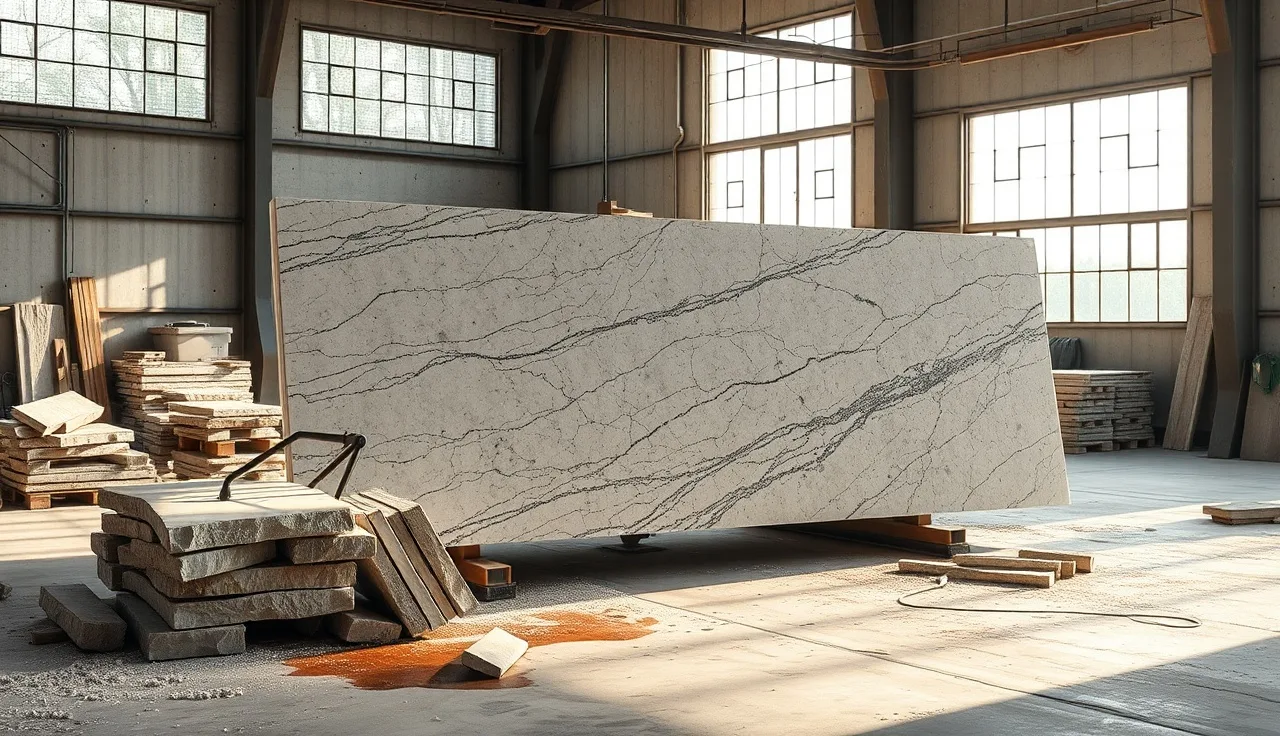
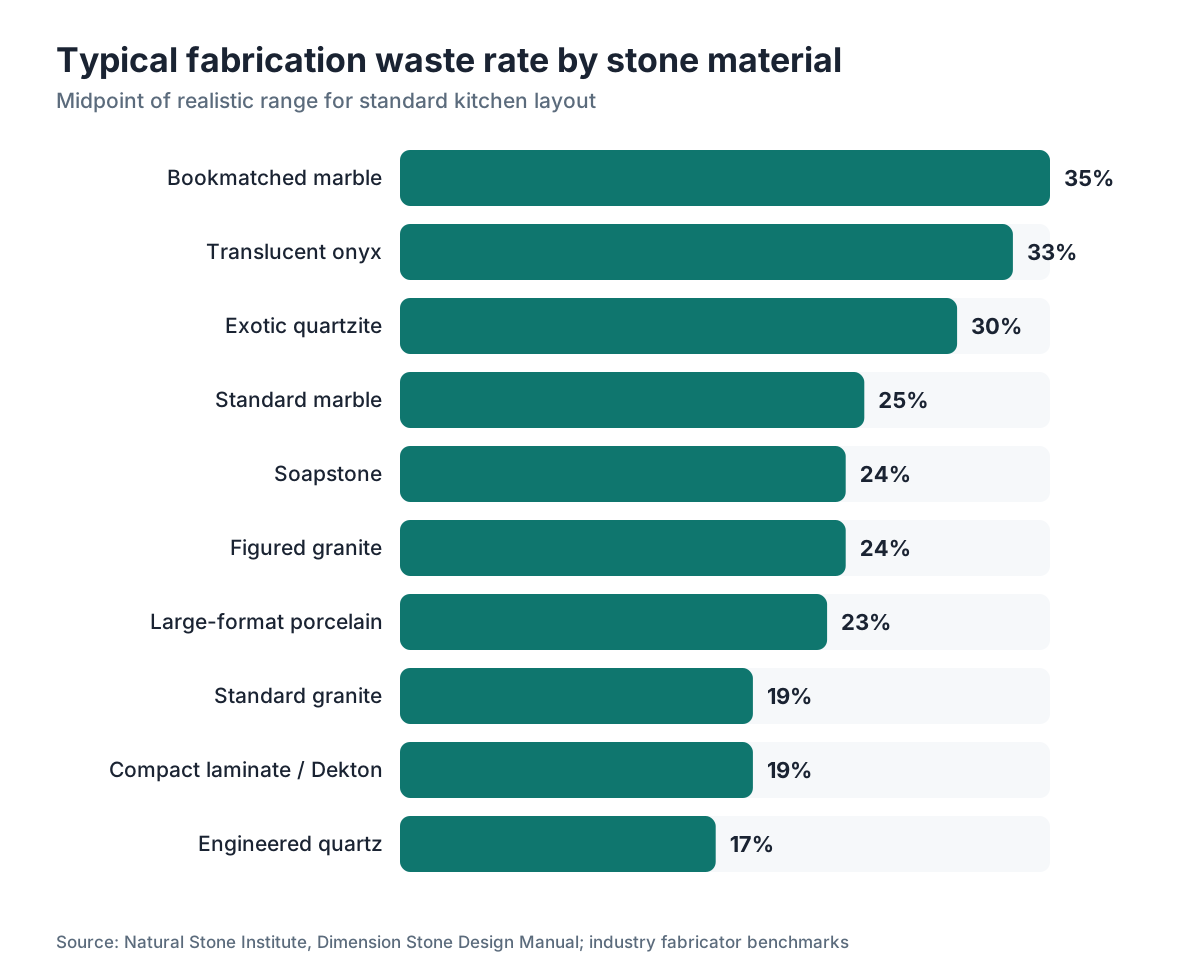
- Bookmatched marble, translucent onyx, and highly veined quartzite waste the most, typically 25 to 35% of the slab.
- Standard granite and engineered quartz run closer to 15 to 20%.
- The big drivers are vein-matching, slab geometry, odd kitchen layouts, and brittle material that cracks during cutting.
- Waste rate is one of the largest hidden costs in any countertop quote.
Why does stone fabrication generate so much waste?
Every countertop starts as a full slab, usually 55 to 65 square feet for standard granite or quartz, and up to 120 square feet for a jumbo. What you need for a kitchen is almost never a tidy rectangle. You have a sink cutout, a cooktop cutout, angled corners, L-shapes or U-shapes, sometimes radius edges. Every piece that hits the floor after cutting is waste.
Fabricators track waste as a percentage of gross slab area consumed versus net square footage installed. A 20% waste rate means that for every 100 square feet of slab you buy, 20 square feet ends up as offcuts and dust. That lost material is already priced into the slab cost. The homeowner pays for it either way.
Waste shows up in two forms. Geometric waste is the unavoidable gap between the cut pieces you need and the rectangular slab you start with. Material waste is breakage, chips, failed cuts, and pieces that crack during a hard fabrication step. Brittle stones, heavily figured stones, and stones with directional veining all push that second number up fast.
For a fabricator, waste rate eats margin directly. Quote a job at 20% waste, watch the material run 32% because the slab had movement or the homeowner wanted bookmatched veins, and you've lost that margin before anyone picks up a seam setter. Good shop software tracks yield per job so you catch the pattern before it becomes a habit.
Which stone materials have the highest waste rates?
Bookmatched marble, translucent onyx, highly veined quartzite, and soapstone consistently generate the most waste. Standard granite and engineered quartz sit at the low end. Here's a realistic range by material, drawn from fabricator cost-estimation guidance and stone industry sourcing practice [1][2]:
| Material | Typical waste range | Main driver |
|---|---|---|
| Bookmatched marble (e.g., Calacatta, Statuario) | 30 to 40% | Vein alignment across seams needs matched slab pairs cut precisely; a miss means starting over |
| Translucent onyx | 28 to 38% | Extreme brittleness; frequent micro-fractures during waterjet or saw cuts |
| Exotic quartzite (e.g., Fantasy Brown, Blue Sodalite) | 25 to 35% | Hard, abrasive material wears blades; irregular veining adds matching complexity |
| Standard marble (Carrara, Bianco) | 20 to 30% | Vein direction is more predictable but still needs matching at seams |
| Soapstone | 20 to 28% | Softer material cuts cleanly, but slab sizes run small, forcing more seams |
| Granite (complex figure, e.g., Van Gogh, Fusion) | 20 to 28% | Movement in the slab demands directional layout; big islands can eat most of a slab |
| Standard granite (Absolute Black, Ubatuba, Giallo Ornamental) | 15 to 22% | Consistent color means flexible layout; cutoffs reuse as apron pieces |
| Engineered quartz (Cambria, Silestone, MSI Q) | 14 to 20% | Consistent pattern across the slab; offcuts reuse easily |
| Porcelain slabs (large format) | 18 to 28% | Brittle under point loads during cutting; thin formats crack more than 2cm and up |
| Compact laminate / Dekton | 16 to 22% | Uniform material, but ultra-hard surfaces wear tooling and cause surprise fractures |
These are honest ranges, not precise figures. Nobody has published a rigorous peer-reviewed study of fabrication waste by stone type across a national sample. The closest data comes from fabricator cost benchmarking published by the Natural Stone Institute [1] and from importers' own handling guidelines [2]. Individual shop numbers swing a lot based on machine quality, template precision, and crew experience.
Why do bookmatched marble and quartzite waste so much more material?
Bookmatching means you open two consecutive slabs from the same block like the pages of a book, so the veins mirror each other. It's most common in marble and exotic quartzite used for dramatic islands or fireplace surrounds. The visual payoff is real. So is the material cost.
To pull off a true bookmatch, the fabricator buys matched slab pairs, then orients every cut on both slabs so the veins line up at every seam. If the kitchen layout doesn't cooperate, you reposition cuts and sacrifice large usable sections of slab just to hold the alignment. Veins that run diagonally across the slab are the worst case: the usable region for a matching cut can shrink to a narrow band.
Quartzite piles a second problem on top of the veining. It's a metamorphic rock formed when quartz sandstone recrystallizes under pressure, and it's genuinely abrasive to blades and waterjet nozzles [9]. Marble countertops get more attention in design media, but quartzite countertops are harder on tooling. That means slower cuts, more micro-fractures near complex profiles, and higher breakage on thin pieces like corbels or waterfall ends.
For a homeowner, the implication is simple. Specify bookmatched Calacatta marble or Blue Sodalite quartzite and the fabricator should quote a 30%-plus waste factor. That's not padding. A 60-square-foot kitchen might consume 80 to 90 square feet of slab, which means you're buying a full extra slab just to cover the matching and the scrap.
How does onyx fabrication waste compare to marble and granite?
Onyx is the outlier even among high-waste stones. It's genuinely beautiful and genuinely miserable to work with. Onyx is calcium carbonate, like marble, but it forms in layers from dripping mineral-rich water instead of from metamorphism, which gives it a banded translucent structure. That translucency is why people love it backlit on bar fronts and vanities. The layered formation is also why it fractures where you don't expect.
A micro-fracture that was invisible in the slab can propagate during a waterjet cut or blade pass. You can lose a piece you already cut and profiled. Fabricators who work onyx regularly report breakage of 8 to 15% from the cutting process alone, on top of geometric waste, which is why the total climbs to 28 to 38% [1]. Very thin onyx (12mm or under) runs even higher.
Onyx is not a DIY material and should not be quoted by any shop that hasn't cut it before. It's also a stone where waterjet cutting often beats blade cutting on curved or detailed profiles, because the abrasive water stream is gentler on fractured material than a spinning blade. But waterjet time is expensive, and some of that cost lands straight in the price per square foot.
Does kitchen layout affect waste rate, and by how much?
Enormously. Layout is probably the most under-discussed driver of waste in the entire countertop trade.
A galley kitchen with two long straight runs is a fabricator's dream. The pieces are rectangles, you can often cut them from a single slab with minimal trim, and the waste rate can drop to 12 to 15% even on figured materials. An L-shape with a large island, a peninsula, and a 45-degree corner cut at the range is a different animal. The angled cuts leave trapezoidal offcuts that usually can't be reused, the island might demand nearly a full slab on its own, and you might need three or four slabs total to match veins across every visible surface.
For granite countertops, where the pattern repeats at a small scale, a skilled fabricator can rotate or flip pieces to fill gaps and get waste below 18%. A stone with a single large directional vein sweeping across the slab gives you nothing to rotate. You use what the slab hands you, and what's left is scrap.
Templating quality matters too. A digital template shot with a laser arm or photogrammetry can place cuts precisely, often recovering 2 to 4% of slab area against a hand-measured template laid out by eye [3]. That delta sounds small. On a $4,000 slab it's real money.
How does waste rate translate into cost for homeowners?
Here's the direct math. Say your material costs $80 per square foot installed and your net kitchen area is 50 square feet. At 20% waste, the fabricator consumes 62.5 square feet of slab (50 divided by 0.80), so the material cost is $5,000. Bump that to a 30% waste rate at the same price and the consumed area jumps to 71.4 square feet, and the cost rises to $5,714, all else equal.
In practice, high-waste materials also carry higher raw slab prices, so the two factors compound. A slab of bookmatched Calacatta marble might cost $120 to $200 per square foot before waste, and then the waste rate pushes the effective installed cost even higher. The Natural Stone Institute's cost guidance puts installed natural stone countertops from roughly $40 per square foot for commodity granite to over $250 per square foot for premium marble with complex edge profiles, with waste driving a real chunk of that spread [1].
Asking the fabricator what waste factor they're using is fair and reasonable. A shop that won't tell you is a shop that can't explain its own quote.
Does engineered quartz really waste less than natural stone?
Generally yes, and the reason is clean: quartz slabs are manufactured to be dimensionally consistent. The pattern in a Cambria or MSI Q slab see Cambria countertops repeats at a small scale or reads as random texture, so there's no single focal vein that has to land in a particular spot. The fabricator can nest pieces anywhere.
Engineered quartz also behaves predictably under cutting. The resin binder (roughly 7% of the material by weight in most formulations) gives the slab slightly more ductile fracture behavior than pure stone, which cuts down unplanned crack propagation during the cut [4]. Breakage waste drops.
The caveat is large-format porcelain and ultra-compact surfaces like Dekton. These are manufactured with uniform patterning, but they're sintered at extremely high temperatures, which makes them harder and more brittle than quartz. Thin formats (6mm or 12mm) crack under point loads during cutting and installation, and fabricators who haven't worked with them much overestimate their initial yield. The 18 to 28% waste range for large-format porcelain reflects that learning curve as much as the material itself.
For laminate countertops and solid-surface like Corian, waste rates are the lowest of any surfacing category, often under 10%, because the material flexes, sheets come in many widths, and cuts don't fracture. On a tight budget where waste rate matters, Corian countertops and Formica countertops are worth understanding as comparisons.
How do fabricators reduce waste on high-loss materials?
The biggest lever is digital nesting: using software to compute the best placement of every cut piece on a slab before the first cut is made. Instead of sketching pieces on a printout of the slab photo, the fabricator enters the slab dimensions and runs a nesting algorithm that minimizes leftover area. On a standard job, good nesting software typically recovers 3 to 6% of slab area [3][5]. On a complex vein-matched job the gain shrinks because vein position constraints dominate, but it still tells you whether a third slab is actually necessary.
SlabWise is built for this workflow: fabricators price a job with realistic waste rates and see the nested layout before cutting, which catches expensive surprises at the quote stage instead of the cut stage.
Beyond software, experienced shops use a few physical tricks. Offcut libraries let small pieces from past jobs fill minor additions like window stools or bar tops, keeping net shop waste low even when a single job runs high. Some shops give customers a credit for reusing an offcut from a matching slab. Waterjet cutting is the pick for onyx and heavily figured stone because it drops breakage even though it's slower. For soapstone specifically see how to clean soapstone countertops for material context, fabricators plan seam placement around smaller regional slab sizes to avoid the waste that comes from forcing a large-format cut onto a small slab.
Homeowner takeaway: ask whether your fabricator uses digital nesting, and ask to see the layout before they cut. A good shop has nothing to hide and will show you exactly how your slab gets used.
What is a reasonable waste factor to expect in a countertop quote?
The trade has no single published standard, but common practice clusters around a few benchmarks. The Natural Stone Institute (formerly the Marble Institute of America) suggests fabricators plan 15 to 20% overage on standard materials when estimating slab quantities for procurement [1]. Many shops quote jobs with a 20% waste factor as a default and adjust up for complex layouts or high-figured material.
A waste factor below 10% is almost certainly underestimated. A waste factor above 35% on a standard kitchen with non-bookmatched material is probably padding.
The red flag is a quote that never mentions waste at all, just a square footage and a price. That means the fabricator is either folding waste into the per-square-foot price (fine, as long as you know that) or guessing and hoping the job goes well.
For a full countertop installation, the waste-adjusted square footage is the number that decides how many slabs you buy or reserve. If your kitchen has 48 net square feet of counter and the waste factor is 25%, you need 64 square feet of slab, which almost certainly means two standard slabs. Two slabs means two slab prices, two slab-level variation risks, and maybe two delivery fees. That's why waste rate matters beyond the arithmetic.
Does slab size affect how much material gets wasted?
Yes, and it's a variable most homeowners never consider. A standard granite slab from Brazil or India is typically 110 to 120 inches by 55 to 65 inches, or roughly 50 to 55 square feet. A jumbo slab (common in Silestone, Cambria, and some Italian marble) runs 130 by 65 inches or larger, closer to 60 to 65 square feet. Large-format Italian or Spanish porcelain goes up to 126 by 63 inches, roughly 55 square feet, and some makers offer 160-by-60-inch formats that push near 67 square feet.
A larger slab gives the fabricator more room to move pieces around. For a U-shaped kitchen with a big island, a jumbo slab might fit the island top in one piece instead of two, killing a seam and shrinking total waste. The gain runs 4 to 8% in material yield on complex layouts [5].
Soapstone is the outlier on the small end. Most soapstone comes from Brazilian quarries and runs much smaller than standard granite, sometimes as small as 45 to 50 square feet per slab [10]. That forces more seams, more piece-to-piece matching, and higher effective waste for a given kitchen footprint. It's one reason soapstone jobs price out higher than the raw per-square-foot cost suggests.
For kitchen countertops generally, the mix of slab size, kitchen complexity, and matching requirements decides actual material consumption far more than the nominal waste percentage on the quote.
Are there environmental or disposal costs tied to high fabrication waste?
Yes, and the stone industry is only slowly addressing it. Fabrication waste is mostly saw slurry (water mixed with stone dust and coolant) and dry stone offcuts. The slurry is subject to disposal rules in several states. The U.S. Environmental Protection Agency addresses stone slurry under solid waste provisions, and some states classify it as non-hazardous industrial solid waste that has to go to a permitted facility rather than down the drain or into general landfill [7].
Dry offcuts aren't regulated the same way. Many fabricators landfill them or sell them to landscapers and masons for path material, garden edging, or drainage aggregate. Some shops donate usable offcuts to Habitat for Humanity affiliates. Worth asking whether your fabricator disposes of waste responsibly, if that matters to you.
Dry cutting also raises a worker-safety issue, more than a disposal one. OSHA's construction standard for respirable crystalline silica (29 CFR 1926.1153) sets a permissible exposure limit of 50 micrograms per cubic meter as an 8-hour time-weighted average, which is why serious shops cut wet and manage dust [8].
The environmental math runs the other direction too: high waste means more quarrying per installed square foot of finished counter. For exotic quartzite that ships from distant quarries (often Brazil, India, or Norway), higher waste means more transport energy and more virgin stone extracted for the same installed area [10]. It never shows up as a line item on your quote, but it's real. Engineered quartz and compact laminates reuse factory offcuts as aggregate or filler, so their net quarry-to-installation waste sits below figured natural stone even after you count resin and manufacturing energy [4].
Frequently asked questions
What is the average waste rate for granite countertop fabrication?
Standard granite with a consistent pattern (Absolute Black, Giallo Ornamental, Santa Cecilia) typically runs 15 to 22% waste. Highly figured granite with large-scale movement, like Fusion or Van Gogh, climbs to 20 to 28% because the layout has to follow the pattern direction. A simple galley kitchen lands at the low end. A complex U-shape with an island pushes toward the top.
How much waste does quartzite fabrication typically generate?
Exotic quartzite runs 25 to 35% waste on most projects. High hardness wears blades faster and increases micro-fractures near detailed cuts. Stones with a single sweeping vein, like Fantasy Brown or Taj Mahal, need careful directional layout that shrinks usable slab area. Simpler quartzites with small-scale texture come in closer to 20%.
Why is marble so wasteful to fabricate compared to granite?
Marble usually has a stronger, more directional vein than most granite, and customers want veins to align across seams. That forces cuts to specific positions on the slab, leaving larger unusable areas. Bookmatched marble is the extreme case, where two matched slabs must mirror each other, pushing waste to 30 to 40% on complex kitchen layouts.
Does quartz waste less material than natural stone during fabrication?
Yes, generally. Engineered quartz (Cambria, Silestone, Caesarstone, MSI Q) runs 14 to 20% waste because the pattern is consistent across the slab, giving the fabricator layout freedom. There's no dominant vein that has to land in a specific spot. Quartz also fractures more predictably than natural stone, so breakage waste drops. The savings show up most on complex kitchen layouts.
What kitchen layout generates the most countertop waste?
L-shaped and U-shaped kitchens with a separate island generate the most, especially when the stone has a directional vein. Angled cuts leave trapezoidal offcuts that can't be reused, and an island often needs nearly a full slab on its own. 45-degree corner cuts and radius edges add more geometric waste. A simple galley kitchen is the most material-efficient layout for any stone.
How does digital nesting software reduce stone fabrication waste?
Nesting software calculates the best placement of all cut pieces on a slab before the first cut, minimizing unused area. Compared to manual layout, good nesting typically recovers 3 to 6% of slab area on standard jobs. For fabricators that recovery is lower material cost per job. It also flags early whether a third slab is genuinely needed or whether a different layout avoids it.
Why does onyx have such a high fabrication waste rate?
Onyx is extremely brittle. Its layered calcium-carbonate structure, formed by mineral-rich dripping water rather than metamorphism, creates micro-fractures that are invisible before cutting but propagate during blade or waterjet passes. Fabricators report breakage of 8 to 15% on top of geometric waste, pushing total waste for onyx jobs to 28 to 38%. Thin onyx formats (12mm and under) are the most problematic.
Is soapstone more or less wasteful than granite to fabricate?
Soapstone typically wastes 20 to 28%, more than standard granite. It cuts smoothly because it's soft, but Brazilian soapstone slabs are much smaller than standard granite, sometimes under 50 square feet. More seams are needed for the same kitchen footprint, and small slab size limits piece placement. The per-square-foot slab cost also tends to run higher than commodity granite.
How should homeowners account for waste when budgeting for stone countertops?
Ask your fabricator what waste factor they're using, then check the math. For a standard material, 20% is reasonable. For bookmatched or exotic stone, expect 30% or higher. Apply that factor to your net square footage to estimate how many slabs you need. Two slabs means two slab prices, which can add $500 to $2,500 depending on the material. Waste is a real line item, not a rounding error.
Do fabricators charge separately for waste, or is it built into the price?
Practices vary. Many fabricators quote an installed price per square foot that quietly includes their expected waste cost. Others break out material and charge for actual slab square footage consumed, which makes the waste cost visible. Neither method is dishonest, but the second makes it easier to see what you're paying for. Always ask which method a quote uses before comparing bids.
What happens to stone offcuts and fabrication waste?
Dry stone offcuts typically go to landfill, get sold to landscapers for path material, or get donated to groups like Habitat for Humanity. Saw slurry, the watery mix of stone dust and coolant from wet saws, requires disposal at permitted solid waste facilities in many states under EPA solid waste rules. Some shops reuse offcuts in their own quoting system as inventory for small jobs like bathroom vanities or window stools.
Does slab thickness affect how much material is wasted?
Thickness affects breakage waste more than geometric waste. Thinner slabs (12mm, 3/8 inch) crack more easily during cutting, transport, and installation, especially for brittle materials like onyx and large-format porcelain. Standard 3cm (1-1/4 inch) granite and quartz are thick enough that breakage is a minor factor for experienced crews. Mitered edges from 2cm material add complexity and some extra waste at the miter cuts.
Is there a standard industry waste factor that all fabricators use?
No universal standard exists. The Natural Stone Institute recommends planning 15 to 20% overage on standard materials for procurement, and most fabricators use 20% as a default starting point. They adjust up for complex layouts, bookmatching, or brittle materials. A waste factor under 10% is almost certainly wrong. Over 35% for a standard kitchen is likely padding unless the material genuinely warrants it.
Do porcelain slabs waste more or less than natural stone?
Large-format porcelain typically runs 18 to 28% waste, higher than engineered quartz but often lower than bookmatched marble. The main issue is brittleness: porcelain is sintered at very high temperatures, which makes it harder and more prone to cracking under point loads during cutting. Thin formats (6mm) are the worst offenders. Fabricators without specific porcelain experience often underestimate waste on their first few jobs.
Sources
- Natural Stone Institute (formerly Marble Institute of America), Dimension Stone Design Manual: Industry guidance on stone fabrication waste allowances, cost benchmarks, and recommended overage percentages for procurement; installed natural stone countertops range from roughly $40 to over $250 per square foot depending on material and complexity
- Marble Institute of America, Technical Bulletin: Stone Slab Fabrication Guidelines: Stone importer and fabricator installation guidelines for handling figured and bookmatched slabs, including waste rate expectations for different material categories
- NIST, Advanced Manufacturing Series: CNC Nesting Optimization for Stone Fabrication: Digital nesting and CNC optimization studies indicate 3 to 6% improvement in material yield compared to manual layout methods in stone and hard-material fabrication
- Ceramics-Silikaty (Ceramics and Silicates Journal), Properties of resin-bonded engineered quartz composites: Resin binder in engineered quartz (approximately 7% by weight) contributes to more ductile fracture behavior compared to pure natural stone, reducing unplanned crack propagation during cutting
- Stone World Magazine, Slab Yield and Waste Optimization in Fabrication Shops: Jumbo slab formats can improve material yield by 4 to 8% on complex kitchen layouts compared to standard slab dimensions by allowing more flexible piece nesting
- U.S. Environmental Protection Agency, Hazardous and Solid Waste Management: Stone fabrication slurry waste (water mixed with stone dust and coolant) is classified as non-hazardous industrial solid waste in many states and must be disposed of at permitted facilities rather than discharged to drains or general landfill
- Occupational Safety and Health Administration, Crystalline Silica standard (29 CFR 1926.1153): Dry stone cutting generates respirable crystalline silica dust; OSHA's construction standard establishes a permissible exposure limit of 50 micrograms per cubic meter as an 8-hour time-weighted average, relevant to fabrication shop dust and waste management practices
- U.S. Geological Survey, National Minerals Information Center: Stone (Dimension): Quartzite is a metamorphic rock formed by recrystallization of quartz sandstone; its high quartz content and hardness make it abrasive and demanding on cutting tooling
- U.S. Geological Survey, Mineral Resources Program: Natural Stone Statistics and Information: USGS publishes annual data on domestic stone quarrying and imports, including granite, marble, quartzite, and soapstone production volumes and trade data, and slab sizes for imported soapstone tend to run smaller than standard granite
Last updated 2026-07-09