TL;DR
- Most fabrication shops lose between 15% and 30% of every slab they cut to offcuts and miscuts.
- The biggest gains come from digital nesting software, disciplined remnant inventory, better templating accuracy, and intentional job batching.
- Getting below 15% waste is realistic for a mid-size shop without major capital spending.
Why does stone waste matter so much financially?
Slab material is usually the single largest line item in a fabrication job, routinely running 40 to 60% of total project cost. When you throw a piece away, you're more than losing rock. You're losing the margin that was supposed to pay your bridge saw time, your labor, and some portion of overhead.
The industry rule of thumb is that shops waste 15 to 30% of every slab on average, with inexperienced shops or shops cutting lots of complex shapes sometimes pushing past 30% [1]. On a $400 slab that's $60, $120 in material that leaves in the dumpster. Multiply that by the number of slabs you run per week and the number gets painful fast.
Waste reduction is also a materials efficiency story. Natural stone is a finite resource quarried and transported at significant environmental cost. Fabricators who get more usable surface out of each slab are in a better competitive position because their material cost per square foot of finished countertop is lower. That's a durable pricing advantage, not a temporary one.
One more angle: remnants and drops get treated as waste, but they have real resale value if you manage them right. A shop that tracks and sells remnants instead of tossing them recovers a meaningful fraction of material cost.
What causes the most stone waste in a typical shop?
Before you can fix waste, you have to know where it actually comes from. In most shops, the losses cluster around four problems.
Poor layout and manual nesting is the biggest one. When a cutter marks up a slab freehand or eyeballs part placement, they almost always leave more space between parts than is necessary, and they rarely optimize across multiple jobs at once. A digital nesting study by the National Institute of Standards and Technology found that algorithmic 2D nesting can reduce material waste by 10 to 15 percentage points compared to manual layout in sheet-goods cutting environments [2]. Stone isn't sheet goods, but the geometry problem is identical.
Templating errors come next. If your template is off by a quarter inch in width, you may cut a piece that doesn't fit and can't be salvaged. That's a full remade piece, meaning you've now consumed two pieces from the slab to produce one finished part. Shops running digital templating (laser or photogrammetry-based) consistently report fewer remakes than shops using cardboard or wood templates [3].
Job batching failures are less obvious but real. When you process one job at a time, a slab that's 80% used by that job gets either shelved as a remnant or, worse, scrapped. If you had batched that job with another small job using similar material, you might have hit 95% utilization. Batching takes coordination, but it doesn't take new equipment.
Sink cutouts and cooktop cutouts are dropped material most shops either discard or have no system for. Those drops are often large enough to use as bar top sections, outdoor pieces, or small vanities. A tracking system for drops is cheap to build and recovers real value.
How much can digital nesting software actually reduce waste?
Digital nesting is the highest-leverage single change most shops can make. The software takes the part shapes for one or more jobs, along with the actual dimensions and any veining or defect zones of the slab, and calculates part placement to minimize wasted area.
The real-world improvement depends on your starting point. A shop doing fully manual layout might run 28% waste. That same shop, after switching to digital nesting, often gets to 16 to 18% in the first few months and can reach 12 to 14% once operators get comfortable feeding the software accurate slab data [1]. That's a 10 to 16 percentage point improvement on a change that requires no new cutting equipment.
Nesting software also merges remnants into new jobs. If you have a 24" x 48" drop sitting in your remnant rack, the software can tell you whether that drop satisfies one of the smaller pieces in an upcoming job, pulling it from inventory instead of cutting into a new slab. Without software, most shops don't have fast enough visibility into their remnant stock to do this reliably.
SlabWise includes a nesting module built specifically for countertop fabrication, so you can tie nesting directly to your quoted job dimensions rather than re-entering measurements. If you want to see how it changes your material yield on a real job, the demo is worth running.
The cost of nesting software varies widely. Entry-level tools run $100, $300/month. More capable platforms with CNC integration run $500, $1,500/month. In most shops, the material savings pay back the subscription within the first one to three months.
What is a good stone waste percentage to target?
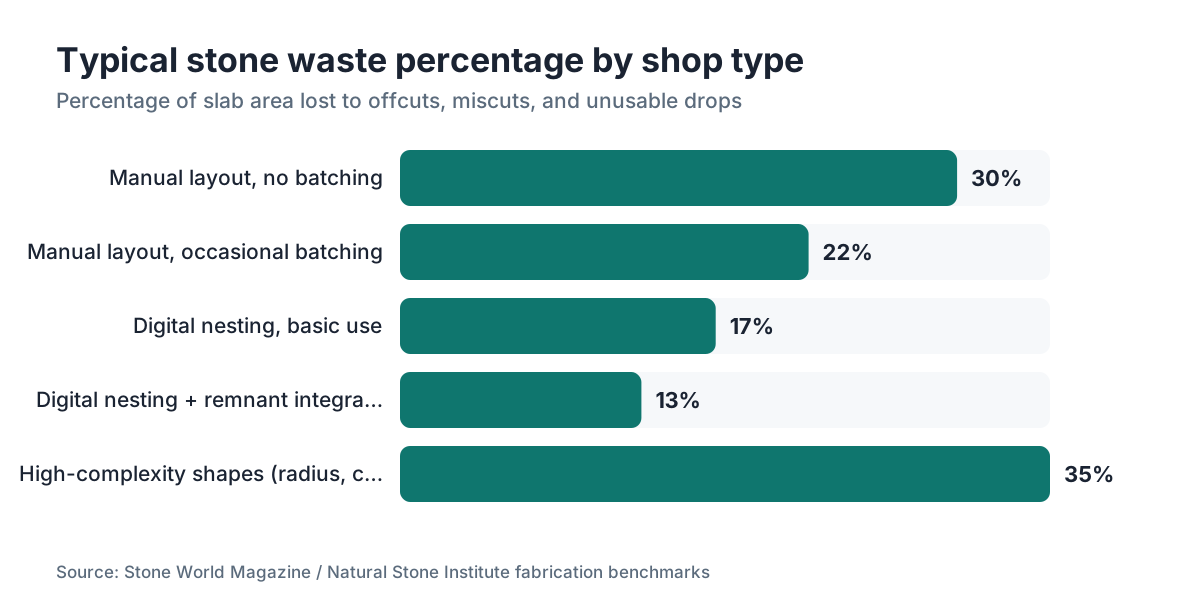
There's no single authoritative benchmark published by a government body or trade association, so treat any specific number with appropriate skepticism. The ranges you'll hear consistently across fabricator forums, equipment suppliers, and software providers are:
| Shop type | Typical waste % | With digital nesting |
|---|---|---|
| Manual layout, one job at a time | 25 to 35% | n/a |
| Manual layout, occasional batching | 18 to 25% | n/a |
| Digital nesting, basic use | 15 to 20% | 12 to 16% |
| Digital nesting, advanced (remnant integration, multi-job) | n/a | 10 to 14% |
| High-complexity shapes (radius edges, curved islands) | 30 to 40% regardless | 22 to 28% |
Getting below 10% is theoretically possible but usually requires either very simple, rectangular jobs or an unusually high proportion of large uninterrupted slabs. Complex residential kitchens with sinks, cooktops, and L-shapes make 10% nearly impossible at scale.
A realistic and honest goal for a shop that currently runs 25% waste is to reach 15% within six months of adding digital nesting plus the remnant and batching practices described below. That's a 40% reduction in wasted material dollars.
For granite countertops specifically, veining and pattern matching requirements force less efficient layouts, so your effective waste floor is higher on figured stone than on plain materials.
How does accurate templating reduce material waste?
Every dimension error in your template propagates directly into cut error. If your template says a run is 97.5" but the actual measurement is 98.25", you cut a piece that doesn't reach the wall. In natural stone, you usually can't piece it out cleanly. You remake the piece, using more material and more saw time.
Digital templating systems, whether laser-based (like Prodim or similar) or photogrammetry-based, produce dimension files accurate to within 1 to 2 mm consistently [3]. Traditional cardboard templates, done carefully by an experienced installer, can hit similar accuracy, but they depend heavily on the individual doing the work. One distracted afternoon produces one bad template.
The fix isn't necessarily buying a $30,000 laser templating system tomorrow. For many shops, training your templating crew on a strict verification checklist (every measurement taken twice, diagonals checked on L-shapes and U-shapes, all appliance cutout positions confirmed against spec sheets) closes most of the accuracy gap at zero equipment cost.
Where digital templating pays off fastest is on jobs with complex geometry: radius corners, curved islands, bump-outs, and multiple cutouts. The more complex the job, the more a small template error costs in material.
For a practical look at how installation fit affects the whole process, see our countertop installation guide.
How does job batching reduce waste on slabs?
Job batching means processing multiple jobs on the same material species and color at the same time, so you can fill a slab more completely before moving on.
Here's the basic mechanics. A 3 cm slab of a common granite might be 63" x 126", giving you roughly 55 square feet of usable surface. A typical single kitchen runs 35 to 45 square feet. If you cut one job per slab, you've used 64 to 82% of the slab and the remainder either goes to remnant inventory or gets scrapped. Batch even one small companion job (a vanity top or laundry room piece in the same material), and utilization climbs quickly toward 90%+.
For batching to work, you need a few things. A quoting system that tags jobs by material species so you can sort your queue by material. A scheduling approach that allows a two-to-five day wait window for companion jobs to appear. And a production manager willing to hold a partially used slab rather than immediately putting it in the remnant rack.
The challenge is customer scheduling. Batching adds lead time. Most shops using batching tell customers that production begins within three to five business days of material arrival, not same-day. That's a conversation worth having, because it saves real money.
One practical approach: reserve batching for your top five highest-volume materials and run everything else immediately. That captures most of the benefit with less scheduling complexity.
What is the best way to manage a remnant inventory?
A remnant is any piece of stone that's been partially used from a slab and returned to inventory for future use. The average fabrication shop sits on a surprisingly large pile of remnants. The problem isn't having them, it's not being able to find or use them quickly enough.
A remnant management system needs three things: a unique ID for each piece, accurate dimensions, and a photo. That's it. Run it in a spreadsheet, in your ERP system, or in the remnant management features built into your nesting software. The photo matters because stone with visible movement or color variation needs to be seen before a salesperson can quote it confidently for a customer.
Remnants have real market value. Small vanity tops (20" x 42", for example) frequently retail for $150, $400 depending on material. Larger drops (30"+ in any direction) can cover bar areas, hearth surrounds, or island seating overhangs. Some shops run regular remnant sales, similar to a clearance event, to move older stock before it crowds the yard.
Remnants should be slotted into new jobs by your nesting software before you open a new slab. This is the highest-leverage use of your remnant tracking data. If the software can see that a 24" x 60" piece of Bianco Venatino is sitting in your rack, and a new job needs a 22" x 56" vanity top in the same material, you've just eliminated one full slab pull for that piece.
Set a maximum remnant age policy. Pieces that haven't been used or sold in 90 days should be reviewed. Pieces past 180 days are often not worth the yard space they occupy.
Can sink and cooktop cutouts be reused or sold?
Yes, and most shops throw away real money by treating them as scrap.
A standard undermount sink cutout from a 3 cm granite slab typically measures about 12" x 16" to 15" x 20". That's a usable piece. It won't cover a vanity top, but it can become a trivet, a small display shelf, a wine bar inset, or a custom chopping board. Some shops sell these as finished products for $30, $80 each with a quick edge profile applied.
Cooktop cutouts are larger, often 18" x 20" or bigger. Those are genuine small countertop sections. A double-burner cooktop cutout has enough surface for a small prep area or a bathroom accent shelf.
The economics matter. Cut ten undermount sinks per week and sell those drops at an average of $50 each, and that's $500/week or roughly $26,000/year in recovered material that was previously in the dumpster. Not every shop can sell every drop, but the upside is real.
The barrier is processing time. You need to clean, edge, and store the drops rather than discarding them during cleanup. Budget ten minutes per drop. That's a labor cost, but the math still works at almost any reasonable material price.
For shops working with materials like marble countertops or exotic stone, drops have even higher resale value because the raw material price is higher.
What shop floor practices reduce miscuts and remakes?
Miscuts are the most expensive waste category because you lose both the material and the saw time. A miscut on an exotic stone can cost $200, $500 in material alone, plus the remake labor.
The single most effective practice is a mandatory pre-cut check. Before any bridge saw or CNC makes its first pass, the operator verifies part dimensions against the template file, slab orientation relative to veining requirements, cutout positions against the specification sheet, and edge clearances. This takes three to five minutes and catches the majority of setup errors.
Color-coding your cut lines helps. Some shops draw new cut lines in one color and check off verified lines in another. Any line without a verification mark doesn't get cut.
For CNC-routed work, running a dry simulation of the toolpath before cutting stone is standard practice in metal and wood shops but underused in stone fabrication. Most CNC software has a simulation mode. Use it.
Staff training matters more than any single process. Experienced operators make fewer errors. Pairing newer operators with experienced mentors for the first 60 to 90 days of bridge saw operation is worth the labor cost.
Track remakes by cause. If you know that 40% of your remakes come from template errors on U-shape kitchens, that's where you invest training dollars. Without tracking, you're guessing.
How do edge profiles and material thickness affect waste?
Edge profile choice affects waste in ways most fabricators understand intuitively but rarely quantify.
Mitered edges (used to create the appearance of a thicker slab) require cutting strips from a second piece of stone and bonding them to the face of the primary slab's edge. That lamination strip has to come from somewhere, either from the same slab (reducing available surface) or from a dedicated remnant. Complex lamination on full perimeters can add 5 to 8% to effective material consumption per job.
Eased or straight edges waste essentially nothing extra. Ogee, waterfall, and dupont profiles require additional CNC passes but no extra material. The material story is almost entirely about mitered and laminated edges.
Material thickness choice matters differently. The shift from 2 cm to 3 cm slabs became nearly universal for granite and quartz in the US residential market partly because it eliminated the need for plywood buildup, but 3 cm slabs are heavier and harder to move, which can increase breakage waste. Breakage rates during handling are hard to measure precisely. Operators handling 3 cm slabs more carefully is a real practice adaptation.
For laminate, solid surface, and some engineered stone products, sheet thickness is consistent and waste profiles are different. See our notes on laminate countertops and Corian countertops for how those materials behave differently in production.
Is there a role for waste tracking metrics in reducing stone loss?
You can't improve what you don't measure. Waste tracking is one of those practices that sounds bureaucratic but pays off quickly once the data starts informing decisions.
The minimum useful metrics for a fabrication shop are material waste percentage by job (square feet cut versus square feet of slab consumed), remake rate by material type, and remnant turnover (how long pieces sit before use or sale).
Waste percentage by job is the most actionable. Run this number weekly, post it where your production team can see it, and behavior changes. Operators who see the number start thinking about it during layout. That's not magic, it's how performance metrics work.
Remake rate by material type tells you where your process has weak spots. Consistent high remakes on one material might point to a templating problem specific to that stone's thickness variation, or a saw setup issue. Without tracking, you might spend months assuming it's a training problem when it's actually a tooling problem.
Remnant turnover tells you whether your remnant management is working. If pieces sit 200 days on average before being used, you either have too many remnants, the wrong materials, or a visibility problem (your sales team doesn't know what's in stock).
Building these dashboards doesn't require expensive software. A well-structured spreadsheet updated weekly gets you most of the benefit. The investment is discipline, not technology.
Shops running platforms like SlabWise can pull material consumption data straight from the quoting and production workflow, which makes tracking less manual and more consistent.
What are the environmental benefits of reducing stone waste?
Stone waste isn't just a cost problem. Natural stone quarrying is an energy-intensive process. The US Geological Survey reports that dimension stone production in the United States was approximately 1.35 million metric tons in 2022 [4]. Every ton of finished stone represents quarrying, primary processing, and transcontinental or international shipping before it reaches a fabrication shop.
Stone dust and slurry from wet cutting are regulated as a solid waste or wastewater discharge depending on jurisdiction and volume. The EPA's sustainable materials management guidelines address stone processing residuals, and some state environmental agencies require fabricators above certain production thresholds to document waste handling practices [5].
Reducing solid offcut waste has a practical benefit beyond cost: it reduces dumpster pull frequency and disposal fees. Commercial waste disposal for stone runs roughly $150, $400 per ton depending on location and disposal method [6]. A shop cutting 100 slabs per week and generating 20% waste produces a substantial ongoing disposal cost.
The good news is that waste reduction measures don't need any environmental justification to make business sense. The financial and environmental benefits move in the same direction, which makes this one of the cleaner operational improvement decisions available to a shop owner.
Frequently asked questions
What is an average stone waste percentage for fabrication shops?
Most shops run 15 to 30% waste as a percentage of total slab area consumed. Manual-layout shops with no nesting software tend toward the high end of that range or above it. Shops using digital nesting and active remnant management can get below 15%. Under 10% is rare outside of shops with very simple, rectangular job types.
Does digital nesting software really pay for itself?
For most mid-size shops, yes, within one to three months. If a shop spends $8,000 per month on slab material and is running 25% waste, dropping to 15% saves roughly $800/month in raw material. A nesting software subscription at $200, $500/month has a clear positive return. The math gets even better when you factor in reduced remake labor.
How should I store and label remnants so they actually get used?
Every remnant needs a unique ID, its actual dimensions, material name, thickness, and a photo taken in consistent lighting. Store remnants upright in a dedicated rack with IDs facing outward. Feed the ID and dimensions into your quoting system or nesting software so salespeople can check availability before pulling a new slab. Set a 90-day review threshold and a 180-day disposal policy.
What is the best way to handle stone slurry and wet-cut waste?
Stone slurry (the water and fine particulate from wet cutting) is regulated under EPA and state wastewater guidelines and can't be discharged directly to storm drains in most jurisdictions. Most shops use a settling tank and filter press system to separate solids from water. Dried stone dust can often be disposed of as non-hazardous solid waste, but check your state environmental agency's requirements for your production volume.
Can I sell stone remnants directly to homeowners?
Yes, and many shops do. Remnant sales work well for small bathroom vanities, laundry room tops, bar areas, and hearth surrounds. Price remnants at 40 to 60% of your standard per-square-foot rate for the material, adjusted for size and usability. A few good photos and a listing on a local buy-sell platform or your shop's website moves material faster than waiting for it to come up in a job match.
Does seam placement affect stone waste?
Significantly. Poor seam placement forces cuts that leave unusable narrow strips. Planning seams to align with natural break points in the layout (at dishwasher openings, range gaps, or at inside corners) lets each section be cut more efficiently from the slab. Seam placement should be decided during the layout and nesting phase, not improvised at the saw.
How does pattern matching on figured stone increase waste?
Figured materials like book-matched marble, highly veined quartzite, or exotic granite with strong pattern movement require part placement that aligns the visual pattern across seams. This alignment constraint limits where you can position parts on the slab and often forces higher waste. Budget an additional 10 to 15% material yield loss on heavily figured stone compared to plain materials.
Are there tax incentives for reducing manufacturing waste?
Some states offer tax credits or grants for small manufacturers that reduce solid waste or improve material efficiency, often through their state environmental or economic development agencies. The EPA's Waste Reduction Model (WARM) tool and the Small Business Administration both publish resources on qualifying programs. There is no specific federal tax credit for stone fabrication waste reduction, but check your state's environmental agency website for current programs.
How much does stone disposal cost per ton?
Commercial disposal rates for stone offcuts and rubble vary widely by region and hauler. Rough estimates run $150, $400 per ton for landfill disposal, with some regions higher. Shops in areas with stone recycling programs (road base aggregate, landscape fill) may have lower-cost disposal options. Reducing offcut volume directly reduces this cost, so it's worth including disposal fees in your true waste cost calculation.
What is the difference between offcuts and drops in stone fabrication?
The terms are often used interchangeably, but in many shops an offcut is any piece remaining after parts are cut from a slab (which might be large enough to be a future remnant), while a drop specifically refers to the material removed from a cutout (sink, cooktop, outlet). Drops are smaller and less likely to be usable as countertop surface, but they have value for accent pieces, trivets, or display items.
How does switching to CNC from a bridge saw affect waste?
CNC machining generally reduces waste compared to freehand bridge saw work because cut paths are digitally programmed rather than operator-driven. The improvement comes from tighter kerf management, more precise part dimensions (fewer remakes), and the ability to nest parts computationally. The tradeoff is higher equipment cost and a programming learning curve. For shops doing complex edge profiles or large volumes, the waste reduction alone often justifies the CNC investment within two to four years.
Should I track waste per job or per week?
Both, for different purposes. Per-job tracking identifies which job types or materials are your worst performers and where to focus process improvement. Weekly aggregate tracking tells you whether your overall operation is trending better or worse and lets you set team targets. Starting with weekly aggregate is easier to implement. Add per-job detail once you have a reliable weekly baseline.
Sources
- Stone World Magazine, 'Nesting Software and Material Yield in Stone Fabrication': Industry fabrication shops typically waste 15 to 30% of each slab; digital nesting can reduce this to 12 to 16%
- National Institute of Standards and Technology (NIST), Manufacturing Engineering Laboratory: Algorithmic 2D nesting reduces material waste by 10 to 15 percentage points versus manual layout in sheet-goods cutting environments
- U.S. Geological Survey, Mineral Commodity Summaries: Dimension Stone 2023: U.S. dimension stone production was approximately 1.35 million metric tons in 2022
- U.S. Environmental Protection Agency, Sustainable Materials Management: EPA guidelines address stone processing residuals; state agencies may require waste handling documentation above certain production thresholds
- National Waste & Recycling Association, Commercial Disposal Rate Data: Commercial disposal for heavy construction materials including stone runs approximately $150, $400 per ton depending on region and method
- U.S. Environmental Protection Agency, WARM (Waste Reduction Model) Tool: EPA WARM tool and related resources identify state-level waste reduction incentives for manufacturers
- U.S. Small Business Administration, Green Business Resources: SBA publishes resources on state and federal programs available to small manufacturers reducing solid waste
- Natural Stone Institute, Fabrication Best Practices: Industry best practices for remnant management, seam placement, and yield optimization in stone fabrication
- U.S. Geological Survey, Mineral Industry Surveys: Stone, Crushed and Dimension: Dimension stone quarrying and processing is energy-intensive with material traveling long distances before reaching fabrication shops
Last updated 2026-07-09