TL;DR
- Stone slurry is a mix of water, crystalline silica, and abrasive grit that most cities treat as regulated wastewater.
- Small shops manage it with a settling tank, then discharge to sewer under a permit, haul it off as liquid waste, or dry it and landfill the solids.
- Wash it into a storm drain and you risk fines up to $10,000 per day.
What exactly is stone slurry and why does it matter legally?
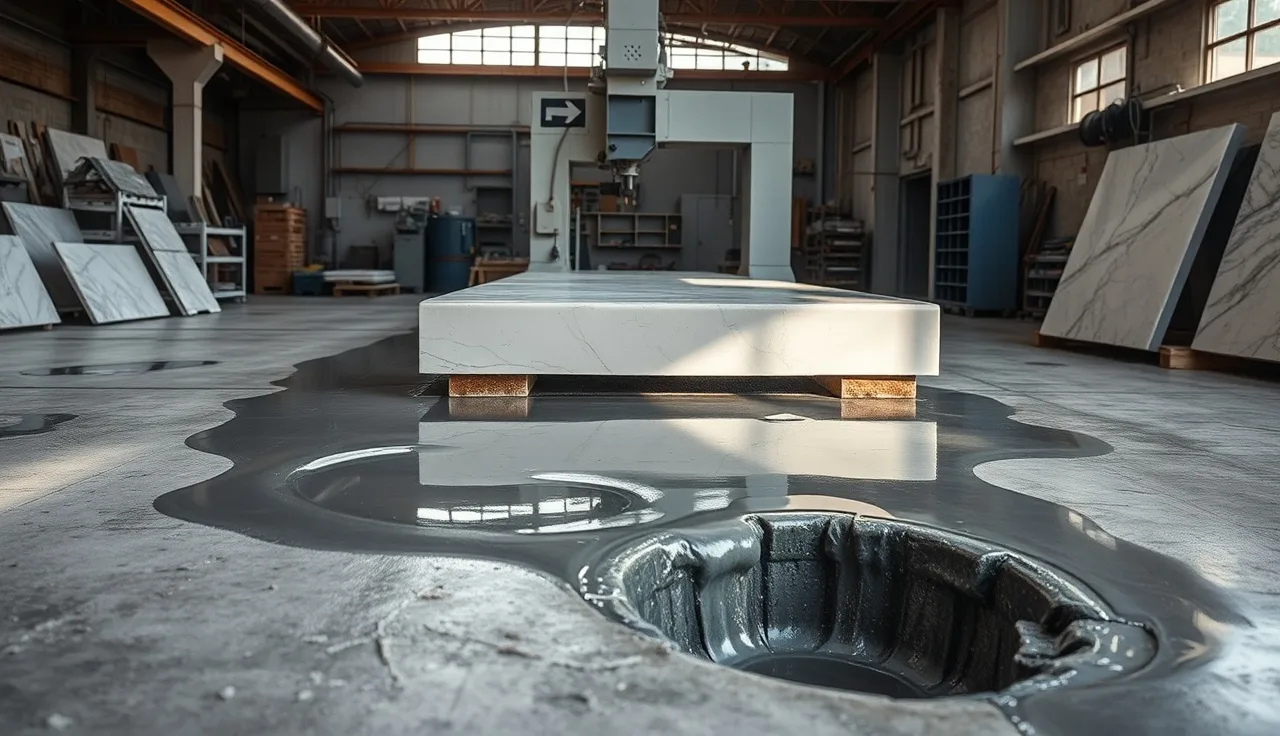
Stone slurry is the gray-to-white liquid that drains off your saw table, CNC bridge, and edge polisher during any wet-cut. It looks like dirty water. It's actually a dense suspension of fine stone particles, crystalline silica dust, coolant, and abrasive grit worn off your tooling. Leave it sitting and the solids drop out as a heavy paste.
The legal trouble is that this stuff sits between two regulatory frameworks. The Clean Water Act bans discharging pollutants into waters of the United States without a permit [1]. Storm drains count. So does a parking lot that drains to a storm sewer. EPA writes the general prohibition broadly, and states run their own pretreatment programs under it. Separately, most local publicly owned treatment works (POTWs) cap pH, total suspended solids (TSS), and oil and grease at levels slurry blows past even when you send it to the sanitary sewer.
Crystalline silica is the ingredient that draws the most attention. OSHA's silica standard at 29 CFR 1926.1153 covers airborne exposure at work [2], but state environmental agencies increasingly treat high-silica slurry as material you can't just rinse down a drain, because the fines re-suspend and travel into waterways. California's State Water Resources Control Board, for one, requires most fabrication shops to hold a general industrial stormwater permit or a wastewater discharge permit if any process water leaves the property [3].
Here's the practical version. You cannot legally hose slurry off your floor into a parking lot drain in any U.S. state. You probably can discharge to a sanitary sewer once you get a permit and meet the TSS and pH limits. And in most states you can collect, dry, and landfill the solids as non-hazardous solid waste, as long as the material doesn't leach metals above regulatory thresholds. That last part matters for some engineered stones and certain soapstones.
Is stone slurry classified as hazardous waste?
For most natural stone, no. Granite, marble, quartzite, and limestone slurry generally passes EPA's TCLP (Toxicity Characteristic Leaching Procedure) test, which means it doesn't leach heavy metals at levels that trigger Resource Conservation and Recovery Act (RCRA) hazardous waste rules [4]. That's the easy case.
Engineered and composite materials complicate it. Some quartz surfaces carry resins and pigments. Certain engineered stones run above 90% crystalline silica by weight, which is why Cal/OSHA and OSHA tightened their silica rules so hard after 2016. The dust hazard during dry cutting is documented cold, and the slurry from those materials carries a very high silica fraction too. It still usually passes TCLP for metals, but read the Safety Data Sheet (SDS) for every product you cut.
Portland cement countertops, recycled glass surfaces, and terrazzo can add calcium, alkalis, or colorant metals. If you cut oddball composite products regularly, send a slurry sample to an environmental lab for basic characterization before you assume it's clean. A standard TCLP analysis from a certified lab runs roughly $100 to $300 depending on the parameter list [5].
So: natural stone slurry is almost always non-hazardous solid waste once it dries. Engineered stone slurry needs an SDS review, and sometimes a TCLP test, before you say the same.
What are your main disposal options for stone slurry?
Four paths are realistic for a small shop. Here's how they stack up.
| Method | Typical cost range | Works for shops that... | Key permit needed |
|---|---|---|---|
| Settling tank + sewer discharge | $3,000 to $15,000 setup; $50 to $200/mo sewer fees | Have sanitary sewer access, moderate volume | Local POTW discharge permit |
| Slurry vacuum + off-site liquid hauler | $0.10 to $0.40/gallon hauled | Are very small, rent space, no room for tanks | Waste hauler manifest |
| Dry-and-bag (evaporation bed/filter press) | $500 to $5,000 setup; dumpster fees | Have outdoor space, dry climate | None usually, but confirm with local solid waste authority |
| Recirculating closed-loop system | $8,000 to $40,000 equipment | Run high volume, have capital budget | Often eliminates discharge permit need |
The settling tank with sewer discharge is the common setup for shops doing 20 or more slabs a week. Slurry flows into a multi-chamber concrete or plastic tank, solids drop out, the clarified water gets pH-adjusted and discharged, and you pump out the accumulated sludge on a schedule. Most shops running granite countertops or marble countertops at any real volume land here.
Dry-and-bag works better than you'd think for very small shops, especially in the southwest. Run slurry into a lined pit or filter bags, let it dry in the sun or under heat, haul the cake to a landfill as construction debris. The catch: liquid slurry is heavy, drying eats space and time, and you can never let uncured liquid slurry pond where it can reach a storm drain.
Closed-loop recirculating systems are the best answer if you can afford them. Water gets filtered, clarified, pH-corrected, and pumped back to the machine. Zero discharge, almost no permit headache. The upfront cost is real. Shops that install them often find water and sewer savings pay back 30 to 50 percent of the system cost over five years, depending on local rates.
How do settling tanks actually work and how do you size one?
A basic settling system is two or three tanks in series. Slurry enters the first tank, the flow slows, and the heaviest particles (coarse grit, large chips) fall out. Water spills over a baffle into the second tank, where finer particles settle. A third tank, if you have one, holds clarified water for pH testing and discharge or reuse.
The design number that matters is hydraulic retention time (HRT), which is how long water sits in the tank before it overflows. More HRT, more settling. For stone slurry, most environmental engineers recommend a minimum 2-to-4 hour HRT per chamber to pull TSS down to the 150 to 300 mg/L range that typical POTW limits allow [6]. If your permit caps TSS below 100 mg/L, plan on a third settling stage or a flocculant dosing system.
Sizing follows your daily water use. A shop running one bridge saw plus two edge polishers uses maybe 400 to 800 gallons of process water a day. A two-chamber system with 1,000 to 1,500 gallons of total capacity usually handles that. Do the math carefully if you run CNCs on production hours, because a single CNC spindle can push 5 to 10 gallons per minute of coolant.
pH adjustment is not optional for sewer discharge. Most municipalities require effluent pH between 6.0 and 9.0. Fresh slurry varies a lot. Granite slurry runs mildly acidic (pH 5 to 7). Limestone and marble slurry runs alkaline (pH 8 to 11) from the calcium carbonate. Keep a pH probe in your final chamber and citric or muriatic acid on hand to bring alkaline slurry down, or sodium carbonate to bring acidic slurry up. Test every discharge event, at least until you know your normal range.
Sludge piles up in the bottom of the first tank and needs pumping out. How often depends on cutting volume. Most small shops need pump-out every one to four months. A local septic or industrial vacuum truck handles it for $150 to $500 per visit, depending on volume and region.
What permits do you actually need and how do you get them?
This is where most shop owners freeze up. The process is less painful than it sounds once you know who to call.
Sewer discharge first. Contact your local POTW, the agency that runs the municipal wastewater plant, usually inside the city's public works or utilities department. Ask for the industrial pretreatment program coordinator. Tell them you're a stone fabrication shop and you want to discharge clarified process water to the sanitary sewer. They'll tell you whether you need a permit, what the limits are, and what monitoring they want. Plenty of small shops end up on a categorical exemption or a simple permit with annual self-monitoring. Application fee is usually $0 to $500.
Stormwater next. If any process water could reach a storm drain or leave your property anywhere other than the sanitary sewer, you almost certainly need coverage under your state's general industrial stormwater permit. In most states you register online, pay an annual fee ($200 to $1,000 depending on the state), and write a Stormwater Pollution Prevention Plan (SWPPP). EPA's NPDES (National Pollutant Discharge Elimination System) program is federally authorized but state-run, so the details shift state to state [1].
Solid waste disposal is the simplest. If you're drying slurry and landfilling it, you generally don't need a special permit as long as the material qualifies as non-hazardous construction and demolition (C&D) debris or industrial solid waste. Call your county solid waste or environmental health office, describe the material, and get the answer in writing if you can.
Don't guess on permit status. Regulators will usually give you informal guidance over the phone before any violation happens, and they treat shops that call proactively very differently from shops they catch discharging dirty. A first-time violation for unpermitted discharge runs $1,000 to $10,000 per day in most states, and EPA can stack federal penalties on top [7].
How do you handle slurry inside the shop, from saw to tank?
The path from saw to tank matters as much as the tank itself. If slurry dries inside floor drains or pipes before it reaches the tank, you get blockages that back up into the shop or bypass the settling system.
Start at the machine. Most bridge saws have a sump or drain channel at the base. Keep it clear and sloped toward your collection pipe. Run at least a 3-inch drain line from each machine to your settling system, and slope it at least 1/4 inch per foot. Slurry is dense and will settle in any flat or back-pitched pipe.
Floor drains inside the shop should route to your settling tank too, never the storm sewer. This is the mistake inspectors catch most: the saw drain goes to the tank, but the shop floor drain goes to a storm line. Trace every drain in the building before you sign a lease or build out.
A sump pump in the pit under your saw makes everything easier. Instead of trusting gravity all the way to an outdoor tank, you pump slurry from the saw sump to the tank inlet, which frees you up on tank placement. Use a trash pump or a submersible slurry pump rated for abrasive solids. A standard effluent pump wears out in weeks under slurry.
Some shops add a coarse screen or sieve basket at the collection point to catch large chips before they hit the pump or tank. Less pump wear, more time between cleanouts. A stainless mesh basket in a floor-mounted catch basin does the job for under $300.
Keep a hose and squeegee handy. When slurry spills during templating or countertop installation prep, moving it to a drain right away beats scraping dried paste off the floor two hours later.
What are the OSHA requirements around slurry and silica exposure in the shop?
OSHA's crystalline silica standard, 29 CFR 1926.1153 for construction and 29 CFR 1910.1053 for general industry, sets an action level of 25 micrograms per cubic meter (μg/m³) as an 8-hour TWA and a permissible exposure limit (PEL) of 50 μg/m³ [2]. Engineered quartz fabrication has caused silicosis cases bad enough that OSHA and NIOSH issued a joint hazard alert about it in 2019 [8].
Slurry ties into OSHA because wet cutting is the main engineering control the silica standard leans on. Table 1 in the standard lists specific wet methods as the required control for many stone cutting tasks. Cut wet and you suppress airborne silica at the source, sending it into your slurry instead of your workers' lungs. Your slurry system is your OSHA compliance mechanism.
Slurry becomes an airborne hazard the moment it dries inside the shop. Dried slurry gets kicked up off the floor, machines blow it around, and workers sweep it into the air. Keep slurry wet until it leaves the shop or reaches a covered drying area. Never dry-sweep slurry off a shop floor. Wet mop, squeegee, or wet vacuum only.
For any task where wet methods aren't fully effective, OSHA requires respiratory protection rated N95 or higher at or above the action level, and supplied-air respirators for high-exposure work. A written Exposure Control Plan is required for any employer whose workers can be exposed above the action level [2].
Workers who handle sludge pump-out or filter cake should also wear nitrile gloves and eye protection. Slurry pH can climb high enough to be mildly caustic.
How much does proper slurry management cost for a small shop?
The honest answer: it depends on your state's rules, your water volume, and how much plumbing you already have. Here's a realistic breakdown for a shop cutting 25 to 50 slabs a week.
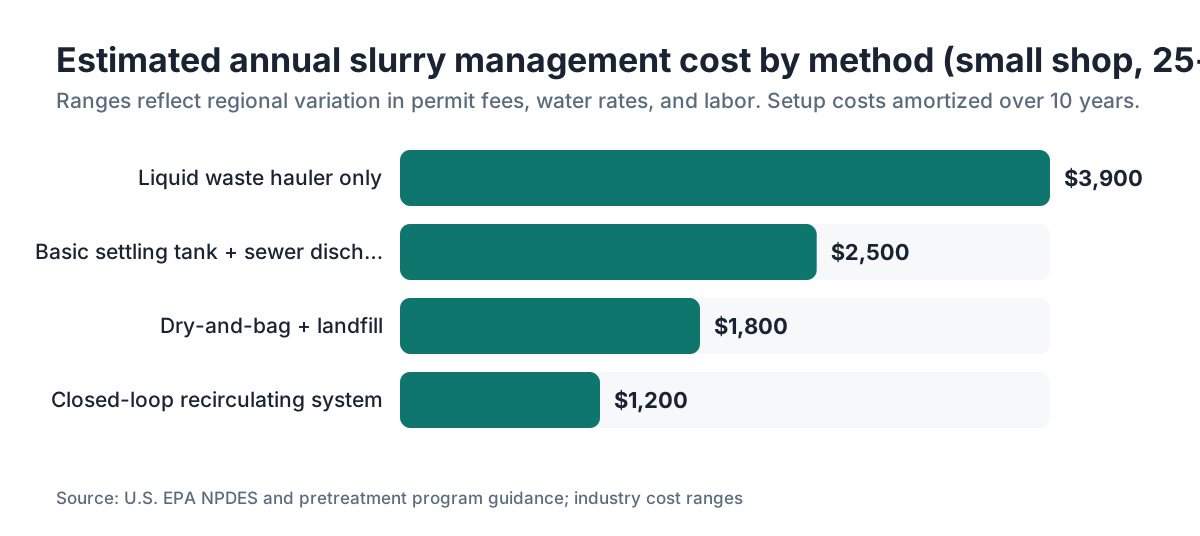
A basic two-chamber settling system built from plastic tanks (used IBC totes go for $200 to $400 each and are popular for a reason) plus a sump pump, pH probe, and drain plumbing runs $3,000 to $6,000 installed if you do most of the labor. A concrete tank poured in place runs $5,000 to $15,000 depending on size and local concrete labor.
Ongoing costs are pump-out service ($150 to $500 per event, two to six times a year for a mid-size shop), pH chemicals ($50 to $200 a year for most shops), and POTW permit fees ($0 to $500 a year). Total annual operating cost for a basic system lands around $500 to $3,000 depending on volume and location.
A closed-loop recirculating system from an industrial water treatment vendor runs $10,000 to $40,000 for a complete install sized for a small shop. Steep, yes. But if your municipal water rate is $8 per 1,000 gallons and sewer adds another $10 per 1,000 gallons (typical in many mid-sized U.S. cities as of 2024), a shop using 500 gallons a day spends roughly $3,000 to $5,000 a year on water and sewer alone. A closed-loop system can cut that 70 to 90 percent [9].
If you run quoting software like SlabWise to track job costs, add a per-job slurry disposal line item (usually $5 to $20 per slab depending on your system). It recovers this overhead instead of leaving you to guess at year-end.
Can you recycle or reuse the water from stone slurry?
Yes, and this is where well-run shops actually save money. Once you settle out the solids and correct the pH, the clarified water is usually clean enough to reuse as saw coolant. Nobody's drinking it, and stone cutting tolerates water with moderate dissolved solids far better than precision metalworking does.
The simplest reuse setup adds a pump in your final settling chamber that routes clarified water back to your machine coolant supply. Many shops use a float-controlled pump so the system tops up machine water automatically during cuts. You still lose some water to evaporation and to the sludge you pump out, so you need a makeup water connection, but recirculation can cut fresh water use 60 to 80 percent [9].
If you cut engineered quartz at high volume, know that recirculated water builds up dissolved solids over time, which shortens tooling life and can leave deposits on stone surfaces. Drain and refill your system water fully every quarter or half-year to keep that in check.
The sludge has limited reuse potential. Some ready-mix concrete producers have historically taken stone slurry as a partial aggregate filler, and a few kiln operations have used it, but those deals are local and informal. If you find a taker, get a written agreement and confirm the receiving facility can legally accept the material. Don't just drop it somewhere because a guy said he'd use it.
What do state inspectors actually look for when they visit a fabrication shop?
State environmental inspectors work off a fairly consistent list when they walk into a stone shop. Knowing it lets you self-audit before anyone shows up uninvited.
First, they trace all drains. They find every floor drain and exterior drain and ask where each one goes. If a drain routes to a storm sewer and your process water touches the floor, you have a problem unless you can document that no process water ever reaches that drain. Physical plugs or caps on any storm-connected interior drains read as good practice.
Second, they check permit paperwork. Do you hold a POTW discharge permit if you discharge to sewer? Is it current? Do you have your SWPPP if you're covered under a stormwater permit?
Third, they read your monitoring records. Most permits make you test your discharge periodically (often quarterly for small dischargers) and keep records for three years. A missing logbook is a finding even if your discharge is spotless.
Fourth, they may pull a sample. They can take a grab sample of your discharge or your stormwater runoff and have it analyzed. Fail the permit limits and that's a violation no matter how clean your paperwork is.
Fifth, they look at sludge storage. If you're accumulating dried slurry on site, is it covered or contained so rain can't wash it off? An uncovered pile of stone dust next to a storm drain is an easy citation.
EPA's Small Business Environmental Assistance Program (SBEAP) has resources built for shops like yours, and many states offer free, confidential pre-inspection assessments through their SBEAP office [10]. An advisor can walk your shop and tell you exactly what to fix before an official inspection. The program exists because regulators know small shops don't have a compliance department.
How do you train employees to handle slurry correctly every day?
The best system in the world fails if the person running the saw at 7 a.m. doesn't know why it matters. Training doesn't have to be elaborate. It has to happen.
Four habits carry most of the load: keep the drain path clear, never dry-sweep the floor, check the pH before discharging, and report any blockage or overflow right away. Those four cover roughly 80 percent of the compliance risk.
For a shop with several employees, a posted sign at each machine showing the drain path and the discharge checklist beats a one-time orientation talk. Laminated card, 8.5 by 11, next to the saw: "Where does this drain go? What do I check before I discharge?"
Document your training. OSHA's silica standard requires written records of training for workers exposed to silica [2]. Environmental permits often require that employees know your SWPPP or pretreatment procedures. A sign-off sheet with the employee's name, date, and topics covered is usually enough.
If you cut a range of stone types (granite, quartzite, soapstone, engineered quartz), employees should know that different materials make different slurry. Soapstone slurry looks and feels different from granite slurry, and engineered quartz slurry carries a very high silica fraction that makes the wet-cutting control even more important. A crew that cuts granite countertops five days a week and then gets an engineered quartz job needs to treat that job with extra wet-cutting discipline.
What should small shops do first if they have no slurry management system at all?
Start with a phone call, not a tank purchase. Call your local POTW pretreatment coordinator and your state's Small Business Environmental Assistance Program. Tell them exactly what you cut, how much water you use a day, and where your drains go now. Ask what they require. Get the permit application if there is one.
While the permit works its way through, run a no-discharge containment setup. Collect all slurry in containers (drums, IBC totes, or a lined portable sump), keep it away from every drain, and hire a liquid waste hauler to remove it. It costs more per gallon than a permanent system, but it makes you legally compliant today while you plan and budget for something permanent.
For very small shops (under 10 slabs a week), the hauler approach may be the right long-term answer. At low volumes, a settling system may never pay back. Run the numbers. Generate 50 gallons of slurry a week, and a hauler at $0.25 a gallon with a $75 minimum pickup charge costs around $3,900 a year. A settling system with install and ongoing costs might run $2,000 to $4,000 a year at that scale. The settling system barely wins, and it drags permit paperwork along with it.
Once a system is installed and permitted, audit it yearly. Regulations change, your discharge volume changes, tanks develop leaks. A one-hour self-audit every 12 months, using a checklist that mirrors what your permit requires you to monitor, catches small problems before they turn into violations.
If your shop is growing and you're weighing shop operations software, tracking slurry disposal cost per job (alongside material waste, labor, and tooling) shows you real job profitability instead of a fuzzy guess. A demo of SlabWise shows how fabricators fold those overhead line items into their quoting workflow, so disposal costs stop eating margins quietly.
Frequently asked questions
Can I dump stone slurry down the sink or floor drain?
Only if that drain goes to a sanitary sewer and you hold a pretreatment permit from your local wastewater authority. You cannot dump slurry into a storm drain under any circumstances. Most municipalities also require you to settle out solids first, because raw slurry TSS (often 2,000 to 10,000 mg/L) far exceeds typical sewer limits of 150 to 300 mg/L.
Is stone slurry considered hazardous waste under federal law?
For natural stone like granite, marble, and quartzite, no. It typically passes EPA TCLP testing and doesn't meet RCRA hazardous waste criteria. Engineered quartz slurry should be checked against the product SDS. If a material carries unusual metals, colorants, or pigments, a TCLP lab test ($100 to $300) confirms non-hazardous status before you assume it.
How often do I need to pump out my settling tank?
Most small-to-mid shops cutting 25 to 50 slabs a week need pump-out every one to four months. Sludge accumulates in the first chamber. Watch for the solids layer reaching within 12 inches of the overflow baffle, which is your signal it's time. Your pump-out contractor can help you set a site-specific schedule after the first few cleanings.
What pH should stone slurry be before I discharge it to the sewer?
Most municipal pretreatment permits require effluent pH between 6.0 and 9.0. Marble and limestone slurry runs alkaline (pH 8 to 11) from calcium carbonate. Granite slurry runs mildly acidic (pH 5 to 7). Test with a calibrated pH probe before every discharge and adjust with citric or muriatic acid for high pH, sodium carbonate for low pH.
Do I need a permit to dry my slurry and throw it in the trash?
Usually not a special permit, but confirm with your county solid waste authority that they classify dried natural stone slurry as non-hazardous C&D debris or industrial solid waste. Get that confirmation in writing. Do not landfill slurry from engineered products without checking the SDS and, if you're unsure, running a TCLP test to confirm non-hazardous status.
How does a closed-loop recirculating water system work and is it worth it?
A closed-loop system filters and clarifies process water, corrects pH, and pumps it back to your machines instead of discharging it. Water use drops 70 to 90 percent. You still make sludge, which gets hauled as solid waste. For shops spending $3,000 or more a year on water and sewer, payback on a $15,000 to $25,000 system runs 5 to 8 years, reasonable for a permanent shop.
What happens if a state inspector finds I have no slurry system?
Penalties vary by state and violation history, but unpermitted discharge to a storm sewer can trigger $1,000 to $10,000 per day in administrative penalties under most state environmental statutes, mirroring federal Clean Water Act authority. First-time violators who cooperate and fix the problem fast often see reduced penalties, but the enforcement record stays. Inspectors sometimes refer willful violators for criminal prosecution in egregious cases.
Can I use IBC totes as settling tanks?
Yes, and many small shops do exactly this. Used food-grade IBC totes (275 or 330 gallons) run $200 to $400 each and can be plumbed in series with overflow fittings between them. They aren't as durable as concrete tanks and UV exposure degrades the plastic over time, but a two- or three-tote system in a covered area works well at lower cutting volumes. Inspect them yearly for cracks.
Does engineered quartz slurry require different handling than natural stone slurry?
The disposal process is similar, but engineered quartz slurry can run above 90 percent crystalline silica in some products, which makes the wet-cutting control even more important for worker safety under OSHA's silica standard. For disposal, check the SDS for unusual resin chemistries or pigments. Most engineered quartz slurry still passes TCLP, but the high silica fraction makes it more important to keep the slurry wet and contained.
What is a SWPPP and does my stone shop need one?
A Stormwater Pollution Prevention Plan (SWPPP) is a written document describing how your facility keeps process water and pollutants from leaving the property in stormwater runoff. Most states require it under EPA's NPDES general industrial stormwater permit if your shop's SIC code triggers coverage. Stone fabrication operations (SIC 1741, masonry, or SIC 5211 in some classifications) often trigger it. Check with your state environmental agency.
How do I find a liquid waste hauler for stone slurry?
Search for licensed industrial liquid waste haulers or environmental services companies in your area. They must be licensed by your state environmental agency to transport non-hazardous industrial wastewater. Ask for their state transporter license number before they pick anything up. They should give you a manifest (shipping document) for each pickup, which you keep for at least three years as a compliance record.
Can stone slurry damage my plumbing or sewer lines?
Raw unsettled slurry absolutely can. The fine particles settle and compact inside pipes, building deposits over months. A partial blockage in a drain line can back slurry up and bypass your settling system entirely. Keep at least 1/4-inch per foot of slope in all drain lines, use 3-inch or larger pipe, and flush drain lines annually with high pressure. Never let slurry sit stagnant in a pipe.
What free resources exist for small shops trying to figure out compliance?
EPA's Small Business Environmental Assistance Program (SBEAP) operates in every state and offers free, confidential compliance help with no enforcement authority. Your state environmental agency's small business liaison can answer permit questions. OSHA's On-Site Consultation Program offers free safety visits to small businesses, kept separate from enforcement inspections. Use all three before you spend money on a consultant.
Sources
- U.S. EPA, National Pollutant Discharge Elimination System (NPDES) program overview: The Clean Water Act prohibits discharging pollutants into waters of the United States without an NPDES permit; states administer the program under EPA authorization.
- OSHA, Occupational Exposure to Respirable Crystalline Silica standard, 29 CFR 1926.1153 and 1910.1053: OSHA's silica standard sets an action level of 25 μg/m³ and a PEL of 50 μg/m³ as 8-hour TWA; wet cutting is listed as a required engineering control for stone cutting in Table 1.
- California State Water Resources Control Board, Stormwater Program: California requires most fabrication shops with industrial activities to operate under a general industrial stormwater permit if process water could leave the property.
- U.S. EPA, Resource Conservation and Recovery Act (RCRA) program: RCRA hazardous waste classification for solid waste relies on TCLP testing for toxicity characteristic; materials passing TCLP thresholds for listed metals are non-hazardous.
- U.S. EPA, SW-846 Test Methods for Evaluating Solid Waste (TCLP Method 1311): TCLP (Method 1311) is the standard EPA test for determining whether solid waste exhibits the toxicity characteristic that would classify it as hazardous.
- U.S. EPA, Pretreatment Program under the NPDES program: Local POTW pretreatment programs set discharge limits on TSS and pH; typical local limits for suspended solids fall in the range shops must meet before discharging process water.
- U.S. EPA, Clean Water Act enforcement and penalties: The Clean Water Act authorizes civil penalties for unpermitted discharge, and state programs administered under it apply comparable per-day penalty authority.
- OSHA and NIOSH, Hazard Alert: Worker Exposure to Silica During Countertop Manufacturing, Finishing, and Installation (2019): OSHA and NIOSH issued a joint hazard alert in 2019 identifying engineered quartz countertop fabrication as a high-risk activity for silicosis; wet methods are the primary recommended control.
- U.S. EPA, WaterSense and industrial water efficiency resources: Closed-loop recirculating water systems in industrial processes can reduce fresh water consumption substantially compared to once-through systems.
- U.S. EPA, Small Business Environmental Assistance Program (SBEAP): EPA's Small Business Environmental Assistance Program operates in every state and provides free, confidential compliance assistance separate from enforcement.
- OSHA, On-Site Consultation Program for small businesses: OSHA's free On-Site Consultation Program provides safety and health consultations to small businesses that are entirely separate from OSHA enforcement inspections.
Last updated 2026-07-11