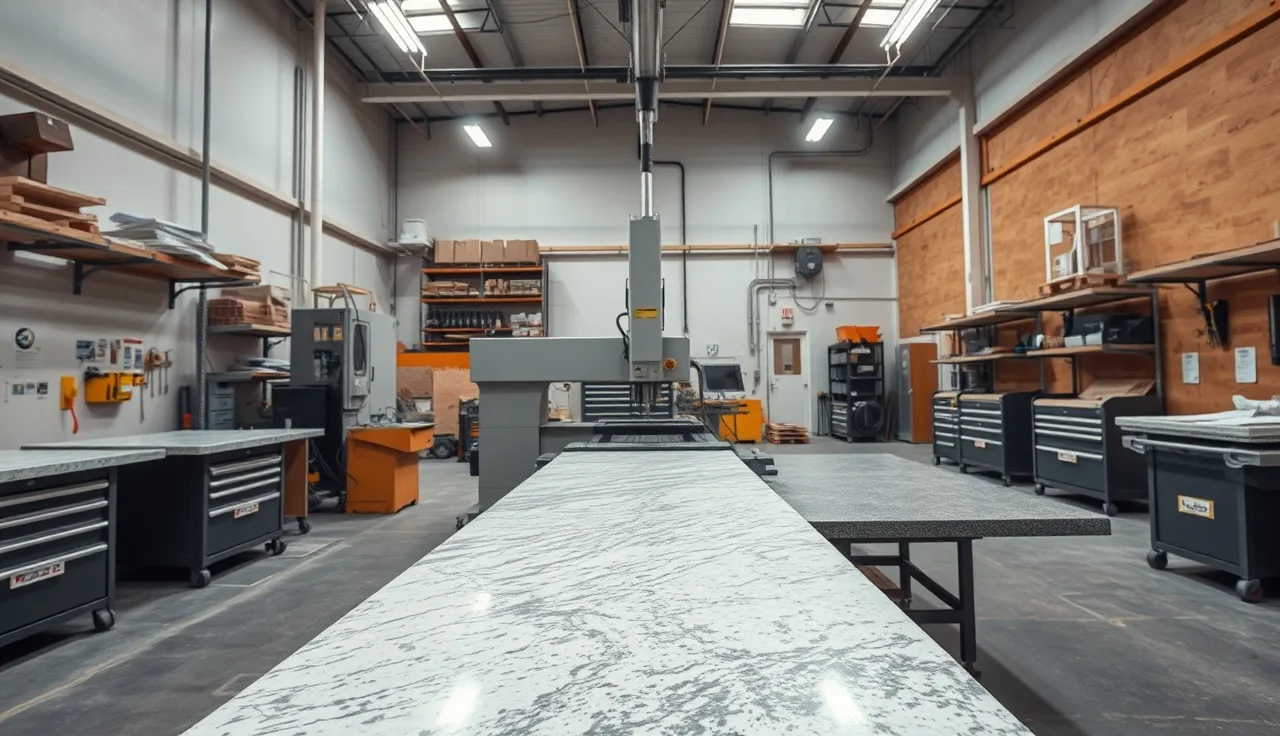
TL;DR
- Lean manufacturing for stone fabrication applies Toyota Production System principles, specifically value-stream mapping, 5S workplace organization, single-piece flow, and pull scheduling, to a countertop shop.
- Shops that implement lean report lead-time reductions of 30 to 50 percent and material yield improvements of 8 to 15 percent.
- The core idea: remove every step that doesn't add value a customer would pay for.
What does lean manufacturing actually mean in a stone shop?
Lean manufacturing is a management system built to eliminate waste: excess motion, waiting, overproduction, defects, unnecessary inventory, over-processing, and unused talent. Toyota codified these as the "seven wastes" (muda) in the Toyota Production System, and every industry that has adopted lean starts by finding those same wastes in its own process [1].
In a stone fabrication shop, lean looks different than it does in an auto plant, but the structure is the same. A granite slab that sits in the yard for three weeks waiting for a template is waste. A CNC bridge saw that runs 45 minutes of air-cutting between jobs is waste. A polisher walking across a 6,000-square-foot floor six times per shift because sanding pads live at the far wall is waste. None of that adds a dime of value the homeowner is paying for.
The practical translation: organize every station so the work flows in one direction, pull new jobs only when capacity exists, and make defects visible before they reach the install truck. That's lean. It is not about working faster. It's about working without interruption.
One note on terminology: some shops call this "continuous improvement" or use the Japanese term kaizen. The labels matter less than the discipline. What matters is a written standard for each operation and a regular meeting (usually 15 minutes, daily) where the crew surfaces problems. Without that feedback loop, any physical changes to the shop floor drift back toward chaos within a few months.
What are the seven wastes in stone fabrication specifically?
The Lean Enterprise Institute defines the seven wastes as transportation, inventory, motion, waiting, overproduction, over-processing, and defects [2]. Here's how each one shows up on a stone shop floor.
Transportation is moving slabs or cut pieces more than necessary. Every time a slab moves from the yard to the saw to a staging rack and back again, you're spending crane or forklift time that adds zero value. A well-designed shop moves a slab in one direction: yard to saw, saw to CNC or hand-polish, polish to install staging.
Inventory in stone shops is expensive because slabs are heavy, fragile, and capital-intensive. Remnants that pile up without a plan are a classic sign of lean immaturity. Some shops track remnant square footage and set a hard cap; when the cap is hit, remnants go to a sale rack before new full slabs are pulled.
Motion is workers walking or reaching unnecessarily. Time-and-motion studies in manufacturing consistently show that workers in unorganized shops travel 20 to 40 percent more distance per shift than those in lean shops [3]. In a stone shop, that translates directly to fatigue and slower throughput.
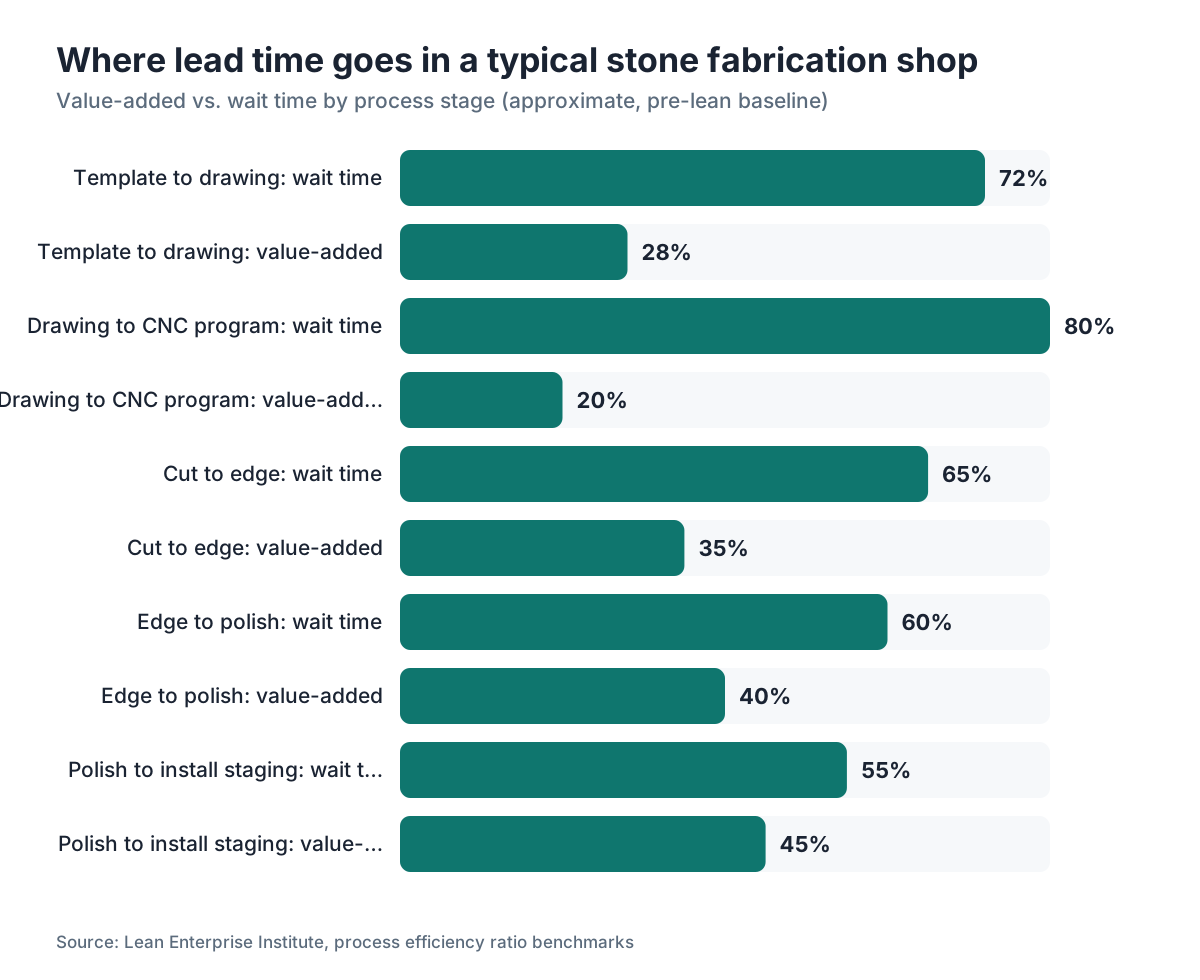
Waiting is the biggest visible waste in most shops. Jobs wait for templates, templates wait for drawings, drawings wait for CNC programs, cut pieces wait for edge work. Mapping this out (see the next section on value-stream mapping) usually shocks shop owners. A job that takes 4 hours of actual work often has 3 to 5 days of waiting embedded in its lead time.
Overproduction means cutting or polishing more than the current order requires. In stone, this shows up as running a whole slab when only half is needed, or edging every piece at the start of the day instead of as each job reaches that stage.
Over-processing is applying more work than the customer specified. Spending 20 minutes hand-polishing a surface that will be covered by a sink template, or sealing a countertop that the homeowner didn't order sealed, are common examples.
Defects in stone are expensive because the material cost is high and rework often means cutting a new piece from a new slab. Chips, wrong dimensions, wrong edge profiles, and incorrect cutout locations are the most frequent categories. Lean shops build inspection into the workflow at each handoff point rather than inspecting only at the end.
How do you map the value stream for a countertop fabrication shop?
Value-stream mapping (VSM) is a pencil-and-paper (or whiteboard) exercise where you trace every step a job takes from customer order to installed countertop, recording the cycle time, wait time, and information flow at each step [1]. The goal is to see the whole system, more than the machine you're standing next to.
For a typical countertop shop, the value stream runs roughly like this: customer order confirmed, template scheduled, template completed, drawing drafted, CNC program generated, slab pulled from yard, slab cut, pieces edged, pieces polished, QC check, packaged for install, installed. That's 10 to 12 steps. In a shop that hasn't mapped this, it's common to find that the total wait time between steps is 4 to 8 times longer than the actual processing time.
To do a VSM, walk the floor with a stopwatch. Record the actual cycle time for each operation (how long the machine or person is actively working on one job). Then record the average queue time before that step (how long a job sits waiting). When you add those up across all steps, you get the total lead time. The ratio of value-added time to total lead time is called the process efficiency ratio. Lean practitioners aim for 25 percent or higher [2]. Most shops starting out are at 5 to 10 percent.
The map also captures information flows: when does the template tech send measurements to the drafting station? Does the CNC programmer wait for an email, or does the drawing appear in a shared folder automatically? Paper-based information flows are a common hidden bottleneck. Many shops cut their lead time by 20 percent just by switching to a shared digital job board, with no changes to the physical shop at all.
After mapping the current state, you draw the future-state map: what would the flow look like if each identified waste were removed? That future-state map becomes the improvement roadmap.
What is 5S and how does a stone shop apply it?
5S is the foundational lean workplace organization method. The five steps are Sort, Set in Order, Shine, Standardize, and Sustain [4]. The Manufacturing Extension Partnership (MEP), a NIST program that helps small manufacturers, has documented 5S implementations across hundreds of U.S. shops, including stone and tile fabricators [5].
Sort means removing everything from the work area that is not needed for current production. In a stone shop, this usually means clearing old tooling, broken blades, unused fixtures, and accumulated remnants. One common rule: if it hasn't been used in 90 days and has no scheduled use, it leaves the floor.
Set in Order means assigning a specific, labeled location to every tool, blade, pad, and consumable that stays on the floor. Shadow boards for hand tools, labeled hooks for angle grinders, a fixed rack position for each edge profile tooling set. The test: can a new employee find any tool in under 60 seconds? If not, the layout needs more work.
Shine means cleaning as a diagnostic activity, more than for appearance. When a saw is clean, you notice coolant leaks, blade wear, and cracks in the table immediately. A dirty saw hides all of that until it becomes a breakdown.
Standardize means writing the Sort, Set in Order, and Shine routines into a checklist that gets done at the same time every day or every shift. Without this, the organization erodes.
Sustain is the hardest step, and it's where most shops fail. Sustain requires management to audit the 5S standard regularly (typically weekly at first) and to treat a deviation as a process failure worth investigating rather than just a mess to clean up.
A well-executed 5S in a stone shop typically recovers 15 to 25 minutes per operator per shift in search and motion time [3]. That's a meaningful number when you're running 8 to 12 employees.
What does single-piece flow mean in a countertop shop, and is it realistic?
Single-piece flow means processing one job (or one piece) all the way through the value stream before starting the next one. It's the opposite of batch processing, where you cut all of Monday's jobs, then edge all of Monday's jobs, then polish all of Monday's jobs.
In stone fabrication, pure single-piece flow is difficult because machine cycle times are long and some operations (large format CNC cutting, for example) are genuinely efficient only when run in longer sequences. But the principle still applies in a modified form. Instead of batching a full day's work at each station, many lean stone shops move to half-day batches, then quarter-day batches, progressively shrinking the queue between stations.
The practical benefit of moving toward smaller batches is faster detection of defects. If you cut 20 pieces and then edge 20 pieces, a dimension error in the cut pieces won't be discovered until the edging step. If you cut 5 pieces, edge those 5, then cut the next 5, you find the error after 5 pieces instead of 20. In stone, where a single slab might cost $200 to $1,200 depending on material, that early detection is worth real money [6].
Some shops use a "one-job, one-cart" system where every cut piece for a single order travels together in a labeled cart from saw to edge to polish to staging. The cart never mixes with another job. This is a practical implementation of flow without requiring true single-piece throughput.
How does pull scheduling work in stone fabrication?
Pull scheduling means a downstream station signals to the upstream station to produce more only when the downstream station has capacity. This is the opposite of push scheduling, where the saw (or the scheduler) decides how much to cut regardless of whether the downstream steps are ready.
In a stone shop, a simple pull signal might be: the polishing station has a physical or digital board showing three open slots. When those slots open, the edge station knows it can send the next three jobs forward. The edge station then pulls from the saw, and the saw pulls from the template/drafting queue. No station produces ahead of demand.
Kanban cards are the classic pull signal. In stone fabrication, many shops use a simpler version: a whiteboard or digital job board with column headers for each station (Cut, Edge, Polish, Stage, Install). A job card moves right only when the next column has open capacity. This takes about 30 minutes to set up physically and costs almost nothing.
Pull scheduling directly reduces WIP (work in process) inventory. Less WIP means less floor space consumed by partially finished jobs, less risk of pieces getting mixed up or damaged while waiting, and a clearer picture of true shop capacity. The Lean Enterprise Institute's research across manufacturing sectors shows that pull systems typically reduce WIP by 50 to 70 percent compared to push scheduling [2].
For fabricators juggling several concurrent jobs, this kind of scheduling visibility is one of the biggest operational gains from lean. Software that shows each job's real-time station status makes the pull logic easier to enforce without a full-time scheduler watching the floor.
What physical layout works best for a lean stone fabrication shop?
The lean ideal is a U-shaped or linear cell layout where material enters at one end and finished work exits at the other, with stations arranged in process sequence. For stone fabrication, a linear layout usually looks like this: slab storage and saw at one end, then CNC or hand edge work, then polishing, then a QC and staging area near the loading dock.
The most common anti-pattern in stone shops is the "hub and spoke" layout, where a central saw feeds multiple scattered workstations and finished pieces travel back to a central staging area. That layout made sense when shops processed a high mix of materials on dedicated stations, but it generates enormous transportation waste as shop volume grows.
Ceiling crane coverage matters a lot. In a linear layout, a crane that covers the full length of the shop eliminates the need for forklifts to move slabs between stations. Many shops that have done a lean redesign report that crane coverage decisions drive the layout more than anything else.
Aisle width is another consideration. OSHA 29 CFR 1910.22 requires that aisles and passageways be kept clear and marked, with sufficient width for safe movement of materials and equipment [7]. Most lean consultants recommend a minimum 8-foot aisle in any stone shop using cart or forklift movement. Narrower aisles become bottlenecks and create safety hazards.
A realistic lean shop redesign for a mid-size stone fabricator (10 to 20 employees, 5,000 to 15,000 square feet) takes 2 to 4 months to plan and 1 to 3 days to physically reorganize if the plan is solid. The downtime cost is real, but most shops recoup it within 6 months through throughput gains.
How does nesting software reduce waste in stone fabrication?
Nesting is the process of arranging cut shapes on a slab to minimize offcuts and remnants. Before CNC-driven shops, nesting was done by eye, and material yield depended heavily on the skill of the individual cutter. Manual nesting in stone fabrication typically achieves 65 to 75 percent yield on complex jobs; good nesting software routinely hits 80 to 92 percent on the same jobs [8].
In lean terms, nesting software attacks the waste of overproduction (wasting slab area that could have been used) and defects (misplaced cuts that destroy pieces). It also reduces the time a CNC programmer spends on layout decisions, which is a motion and waiting waste reduction.
The integration between quoting software and nesting software is where many shops find the next big gain. When a quote is built, a rough nest can estimate the number of slabs needed for that job. That estimate feeds directly into material purchasing decisions, which reduces the overstock inventory waste. Tools like SlabWise connect the quoting step to slab layout so material requirements are visible before a job is committed [9].
The real-world yield improvement from nesting software varies by job complexity. Simple kitchen countertops with rectangular runs and minimal cutouts see modest gains. Jobs with multiple L-shapes, curved sections, and large sink cutouts see the biggest improvements because the optimizer can rotate and pack shapes in ways a human eye misses.
For a shop processing 30 to 50 jobs per week with an average slab cost of $300 to $600, a 10-percentage-point improvement in material yield translates to $15,000 to $50,000 per year in avoided slab purchases. That math is why nesting software is almost always the first technology investment in a lean stone shop.
How do you measure whether lean is working in a stone shop?
Lean without measurement is just rearranging furniture. The metrics that matter for a stone fabrication shop fall into four categories: flow, quality, delivery, and cost.
Flow metrics include lead time (order to install), WIP count (jobs currently in process), and throughput (jobs completed per week). These should be tracked weekly at minimum. Lead time is the single most important metric because it correlates directly with customer satisfaction and with cash conversion speed.
Quality metrics include defect rate (pieces requiring rework or replacement per 100 pieces produced), customer complaint rate, and first-pass yield (percentage of jobs that go from cut to install without any rework). A lean stone shop should target a defect rate below 2 percent; many shops starting lean are at 5 to 10 percent.
Delivery metrics include on-time install rate (percentage of jobs installed on the originally promised date) and template-to-install cycle time. On-time delivery below 85 percent is a red flag for systemic scheduling problems.
Cost metrics include material yield percentage, labor hours per square foot, and machine utilization. Machine utilization is tricky: a saw running at 95 percent utilization sounds good, but in a pull system it often means the saw is overproducing and creating WIP backlog downstream. Target utilization is typically 70 to 80 percent, which leaves buffer for variation.
Track these on a visible scoreboard in the shop, updated daily or weekly. The scoreboard itself is a lean tool: it makes performance visible to everyone and surfaces problems without waiting for a monthly management report.
Many shops use a simple spreadsheet for this initially. As job volume grows past 20 to 30 jobs per week, a dedicated job-tracking system becomes necessary to keep the data current without adding administrative labor.
What does a lean daily management routine look like for a fabrication shop?
The operational heartbeat of a lean shop is the daily standup meeting, usually 10 to 15 minutes at the start of each shift. The meeting covers three things: what happened yesterday (production vs. plan, any defects or near-misses), what's planned for today (job assignments, any constraints), and what obstacles need to be cleared.
That's it. Not a full review, not a scheduling session. Just a check of the plan vs. reality and a quick escalation of blockers.
The shop manager or lead walks a fixed route through the shop at least once per shift, what lean practitioners call a "gemba walk" (gemba means "the actual place" in Japanese). The point is to observe the real process, not the reported process. Common things to check: are WIP levels at each station within the target range? Are any jobs sitting waiting with no visible reason? Are tools in their marked locations?
Problems found on the gemba walk get logged in a simple issue register: what the problem is, who owns the fix, and by when. The issue register is reviewed weekly. This closes the feedback loop and prevents the same problem from recurring unaddressed.
Kaizen events (focused 1 to 5 day improvement workshops targeting a specific problem) are the more intensive improvement tool. A typical stone shop might run 4 to 6 kaizen events per year, each targeting one process area: edge work cell layout, slab receiving and storage, CNC programming, or install crew staging. The Manufacturing Extension Partnership offers facilitation and co-funding for kaizen events through its network of state MEP centers [5].
How much does implementing lean manufacturing cost for a stone fabricator, and what's the ROI?
The honest answer: most of lean costs time, not money. Value-stream mapping, 5S, pull scheduling, daily standups, and gemba walks require zero capital investment. The main cost is the labor time of the people involved in improvement activities, and the temporary productivity dip while new workflows settle in.
For a shop with 10 to 15 employees, expect 3 to 6 months of active lean implementation work before the new routines feel stable. During that period, the owner or manager typically spends 4 to 8 hours per week on improvement activities rather than production activities. That's real opportunity cost.
Capital investments that often accompany lean in stone shops include: shadow boards and labeling materials ($500 to $2,000), a digital job board or TV monitor for the shop floor ($200 to $800), nesting and quoting software ($200 to $600 per month depending on the platform), and occasional fixture or rack fabrication to support the new cell layout (variable, often $2,000 to $10,000).
The ROI case is typically strong. The NIST MEP program tracks outcomes across its client base. According to NIST's 2022 MEP National Network Impact Report, manufacturers who completed improvement projects through MEP reported an average of $245,000 in new or retained sales and $98,000 in cost savings per engagement [5]. Stone shops are smaller than the average MEP client, so those numbers don't translate directly, but the proportional impact is consistent.
A realistic target for a 10-person stone shop implementing lean over 12 months: 20 to 35 percent reduction in lead time, 5 to 10 percent improvement in material yield, and 10 to 20 percent improvement in throughput with the same headcount. Run those numbers against your own revenue and margin and the case makes itself.
What are the most common mistakes when shops try to go lean?
The most common mistake is treating lean as a one-time reorganization project rather than an ongoing management system. A shop will do a 5S event, label everything, take photos for the website, and then slowly drift back to the old layout over 6 months because no audit routine exists. This is the "5S twice a year" trap and it's extremely common.
The second common mistake is starting with tools instead of starting with problems. Buying new nesting software or installing an ERP system before mapping the value stream often just automates the existing waste rather than eliminating it. The right sequence: map first, identify the biggest waste, solve that waste with the simplest possible tool, then measure.
The third mistake is excluding the crew from improvement decisions. Lean depends on the people doing the work identifying problems and testing solutions. A shop owner who designs the new layout in their office and announces it to the crew will get compliance but not engagement. The crew knows where the real friction points are.
Fourth: trying to improve everything at once. Pick the single biggest bottleneck (usually identifiable as the station with the longest queue in front of it) and fix that first. Everything else is secondary until the bottleneck is resolved. This is the constraint-based thinking from Goldratt's Theory of Constraints, which pairs well with lean [10].
Fifth: ignoring the office. Many stone shops do the physical shop-floor work well but leave the quote-to-template-to-program information flow as a tangle of emails, phone calls, and spreadsheets. The office process is often where 40 to 60 percent of total lead time lives. Lean in the shop without lean in the office gets you halfway.
Frequently asked questions
Can a small stone shop with 3 to 5 employees benefit from lean?
Yes, and in some ways it's easier at that size because you can change routines quickly. The highest-value lean tools for a small shop are 5S (especially tool organization), a simple visual job board, and basic nesting discipline. Value-stream mapping at 3 to 5 people takes less than a day and usually reveals 2 or 3 obvious fixes. You don't need a consultant. Walk the floor, write down every wait and every unnecessary move, and fix the worst one.
How long does it take to see results after starting lean in a fabrication shop?
Most shops see measurable lead-time improvement within 60 to 90 days of a genuine 5S and visual management implementation. Material yield improvements from nesting software show up immediately. The harder cultural changes, like daily standups becoming a real habit or pull scheduling replacing push, take 6 to 12 months to stabilize. Don't expect everything at once. Track two or three metrics from day one so you can see the change.
What's the difference between lean and Six Sigma for a stone shop?
Lean focuses on eliminating waste and improving flow speed. Six Sigma focuses on reducing process variation and defect rates using statistical tools. For a stone shop, lean is almost always the right starting point because the biggest problems are flow and waste, not statistical variation. Six Sigma tools like control charts become useful later, when you're optimizing an already-flowing process. Many large manufacturers combine both under the label Lean Six Sigma.
Does lean manufacturing apply to the countertop installation process, more than the shop?
Absolutely. The install crew is the last step in the value stream, and waste there is expensive because it involves homeowner time and travel costs. Common install wastes: arriving without the right tools, discovering a piece doesn't fit because a field measurement changed, and making two trips because the install wasn't staged completely. Standardized install kits, a pre-install checklist, and a digital confirmation of field measurements before the crew leaves the shop all apply lean thinking directly to installation.
How does lean affect the quoting process for countertop jobs?
Quoting is the first step in the value stream, and waste there propagates through every downstream step. A vague or inaccurate quote means re-measurement, re-pricing, customer confusion, and delayed starts. Lean quoting means a standardized input form that captures all the dimensions and specifications a fabricator needs in one pass, with no back-and-forth. Integrating a nesting-based material estimate into the quote reduces surprises at the slab pull stage.
What role does slab inventory management play in lean stone fabrication?
Slab inventory is the biggest working capital item in most stone shops, so lean inventory management has direct cash flow impact. The lean approach: maintain a small buffer of high-velocity materials (the top 5 to 10 colors by order frequency), and order less-common materials to order rather than stocking them speculatively. Track remnant square footage and set a cap. Remnants beyond the cap either go to a sale event or get incorporated into current jobs before new full slabs are pulled.
How do I know which station is my shop's bottleneck?
The bottleneck is almost always the station with the longest queue of waiting work in front of it. Walk the floor at the start of each day for a week and count the jobs waiting at each station. The station with the consistently longest queue is the bottleneck. Secondary clue: it's often the station where the most urgent expediting happens. The Theory of Constraints says to focus all improvement energy there first, and only there, until the queue clears consistently.
Can lean principles help reduce CNC programming time?
Yes. CNC programming is often a hidden bottleneck because it sits between templating and cutting and requires a skilled person. Lean improvements here include: standardized profile libraries so programmers don't rebuild common edge profiles from scratch, nesting software that generates programs automatically from drawn shapes, and a queue discipline that batches similar material types together to reduce tool change time. Shops that automate nesting-to-CNC output typically cut programming labor by 40 to 60 percent per job.
Is there any government support or funding available for lean implementation in small stone shops?
Yes. The NIST Manufacturing Extension Partnership (MEP) operates centers in all 50 states and Puerto Rico that provide lean consulting, workforce training, and process improvement facilitation to small and mid-sized manufacturers, including stone and tile fabricators. Cost-sharing arrangements vary by state, but many engagements are subsidized at 50 percent or more for qualifying small manufacturers. Contact your state's MEP center through the NIST MEP website.
How does lean affect worker safety in a stone fabrication environment?
Lean and safety are closely linked. A clean, organized shop with marked aisles, stored tools in fixed locations, and clear WIP limits is a safer shop. OSHA's general industry standards require clear aisle marking and housekeeping under 29 CFR 1910.22. Beyond compliance, lean shops typically see fewer injury incidents because they eliminate the rushed, cluttered, improvised conditions where most shop injuries happen. Some shops track near-miss incidents as a lean quality metric alongside defect rates.
What software tools support lean operations in a stone shop?
The minimum useful toolkit: a digital job board (can be a shared Google Sheet or a dedicated shop management app), nesting software that integrates with your CNC, and a quoting tool that captures enough detail to avoid re-measurement. As job volume grows past 25 to 30 jobs per week, dedicated stone fabrication software that connects quoting, nesting, job tracking, and scheduling becomes worth the monthly cost. Evaluate tools based on whether they reduce information handoff friction, not on feature count.
How does lean change how a stone shop handles customer changes and rush orders?
Rush orders are the enemy of flow, but they happen. Lean shops handle this by defining an explicit protocol: what qualifies as a rush (and at what premium cost), where in the queue it gets inserted, and which jobs it displaces. Without that protocol, every urgent call from a customer or contractor triggers ad-hoc decisions that disrupt the whole schedule. The protocol doesn't eliminate rushes; it just makes the cost and displacement visible so the decision is conscious.
Does lean manufacturing work with high-mix, low-volume stone fabrication?
High-mix is the default in stone fabrication, and lean was originally developed in high-mix environments (Toyota builds thousands of vehicle configurations). The key adaptation is focusing on flow principles rather than mass-production line balancing. Flexible cell layouts, quick-change tooling, standardized work instructions for the most common operations, and pull scheduling all work regardless of mix. The value-stream map changes per job type, but the waste categories are the same.
Sources
- Lean Enterprise Institute, "What Is Lean?": Toyota Production System origins of lean, value-stream mapping as a core diagnostic tool, and the seven wastes framework
- Lean Enterprise Institute, Learning Resources: Process efficiency ratio targets of 25 percent or higher; pull systems reducing WIP by 50 to 70 percent versus push scheduling
- National Institute of Standards and Technology, Manufacturing Extension Partnership: Time-and-motion waste in unorganized manufacturing shops; 5S documented as recovering 15 to 25 minutes per operator per shift
- ASQ (American Society for Quality), 5S Overview: Definition and five steps of 5S: Sort, Set in Order, Shine, Standardize, Sustain
- NIST MEP National Network, FY 2022 Impact Report: MEP client outcomes: average $245,000 in new or retained sales and $98,000 in cost savings per engagement; MEP supports lean implementation in small manufacturers including stone and tile fabricators
- Natural Stone Institute, Slab Pricing and Market Data: Natural stone slab cost range of $200 to $1,200 depending on material type and grade
- OSHA, 29 CFR 1910.22 General Industry Walking-Working Surfaces: OSHA requirement that aisles and passageways be kept clear, marked, and of sufficient width for safe material movement
- Marble Institute of America (now Natural Stone Institute), Fabrication Best Practices: Manual nesting achieves 65 to 75 percent material yield; CNC nesting software routinely achieves 80 to 92 percent yield on complex jobs
- SlabWise, Quoting and Nesting Software for Stone Fabricators: Integration of quoting and nesting to estimate slab requirements before job commitment
- Theory of Constraints Institute, Overview of Goldratt's TOC: Theory of Constraints identifies the single binding constraint (bottleneck) as the focus for all improvement effort until that constraint is resolved
- OSHA, 29 CFR 1910 General Industry Standards Overview: General industry safety and housekeeping standards applicable to stone fabrication shops
Last updated 2026-07-11