TL;DR
- Granite, soapstone, and quartzite are the strongest picks next to a range.
- All three shrug off brief contact with a hot pan.
- Engineered quartz is the risky one because its resin binders discolor or crack under sustained heat.
- Marble etches from cooking acids and belongs somewhere else.
- Your real decision comes down to how much upkeep you'll accept and how much you'll spend.
Why does heat matter so much for countertops near a stove?
The strip of counter right beside a range takes abuse the rest of your kitchen never sees. Hot skillets land there without a thought. Grease spatters at frying temperature. Steam off boiling pots hits the same spot over and over. Give it a few years and that combination can crack, discolor, or delaminate a material that looked flawless on the showroom slab.
The physics is simple. Stone expands when it heats and contracts when it cools. If the material is rigid and the expansion is uneven, stress piles up in one spot. Natural stone handles that better than composites because there's no resin matrix to soften or char. But natural stone isn't all equal, and thickness, edge profile, and hidden fissures all change how a slab holds up to repeated thermal shock.
Ask any fabricator who does a lot of kitchens and you'll hear the same story. The most common damage call is a crack that started right next to the cooktop, usually in a slab that already had a weak spot or a vein running through it. That's why the material you pick next to a range matters more than anywhere else on the counter.
Which stones are actually heat-resistant?
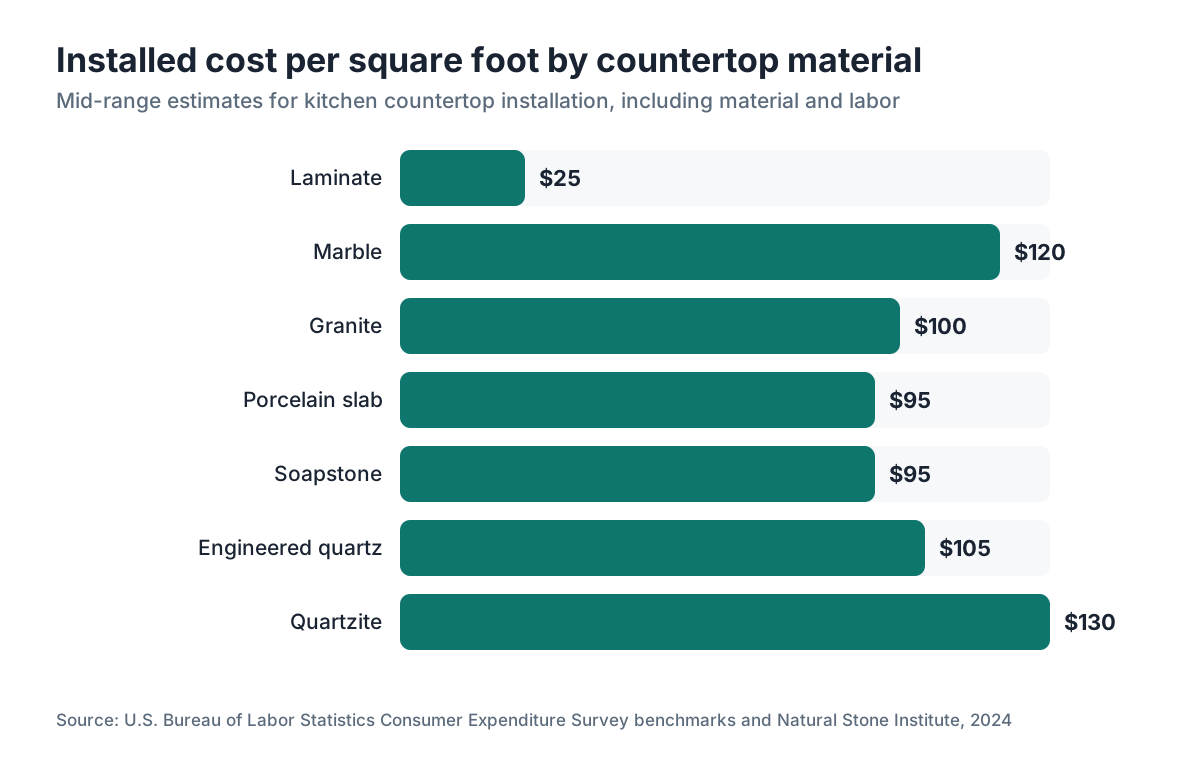
Here's how the main natural stones stack up on heat tolerance, upkeep, and typical installed cost for a kitchen [1][2][8].
| Stone | Max safe surface temp (general guidance) | Sealing needed | Typical installed cost per sq ft |
|---|---|---|---|
| Granite | ~480°F (250°C) brief contact | Yes, every 1-3 years | $50, $150 [2] |
| Soapstone | ~350°F+ (no resin binder to fail) | No (just oil) | $70, $120 [8] |
| Quartzite | ~480°F, similar to granite | Yes, every 1-2 years | $60, $200 [8] |
| Marble | ~350°F but etches from acids | Yes, every 6-12 months | $40, $200 [2] |
| Engineered quartz | ~150°F before resin risk | No | $55, $155 [2] |
| Porcelain slab | ~1200°F (fired ceramic) | No | $60, $130 [11] |
Granite is the most common answer to this question and it earns the reputation. It's a hard igneous rock, Mohs 6 to 7, and it won't scorch or discolor under a pan set down for a few seconds [1]. Soapstone is softer (Mohs 1 to 5, depending on talc content) but chemically inert: no resin, no epoxy fill, no composite matrix, so nothing can fail under heat. Quartzite (the natural stone, not engineered quartz) is a metamorphic rock that matches granite on hardness and heat.
Marble deserves a straight answer because it's beautiful and people want it near a range. Heat alone won't necessarily crack a well-fabricated marble slab in normal use. Acid is the problem. Tomato sauce, lemon juice, wine, anything acidic etches the calcite surface and leaves dull spots that don't come back without professional honing. A cooking zone is the worst spot in the house for marble.
Is engineered quartz safe near a stove?
Engineered quartz (Caesarstone, Silestone, Cambria, and the rest) is roughly 90 to 94 percent ground quartz bound with polymer resins and pigments [4]. The quartz itself is very hard and heat-resistant. The resin is not. Most manufacturers flatly warn against setting hot cookware directly on the surface, and several publish a maximum recommended temperature around 150°F (65°C) [4][5].
What happens above that line is gradual and sometimes permanent. The resin softens and micro-warps. Pigments bleach out, leaving a pale ring where a pot sat. In the worst cases, thermal shock from a cast iron pan straight off a high burner opens a hairline crack, usually near an edge or a cutout. Heat damage is rarely covered by warranty.
The spot next to a stove is exactly where this risk peaks. If you love a quartz color, it's a fine choice for most of the counter. Just put a different material as the landing zone right beside the range, or commit to trivets every single time. Some people pull that off for years. Others forget once. See cambria countertops for how one major brand handles heat in its warranty language.
One tell: if a fabricator says quartz is totally fine next to any stove with no caveats, get a second opinion.
What makes granite a good choice near a range?
Granite formed under punishing heat and pressure deep in the earth, so a hot skillet doesn't register as a threat [1]. Its crystalline structure spreads heat around instead of trapping it in one spot, which cuts down on thermal-stress cracking. At Mohs 6 to 7, it's also hard enough to laugh off the scratches of everyday cooking.
The one thing granite asks of you is periodic sealing. The stone is porous, and grease or cooking oil near a range will eventually soak into an unsealed surface and stain. Most granite needs resealing every one to three years, depending on density and use [2]. Dark stones like Absolute Black and Blue Pearl are usually denser and go longer between sealings. Lighter ones like White Ice or Colonial White can be thirsty and need it more often.
The water test tells you when. Drop a few tablespoons on the surface and watch. If the stone darkens within a couple of minutes, it's time to seal. If water still beads after 20 minutes, you're covered.
For how granite stacks up against other materials across the whole kitchen, see granite countertops.
Granite is also forgiving to fabricate. It cuts, polishes, and edges predictably. If you're running estimates on kitchen jobs with range cutouts or a cooktop island, SlabWise handles the cutout deductions and yield math for you, which matters when you're pricing a tight slab.
How does soapstone compare to granite near a cooktop?
Soapstone has one property that sets it apart from every other stone in a cooking context. It's thermally conductive and dimensionally stable under heat in a way that keeps cracking risk low. People have used it for wood stove surrounds and fireplace hearths for centuries for exactly that reason: it holds and moves heat without fracturing [8].
Near a range, soapstone won't discolor, won't react with cooking acids, and won't soak up water even without sealer. The routine is easy. Rub mineral oil into it every few weeks when it's new, then less often as it darkens evenly to its final patina.
Softness is the tradeoff. Soapstone scratches easily, knives mark it, and a dropped cast iron pan can leave a dent. Plenty of owners read the scratches as character, and light ones sand out, but if you want a surface that stays pristine for decades, soapstone isn't your stone.
For keeping it in shape over time, see how to clean soapstone countertops.
Soapstone is genuinely scarce. Most of it comes from quarries in Brazil, with a few in Virginia. Fabricators who don't handle it often underestimate how different it is to cut and polish next to granite. If you're set on soapstone, ask your fabricator point-blank whether they've done it before.
What about quartzite near a stove?
Quartzite is a metamorphic rock, born when sandstone gets cooked and squeezed until the quartz grains fuse. The result is one of the hardest countertop stones you can buy, often Mohs 7 or above [1]. It takes heat at least as well as granite.
Here's the confusion to sidestep. Quartzite and engineered quartz are not the same thing. Quartzite is natural stone, quarried and cut like granite. Engineered quartz is a manufactured composite. The names sit close enough together that the mix-up happens constantly in showrooms and on product sites.
Quartzite does need sealing because it's porous, sometimes more than granite. Some quartzites (Super White is the classic example) are very porous and want aggressive sealing schedules. If you're comparing specific slabs, ask the fabricator to run a water absorption test on the actual slab in front of you, not the generic stone type. Penn State Extension makes the same point: sealing schedules should ride on tested absorption of the specific slab, not the category [8].
Many quartzites carry a veined, marble-like look with the durability of a much harder stone. If you want marble looks next to a stove without marble's acid problem, a well-sealed quartzite is the honest answer. For cleaning, see how to clean quartzite countertops.
Can porcelain slab countertops handle stove heat?
Porcelain slabs are fired above 1200°C during manufacturing [6]. A hot pan is no threat at all. It won't stain, won't etch from acids, and never needs sealing. On raw heat resistance, porcelain beats every natural stone on this list.
Edges and seams are the catch. Porcelain slabs run thin (typically 6mm, 12mm, or 20mm) and get brittle at the edges compared to 3cm granite or quartzite [11]. A hard impact can chip that edge. Full-thickness 20mm slabs are tougher and take most standard edge profiles, but fabrication needs diamond tooling and someone who has worked the material before.
Cost lands near mid-range granite, and the color and pattern options have gotten much better. Large-format slabs mean fewer seams. If you want a truly no-maintenance surface next to a range and you'll stay mindful about edge impacts, porcelain is a real option that most countertop guides skip past.
What stones should you avoid next to a range?
Marble gets its own note here because the pull is so strong and the case against it in a cooking zone is real. Calcite-based stones (marble, travertine, limestone) etch the second they touch acid. A cooking zone throws acid at the counter constantly: citrus, tomatoes, wine, vinegar sauces. Etching isn't a stain you wipe away; it's a chemical change to the surface that needs professional honing to fix. The Natural Stone Institute recommends against marble for surfaces exposed to acidic foods [9]. Use it elsewhere if you love it. Keep it clear of the range.
Engineered quartz carries the resin-heat risk covered above. If it's already installed next to your stove, that doesn't mean it will fail, but steady trivet use stops being optional.
Laminate (Formica and its cousins) is flammable and will blister, scorch, and peel under heat. The CPSC flags counter areas next to ranges as a zone of raised fire and burn risk, which is reason enough to keep laminate out of direct contact with a range surround [10]. See laminate countertops and formica countertops for where these materials do fit.
Butcher block near a range is a popular look and not an automatic no, but wood chars, scorches, and holds bacteria in the cuts and burns near a cooking zone. If you want it in the kitchen, put it on an island or prep area away from the heat. Butcher block countertops has more.
Corian and similar solid surfaces soften around 120°F to 150°F and can warp or stain from hot cookware. A poor match for a stove landing zone. See corian countertops for the full picture.
Does the size of the gap between stove and counter change things?
Yes, and it matters. A standard freestanding range drops into a cutout with a narrow gap on each side, usually under an inch. The counter next to it catches radiant heat from the burners plus the occasional pan that overhangs the cooktop edge.
A slide-in or drop-in cooktop set into the counter changes the math. Now the counter surrounds the cooktop on three or four sides and can run much hotter, because it sits closer to the burner elements with no air gap from a range body. This is where quartz installations report heat damage most often.
Installing a drop-in cooktop makes the case for a more heat-tolerant stone right around the cutout much stronger. Some kitchen designers spec a different stone just for the surround, running a consistent-looking but tougher material (soapstone or a dark granite) there while keeping the preferred material everywhere else. NKBA design guidelines cover landing zone requirements and material picks near cooking appliances [7]. It's more work at install, but it's an honest fix.
For how cutouts affect slab pricing and structural support, see countertop installation.
What does heat damage to countertops actually look like?
On engineered quartz, the first sign is usually a white or pale ring, circular or oval, where a hot pot sat. The resin has bleached. It won't wipe off. Worse cases show surface crazing (tiny cracks in the finish) or a through-crack starting at a weak point.
On sealed natural stone, heat damage is rare from brief contact, but years of repeated thermal shock can open existing microfissures, which then trap stains and become visible. Watch for a hairline crack near a cutout corner, which is always a stress concentration point.
On marble, the damage near a range usually isn't thermal at all. It's etch marks from acidic cooking residue, dull matte spots against the polished surface. They're easy to write off as water spots at first.
On laminate, there's no mistaking it: bubbling, dark scorched patches, and edge lifting where the substrate swelled unevenly.
Sizing up a used kitchen or a house you might buy? Run your hand over the counter nearest the stove. Texture changes, dull patches, or seam gaps near the cooktop cutout all tell you what material is there and how it's aged.
How do you choose the best stone for your specific kitchen setup?
Start honest about how you cook. High-heat, everyday cooking with cast iron and carbon steel landing beside the burner is a different world from occasional light cooking. The harder you cook, the more weight heat resistance should carry in your choice.
Next, weigh your tolerance for upkeep. Granite and quartzite need periodic sealing. Soapstone needs periodic oiling and takes scratches in stride. Porcelain needs nothing but careful edges. If you want zero maintenance, porcelain is the honest answer. If you're fine with moderate upkeep and want a natural stone that ages well, granite or soapstone will run for decades.
Third, look at your whole kitchen countertops plan, more than the stove zone. Matching material throughout is the common move, but mixing is legitimate and sometimes the smartest option. A soapstone or dark granite landing zone beside the range with quartzite everywhere else reads as intentional, not patched, when the edge profiles match and the colors work together.
Fourth, ask about the actual slabs your fabricator has in stock. A specific granite slab might be denser and more heat-tolerant than a generic quartzite. Test the slab, not the category. Fabricators using estimating tools like SlabWise can show you yield and cost across material options fast, which lets you make the tradeoff with real numbers.
For general upkeep on whatever you land on, how to clean stone countertops covers the basics for most natural stone.
One honest recommendation. If you're stuck and can only pick one stone for the whole kitchen including the stove zone, pick granite. It's everywhere, durable, heat-tolerant, and has a long track record in real kitchens. Not the most glamorous answer. The most defensible one.
Frequently asked questions
Can you put a hot pan directly on granite near the stove?
Brief contact with a hot pan (up to a few hundred degrees) won't damage granite. The stone forms under intense geological heat and won't scorch or crack from a skillet. That said, thermal shock from repeated extreme swings can slowly widen microfissures over years, especially in a slab with heavy vein structure. A trivet is still a smart long-term habit, even with granite.
Will quartz countertops crack near a stove?
They can. Engineered quartz holds polymer resins that start to soften around 150°F (65°C). A cast iron pan pulled straight off a high burner and set on quartz can cause discoloration or surface crazing. Hairline cracks near cutout corners get reported too. Most quartz warranties exclude heat damage outright. The risk climbs with drop-in cooktops, where stone surrounds the burners on multiple sides.
Is soapstone or granite better next to a stove?
Both are excellent. Soapstone wins on heat conductivity and needs no sealing, but it scratches and dents more easily. Granite is harder, more scratch-resistant, and comes in far more colors, but wants sealing every one to three years. If you want fuss-free heat tolerance and like a matte, aged look, soapstone edges ahead. If you want color options and a harder surface, granite is the call.
What is the most heat-resistant countertop material overall?
Porcelain slab is technically the most heat-resistant countertop you can buy. It's fired above 1200°C, so no cooking pan touches its limit. After porcelain, granite and quartzite are the strongest natural-stone options. The tradeoff with porcelain is edge brittleness. For heavy-cooking kitchens, porcelain around a cooktop cutout paired with granite elsewhere is a reasonable high-performance combination.
Can marble countertops go next to a stove?
Marble can physically take brief heat without cracking in most cases, but it's a poor pick next to a stove for a different reason: acid etching. Cooking means constant exposure to acidic foods and splatter that chemically dull the surface, leaving permanent matte spots. Those need professional honing to fix. The cooking zone is the worst possible spot for a calcite-based stone. Keep marble away from the range.
How close to the stove does heat damage actually occur?
The highest-risk zone runs within about 12 inches of active burners, and worst directly beside and behind a drop-in cooktop where there's no air gap. Damage from brief incidental contact can happen anywhere a hot pan lands. With engineered quartz, even radiant heat from a pot on an adjacent burner can push the surface toward problem thresholds over time. Stone bordering a cooktop cutout is the most exposed spot.
Does countertop thickness affect heat resistance near a stove?
Somewhat. A thicker slab (3cm versus 2cm) has more thermal mass and spreads heat more evenly, which slightly eases stress concentration. Thickness matters more for structural support around cutouts than for heat resistance itself. The material's own properties matter more. A thin 12mm porcelain slab is more heat-resistant than a thick 3cm quartz slab. Thickness won't make up for a weak resin binder.
What edge profile is best for countertops near a range?
Eased or slightly beveled edges are the most practical near a stove. Sharp square edges chip more readily when cookware hits them, and ornate ogee or dupont profiles trap grease and food residue that's harder to clean near a cooking zone. A simple eased or full bullnose edge wipes down easily, resists impact chipping, and still looks clean. This holds regardless of which stone you choose.
Does sealing granite protect it from heat damage?
No. Sealer protects granite from liquid absorption and staining. It does nothing for heat resistance. The stone handles heat; the sealer handles porosity. If you're worried about a hot pan on granite, a trivet is the answer, not sealer. Keeping granite sealed near a stove still matters, because cooking grease and oils will soak into an unsealed surface and stain it over time.
Is quartzite the same as quartz countertops?
No, they're completely different. Quartzite is a natural metamorphic stone quarried from the earth, made much like granite. It's very hard (Mohs 7+) and heat-tolerant. Engineered quartz is a manufactured composite of ground quartz crystals bound with polymer resins. The resin makes engineered quartz vulnerable to heat. The similar names cause constant showroom confusion. Always confirm which one you're actually looking at.
How much more does a heat-resistant stone cost compared to laminate near a stove?
Laminate runs roughly $10 to $40 per square foot installed. Granite runs $50 to $150 installed, soapstone $70 to $120, and quartzite $60 to $200 depending on material and region. Porcelain slab lands around $60 to $130. The premium for natural stone over laminate near a stove is real, but laminate blisters and scorches, which makes it a poor pick for that specific zone no matter what you save.
Can you mix two different stones in the same kitchen?
Yes, and near a stove it can be the smartest move. Running soapstone or dark granite just for the cooktop surround while using quartzite or a lighter granite everywhere else is a legitimate design choice. The trick is matching edge profiles across materials so the transition looks intentional. Bring it up with your fabricator before the template visit so they can plan seam placement and material quantities right.
Do I need to tell my fabricator where my stove is before ordering stone?
Absolutely. Your fabricator needs to know where cooktop cutouts fall on each slab, where seams land relative to the heat source, and whether you're doing a drop-in cooktop or a freestanding range. Seams that land right beside a cooktop cutout are a stress point. A good fabricator positions seams away from those zones and can flag a slab with a fissure or vein running through a high-stress area.
Sources
- USGS Minerals Information: Stone, Crushed and Dimension: Granite is a hard igneous rock with Mohs hardness of 6-7; quartzite is a metamorphic rock with hardness at or above 7.
- U.S. Bureau of Labor Statistics: Consumer Expenditure Survey (home improvement benchmarks): Installed countertop costs range from approximately $40-$200 per square foot for natural stone and $55-$155 for engineered quartz, varying by region and material.
- Caesarstone: Care and Maintenance Guidance: Engineered quartz is roughly 90-94 percent ground quartz bound with polymer resins and pigments; manufacturers warn against placing hot cookware directly on the surface.
- Silestone by Cosentino: Product Care Instructions: Silestone advises using trivets and hot pads, noting that high temperature exposure can damage the quartz surface and is not covered under warranty.
- American Ceramic Society: Porcelain Tile Manufacturing Overview: Porcelain is fired at temperatures exceeding 1200°C, producing a vitrified surface with very low porosity and high thermal resistance.
- NKBA (National Kitchen and Bath Association): Kitchen Design Guidelines: NKBA design guidelines address landing zone requirements adjacent to cooking appliances and material selection considerations for countertops near heat sources.
- Penn State Extension: Natural Stone Selection for Home Construction: Natural stone countertop porosity varies significantly by stone type and individual slab; sealing schedules should be based on actual absorption testing of the specific slab.
- Natural Stone Institute (formerly Marble Institute of America): Stone Comparison Guide: Marble and other calcite-based stones etch on contact with acidic substances; the Natural Stone Institute recommends against marble for surfaces exposed to acidic foods.
- CPSC (U.S. Consumer Product Safety Commission): Kitchen Safety: The CPSC identifies countertop areas adjacent to ranges as a zone of elevated fire and burn risk, relevant to material flammability and heat resistance considerations.
- Tile Council of North America: Large Format Porcelain Slab Installation Guidelines: Porcelain slabs are available in 6mm, 12mm, and 20mm thicknesses; edge fragility increases at thinner profiles and requires diamond tooling for fabrication.
Last updated 2026-07-11