TL;DR
- Laminate countertops cost roughly $15 to $40 per square foot installed, depending on grade and edge profile.
- They're the cheapest countertop you can buy and far easier to DIY than stone.
- Modern high-pressure laminate (HPL) looks dramatically better than it did 20 years ago.
- The tradeoffs are real: they scratch, they can't take a hot pan, and once damaged they're hard to fix.
What are laminate countertops, exactly?
Laminate countertops are a thin decorative layer, typically 0.028 to 0.048 inches thick, bonded to a particleboard or MDF core with heat and pressure. The decorative layer is a printed paper or resin film under a clear wear layer. That whole sandwich is what the industry calls high-pressure laminate, or HPL.
Most people know it as Formica, a brand name that went generic the way Kleenex did. Wilsonart is the other big name in North America. Both make HPL sheets that fabricators bond to a substrate, then trim, route, and edge into finished countertop sections [9].
The substrate matters more than most people realize. Particleboard is cheaper and more common. Moisture-resistant MDF costs a little more and holds up better near sinks. Premium products use a thicker core and sometimes add a backer sheet underneath to stop warping. Buy pre-made sections at a home center and the substrate is almost certainly standard particleboard, which is fine for most kitchens as long as water never pools at the seams.
High-pressure laminate is a different animal from low-pressure laminate (LPL), the stuff on flat-pack furniture. LPL is thinner, softer, and not built for countertop duty. Say "laminate countertop" and you mean HPL every time.
How much do laminate countertops cost?
Installed, laminate countertops run $15 to $40 per square foot in 2024 [2]. Raw HPL sheet goods sell for $1.50 to $3.50 per square foot, but that number misleads homeowners, because you're buying finished sections, not bare sheet. Here's the real breakdown.
| Scenario | Typical cost per sq ft |
|---|---|
| Post-form (pre-made, home center) | $15, $22 installed |
| Custom flat-lay laminate, standard edge | $22, $32 installed |
| Custom laminate, decorative edge (ogee, bevel) | $28, $40 installed |
| DIY install (materials only) | $8, $18 |
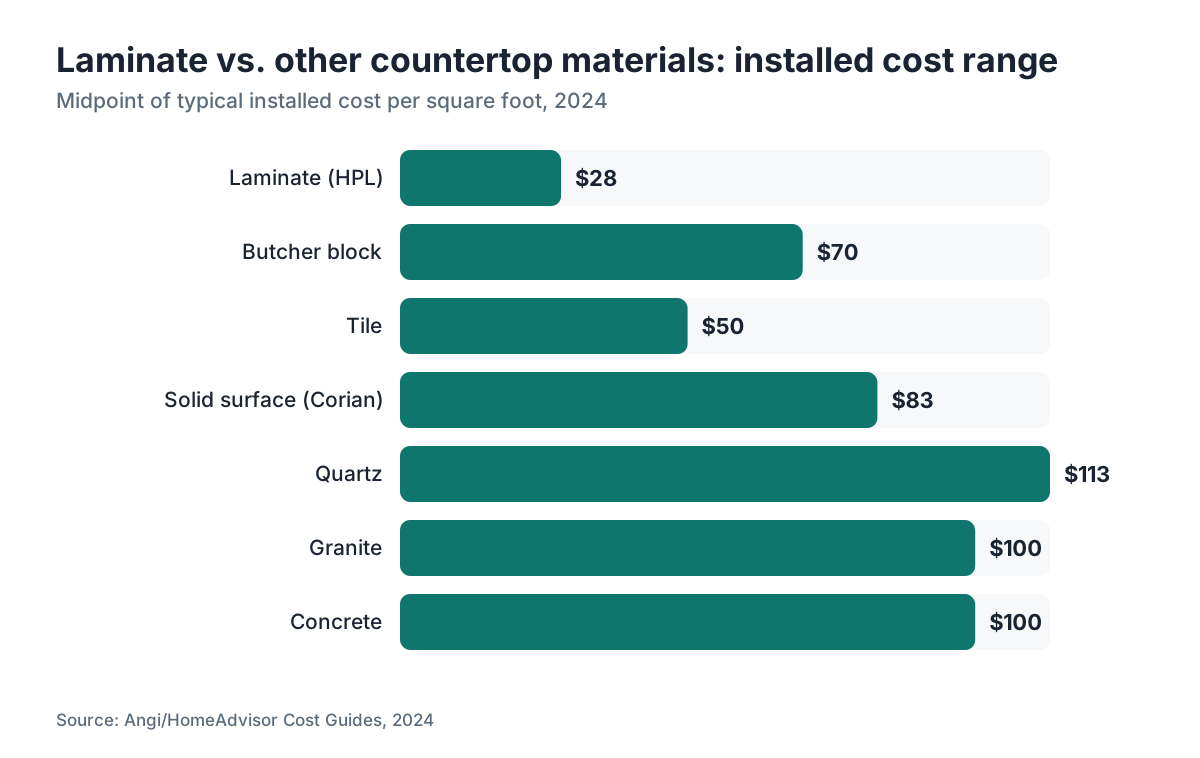
A standard 30-square-foot kitchen (one average run of base cabinets plus a small island) lands around $450 to $1,200 installed. That's the figure most homeowners see on the estimate. Quartz runs $75 to $150 per square foot installed and granite runs $60 to $140, which is exactly why laminate still holds a real slice of the market [3].
Labor usually runs $30 to $60 per linear foot for a basic install, or $200 to $400 flat for a small kitchen. Few contractors take a job under a half-day minimum, so expect a floor of $150 to $250 no matter how little square footage you have.
What pushes the cost up: cutouts for sinks and cooktops ($50 to $100 each), mitered outside corners, and any fancy edge profile. Post-form countertops, the rolled-edge prefab sections at Home Depot and Lowe's, come in cheapest because the edge is formed into the laminate at the factory with no separate banding to apply.
Nobody has clean national data here. The ranges above come from contractor cost databases and industry guides, and your market will move them. Rural areas often run 10 to 20 percent under major metros [2].
How does laminate compare to other countertop materials?
Laminate wins on cost, full stop. Nothing else gets near it at the low end. And cost is the only category where it leads.
| Material | Installed cost/sq ft | Heat resistance | Scratch resistance | Repair ease |
|---|---|---|---|---|
| Laminate (HPL) | $15, $40 | Poor | Fair | Poor |
| Butcher block | $40, $100 | Fair | Fair | Good (can sand) |
| Tile | $20, $80 | Excellent | Excellent | Moderate |
| Corian/solid surface | $45, $120 | Poor | Good | Good (can sand) |
| Quartz | $75, $150 | Poor, Fair | Excellent | Poor |
| Granite | $60, $140 | Excellent | Excellent | Moderate |
| Concrete | $65, $135 | Excellent | Moderate | Moderate |
Here's the honest read. Laminate is disposable in a way stone isn't. A chip in a quartz top is a headache. A chip in a laminate top is a $400 replacement job you'll deal with in a decade. For rentals, budget kitchens, and anyone planning to remodel again in 10 to 15 years, that math actually works in your favor.
Where laminate loses is heat and moisture. Set a hot pan straight on it and the surface blisters in seconds. No undo. Let water sit at a seam and the particleboard swells, then the laminate lifts. These aren't rare corner cases. They're the two ways laminate dies most often. If hot pans travel across your counter as a matter of habit, laminate is the wrong call.
What are the different types and grades of laminate countertops?
Post-form countertops are the pre-made sections sold at home improvement stores. They come in standard 25.5-inch depths and 96-inch lengths, with the coved backsplash and rounded front edge all molded in one piece. Fast to install, cheap to buy. The design catalog is thin, and you can't do fancy corners or custom depths.
Custom flat-lay laminate opens up any size, any pattern in the full manufacturer catalog, and your pick of edge profile. A fabricator glues HPL sheet to a substrate, then routes and edges it to your exact dimensions. Turnaround usually runs two to four weeks.
Thick laminate (1.5mm and up) is worth asking about if you're going custom. Standard sheet laminate is 0.028 inches, about 0.7mm. Thicker laminate resists edge chipping better and feels more solid under your hand. Wilsonart HD and Formica's premium lines both run closer to 1.5mm [9].
Texture and finish drive durability more than people expect. High-gloss finishes show scratches faster than matte or textured ones. A matte or satin finish in a mid-tone color is the most forgiving pick for a working kitchen. Very dark laminate in gloss will flag every water spot and fingerprint.
The newest laminate copies stone through embossed surface patterns. Formica's 180fx and Wilsonart's stone-look lines use large-format photographic printing plus embossing to fake the depth of real slab [9]. They're genuinely convincing up close. Tap one and it still sounds like laminate, but almost no guest is checking from three feet away.
How do you install laminate countertops yourself?
DIY laminate is one of the friendlier home projects out there. A careful first-timer can knock out a single-run kitchen in a day. Here's the honest walk-through.
Post-form install (prefab sections)
For post-form sections from a home center, the sequence is: measure, cut to length, fasten from below, caulk the backsplash. Most of the difficulty lives in the measuring and cutting.
- Measure your cabinet run precisely. Account for out-of-square walls. If the wall isn't straight, you'll scribe (trim) the backsplash to fit.
- Cut the post-form to length with a circular saw and a fine-tooth blade. Cut with the finished face down to keep chipping on the back, or use a dedicated laminate blade.
- For inside corners, cut the miter with a saw and apply a corner joint kit. It comes with a bolt system that pulls the two sections tight.
- Set the countertop on the cabinets. Shim if the cabinets aren't level. The top should be dead level even when the boxes aren't.
- Fasten from below through the corner brackets inside the cabinet carcasses. Screws go up into the substrate, never down through the surface. Use 1.25-inch screws. Longer ones punch through the top.
- Caulk the joint between backsplash and wall with paintable latex caulk.
Sink cutout: doing an undermount? Stop. Laminate doesn't support a true undermount. Drop-in sinks are the play. Cut with a jigsaw and a laminate blade, stay just inside your template line, and file to fit.
Custom flat-lay install
Custom sections show up pre-fabricated. Your job is to set them, fasten them, and caulk the seams. The fabricator should have cut every opening already. In most ways this beats post-form, because the hard cutting is done [4].
Knowing how to install countertops in general gets you most of the way, but laminate has a few wrinkles stone installs don't share, mainly seam joining and scribe fitting.
Tool list: tape measure, circular saw with a fine-tooth or laminate blade, jigsaw, drill/driver, belt sander (for scribing), silicone or contact cement (for seam edges), caulk gun. Budget $50 to $100 for tools if you're starting from nothing.
What tools and materials do you actually need to install laminate countertops?
The install is genuinely DIY-friendly, but a handful of specific tools decide whether you get a clean result or a fight. For post-form or custom pre-fab sections you need a circular saw with a carbide laminate blade (60-tooth or higher), a jigsaw with a fine-tooth blade for cutouts, a drill/driver, a scribing compass, a belt sander or hand file for scribe fitting, silicone caulk, corner bolt kits for inside corners, and a tape measure you trust.
Contact cement is the adhesive for bonding raw laminate sheet to substrate in a shop. You don't usually need it to set pre-made sections. Where adhesive earns its keep is the seam faces: a thin bead of color-matched silicone or manufacturer seam filler holds the joint tight and keeps water out.
A router with a laminate trimming bit is essential for custom sheet work and pointless for post-form or finished custom sections. Buying a router just for this project? Weigh it against a local fabricator's install charge, which may be the smarter use of $150.
Buy the laminate blade. It's the tool people skip and regret. A standard wood blade shreds the surface. A 60-tooth carbide or a blade labeled for laminate/melamine costs $15 to $30 and pays for itself on the first cut [4].
How do you handle seams, sink cutouts, and backsplash when installing laminate?
Seams are laminate's biggest visual weakness. Sheets max out around 96 to 144 inches, so any kitchen longer than about 10 feet gets at least one seam. There's no dodging it. The job is to make that seam tight, aligned, and sealed against water.
Placement matters. Never park a seam over a dishwasher or directly over a cabinet door gap if you can help it. Over a solid base gives the joint real support. Draw bolts (miter bolts) pull the two sections together from below. Use them at every seam, roughly every 18 inches.
Run color-matched seam filler on the joint face before you close it. Most manufacturers sell a dedicated paste. It's more than cosmetic. It seals the raw substrate edge against water.
Sink cutouts for drop-in sinks: the template ships with the sink. Drill a starter hole just inside the line, drop in your jigsaw blade, and cut slow. Lay a bead of silicone under the sink rim before you set it. That bead is what actually waterproofs the connection.
Backsplash options: the coved post-form backsplash is built in. For flat-lay custom, you pick between a separate laminate backsplash panel, tile, or paint. A 4-inch laminate backsplash bonded to the wall is the easiest waterproofing move and matches the counter exactly. Full tile runs on its own schedule and looks great, but it costs more and takes longer.
How long do laminate countertops last, and what wears them out?
Laminate countertops last 10 to 20 years in a normal kitchen, according to the National Association of Home Builders study of home component life expectancy [5]. The wear layer itself is fairly hard, rated in cycles of abrasion resistance. Wilsonart and Formica publish those numbers; premium lines run 400 to 900 Taber cycles, which means nothing on its own but lets you compare products inside one brand.
What actually kills laminate early:
Heat. Fast and permanent. The wear layer is thermoplastic resin. A hot pan or slow cooker straight on the surface bubbles or yellows it in seconds. Trivets aren't optional on laminate. They're required equipment.
Moisture at seams and cutouts. Once water gets under the laminate and into the particleboard, the core swells and the laminate delaminates. You'll usually see it within a year or two of it starting. Keeping the caulk lines intact at the backsplash and sink is the single most useful thing you can do.
Knife scratches. Laminate doesn't have quartz or granite hardness. Cut on it directly and you leave marks. Not structural, but permanent and ugly.
The upside: laminate is replaceable without a full kitchen renovation. Worn out? You pull the old sections off the cabinets, set new ones, and re-caulk. The boxes stay put. That swap-ability is a real part of the honest case for laminate in a budget kitchen.
What are the most common laminate countertop problems and can you fix them?
Peeling edges and delamination: if the laminate is lifting at an edge or seam, you can sometimes press it back with contact cement and a roller, then weight it with books while it cures. Clean both surfaces first. This works best on small lifts caught early. Large areas over swollen substrate won't ever sit flat again.
Burns and blisters: not fixable in any honest sense. Laminate repair paste in matched colors fills chips and small burns cosmetically, but you'll always spot the repair up close. On real burn damage, replacement is the only clean answer.
Edge chips: chips on post-form edges are hard to hide. Repair kits (seam paste or putty from the hardware store) fill the void and cut the visibility, but they won't bring back the original look. Matching paste pressed in and sanded flush gets you to maybe 70 percent on a good day.
Scratches: shallow surface scratches fade a little with a mild abrasive cleaner. Deep scratches into the substrate are permanent.
Swollen substrate: once the particleboard soaks up water and swells, the whole section needs replacing. You can't un-swell a core.
The honest takeaway: laminate isn't a repairable material the way butcher block is. Butcher block sands and refinishes. Solid surface buffs out. Laminate you live with or replace. Let that shape your material choice going in.
How do you clean and maintain laminate countertops?
Day-to-day cleaning is easy. Mild dish soap, water, a soft cloth or sponge. Rinse and dry. That covers 90 percent of spills, and it's the whole program.
What to skip: abrasive cleaners like Comet or Bar Keepers Friend scratch the wear layer over time. Bleach cleaners can discolor some finishes with repeated use. Stay off scrubby pads with any grit. And don't leave standing water at the seams.
For stubborn stains, Wilsonart's care guidance points to a paste of baking soda and water; let it sit, then wipe clean [9]. Acetone (nail polish remover) lifts many adhesive-based stains, but rinse it off right away and use it sparingly, since repeated use softens the wear layer.
What laminate never needs: no sealing, no oiling, no resealing, no annual treatments. Set it against the maintenance calendar for marble or other natural stone and laminate looks lazy in the best way. Natural stone including marble and granite needs periodic resealing, typically once a year or more depending on how porous the stone is, per the Natural Stone Institute [6]. Laminate needs nothing past cleaning.
One practical rule: keep a trivet and a cutting board in the kitchen. Not as accessories. As required gear. Treat laminate as a work surface that needs those two protections and it'll hit the full 15 to 20 year window without drama.
Is laminate a good idea for your kitchen, or should you spend more?
Here's an honest framework. Laminate makes sense in four cases: your remodel budget is genuinely tight and you'd rather have a working kitchen now than wait; you plan to gut and renovate again in 10 to 15 years anyway; you're outfitting a rental where substrate durability beats aesthetics; or you're a careful cook who reaches for trivets and cutting boards every time without thinking.
It stops making sense when you cook hard and hot pans live near the counter, when you want a resale-boosting renovation (stone and quartz score higher in buyer surveys), or when you want a surface you can repair instead of replace.
The middle ground is real. High-end laminate in 2024, like Formica's 180fx or Wilsonart's HD gloss lines, runs $28 to $38 installed and genuinely fools casual observers [9]. Set that against entry-level quartz at $75 to $90 installed and the appearance gap has shrunk a lot. The heat and scratch gap hasn't budged.
For fabricators quoting jobs, laminate carries solid margins on post-form and trim work because the labor is simple and material waste is low. If you track job profitability by material type, laminate's short fabrication time per linear foot makes it a category worth keeping even at lower ticket prices. Shops using quoting tools like SlabWise can template laminate jobs right alongside stone quotes without a separate workflow, which saves real time on mixed-material kitchens.
The material choice for a kitchen countertop project comes down to budget, lifestyle, and how long you plan to stay. Laminate isn't a compromise you apologize for. It's a deliberate choice that works well under the right conditions.
What do fabricators need to know about laminate countertop production?
Shop-level laminate work differs from stone in a few key ways. Sheet goods arrive in 4x8 and 5x12 formats [7]. Contact cement bonding demands a clean, dry substrate, full adhesive coverage on both faces, and dead-on alignment the moment surfaces touch, because contact cement grabs instantly and does not let you slide.
Edge treatments on custom flat-lay run from simple self-edge (a matching laminate strip on the edge face) to wood or PVC banding to post-formed profiles. Bearing-guided router bits handle the trim. The recurring quality problems are bubbling from bad cement application, edge chipping from dull bits, and visible seam lines from misaligned joins.
Nesting laminate sheet across multiple simultaneous jobs takes the same cutlist optimization you'd apply to stone. Panel yield on a 5x12 sheet swings hard on job sizing. A cabinet shop running volume laminate can bleed real material dollars from poor yield when jobs aren't laid out carefully across sheets [7].
Turnaround on custom laminate is typically one to three days for fabrication, plus scheduling. That's much faster than stone, which matters when a customer is on a tight remodel clock.
For homeowners: getting a custom laminate quote? Ask three questions. What substrate (particleboard or moisture-resistant MDF)? What adhesive system? Do they apply a backer sheet? Those answers separate a 10-year counter from a 20-year one.
Frequently asked questions
How much are countertops in general?
Countertop cost swings hard by material. Laminate runs $15 to $40 per square foot installed. Tile and butcher block start around $20 to $40. Solid surface like Corian is $45 to $120. Quartz is $75 to $150. Granite runs $60 to $140. Marble starts around $75 and climbs past $200 for premium stone. A typical 30-square-foot kitchen counter costs $450 to $1,200 in laminate, or $2,250 to $4,500 in quartz.
Can you install laminate countertops yourself?
Yes. For post-form prefab sections, DIY is genuinely doable. You need a circular saw with a fine-tooth blade, a drill/driver, and solid measuring skills. A single-run kitchen takes most first-timers about a day. Custom flat-lay sections arrive pre-fabricated and are even easier to set. The tricky parts are scribing to an out-of-square wall and getting seam joints tight. Neither is impossible, but both need patience and the right tools.
How long does it take to install laminate countertops?
A pro usually finishes a standard kitchen in two to four hours. A careful DIYer should budget a full day for a first install: a few hours to measure, cut, and fit, then more time for caulking and cleanup. Multiple inside corners, sink cutouts, or an out-of-square room add time. Custom sections cut to size ahead of time go faster than post-form sections you're trimming yourself.
Do laminate countertops look cheap?
Older laminate often did. Modern high-pressure laminate from Formica and Wilsonart uses large-format photographic printing and embossed textures that convincingly copy stone. Up close, the surface lacks the depth of real granite or quartz. From normal kitchen distance, the difference is much harder to catch. A matte or satin finish helps a lot, since gloss laminate reads more synthetic to most eyes.
What is the best laminate countertop brand?
Formica and Wilsonart are the two dominant HPL makers in North America, and both build quality products. Formica's 180fx and Wilsonart's HD lines are the premium tiers, with more realistic stone visuals and thicker wear layers. Prefinished home-center sections are typically either brand's laminate bonded to particleboard by regional fabricators. For custom work, ask your fabricator which brand they stock and whether they can order a specific pattern.
Can laminate countertops be painted?
Yes, with the right prep. Sand with 220-grit to scuff the surface, clean it thoroughly, prime with a bonding primer made for slick surfaces, then paint with a durable enamel or chalk finish. Results vary. Painted laminate scratches and chips faster than the original surface. It's a real option for a tight budget or a stopgap, but expect to repaint every few years in a heavy-use kitchen.
Can you put an undermount sink with laminate countertops?
No, not reliably. Undermount sinks need the cutout edge sealed and structural, because water runs over it constantly. Laminate over particleboard can't take that steady moisture; the substrate swells and the laminate delaminates. Drop-in (self-rimming) sinks work well with laminate because the rim covers the cutout edge. Want an undermount? Use solid surface, quartz, granite, or another waterproof material.
How do you get rid of scratches on laminate countertops?
Shallow surface scratches buff down a little with a baking soda and water paste or a mild automotive scratch compound. That reduces visibility but won't erase deep scratches. For chips or gouges, color-matched laminate repair paste (hardware stores and manufacturers sell it) fills the void and blends reasonably. The honest answer: laminate scratches don't vanish. You can make them less noticeable, but true repair isn't on the table the way it is with butcher block or solid surface.
How do you cut laminate countertops without chipping?
Two techniques. First, use a fine-tooth carbide blade (60-tooth or higher, labeled for laminate or melamine) in a circular saw, and cut with the finished face down so any tear-out lands on the back. Second, score the cut line several times with a utility knife before cutting to give the blade a clean break line. For jigsaw cuts, use a down-cut blade so chipping stays on the back face. Go slow and let the blade work.
How do you remove laminate countertops?
Pull the sink and disconnect the plumbing first. Cut the caulk line at the backsplash with a utility knife. Open the cabinet doors, find the screws or staples holding the top from below, and remove them all. The top should lift with a firm upward pull. If it sticks, caulk or adhesive is still holding. Run a putty knife along the backsplash line and hit any contact cement with a heat gun to soften it.
Is laminate better than tile for kitchen countertops?
They trade off differently. Tile is far more heat-resistant, and individual tiles are replaceable if one cracks. Laminate has no grout lines, so it cleans easier and keeps moisture off the substrate. Tile cost overlaps with laminate but can run much higher with premium ceramic or stone. For a practical kitchen you want to wipe down fast, laminate often wins. For a cook who wants durability and doesn't mind grout upkeep, tile is real competition.
Do laminate countertops increase home value?
Not much, and that's worth saying plainly. Buyer surveys and real estate research consistently show stone countertops (granite, quartz) as stronger value drivers in a kitchen remodel than laminate. Remodeling Magazine's 2023 Cost vs. Value report notes that mid-range kitchen remodels, which typically include laminate, recoup around 85 percent of cost at resale, while upscale remodels with stone recoup less in raw dollars but score higher on buyer perception [8].
What is the price to install laminate countertops professionally?
Professional laminate install typically runs $30 to $60 per linear foot, or $150 to $400 flat for a standard small kitchen. Most installers charge a minimum regardless of job size. The full installed cost with materials is $15 to $40 per square foot, depending on whether you pick post-form (cheaper) or custom flat-lay with edge work (higher). Sink cutouts add $50 to $100 each. Get three quotes; laminate pricing varies more by market than stone does.
Sources
- Wilsonart LLC, Care and Maintenance Guide for High Pressure Laminate: Wilsonart HPL construction, wear layer specifications, and recommended cleaning agents including baking soda paste for stubborn marks
- HomeAdvisor (Angi), Laminate Countertop Cost Guide 2024: Installed laminate countertop cost range of $15 to $40 per square foot nationally, with labor at $30 to $60 per linear foot
- HomeAdvisor (Angi), Countertop Installation Cost Guide 2024: Quartz countertops installed at $75 to $150 per square foot; granite at $60 to $140 per square foot
- This Old House, How to Install a Laminate Countertop: Recommended blade specifications (60-tooth carbide) and technique for cutting laminate without chipping; fastening sequence from below
- National Association of Home Builders (NAHB), Study of Life Expectancy of Home Components 2021: Laminate countertop expected service life of 10 to 20 years under normal residential use conditions
- Natural Stone Institute, Natural Stone Care and Maintenance guidance: Natural stone countertops including marble and granite require periodic resealing, typically annually or more frequently depending on stone porosity
- USDA Forest Products Laboratory, Wood Handbook and panel products reference: Standard HPL sheet panel sizes (4x8 and 5x12 feet) and particleboard substrate properties relevant to fabrication yield
- Remodeling Magazine, 2023 Cost vs. Value Report: Mid-range kitchen remodels recoup approximately 85 percent of cost at resale; upscale remodels with stone countertops score higher in buyer perception metrics
- Formica Corporation, Product and Technical Data: Formica 180fx large-format printing and HPL sheet specifications; brand history as generic name for high-pressure laminate category
- U.S. Department of Housing and Urban Development (HUD), main site: Countertop material standards and moisture-resistant substrate requirements for residential kitchen applications
Last updated 2026-07-09