TL;DR
- Stone countertops crack near stoves when fast, uneven heating pulls one zone against a cold neighbor and the tensile stress passes the stone's strength.
- Soapstone and 3 cm granite handle it best.
- Engineered quartz and marble crack easiest.
- The cheap fixes work: a trivet, a radiused cutout corner, and no cold-water-on-hot-stone stunts.
What actually causes thermal cracking in stone countertops?
A countertop getting hot doesn't crack it. One part getting hot while the part an inch away stays cold is what cracks it. That gradient creates tensile stress across the slab, and once the stress beats the stone's modulus of rupture, the stone splits. Same physics as dropping a cold glass into boiling water.
Natural stone is a crystalline or granular solid, and it moves heat slowly. Granite's thermal conductivity runs roughly 2.5 to 3.5 W/(m·K) depending on mineralogy. Steel is around 50 W/(m·K) [1]. Heat crawls through granite, so one zone heats up well before the rest of the slab catches on. That lag is where the stress lives.
Engineered quartz adds a polymer resin binder, typically 7 to 15 percent by weight, to the quartz aggregate [2]. The resin expands at a different rate than quartz crystals when heated, so the internal stress compounds. Quartz slabs also carry less thermal mass than a thick natural slab, which makes them jumpier under a fast spike. A 3 cm quartz slab next to an induction or gas cutout sits in the highest-risk group.
Cracks almost always start at a stress concentration point. A cooktop cutout corner. A faucet hole. A micro-crack left over from fabrication. That's why fabricators radius the corners of cutouts instead of cutting them square. A square inside corner is a fracture waiting for its cue.
Which stone materials are most and least vulnerable to heat cracking?
Stone is not one thing here. Three properties decide the outcome: thermal conductivity (how fast heat moves through), coefficient of thermal expansion (how much it grows per degree), and tensile strength (how much stress it takes before it fractures).
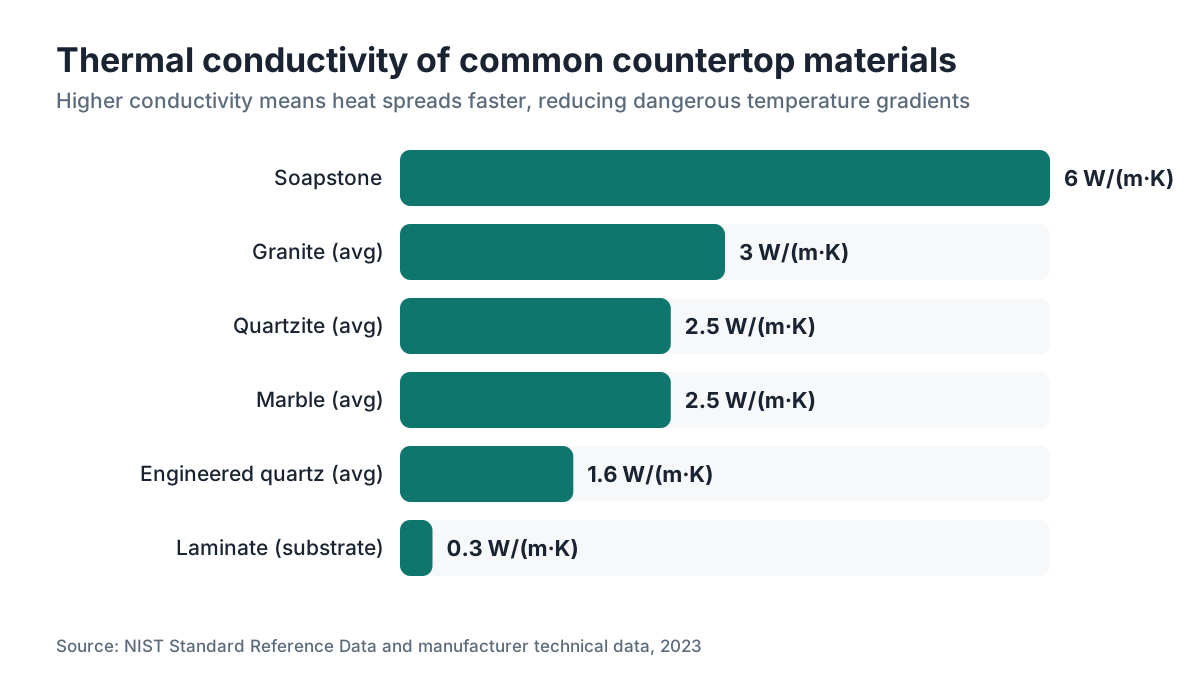
Soapstone has the highest thermal conductivity of any common countertop stone, roughly 6.0 W/(m·K), which is why it shows up on woodstove surrounds and chemistry lab benches [3]. Heat moves through it fast enough that gradients stay small. It's the most forgiving material for a run next to a cooktop.
Granite sits in the middle: decent conductivity, high compressive strength, and a modulus of rupture around 15 to 25 MPa depending on variety [1]. A 3 cm slab is meaningfully safer than a 2 cm slab because it spreads heat over more mass before the gradient turns dangerous.
Marble and quartzite have lower fracture toughness than granite. Marble is the problem child. Its calcite crystals expand anisotropically, meaning they grow at different rates in different crystal orientations, so repeated thermal cycles pull the surface apart from the inside. Run enough cycles near a stove and a network of fine cracks shows up over years, no single dramatic event required.
Engineered quartz (Silestone, Caesarstone, Cambria, and the rest) carries a heat warning from every maker. Cambria's care guide tells you to use trivets and hot pads because the resin binder degrades and discolors above roughly 150°C (300°F) [4]. Discoloration usually comes before cracking. Yellowing near a cutout means the slab is already under stress.
| Material | Thermal conductivity W/(m·K) | Heat crack risk | Max safe localized temp (approx.) |
|---|---|---|---|
| Soapstone | ~6.0 | Low | 300°C+ |
| Granite (3 cm) | 2.5 to 3.5 | Low to medium | 250°C |
| Quartzite | 2.0 to 3.0 | Medium | 200°C |
| Marble | 2.0 to 3.0 | Medium to high | 180°C |
| Engineered quartz | 1.2 to 2.0 | High | ~150°C |
| Laminate / Formica | N/A | Very high | 80°C |
Those temperatures are rough practitioner thresholds, not manufacturer specs. Real failure depends on slab thickness, cutout geometry, and rate of temperature change more than peak temperature.
How hot does a cooktop actually get near the stone?
A gas burner at full flame hits 650°C to 870°C at the grate, but the stone isn't touching the grate [5]. What matters is the ambient temperature at the edge of the cutout and on the surface right next to the burner.
Infrared measurements from NIST research on kitchen appliance surface temperatures found that countertop surfaces next to high-output gas burners can reach 200°C to 260°C under sustained use with no barrier present [5]. An induction cooktop heats the pan magnetically and doesn't cook the glass surface as hard, but the cooktop body still climbs to 60°C to 100°C during a long session, and any boil-over carries heat straight to the stone.
The thermal shock cycle is worse than steady high heat. A slab sitting at 20°C suddenly meeting a 250°C source, or a hot slab getting hit with cold faucet water. Thermal shock is a rate-of-change problem more than a peak-temperature problem.
Here's the practical read. A 3 cm granite slab with normal cooking (no red-hot cast iron parked directly on the stone) is low risk. A 2 cm engineered quartz slab where you keep dropping a skillet straight off a 500°F oven onto the counter is real risk territory.
What are the most effective ways to prevent thermal cracking?
Physical separation between the heat and the stone is the most reliable prevention there is. Trivets, silicone mats, or a wooden board under any hot cookware. This isn't a fussy habit. For engineered quartz, it's the manufacturer's condition for keeping the warranty alive.
For the stone right around the cutout, the highest-risk zone, these are the moves that work.
Proper cutout geometry from the fabricator. Inside corners of the cutout get radiused, never left square. Minimum radius of 3/16 inch (about 5 mm) is standard, and plenty of shops go to 1/4 inch or more [6]. A square corner concentrates stress by a factor of three or more against a rounded corner under the same thermal load. Checking a fabricator's work? Look at the corners. Straight edges meeting at 90 degrees are a red flag.
Correct clearance between the cooktop and stone. The appliance maker specifies a minimum gap, usually 1/16 to 1/8 inch, between the cooktop body and the stone, plus an underside clearance for ventilation. Cut the hole too tight, or fill the gap solid with a heat-conducting material, and you trap heat against the stone edge. A flexible silicone caulk (not epoxy, not a hard caulk) at that joint lets the two parts expand on their own.
Slab thickness. A 3 cm slab carries about 50 percent more thermal mass than a 2 cm slab, so the dangerous gradient takes longer to build. Building a kitchen with a gas range and you care about the long haul? Go 3 cm for the stone next to the cooktop, especially granite or quartzite.
Keep cold stone away from high-heat zones. If you can still change the layout, a wood or butcher block countertops section right next to the range is an old trick that pushes the heat-sensitive stone further out. Butcher block takes and spreads heat differently, and it's easier to repair.
Support continuity. Unsupported overhangs flex under their own weight, and that flexural stress stacks onto thermal stress. A cracked slab near a cooktop often has an under-support problem hiding behind the heat story. The Marble Institute of America guidelines cap unsupported overhangs at roughly 1/3 of the slab depth for natural stone [6].
Does sealing stone protect it from heat cracking?
No. Sealing is about stain resistance, full stop. A penetrating sealer fills the pore structure to slow liquid absorption. It does nothing to the stone's modulus of rupture or its thermal behavior.
This is one of the most common things homeowners get wrong. Sealing your marble religiously will not make it more heat-resistant. It might keep the surface looking better longer by fending off acid etching, but that's a different fight from cracking.
Sealing matters for how to clean stone countertops and how to clean soapstone countertops. For thermal fracture, it's beside the point.
One partial exception. A cutting board or trivet on the stone gives you a genuine thermal break. A sealer is a molecular-level film. It doesn't buffer heat in any way you'd notice.
Can a cracked countertop near a stove be repaired?
Sometimes. It depends on the material, the crack geometry, and how invisible the fix needs to be.
For natural stone (granite, marble, quartzite), a clean crack with no displacement can be stabilized with a color-matched epoxy or polyester filler. A stone repair tech grinds a shallow V-groove along the line, packs or injects the filler, then hones the surface back to the original finish. On a honed or leathered surface, a good repair is nearly invisible. On a high-polish surface, the repair always shows under raking light because the filled zone scatters light differently than the stone around it. Say that out loud before you decide repair versus replace.
Engineered quartz is harder. The resin-aggregate composite doesn't bond to fill materials the way natural stone does. Caesarstone and Silestone have authorized repair kits and certified techs, but results run inconsistent. A crack in a high-visibility part of a quartz top is usually a replacement.
If the crack has displaced (the two sides sit at different heights or have shifted sideways), repair gets much harder and the structural integrity is already gone. Replace that slab.
For any material, if the crack runs through a cutout corner, fix the underlying cause first (cutout geometry, support, clearance) before you repair or replace. Skip that and you'll crack the new slab too.
Managing a stack of repair estimates across a shop? Quoting software like SlabWise tracks material cost and labor time for repair jobs next to full fabrications, so repair calls get the same cost visibility as new-slab work.
Does cooktop type (gas, electric, induction) affect crack risk?
Yes, and the gap is real.
Gas cooktops are the highest risk for the stone right by the burner opening. The open flame throws radiant heat that can reach the nearby stone surface directly, and gas units usually run hotter at full output than residential electric or induction.
Electric coil and smooth-top electric cooktops land in the middle. The elements don't radiate outward the way a flame does, but a coil can pass 700°C at its surface, and any contact between a hot element or pot bottom and the stone creates a localized shock.
Induction is the lowest risk for cracking. The glass surface itself stays cooler because the heat is generated in the pan, not the surface, and the appliance body runs cooler too. NIST testing found induction cooktop surface temperatures 40 to 60 percent lower than equivalent gas burners at similar cooking outputs [5]. Induction isn't a free pass, though. The zone around the cutout still takes conducted heat from the appliance body, and overflow liquids are still hot.
Planning a kitchen and free to pick? Induction is the best choice for stone survival. One catch: induction needs a specific clearance from the countertop edge for the magnetic field, so your fabricator wants those specs before cutting.
For kitchen countertops next to any cooktop, the cutout radius and clearance gap matter more than the appliance type for stopping cracks.
What do fabricators do during installation to reduce cracking risk near cooktops?
The steps that matter most happen before the homeowner ever lights a burner.
First, the template. A careful templater measures the cooktop's exact dimensions and pulls the required clearances off the manufacturer's spec sheet. Get this wrong and you land on a too-tight fit that traps heat or a gap wide enough to leave an unsupported edge that chips.
Second, the cutout. Corners get radiused to at least 3/16 inch. A shop doing it right checks the radius with a file or router after the cut. On countertop installation jobs, corners sometimes get hand-finished when the CNC radius wasn't tight enough in the program.
Third, the underside edge. A sharp arris (raw edge) at the bottom of the opening is another stress concentration point. Easing that edge kills it.
Fourth, the support. The cabinet or ledger under the stone has to carry the load evenly, especially near the opening where material got removed. Installers add plywood subtops or metal brackets when the cabinet leaves that area hanging.
Fifth, the caulk joint. The installer seals between the cooktop and stone with kitchen-rated silicone in a thin, even bead that allows movement. Rigid caulk or epoxy here is wrong.
Shops running digital quoting and nesting software can flag cutout jobs during quoting so the right thickness and edge profile get priced. SlabWise, for one, lets fabricators pin custom notes and checklist items to job types, so a cutout-radius requirement doesn't vanish in the noise of a busy shop day.
Are some countertop materials naturally immune to heat cracking near stoves?
Immune is too strong. Every material has a limit. But a few are so heat-tolerant that thermal cracking is a non-issue for normal home cooking.
Soapstone is as close to immune as kitchens get. Its high thermal conductivity spreads heat fast enough that dangerous gradients rarely form. People have set soapstone right next to wood-burning stoves and cast iron cookstoves for centuries, which is a solid durability record. Its softness (Mohs hardness around 1) means it scratches easily, but that's a different problem.
Stainless steel is heat-proof, plain and simple, which is why pro kitchens use it. Most homeowners find a full stainless top impractical, but a stainless insert right around the cooktop is a legitimate design move.
Laminate countertops and Formica countertops can't take sustained heat. They blister, bubble, or delaminate well below the temperatures that crack stone. They don't belong in the thermal-crack conversation, but they're in far more danger from a hot pot than any stone.
Corian countertops and other solid surface materials handle higher temperatures than laminate but lower than stone. They dent and scorch more than they crack.
The honest answer for most homeowners: 3 cm granite, fabricated right, is tough enough for almost any home cooking. Soapstone is the upgrade if you cook hot and hard. Engineered quartz asks for trivet discipline.
How can I tell if my countertop is showing early signs of heat stress?
Early signs hide well until the crack is obvious.
On engineered quartz, watch for yellowing or white chalky patches near the cutout. That's resin degradation. The material has been thermally stressed and the bond between aggregate and binder is loosening. A small discolored spot today is a crack next year if the heat keeps coming.
On granite and natural stone, run your hand across the surface near the cutout and feel for hairline ridges. A hairline crack in polished granite often hides from your eye but catches your fingertip. Shine a strong flashlight across the surface at a low angle (raking light) and look for lines that break the reflection. That's the most reliable way to catch early surface cracks before they run.
On marble, watch for a web of very fine, irregular cracks called crazing. It builds over many thermal cycles before a full separation crack shows, and it usually starts at the edges of the cutout.
See any of these? Get a stone restorer to look before you keep cooking in that spot. A crack caught early, before it runs the full thickness, is a repair. A crack caught after the slab separates is a replacement.
What distance from the cooktop edge makes the countertop safe?
There's no universal safe distance, but the trade has settled on some workable guidance. The stone within about 2 to 4 inches of the cutout is the primary risk zone. Past 6 inches from the edge of the flame or element, most stone isn't at meaningful cracking risk from normal cooking, because the gradient dissipates fast. Slab thickness and cooktop output shift these numbers.
For a high-BTU gas range (above 15,000 BTU per burner), many designers put a non-stone material in the section right next to the range and start the main stone run 12 to 18 inches from the nearest burner. Conservative, but low-stress.
For standard residential gas or electric ranges (9,000 to 12,000 BTU), 3 cm granite from the cutout edge outward has a good long-term track record with normal use and decent trivet habits.
For engineered quartz, keeping any hot cookware at least 12 inches from the cutout edge is a fair rule of thumb, roughly in line with most manufacturers' guidance, though few of them print an actual number.
The Marble Institute of America (now the Natural Stone Institute) publishes fabrication standards that cover cutout geometry but set no thermal-safe distance from a cooktop [6]. Most of the distance advice in the trade comes from shop experience, not controlled testing.
Frequently asked questions
Can I put a hot pan directly on granite near the stove?
A brief touch from a hot pan (up to around 250°C) is unlikely to crack a 3 cm granite slab in good shape with no pre-existing micro-cracks. The real danger is extreme differentials: a screaming-hot cast iron skillet on cold stone, or cold water splashed on a hot surface. Use a trivet anyway. It costs nothing and takes the risk to zero.
Will quartz countertops crack from heat near a stove?
Yes. Engineered quartz is more heat-sensitive than natural stone because the polymer resin binder degrades and expands differently than the quartz aggregate. Most makers void the warranty if you set hot cookware directly on the surface. Sustained contact above roughly 150°C (300°F) can cause discoloration that comes before cracking. Trivets are mandatory for quartz near any cooktop, not optional.
What is the best countertop material for next to a stove?
Soapstone is the most heat-tolerant material for a run next to a stove, with 3 cm granite close behind. Both handle rapid temperature swings far better than marble, quartzite, or engineered quartz. Soapstone's high thermal conductivity prevents the localized gradients that cause cracking. Its main downside is softness and scratching, which has nothing to do with heat resistance.
Does the thickness of the stone matter for preventing heat cracks?
Yes, a lot. A 3 cm slab carries about 50 percent more thermal mass than a 2 cm slab, so it spreads heat over more material and builds smaller gradients under the same load. For any stone next to a high-heat cooktop, 3 cm is the safer pick. The price gap between 2 cm and 3 cm is small next to the cost of replacing a cracked top.
Why do countertop cracks start at cooktop cutout corners?
Square or sharply-angled inside corners are stress concentration points. Under any load, stress amplifies at a corner in proportion to how sharp the angle is, and thermal stress plays by the same rules. A square inside corner of a cutout sees three times or more the stress of a rounded corner under the same conditions. Fabricators should always radius cutout corners, 3/16 inch minimum.
Can thermal cracking happen from cold too, more than heat?
Yes, though it's less common in kitchens than heat cracking. The danger is the rapid change: cold liquid hitting a hot stone surface creates the same gradient as heat hitting cold stone. If you've been cooking and the stone near the stove is warm, splashing cold faucet water or setting down a cold ice bucket builds tensile stress. The rate of change matters as much as the absolute temperature.
Is marble safe to use near a stove at all?
Marble can go near a stove, but it asks for more care than granite or soapstone. Calcite crystals in marble expand anisotropically under heat, so repeated cycles build micro-stress even without one dramatic crack. Over time that shows as crazing or fine surface cracks near the cutout. Want marble in the kitchen? Keep it out of the cooktop zone, or commit to trivets and never let direct heat touch the surface.
How should the gap between a cooktop and stone countertop be sealed?
Use a flexible, kitchen-grade silicone caulk in a thin, even bead. The joint has to allow differential movement between the appliance and the stone. Rigid caulk or epoxy blocks that movement and pushes cooktop heat stress straight into the stone edge. The cooktop manufacturer's installation spec sheet lists the required gap width, usually 1/16 to 1/8 inch.
Will heat crack a marble backsplash behind the stove?
A vertical marble backsplash is at lower risk than a horizontal surface because it never touches cookware and takes mostly radiant heat from a distance. Still, marble directly behind a high-output range, especially gas, can pick up thermal cycling damage over years. Many designers put a heat-resistant tile or a metal panel right behind the burners and bring the marble backsplash in from the sides.
Does the type of edge profile on a countertop affect crack risk near a stove?
Slightly. A thin, sharp profile like a knife edge or very thin eased edge leaves less material at the edge of the cutout and is more prone to chipping and cracking under thermal stress. A fuller profile like an ogee or bullnose keeps more material there. For cutouts specifically, the top-surface profile facing the kitchen barely matters. What matters is the radius at the inside corners and the easing on the underside arris.
Can I add a heat barrier strip between my cooktop and existing stone countertop?
Yes, and it's a practical retrofit if an existing installation worries you. Thin silicone heat-resistant gaskets or metal trim strips install between the cooktop rim and the stone to break direct thermal contact. Appliance accessory suppliers carry them. They won't fix a bad cutout geometry or a too-tight fit, but they do cut the conducted heat moving from the cooktop body into the adjacent stone.
How much does it cost to replace a countertop cracked by heat near a stove?
A top cracked at the cutout usually needs full slab replacement, because the crack tends to run from the corner outward. Material and labor for granite replacement runs roughly $60 to $150 per square foot installed depending on region and stone variety, based on industry pricing surveys. Engineered quartz trends toward the top of that range. Getting a few quotes from local fabricators is the fastest way to a real number for your size and material.
Do all quartz manufacturers recommend against heat near their countertops?
Yes, across the board. Caesarstone, Silestone, Cambria, MSI Q Premium, and other major engineered quartz brands all warn against setting hot cookware on their surfaces without protection. Most state in their care documentation that heat damage voids the warranty. The reason is the resin binder, which isn't a manufacturing shortcut but a structural necessity for compacting quartz aggregate.
Is there a building code requirement for countertop clearance near stoves?
Countertop material clearance from cooktops isn't addressed in residential building codes at the federal level. It's covered by appliance manufacturer installation specs and, for commercial kitchens, by NFPA 96 (Standard for Ventilation Control and Fire Protection of Commercial Cooking Operations). For home kitchens, the appliance maker sets the clearances, not a code official. Always check the cooktop installation manual before your fabricator cuts.
Sources
- USGS, Physical Properties of Rocks and Minerals (via NIST Standard Reference Data): Granite thermal conductivity is approximately 2.5 to 3.5 W/(m·K); modulus of rupture for granite is typically 15 to 25 MPa depending on variety
- Caesarstone Product Technical Specifications, Caesarstone Ltd.: Engineered quartz surfaces contain polymer resin binders in the composite formulation, which affect thermal behavior
- Vermont Soapstone, Soapstone Properties and Uses: Soapstone thermal conductivity is approximately 6.0 W/(m·K), making it suitable for high-heat applications including stove surrounds and lab surfaces
- Cambria Surfaces, Care and Maintenance Guide: Cambria recommends trivets and hot pads and states that heat can damage the surface; resin binders degrade at sustained elevated temperatures
- NIST, Residential Kitchen Fire Suppression Research: Assessment of Residential Kitchen Cooktop Hazards (NISTIR 7881): NIST testing found countertop surfaces adjacent to high-output gas burners can reach 200 to 260 degrees C under sustained use; induction cooktop surface temperatures are 40 to 60 percent lower than equivalent gas burners
- Natural Stone Institute, Dimensional Stone Design Manual (Marble Institute of America): Industry fabrication standards specify minimum cutout corner radii of 3/16 inch and maximum unsupported overhangs of approximately 1/3 of slab depth for natural stone
- NFPA 96, Standard for Ventilation Control and Fire Protection of Commercial Cooking Operations, National Fire Protection Association: Commercial kitchen clearance requirements for cooking surfaces are addressed in NFPA 96; residential countertop clearances are not covered by federal building code
- Silestone by Cosentino, Care and Maintenance: Silestone explicitly warns against placing hot cookware directly on the surface and notes that heat exposure voids the warranty
- University of Minnesota Extension, Selecting Kitchen Countertops: Extension guidance on countertop material selection notes differences in heat resistance between natural stone, engineered stone, and laminate
- International Residential Code, Chapter 3, Building Planning (IRC 2021), ICC: Residential building code does not specify countertop material clearance from cooktops; appliance clearances are governed by manufacturer specifications
Last updated 2026-07-11