TL;DR
- A-frame steel racks are the standard for vertical slab storage in most stone yards.
- They protect edges, let you pull one slab without moving a stack, and cost roughly $300 to $800 per unit.
- Cantilever racks and purpose-built cradles beat A-frames for high-volume or mixed-size inventory.
- Flat storage is almost always a mistake for finished stone.
Why slab storage deserves more thought than most shops give it
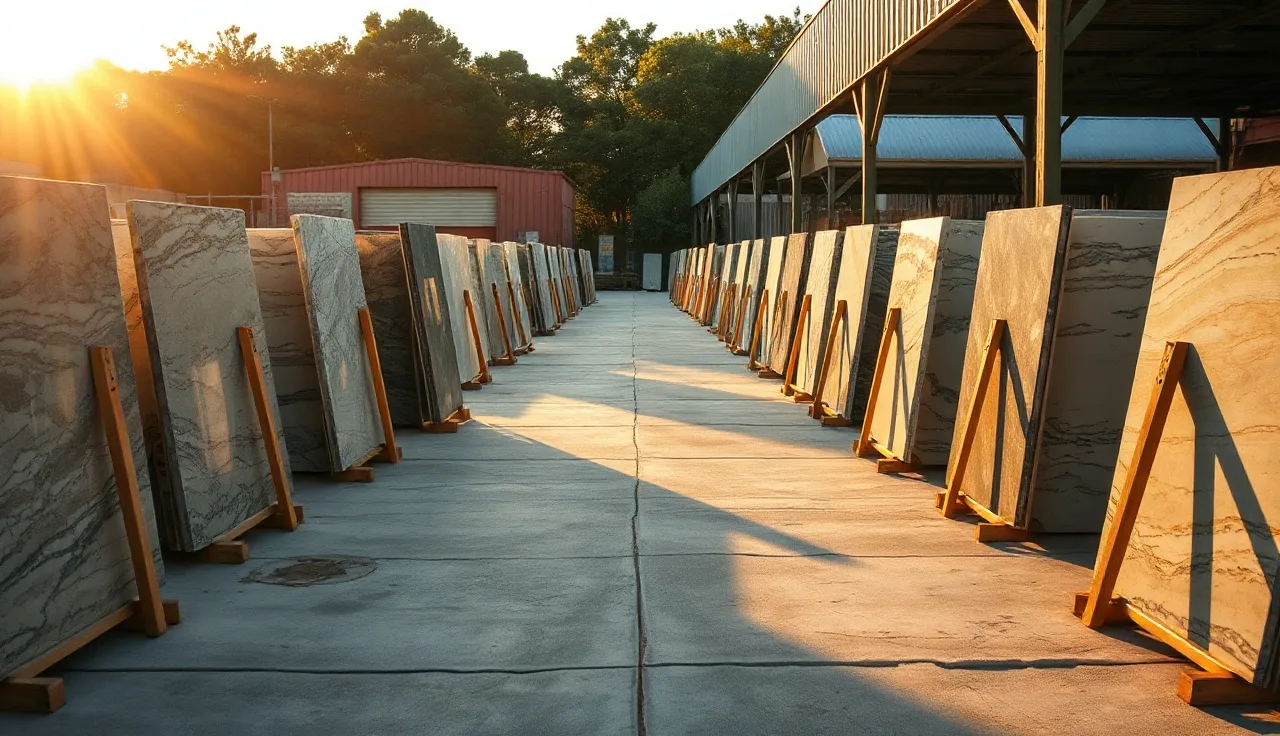
Walk into a mediocre stone yard and you'll find slabs leaning at random angles against a concrete wall, balanced on wood scraps, cracked at the corners from a forklift bump nobody reported. Walk into a well-run yard and everything is on welded steel A-frames, labeled by material and thickness, tilted at a consistent angle between 5 and 15 degrees off vertical. The difference is more than looks. It's broken stone, injured workers, and blown estimates.
OSHA's general industry standards under 29 CFR 1910.176 require that materials be stored in a way that prevents tipping, falling, and collapse [1]. Stone slabs are among the most dangerous stored materials in any light manufacturing setting. A single 2 cm full slab of quartzite can weigh 600 to 900 pounds. If it goes over, it doesn't bounce.
Homeowners reading this, pay attention. How a fabricator stores stone tells you a lot about how they run the rest of the shop. A yard with slabs flat on the ground or stacked loose on pallets is a yard with chipped edges, hidden cracks, and a crew that's probably cutting corners on the job you're paying for too.
What types of slab storage systems actually exist?
There are four main categories, and every real yard uses at least one. Most use a combination.
A-frame racks (the most common): Two angled steel legs meet at a top rail, forming an A shape. Slabs lean against both sides, padded by rubber or foam strips at contact points. A-frames can be freestanding or bolted to a floor. They come in single-sided (stacked against a wall) and double-sided configurations. A standard double-sided A-frame holds 8 to 16 full slabs depending on thickness, though experienced yard managers often cap them at 10 to avoid tip risk at the base.
Cantilever racks: Picture a shelving unit where the arms stick straight out with no front column. Each arm holds a slab or a small group of slabs horizontally or at a slight angle. Cantilever systems come out of the lumber and steel service center world and get adapted for stone. They work especially well for cut remnants and smaller pieces that don't lean well on A-frames. A heavy-duty single-sided cantilever unit rated for stone runs $500 to $1,500 depending on arm count and load rating [2].
Slab cradles (also called saddles or bunks): Low-profile steel or timber cradles that hold slabs nearly vertical. Often used for transport as much as storage. Some yards keep stone in the cradles it arrived in from the distributor, which is fine short-term but creates organization problems as cradle sizes vary by supplier.
Flat storage (pallets, the floor, or horizontal racks): Slabs laid flat on padded pallets or horizontal rack shelves. Used once in a while for very thick material (4 cm or 6 cm monumental pieces) that would be unstable upright, or for small remnants. For anything you plan to fabricate, flat storage is risky. Stacking slabs flat on each other causes edge chips and surface scratches at every contact point, and pulling a slab from the middle of a flat stack without a crane is genuinely dangerous.
What makes an A-frame rack the right choice for most yards?
A-frames dominate the industry for good reasons. They're simple to fabricate locally, easy to move with a forklift (if on skids), and the slant means gravity holds slabs in place instead of fighting you. A slab leaning at 10 degrees off vertical against padded steel rails takes real lateral force to dislodge. A slab balanced at 45 degrees on a wood scrap goes over from a forklift vibration.
The standard fabricated-steel A-frame for a stone yard uses 2-inch or 3-inch square steel tubing for the main legs, with a top cap rail and rubber pipe insulation or commercial foam padding glued to every contact surface. A competent metal fabricator can build a double-sided unit for $250 to $400 in materials. Buying commercially manufactured units runs $300 to $800 per unit, with heavy-duty versions from stone-industry suppliers topping $1,200 [2].
A-frames fail when shops overload them. The physics are simple. The farther a slab's center of gravity sits from vertical, the more outward force it puts on the base. Pack too many slabs on one side of a freestanding A-frame and it will walk, tip, or rack under a lateral load. Most manufacturers rate their frames for a total load, not a per-side load, so read the spec sheet carefully.
For a yard storing 50 to 200 slabs, plan on one A-frame per 8 to 10 slabs as a conservative starting point. That gives you room to group by material type without over-crowding.
When should you use cantilever racks instead of A-frames?
Use cantilever racks over A-frames in a few specific cases: you have a large volume of remnants and cut pieces in irregular sizes; you want a system that integrates with forklift access along a main aisle; or you're storing slabs in an indoor facility with defined rack rows rather than an open yard.
Here's why cantilever racks handle remnants better. An A-frame really wants full slabs of similar height. A 24-by-24-inch sink cutout leaning next to a 65-inch full slab on the same A-frame is an unstable pairing. Cantilever arms let you put same-size pieces on the same arm, or use one arm per piece for heavier remnants.
For high-volume operations (wholesale distributors, large fabrication plants), some shops run a hybrid: A-frames in the outdoor display area where customers and sales staff walk, cantilever racks in the indoor shop or warehouse where the crane or bridge saw operator works. The indoor section prioritizes access speed. The outdoor section prioritizes visibility.
Cantilever rack load ratings for stone duty typically start at 1,000 pounds per arm [2]. Never use standard light-duty cantilever shelving (the kind sold for lumber at hardware stores) for full slabs. Those arms are designed for distributed loads along their length, not the point load of a slab edge pressing on foam pads.
How do you build a safe A-frame: angles, padding, and spacing
The lean angle matters more than most people realize. Industry practice and most commercial frame designs lean slabs between 5 and 15 degrees from vertical toward the frame [3]. Steeper than 15 degrees (more horizontal) and you load the slab's bottom edge, which is exactly where chips and fractures start. Flatter than 5 degrees and the slab is nearly vertical, relying on friction alone to stay up.
Pad every steel contact point. This is not optional. Bare steel against polished stone causes scratches, and scratches on a $2,000 slab are your liability. Commercial rubber pipe insulation (the foam tubes sold for plumbing) glued with contact cement works well and costs almost nothing. Some yards use UHMW polyethylene strips, which last longer. Replace padding when it compresses flat or shows tears.
Leave at least 3 to 4 inches of space between slabs at the top rail so you can get a suction cup between them. A common mistake is packing slabs in tight, then finding you can't lift out the third one from the right without moving everything. That's when accidents happen, because workers start improvising with pry bars and straps.
Bolt freestanding A-frames to the floor if they sit in a fixed location. A 3/8-inch anchor bolt into a concrete slab is adequate for a loaded frame in most jurisdictions, but check your local building code and your insurance carrier's requirements. OSHA 1910.176 doesn't specify the anchor method, but it does require that stored materials be stable and secured against unintentional displacement [1].
What are the OSHA and insurance requirements for stone storage?
OSHA's primary standard for material storage in general industry is 29 CFR 1910.176. It states that "storage of material shall not create a hazard" and that "bags, containers, bundles, etc., stored in tiers shall be stacked, blocked, interlocked and limited in height so that they are stable and secure against sliding or collapse" [1]. Stone slabs aren't bags or bundles, but OSHA compliance officers apply this standard to slab storage consistently.
Some fabricators fall under the construction classification. For them, 29 CFR 1926.250 covers material storage with similar language about stability and fall prevention [4].
On the workers' compensation and commercial general liability side, your insurance carrier may have its own inspection criteria for material storage. Some carriers ask specifically about slab storage methods on renewal questionnaires. A yard storing slabs badly can face premium increases or coverage exclusions after an incident. Check with your broker every year, especially after adding volume or changing your storage layout.
Forklifts and overhead cranes used in slab handling fall under separate OSHA standards: 29 CFR 1910.178 for powered industrial trucks and ASME B30.2 for overhead cranes [5][9]. Both require regular inspections and trained operators. If you're moving slabs with a vacuum lifter or mechanical grab, those devices should be rated and inspected per manufacturer recommendations, typically annually or every 500 lifts, whichever comes first.
How should you organize a slab yard for fast picking?
The best storage system on earth doesn't help if nobody can find the right slab. Organization matters as much as the rack itself.
Group by material family first: granite together, marble together, quartzite together, engineered stone together. Within each family, sort by color family (darks, whites, beiges, exotics). Within color, sort by thickness (2 cm separate from 3 cm, because they lean differently and get cut differently). This three-level grouping means a salesperson or customer can walk to the right section in under 30 seconds.
Tag every slab at the top corner with a durable label: material name, color, origin country if you know it, thickness, square footage, and your internal SKU or lot number. Aluminum tags wired to the frame hold up outdoors better than paper or adhesive labels. Some yards use QR codes on metal-backed labels that link to a digital inventory record.
Aisle width matters more than most new shop owners realize. A standard forklift needs a minimum of 8 to 10 feet of clear aisle to turn and approach a rack face safely. An outdoor slab yard with 7-foot aisles between A-frames is an accident waiting to happen when someone rushes. OSHA 1910.176(a) also requires aisles and passageways to be kept clear and in good repair [1].
If you run a quoting and job management system, keeping your digital inventory linked to your physical layout speeds up the whole sales process. Shop software like SlabWise can track slab inventory alongside job estimates, so you're not walking the yard every time a customer asks what's available in Calacatta white.
Indoor versus outdoor storage: what does it actually cost stone?
Most stone tolerates outdoor storage better than the salespeople admit and worse than the fabricators claim. Here's the honest picture.
Polished granite and engineered quartz surfaces are basically impervious to rain and UV outdoors. The finish doesn't fade, and water beads off. The real outdoor risks are thermal cycling (stone expanding and contracting with temperature swings) and the edges, which are the weakest point on any slab.
Marble and softer limestones are genuinely more vulnerable outdoors. Acid rain (pH common in industrial areas can run 4.2 to 4.4, compared to neutral 7.0) etches polished marble surfaces over time [6]. A marble slab left outside for six months in a rainy climate can show visible etching on the exposed top corner. Not a catastrophe, but a source of customer complaints and price negotiations.
Calcite-based stones (marble, travertine, limestone) stored outdoors should have their polished face protected. Some yards stack them face-to-face with foam sheets between, then stand them on a padded A-frame. Others use fabric covers or tarps, which work fine as long as they allow airflow and don't trap moisture that then freezes.
For granite countertops, outdoor storage is basically a non-issue as long as the support system is good. For marble countertops, you want indoor or at minimum covered outdoor storage for anything you plan to sell as first-quality.
Indoor storage costs money in building footprint. Covered storage in a light industrial building runs $8 to $20 per square foot per year in most US markets, depending on location [7]. For a shop storing 150 slabs on A-frames, you'd need roughly 2,000 square feet of indoor space just for storage (frames plus aisles), so indoors-only storage can run $16,000 to $40,000 in occupancy cost alone. Most yards compromise: engineered stone and granite outdoors, premium natural stone indoors or under a steel canopy.
What does a complete slab storage setup cost for a small to mid-size yard?
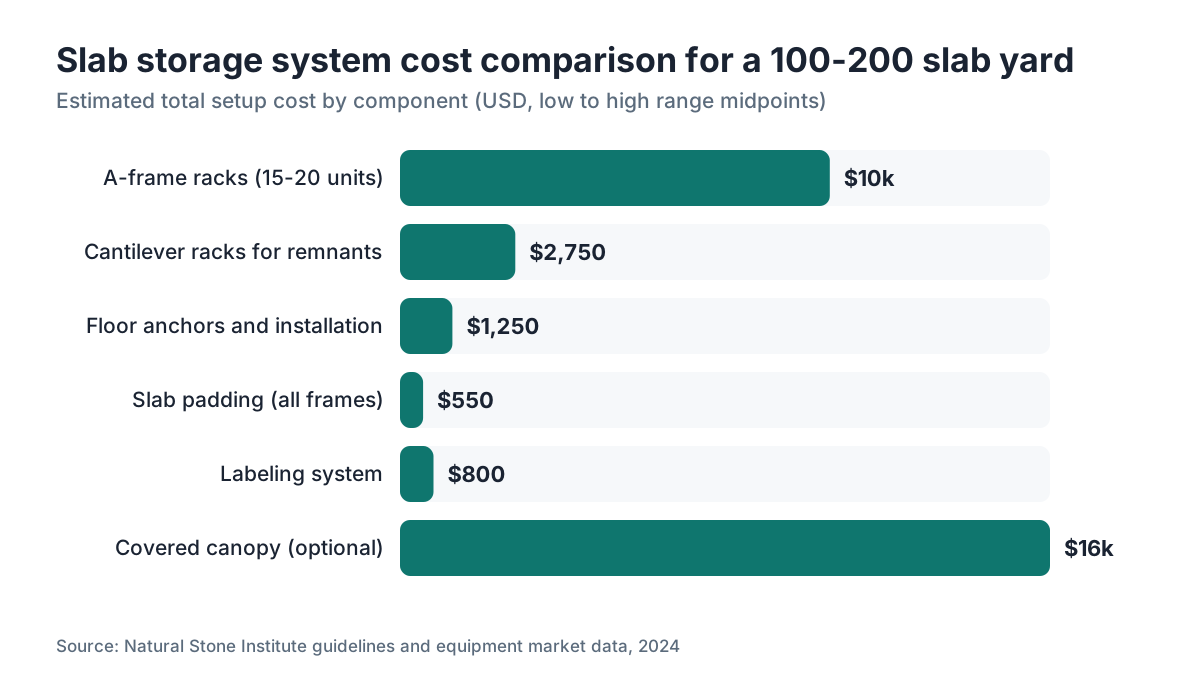
This is where shops consistently under-budget. Here's a realistic breakdown for a yard holding 100 to 200 slabs.
| Item | Low estimate | High estimate | Notes |
|---|---|---|---|
| A-frame racks (15-20 units) | $4,500 | $16,000 | Fabricated local vs. commercial heavy-duty |
| Cantilever rack section (remnants) | $1,500 | $4,000 | 10-arm single-sided, stone-rated |
| Floor anchors and installation | $500 | $2,000 | Concrete anchoring, labor |
| Slab padding (foam/UHMW) | $300 | $800 | Full replacement for all frames |
| Labeling system (aluminum tags, printer) | $400 | $1,200 | Metal tags, label printer, wire |
| Covered canopy (for premium stone) | $6,000 | $25,000 | Steel canopy structure, varies hugely by size |
| Forklift or telehandler (used) | $15,000 | $40,000 | If not already owned |
| Total (without forklift) | $13,200 | $49,000 |
The range is wide because local fabrication versus commercial racks is a 2x to 3x cost difference, and a covered canopy versus a bare concrete pad is a huge swing. Most small independent yards land between $20,000 and $35,000 for a complete setup that handles 150 slabs safely.
The forklift question deserves its own answer. You cannot run a stone yard of any scale without a way to move loaded A-frames and full slabs mechanically. A used 5,000-pound capacity forklift in decent shape costs $15,000 to $30,000 [8]. A telehandler (telescoping forklift) gives you more outdoor flexibility for $30,000 to $60,000 used. Budget this as a capital expense from day one.
How do you handle remnants and odd-sized pieces without creating chaos?
Remnants are the entropy engine of every stone yard. Full slabs are easy; they're all roughly the same shape. Remnants come in every dimension, get set down wherever's convenient, then never move again until someone trips on them.
The simplest system that actually works: a dedicated remnant zone with cantilever or small A-frame racks, sorted by material type, with a hard minimum size rule. Many shops keep only remnants larger than 24 inches by 24 inches (enough for a bathroom vanity or a small island overhang). Anything smaller becomes a sample, gets cut for testing, or goes in the dumpster. Hoarding tiny remnants is a space and safety problem, not a profit center.
Label remnants the same way you label full slabs. When a customer or estimator is quoting a small job, a quick scan of the remnant rack with actual square footage measurements saves time and can close the sale at a lower material cost than pulling a new slab.
For shops using countertop design and nesting software, remnants tracked digitally (with dimensions) can be matched automatically against new job cut lists. That's where software like SlabWise pays for itself: instead of walking the yard every time, the remnant library is searchable from the quoting screen.
Store remnants standing up, not flat. A 30-by-40-inch granite remnant standing on a padded cantilever arm takes up 3 inches of horizontal space. The same piece lying flat on a pallet takes up 30 by 40 inches of floor and goes invisible under the next piece stacked on top.
What mistakes do stone yards make most often with slab storage?
The same problems show up again and again in shop conversations and OSHA inspection records.
Overloading one side of an A-frame is the most common physical mistake. It happens gradually. Someone puts a slab on the left side because it's easier to reach, then another, then another. The frame racks visibly to one side and everyone ignores it until it falls.
Skipping floor anchors because "we might want to move it later" is second. A loaded A-frame weighs 3,000 to 8,000 pounds. It's not moving easily. Anchor it, and if you genuinely need to relocate it, unload it first.
Using wood as permanent padding is common and bad. Dimensional lumber compresses, splinters, absorbs water, and rots. A 2x4 that seemed like fine edge support in March is a crumbling wet mess in November. Use rubber, foam, or UHMW plastic at every stone-contact point.
No lighting in the storage area. Picking slabs in poor light means missed cracks, wrong materials, and foot injuries. Basic LED shop lights on a canopy structure are a $500 to $2,000 upgrade that pays off right away.
Ignoring traffic flow between the yard and the shop. Slabs move from the yard to the saw table several times a day. If the forklift route crosses the customer walkway, an incident is only a matter of time. Lay out the yard so the production path and the customer path never intersect.
How do high-volume distributors and wholesale yards approach slab storage differently?
Wholesale stone distributors (the companies that import containers of stone and sell to fabricators) operate at a different scale than a retail fabrication shop. A mid-size distributor might hold 1,000 to 5,000 slabs at any given time. At that scale, the whole logic of storage changes.
Most large distributors run a warehouse rack system that looks more like a lumber yard than a fabrication shop: long rows of cantilever racks or purpose-built slab storage modules in a large covered building, accessed by a reach truck or side-loading forklift. Slabs get indexed by lot number in a warehouse management system. A picker gets a pull ticket, goes to the specific location, and extracts the slab.
Outdoor storage at this scale uses forklift-accessible cradles or pallets, often stacked two or three cradles high with a counterbalanced forklift and stone-handling attachments. This is faster per pick than A-frames because the forklift grabs an entire cradle and moves it.
The investment gap is huge. A wholesale distributor's storage infrastructure (racking, crane systems, building) can run $500,000 to several million dollars for a facility handling 2,000 or more slabs. That's not relevant for most fabrication shops, but it's worth understanding if you're weighing whether to buy direct from importers (they've built that infrastructure into their margins) versus buying through a local distributor.
For a retail fabrication yard doing countertop installation, the distributor model is overkill. Your goal is safe, organized storage of 50 to 300 slabs with fast picking and good customer visibility, not warehouse throughput.
What should you look for when buying or inspecting used A-frame racks?
Used A-frames turn up regularly at industrial auctions, stone shop liquidations, and marketplace platforms. The price is attractive, typically 30 to 60 percent below new. But stone storage is the wrong place to cut corners on structural integrity.
Check every weld, more than the obvious ones. A-frame racks fail at the leg-to-top-rail weld and the leg-to-base-plate weld. Cracked welds can be repaired, but an undetected crack under a loaded frame is a serious hazard. Bring a flashlight and look at every joint.
Check the base plates for rust damage. Surface rust is cosmetic. Rust that has eaten through the plate thickness is structural. Tap suspect areas with a hammer; solid steel rings, compromised steel thuds.
Measure the actual lean angle with a level or angle finder. A frame that's been overloaded on one side may have a permanent set (a slight lasting lean). A degree or two is livable. Five degrees of permanent deformation in the main legs is not.
Replace all padding on used racks before putting stone on them. Old padding is compressed, torn, or contaminated. New rubber pipe insulation for a full frame costs under $50 and takes an hour. Don't skip it.
Get the load rating in writing if you can. Many fabricated (non-commercial) A-frames were never tested or rated. If you can't get documentation, have a structural engineer evaluate the design before loading it to capacity. That consultation typically costs $300 to $600 and is worth every cent.
Frequently asked questions
How many slabs can a standard A-frame rack hold?
A commercial double-sided A-frame rack for stone typically holds 8 to 16 full slabs depending on slab thickness and the frame's span. In practice, experienced shop managers cap loading at 10 slabs per frame to keep weight centered and avoid overloading one side. Thicker 3 cm slabs should stay at the lower end of that range because of their higher per-slab weight.
What angle should slabs lean at on an A-frame?
Industry practice is 5 to 15 degrees off vertical, tilting toward the frame. This angle keeps gravity working in your favor without loading the bottom edge of the slab. Angles steeper than 15 degrees concentrate stress on the edge and raise chip risk. Flatter than 5 degrees and the slab relies mainly on friction, which is not reliable with smooth polished surfaces.
Can you store marble and natural stone outdoors?
Granite and engineered quartz are fine outdoors long-term. Calcite-based stones like marble, travertine, and limestone are vulnerable to acid rain etching on polished surfaces. In areas with heavy rainfall or industrial air quality, marble stored outdoors for more than a few weeks can show visible surface etching. Store premium natural stone indoors or under a covered canopy and protect polished faces with foam sheets between slabs.
What OSHA regulations apply to slab storage in a stone yard?
29 CFR 1910.176 is the primary OSHA standard for material storage in general industry. It requires that stored materials not create hazards and that stacked materials be stable and secured against collapse. Forklift operations fall under 29 CFR 1910.178. If your operation is classified as construction, 29 CFR 1926.250 covers storage. OSHA compliance officers apply these standards to slab storage even though stone yards aren't named in the regulation text.
How should remnants be stored in a stone yard?
Remnants should stand upright on padded cantilever arms or small A-frames, grouped by material type. Laying remnants flat wastes floor space and makes them impossible to identify or extract safely when stacked. Most shops set a minimum size threshold (often 24 by 24 inches) below which pieces get scrapped rather than stored. Label every remnant with material type, dimensions, and square footage so it matches to small jobs quickly.
Do A-frame racks need to be bolted to the floor?
Yes, if they're in a fixed location. A loaded A-frame can weigh 3,000 to 8,000 pounds, but a lateral bump from a forklift or an uneven load can tip a freestanding frame. Standard 3/8-inch concrete anchor bolts are adequate for most installations, but check local building codes and your insurance carrier's requirements. If you need to relocate the frame, unload it completely before moving it.
What is the difference between A-frame racks and cantilever racks for stone?
A-frames have slabs leaning against angled legs on both sides of a central spine. They're simple, cheap, and work well for full slabs of consistent height. Cantilever racks have horizontal arms extending from a vertical column with no front support, which makes them better for remnants and mixed-size pieces. Cantilever arms rated for stone start around 1,000 pounds per arm. Most shops use A-frames for full slabs and cantilever racks for the remnant section.
How much does it cost to set up slab storage for a small stone yard?
A complete setup for a yard holding 100 to 200 slabs, including A-frames, cantilever racks for remnants, floor anchors, padding, and labeling, typically runs $13,000 to $49,000 depending on whether you buy commercial frames or have them fabricated locally. Adding a covered canopy for premium natural stone adds $6,000 to $25,000. A used forklift, if you don't already own one, is another $15,000 to $40,000.
Is flat storage ever acceptable for stone slabs?
Rarely. Flat storage on padded pallets is acceptable for very thick pieces (4 cm or 6 cm monumental stone) that would be unstable standing up, or for transport. For everyday shop storage, slabs laid flat on each other cause edge chips and surface scratches at every contact point. Pulling a slab from the middle of a flat stack without a crane is genuinely dangerous. Stand slabs upright on padded frames in almost every situation.
How wide should aisles be between slab racks?
A standard counterbalanced forklift needs a minimum of 8 to 10 feet of clear aisle to approach a rack face safely. OSHA 1910.176(a) requires aisles to be kept clear and in good repair. For a yard where customers also walk through, 10 to 12 feet gives you enough space to run a forklift without it crossing the customer path. Design customer and production traffic routes so they don't intersect.
What padding material works best on A-frame racks for stone?
Commercial rubber pipe insulation foam glued with contact cement is the most common choice and costs almost nothing. UHMW (ultra-high-molecular-weight polyethylene) strips last longer and resist compression better. Avoid wood: it splinters, absorbs water, and rots. Whatever material you use, replace it when it's compressed flat or torn. Bare steel against polished stone creates scratches that are your liability, not the customer's problem.
How do you keep track of which slabs are where in a large yard?
Use a three-level system: group by material family, sort by color family within that, and sort by thickness within color. Tag every slab with an aluminum or metal-backed label at the top corner showing material, color, thickness, square footage, and an internal SKU. For remnants, include exact dimensions. Digital inventory linked to your physical location (rack number and position) makes matching slabs to customer jobs much faster and cuts errors on quotes.
What should I check when buying used A-frame racks for a stone yard?
Inspect every weld, especially at the leg-to-top-rail and leg-to-base-plate joints. Check base plates for through-rust, more than surface rust. Measure the frame's lean angle with a level to catch permanent deformation from overloading. Get the load rating documentation if possible. Replace all padding before putting stone on any used frame. For frames with no documentation, a structural engineer review costs $300 to $600 and removes the guesswork.
Sources
- OSHA, 29 CFR 1910.176 Handling materials - general: OSHA requires materials be stored to prevent tipping, falling, and collapse; aisles must be kept clear and in good repair
- Natural Stone Institute, Stone Industry Safety Resources: Commercial A-frame racks cost $300 to $1,200 per unit; cantilever racks for stone rated at 1,000 pounds per arm and up
- Natural Stone Institute, ANSI/NSI Safety Standards for the Stone Industry: Industry practice for slab lean angle is 5 to 15 degrees off vertical toward the frame
- OSHA, 29 CFR 1926.250 General requirements for storage: Construction industry storage standard requiring materials to be stable and secured against sliding or collapse
- OSHA, 29 CFR 1910.178 Powered industrial trucks: Forklifts used in slab handling require regular inspections and trained operators
- EPA, Acid Rain program information: Acid rain in industrial areas can reach pH 4.2 to 4.4, which etches polished marble and calcite-based stone surfaces
- CoStar Group, U.S. Industrial Real Estate Market Reports: Light industrial covered storage space costs roughly $8 to $20 per square foot per year in most U.S. markets depending on location
- EquipmentWatch, Used Forklift Valuation Data: A used 5,000-pound capacity forklift in decent working condition costs $15,000 to $30,000 at auction or private sale
- ASME B30.2, Overhead and Gantry Cranes (Top Running Bridge, Single or Multiple Girder): Overhead cranes used in slab handling must be inspected per ASME B30.2 standards, typically annually or per manufacturer intervals
Last updated 2026-07-11