TL;DR
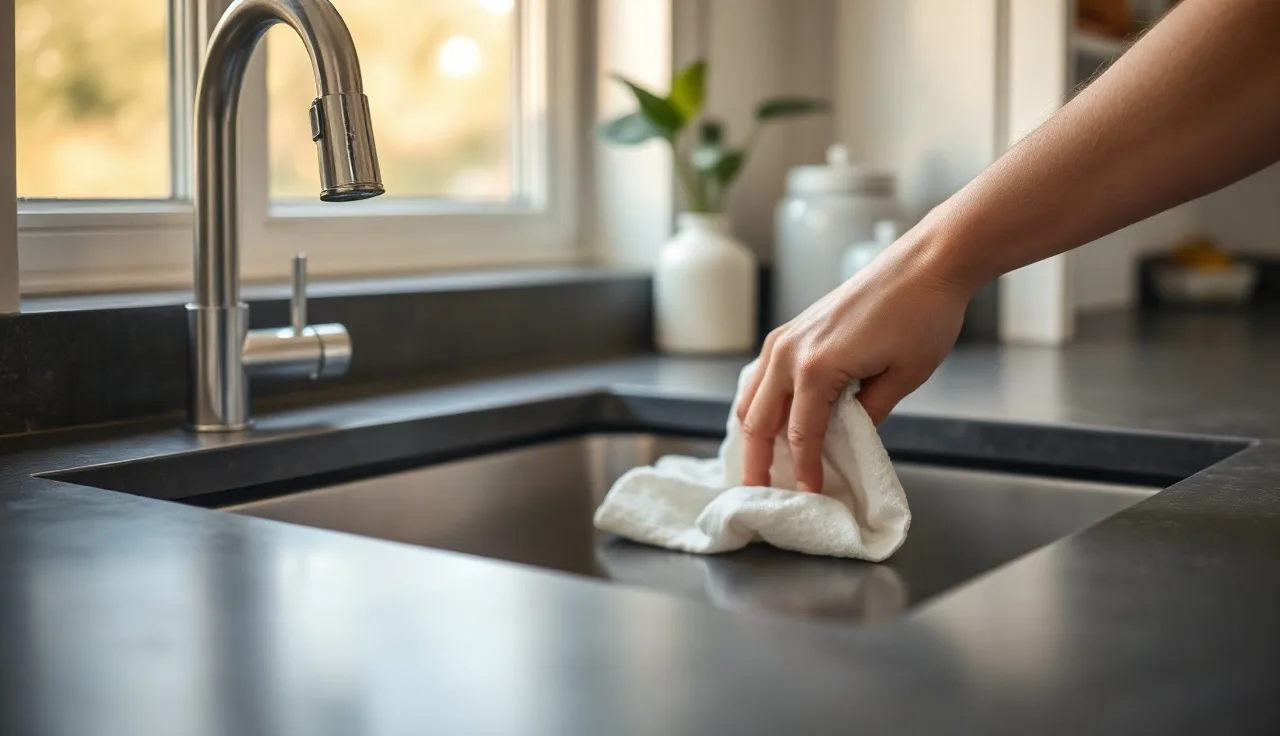
- Soapstone countertops clean up with warm water and a few drops of dish soap.
- Dry the surface after washing.
- For oil maintenance, rub in mineral oil every few weeks until the stone reaches the patina you want, then stop or go once a year.
- Skip abrasive scrubbers, bleach, and acidic cleaners.
- Scratches sand out in minutes with fine-grit paper.
What makes soapstone different from other stone countertops?
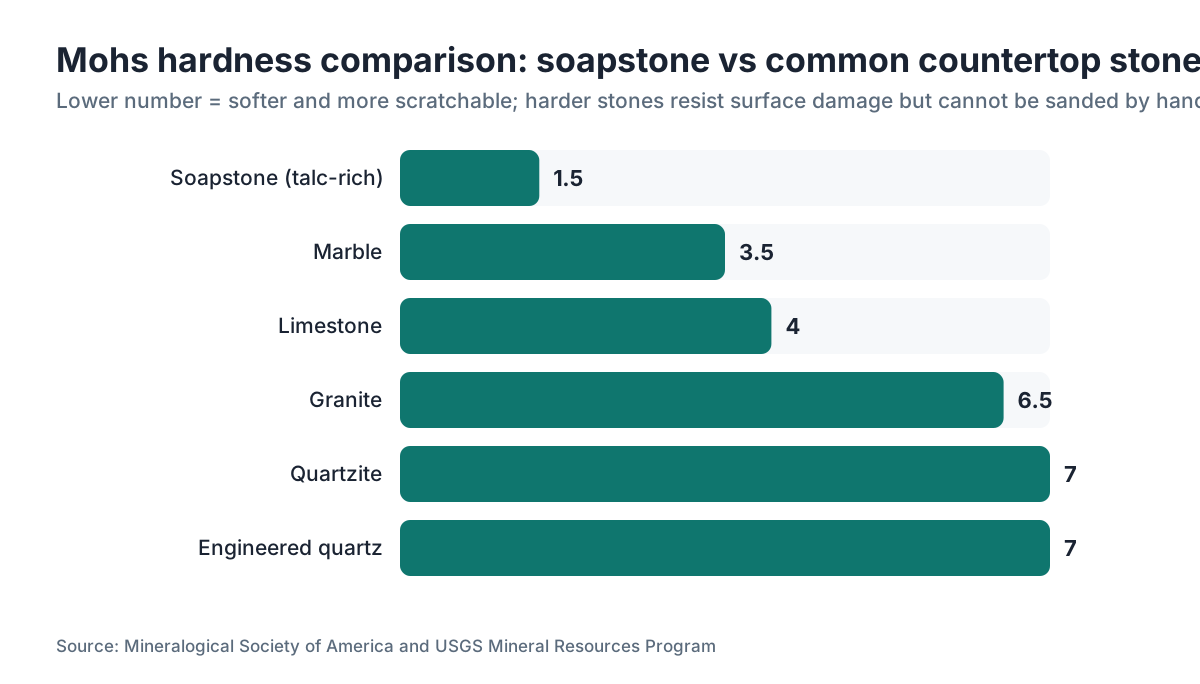
Soapstone is a metamorphic rock made mostly of talc, the softest common mineral on the Mohs scale. Most countertop-grade soapstone runs between 1 and 2 on Mohs hardness, though the chlorite and magnesite content in denser slabs pushes some grades toward 3 [3]. That softness is the whole story behind how you clean, maintain, and live with it.
Because talc is essentially non-porous, soapstone does not absorb liquids or stain the way granite or marble does. Acids don't etch it. Wine, lemon juice, tomato sauce, none of it matters. Routine cleaning is genuinely easy, probably easier than any other natural stone you can buy. The catch is that the surface scratches and dents from ordinary use, and it oxidizes from dark gray to near-black over time. Those two traits drive almost every maintenance decision you'll make.
The oiling routine people associate with soapstone is not about sealing it or protecting it from stains. It's purely cosmetic. Mineral oil speeds up the natural darkening and evens out the color. Like the mottled look of a stone aging unevenly? Skip oiling entirely. Want uniform dark color fast? Oil it often. Neither approach damages the stone. Worth knowing before you buy any specialty product.
For comparison with stones that do need acid-safe cleaners and sealers, see the guide on how to clean stone countertops.
What do you need to clean soapstone countertops daily?
Almost nothing. Here is the actual supply list:
- Warm water
- A few drops of standard dish soap (Dawn, Seventh Generation, whatever you have)
- A soft cloth, sponge, or microfiber towel
- A dry cloth for finishing
That covers 95 percent of daily cleaning. Wipe the surface with the damp soapy cloth, then dry it. Standing water won't stain or damage soapstone, but it can leave mineral deposits from hard tap water if you let it air-dry in the same spot over and over. The Natural Stone Institute recommends mild dish soap and water for routine cleaning of natural stone and warns against abrasive and acidic household cleaners [9].
No pH-neutral stone cleaner required. No specialty soapstone spray. Those products exist and won't hurt anything, but they don't beat dish soap. Save the money.
For stubborn residue like dried grease, sticky cooking spray, or a ring from a jar, a few minutes of soak time with a warm damp cloth loosens almost everything. If something is genuinely stuck, a plastic scraper or an old credit card works fine. Metal scrapers can leave marks.
The one cleaner category to avoid is anything abrasive: powdered cleansers like Comet or Bar Keepers Friend scrubbing powder, steel wool, rough scrubbing pads. They scratch. On the flip side, if you already scratched the surface, that same fine-grit sandpaper approach fixes it, which is covered below.
How to deep clean soapstone countertops
Deep cleaning soapstone is mostly about timing and thoroughness, not special chemicals.
Step 1: Clear the surface completely and wipe off loose debris with a dry cloth.
Step 2: Mix a small amount of dish soap into warm water, maybe a teaspoon per quart. Wet your cloth well and wipe down the entire surface. Pay attention to seams, edges, and the area around the sink where grime builds up.
Step 3: For greasy buildup, apply a drop of dish soap directly to the cloth and work it in with gentle circular pressure. Let it sit two or three minutes.
Step 4: Rinse with a clean damp cloth, several passes, to pick up soap residue. Soap film left behind can look cloudy once it dries.
Step 5: Dry with a clean towel.
Doing a deep clean before re-oiling? Let the stone dry completely, at least an hour at room temperature, before you apply mineral oil. Oil over a damp surface won't penetrate evenly.
Fabricators mention one spot constantly: the area directly around the cooktop and behind the faucet collects baked-on grease that regular wiping misses. A plastic scraper plus dish soap handles it without damage. Some people use a little isopropyl alcohol on a cloth for that zone. It cuts grease well and evaporates fast. Fine occasionally, but daily use can dry out the surface.
Should you use mineral oil on soapstone, and how often?
Mineral oil is the traditional maintenance product for soapstone, and it works. It is also entirely optional.
What mineral oil does: it temporarily darkens the stone and gives an even, rich appearance. Over several months to a couple of years, soapstone oxidizes and reaches that same dark color on its own. Oiling just speeds up the cosmetic process and keeps the color uniform while the natural patina develops.
What oil to use: food-grade mineral oil is the standard. It's cheap (usually $3 to $6 for a 16 oz bottle at a pharmacy or grocery store), safe around food prep, and doesn't go rancid. Food-grade mineral oil is permitted for food-contact surfaces under the FDA's indirect food additive rules in 21 CFR Part 178 [5]. Some fabricators sell branded soapstone oil that is the same product at a higher price. Tung oil and danish oil come up in DIY forums, but they polymerize as they cure and can leave an uneven sheen. Stick with mineral oil.
How to apply it: pour a small amount onto a soft cloth and rub it into the stone in a circular motion, covering the whole surface. Let it sit 20 to 30 minutes, then wipe off any excess. The stone should look darker and fairly even. If dry patches show up after the first coat, apply a second coat the same day.
How often: for new soapstone, every two to four weeks for the first few months is common. Once the stone reaches the color depth you want, stretch to every few months, or stop altogether and just touch up spots that look uneven. There's no harm in oiling more often. There's also no harm in stopping.
Prefer a more matte, lighter look with the stone's own character? Skip the oil. It's a preference, not a requirement.
For fabricators tracking material costs and maintenance specs for client quotes, SlabWise lets you attach maintenance notes and care documentation directly to a project, which helps when you hand off to homeowners.
How do you remove scratches from soapstone?
This is one of the genuinely good things about soapstone. Scratches are reversible.
Because the stone is soft, it scratches easily. Dragging a cast iron pan, a knife, or even a ring across it can leave a visible mark. But that same softness means you can sand scratches out by hand in a few minutes, something you cannot do with granite or quartz.
For light scratches: rub the area with 220-grit sandpaper, moving with the grain of the stone if there is a visible one. The scratch disappears quickly. Wipe off the dust with a damp cloth and re-oil if the area looks dry or lighter than the surrounding surface.
For deeper gouges: start with 120-grit to remove material faster, then follow with 220-grit to smooth it out. Finish with 400-grit if you want a polished feel. The stone lightens in the sanded area for a while. A coat of mineral oil brings it back into range with the rest of the surface.
For large areas: a random-orbit sander with 150-grit followed by 220-grit works faster and is still something a homeowner can do without professional help. Wet-sand if you're worried about dust.
No filler, no epoxy, no pro needed for most scratches. That repairability is a real edge over harder but less forgiving materials like quartz countertops or granite countertops, where surface damage usually means calling someone.
What cleaners should you never use on soapstone?
A short list, but worth knowing:
Abrasive powders and pads: Comet, Ajax, Bar Keepers Friend (the powder version), steel wool, and rough green scrubbing pads all scratch the surface. Soapstone is soft. Any abrasive that would scratch a wooden cutting board will scratch soapstone.
Bleach and hydrogen peroxide: These won't chemically damage soapstone the way they affect some stones, but they can lighten and dry out the surface, creating uneven patches that are annoying to fix. A diluted bleach solution used once or twice in a kitchen emergency won't destroy your countertop, but it's not a routine cleaner.
Vinegar and other acids: Soapstone is acid-resistant, a real advantage over marble. But acidic cleaners still aren't the right choice. Vinegar leaves a residue and a smell, and there's no benefit over soap and water.
Multi-surface sprays with wax or silicone: Products like Pledge or furniture polish leave a film on soapstone that looks wrong and is hard to remove. They aren't for stone.
High-pH degreasers: Products like TSP (trisodium phosphate) or industrial degreasers can strip mineral oil from the surface and leave the stone dull and patchy. TSP is a strong alkaline cleaner, and OSHA's hazard communication guidance flags high-pH degreasers as harsh on treated surfaces [6]. If you use one by accident, clean the surface with dish soap, let it dry, and re-oil.
The principle is simple: soapstone doesn't need anything harsh, so there's no reason to reach for it.
How do you get stains out of soapstone?
True staining on soapstone is rare because the stone is non-porous. When something looks like a stain, it's usually one of a few things:
Water spots and mineral deposits: Hard water leaves a white or gray film when it dries repeatedly in the same spot. Wipe the area with a cloth dampened with a little white vinegar, then rinse with water and dry. Hard water deposits are calcium and magnesium, and they dissolve in mild acids like diluted white vinegar, per University of Minnesota Extension [10]. This is the one case where vinegar makes sense, used carefully and rinsed off quickly.
Oil marks from hands or food: The stone darkens where oils touch it, which can look patchy. Apply mineral oil to the whole surface to even it out. The oil spot blends in as everything darkens together.
Rust rings: Metal cans, cast iron pans, or steel wool left on soapstone can leave rust-orange marks. A paste of baking soda and water left on the spot for 20 to 30 minutes, then scrubbed gently with a soft cloth, usually lifts rust staining. Rinse well. If the mark is stubborn, a commercial rust remover labeled safe for natural stone can help.
Paint, adhesive, or dried food: Gentle scraping with a plastic scraper, then dish soap and warm water. Goo Gone works on adhesive residue and is safe on soapstone.
Anything that still won't budge after those approaches is almost certainly surface scratching or discoloration that the fine-grit sandpaper method will handle.
How is cleaning soapstone different from cleaning other natural stones?
The difference is mostly about what you don't have to worry about.
With marble and limestone, acids etch the surface. Lemon juice, vinegar, wine, and even some cleaning products leave dull spots that need professional polishing. Soapstone doesn't etch. Marble countertops require pH-neutral cleaners specifically. Soapstone doesn't care.
With granite, the surface is sealed and you need to keep that sealer intact. Harsh chemicals can degrade the sealer and open the stone to staining. Soapstone doesn't need sealer, so that concern disappears. See the broader guide on granite kitchen countertops for how sealers factor into maintenance there.
With quartzite, which people confuse with quartz constantly, the stone is acid-sensitive like marble in many cases. Its cleaning needs overlap more with marble than with soapstone. The how to clean quartzite countertops guide covers that in detail.
Engineered quartz (brands like Silestone and Cambria) is also non-porous like soapstone, but the resin binders in quartz react badly to certain solvents. Bleach and acetone can damage them. Soapstone has no resin, so solvent sensitivity isn't a factor.
The one place soapstone asks more of you than most stones is scratch maintenance. Harder stones stay smooth with normal use. Soapstone doesn't, and you either accept that or embrace the worn patina as part of the look. The Smithsonian's Museum Conservation Institute recommends neutral pH detergents and clean water for most natural stone surfaces in conservation work [8].
| Stone | Acid-resistant | Sealer needed | Scratches easily | Stains easily |
|---|---|---|---|---|
| Soapstone | Yes | No | Yes | No |
| Granite | Yes | Yes | No | Without sealer, yes |
| Marble | No | Yes | No | Yes |
| Quartzite | Varies | Yes | No | Without sealer, yes |
| Quartz (engineered) | Yes | No | No | No |
How do you maintain soapstone around a sink or cooktop?
These two zones take the most abuse and need a little more attention than the open counter.
Around the sink: water splashes constantly, soap residue builds on the underside of the edge, and the area behind the faucet collects mineral deposits and grime in the seam between the stone and the wall. Wipe this area dry after doing dishes when you can. A weekly focused clean with dish soap and a small brush (an old toothbrush works) on the seam and any caulk line keeps buildup from setting. Hard water deposits around the drain respond to vinegar on a cloth, left for a few minutes.
Around the cooktop: grease splatters and spills bake onto the surface. Wipe spills while the counter is still warm instead of letting them harden. For anything already baked on, a damp cloth on the area for a few minutes softens it before you scrape. If the stone around the cooktop looks consistently lighter than the rest, it's because heat drives off the mineral oil faster. Re-oil that zone more often.
Soapstone's heat resistance is real. The stone handles hot pots and pans without cracking, and some labs and scientific installations use soapstone (steatite) specifically for its thermal stability and acid resistance [2]. That's why it shows up in old chemistry lab countertops. Set a hot pan directly on it. No trivets needed from a damage standpoint, though trivets still prevent scratching from the rough bottom of cast iron.
For other materials around the kitchen, the kitchen countertops overview covers how maintenance varies across the common options.
How do you restore soapstone that looks dull, dry, or neglected?
Neglected soapstone usually looks gray, streaky, and dry. Sometimes there are scratches throughout, dried mineral deposits near the sink, and areas where the color is uneven from partial oiling over the years. It looks bad. It's easy to fix.
Step 1: Clean thoroughly. Dish soap and warm water, scrub the whole surface, rinse, dry. Get rid of all the surface grime first.
Step 2: Address any staining or deposits. Vinegar for mineral deposits, baking soda paste for rust, plastic scraper for anything dried on.
Step 3: Sand. If the surface has scratches throughout, start with 150-grit sandpaper across the whole thing, then 220, then 400 if you want a smooth finish. Wipe dust off with a damp cloth and let the stone dry completely. This step takes time, but it brings old soapstone back to something close to new.
Step 4: Apply mineral oil. Coat the whole surface, let it absorb for 30 minutes, wipe off excess. Apply a second coat if the stone still looks dry or uneven. Some fabricators do three coats on the first day of a restoration job.
Step 5: Repeat the oiling every few weeks for a couple months until the color stabilizes.
Soapstone that looks terrible can come back to life in an afternoon. That's a real advantage over surfaces you can't resurface without professional equipment, like laminate countertops where damage is usually permanent, or Formica countertops where surface repairs are rarely invisible.
For fabricators quoting restoration jobs or new soapstone installs, accurate per-square-foot pricing built into your workflow saves real time. The SlabWise quoting tool handles soapstone with the same material categories as any other natural stone.
What is the long-term maintenance schedule for soapstone countertops?
Here is a realistic schedule based on how soapstone actually behaves over years of use:
Daily or after cooking: Wipe with a damp cloth and dish soap. Dry the surface. Two minutes.
Weekly: Focused clean around the sink and cooktop. Small brush on seams. Check for water spots.
Monthly (first 6-12 months): Apply a coat of mineral oil to the full surface. This is the phase where the patina develops fastest and oiling makes the biggest visible difference.
Every 3-6 months (after the first year): Oil if the surface looks uneven or dry, or skip it if you're happy with the color. Patch scratches with sandpaper as they show up, or do a light pass with 220-grit across the whole surface if heavy use has scratched it up.
Every few years: If the surface has significant scratching or you want to reset the look, do the full restoration: clean, sand through grits, re-oil. Soapstone can be restored this way essentially forever.
Compare that to butcher block countertops, which need oiling to prevent cracking and can harbor bacteria in knife cuts. Soapstone is lower-stakes. You're not protecting it from structural damage with your routine. You're just managing the appearance.
Frequently asked questions
Can you use Windex or glass cleaner on soapstone?
Windex won't damage soapstone chemically, but it leaves a streaky film and isn't necessary. The ammonia in some glass cleaners can dry out the surface over time if you use it regularly. Warm water and dish soap clean soapstone better and leave no residue. Save the Windex for the glass.
Does soapstone really not need to be sealed?
Correct. Soapstone is non-porous, so liquids don't penetrate the surface and sealer has nothing to bond to. Applying a stone sealer to soapstone wastes product and money. The mineral oil routine some people follow is purely cosmetic, not protective the way sealing is for granite or marble.
Is soapstone safe for food preparation?
Yes. Soapstone is non-porous, so it doesn't harbor bacteria in the surface the way a cracked or unsealed porous stone might. Dish soap and water clean it thoroughly. The mineral oil used for maintenance is food-grade and permitted for food-contact surfaces under FDA rules. You can cut on it directly, though you will scratch the surface, so most people use a cutting board.
What grit sandpaper works best for soapstone scratch removal?
For light surface scratches, 220-grit is usually enough. For deeper gouges, start with 120-grit to remove material, move to 220-grit to smooth, and finish with 400-grit if you want a polished feel. Wipe dust away with a damp cloth and apply mineral oil to the sanded area to bring the color back into range with the rest of the surface.
Why does soapstone turn dark over time?
Soapstone oxidizes with air exposure, shifting from medium gray toward near-black. The talc in the stone reacts slowly with oxygen and oils from handling. Applying mineral oil speeds this up and makes it happen more evenly. If you never oil it, it still darkens, just more slowly and sometimes in patches where hands and objects touch the surface most.
Can you use bleach on soapstone to disinfect it?
A diluted bleach solution used once or twice won't destroy soapstone, but it can lighten the surface and create uneven patches, especially on oiled stone. For disinfection, 70 percent isopropyl alcohol is a better choice. The CDC notes 70% isopropyl alcohol is effective on hard surfaces and evaporates cleanly. Dish soap and hot water handle most kitchen sanitation.
How often do you really need to oil soapstone countertops?
For new soapstone, every two to four weeks for the first six months to a year gives you even, consistent darkening. After that, once or twice a year is plenty if you just want to touch it up. If you like the fully darkened look and the color is stable, you can stop oiling entirely. There's no maintenance penalty for skipping it.
Will hot pots and pans damage soapstone?
No. Soapstone has very high thermal tolerance and was historically used in laboratory settings for exactly this reason. Setting a hot pot, pan, or baking dish directly on it won't crack, scorch, or discolor the surface. Cast iron and rough-bottomed pans can still scratch it, so trivets help there, but heat itself is not a concern.
Can you use baking soda on soapstone?
Yes, carefully. A paste of baking soda and water works well for rust stains and some stubborn residues. Apply it to the spot, let it sit 20 to 30 minutes, scrub gently with a soft cloth, then rinse thoroughly. Don't use it as a routine cleaner, because repeated use of any mild abrasive will dull the surface over time.
Does soapstone scratch from normal kitchen use?
Yes. Dragging pots, keys, rings, and canned goods across soapstone leaves marks. That's the nature of talc-based stone. Most homeowners come to see the scratches as part of the character and let a worn patina develop. If you want a consistently smooth surface, plan on a light sanding pass with 220-grit every year or so.
What is the difference between soapstone and other black countertop options?
Black granite and black quartz are much harder and don't scratch as easily, but they need sealing or have resin sensitivities that soapstone doesn't. Soapstone's darkness comes from natural oxidation over time, not pigmentation, so the look evolves. It's also genuinely matte, while many black granites have a polished gloss that's hard to match with soapstone.
How do you prevent water spots on soapstone near the sink?
The best prevention is drying the surface after splashes instead of letting water evaporate on its own. Hard water leaves mineral deposits when it dries repeatedly in the same spot. A quick wipe-down after doing dishes handles it. If deposits have already built up, a cloth dampened with white vinegar dissolves them quickly. Rinse and dry after.
Sources
- U.S. Geological Survey, Mineral Resources Program: Talc and Pyrophyllite: Soapstone (steatite) is used in laboratory countertops for its thermal stability and acid resistance
- U.S. Geological Survey, Mineral Commodity Summaries: Talc: Talc's composition includes magnesite and chlorite in varying proportions, which affects hardness of soapstone grades
- EPA, Safer Choice: Safer Chemical Ingredients List: Mineral oil (food-grade, CAS 8042-47-5) is listed as a safer chemical ingredient acceptable for use on food-contact surfaces
- FDA, Code of Federal Regulations Title 21, Part 178: Indirect Food Additives: Food-grade mineral oil is permitted for use on food-contact surfaces under 21 CFR 178
- OSHA, Hazard Communication Standard: Trisodium Phosphate (TSP) Safety Data: High-pH degreasers such as TSP are strong alkaline cleaners that can strip surface treatments from porous and treated stone surfaces
- National Park Service, Preservation Briefs: NPS preservation guidance references mineral oil as a standard, non-film-forming oil appropriate for natural material maintenance
- Smithsonian Institution, Museum Conservation Institute: Stone Conservation: Neutral pH detergents and clean water are the recommended cleaning agents for most natural stone surfaces in conservation contexts
- Natural Stone Institute, Care and Cleaning for Natural Stone Surfaces: Abrasive cleaners, bleach, and acidic household cleaners can damage natural stone surfaces; mild dish soap and water recommended for routine cleaning
- University of Minnesota Extension, Hard Water and Your Home: Hard water mineral deposits (calcium and magnesium) dissolve in mild acids such as diluted white vinegar
- CDC, Cleaning and Disinfecting: 70% isopropyl alcohol is an effective disinfectant for hard surfaces and evaporates without leaving residue
- USGS, Mineral Commodity Summaries: Talc and Pyrophyllite statistics: Soapstone mineral hardness and non-porous properties sourced from USGS mineral commodity data
Last updated 2026-07-09