
TL;DR
- Before hiring a countertop fabricator, ask about their lead time, how they price remnants versus full slabs, what the quote includes (edge profiles, cutouts, removal), who does the template and installation, what warranty they offer, and whether they carry liability insurance.
- Clear answers to these 13 questions can save you hundreds of dollars and weeks of frustration.
Why the questions you ask a fabricator matter more than the quote itself
A quote is just a number on a page. Two shops can hand you identical dollar amounts and deliver completely different outcomes: one installs perfectly in four weeks, the other ghosts you for six and cracks a corner on delivery. The difference almost always comes down to what you asked before you signed.
Most homeowners compare price and stop there. That's understandable. Countertop jobs are expensive and full of jargon. But the questions below pull back the curtain on how a shop actually runs, and the answers tell you a lot more than any showroom visit will.
This guide is written for homeowners who want to hire confidently. Fabricators will recognize what good shops answer versus what red-flag shops dodge. Work through these in order. They build on each other.
What does your quote actually include, and what's extra?
This is the single most important question, and most homeowners skip it entirely. A quote that looks cheap often excludes things you'll definitely need.
Ask specifically about: the template visit (some shops charge $50-$150 for this separately), edge profiles (a basic eased edge is usually included; an ogee or waterfall can add $15-$30 per linear foot), sink and cooktop cutouts ($50-$150 each at many shops), removal and disposal of your old countertops ($100-$300 depending on material and square footage), and seaming location approval.
The National Kitchen and Bath Association notes that countertop installation costs vary widely based on scope, and that homeowners frequently underestimate add-on charges. [1] Get every line item in writing before you sign. A trustworthy shop will hand you an itemized quote without being asked twice.
Here's a quick reference for what's typically included versus what gets added later:
| Line Item | Usually Included | Often Extra |
|---|---|---|
| Material (per sq ft) | Yes | Upgrades/overages |
| Basic eased edge | Yes | Premium profiles |
| Template visit | Sometimes | Often $50-$150 |
| Sink cutout | Sometimes | Often $75-$150 |
| Cooktop cutout | Sometimes | Often $75-$150 |
| Old countertop removal | Rarely | $100-$300 |
| Backsplash cuts | Rarely | Varies |
| Delivery and install | Usually | Sometimes split out |
What is your current lead time from deposit to installation?
Lead times in this industry swing hard. During the 2020-2022 supply crunch, some shops were running 8-12 weeks on granite and quartz. In a slow season at a well-staffed shop, you might see 2-3 weeks. Right now, 3-5 weeks is a reasonable baseline for most markets, but nobody has universal data on this. Ask your local shops directly, because regional capacity differences are real. [2]
The follow-up question matters just as much: ask what could delay that timeline. Common culprits are slab availability (if the color you chose is backordered at the distributor), a backlog of jobs ahead of yours, or a short-staffed install crew. If you're running a kitchen renovation and a contractor is scheduling plumbers and electricians around your countertop date, a surprise two-week slip is genuinely costly.
Also ask when the clock starts. Some shops start counting from deposit, others from the template date, others from when materials arrive at their facility. Know exactly what they mean.
How do you price slabs, and will I be paying for a full slab I don't use?
Stone pricing is often quoted per square foot, but the slab you're buying doesn't divide cleanly into your countertop shape. The leftover material after your job is cut is called a remnant, and what happens to it matters to your wallet.
Some shops sell you only the square footage they use and keep the remnant to sell later. Others charge for the full slab regardless. Still others offer a credit if the remnant is large enough to resell. None of these is inherently wrong, but you should know which model applies before you sign.
If your job is small (say, a bathroom vanity or a laundry room), ask whether they have remnants in stock. A remnant piece can cover small projects at 20-40% less than full-slab pricing, and it's often available faster since no new slab order is needed.
For engineered quartz, pricing works differently because quartz slabs come in standardized sizes (typically 55" x 120" or 63" x 126") from manufacturers like Cambria, Silestone, or Caesarstone, and shops pay by the slab. [3] Knowing the slab dimensions up front helps you ask smart questions about yield and waste.
If you're shopping for granite countertops, ask the fabricator whether the slab you're considering has enough usable square footage to complete your job without a seam in an awkward location, or whether they'd need to order a second slab.
Where will the seams be, and how visible will they be?
Seams are unavoidable on most kitchens because standard slabs aren't wide enough to cover an L-shaped or U-shaped layout in one piece. A skilled fabricator minimizes their visibility. A careless one puts them wherever is easiest to cut.
Ask the fabricator to show you on your layout drawing where the seams will fall. Good placement puts them away from the primary sight line (not directly in front of the sink, not centered on an island), and follows any veining pattern in the stone to make the transition less obvious.
Seam quality depends heavily on the material. Quartz seams are typically tight (under 1/16") and filled with color-matched epoxy. Natural stone seams can be slightly wider and are harder to hide in highly veined material like marble countertops. A fabricator who can't show you seam examples from previous jobs on similar material is a yellow flag.
Who does the template, and who does the installation?
This sounds like an operational detail but it matters. Some shops use their own trained crew for both templating and installation. Others subcontract installation to independent crews they may or may not supervise closely. A third category is the big-box store or countertop broker model, where the shop you talk to hands off the job to whoever is available.
Ask directly: are the people who install my countertops your employees, or are they subcontractors? If subcontractors, how do you vet them and who is my point of contact if something goes wrong?
Templating method also matters. Digital templating with a laser or camera system (tools like Prodim or Laser Products Industries systems are common in the industry) is more accurate than physical templates made from luan boards, especially for irregular shapes and curved walls. [4] Ask which method they use and whether the template data is what drives the CNC cut. Shops that run a tight digital workflow from template to saw to install tend to have fewer fitment problems.
What warranty do you offer on labor and materials?
Material warranties and labor warranties are different things, and most homeowners conflate them.
The material warranty (covering defects in the stone or engineered quartz) typically comes from the manufacturer or distributor, not the fabricator. Cambria, for example, offers a limited lifetime warranty on their quartz products. [5] Silestone also offers long-term coverage. But those warranties have conditions: professional installation, proper care, no physical abuse.
The labor warranty (covering the fabrication and installation work, including seams, cutouts, and edge finishing) is the fabricator's own commitment. A good shop stands behind their work for at least one year. Some offer longer. Ask specifically what is covered: chipped edges at installation, seam failure, improper levelness, support issues.
Get the warranty in writing. A verbal promise from a salesperson means nothing if there's turnover or a dispute six months later.
Are you licensed and insured, and can I see proof?
Licensing requirements for countertop fabricators vary by state and sometimes by county. Some states require a contractor's license for anyone doing countertop installation; others don't regulate it at all. [6] Either way, general liability insurance is non-negotiable.
Ask for a certificate of insurance and verify it's current. The certificate should list general liability (at minimum $1 million per occurrence is standard for trades work) and workers' compensation if they have employees. If a crew member drops a 150-pound granite slab on your hardwood floor and the shop has no liability coverage, you may be pursuing a claim against someone with no assets.
Workers' comp matters too. If an uninsured worker is injured on your property during installation, homeowner's insurance policies vary on whether they cover that liability. [9] Don't put yourself in that position. A shop that balks at sharing proof of insurance is telling you something.
How do you handle damaged slabs or mistakes after installation?
Ask this hypothetically, before anything goes wrong. How a shop answers tells you about their culture.
A good answer sounds like: we inspect every slab at our facility before fabrication, we do a final check on delivery, and if we caused the damage, we fix it on our dime, period. A bad answer involves hedging, mentioning the distributor, or saying it depends on what kind of damage.
Real problems that come up: a chip on an edge revealed only after delivery, a seam that opens up slightly within the first few months, a cooktop cutout that's off by a quarter inch, or a crack that appears weeks later (usually from improper support or a stress point during install). Ask how each of these would be handled and who pays.
What material would you recommend for my specific kitchen, and why?
A fabricator who works with dozens of materials every week has a perspective worth hearing. Ask what they'd put in their own kitchen given your cooking habits, household, and budget. If they push whatever has the highest margin without asking about your lifestyle, that's a signal.
Some honest trade-offs to discuss:
Granite is hard, heat-resistant, and needs sealing roughly once a year. It's one of the more forgiving natural stones for a busy kitchen. See our full breakdown at granite countertops.
Quartz (engineered) needs no sealing and handles daily abuse well, but it can discolor with prolonged direct UV exposure and isn't as heat-resistant as granite. If you're interested in Cambria specifically, our Cambria countertops guide covers what sets them apart.
Marble is beautiful and genuinely soft. It etches from acidic foods and drinks (lemon juice, wine, vinegar) even when sealed. That's not a fabricator flaw. It's the material's nature.
Laminate and surfaces like Formica have gotten much better in recent years and are perfectly respectable choices for budget projects. See laminate countertops and Formica countertops for more.
Be skeptical of any fabricator who says a material is maintenance-free. Everything needs something.
How do you handle supports, overhangs, and edge profiles?
Overhangs are a structural issue that homeowners rarely think to ask about. The general industry guideline, referenced by the Natural Stone Institute (formerly the Marble Institute of America), is that unsupported overhangs should not exceed 1/3 of the countertop's total depth, and that overhangs beyond about 6-8 inches typically require support corbels or brackets. [7] For stone, exceeding this without support creates a cracking risk that often shows up months after install, not immediately.
If you're planning a seating overhang on an island, ask specifically: what overhang depth are you quoting, will you provide brackets, and what's included in that price?
Edge profiles affect both looks and price. A simple eased or beveled edge is usually standard. An ogee, dupont, or mitered waterfall edge takes more machine time and hand finishing, often adding $15-$30 per linear foot or more. Ask to see edge samples in person. Photos don't convey how they look at knee height and how they'll interact with cabinetry reveals.
If you need guidance on the full installation process, countertop installation covers what to expect on job day.
What should I do (and not do) before the installers arrive?
A good fabricator briefs you on prep. If they don't, ask.
Typically you need appliances pulled back and disconnected (dishwasher, cooktop, fridge), sinks and faucets removed or a clear answer on who handles that, cabinet boxes level within 1/8" across their span (shimming is your contractor's job, not the fabricator's, unless agreed otherwise), and a clear access path from your front door to the kitchen for a crew carrying heavy stone.
Ask whether they disconnect and reconnect plumbing or whether you need a plumber for that. Some shops handle it under a general contractor license; others don't touch plumbing. This coordination failure is a top cause of day-of install problems.
Also ask whether they cover floors and cabinet faces during install. Stone dust and heavy equipment can damage flooring. A shop that doesn't mention protection without being prompted may not be in the habit of providing it.
Can I see your past work and talk to a recent customer?
Reviews on Google and Houzz are useful, but ask for references you can actually call, specifically for jobs similar to yours in material and scope. A shop that does excellent work on granite slabs may struggle with a highly figured quartzite or a complex waterfall island they've only done twice.
Look at photos with an eye for seam quality, edge consistency, and how corners and inside angles look. Gaps at the wall, visible step differences across a seam, or uneven edge heights are all signs of workmanship problems.
Also check how long the shop has been operating and whether the people you're talking to are the same ones who will be on your job. High staff turnover in fabrication shops is more common than customers realize, and it affects quality consistency.
For shops that quote digitally, look for those using structured quoting and job-management systems. SlabWise, for example, is a quoting and nesting platform used by fabricators that helps shops track job details, material yield, and pricing in a structured way, which tends to mean fewer surprises on your invoice. [8]
What's your payment schedule, and what are the cancellation terms?
Payment terms in countertop fabrication are typically a deposit up front and the balance on or before installation. A common structure is 50% deposit at signing, 50% on installation day. Some shops ask for full payment before install. Avoid any shop asking for full payment weeks before any work starts.
Ask what happens if you cancel after the deposit. If they've already ordered your slab from the distributor, they may be entitled to keep part or all of the deposit to cover the material cost. That's reasonable. Keeping it with no material ordered is not.
Get cancellation and refund terms in writing as part of the contract. Also ask what happens on their end if they miss the installation date. If you're a homeowner paying a contractor to be onsite that day, a no-show costs you real money.
Frequently asked questions
How many quotes should I get from countertop fabricators?
Get at least three quotes for any job over roughly $1,500. Price differences of 20-30% between shops for the same material and scope are common, and the reasons behind those differences (material grade, subcontracted versus in-house install, warranty terms) are exactly what these questions help you find. More quotes also calibrate your sense of what's normal for your market.
Is it okay to buy my own slab and have a fabricator cut and install it?
Some fabricators accept customer-supplied slabs, but many won't, or they charge a higher fabrication fee and exclude the material from their warranty. The risk is yours if the slab has a hidden crack that reveals itself during cutting. If you do this, negotiate a clear written agreement about who bears responsibility if the slab is damaged or unusable.
What is a template visit, and do I need to be home for it?
The template visit is when the fabricator measures your existing cabinet layout precisely before cutting any stone. Yes, you should be present. This is when you approve seam placement, confirm sink and cooktop positions, and flag any wall irregularities. Changes after the template is locked in can cost real money. Treat this appointment as seriously as the install day itself.
How do I know if a fabricator's price per square foot is fair?
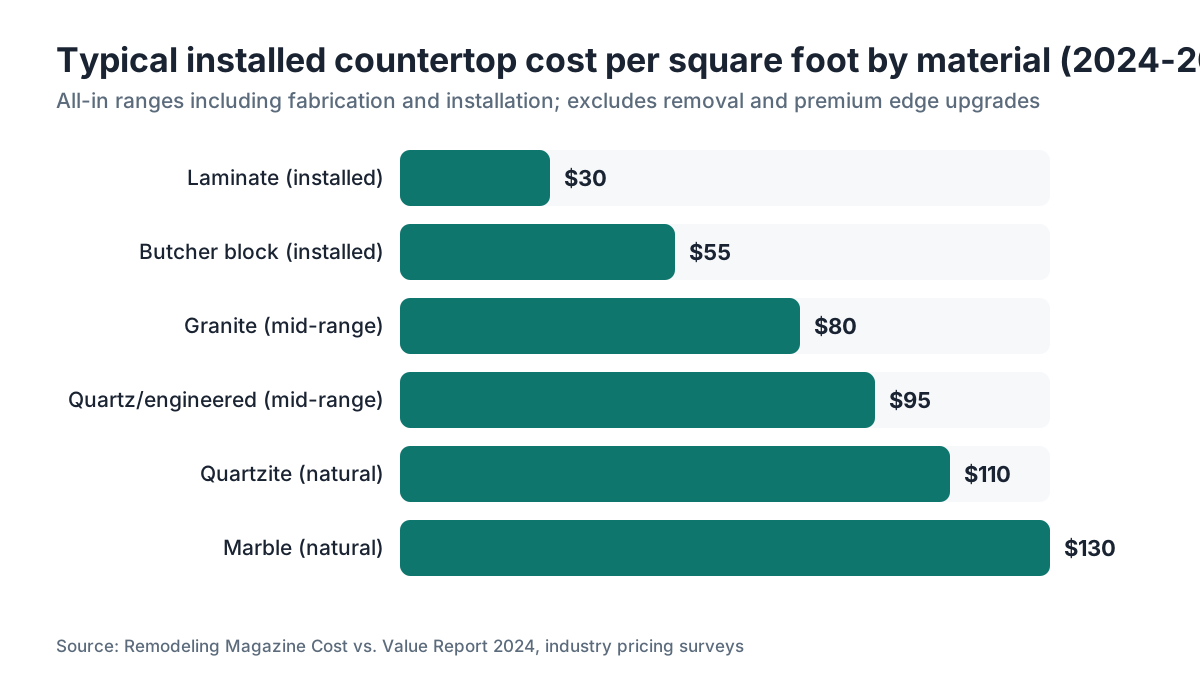
Price per square foot varies widely by material, region, and shop overhead. For installed granite, a rough national range in 2024-2025 is $50-$120 per square foot all-in. Quartz runs $60-$150. Marble can exceed $200 for premium material. A quote well below the low end of local ranges usually means something is excluded, often removal, edge upgrades, or a lower material grade.
What is a remnant countertop, and is it a good deal?
A remnant is a leftover slab piece from a previous job. Shops sell these at reduced prices, often 30-50% below full slab cost, to avoid storing them. They're excellent for small projects: bathroom vanities, laundry rooms, and bar tops. The limitation is that you can't choose color freely; you're limited to what's in stock. Ask your fabricator if they have a remnant yard.
Should I care whether a fabricator uses CNC machines versus hand fabrication?
CNC (computer-controlled) cutting produces more consistent results on standard edges and cutouts than purely hand-cut work, especially on engineered quartz. It also speeds up production. But hand finishing is still required for certain edge profiles, seam work, and material that's too fragile for aggressive machine cutting. Ask what combination they use and see finished samples from both processes.
Can a fabricator fix a countertop that was installed by someone else?
Many can, but most prefer not to, especially for warranty work or seam repairs. If you have a chip, crack, or failing seam from a previous job, some fabricators offer repair-only services. Expect to pay a minimum trip charge ($150-$300 is common). Get a clear scope and price before they touch anything, because some repairs that look simple require a full slab replacement.
What's the difference between fabrication and installation, and does the same company do both?
Fabrication is cutting, edging, and finishing the stone in a shop. Installation is bringing it to your home and setting it on the cabinets. Most full-service fabricators do both. Some shops fabricate and subcontract installation. Home improvement retailers often act as brokers who subcontract both. Knowing who is responsible at each stage matters for accountability when something goes wrong.
How do I check if a fabricator is properly insured?
Ask for a certificate of insurance (COI), not a verbal assurance. The certificate comes from their insurer and shows coverage type, dollar limits, and expiration date. Call the insurer's number on the document to confirm it's active. General liability of at least $1 million per occurrence is standard. Workers' compensation is required in most states if they have employees.
What questions should I ask about sealing and ongoing care?
Ask whether the material needs sealing at all (quartz and solid surfaces don't; most natural stone does), who seals it after installation, whether that's included, and what product they recommend. For natural stone maintenance, our guide on how to clean stone countertops covers what to do after the fabricator leaves. Some stones need re-sealing annually; others are more forgiving.
Can I negotiate the price with a countertop fabricator?
Yes, and it's worth trying. The most negotiable items are usually edge profiles (accepting a simpler edge can knock $200-$500 off a large kitchen), sink cutout fees, and removal fees if you're willing to demo your old countertops yourself. Material price per square foot is harder to move because it's tied to what the shop paid the distributor. Showing a competing quote in writing opens most conversations.
What should I do if I'm unhappy with the installation after the crew leaves?
Document everything the same day with dated photos before moving anything. Contact the fabricator in writing (email, not a call) describing the specific issue. Give them a reasonable opportunity to assess and repair. If they don't respond within a reasonable time frame (five business days is fair), follow up in writing again. If you paid by credit card, a dispute is a last resort but a real option for non-performance.
Do fabricators work with all countertop materials, or do some specialize?
Many fabricators focus on stone (granite, quartz, marble, quartzite) because it needs the most specialized equipment. Solid surfaces like Corian are often fabricated by different shops with thermoforming capabilities. Butcher block and laminate are typically handled by woodworkers or cabinet shops, not stone yards. Ask whether the shop you're talking to has direct experience with the specific material you want.
Sources
- National Kitchen and Bath Association (NKBA) - Cost vs. Value and Project Costs: Countertop installation costs vary widely based on scope, and homeowners frequently underestimate add-on charges for edges, cutouts, and removal.
- U.S. Bureau of Labor Statistics - Construction and Specialty Trade Industries: Regional labor capacity and workforce levels in specialty trade construction vary significantly, affecting lead times for countertop fabrication.
- Cambria - Product Specifications and Slab Dimensions: Engineered quartz slabs come in standardized sizes; Cambria slabs are available in formats including approximately 55 by 120 inches and 63 by 126 inches.
- Laser Products Industries - Digital Templating Technology Overview: Digital laser templating systems produce more accurate countertop measurements than physical luan templates, reducing fitment errors during installation.
- Cambria - Warranty Information: Cambria offers a limited lifetime warranty on its quartz products, subject to conditions including professional installation and proper care.
- U.S. Small Business Administration - State Licensing Requirements for Contractors: Licensing requirements for countertop installers vary by state; some require a contractor's license while others have no specific regulation for this trade.
- Natural Stone Institute - Technical Bulletins and Installation Standards: Industry guidelines indicate that unsupported stone countertop overhangs should not exceed one-third of the total countertop depth, with overhangs beyond approximately 6-8 inches typically requiring support corbels.
- SlabWise - Countertop Fabrication Quoting and Nesting Software: SlabWise is a quoting and nesting platform used by countertop fabricators to track job details, material yield, and pricing in a structured workflow.
- U.S. Occupational Safety and Health Administration (OSHA): Workers injured on a job site may have claims that affect the property owner if the contractor lacks workers' compensation insurance.
- Remodeling Magazine - Cost vs. Value Report 2024: Kitchen countertop replacement costs and value recovery vary by region and material, with mid-range projects averaging significant variation in installed cost per square foot.
- Natural Stone Institute - Stone Care and Maintenance: Most natural stone countertop surfaces require periodic sealing, with frequency depending on stone porosity and household use.
Last updated 2026-07-11