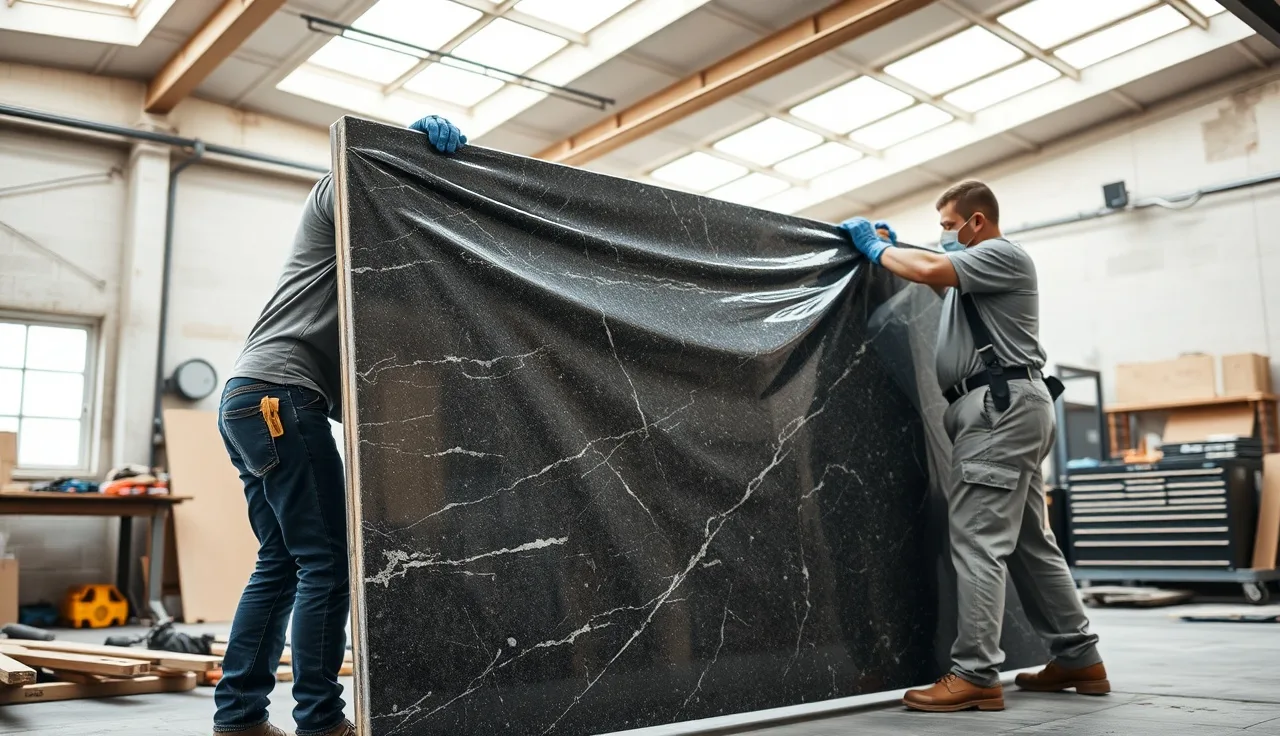
TL;DR
- For countertop delivery, use professional moving blankets rated at 80 pounds per dozen or heavier, sized at least 72x80 inches.
- Cotton-poly fill beats pure polyester at the edges, where stone chips.
- Budget blankets under 50 lbs per dozen are a gamble on stone.
- This guide covers weight ratings, fill materials, how many you need, and how to pad each countertop type.
Why does blanket quality matter so much for countertops specifically?
Countertops are not furniture. A dresser flexes a little, absorbs a bump, keeps going. A granite or quartz slab is rigid and brittle at the edges and corners, and one hard impact in transit can snap a corner off or run a hairline fracture through the field that nobody sees until installation. Marble is less forgiving still. Butcher block and solid wood take abrasion and moisture better than stone, but they still need real protection on the truck.
The blanket does three jobs at once. It cushions impact, keeps surface from touching surface, and holds the piece in place so it can't slide inside the truck. A cheap blanket fails at all three. Thin fill flattens to nothing under a heavy slab, the woven shell snags on a rough truck floor, and sloppy stitching lets the fill migrate to one end and leave a bare spot.
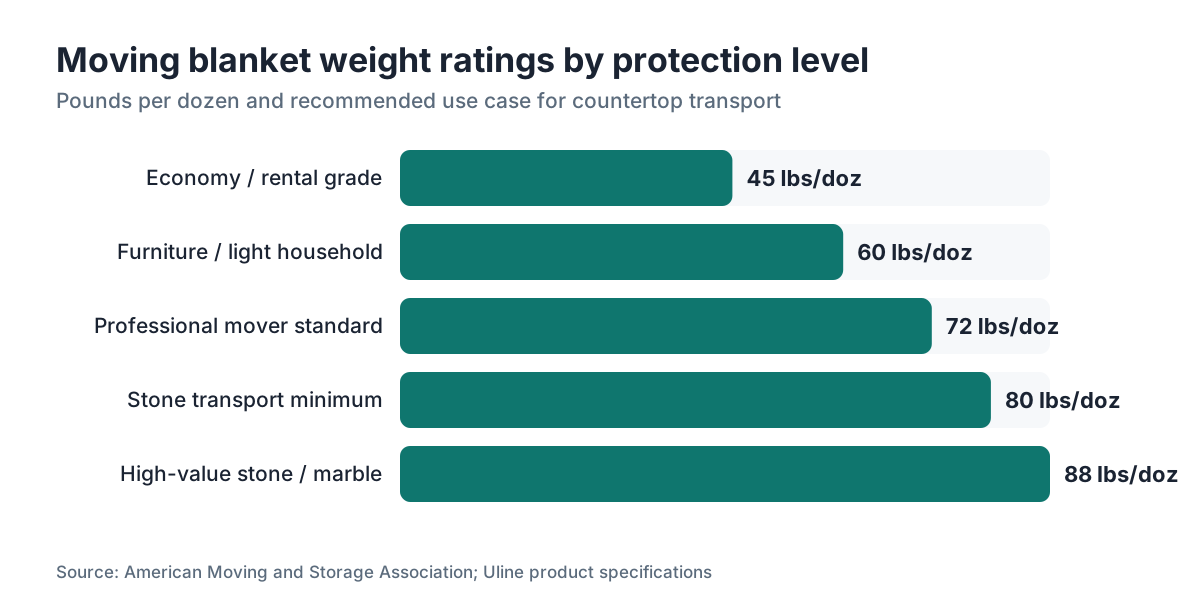
The moving industry rates blankets by "pounds per dozen." You weigh twelve blankets on a scale, and heavier means more fill, which means more cushion. Professional movers run 72 or 80 pounds per dozen as their baseline. For countertops, 80 lbs per dozen is my floor, and 85 to 90 is better for natural stone.
Homeowners renting a truck for a DIY install usually grab the cheap 40 to 50 lb per dozen pads the rental counter offers. Those are fine for a sofa. Under a 200-pound granite slab, they're not protection. They're a comfort blanket for you, not the stone.
What weight rating should moving blankets be for stone countertops?
Match the rating to the material. Stone wants 80 lbs per dozen minimum, and natural stone wants 85 to 90. Softer, lighter materials like laminate and Corian get by on less. Here's the whole spread.
| Countertop Material | Minimum Blanket Weight | Recommended Weight |
|---|---|---|
| Quartz (engineered) | 72 lbs/dozen | 80 lbs/dozen |
| Granite | 80 lbs/dozen | 85-90 lbs/dozen |
| Marble / Quartzite | 80 lbs/dozen | 85-90 lbs/dozen |
| Porcelain slabs | 80 lbs/dozen | 85-90 lbs/dozen |
| Soapstone | 72 lbs/dozen | 80 lbs/dozen |
| Butcher block | 50 lbs/dozen | 72 lbs/dozen |
| Laminate / Formica | 50 lbs/dozen | 72 lbs/dozen |
| Corian / solid surface | 50 lbs/dozen | 72 lbs/dozen |
Those minimums run conservative on purpose. I've talked to shop owners who ran 72 lb per dozen blankets on granite for years with no cracked pieces, but every one of them doubled up at the edges and corners. For a one-time homeowner move, buy heavier and stop thinking about it. For a shop buying a fleet, 80 lbs per dozen gives you one consistent baseline that covers your whole material mix without sorting pads by job.
Porcelain deserves a callout. It's showing up on more jobs every year, and it's genuinely hard to handle: thin (often 6 to 12mm), extremely hard, and quick to chip at the edge in ways granite never would. Treat porcelain like marble. That means 80 lbs per dozen minimum and a double wrap on every edge. [1]
What size moving blanket works for countertop pieces?
For countertop runs, 72x80 inches is the practical minimum, and it's also the most common size on the market. A typical kitchen section runs 96 to 120 inches long and 25 to 26 inches wide. You wrap the blanket around the piece rather than laying it flat, so the 80-inch dimension runs along the length and the 72-inch dimension goes around the cross-section.
Standard blankets come in a handful of sizes. The usual is 72x80 (same thing as 80x72), and some makers offer 72x54 or 80x86.
Long pieces need two blankets overlapped. Set the overlap at 12 inches or more and center it on the longest span. Corners and sink cutouts need their own padding on top of the wrap. Cut a strip of rigid foam or slip a corner protector under the blanket at those points. A blanket by itself will not save a sink cutout corner if the piece shifts.
Small remnants and tile-size cuts wrap best one at a time, each in its own blanket, before you stack them. Stacking bare stone face-to-face is how shops ruin finishes. The surfaces look smooth to your hand. Stone-on-stone contact still scratches a polished finish.
Cotton vs. polyester fill: which material actually protects better?
Cotton-poly blends protect stone better, and fill is exactly where budget blankets cut corners. You'll run into three constructions.
Cotton-poly blends (usually 50/50 or 60/40 cotton to poly) are the professional standard. Cotton adds density and resists flattening under sustained weight far better than pure polyester. The shell is typically a woven cotton cover on both faces. These cost more, last longer, and hold their fill spread after hundreds of uses.
All-polyester fill runs lighter and cheaper. It's fine for lamps and dishes. Under a 150 to 200 pound granite slab for an hour on the highway, polyester fill compresses and migrates, leaving thin spots right where the slab edge digs in. That thin spot is the chip you find at install.
Non-woven blankets, the "economy" or "rental" grade, sandwich a thin fiber-fill layer between two sheets of non-woven polypropylene. That's the pad most truck rental counters hand you. Fine for a bookcase. Wrong under stone.
The math is simple for a shop. A professional 80 lb per dozen cotton-poly blanket from a moving supply wholesaler runs about $12 to $18 each in a case of 12. [2] A granite slab you crack on the truck costs $500 to $2,000-plus to remake and reinstall. A single delivery vehicle needs maybe 8 to 12 blankets. Call it a $150 to $200 buy that insures against a very expensive afternoon.
Homeowners doing one DIY move should rent professional-grade blankets (not the economy pads) from a moving equipment rental company. Those usually run about $2 to $4 per blanket per day.
How many moving blankets do you need for a countertop delivery?
For a typical kitchen with 3 to 5 sections, plan on 12 to 16 blankets minimum. That gives you two blankets per major piece plus extras for backsplash sections and remnants. A full gut with an island pushes you to 20 to 24. There's no single number because it rides on how many pieces you're moving and how complicated their shapes are, but that's the starting point.
The pieces that eat blankets fastest are pre-cut L-shapes and U-shapes. If your fabricator delivers pieces already cut with a sink cutout, each one needs a full blanket wrap plus dedicated corner protection at the cutout.
Here's a rule of thumb from fabricators I've talked to: take your linear feet of countertop, divide by 8, and that's a bare minimum blanket count. A 40-linear-foot kitchen (on the larger end for a home) pencils out to 5 blankets, but you'd really want 10 to 12 because most of that footage lives in separate disconnected pieces, not one long run.
Blankets go under the piece, not only around it. Setting a slab straight on the truck floor with just a wrap invites vibration damage over every seam and pothole. Lay at least one blanket flat on the truck bed, set the piece on it, then wrap more blankets around and lock everything down with stretch wrap or moving straps. Never run a ratchet strap against bare stone. A blanket goes between the strap and the surface every time.
What specific brands or product lines do professional fabricators use?
Honest answer: no independent lab certifies moving blankets the way UL certifies electrical gear. "Pounds per dozen" is a number you get by weighing a dozen blankets, and manufacturers aren't lying about it, but it tells you nothing about how the fill is distributed or how the blanket holds up after 200 washes.
Still, a few product lines have earned steady reputations in stone and moving work.
AMOVER, Sure-Max, and similar mid-to-high-tier blankets sold through distributors like Uline usually land in the 80 to 85 lb per dozen range with honest cotton-poly fill. Uline's own catalog blankets are a common fleet buy for stone shops because the specs hold steady from order to order. [2]
Annie's Woolens and other quilted cotton pads built for antiques transport go heavier, sometimes 90-plus lbs per dozen, and they're excellent for high-value marble. They're also expensive and overkill for engineered quartz.
If you're building out a delivery operation, buy straight from a moving supply wholesaler (Uline, Rocky Mountain Mover's Supply, and the like). You get better pricing than retail and you can ask for spec sheets. Request the fill composition and the weight per dozen in writing before you order.
Skip anything sold in a retail store as a "furniture pad" with no weight rating printed on it. A missing weight rating is the red flag. If they won't tell you the number, the number isn't good.
Should you use shrink wrap, straps, or tape to secure the blanket?
Use stretch wrap over the blanket. Never tape directly on polished stone. Stretch wrap (also called shrink wrap or pallet wrap, though it doesn't shrink) holds the blanket to the piece without adhesive. Tape residue is a pain to remove, and on softer stones like marble or quartzite the adhesive can etch the surface.
Stretch wrap goes over the blanket, not against the stone. Spiral it around several times, pulling tension on every pass. On long pieces, start at one end, spiral to the other, then double back. You want the blanket and the piece to move as one unit so nothing shifts on the road.
Moving straps are fine for securing pieces to the truck wall or an A-frame rack, but the strap goes over a blanketed piece, never on bare stone. A ratchet strap with 500-plus pounds of tension riding on a 2-inch band will crack most stone at the contact point. [9]
A-frame racks (also called stone transport racks or saddle racks) are how professional shops move slabs. The piece stands nearly vertical against the rack's padded arms, and blankets fill the gaps between pieces. The Natural Stone Institute recommends orienting slabs at roughly 15 degrees from vertical to cut stress and movement in transit. [10] If you deliver countertops regularly, an A-frame plus good blankets removes most of the damage risk that flat transport builds in. Load securing is also a legal duty for commercial vehicles: the Federal Motor Carrier Safety Administration requires cargo to be secured against shifting under 49 CFR Part 393, and OSHA covers safe material handling for the crew loading and unloading. [3][4]
Are there other padding materials you should use alongside moving blankets?
Blankets are the main layer, but a few other materials fill gaps blankets can't.
Closed-cell foam sheeting, the kind sold as pipe insulation or as craft foam in 1/4-inch and 1/2-inch sheets, is the best thing going for corners and cutout edges. Cut a strip, wrap it around a corner, then run the blanket over it. Foam holds its shape under pressure where blanket fill just flattens.
Cardboard corner protectors (the L-shaped furniture kind) work in a pinch and cost almost nothing, but they're single-use and cardboard crushes. Foam or rubber corner guards are reusable and more reliable.
Bubble wrap has almost no place in stone transport. It isn't dense enough to absorb the impact a heavy slab generates, and it traps moisture against the surface on a long haul. Skip it.
For marble countertops, some fabricators lay a sheet of kraft paper between the polished face and the first blanket. That stops the woven blanket texture from leaving micro-scratches on a high-gloss polish under vibration. Sounds fussy. It's a real problem on mirror-polished Calacatta.
Non-slip padding, the rubbery mesh sold as drawer liner, keeps pieces from sliding on truck floors and A-frame arms even with blankets in place. Cheap, reusable, worth having in the truck.
How do moving blanket needs differ by countertop material?
Each material has its own weak point, and your padding should track the risk. Stone wants impact and corner protection. Wood wants dryness. Laminate wants full-length support. Here's how that breaks down.
Granite countertops are dense and tough, but corners chip and hard impacts crack through the field. The 80 lb per dozen standard fits, with foam protection on every outside corner.
Marble countertops are softer, around 3 to 4 on the Mohs scale against granite's 6 to 7, so they abrade more easily. [7] Use heavier blankets and put kraft paper on the polished face. Marble reacts to acid too, so keep the blankets dry and clean.
Engineered quartz is among the most chip-resistant materials in the category, but it's not bulletproof. Standard 80 lb per dozen blankets do the job. The real risk with quartz is weight: a 3cm slab piece can run 15 to 20 pounds per square foot, so the strength of your transport setup matters more than the blanket spec by itself. [5]
Butcher block countertops need moisture protection more than impact protection. A wet blanket against wood for a few hours raises the grain or swells it. Load wood dry, keep it dry.
Laminate countertops and Formica are lighter and more flexible, and they warp if you transport them flat without support. Use blankets for surface protection, but support the piece along its full length instead of letting it cantilever off the ends.
Soapstone is dense and heavy like granite, but its surface is softer and shows scratches more because it's usually oiled. The how to clean soapstone countertops guide gives a sense of how delicate that finish is. Double-wrap it, and touch up with a little oil on arrival if anything rubbed the surface.
What should homeowners check before accepting a countertop delivery?
Before the crew unwraps anything, walk the vehicle and see how the pieces were loaded. Are they wrapped in blankets? Are they standing on an A-frame rack, or lying flat in the bed? Flat transport carries more risk. Pieces sliding around loose is a bad sign, and it's the moment to say something.
As the crew unwraps each piece, inspect it right then, in good light, before anyone leaves. Run your hand along every edge and corner. Look across the surface at a low angle (raking light) to catch scratches. Check the underside too, not only the top.
Find a chip or crack, photograph it before the crew leaves, and note it on the delivery paperwork. Most fabricators make good on transit damage, but documentation is what settles it. Once you've signed off and the crew is gone, the burden of proof swings to you.
Countertop installation starts the second pieces arrive on site. Damage found during install that nobody noted at delivery turns into a dispute, and those go badly for everyone in the room.
One practical move: if you're having kitchen countertops put in and want to see the slabs at the shop before they're cut, that's always a fair ask. You'll see the raw material and can flag natural fissures or inclusions that might otherwise read like damage later when they were in the stone all along.
How should fabricators think about blanket inventory and replacement cycles?
Treat your blanket fleet like a piece of equipment, the same way you treat your truck tires. Professional-grade blankets last 3 to 5 years in regular use if you wash them and store them dry. [6] Fill migrates over time toward the edges and ends, leaving thin spots in the middle. When a folded blanket feels thin in the center, retire it to a non-critical use (shop floor protection) and replace it.
A shop running 2 to 3 deliveries a week might retire 2 to 3 blankets a year. A high-volume shop doing 10-plus deliveries a week should plan to swap out about a quarter of the fleet each year.
Buy in cases of 12. Blankets sold one at a time at retail run 30 to 50% more per unit than case pricing from a moving supply distributor.
If you track job costs closely, software like SlabWise lets you put delivery materials (blanket amortization, truck time) into quotes as line items, so those costs stop hiding in overhead. Delivery materials that aren't in your quote are subsidized somewhere else, usually your margin.
Wash blankets quarterly, more often if they're catching stone dust. Dust trapped between a blanket and a polished face works like sandpaper. A clean blanket and a dusty one are different tools that happen to look alike.
What are the most common blanket mistakes that cause countertop damage?
Most job-site damage traces back to a short list of avoidable moves. Fix these and you fix most of your breakage.
Too few blankets. One per piece feels like protection. It isn't. Two minimum, with corners padded on their own.
Ratchet straps on bare stone. Common. Very bad. A blanket goes between the strap and the surface, always.
Dirty or wet blankets. Stone dust scratches the finish. A wet blanket stains some stones. Keep them clean and dry.
Stacking stone face-to-face. Even with each piece wrapped, stacking pieces face-to-face without a full blanket layer between every pair is a gamble. Give each piece its own complete wrap.
Blankets that slip in transit. A blanket that slides to one end leaves the other end bare. Stretch wrap locks it. Use it every time.
Rushing on delivery day. Most damage happens in the last 20 feet, carrying pieces from the truck into the house. That's where people tire out, corners catch door frames, and someone sets a piece down on bare concrete. Slow down exactly there.
For keeping finished tops looking new after they're in, the how to clean stone countertops guide covers the maintenance that holds the finish.
Frequently asked questions
Can I use regular furniture pads instead of moving blankets for countertop delivery?
Only if the furniture pads are rated at 72 lbs per dozen or heavier with cotton-poly fill. Many retail furniture pads carry no rating and use thin polyester fill that flattens under stone. Check the weight rating before putting them on granite, quartz, or marble. If no weight is printed on the product, it isn't adequate for stone transport.
How do you wrap an L-shaped countertop section for delivery?
Wrap each leg of the L on its own before wrapping the whole piece. Start with foam corner protection at the inside corner, which is the highest-stress point, then wrap one blanket around the full perimeter. Add a second blanket focused on the inside corner and the two outside corners at the ends. Secure it all with stretch wrap, pulling firm tension on every pass.
Do moving blankets protect against water damage during delivery?
Not meaningfully. Standard moving blankets soak up water instead of shedding it. If rain is possible on an open-truck delivery, add a poly sheeting layer over the blanketed pieces. Butcher block is the biggest concern, since moisture in transit raises the wood grain. Keep blankets dry in storage so they aren't already damp when you load.
How many moving blankets does a professional stone fabricator typically carry in their delivery truck?
Most shops keep 20 to 30 blankets in the delivery vehicle for a typical day. That covers 12 to 16 for the main delivery plus extras for backsplash pieces, remnants, and surprises. High-volume shops running multiple deliveries a day may carry 40 or more and restock at the shop between runs.
Is it worth buying moving blankets for a one-time DIY countertop installation?
Renting is usually the smarter call for a one-time job. Moving equipment rental companies (not the truck rental counters) often stock professional-grade blankets at $2 to $4 per blanket per day. If you'd rather buy, a case of 12 at 80 lbs per dozen runs about $150 to $200 from a moving supply distributor, and you can resell them after the job or keep them around.
Will moving blankets scratch a polished marble or granite surface?
A clean blanket with a smooth woven face generally won't scratch polished granite. Marble is softer and more abrasion-sensitive. For mirror-polished marble, some fabricators put clean kraft paper or plastic sheeting between the face and the blanket so the woven texture can't leave micro-scratches under transport vibration. The bigger scratch risk is a dirty blanket carrying embedded stone dust.
What is the pounds-per-dozen rating and where does it come from?
It's exactly what it sounds like: the weight of twelve blankets on a scale. Manufacturers weigh a dozen of their blankets and report the number. Heavier means more fill, which means more cushion. No third party certifies the figure, but it's consistent and honest. Professional movers use 72 to 80 lbs per dozen as their minimum; for stone transport, 80 lbs per dozen is the floor.
Can you use moving straps directly against a countertop surface?
No. Moving straps, ratchet straps especially, concentrate several hundred pounds of tension on a narrow edge. On stone that builds a stress point that can chip or crack the piece at the contact spot. Put at least one full layer of moving blanket between any strap and a stone surface. This goes for truck tie-down straps and for any straps used to carry the piece.
How do you transport a sink cutout countertop piece without chipping the cutout corners?
Cutout corners are the highest chip risk on any piece. Put a foam corner guard or a folded piece of closed-cell foam at each inside corner of the cutout before wrapping with blankets. Foam holds shape under pressure where blanket fill flattens. Wrap the full piece in at least two blankets afterward and secure with stretch wrap. Transport it upright on an A-frame rack if you can.
What's the difference between moving blankets and stone transport pads sold by fabrication suppliers?
Stone transport pads from fabrication suppliers are typically heavier, carry reinforced edges, and sometimes use rubber-backed or non-slip faces built for stone. They cost more but they're purpose-made. Standard moving blankets work well when used right, but if you deliver stone every day, purpose-built pads last longer and hold up better at the edges and corners where damage usually starts.
How should you store moving blankets in a fabrication shop to keep them in good condition?
Store blankets flat or loosely folded in a clean, dry spot away from stone dust. Hanging them on a rack is ideal because it keeps the fill evenly spread. Don't store them crushed under heavy objects, which forces fill migration. Wash them when they look dusty or dirty, since embedded stone dust abrades polished surfaces. Most cotton-poly blankets machine-wash fine on a gentle cycle.
Are there OSHA or DOT rules about how countertops must be secured during delivery?
For commercial vehicles over 10,001 lbs GVWR, the Federal Motor Carrier Safety Administration requires cargo to be secured against shifting or falling under 49 CFR Part 393. Stone transport falls under those cargo securement rules. OSHA's general industry standards also cover safe material handling for workers loading and unloading. Proper blanket-and-strap securing is both a product protection issue and a compliance issue for commercial deliveries.
Sources
- Natural Stone Institute (formerly Marble Institute of America), Stone Fabrication and Handling: Porcelain and thin stone slabs are particularly susceptible to edge chipping during transport and require reinforced edge protection
- Uline, Moving Blankets product catalog: Professional moving blankets rated at 80 lbs per dozen with cotton-poly fill are available from moving supply distributors at approximately $12-18 per blanket in case quantities
- OSHA, Materials Handling and Storage guidance: OSHA general industry standards cover safe material handling practices for workers loading and unloading heavy materials
- FMCSA, Cargo Securement Rules 49 CFR Part 393: Federal Motor Carrier Safety Administration regulations at 49 CFR Part 393 require cargo on commercial vehicles to be secured against forward, rearward, and lateral movement
- Cambria, Product Specifications and Technical Data: Engineered quartz slabs at 3cm thickness can weigh approximately 15-20 pounds per square foot depending on the specific product
- American Trucking Associations / American Moving and Storage Association, Professional Mover Standards: Professional-grade moving blankets used in regular commercial moving operations have an expected service life of 3-5 years with proper maintenance and storage
- Natural Stone Institute, Handling and Installation Guidelines: Marble has a Mohs hardness of approximately 3-4, making it significantly more susceptible to surface abrasion than granite which rates 6-7 on the Mohs scale
- FMCSA, Cargo Securement Standard Requirements Summary: Cargo securement requirements apply to commercial motor vehicles with a gross vehicle weight rating over 10,001 pounds operating in interstate commerce
- Uline, Stretch Wrap and Moving Supply Product Guide: Stretch wrap applied over moving blankets is the industry standard method for securing blankets to furniture and building materials during transport without using adhesive tape against finished surfaces
- Natural Stone Institute, Slab Transportation Best Practices: A-frame racks oriented at approximately 15 degrees from vertical are the recommended transport configuration for stone slabs to minimize stress and movement during delivery
Last updated 2026-07-11