TL;DR
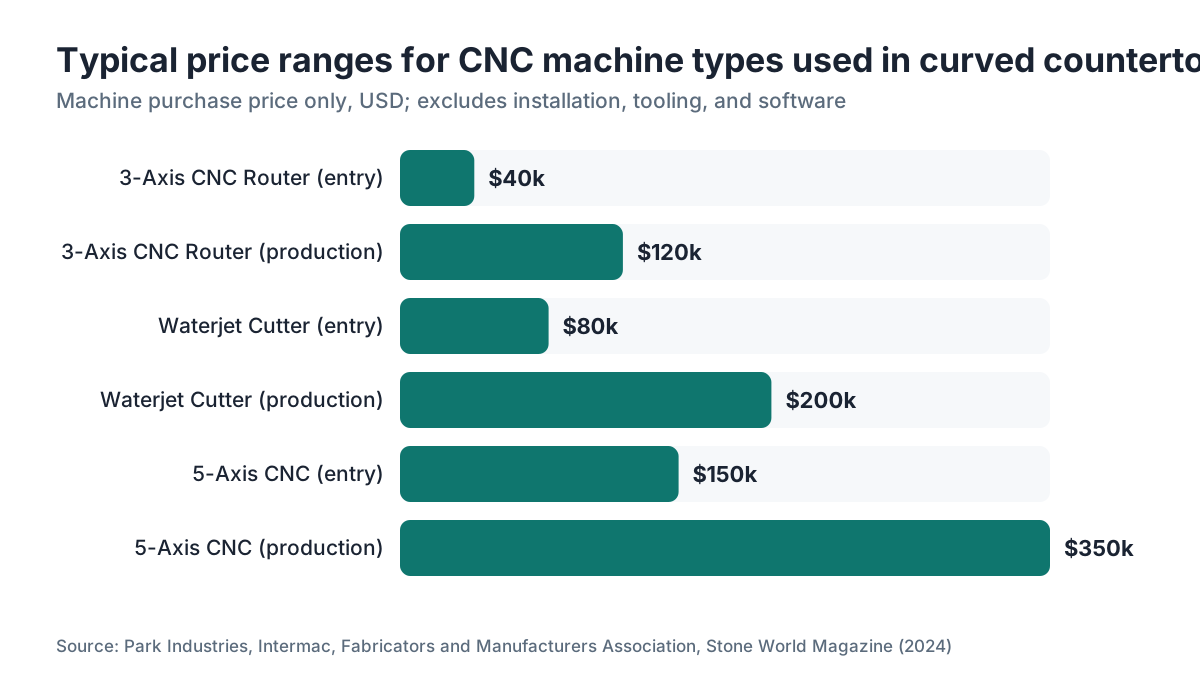
- For curved countertop fabrication, a 3-axis CNC router with a stone spindle covers most shops at $40,000 to $120,000.
- Shops cutting true 3D curves, mitered returns on a radius, and complex sink profiles get the most from a 5-axis CNC at $150,000 to $350,000.
- Waterjet cuts any curve but runs slower and wetter.
- Your material mix and annual volume decide which machine pays.
What makes curved countertop fabrication different from straight cuts?
A straight cut is a bridge saw problem. Clamp a slab, make a pass, repeat. Curves are harder because the tool has to travel a continuous arc while holding one edge profile the whole way, and that means the machine needs simultaneous multi-axis motion instead of simple X-Y positioning.
The geometry gets demanding fast. A curved island top might have a 4-inch inside radius, a full bullnose or ogee around the perimeter, and a sink or cooktop cutout in the field. That mix asks the tool to tilt, rotate, and feed at the same time. A machine that moves only in three linear axes can shape the outline, but it leaves the edge profile as a separate hand step or a second-machine step. A 5-axis machine does both in one setup.
Material matters too. Granite countertops and engineered stone like Cambria countertops are hard and abrasive, so tooling costs and spindle RPM run higher than for softer marble countertops or Corian countertops. A machine dialed in for granite runs Corian fine. The reverse is not true, because solid surface needs lower speeds and different tooling or the material melts.
Here is the practical consequence. Shops that do mostly straight kitchen runs with a few curved islands get by with a good 3-axis CNC plus hand finishing. Shops where curved custom work is 30 percent or more of revenue feel that compromise in labor time and edge consistency every single week.
What are the main types of CNC machines used in countertop shops?
Four machine categories matter before you start calling dealers.
3-axis CNC router (bridge-style). The gantry moves in X and Y, the spindle moves in Z, the worktable stays fixed. This is the most common CNC in stone shops. It profiles edges, cuts sink openings, and follows curved perimeters well as long as the curve is a 2D shape that lives in a flat plane. Price runs roughly $40,000 to $120,000 for a production-grade stone machine [1]. Most fabricators who do curved countertops own one.
5-axis CNC machining center. Adds two rotational axes (usually A and B, or A and C depending on the builder) so the spindle can tilt and rotate while moving through space. That lets the machine undercut, carve 3D surface features, match complex sink profiles, and cut angled edges in a single fixture. Entry price starts around $150,000, and production models run $250,000 to $350,000 or more [2]. The payback comes from labor saved on manual edge work and from jobs competitors cannot take.
Waterjet cutter. Uses a high-pressure water-abrasive stream (typically 60,000 to 90,000 PSI) to cut stone without heat [3]. It shines on detailed 2D curves, inlays, and materials that chip under rotary tools. It runs slower than a CNC router on most countertop work and needs a water management system. Expect $80,000 to $200,000 for a production table [4].
CNC bridge saw with tilting head. A bridge saw that tilts the blade to 45 degrees or more. Good for miter cuts and beveled straight edges. It is not a curved-surface machine and cannot follow an arc. A useful companion to a CNC router, not a substitute.
Most busy shops land on a bridge saw plus a 3-axis CNC. The ones doing high-end custom work add a 5-axis or a waterjet over time.
How does a 3-axis CNC compare to a 5-axis for curved stone work?
The honest comparison turns on what you mean by "curved."
A 3-axis CNC follows any 2D curve perfectly. Hand it a DXF or DWG of a curved island top and it traces the perimeter, profiles the edge with a bullnose or eased-edge wheel, and cuts the sink opening. That covers most curved countertop work in residential kitchens. Edge quality on a good 3-axis machine with a quality diamond profile wheel is very hard to tell apart from 5-axis work on those same profiles [5].
Where 3-axis falls short: any edge that puts the tool at an angle other than vertical, any feature that wraps around a curved surface in 3D, and compound-angle miter joints on curved sections. Build a curved waterfall edge with a mitered return on a radius, and a 3-axis machine needs secondary setups, jigs, or hand work. A 5-axis machine cuts that in one pass.
Here is the head-to-head:
| Feature | 3-Axis CNC | 5-Axis CNC |
|---|---|---|
| 2D curved perimeter | Yes | Yes |
| Sink cutout in field | Yes | Yes |
| Vertical edge profiles (bullnose, ogee) | Yes | Yes |
| Angled/beveled curved edges | No (requires secondary) | Yes |
| 3D surface relief or carving | No | Yes |
| Curved miter joints | No | Yes |
| Typical price range | $40K-$120K | $150K-$350K |
| Setup time per curved piece | Lower | Higher |
| Operator skill required | Moderate | High |
For a shop doing 10 to 20 curved tops a month, a 3-axis CNC handles 80 to 90 percent of those jobs cleanly. The 5-axis buy makes sense when the remaining 10 to 20 percent carries enough revenue, or when the shop is deliberately chasing high-end custom architectural work.
Brands worth knowing in the 3-axis stone CNC space include Park Industries (U.S.-based, strong service network), BACA Systems, and the Italian builders like Intermac and Comandulli. In 5-axis, Donatoni and Brembana are the names most fabricators mention first [2].
Is a waterjet cutter better than a CNC router for curved stone countertops?
Waterjet and CNC router are genuinely different tools, not two answers to the same job.
A waterjet cuts by erosion. No rotary tool touches the stone, so there is zero chip-out risk on brittle materials and no edge heat. For very tight inside radii, thin inlay strips, or materials like onyx that crack under vibration, waterjet is often the better call. The waterjet edge on granite comes out slightly rougher than a polished diamond wheel leaves, so curved perimeter edges still need polishing after the cut [3].
Speed is the weak point. A 3-axis CNC router running a 3/4-inch diamond profile wheel cuts and profiles a curved edge in one pass at 15 to 25 inches per minute on granite. A waterjet cutting the same profile runs closer to 8 to 12 inches per minute and adds a separate polishing step [4]. On a full curved island perimeter, that gap adds up.
Where waterjet wins outright: inlay work (cutting matching curved pieces from different slabs), mosaic borders, custom curved sink cutouts in thin porcelain, and any shape so detailed that a rotary tool cannot reach the geometry. The Fabricators and Manufacturers Association notes that waterjet is particularly strong for decorative stone inlays and detailed pattern work [4].
A shop that runs decorative inlay work as a real revenue line should own a waterjet. A shop that does curved countertops with standard edge profiles does not need one to compete.
What machine specs actually matter for curved countertop work?
Dealers hand you a spec sheet a page long. Here is what matters and what is noise.
Spindle power. For granite and engineered quartz, you want at least 11 to 15 kW (roughly 15 to 20 HP) at the spindle. Softer materials like marble countertops or Corian countertops run fine at 7 to 11 kW. Underpowered spindles stall on hard stone and burn tooling fast.
Table size. Full slabs run 55 by 120 inches or 63 by 126 inches. Your table needs to handle at least 60 by 130 inches to process a full slab without repositioning. Repositioning mid-slab adds time and introduces registration error, which shows up in curved pieces as a slight kink at the seam point.
Z-axis travel. At least 8 inches of Z travel for most countertop work. Thicker mitered edges or stacked profiles need more. 12 inches is comfortable.
Controller and CAM software compatibility. The machine is dead weight without a CAM workflow that turns your template or digital layout into toolpaths. Confirm the controller accepts standard G-code and that your CAM software supports the machine. Most stone-specific CNCs use controllers from Siemens, Fanuc, or a proprietary system from the builder. Have this conversation before you buy.
Vacuum table vs. mechanical clamps. A vacuum table sets up faster for varied shapes. Mechanical clamps hold better on small pieces or porous stone where suction cups lose grip. Most production stone CNCs run vacuum with backup clamp options.
Water management. Stone CNCs run wet. You need a slurry system, a settling tank or filter press, to pull stone slurry out of the recycled water. Undersizing this is a common mistake that turns into maintenance headaches within six months of install [5].
Service network. Not glamorous, but real. A machine down two weeks waiting on a part from Italy costs more than any spec difference. Park Industries and BACA run U.S.-based service teams. European brands have North American dealers, but response times vary. Ask current owners in your region, not the dealer.
How much does a CNC machine for curved countertops actually cost?
The sticker price is only part of the number.
Here is a realistic all-in picture for each category:
| Machine Type | Machine Price | Installation & Electrical | Tooling (Year 1) | CAM Software | Training | Total Year-1 Cost |
|---|---|---|---|---|---|---|
| 3-Axis CNC Router | $40K-$120K | $5K-$15K | $8K-$20K | $3K-$10K | $2K-$5K | $58K-$170K |
| 5-Axis CNC | $150K-$350K | $15K-$30K | $15K-$30K | $8K-$20K | $5K-$15K | $193K-$445K |
| Waterjet Cutter | $80K-$200K | $10K-$20K | $5K-$15K | $3K-$8K | $2K-$5K | $100K-$248K |
Installation covers electrical service upgrades (stone CNCs often need 3-phase power at 200 to 400 amps), compressed air lines, and floor reinforcement. Older shops often need a $5,000 to $15,000 electrical panel upgrade they never budgeted for [6].
Tooling is the ongoing cost that surprises new owners. Diamond profile wheels for granite run $300 to $800 each and last 400 to 800 linear feet of edge profiling, depending on granite hardness. A shop doing 50 curved tops a month can spend $1,500 to $3,000 a month on tooling alone [5].
Financing runs through equipment lenders and SBA 7(a) loans for qualifying small businesses. The SBA 7(a) program allows loan amounts up to $5 million for equipment, and the maximum interest rate is pegged to the prime rate plus a spread the lender sets [7]. A $120,000 CNC financed over 60 months at 9 percent works out to roughly $2,490 a month, which a shop running 15 to 20 curved tops a week can usually cover from the added revenue.
Which CNC brands do stone fabricators actually use for curved work?
Brand preference in stone CNC runs regional and relationship-driven, but the same names come up again and again.
Park Industries (U.S.) is the most common brand in North American stone shops for 3-axis work. The TITAN and SABER lines are built for stone. Service is U.S.-based, parts sit in domestic stock, and the dealer network is the densest in the country. Most fabricators who start with a Park machine stay with them on the second buy.
BACA Systems (U.S.) takes a different tack, building automated lines that pair CNC routing with robotic handling. Their Robo SawJet combines waterjet and saw functions. Aimed at higher-volume shops that want automation past the CNC itself.
Intermac (Italy, Biesse Group) is strong in the 3-axis to 5-axis transition range. The Master line handles complex edge profiles and shows up in shops doing architectural stone alongside countertops.
Comandulli (Italy) specializes in edge polishing and profiling machines that run alongside CNCs. Not a standalone CNC, but worth knowing if edge quality is your bottleneck.
Donatoni (Italy) and Brembana (Italy) are the standard references for 5-axis stone machining. High-end custom fabricators and monument shops run these. Price and complexity both climb, and you need a dedicated operator with real training.
MultiCam and MultiCam Stone serve smaller or newer shops entering stone CNC for the first time. Entry-level pricing, U.S. support, reasonable for solid surface and softer stone.
For solid surface and engineered materials like Corian countertops, standard woodworking CNCs from Thermwood, AXYZ, or ShopBot run fine with the right tooling, and they cost less than purpose-built stone machines. Do not buy a $100,000 stone CNC to cut Corian all day.
How do you pick the right machine for your shop's volume and job mix?
The "best" machine is the one that pays for itself in your shop. That means being honest about two numbers: your actual curved-work volume today, and where you realistically expect it in three years.
A shop doing 5 to 10 curved jobs a month can justify a 3-axis CNC if most of those are standard radius work with eased or bullnose edges. The labor saved on manual grinding and polishing, plus the consistency gain, typically turns the machine cash-flow positive in 18 to 30 months depending on local labor rates [5].
A shop doing 20-plus curved jobs a month with a real share of compound edges, inlays, or architectural detail should model the 5-axis or waterjet add. The question is not whether those machines can earn their ROI. It is whether your sales pipeline supports the added capacity and whether your team has or can build the operator skill.
Here is a simple decision framework:
- Fewer than 10 curved tops a month, standard profiles: 3-axis CNC, $40K-$120K range.
- 10 to 30 curved tops a month, varied profiles, no 3D work: 3-axis CNC at the higher end with strong CAM software.
- 30-plus curved tops a month OR significant architectural/3D work: model the 5-axis add. It will probably pencil out.
- Heavy inlay and decorative work at any volume: add a waterjet. It opens a revenue category with higher margins.
Fabricators keep underestimating one thing: CAM software and template accuracy. A $200,000 5-axis machine cutting from a bad template makes scrap at $200,000-machine speed. Shops that invest in accurate digital templating (laser or structured-light systems) and CAM software that spits out clean toolpaths see a bigger jump in curved-work quality than shops that upgrade the machine and keep paper templates. For quoting and nesting those jobs, tools like SlabWise help fabricators see material yield and job profit before the stone ever hits the machine.
What role does CAM software and digital templating play in curved cuts?
A CNC is only as accurate as the file it gets. For curved countertops, that file comes from a template, a laser measurement, or a structured-light 3D scan of the actual space.
Paper templates work, but they add human error at the step where the template shape gets digitized into a CAD/CAM file. Laser templating systems like those from Prodim or Laser Products Industries capture the curve digitally at the measurement step, so the file the CNC receives is a direct read of the space, not a copy of a paper copy.
CAM software turns the shape file into toolpaths. For curved countertop work, the CAM software needs to handle:
- Smooth arc interpolation (so curves are true arcs, not polygon approximations)
- Offset compensation for tool diameter
- Edge profile tool selection and depth passes
- Roughing and finishing passes on hard stone
Most CNC builders sell or recommend a specific CAM package. ETemplate, Slabsmith, and Alphacam Stone are the stone-specific names fabricators mention. For simpler solid-surface and laminate work, VCarve and Aspire work well.
The digital chain from template through CAM to machine output is where curved jobs come out clean or come out as expensive scrap. Budget for real CAM training alongside the machine. Skipping it is the top reason new CNC owners are unhappy with their curved-work results in the first six months.
Can you cut curved laminate and solid-surface countertops on the same machine as stone?
Technically yes. Practically, it depends on how much of each material you run.
Solid surface like Corian and its competitors cuts at much lower speeds than stone and needs different tooling: spiral upcut or downcut router bits instead of diamond wheels. Run those at stone-machine speeds and you get melted edges and tool failure. Most stone CNCs can drop to the lower RPMs solid surface needs, but then you are running a purpose-built stone machine at a fraction of its capability.
Laminate countertops and Formica countertops are softer still and cut fine on any CNC router with a sharp carbide bit. The curved edge profiles on laminate usually get done with a router and bearing-guided bits at the bench, not on a CNC, because laminate tops typically ride on a post-form substrate that is already curved.
Butcher block countertops cut well on wood CNCs. A stone CNC for wood is a bad idea because the wet cutting environment rusts the wood workholding components.
If your shop runs a real mix of stone and solid surface, a stone CNC with a second spindle or a tool changer that holds both diamond wheels and router bits runs both materials in one footprint. Ask the dealer about this configuration specifically before you buy.
What safety and shop setup requirements come with a stone CNC?
Stone CNCs are not plug-and-play. The shop requirements are real, and skipping them creates problems within months.
Electrical. Most production stone CNCs need 3-phase power at 208 to 480 volts. Many older shops run single-phase or lack the amperage. Budget $3,000 to $15,000 for a service upgrade if you are not already on 3-phase [6].
Floor load. A production stone CNC with a full slab on it can weigh 8,000 to 15,000 pounds. Verify your floor slab is rated for that point load. A structural engineer review costs $500 to $1,500 and earns back every dollar before you buy.
Water and drainage. Stone cutting uses water nonstop. You need a slurry pit or settling tank to capture the water-slurry mix, let solids settle, and recirculate clean water. OSHA's general industry standards (29 CFR 1910) require that waste water carrying crystalline silica not be discharged untreated to storm drains [8]. Many municipalities set their own discharge limits, so check with your local water authority before you build the system.
Silica dust exposure. Dry cutting and grinding stone throws respirable crystalline silica dust, which causes silicosis, a serious progressive lung disease. OSHA's silica standard for general industry (29 CFR 1910.1053) requires fabricators to measure worker exposure and keep it below the permissible exposure limit of 50 micrograms per cubic meter as an 8-hour time-weighted average [8]. Wet cutting cuts dust dramatically, which is one reason all production stone CNCs run wet. NIOSH has documented silicosis cases specifically among engineered stone (quartz) countertop fabricators and recommends wet cutting, local exhaust ventilation, and respiratory protection [9].
Compressed air. Vacuum tables and tool changers need a steady air supply, typically 100 PSI at 10 to 15 CFM sustained. Size your compressor for it.
Machine guarding. Most CNCs have interlocked enclosures that stop the spindle when a door opens. Do not defeat these. Fragments from a broken diamond wheel are a serious injury hazard.
How long does it take to learn to run a CNC for curved countertop fabrication?
Honest answer: basic machine operation, loading slabs, starting programs, watching a run, takes one to two weeks for a motivated employee with no CNC background. Running it well, toolpath setup, tool changes, CAM file prep, and troubleshooting, takes three to six months of regular use.
For 5-axis machines, add real time. The geometry is more complex, a setup error costs more (you can crash a 5-axis head into a slab or the table in ways a 3-axis machine makes harder), and the CAM software is harder to learn.
Most builders include operator training in the purchase price, typically two to five days on-site after install. That covers the basics. Skill past that comes from running jobs, watching what happens, and having someone to call when something breaks. The dealer relationship earns its keep here.
Online resources from builders, forums like the Stone Fabricators Alliance community, and trade shows like TISE (The International Surface Event) are real places fabricators trade curved-work technique. TISE runs machine demos from most major brands, and it is worth attending before a purchase if you are spending over $100,000 [10].
Frequently asked questions
Can a 3-axis CNC cut a curved countertop with an ogee edge?
Yes. A 3-axis CNC follows a curved perimeter in the X-Y plane and profiles the edge with a diamond ogee wheel in the Z axis. The limit is that the edge must be vertical. If you need the ogee on a curved edge that also carries an angled or compound miter, you need a 5-axis machine or secondary hand work. For most residential curved countertops, 3-axis is fully capable.
What is the minimum CNC machine size (table) for countertop fabrication?
You need a table that handles at least 60 by 130 inches to process a full slab without repositioning. Repositioning introduces registration error that shows up as a slight offset on curved pieces. Some entry-level machines have 48-by-96-inch tables, which forces you to cut slabs in sections, adding time and seam risk.
Is waterjet cutting better than CNC routing for radius countertops?
For most radius countertop work, a CNC router is faster and leaves an edge that polishes more easily. Waterjet is better for very tight inside radii, brittle materials like onyx, and inlay work where two dissimilar materials have to fit perfectly. Many high-end shops own both and route jobs to each machine based on the specific geometry and material.
How much does it cost to cut a curved countertop on a CNC?
Fabricators typically charge $15 to $40 per linear foot for curved countertop edges, and CNC machine time on a curved top runs 20 to 45 minutes depending on complexity and perimeter length. Machine cost, tooling, and operator time together run $8 to $18 per linear foot in direct production cost, which leaves room for a reasonable margin at market rates.
What CAM software do stone fabricators use for CNC curved cutting?
The most common names are ETemplate, Slabsmith, and Alphacam Stone for full stone shop workflows. For simpler curved work on softer materials, Aspire and VCarve (from Vectric) work well. The CAM software needs to support smooth arc interpolation, not polygon approximations, or the curved edge shows flat facets after cutting.
Do I need a 5-axis CNC for curved sink cutouts in countertops?
No. A standard 3-axis CNC handles sink cutouts in curved countertops well. The sink opening is a 2D shape cut in the flat plane of the slab. A 5-axis machine matters only if the sink needs an undercut edge profile, a non-vertical cutout wall, or a compound angle, which is uncommon in standard residential work.
What is the ROI timeline for a CNC machine in a countertop fabrication shop?
Most shops doing 15 or more curved jobs a week see a 3-axis CNC pay for itself in 18 to 30 months through labor savings and less waste. The key variable is whether the machine replaces paid labor hours or just adds capacity. A machine that lets you hit the same volume with fewer grinders running adds cost, not savings. Volume growth justifies the buy.
Can you use a woodworking CNC for cutting stone countertops?
Generally no, not safely or effectively. Stone requires water-cooled diamond tooling, a wet cutting environment, and a much more rigid frame than standard woodworking CNCs provide. Running stone on a woodworking CNC destroys the machine through water damage and frame deflection, and the edge quality is poor. Purpose-built stone CNCs are built differently for a reason.
How do I handle silica dust when operating a CNC stone machine?
Run the machine wet. All production stone CNCs use water flood cooling that suppresses respirable silica dust at the source. OSHA's 29 CFR 1910.1053 requires fabricators to keep worker silica exposure below 50 micrograms per cubic meter as an 8-hour TWA. Wet cutting, local exhaust ventilation, and respiratory protection for cleanup are the standard controls NIOSH recommends.
What electrical service does a stone CNC machine require?
Most production stone CNCs need 3-phase power at 208 to 480 volts, with service amperage from 60 to 200 amps depending on the machine. Older shops on single-phase power face electrical upgrade costs of $3,000 to $15,000 before the machine can run. Confirm the power requirement with the dealer and get an electrician quote before you finalize the budget.
Which is better for a small countertop shop: CNC router or CNC saw?
They do different jobs. A CNC bridge saw cuts slabs into pieces quickly but cannot profile edges or follow curves. A CNC router profiles edges and cuts curved shapes but is slower on straight cuts. A productive small shop usually needs both, or a combination machine that does both functions, especially if curved countertops are part of the regular workload.
What brands make CNC machines specifically for stone countertop fabrication?
Park Industries and BACA Systems are the main U.S.-based builders with domestic service networks. Intermac, Comandulli, Donatoni, and Brembana are Italian manufacturers with North American dealer presence. For entry-level or solid-surface work, MultiCam Stone serves smaller shops. Most experienced fabricators put service network availability ahead of brand prestige when choosing between comparable machines.
How long does a diamond profile wheel last on granite curved countertops?
Expect 400 to 800 linear feet of edge profiling per wheel on granite, depending on granite hardness and whether the wheel runs wet and cool consistently. Harder granites like Absolute Black or Blue Pearl wear wheels faster. Running a wheel dry even briefly shortens its life dramatically. Most shops budget $1,500 to $3,000 a month in tooling for a machine running full production on hard stone.
Does CNC accuracy improve the fit of curved countertop seams?
Yes, significantly. Hand-cut curved seams on stone depend on grinder skill and typically land within 1/16 to 1/8 inch. A well-calibrated CNC holds curved seams to plus or minus 0.005 to 0.010 inch. The improvement shows in the finished install. The limiting factor then shifts from cutting accuracy to template accuracy, which is why laser templating is the right companion to a CNC for curved work.
Sources
- Park Industries - Stone CNC Machine Product Line: 3-axis stone CNC routers for countertop fabrication are priced in the $40,000-$120,000 range from major U.S. builders
- Intermac (Biesse Group) - Stone Machining Centers: 5-axis CNC machining centers for stone start at approximately $150,000 and production models run $250,000 to $350,000 or more
- Flow International Corporation - Waterjet Cutting Technology Overview: Waterjet cutters use 60,000 to 90,000 PSI water-abrasive streams to cut stone without heat or chip-out
- Fabricators and Manufacturers Association International - Stone and Tile Fabrication Resources: Waterjet is particularly effective for decorative stone inlays and detailed pattern work; production waterjet tables run $80,000-$200,000
- Stone World Magazine - CNC Equipment and Shop Operations Coverage: Diamond profile wheels on granite last 400-800 linear feet; shops running full production on hard stone budget $1,500-$3,000/month in tooling; slurry management undersizing is a common maintenance issue
- U.S. Small Business Administration - Equipment Financing and Business Loans: Electrical service upgrades for 3-phase CNC installations run $3,000-$15,000; SBA 7(a) loans allow up to $5 million for equipment
- U.S. Small Business Administration - SBA 7(a) Loan Program: SBA 7(a) program maximum loan amount is $5 million; interest rate is pegged to prime rate plus a lender spread
- U.S. Occupational Safety and Health Administration - Respirable Crystalline Silica Standard for General Industry (29 CFR 1910.1053): OSHA requires fabricators to maintain worker silica exposure below a permissible exposure limit of 50 micrograms per cubic meter as an 8-hour time-weighted average; waste water with crystalline silica may not be discharged untreated
- National Institute for Occupational Safety and Health (NIOSH) - Silicosis in Engineered Stone Countertop Fabrication Workers: NIOSH has documented silicosis cases specifically among engineered stone countertop fabricators and recommends wet cutting, local exhaust ventilation, and respiratory protection
- The International Surface Event (TISE) - Trade Show and Education: TISE features live CNC machine demonstrations from major stone fabrication equipment brands and is a recommended venue for pre-purchase machine evaluation
Last updated 2026-07-11