TL;DR
- Vein matching is cutting and positioning stone slabs so the natural veins run uninterrupted across seams and around corners.
- Done right, an island and its surrounding counters read as one piece of rock.
- It adds 15 to 40% to fabrication labor and forces careful slab selection before you buy.
- Skip it on scattered granites and hidden seams.
What exactly is vein matching in stone fabrication?
Vein matching means arranging cuts from natural stone slabs so the veins, the mineral streaks running through marble, quartzite, or granite, line up at every seam and every edge where two surfaces meet. The goal is visual continuity. A counter that wraps a corner, or an island sitting next to a perimeter run, reads as a single flowing surface instead of a pile of separate pieces.
The veins form when minerals push into the host rock under pressure over millions of years. They're never straight and never identical from one slab to the next. That randomness is what makes the material beautiful, and it's also what makes matching hard. You're not aligning a printed repeat. You're working with a geological accident and trying to make it look deliberate.
Vein matching is not the same as bookmatching (more on that below), and it's not the same as color matching, which just means two pieces come from the same quarry lot and read as the same shade. Vein matching is the line-by-line alignment of the stone's movement at every joint.
What are the main types of vein matching?
Four techniques cover almost everything fabricators do. Each has a different look, a different material cost, and a different level of difficulty in the shop.
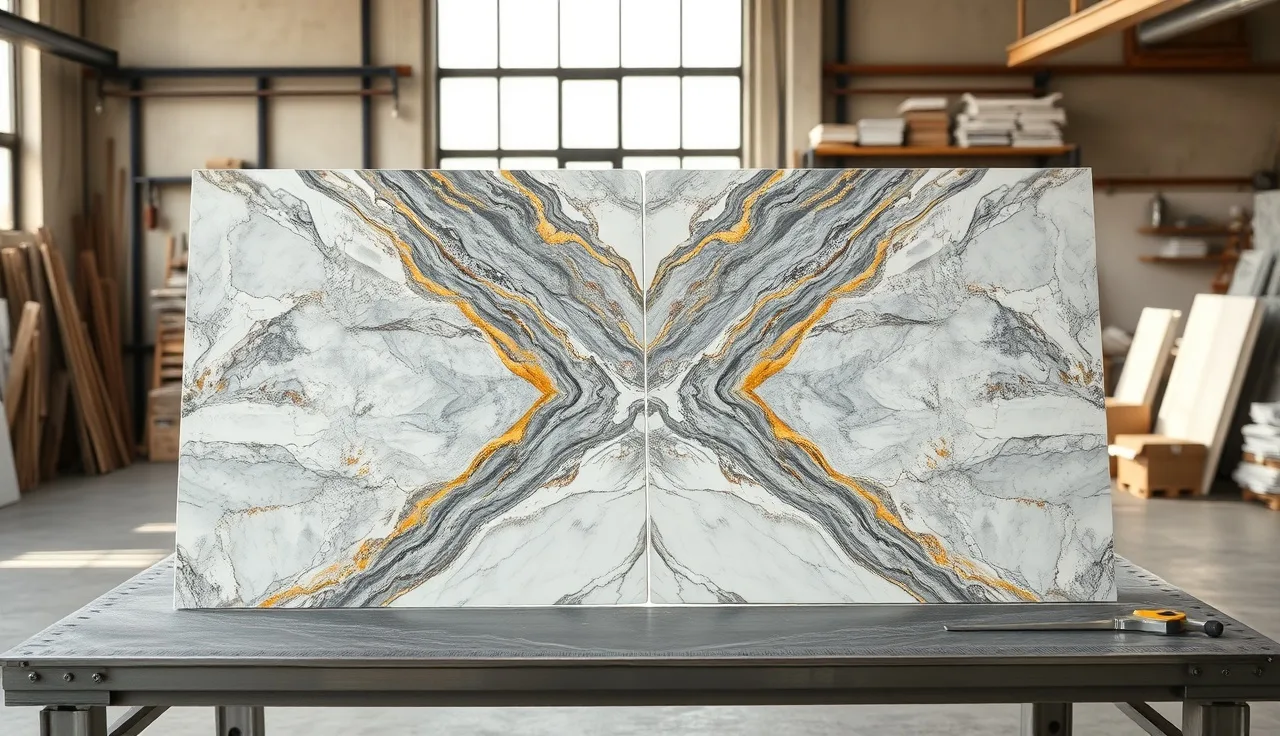
Book matching is the loud one. You open two consecutive slabs from a quarry bundle like the pages of a book, flip one, and the mirrored image creates a symmetrical butterfly pattern. The veins meet at the seam as a mirror. This only works if the two slabs are sequential cuts from the same block, which means you buy them as a matched pair. Fabricators call these "gangsaw pairs." Slabs from different bundles cannot be book matched, full stop.
Slip matching (also called flow matching or run matching) keeps every piece pointed the same direction so the veins flow the same way across the seam. It's quieter than book matching. A perimeter counter that turns a corner is usually slip matched so the movement carries around the room without the jolt of a mirror flip. This is the most common technique for kitchen counters.
End matching aligns veins across the short dimension of the slab, which helps when you join pieces end to end in a long run. It's less common because most countertop seams run parallel to the long axis of the slab. But for a very long island where two slabs get seamed lengthwise, end matching keeps the movement coherent.
Continuous vein matching (sometimes called flow-through) is the most ambitious. It tracks specific veins across multiple pieces, including backsplashes, waterfall edges, and vertical panels, so a single vein appears to run up a waterfall island edge and across the counter top. This is a full architectural effect. It needs careful layout on a digital template, or at minimum a physical dry-lay of every piece before cutting.
| Technique | Best use case | Material waste | Labor premium |
|---|---|---|---|
| Book matching | Statement islands, fireplace surrounds | High (sequential slabs required) | 20 to 35% |
| Slip matching | Perimeter counters, L-shapes | Low to moderate | 10 to 20% |
| End matching | Long seamed runs | Moderate | 15 to 25% |
| Continuous vein | Waterfall islands, full-height backsplash | Very high | 30 to 50% |
The waste figures above are working estimates from shop practice. Exact numbers move with slab size and layout complexity.
How does vein matching affect slab selection at the yard?
This is where homeowners burn money. They fall for a marble or quartzite slab at the yard, buy it, and then find out their runs are too long to come from that one slab. The fabricator needs a second slab, and the seam shows because the veins don't line up.
Do it in the right order. Bring your kitchen layout, ideally a dimensioned drawing with seam locations marked, to the yard before you pick stone. Walk the yard with your fabricator, or ask the yard's layout person to pull sequential slabs from the same bundle. Book matching needs consecutive slabs, usually labeled with matching lot and sequential slab numbers on the edge or back. Good importers track this. The Natural Stone Institute's Dimension Stone Design Manual states that book matched slabs "originate from the same block and are cut in sequence," which is why the bundle number and slab sequence number are the documentation you want to see. [1]
Slip matching gives you more room. As long as two slabs come from the same quarry block (same bundle lot), the veins usually read as continuous even without a mirror pair. Vein direction and scale should be close.
Buy more slab than your square footage. A 20 to 25% overage allowance is standard on any natural stone job. For vein-matched layouts that need specific cuts in specific orientations, ask your fabricator to model the layout digitally before you settle on a slab count. Some shops run nesting software that maps exact cut positions onto slab photos, which cuts both waste and the guesswork on how much material to buy.
What stone types are best suited to vein matching?
Not every stone pays you back for the effort. The payoff depends on how strong and directional the movement is.
Marble, especially Calacatta and Statuario, has the bold, branching veins that make matching dramatic and easy to read. [2] These are the stones people specify for book-matched islands. One caveat: marble is acid-sensitive, and the seam on a book-matched island is a maintenance consideration, since spills can track into the joint if it isn't filled and sealed well.
Quartzite (the real metamorphic rock, not the engineered quartz sold under quartzite-sounding names) runs from subtle to bold. Taj Mahal quartzite has soft gold and gray movement that book-matches beautifully. Super White, sold as quartzite or dolomite depending on the supplier, has marble-like veins people love. [3]
Granite is trickier. Plenty of granites have a scattered, speckled pattern with no clear direction, so matching doesn't really apply. Some, like certain Brazilian exotics, have flowing patterns you can slip-match. But with a classic Venetian Gold or an Uba Tuba, matching veins isn't the goal, because there aren't distinct veins to follow.
Engineered quartz has printed or aggregate patterns. Some brands, Cambria among them, make slabs consistent enough across a production lot to allow approximate matching. It isn't the same as matching natural stone, but Cambria countertops and similar products have tightened their pattern consistency specifically to make it possible. [4]
For marble countertops, the vein scale, color contrast, and pattern type together decide whether matching looks powerful or barely registers.
How much does vein matching cost?
Three things drive the price: extra material, extra layout time, and harder cutting.
Material is usually the biggest chunk. Book matching needs sequential slabs. If your island takes 45 square feet and a single slab covers 55 to 60, you still buy two slabs because the cuts have to come from a matched pair. You pay for both even if you use 45 square feet between them. Waste on book-matched jobs commonly runs 30 to 50% of purchased material.
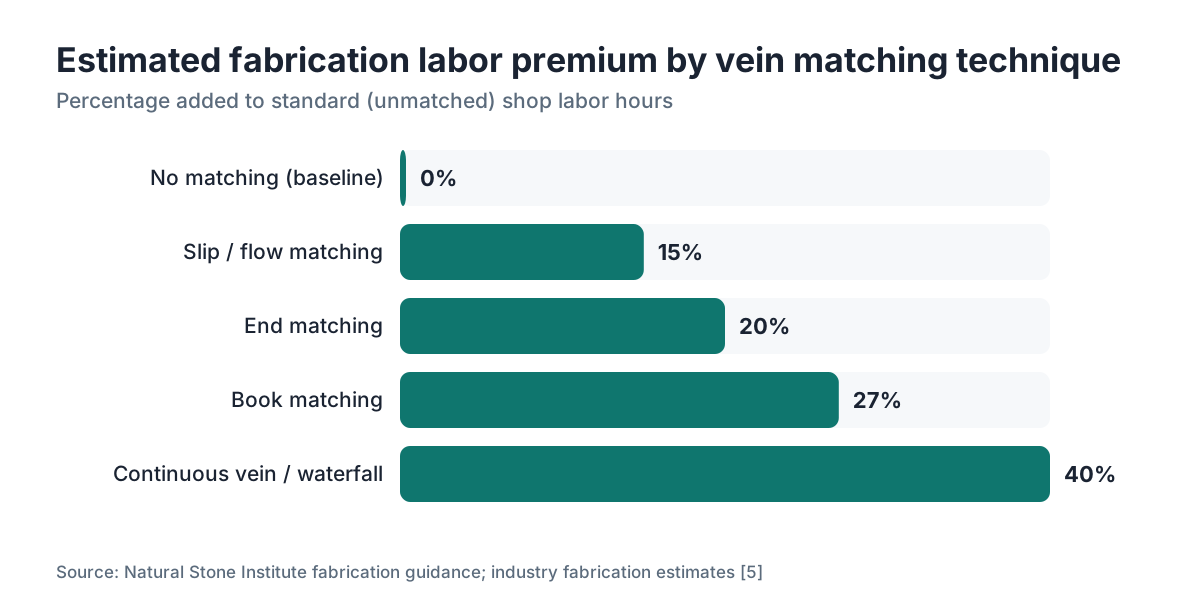
Labor for matched work runs roughly 15 to 50% higher than a standard layout, depending on technique and the shape of the room. At a shop rate of $80 to $150 per hour, a job that normally takes 6 hours of layout and cutting might take 8 to 10 hours for slip matching and 12 to 15 hours for a full continuous-vein waterfall island. Those hours line up with ranges reported by fabrication trade publications, though shop rates swing hard by region. [5]
Here are rough total installed premiums for matched versus unmatched work, based on reported labor differentials:
- Slip matching on a standard L-shaped kitchen: add $300 to $800 to the job
- Book-matched island with matched pair slabs: add $800 to $2,500 depending on stone cost and region
- Continuous vein waterfall island: add $1,500 to $4,000 or more
These are ranges, not promises. Get a line-item quote. A fabricator who does matched work often will have it priced out. One who doesn't may underbid and then cut corners on the matching itself.
How do fabricators actually execute vein matching in the shop?
It starts at templating. When a templater visits the site, a matched job needs notes on which direction the stone runs, where seams fall, and which surfaces flow into each other. That travels back to the shop as part of the work order. Without it, whoever runs layout has no reference.
The traditional method is to bring the slabs onto a big layout table and dry-lay them by hand. The fabricator marks cut lines with chalk or grease pencil, flips the second slab (for book matching), and nudges things until the veins align at the seam within tolerance. "Acceptable" for high-end residential work is typically within 1 to 3mm of vein alignment at the seam. Tight book matching can get closer.
Digital templating and CNC saw systems changed how precisely a shop can plan this. A digital template captures the exact kitchen dimensions. Layout software overlays a high-resolution photo of the slab and lets the fabricator position cuts on screen, checking alignment at every seam before a single cut. That kills waste from miscut slabs and lets you show the homeowner a preview of the matched seam.
Software like SlabWise is built for this workflow. Shops map cut positions onto slab images during quoting, so you know before you start cutting whether the veins land where you need them. The layout then feeds straight into nesting and CNC programming.
After cutting, pieces get dry-laid again on the shop floor to confirm alignment before they leave for the site. For waterfall edges, the vertical piece is stood up next to the horizontal top to check that the vein carries across the corner.
Seam placement matters more than most people think. Good fabricators put seams where veins are quiet, or where the seam is structurally required anyway, and fill the joint with epoxy tinted to the stone's background color. A tight, well-colored seam in a matched slab can be nearly invisible from standing height.
What is a waterfall edge and how does vein matching work with it?
A waterfall edge is where the countertop surface keeps going down the side of the cabinetry to the floor, making a vertical panel that looks like the stone pours over the edge. It's a strong statement, and it's popular on islands.
To match veins on a waterfall, the vertical piece is cut from the same slab as the top, and the cut is set so the veins at the top's edge continue as if the stone bent 90 degrees. Done right, one vein seems to travel across the top and then drop straight down the side.
This needs a miter at the edge where the two pieces meet, usually a 45-degree miter on both so the joint nearly disappears. It also needs the waterfall panel laid out as a mirror of the countertop edge, because the panel gets flipped 90 degrees. Mapping that before cutting, especially on a slab with complex, non-linear veins, is genuinely hard. That's why continuous vein waterfall work carries the highest labor premium.
For countertop installation with a waterfall, the mitered joint is glued and reinforced with a rod or butterfly key epoxied into a routed channel on the back of both pieces. The joint has to be strong, because the vertical panel carries its own weight.
Not every stone works here. Thin veins in a busy, chaotic background (some Calacatta Violetta, for instance) are much harder to match at a waterfall corner than a stone with a few bold, widely spaced veins moving in a clear direction.
How is vein matching different from bookmatching?
Bookmatching is one technique inside the bigger category of vein matching. All bookmatching is vein matching. Not all vein matching is bookmatching.
When people say "book matched" they mean the mirrored butterfly pattern from flipping consecutive slabs. The veins meet at the seam as a mirror image, an almost Rorschach-inkblot effect that lands hard on the right stone.
Slip matching, end matching, and continuous flow are all vein matching, and none of them use the mirror flip. The veins run the same direction, giving continuity without symmetry.
For most kitchens, slip matching is the better call. Bookmatching creates an obvious, deliberate focal point, which you may or may not want. On a marble island that anchors a kitchen, it's stunning. On a perimeter counter running under upper cabinets and across a peninsula, the mirror effect can look awkward and busy.
What should homeowners ask their fabricator about vein matching?
Start at the yard, before you buy anything. Ask your fabricator to come with you or to review your layout before you pick slabs. Bring dimensions. Ask the yard to show you sequential slabs from the same bundle so you can see a matched pair side by side.
When you're collecting quotes, ask these five questions:
- Will you dry-lay the pieces before cutting? Get a yes or no.
- Will you show me a digital layout or shop photo of the vein alignment before cutting?
- Where will the seams fall? Ask to see seam locations on a drawing.
- Is the seam epoxy color-matched to the stone?
- What is your tolerance for vein alignment at the seam? Any shop doing quality matched work can answer this.
Ask what happens if the veins don't match acceptably after cutting. Some shops recut. Others won't, because the material is already used. Sort out that policy before you sign a contract. It's worth the conversation.
For kitchen countertops in general, seam location is the one thing most homeowners ignore until it's too late. On a matched job, seam placement and vein alignment are a single decision, and it has to be made before anyone touches a saw.
Does vein matching affect how you care for the stone afterward?
The stone doesn't change because it was vein matched. Cleaning and sealing for marble stay the same whether or not the slabs were matched. See the guide on how to clean stone countertops for the basics.
The seam is the one spot that wants extra attention. A well-filled epoxy seam in a matched stone is slightly less porous than the stone around it, but the edges of the joint where epoxy meets stone can collect grime. Clean seams with a soft cloth, not scrubbing pads that might abrade the filler. Some fabricators recommend a light coat of stone sealer over the whole surface, seam included, after install.
Marble adds one wrinkle. The seam area is where acid etching shows most, because the polished surface is already disrupted there. If you have a book-matched marble island with a visible seam down the center, a wine spill that etches near that line reads more clearly than one out in the middle of an unbroken surface. That's not a reason to skip marble, but know it going in. The how to clean quartzite countertops guide covers a similar but tougher stone if that concern matters in your house.
Matched stone is not more fragile than unmatched stone. The matching is a layout and cutting decision. The physical properties don't change.
When is vein matching not worth the cost?
Honest answer: more often than designers and stone yards let on.
If your countertop has no seams, matching is irrelevant. A single slab that covers your whole island is automatically "matched" because it's one piece. Buy the best single slab you can afford and you're done.
If your stone has a scattered pattern with no clear direction, like most granites, matching doesn't apply. You'd pay a labor premium for alignment work nobody can see.
If your seams fall in low-visibility spots, under a window, at the back of a peninsula, behind an appliance, the payoff of a perfectly aligned seam is close to zero. Slip matching there costs extra and nobody notices.
Matching earns its premium in a few clear cases: a statement island in a stone with bold veining; a waterfall edge where the vein continuation is the entire point; a fireplace surround or bathroom vanity where every surface shows and the stone is the main feature.
For materials where pattern matching isn't a concern at all, laminate countertops and Corian countertops give you seams that hide by design, not by careful stone alignment.
Frequently asked questions
Can you vein match quartzite the same way as marble?
Yes. True quartzite, the metamorphic rock, has directional veining that responds to the same techniques as marble. Slip matching is common on quartzite perimeter counters. Book matching works on quartzite with bold movement like Taj Mahal or Macaubas. The process is identical: sequential slabs from the same block, dry-laid before cutting. The upside over marble is that quartzite is harder and less acid-sensitive, so the seam area is easier to maintain over time.
Will the seam always be visible in a vein-matched countertop?
The seam always exists physically, but with good alignment and color-matched epoxy fill it can be very hard to see from standing height. In a book-matched slab, the symmetrical pattern at the seam is a design feature, not a flaw to hide. In slip-matched work, the goal is invisibility. Under raking light, or when you crouch and sight along the surface, most seams show regardless of how well they're matched.
What does it mean when slabs are from the same bundle?
Stone slabs are cut from a quarry block by a gang saw, then kept in order as a numbered bundle. Slabs from the same bundle come from the same block and were cut in sequence, so their color, vein scale, and pattern are as close to identical as natural stone gets. For book matching you need consecutive slab numbers within one bundle. Ask the yard to show you the bundle tag and slab sequence numbers before you buy.
Does book matching work with granite?
Occasionally, but it's uncommon. Most granites have a salt-and-pepper or random crystalline pattern with no directional flow, so flipping one slab next to another produces no real mirror effect. Some Brazilian exotics, like certain blue or green labradorite varieties, have enough directional movement that book matching creates visible symmetry. Ask the yard to physically show you two consecutive slabs side by side before paying the premium.
How many slabs do I need for a book-matched island?
At minimum two slabs from the same bundle, bought as a matched pair. Whether two is enough depends on island size. A typical island runs 25 to 40 square feet. A standard imported marble slab covers roughly 55 to 70 square feet, so two slabs cover most islands with waste to spare. Have your fabricator model the exact layout before you buy, because the mirrored cutting pattern uses material less efficiently than a standard layout.
Can engineered quartz be vein matched?
Partially. Engineered quartz is manufactured with printed or aggregate patterns, not natural geological veining. Some premium brands make slabs consistent enough across a production lot that a fabricator can slip-match them so the pattern flows the same direction. True book matching, with a mirror-image seam, is not possible with engineered quartz, because the pattern isn't sequential across individual slabs the way natural stone is.
What is the difference between vein matching and color matching?
Color matching means two pieces of stone look like the same color and tone, which requires buying from the same quarry lot. Vein matching goes further and aligns the specific directional movement of the veins so they continue across a seam. You can have color matching without vein matching. You cannot have meaningful vein matching without color matching first. Both need stone from the same block bundle.
How does a fabricator match veins on a mitered waterfall edge?
The vertical waterfall panel is cut from the same slab as the horizontal top, right next to the edge piece. The fabricator marks the cut so the veins at the top's front edge continue into the panel when it's rotated 90 degrees. Both pieces get mitered at 45 degrees, then glued with color-matched epoxy. The joint is reinforced with a rod or butterfly key routed into the back of both pieces for structural strength.
Does vein matching cost more if I buy stone online or out of state?
It can. Buying slabs remotely without seeing the bundle is risky for matched work, because you can't verify the sequential slab numbers in person. Shipping damage to one slab of a matched pair is also harder to fix when your fabricator and the supplier sit in different states. If you must buy remotely, ask for high-resolution photos of both slabs side by side, the bundle tag, and clear terms on the replacement policy if one arrives damaged.
Will vein matching affect my countertop resale value?
No published study isolates countertop vein matching as a resale variable. Remodeling industry data does show kitchen renovations recover roughly 60 to 80% of cost at resale on average, but that figure covers the whole renovation, not matching specifically. [6] A clean book-matched marble island reads as a quality signal to buyers. Whether it recoups its premium depends on the local market and the buyer, not the matching technique.
Can vein matching be done on a backsplash too?
Yes, and on high-end continuous vein installations it often is. The backsplash slabs are cut from the same stone as the counter and set so the veins appear to travel from the counter up the wall. This needs full slab backsplash material, not tile-sized pieces, and it pushes up both material cost and layout complexity. It looks best with a bold stone like Calacatta Oro or a dramatic quartzite where the vein direction is clear and strong.
What can go wrong with vein matching and how do I avoid it?
The common failures: buying slabs before confirming they're from the same bundle (unmatched veins); placing seams where veins are complex and busy (obvious mismatch); and skipping the dry-lay so misalignment turns up only after cutting. Avoid all three by pulling your fabricator into slab selection, asking to see the digital or physical layout before any cuts, and confirming your contract says pieces will be dry-laid and approved before installation.
Is vein matching harder on curved or shaped countertops?
Yes, a lot harder. A curved island or an arched sink cutout means the cut lines through the slab aren't straight, which makes aligning a vein to a specific seam point much more complex. CNC-cut curved pieces can still be matched, but the layout needs careful digital planning. A vein that aligns at the tangent point of a curve on one piece can drift noticeably by the time it reaches the adjacent piece. Curved matched work is a specialty and costs more.
Do all fabricators offer vein matching or is it a specialty service?
Most established fabricators can do basic slip matching. True book matching with a mitered waterfall edge and continuous vein through a backsplash is specialty work that not every shop handles confidently. Ask to see photos of past matched jobs, specifically the seam, before you hire. A shop that does this regularly will show you without hesitation. One that doesn't will struggle to find examples.
Sources
- Natural Stone Institute, Dimension Stone Design Manual: Book matched slabs originate from the same block and are cut consecutively; sequential slab documentation is required for verified matching.
- USGS National Minerals Information Center, Stone (Dimension): Marble and calcareous stones are classified by mineral composition, with calcite and dolomite as primary components that determine acid sensitivity and finishing characteristics.
- USGS National Minerals Information Center, Stone (Dimension): Quartzite is a metamorphic rock formed from sandstone under heat and pressure; its hardness and low porosity distinguish it from marble in fabrication and maintenance applications.
- Cambria, Product Technical Data: Cambria engineered quartz slabs are manufactured with consistent pattern runs across production lots to support approximate pattern alignment at seams.
- Natural Stone Institute (formerly Marble Institute of America), Fabrication guidance: Vein-matched and book-matched fabrication work adds measurably to shop labor hours compared to standard layout, with premium labor requirements for complex continuous-vein installations.
- National Association of Realtors, Remodeling Impact Report: Kitchen renovation projects recover an estimated 60 to 80% of cost at resale on average, based on NAR survey data of realtors and homeowners.
- Natural Stone Institute, Quarrying and Processing information: Stone blocks are gangsaw-cut into sequential slabs numbered by position in the block, enabling bundle-level traceability for matching purposes.
- ASTM International, ASTM C503 Standard Specification for Marble Dimension Stone: ASTM C503 defines marble dimension stone by physical and chemical properties including flexural strength and absorption, used by fabricators to assess suitability for countertop and cladding applications.
- OSHA, Silica standards: Stone fabrication shops are subject to OSHA respirable crystalline silica exposure standards; wet-cutting methods are used for most stone countertop work to control dust.
- US Energy Information Administration, Commercial Buildings Energy Consumption Survey: Referenced for economic context on the construction and renovation sector; stone fabrication is a sub-sector of the broader construction materials industry.
- Remodeling Magazine, Cost vs. Value Report: Annual Cost vs. Value data tracks return on investment for common renovation projects including kitchen upgrades; provides regional cost and resale recovery data used to contextualize countertop premium spending.
Last updated 2026-07-11