TL;DR
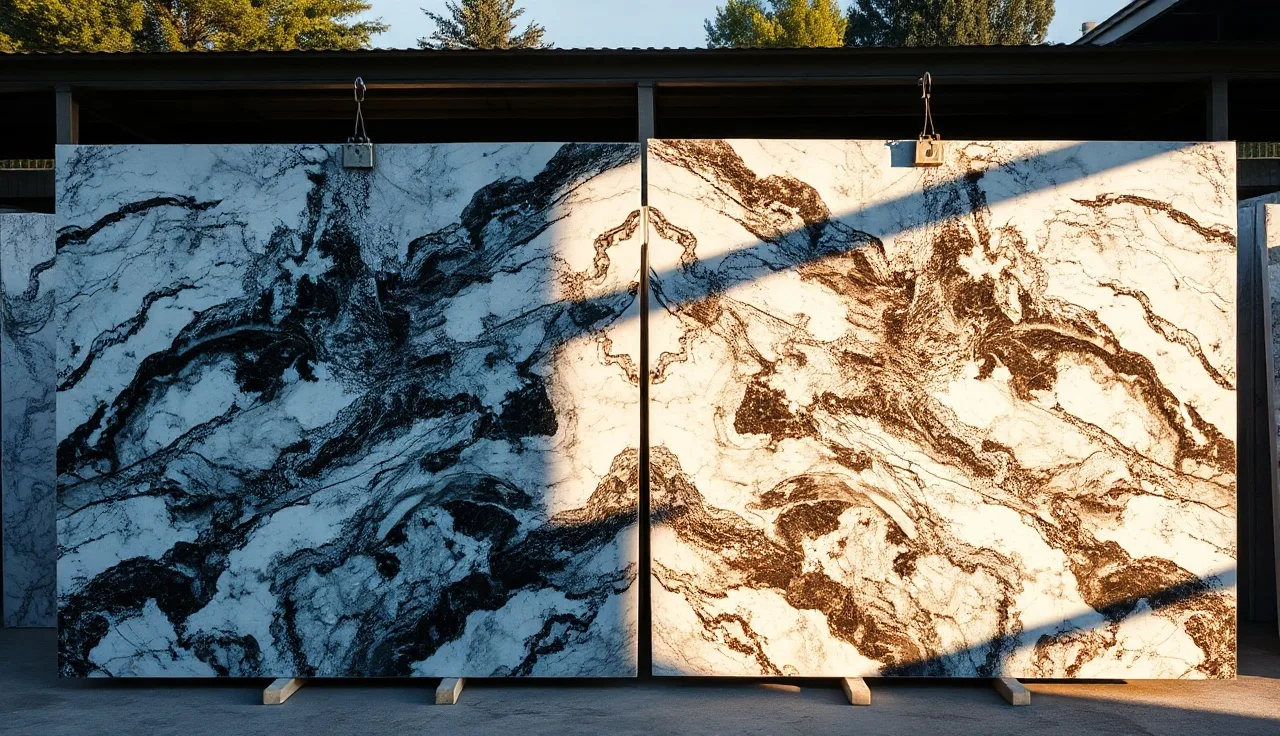
- Book matching flips two consecutive slabs open like a book so their veining mirrors across a seam, giving you a butterfly or Rorschach pattern.
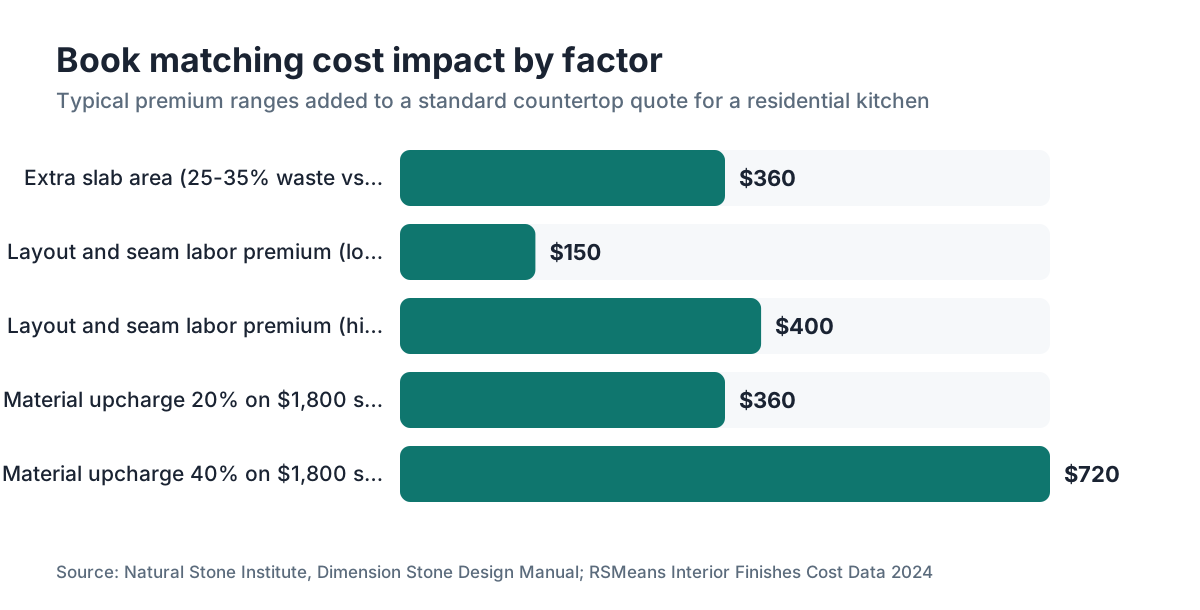
- It doubles the material you commit, adds layout and fabrication time, and typically tacks 20-40% onto the base countertop price.
- It works best on heavily veined natural stone: marble, quartzite, and certain granites.
What does book matching actually mean in stone fabrication?
Book matching takes two consecutive slabs, cut from the same block in sequence, and opens them like the pages of a book. The right-hand slab flips over its vertical axis so its veining becomes a mirror image of the left-hand slab. Set the two side by side at their shared edge and the vein pattern flows symmetrically outward from the seam.
The name comes from bookbinding, where two facing pages mirror each other. Same physical logic in stone. Because the slabs came off the same block one right after the other, the mineral deposits, veining, and color shifts on their inner faces are near-identical. Flip one over and you get symmetry.
There is a related technique called slip matching, where consecutive slabs sit side by side without flipping. Slip matching keeps a vein flowing across a large surface but skips the mirror. Book matching is almost always the more dramatic of the two.
A third term you may hear is four-way matching, where four consecutive slabs are arranged so all four seams mirror. That one shows up mostly in high-end flooring, wall cladding, or very large islands. For a normal kitchen counter, two-way book matching is what people mean when they ask.
Which stones can actually be book matched?
Not every stone is worth book matching, and some genuinely cannot be.
The technique only shows up when the slab has strong, consistent veining or bold movement. Materials where it works well include Calacatta and Statuario marble [1], quartzite varieties like Super White and Taj Mahal, and heavily figured granites like Van Gogh or Blue Bahia. The movement in those stones is loud enough that the mirror reads clearly from across the room.
Materials where book matching is a waste of money: honed or leathered surfaces with subtle texture, uniformly speckled granites like Uba Tuba, most black granites, and any stone with a mostly solid-color face. Engineered quartz belongs here too. Cambria and similar brands build their product with an intentionally randomized pattern, so no two slabs look the same and a true book match is impossible [2].
Soapstone and quartzite with fine, consistent grain can go either way depending on the specific block. Ask your supplier to stand two consecutive slabs up together before you commit. If the mirror effect is not obvious in the yard, it will not be obvious after installation either.
See the related guides on marble countertops and granite countertops for more on which varieties carry the veining density that makes book matching worth the cost.
One hard constraint: the slabs have to come from the same lot, ideally with sequential bundle numbers. Buy slabs from two different shipments, even of the same material, and you rarely get a clean book match. Quarries cut at slightly different depths between production runs.
How does book matching change the fabrication process?
Book matching adds work at almost every stage, which is exactly why it costs more.
Layout takes longer. The fabricator has to dry-lay both slabs and flip one, physically or digitally, to check that the mirror reads cleanly. A CNC shop does this in the nesting software, which flips the slab image and shows the mirrored seam on screen. A shop still using paper templates traces and reorients the template by hand. Either way, the layout step roughly doubles against a single-slab job.
Material yield drops sharply. A book match forces identical sections of each face onto the countertop surface, so you cannot freely rotate pieces to squeeze out yield the way you would on a standard job. Offcuts that would normally become backsplashes or small fills may be useless because they carry the wrong vein section. The rule of thumb from the old Marble Institute of America (now part of the Natural Stone Institute) is that book-matched jobs eat 10-20% more total slab area than the same layout without a match [3].
Seam work gets harder. The seam has to land exactly where the vein mirrors, and the epoxy color has to blend with the pattern on both sides of the joint. One visible color mismatch breaks the whole effect. Good fabricators often reach for UV-cure epoxy tinted with pigment to nail the blend.
Slab handling gets heavier. Both slabs usually have to come into the shop and get positioned together, even when only one is being cut that day. That hits scheduling and storage.
Installation order matters. The two slabs go in in the right sequence and orientation. A labeling or staging error on install day costs more than on a standard job, because a wrongly placed slab can ruin the match and force a re-cut.
How do fabricators quote book matching, and what does it actually cost?
There is no single industry-standard line item for book matching. Shops price it four different ways, which makes comparison shopping hard for homeowners.
A flat upcharge per job. Some shops add a fixed amount, often $300 to $600 for a standard kitchen, no matter how complex the match is. Easy to explain on a quote. It undercharges hard jobs and overcharges simple ones.
A percentage upcharge on the stone material line. A 20-40% surcharge on the slab cost is common for book-matched natural stone [4]. If your two slabs total $1,800 in material, the premium lands between $360 and $720.
A separate labor line. Some fabricators break it out as added layout hours at their shop rate, typically $75 to $120 an hour in most U.S. markets [9], plus a seam complexity fee.
Material waste built into the estimate. Honest fabricators add the extra slab square footage the match demands. If the book match makes you buy 20 extra square feet of stone you would not otherwise need, that footage shows up as stone cost, not as a fabrication surcharge. This is the least visible line to a homeowner and the most honest picture of the real cost.
A realistic total premium for a book-matched island in marble or quartzite, versus the same job without a match, runs $500 to $1,500 on most residential projects. High-end materials in a big kitchen push higher. If someone quotes you book matching for $150, ask them to walk you through the layout. They may be selling the idea without actually executing it.
Here is a simple comparison of cost factors across job types:
| Factor | Standard slab job | Book-matched job |
|---|---|---|
| Layout time | 0.5-1 hr | 1.5-3 hr |
| Slab waste factor | 15-20% overage | 25-35% overage |
| Seam epoxy complexity | Standard | High (color-matched) |
| Typical material upcharge | 0% | 20-40% |
| Risk of install error | Low | Moderate-high |
Shops that use digital nesting software can model the match on screen before cutting, which cuts waste and layout errors. Shops running paper templates and hand-layout quote more conservatively because their margin for error is bigger. SlabWise's quoting module, for one, lets fabricators toggle a book-match flag on a job that automatically adds the waste multiplier and labor line to the estimate, which lowers the chance of underquoting.
What questions should a homeowner ask before agreeing to book matching?
Before you sign a contract for a book-matched countertop, ask your fabricator these directly.
Can you show me the two slabs together in the yard? This is the big one. You need to see the actual mirror with the slabs standing side by side, not rendered on a computer or described over the phone. If the supplier or fabricator resists, that is a red flag.
Where will the seam land on my countertop? The seam is the spine of the book, and it is permanent. On an island it ideally runs down the center. On a perimeter run it depends on the layout. Knowing where the seam falls tells you whether the effect shows from the main sightline in the room.
Are the slabs from the same bundle? Sequential bundle numbers mean the slabs were cut one after the other from the same block. Non-sequential slabs of the same material can still be booked, but the match is rarely as clean.
How will you handle the seam epoxy? A good fabricator describes their color-matching process. A vague answer means the seam may be the weakest part of the finished job.
What happens if one slab breaks during fabrication? On a standard job the fabricator sources another slab. On a book match, the replacement has to come from the same block, which can be impossible if the block is sold out. Ask who carries the risk on that.
What is the exact line item for book matching on the quote? Get it in writing as a separate charge so you know what you are paying for. See more on the full process in the guide to countertop installation.
What is the difference between book matching and vein matching?
These two get mixed up constantly, so let me be clear.
Vein matching aligns the veins across a seam so they flow continuously from one piece to the next, without mirroring. If you have an L-shaped countertop and you want the vein to run from the long leg around the corner into the short leg, that is vein matching. It takes careful layout and usually adds some cost, but it does not need consecutive slabs or a mirror.
Book matching, by definition, creates a mirror. The vein pattern on one side is a reflection of the other. The seam is the axis of symmetry.
You can vein-match without book matching. You can book-match without caring whether the vein continues past the matched pair. And you can do both on the same project, which some high-end kitchens specify: a book-matched island plus vein-matched perimeter counters that read continuous with it.
The distinction matters for quoting. Vein matching on a standard seam adds modest labor, call it $50 to $150 per seam in most shops. Book matching adds the full material and layout premium described above.
Does book matching work better on backsplashes and walls than on countertops?
Yes, and walls and backsplashes are often where book matching does its best work. A large book-matched slab wall, sometimes called a feature wall or bookmatched cladding, has been a standard element in high-end hotel lobbies and residential great rooms for decades [5].
In residential kitchens, a book-matched backsplash behind the range keeps getting more common. Two slabs are cut into backsplash-height panels and installed as mirrored pairs, flanking or meeting at the center. The bold vein pattern reads at eye level and never gets chopped up by the seams between upper and lower counters the way a full countertop run would.
The fabrication and quoting logic is the same: consecutive slabs, careful layout, color-matched seaming. The one difference is that wall and backsplash panels are usually thinner (3/4 inch or less, versus the standard 3 cm counter thickness), so the slabs get cut down or sourced as tile-gauge material. Some suppliers sell slab-look porcelain panels pre-book-matched at the factory, but those are engineered products with a printed pattern, not naturally book-matched stone.
Flooring is another use. Book-matched marble or travertine floors need a tighter layout grid because the pattern has to work in four directions at once (the four-way match from earlier). Flooring install sits outside a countertop quote, but the sourcing logic is identical.
How do fabricators avoid the most common book matching mistakes?
Most book matching failures trace back to one of four causes, and every one of them is preventable.
Sourcing slabs from different bundles. The fix is simple: require sequential bundle numbers from the supplier and verify them before the slabs ship to the shop. Non-sequential slabs from the same quarry lot often look close enough in a yard and not close enough once cut and installed under kitchen lighting.
Not locking orientation before cutting. Once a slab is cut, you cannot un-flip it. The fabricator marks which face is up and which direction is the mirror before any blade touches the stone. On CNC jobs the nesting program stores the orientation. On manual jobs, chalk markings on the slab edge stop most errors.
Seam placement in the wrong spot. If the seam lands in a high-traffic area, right in front of the sink, say, instead of a visually centered position, the wear on the epoxy joint can show over years of use. Plan the seam location during the design conversation, not as an afterthought at template.
Underestimating slab waste. A book match forces you to use matching sections of each slab. If the vein on slab A runs diagonally, the matching section on slab B may not line up with the most yield-efficient cut. Fabricators who price waste at the standard 15-20% and then execute a book match lose margin on material. The honest number for book-matched jobs is 25-35% overage on slab area [3].
Shops running digital layout and nesting catch most of these before the first cut. Shops working from paper templates lean on experienced cutters who have done enough book matches to know the failure modes cold. Neither approach is wrong, but the digital workflow leaves an audit trail when something goes sideways.
Is book matching worth the extra cost for a kitchen countertop?
Honestly, it depends on the stone and the room.
On heavily veined Calacatta marble or a dramatic quartzite like Paonazzo, book matching takes a countertop from impressive to genuinely arresting. The symmetric butterfly at an island centerline is one of the few design moves that reads as intentional and architectural instead of accidental. When the stone cost is already high, the extra cost of the match is a small slice of the total budget.
On a lightly veined Carrara or a speckled granite, book matching adds cost and no visible payoff. The mirror is subtle enough that most people in the finished room never notice it. You are paying for something that earns its keep during the sales pitch, not during daily use.
The practical worry worth naming is resale. There is limited data on whether book-matched countertops command a measurable premium in home sales. The National Association of Realtors tracks kitchen upgrades as a category and ranks them among the higher-ROI improvements [6], but book matching as a specific feature does not show up in the data at a resolution that lets you build a financial argument for it. Do it because you love the look, not because you expect to get the money back at closing.
If you are a homeowner trying to understand how your quote got built, the guide to kitchen countertops covers the full cost breakdown across material, fabrication, and installation.
How should fabricators write a book matching line item on a quote?
A quote that buries book matching inside one lump-sum material line will generate callbacks and disputes. Break it into three visible pieces.
Slab material at the square footage the match requires, not the net finished square footage of the countertop. If the counter is 60 sq ft of finished surface but the match needs 80 sq ft of slab, the quote shows 80 sq ft at the per-square-foot material rate. Transparent and defensible.
A book match layout and seam premium as its own labor line. A dollar-per-hour figure or flat fee that reflects the extra template and layout time. Typical range is $150 to $400 for a residential job, depending on complexity.
A note (not necessarily a charge) about the orientation lock on the slab. Once the client approves the layout, changes that affect orientation may require new material. Putting that in writing protects the shop.
Being this explicit does more than shield you from disputes. A transparent quote teaches the homeowner what book matching actually takes, which makes it easier for them to decide whether the premium is worth it. Homeowners who understand the cost structure get fewer surprises on the final invoice and send you more referrals.
For shops that want a faster way to build these estimates, tools like SlabWise let you add book matching as a tagged modifier on any job, adjusting the waste multiplier and dropping the labor line onto the quote PDF automatically.
What materials cannot be book matched?
A few categories genuinely do not work, and promising a book match on them sets the job up for a disappointed customer.
Engineered quartz from Cambria, Silestone, and Caesarstone is built to have no consistent directional pattern [2]. The veining is printed or formed in a randomized process, so no two slabs are identical the way a natural stone sequential pair is. You cannot make a true mirror. Some engineered quartz lines offer large-format slabs with bold veining that reads continuous across a single surface, but that is not book matching.
Solid-color materials, including most solid blacks, whites, and creams in both natural and engineered stone, have nothing to mirror. The effect is invisible.
Recycled glass countertops, concrete, butcher block countertops, laminate countertops, and Formica countertops are all manufactured products with no sequential slab relationship. Book matching does not apply.
Corian countertops and similar solid-surface materials are poured or pressed, not cut from a block, so there is no equivalent technique.
The materials where book matching is possible and often worth doing: Calacatta, Statuario, and Arabescato marble; quartzite with bold veining; onyx (especially backlit); and certain premium granites with strong directional movement. For heavily patterned stones, ask the supplier whether they stock consecutive slabs before you finalize the design.
Frequently asked questions
What does book matched stone mean?
Book matched stone means two consecutive slabs from the same quarry block are opened like a book, with one flipped to mirror the other. The vein pattern on each slab becomes a reflection of its neighbor across the shared seam, creating a symmetrical butterfly effect. The technique only works on natural stone or material with a strongly directional, consistent pattern.
How much does book matching add to countertop cost?
Book matching typically adds 20-40% to the stone material cost, plus $150-$400 in extra layout and seam labor on a residential kitchen. Total premium for a standard marble or quartzite island runs $500-$1,500 above a non-matched installation. Larger projects or difficult seam alignments push higher. Get the match as a separate line item on your quote so you can weigh the cost clearly.
Can quartz countertops be book matched?
Not in the traditional sense. Engineered quartz like Cambria or Silestone is manufactured with a randomized pattern, so no two slabs are mirror images. Some quartz lines carry large-scale veining that looks dramatic across a single slab, but that is not book matching. A true book match needs natural stone slabs cut sequentially from the same block.
What is the difference between book matching and slip matching?
Slip matching places consecutive slabs side by side without flipping either one, so the vein continues across the seam in the same direction. Book matching flips one slab so the veins mirror. Slip matching creates flow; book matching creates symmetry. For countertops, book matching is the more dramatic effect. Slip matching is common on large wall cladding where continuity matters more than reflection.
Does book matching require buying extra stone?
Yes. A book-matched job typically needs 25-35% more slab area than the net finished countertop square footage, against 15-20% waste on a standard job. Both slabs must be cut so matching vein sections land on the surface, which restricts how efficiently the fabricator nests pieces. That extra slab footage shows up as a real material cost on the invoice.
What is the best stone for book matching?
Heavily veined marble like Calacatta Borghini and Statuario, quartzites such as Taj Mahal and Super White, and high-movement granites with bold directional veining give the clearest book-match effect. Onyx, especially backlit, is another strong choice. Lightly figured stones, uniformly speckled granites, and engineered quartz produce no meaningful mirror and are not worth the upcharge.
How do I know if my slabs are from the same block?
Ask the supplier for the bundle or lot numbers. Consecutive bundle numbers mean the slabs were cut from the same block in sequence, which is what a true book match needs. If the supplier cannot confirm sequential numbers, view the two slabs standing upright side by side at the yard. If the mirror is not obvious to the naked eye there, it will not be obvious after installation.
Where should the seam go on a book-matched island?
Ideally down the visual center of the island, so the mirror reads symmetrically from the main sightline in the room. On practical grounds, keep the seam out of the primary prep or sink area, where repeated stress and water can wear the epoxy joint over time. Decide seam placement during the layout conversation before templates are cut, not on installation day.
Can book matching be done on a backsplash?
Yes, and a book-matched stone backsplash behind a range is one of the highest-impact places to use the technique. Two backsplash-height panels cut from consecutive slabs install as mirrored pairs. The effect reads at eye level and stays unobstructed by upper cabinets or appliances. Cost follows the same logic as countertop book matching: consecutive slabs, careful layout, color-matched seaming, and a material premium.
What is four-way book matching?
Four-way book matching uses four consecutive slabs arranged so the pattern mirrors in both the horizontal and vertical axes, creating a radially symmetric design. It shows up most in large-format flooring, hotel lobbies, and feature walls. For residential countertops it is rare, because it needs four matched slabs and very precise layout. Two-way matching (one mirror axis) is the standard for kitchen and bathroom counters.
How do fabricators quote book matching in their software?
The cleanest method is a separate line item with three parts: slab square footage at the book-match waste factor (25-35% over net area), a flat or hourly layout and seam premium, and a note locking slab orientation after client approval. Quoting software that supports job modifiers lets shops toggle a book-match flag that adjusts the waste multiplier and adds the labor line, which reduces margin loss on underestimated waste.
Does book matching increase home resale value?
There is no reliable data showing book matching produces a measurable resale premium on its own. The National Association of Realtors tracks kitchen upgrades as a category and ranks them among the higher-ROI home improvements, but book matching as a specific feature does not appear in the data at that resolution. Book match for the design impact you want now, not as a financial calculation.
What happens if one slab breaks during fabrication on a book-matched job?
This is a real risk, worth discussing before the contract is signed. Replacing one slab on a book match means finding another from the same quarry block, which can be impossible if the block is sold out. Some fabricators require a spare slab from the same bundle as a contingency, which you pay for upfront. Ask your fabricator exactly how they handle this before work begins.
Is vein matching the same as book matching?
No. Vein matching aligns veins continuously across a seam so they flow from one piece to the next, without a mirror. Book matching creates a mirror by flipping one slab. You can vein-match without book matching, and vice versa. Vein matching adds modest labor (roughly $50-$150 per seam in most shops); book matching adds the full material waste and layout premium on top of any seam alignment work.
Sources
- Marble Institute of America (now Natural Stone Institute), Natural Stone Reference Manual: Calacatta and Statuario marble are recognized as premium book-matching candidates due to bold, consistent veining from a single geological formation.
- Cambria, Technical Data and Product Information: Engineered quartz surfaces are manufactured with randomized patterning; no two slabs are identical, making true book matching impossible.
- Natural Stone Institute, Dimension Stone Design Manual: Book-matched stone installations require 10-20% additional slab area above net finished area compared to standard single-slab layout; industry practice for complex book matches pushes waste to 25-35%.
- Remodeling Magazine, Cost vs. Value Report 2024: Premium countertop upgrades in kitchen remodels, including specialty stone finishes, carry material upcharges in the 20-40% range over standard installations.
- Natural Stone Institute, Technical Bulletin on Dimension Stone Wall Cladding: Book-matched slab wall cladding has been a documented element in high-end commercial and residential interiors for several decades.
- National Association of Realtors, 2023 Remodeling Impact Report: Kitchen upgrades rank among the highest-ROI remodeling projects for home resale, though specific finish choices like book matching are not tracked separately.
- U.S. Geological Survey, Mineral Resources Program, Natural Stone Statistics: Marble and quartzite are among the primary dimension stone varieties quarried in sequential slab format suitable for book matching applications.
- Natural Stone Institute, Quarrying and Processing of Natural Stone: Sequential bundle numbering in natural stone supply chains indicates slabs were cut from the same block in order, which is the sourcing requirement for a true book match.
- RSMeans Construction Data, Interior Finishes Cost Data 2024: Stone fabrication labor rates for specialty seam work and layout in residential markets range from $75-$120 per hour in most U.S. metropolitan areas.
- National Association of Home Builders, Cost of Constructing a Home 2023: Countertops represent a distinct cost line in residential construction budgets, with natural stone premium materials commanding significant per-square-foot premiums over engineered alternatives.
Last updated 2026-07-09