TL;DR
- Most stone fabricators set a minimum of 1.5 to 2 inches of countertop material between the edge of a cooktop cutout and the nearest slab edge, seam, or void.
- Manufacturer installation guides often specify 1 to 2 inches on the sides and 2 to 3 inches at the rear.
- Go below those numbers and you risk cracking, especially in granite and quartz.
What is the minimum stone around a cooktop cutout?
Short version: 1.5 inches is the floor most fabricators will work to, and 2 inches is where the majority feel comfortable. A few engineered stone makers ask for even more at certain spots around the cutout.
That number is not pulled from thin air. The strip of stone between the cutout edge and the counter's outer edge has to carry thermal stress from the cooktop, vibration from cooking, and the occasional elbow or dropped pot. Make it too narrow and it acts like a notch in a bar of chocolate. The slab breaks cleanly right there.
Three things decide the exact minimum: the countertop material, the cooktop model's installation template, and your local fabricator's shop standard. Quartz manufacturers publish their own cutout specs. Granite has no single trade body setting a universal rule, so fabricators rely on their own experience and the cooktop maker's guide. Natural quartzite and marble follow the same logic as granite but can be more brittle depending on the stone's veining and porosity.
Read the cooktop's installation manual, then cross-check with your fabricator. The more restrictive number wins.
Why does the stone strip thickness even matter?
Stone is strong in compression and weak in tension. A narrow strip of stone next to a cutout gets loaded in bending every time someone leans on the counter near the cooktop, or when heat from the burner makes different parts of the slab expand at different rates. Stress piles up at sharp corners.
Shops that have been around a while carry a mental catalog of callbacks. A cracked strip of stone next to a cooktop cutout sits near the top of that list. The crack usually runs parallel to the cutout edge, right through the thinnest section.
There is a grinding and polishing concern too. A strip narrower than about 1.5 inches is hard to polish cleanly on most CNC equipment. The toolpath either clips the cutout edge or leaves a rough section. Some shops refuse to go below 2 inches for that reason alone, not because the stone would break but because the finish quality suffers.
With granite countertops, veining direction matters. A natural vein running parallel to and through that narrow strip drops the effective strength below what a homogeneous section would give you. A good fabricator studies the slab before cutting and repositions the template if a vein threatens a sensitive strip.
What do cooktop manufacturers actually specify?
This is where homeowners get confused. The cooktop manufacturer's installation guide gives you three separate things: minimum countertop opening dimensions (the cutout size), minimum clearances to walls and cabinetry, and sometimes minimum stone dimensions around the cutout. Those are not the same measurement.
Bosch, for example, specifies cutout dimensions for each model and notes that a minimum clearance from the cutout to the counter edge must be held. Their published installation templates for 30-inch and 36-inch gas cooktops typically show 2 inches from the cooktop cutout to the front edge of the counter as a minimum. [1]
Thermador and Wolf publish similar templates. The rear clearance often runs 2 to 3 inches because the backsplash area takes more heat and because the slab tends to be narrower there relative to cabinet depth.
For induction cooktops, some manufacturers add a note that the stone or solid surface must keep minimum dimensions around the cutout so nothing blocks the cooktop's ventilation path, which usually sits underneath. That is a functional clearance, not a structural one, but it still shows up as a minimum stone dimension on the installation sheet.
The U.S. Consumer Product Safety Commission covers appliance safety at the federal level, and the reference for residential gas ranges and cooktops is ANSI Z21.1, administered by the American Gas Association. [2] That standard covers gas connection and clearance to combustibles, not stone dimensions, but it shapes what the appliance makers put in their guides.
Practical takeaway: pull the installation PDF for your exact cooktop model before your fabricator templates. Hand it to them. If the spec says 2 inches at the front, that is the floor, not a suggestion.
Does the minimum change by material: granite, quartz, or marble?
Yes, and the differences are real enough to matter.
Granite is a natural stone with variable grain structure and no internal reinforcement. The practical industry minimum is 1.5 to 2 inches. Most fabricators prefer 2 inches or more on the sides and rear. Because granite gets quarried and cut from slabs with natural variation, a fabricator might push to 2.5 inches near an obvious fissure.
Quartz (engineered stone) manufacturers publish their own fabrication guidelines, and these carry more weight because they affect the warranty. Cambria, for instance, publishes fabrication guidelines stating cutout edges should keep a minimum distance from the slab edge. [3] Silestone and Caesarstone publish similar documents. The consensus across major quartz brands lands at 1.5 to 2 inches minimum, with some brands calling 2 inches the hard floor for cooktop cutouts because of how the resin binders react to thermal cycling.
Marble and quartzite are softer or more crystalline than granite and often carry more dramatic veining. The structural minimum is similar (1.5 to 2 inches) but the risk of a vein weakening that strip is higher. Some fabricators add 0.5 inches of buffer as a personal rule when working with heavily veined marble countertops near heat sources.
Porcelain slabs are getting popular and come with their own rules. They run thin (6 mm to 12 mm typically) and chip at cutout edges. Fabricators working with large-format porcelain often require 2 to 3 inches around a cooktop cutout and use specialized router bits to cut chipout.
Solid surface materials like Corian forgive more because they're non-porous and repairable. Corian countertops and similar products often allow slightly tighter cutout margins, but the material still has thermal expansion limits and the cooktop manufacturer's guide still applies.
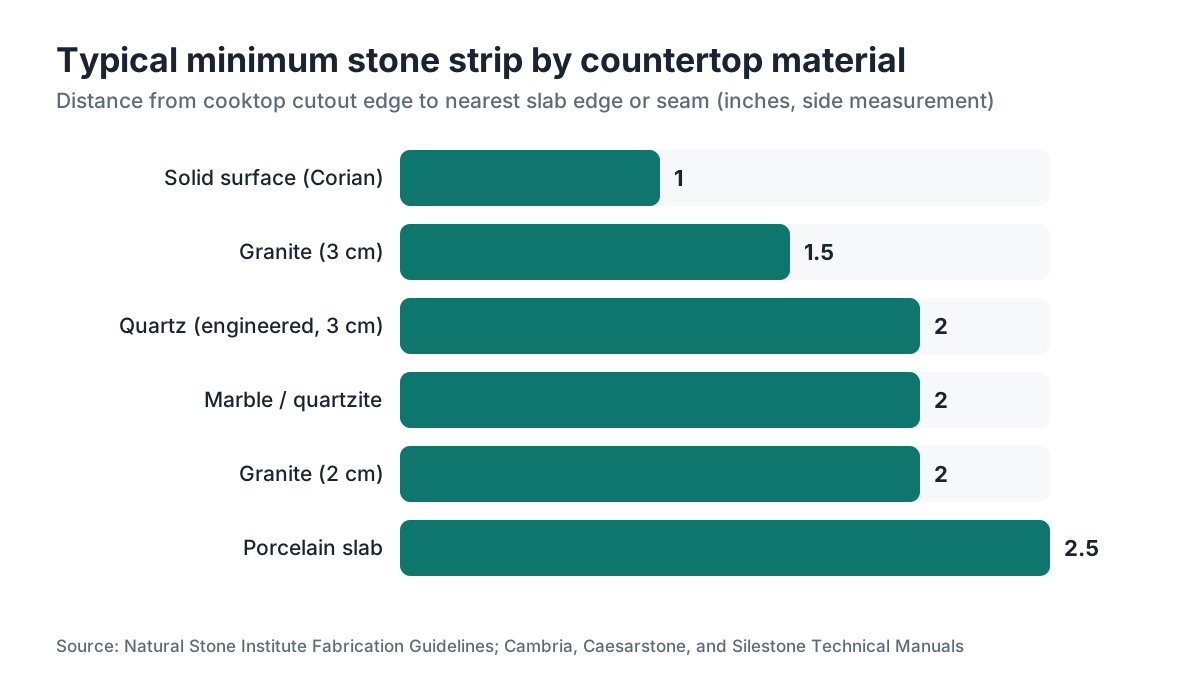
A quick reference for typical minimums by material:
| Material | Typical shop minimum (sides) | Typical shop minimum (front/rear) | Notes |
|---|---|---|---|
| Granite | 1.5 in | 2 in | Vein direction can push this higher |
| Quartz (engineered) | 1.5 to 2 in | 2 in | Check brand fabrication guide for warranty |
| Marble | 2 in | 2.5 in | Veining risk; softer material |
| Quartzite | 1.5 to 2 in | 2 in | Varies by specific stone hardness |
| Porcelain slab | 2 to 3 in | 2 to 3 in | Edge chipout risk |
| Solid surface | 1 in | 1.5 in | More repairable; still check mfr guide |
What happens if the stone strip is too narrow?
Cracking. That is the main failure mode, and it usually shows up weeks or months after installation, not on the day of the job. The first few thermal cycles from the cooktop stress the narrow section. Then someone sets a heavy Dutch oven on the counter near the edge, or a cabinet door corner taps the stone. The crack runs along the line of least resistance, which is exactly that thin strip.
A cracked strip next to a cooktop is one of the harder countertop repairs to hide. The crack sits in a high-traffic, high-heat area. Fill epoxies discolor from heat. A real fix means removing the cooktop, cutting out a section, and either patching or replacing the whole piece. Given fabrication and installation costs for kitchen countertops, a repair can run $300 to $800 or more depending on how much stone has to move.
A second failure mode shows up during or right after fabrication: the edge chips out while the CNC router or wet saw makes the cutout. A too-narrow strip may simply not survive the cut. This is less common with modern CNC waterjet cutting but still happens with aggressive bit selections or if the operator runs too fast.
If your installer pushes to go narrower than 1.5 inches because your cooktop template runs tight against your layout, slow down. Sometimes the cooktop can shift a half-inch in the cabinet opening. Sometimes the layout can be adjusted at the template stage. Those conversations cost a lot less than a cracked slab.
How do fabricators measure and mark the minimum distance?
At the template stage, the fabricator measures your cabinet opening and lays out where the cooktop cutout falls on the slab. With digital templating (a laser or camera-based system), that happens in software and the minimum distances get checked on screen before anything gets cut. With a physical template (usually melamine or Lauan board), the fabricator draws the cutout and measures each edge by hand.
A good fabricator checks:
- Distance from the cutout edge to the front counter edge (usually the most visible and most loaded edge).
- Distance from the cutout edge to the rear of the counter (the backsplash area).
- Distance from the cutout edge to any seam in the slab.
- Distance from any corner of the cutout to any other cutout (sink, second cooktop zone, and so on).
The corner-to-corner check matters because two cutouts close together create an hourglass of stone between them. That neck can be structurally weak even when each individual edge-to-cutout measurement looks fine.
Fabrication software like SlabWise can flag minimum material thresholds automatically during nesting and quoting, so a shop catches a tight layout before the job hits the saw. That kind of automated check cuts callbacks on complex kitchen layouts.
For homeowners: the templating visit is the right time to raise concerns about your cooktop placement. Once the template is approved and the slab is cut, your options narrow fast.
What about the corners of the cooktop cutout?
Inside corners are a separate problem. A perfectly square inside corner in a stone cutout is a stress concentration point. Every fabricator worth their salt rounds the inside corners of a cooktop cutout. The question is how much.
Industry practice is a minimum 3/16-inch (about 5 mm) radius on inside corners of cooktop cutouts, with many shops defaulting to 1/4 inch to 3/8 inch. A larger radius spreads the stress over a longer arc and drops the chance of a crack starting at that corner.
Some cooktop installation templates show a slightly rectangular cutout with small rounded corners already drawn. Follow that shape exactly. If the template shows a radius, match it. Go sharper than the template and you're adding risk.
Gas cooktops forgive a little more here because the grate and burner assembly sit above the stone with an air gap in between. Induction cooktops sit nearly flush, and the cooktop frame itself can add some mechanical support to the opening. That is not a reason to skimp on corner radius.
On a site with detailed countertop installation coverage, the corner radius rule applies to sink cutouts too, even more than cooktops.
Does counter thickness affect the minimum stone strip width?
Yes, though not as dramatically as you might expect. Standard countertop thickness is 3 cm (roughly 1-3/16 inches). Some residential jobs use 2 cm (about 3/4 inch). A 2 cm slab has less cross-sectional area in that narrow strip, which means less total strength even if the width measurement reads the same.
For 2 cm material, most fabricators add 0.5 inches to the minimum strip width as a rule of thumb. So a job that would be fine with a 1.5-inch strip in 3 cm granite might need 2 inches in 2 cm granite.
Mitered edges complicate this. A laminated or mitered edge on the front of the counter adds visual bulk but does not add structural depth at the cooktop cutout location. The structural strip is still whatever the actual single-layer thickness is.
Some fabricators apply a fiberglass mesh or epoxy reinforcement to the underside of a narrow strip before installation, particularly around sink and cooktop cutouts. This is a legitimate technique that can allow slightly tighter margins, but it is not a substitute for good geometry. If someone offers to go very narrow and just "add some reinforcement," that deserves a second opinion. [4]
Can I change the cooktop location to get more stone around the cutout?
Often, yes, and this is the most underused option. Most homeowners assume the cooktop has to land dead-center in the cabinet run, but a shift of 1 to 3 inches in any direction is usually invisible to the eye and can be the difference between a solid job and a marginal one.
A shift toward the center of the slab (away from a nearby edge or seam) adds material on the thin side and removes it from the thick side. If the thick side already has plenty of stone, there is no downside.
A shift toward the backsplash (rear) is trickier. It grows the front stone strip (good) but may shrink the rear strip. If the cabinet is deep and the cooktop is small, the rear still has adequate stone. Worth checking.
A shift away from a seam is almost always a good call. Seams are filled with epoxy and can flex slightly. A cooktop cutout close to a seam creates a compound stress zone. Most fabricators target at least 3 to 4 inches from a seam to any cutout edge, more than the minimum strip to the outer edge.
This is the kind of conversation that happens at templating. If you're getting an online quote first, a tool that lets you visualize the layout (and flags when a cooktop sits too close to an edge) helps you show up at templating with a clear plan. For fabricators running multiple jobs, that same digital layout check cuts field problems.
What if my countertop space is genuinely too tight?
Some kitchens just do not have the geometry for a standard cooktop installation with comfortable stone margins on all sides. This happens most often in small kitchens with a cooktop near a window, a corner, or a narrow peninsula.
Real options in this situation:
First, reconsider the cooktop size. A 30-inch cooktop in a tight space might swap for a 24-inch model. That gives back 3 inches total, split among the sides.
Second, consider a different cooktop type. Induction cooktops have more flexibility in cutout sizing across models. Some compact induction units come with smaller footprints and smaller cutout requirements.
Third, accept a non-stone material in that section. Butcher block countertops can be cut with more flexibility, though they have their own heat concerns next to an open flame. Laminate countertops and Formica countertops also forgive tight cutout margins because the substrate can be reinforced differently.
Fourth, and this is the honest answer: if the geometry cannot be made safe with natural or engineered stone, do not force it. A cracked cooktop surround is a kitchen hazard and an expensive repair. A fabricator who tells you the margins do not work is doing you a favor.
What should I ask my fabricator before approving the template?
Four questions that get you real answers:
1. What is the minimum stone distance you're leaving on each side of the cooktop cutout, and can you show me on the template? A good fabricator has this measured and will tell you without hesitation. If they hedge, that is a signal.
2. Does the cooktop manufacturer's installation guide call for anything more than your shop minimum? Hand them the guide if you have it. Ask them to confirm the most restrictive number is the one they're using.
3. Are any corners of the cutout close to a seam, another cutout, or the counter edge? This catches the multi-factor stress scenarios that simple edge measurements miss.
4. What is the inside corner radius you're cutting, and is it at least 3/16 inch? A fabricator who knows the work answers this fast. One who hasn't thought about it is worth pushing.
For fabricators reading this: these are the questions your best customers will ask. Keep a printed sheet with your shop's cutout standards (minimum strip widths by material, minimum corner radius, seam clearance rules). It builds confidence and cuts the back-and-forth at template approval.
Frequently asked questions
What is the minimum stone from a cooktop cutout to the front counter edge?
Most fabricators set 1.5 to 2 inches as the minimum from the front lip of the cooktop cutout to the front edge of the counter. The cooktop manufacturer's installation guide may specify 2 inches or more. The front edge takes the most physical abuse (leaning, pot placement), so more stone here is better. Never go below the manufacturer's stated minimum.
Can a cooktop cutout be close to a seam?
You want at least 3 to 4 inches between any cooktop cutout edge and a seam. Seams are filled with epoxy and can flex slightly under load. Placing a cutout close to a seam creates a compound stress zone where thermal cycling and mechanical load both concentrate. If your layout puts the cooktop near a planned seam, ask your fabricator to move the seam or shift the cooktop.
What inside corner radius should a cooktop cutout have?
A minimum of 3/16 inch (about 5 mm) radius at each inside corner. Many fabricators use 1/4 to 3/8 inch as their default. A sharp square corner is a crack initiation point. The cooktop's installation template may specify a radius already; match it exactly. Larger radius equals lower stress concentration.
Does the minimum stone distance change for induction vs. gas cooktops?
The structural minimums are similar, but induction cooktops often have specific ventilation clearance requirements that show up as minimum cutout-to-edge dimensions in the installation guide. Gas cooktops have combustion clearances that must be met. Always pull the installation PDF for your exact model because both cooktop types have model-specific templates.
Is 1 inch of stone around a cooktop cutout enough?
No, not for granite, quartz, marble, or porcelain. One inch of stone next to a cooktop cutout is below the industry floor of 1.5 inches and is very likely to crack over time from thermal cycling and mechanical load. Solid surface materials like Corian can sometimes tolerate closer to 1 inch, but even there, check the manufacturer's own fabrication guidelines before proceeding.
Will a fabricator refuse to cut a cooktop cutout if the stone strip is too narrow?
A reputable shop will. If a customer's layout does not allow at least 1.5 inches of stone on all sides, most experienced fabricators will either refuse the cut, ask to shift the cooktop location, or document in writing that the customer is accepting the risk against the shop's recommendation. Proceeding without that documentation exposes the shop to liability if the slab cracks.
How much stone do I need between two burner zones or two adjacent cutouts?
If your cooktop has separate cutouts (modular cooktop configurations, or a cooktop plus a wok burner as separate pieces), the stone between them should be treated the same as any cutout edge: 1.5 to 2 inches minimum. That strip between two cutouts is a double-notched section and is structurally weaker than a single cutout edge, so more is better.
Does counter overhang on the sides affect the minimum stone rule?
The minimum stone strip is measured from the cutout edge to the nearest edge of the countertop, regardless of whether that edge overhangs a cabinet. The structural concern is the width of the stone strip itself. A standard 1.5-inch overhang on the side of the counter does not add structural support to the strip of stone next to the cooktop cutout.
What minimum stone is needed at the rear of a cooktop cutout near the backsplash?
Typically 2 to 3 inches from the rear edge of the cooktop cutout to the back of the counter (where the backsplash meets the counter). This zone gets more heat from rear burners and is also where counter depth decreases on some narrow kitchen configurations. Cooktop installation templates often specify 2 inches minimum at the rear.
Can fiberglass mesh reinforcement allow a narrower stone strip around a cooktop?
Mesh or epoxy reinforcement applied to the underside of the stone can add some tensile strength to a narrow strip. It is a legitimate technique used by some fabricators in tight situations. But it is not a substitute for adequate stone width, and no manufacturer covers a crack in a strip that was intentionally cut below their minimum. If mesh is the only way to make the job work, rethink the layout.
Does the type of cooktop (drop-in vs. slide-in) change the stone requirements?
Drop-in cooktops rest on the countertop surface with their rim covering the cutout edge, which means the rim provides some lateral support. Slide-in ranges do not have a separate cooktop cutout in the counter. For drop-in models, the rim does add a measure of support, but the minimum stone strip recommendation still applies because the rim does not carry structural load, it just covers the edge.
What do quartz manufacturers say about cooktop cutout minimums in their warranty documents?
Major quartz brands including Cambria, Caesarstone, and Silestone publish fabrication guidelines that specify minimum cutout-to-edge distances. These are typically 1.5 to 2 inches for standard cutouts. Failing to follow these guidelines can void the material warranty, which is another reason to read the brand-specific fabrication guide before cutting. Your fabricator should have access to these documents.
How do I find the cooktop cutout template for my specific model?
Search the cooktop manufacturer's website for your model number plus the words 'installation guide' or 'installation template.' Most major brands (Bosch, Thermador, Wolf, GE, Samsung) host PDFs for every current model. The cutout dimensions and minimum clearances usually sit in the first few pages. If you cannot find it online, call the manufacturer's installation support line.
What is the minimum stone strip for a porcelain slab countertop around a cooktop?
Porcelain slabs (typically 6 mm to 12 mm thick) are more brittle at cut edges than granite or quartz. Most fabricators require 2 to 3 inches of material on all sides of a cooktop cutout in large-format porcelain. Chipout during cutting is a real risk with thin porcelain, and a narrow finished strip has very little cross-sectional strength. Undersized strips in porcelain almost always crack.
Sources
- Bosch Home Appliances, Cooktop Installation Instructions (model-series documents): Bosch cooktop installation templates specify minimum clearances from the cutout edge to the countertop front edge, typically around 2 inches.
- U.S. Consumer Product Safety Commission, Appliance Safety Standards Overview: ANSI Z21.1 governs residential gas cooktop installation clearances to combustible materials in the United States.
- Cambria, Fabrication and Installation Guidelines: Cambria publishes fabrication guidelines specifying minimum cutout edge-to-slab-edge distances for engineered quartz countertops.
- Marble Institute of America (now Natural Stone Institute), Natural Stone Technical Bulletins: Industry guidance from the Natural Stone Institute covers reinforcement techniques for cutout strips and minimum dimensional standards in stone fabrication.
- Caesarstone, Technical Fabrication Manual: Caesarstone specifies 1.5 to 2 inch minimum clearances from cutout edges as part of its fabrication warranty requirements.
- International Residential Code (IRC), Chapter 9 and Chapter 16, International Code Council: The IRC includes residential kitchen appliance installation requirements relevant to countertop cutout clearances for cooking appliances.
- ANSI Z21.1 / CSA 1.1, American Gas Association, Household Cooking Gas Appliances: ANSI Z21.1 specifies clearance requirements for gas cooking appliances including countertop cooktops.
- Silestone by Cosentino, Technical Fabrication Guide: Silestone fabrication guides specify minimum strip widths around cooktop cutouts for engineered quartz warranty compliance.
- Natural Stone Institute, Dimension Stone Design Manual Vol. VIII: The NSI Design Manual covers stress concentration at inside corners of stone cutouts and recommends minimum corner radii to prevent crack initiation.
- U.S. Department of Energy, Energy Efficiency and Renewable Energy: Induction Cooking Technology: DOE resources on induction cooktop technology note ventilation clearance requirements that affect countertop cutout sizing.
- GE Appliances, Cooktop Installation Instructions and Cutout Templates: GE Appliances publishes model-specific cutout templates with minimum countertop edge distances for gas and induction cooktops.
- Thermador, Professional Cooktop Installation Manual: Thermador installation manuals specify cutout dimensions and minimum rear clearances of 2 to 3 inches for professional cooktop models.
Last updated 2026-07-11