TL;DR
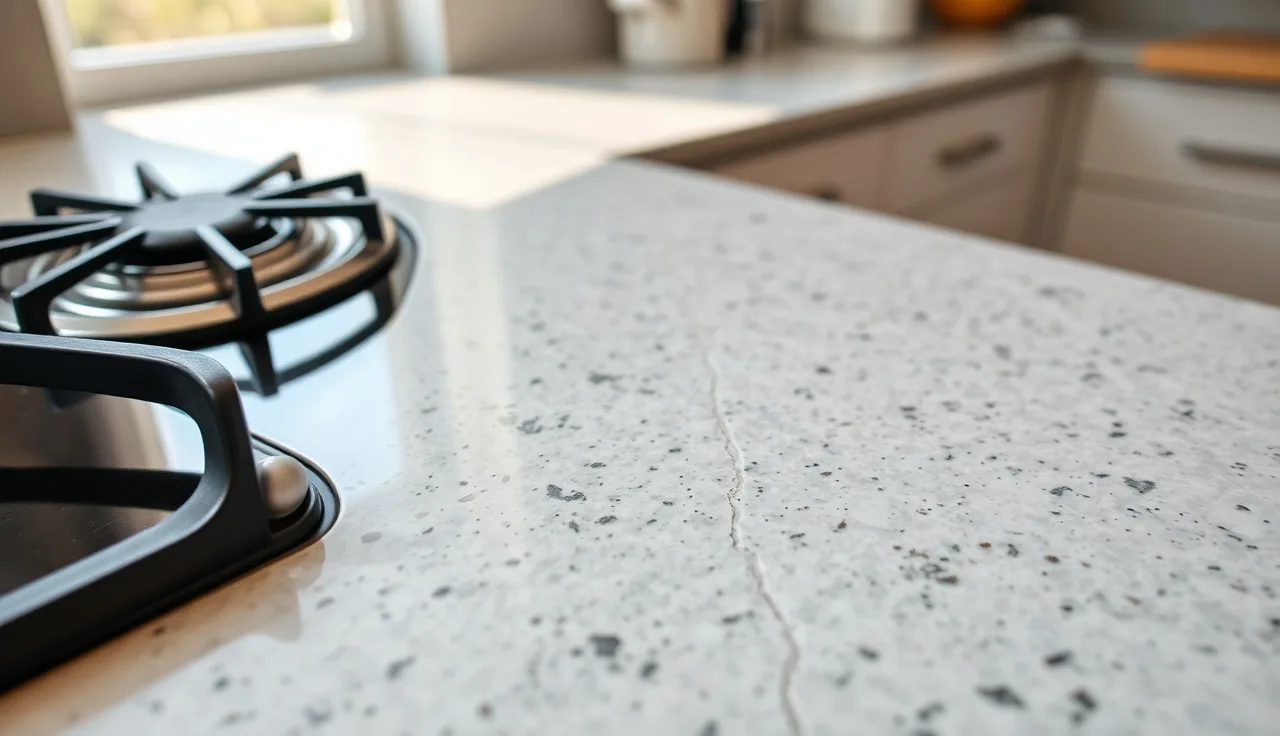
- Countertops crack near cooktops for four main reasons: thermal shock from sudden heat swings the stone can't absorb evenly, stress piling up at the sharp corners of the cutout, uneven support under the slab, and hidden fissures in the material.
- Most cracks start within 6 inches of the cutout, usually at a corner.
- The fix starts at fabrication, not after.
Why do countertops crack near the cooktop in the first place?
The cooktop cutout is the weakest spot on any countertop. You cut a rectangle out of a slab that used to be continuous, and the four corners of that hole turn into stress concentration points. Add heat, and the problem gets worse.
Stone, quartz, and solid surface all expand when heated and shrink when cooled. The movement is small, but it's real. Granite has a coefficient of thermal expansion of roughly 7 to 9 x 10^-6 per degree Celsius, depending on mineral content [1]. When one part of the slab heats faster than another, the two zones try to move at different rates. The stone right at the cutout edge heats quickly because it sits close to the burner. The stone a foot away stays cool. That difference is what cracks the slab.
The crack almost always starts at a corner, never along a straight edge. Sharp 90-degree corners in a cutout create a notch effect that multiplies local stress by a factor of 2 to 3 compared to a rounded corner [2]. Good fabricators radius every inside corner of a cooktop cutout for exactly this reason. A corner with a 3/8-inch or larger radius spreads stress across a curve instead of piling it at a single point.
Short version: cracks near the cooktop come from thermal movement meeting a stress concentration, usually at a square cutout corner, in a slab that isn't supported well underneath.
What role does thermal shock play in countertop cracking?
Thermal shock happens when temperature changes so fast the material can't expand or contract evenly. Near a cooktop, this is less about the steady heat of a burner and more about the sudden hits: a pot of boiling water set an inch from the cooktop edge, a cold wet sponge dropped on a slab that was sitting under a hot wok, a drawer yanked open after a long cooking session that lets cool air rush the warm underside.
Natural stone takes this badly because it isn't uniform. Granite is an aggregate of quartz, feldspar, and mica crystals, and each mineral expands at a slightly different rate [1]. Under fast heating, those mineral boundaries strain against each other. Over dozens of cycles, microcracks creep along the grain boundaries until a visible crack opens. Marble and quartzite are worse still, because calcite and dolomite expand strongly along one crystal axis and weakly along another [3].
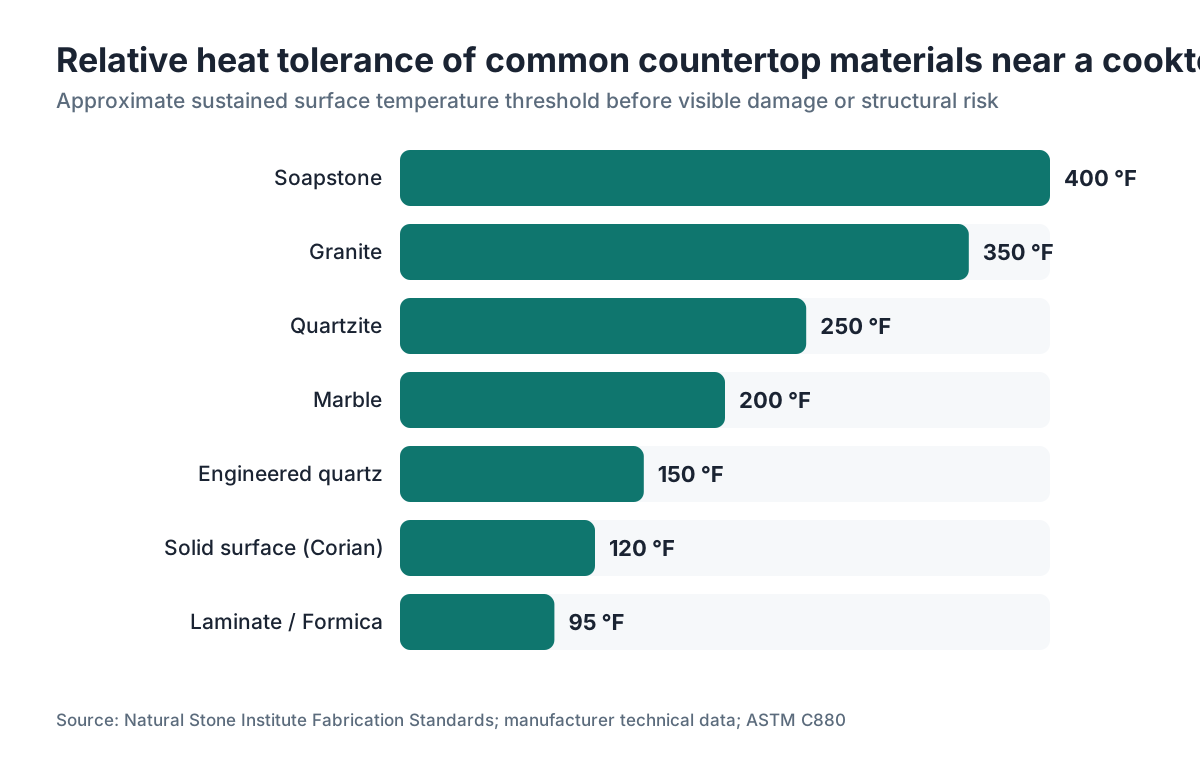
Engineered quartz (Silestone, Cambria, Caesarstone) is roughly 90 to 94 percent crushed quartz held together with polymer resin [4]. That resin expands far more than the quartz filler, so the composite shrugs off moderate heat but fails faster than natural stone under repeated or extreme cycling. Most quartz makers rate their surfaces to a maximum of 150 degrees Fahrenheit (65 Celsius) for sustained contact. A cast iron pan fresh off a high burner easily hits 400 to 500 degrees Fahrenheit at the contact point [5].
Want the material that handles cooktop heat best? Soapstone. It's mostly talc, and it has low thermal conductivity, so heat moves through it slowly and evenly instead of pooling into hot spots [6]. There's more on living with it in our guide to how to clean soapstone countertops. Granite beats marble and quartz in thermal cycling, but none of these materials are built for direct sustained heat.
How does the cooktop cutout shape affect cracking risk?
Cutout geometry matters more than most homeowners realize, and more than some fabricators bother to explain. A square cutout with sharp inside corners loads stress into those corners during thermal expansion and any bending (someone pressing on the counter, a heavy pan set down nearby).
Stress concentration theory, formalized in fracture mechanics, shows that a notch amplifies local stress by a factor tied to how sharp the notch tip is [2]. A perfectly sharp corner is a theoretically infinite stress concentrator. Real stone blunts that somewhat, but the physics still runs against you.
The standard fix is a radius on every inside corner, 3/8 inch minimum, with many shops going to 1/2 inch or larger on harder stones. Some fabricators also undercut the edge of the opening so the cooktop's frame overlaps the stone by 1/4 inch or more, which hides the edge and cuts down on chipping.
Distance from the cutout to the slab edge matters too. If a cooktop sits close to the front of an island, the strip of stone between the cutout and the counter edge can end up as narrow as 2 to 3 inches. That thin band has no structural depth to spread bending stress. Guidance from the Natural Stone Institute (formerly the Marble Institute of America) has long recommended at least 1.5 inches of material between any cutout and the counter edge for 3/4-inch stock, and more for thinner material [7].
Square corners plus a thin edge strip means your countertop is statistically more likely to crack near the cooktop. Thermal cycling just moves up the date.
Does poor installation cause countertop cracks near the cooktop?
Yes, and it's underrated. A countertop isn't a self-supporting beam. It sits on cabinet boxes, and those boxes have to give even, continuous support, especially around a cutout where the slab is already weakened.
High spots on the cabinet frame or uneven silicone beads between the slab and the top rail create pressure points. When someone stands at the cooktop, leans on the counter, or drops a Dutch oven down with a thump, that load pushes into the slab unevenly. If the support isn't flat, the slab flexes toward the low spots. Do that enough times, add thermal cycling on top, and the slab cracks.
Drop-in cooktops give the surrounding stone zero support. The slab spans the cutout as a frame, fully unsupported across the opening. Undermount and flush-mount cooktops sometimes do better, because the appliance frame can carry some load, but only if it's set right and the structure below is solid.
Silicone cure time is a quiet culprit. The silicone between the cooktop and the stone cushions small movements. Use the cooktop before it cures (typically 24 to 48 hours for most construction-grade silicones), and that movement goes straight into the stone with no buffer [8]. This happens constantly on remodels where the crew hands over the kitchen the same day or the day after the counters go in.
For a fuller look at what a good install involves, see our guide on countertop installation.
Which countertop materials are most likely to crack near a cooktop?
Materials don't behave the same under heat. Here's an honest comparison based on material science and what fabricators actually see in the field.
| Material | Heat Tolerance | Thermal Shock Risk | Cutout Crack Risk |
|---|---|---|---|
| Granite | High (igneous rock) | Low to moderate | Low with good fabrication |
| Quartzite | Moderate | Moderate to high | Moderate |
| Marble | Low to moderate | High | High |
| Engineered quartz | Low (resin binder) | High | Moderate to high |
| Soapstone | High | Very low | Low |
| Concrete | Moderate | Moderate | Moderate |
| Laminate | Very low | High | High |
| Butcher block | Very low | Moderate | High (chars) |
| Solid surface (Corian) | Low | High | High |
Engineered quartz is the material fabricators bring up most for cooktop cracks. The resin that binds the quartz particles starts to soften and discolor around 150 degrees Fahrenheit and can delaminate or crack above that [5]. Cambria, Silestone, and Caesarstone all warn against setting hot items directly on the surface in their warranty terms. If you have Cambria countertops near a cooktop, read the warranty language before you assume a high-heat mishap is covered.
Laminate countertops and Formica countertops are the most heat-sensitive of the common options. One hot pan set directly on the surface can blister, delaminate, and crack them in a single go. No repeated cycling needed.
Butcher block countertops don't crack from heat the way stone does, but they char, scorch, and dry out near a cooktop, which weakens the wood over time.
Granite countertops are among the most forgiving. Marble countertops are among the least, even though both are natural stone. The difference is mineralogy: marble's calcite crystals react more to uneven thermal expansion than granite's interlocked silicate minerals do.
Can a fissure in the stone cause a countertop to crack near the cooktop?
Yes, and it's an underappreciated cause. Natural stone slabs often carry pre-existing fissures, which are natural separations or weak planes in the mineral structure left over from the rock's geological history. These aren't cracks. Fissures are part of the stone's natural character, present before fabrication. Cracks show up after installation.
Here's the trouble. A fissure that runs through or near the cutout zone acts as a built-in stress riser. When thermal expansion or installation stress loads the stone, the fissure opens into a full crack instead of the stress spreading out harmlessly. A fissure that would sit quietly in the center of a big slab can become a fracture origin when it lands within 3 to 6 inches of a cooktop cutout corner.
Good fabricators inspect slabs before templating, mark the fissures, and orient the slab so fissures run parallel to critical zones like cooktop and sink cutouts, not across them. That isn't always possible with heavily figured stone, but it's the right practice. If you spot a fissure running perpendicular to a planned cooktop cutout in a slab you're considering, ask your fabricator to reorient it or pick a different slab.
Some fissures are stable and will never move. Others are barely holding. Without specialized inspection you often can't tell the difference, and neither can your fabricator by eye alone. That uncertainty is real, and it's worth saying out loud.
Does the type of cooktop (gas vs. electric vs. induction) affect cracking risk?
Cooktop type matters, mostly because of how heat reaches the surrounding stone.
Gas cooktops throw an open flame, and the heat footprint around the burner is uneven. Radiant heat from the grates and combustion gases warms the stone right at the burner edge faster than stone farther out [12]. Let a pot boil over so liquid runs under the grate and hits the stone near the opening, and you get a fast local temperature change on already-warm stone.
Electric coil cooktops are the historic worst offenders. Radiant heat from the coil element can hit the stone at the cutout edge directly, especially if someone parks a pan half on the burner and half on the stone.
Induction cooktops are the friendliest to countertops by a wide margin. The glass surface stays relatively cool because heat only generates inside the cookware itself, through electromagnetic induction [9]. The cooktop surface might climb to 50 or 60 Celsius from heat conducting back off the hot pan, but that's a long way below the 200 to 400 Celsius surface temperatures gas and electric radiant cooking can produce. Induction doesn't erase thermal shock, though. Slide a hot pan off the burner onto the stone and you still dump heat into it locally.
Picking a cooktop with countertop life in mind? Induction wins for cutting thermal stress on the stone. Stuck with gas? Trivets or silicone mats near the cutout edge cost almost nothing and take a real bite out of the thermal load.
How do fabricators prevent cracks near cooktop cutouts?
A skilled fabricator does several things a rushed one skips, and the difference shows up months or years later as a crack or no crack.
First, inside corners get radiused. No sharp 90-degree corners in a cooktop cutout. The radius scales with the material: brittle stones like quartzite and marble want a larger radius (1/2 inch or more), while granite usually holds up fine at 3/8 inch.
Second, the slab gets even support at the cabinet level. Installers check that the cabinet tops are coplanar (flat within tolerance) before the stone goes down. High spots get shimmed or planed. Low spots get built up. The goal is continuous, even support so the stone can't flex under load.
Third, slab selection accounts for fissure locations. As above, the slab gets turned to keep fissures out of the cutout zone where possible.
Fourth, the cutout edge gets polished to kill micro-chipping. A rough or chipped edge is just another stress riser. Polished or at least honed inside edges are standard in a good shop.
Fifth, silicone under the cooktop cushions movement. The flexible bead between the cooktop frame and the stone soaks up differential expansion so the stone doesn't carry the full strain of every heat cycle.
For shops, tracking cutout geometry, corner radii, and support conditions gets a lot easier when that data is captured digitally at the quote and template stage. Software like SlabWise lets you attach notes and specs at the cutout level so nothing falls through the cracks between template and install.
Some fabricators also brush a penetrating sealer onto the inside edge of the cutout on porous stones. That slows moisture from working into the grain, which over time can weaken the stone and make thermal cracking easier to trigger.
Can you repair a countertop crack near a cooktop, or does the slab need replacement?
It depends entirely on the crack and how far it has run. A hairline crack that doesn't go through the full thickness and stays put can often be stabilized with color-matched epoxy or resin injection. A stone repair pro cleans the crack, injects a low-viscosity epoxy, and sands it flush after curing.
Results vary. On polished dark granite, a repaired crack is usually visible up close. On heavily figured or veined stone, a good repair can vanish into the pattern.
A crack that runs from a cutout corner to the front edge, or one that splits the slab into two pieces, is almost always a replacement job. Even if a fabricator pins and epoxies the pieces back together, the joint moves differently than intact stone under thermal cycling, and it tends to reopen or telegraph through as a seam.
Cracks in engineered quartz are harder to hide than cracks in natural stone, because the even color and pattern make any filler obvious. Quartz makers and independent repair specialists have color-matched filler systems, but the repair is cosmetic, not structural.
Before you spend money, find the cause. If the crack came from a fissure that propagated under heat, and the support and cutout geometry haven't changed, the repair will likely crack again in the same spot. Fix the cause first.
For keeping stone near the cooktop in good shape, sealed and clean helps. See our guides on how to clean stone countertops and how to clean quartzite countertops.
What can homeowners do to prevent cooktop-area cracks?
Most prevention happens before installation, but you've still got moves after the fact.
At selection, pick a material that fits how you cook. High heat daily, cast iron, casual about setting hot pans down? Granite or soapstone will outlast quartz, marble, or laminate in that spot. Ask your fabricator to walk you around the slab and point out any fissures near where the cooktop will land.
At installation, check that the cooktop cutout has rounded inside corners. You shouldn't be able to slip a square corner into the notch. Ask what radius the fabricator used. Ask whether the cabinets were checked for flatness before the stone was set. These are fair questions, and any fabricator worth hiring answers them without flinching.
After installation, put a trivet, a silicone mat, or at minimum a folded kitchen towel between very hot cookware and the stone within 6 inches of the cutout. This goes double for quartz. Don't blast cold water onto hot stone near the cooktop. Wipe spills with a damp cloth, not a cold wet sponge on a hot surface.
Seal porous stone (granite, marble, quartzite) at least once a year, and pay extra attention to the inside edge of the cutout. A sealed edge absorbs less moisture, and less moisture means stronger mineral bonds in the heat zone.
For kitchen countertops in general, the cooktop zone earns more care than any other stretch of surface. It stacks mechanical stress (the cutout), thermal stress (the burners), and physical abuse (pots and pans) into one small area.
Does countertop thickness affect cracking risk near the cooktop?
Yes. Thicker stone has more cross-section to spread stress, which lowers the odds of a fracture at the cutout corners.
The two standard thicknesses for stone are 2 centimeters (roughly 3/4 inch) and 3 centimeters (roughly 1.25 inches). Three-centimeter stone resists cutout cracking noticeably better because it carries about 50 percent more material depth to handle bending and thermal loads [7]. Plenty of fabricators won't install 2-centimeter stone without a plywood sublayer under it, partly for support and partly because the combined assembly is stiffer and harder to crack.
For cooktop cutouts, 3-centimeter is the better call. The upcharge over 2-centimeter usually runs a few hundred dollars for an average kitchen, and it's real insurance against cutout cracking. If a fabricator quotes 2-centimeter material for a cooktop installation, ask flat out about the cracking risk and whether they'd recommend a sublayer.
For fabricators, this belongs in the quote conversation. Documenting the thickness recommendation and the customer's decision protects both sides if a crack shows up later. SlabWise captures these specs in the quote so there's a clear paper trail of what was specified and why.
Are there building codes or standards that address countertop cutout safety?
There's no single federal standard aimed specifically at countertop cutout geometry, but several standards touch the area.
The International Residential Code (IRC), adopted across most U.S. states, covers appliance clearances and installation for cooktops but doesn't spell out countertop fabrication methods in detail [10]. Appliance makers publish their own installation specs with minimum distances between the cooktop and adjacent combustible materials, which shapes countertop edge placement indirectly.
The Natural Stone Institute (formerly the Marble Institute of America) publishes technical bulletins on fabrication best practices, including cutout radius and support requirements [7]. These aren't legally binding codes, but they set the industry standard of care, and they get cited in dispute resolution when a crack shows up after installation.
ASTM International has test methods for stone (C119, C170, C880 among them) that measure flexural strength and modulus of rupture, numbers that inform safe span and cutout geometry limits [11]. Fabricators who read these can make sharper calls on corner radius and support for a given stone. ASTM C880, per its scope, is the "Standard Test Method for Flexural Strength of Dimension Stone."
Underwriters Laboratories (UL) and NSF International certify the cooktop appliances, not the countertops around them. So there's no UL listing that covers the stone-to-cooktop interface.
The working standard of care, as the stone industry recognizes it: minimum 3/8-inch inside corner radius at cooktop cutouts, even support across the full slab, and minimum material widths between cutout edges and slab edges per Natural Stone Institute guidance [7].
Frequently asked questions
Why did my quartz countertop crack right at the corner of the cooktop cutout?
Quartz is brittle, and its resin binder is sensitive to heat. The inside corner of a cooktop cutout concentrates stress. If the fabricator left a sharp 90-degree corner instead of a radius, and the cooktop pushed enough heat near that corner, thermal expansion stress plus the stress concentration at the sharp corner is almost always what caused the fracture. Check whether the corner has a radius. If it doesn't, the fabrication is the primary cause.
Is it normal for granite to crack near a gas cooktop?
It's not common with good fabrication, but it happens. Granite can crack near a gas cooktop when the cutout has sharp corners, when a fissure runs through the cutout zone, or when the stone isn't supported evenly by the cabinet below. Gas burners throw uneven radiant heat, which sets up thermal gradients near the cutout edge. Using trivets for hot pans and confirming the cutout corners are radiused cuts the risk sharply.
Can I put a hot pan directly on the stone next to the cooktop without it cracking?
For granite and soapstone, an occasional hot pan on the surface near the cooktop is unlikely to crack it in one incident. For quartz, marble, or laminate, a very hot pan (over 300 degrees Fahrenheit at the contact surface) near the cutout carries real cracking and discoloration risk. A trivet costs two dollars and removes the risk. It's the right habit no matter what your counter is made of.
How much does it cost to repair a cracked countertop near a cooktop?
Stone repair for a hairline crack usually runs $150 to $400 depending on length, location, and material, based on common contractor pricing ranges. Structural cracks needing pinning or a full section swap can run $500 to several thousand dollars. If the slab needs replacement, expect the full countertop cost plus reinstallation. Get the crack evaluated by a stone fabricator before you pay for a cosmetic repair that might not hold.
Does the brand of cooktop affect how much heat stress hits the countertop?
Cooktop type matters more than brand. Induction transfers the least heat to surrounding stone because the glass surface stays relatively cool. Electric coil and gas cooktops throw more radiant heat around the cutout edge. Across brands, BTU output and burner placement relative to the cutout edge vary, but no major brand is dramatically better or worse for stone stress. Type is the variable that counts.
Will a countertop crack near the cooktop if the cabinets aren't perfectly level?
Uneven cabinet tops leave support voids under the slab. If the slab bridges a low spot right next to the cutout, that span has nothing beneath it. Load the counter there (a heavy pot, a lean) and you bend an already-weakened zone. Add thermal cycling and it can absolutely crack. Cabinet top flatness should be checked before the stone goes on, not after.
Does sealing a stone countertop near the cooktop prevent cracking?
Sealing doesn't directly stop thermal cracking, but it slows moisture from working into the stone's pore structure. Moisture that freezes in micro-pores or weakens mineral bonds at the grain level can make the stone likelier to turn thermal stress into a visible crack over time. Sealing the inside edge of the cutout, which fabricators often leave bare, is a cheap protective step most homeowners skip.
My countertop cracked near the cooktop right after installation. Who is responsible?
If the crack showed up within days of installation, the likely causes are a fabrication defect (sharp cutout corners, a missed fissure, or poor support) or using the cooktop before the silicone cured. Photograph the crack, note where it starts (almost certainly at a corner), and call your fabricator. If the cutout has sharp corners or a fissure runs through the crack origin, those are fabrication-side issues. Reputable fabricators stand behind their work.
Is marble or quartz more likely to crack near a cooktop?
Both beat out granite in vulnerability, for different reasons. Marble cracks from thermal shock because its calcite crystals expand unevenly with heat. Quartz cracks near cooktops because its polymer resin binder softens and fails at relatively low temperatures, around 150 degrees Fahrenheit. For a cooktop-adjacent surface, neither is ideal, though proper fabrication and heat management lower the risk for both.
How long does it take for thermal damage to crack a countertop near a cooktop?
It varies a lot. One extreme heat event (a cast iron pan at 500 degrees on quartz) can crack the surface immediately. More often, thermal cycling piles up damage over months or years. Fabricators report cooktop-area cracks surfacing anywhere from 6 months to 5 years after installation, usually after an incident that pushed past the stone's accumulated fatigue. There's no reliable timeline, because stone variability and cooking habits differ too much.
Does a larger cooktop cutout create more cracking risk than a smaller one?
A larger cutout removes more material, leaving less stone to carry stress around the opening, and it widens the span of unsupported stone on each side. But a small cutout with sharp corners and a fissure can crack faster than a large cutout with radiused corners and a clean slab. Geometry and support matter more than size, though all else equal, a bigger cutout does raise structural vulnerability.
Can I install a countertop right up to the edge of a freestanding range without cracking risk?
Yes, with caveats. A freestanding range needs no cutout in the countertop, so you skip the cutout corner stress problem entirely. The main risk is radiant heat from the oven sides or cooktop transferring to the stone edge over time. Standard practice leaves 1/8 to 1/4 inch of clearance between the range side and the stone edge, partly for thermal movement and partly per the range maker's install requirements. Laminate and quartz at that edge can still discolor from prolonged radiant heat.
What is the minimum inside corner radius for a cooktop cutout to prevent cracking?
Natural Stone Institute fabrication guidance calls for a minimum 3/8-inch inside corner radius at cooktop cutouts. Many fabricators go to 1/2 inch for quartzite, marble, or other brittle materials. Some engineered quartz makers set their own minimum radii in their install guidelines, often 1/4 to 3/8 inch. Asking your fabricator what radius they use is a completely reasonable pre-installation question, and if they can't answer specifically, that's a yellow flag.
Does a kitchen island cooktop carry more cracking risk than a wall cooktop?
Island cooktops can carry slightly more risk. Island slabs often have no back wall support, sometimes span farther between cabinet supports, and get bumped from all sides. The cutout geometry risks are identical, but the flexural load from daily use around an island tends to run higher than on a wall counter. Solid support from the island cabinet structure and proper cutout fabrication matter even more here.
Sources
- U.S. Geological Survey, Mineral Resources: Dimension Stone: Granite is an aggregate of quartz, feldspar, and mica with a coefficient of thermal expansion around 7 to 9 x 10^-6 per degree Celsius, and its mixed minerals expand at different rates under heat.
- MIT OpenCourseWare, 2.002 Mechanics and Materials II: Sharp notches or corners in a material multiply local stress by a factor of 2 to 3 or more compared to a rounded geometry, making square cutout corners a fracture initiation risk.
- U.S. Geological Survey, Mineral Resources Program: Calcite and dolomite show strongly anisotropic thermal expansion, expanding at different rates depending on crystal orientation, which makes marble and quartzite more prone to thermal cracking.
- NSF International, NSF/ANSI 51 Food Equipment Materials: Engineered quartz surfaces are composed of approximately 90 to 94 percent crushed quartz particles bound with polymer resin, giving the material different thermal properties from natural stone.
- U.S. Consumer Product Safety Commission, Home Safety: Cast iron and stainless pans fresh off high burners can reach 400 to 500 degrees Fahrenheit at the contact surface, far exceeding the 150-degree Fahrenheit threshold at which most quartz resin binders begin to soften.
- U.S. Geological Survey, Mineral Commodity Summaries: Talc and Soapstone: Soapstone is composed primarily of talc and has low thermal conductivity, so heat moves through it slowly and evenly rather than creating hot spots.
- Natural Stone Institute, Fabrication and Installation Standards: Industry guidance recommends a minimum of 1.5 inches of material between any cutout edge and the counter edge for 3/4-inch stock, and a minimum 3/8-inch inside corner radius at cooktop cutouts.
- Dow, Silicone Sealant Application Guidance: Construction-grade silicone sealants typically require 24 to 48 hours to fully cure before load or movement should be applied to the joint.
- U.S. Department of Energy, Energy Saver: Induction cooktops generate heat directly in the cookware via electromagnetic induction, so the glass surface itself stays relatively cool compared to gas or electric radiant cooktops.
- International Code Council, International Residential Code (IRC) 2021: The IRC covers appliance clearances and installation requirements for cooktops but does not prescribe specific countertop fabrication methods such as cutout corner radii.
- ASTM International, ASTM C880 Standard Test Method for Flexural Strength of Dimension Stone: ASTM C880 measures the flexural strength and modulus of rupture of dimension stone, providing data that informs safe span and cutout geometry limits for stone countertops.
- U.S. Department of Energy, Energy Saver: Cooktops and Ranges: Gas cooktop burners produce open flame and uneven radiant heat around the burner grates, creating thermal gradients in adjacent surfaces that electric and induction cooktops produce to a lesser degree.
Last updated 2026-07-11