TL;DR
- Diamond-tipped core drill bits are the only reliable tool for drilling faucet holes in stone countertops.
- The standard faucet hole is 1-3/8 inches (35mm) across.
- You need a continuous-rim or segmented diamond core bit, water cooling, and a low-speed drill running 800 to 1,200 RPM.
- Carbide bits will not survive stone.
- Budget $15 to $80 per bit.
What type of drill bit actually cuts through stone?
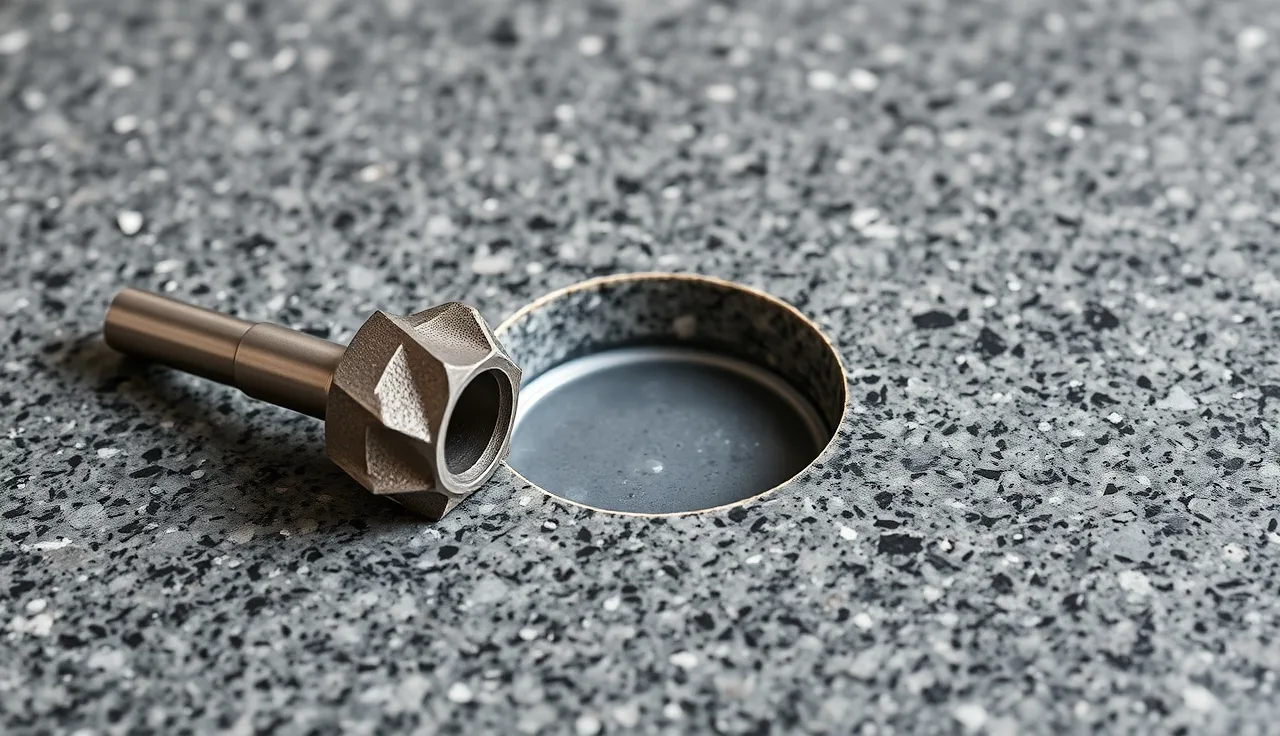
Diamond core drill bits cut stone. Nothing else on the consumer market survives granite, quartz, marble, or quartzite long enough to finish a hole. The cutting edge is industrial diamond particles held in a metal matrix (usually steel or bronze), and that matrix wears away as you drill to expose fresh diamonds underneath. The diamonds do the cutting. No other material is hard enough to cut those minerals at a speed that makes sense.
Carbide-tipped hole saws, the kind you use on tile or wood, will scratch through soft limestone or soapstone in a pinch. On granite or engineered quartz they overheat and go dull almost instantly. Cobalt and high-speed steel bits are the wrong tool entirely.
Diamond core bits split into two families: continuous-rim (also called sintered or crown bits) and segmented. Continuous-rim bits have an unbroken ring of diamond matrix around the edge. They cut smoother and leave cleaner entry holes, which matters on a polished surface people will see. Segmented bits have gaps or slots in the cutting edge that flush water and debris, run cooler, and cut faster. For faucet holes where the finish shows, most fabricators grab a continuous-rim bit. Segmented bits earn their keep on sink cutouts and faster rough work. The Natural Stone Institute names diamond core bits and wet drilling as the recommended method for hole cutting in natural stone [7].
What size core drill bit do you need for a standard faucet hole?
The industry standard for a single faucet hole is 1-3/8 inches across, which is 35mm [10]. That size fits the shank on nearly every kitchen and bathroom faucet sold in North America. Some European fixtures and a few common faucets use a 1-1/2 inch (38mm) hole, and a small number of specialty valves want 1-1/4 inch (32mm). Check the faucet manufacturer's installation spec before the bit touches stone.
Soap dispensers, filtered water taps, and air switches for garbage disposals almost always use that same 1-3/8 inch hole. Sprayer hoses usually match too. The one common exception is a deck-mount pull-down faucet with a large escutcheon plate that hides the hole, where the exact diameter matters less to the eye.
Most shops stock a short set. A 1-1/4", a 1-3/8", and a 1-1/2" cover maybe 95% of jobs. A few keep a 1" bit for pot filler valves and a 2" bit for apron-front accessories, but those come up rarely.
One detail people miss: bit sizes are measured by inside diameter at the cutting edge, not outside. A 1-3/8" core bit pulls out a 1-3/8" plug of stone and leaves a hole that matches the faucet shank. The barrel outside that cut runs a little wider.
Wet vs. dry diamond core bits: which do you need for stone?
Wet drilling wins for stone, and on hard slabs it's effectively required. Diamond core bits overheat fast in dense mineral. Heat cooks the metal matrix holding the diamonds, so they shed early or the face glazes over and quits cutting. Water holds the temperature down and flushes the pulverized stone (the slurry) out of the cut so the diamonds stay exposed and biting. OSHA also lists wet methods as an accepted control for silica during stone cutting [6].
Wet-rated bits have a continuous or lightly segmented rim and run submerged or under constant water flow at the cutting edge. Dry bits are built for softer masonry, brick, or ceramic tile, with deeper segments or flutes that shed heat through airflow. Run a dry bit on granite with no water and you can ruin a $40 bit in under a minute.
In practice, fabricators use a rubber suction-cup water dam (some call it a water crown or drill guide) that grips the surface around the drill point and holds a small pool of water over the hole. Fill it before you start, top it off as you go. Other shops run a steady drip from a squeeze bottle or a hose plumbed to the drill collar. Same goal either way: the bit never runs dry.
You'll see "dry-cut" diamond core bits sold for stone. They work. They also run hotter, wear faster, and chip the stone face at the exit more often. On polished granite or marble that's already a finished countertop, wet drilling gives you the cleaner hole and the longer bit life.
What drill speed should you use with a diamond core bit in stone?
Low speed, steady pressure. Diamond core bits cut stone best somewhere between 600 and 1,800 RPM depending on diameter [1]. Small bits under 1" tolerate the top of that range. The 1-3/8" bits fabricators reach for on faucet holes run well around 800 to 1,200 RPM. Push the speed higher and you make heat faster than water can carry it off, and the matrix wears crooked.
Most variable-speed rotary drills reach those speeds, and a standard corded drill on its low setting works fine. Keep 4.5" angle grinders out of this job; they spin 8,000 to 11,000 RPM, which is far too fast for a core bit. A drill press with adjustable speed is ideal for repeat shop work, but a handheld drill, a water dam, and a steady hand does the job on a bench or an installed top.
Apply moderate downward pressure and let the diamonds work. Leaning hard actually slows the cut, because you close the kerf and trap slurry against the diamonds. If the bit spins without biting, ease off and check the water. A glazed bit (shiny at the face, no diamonds showing) needs dressing on a dressing stick or a soft abrasive brick to expose fresh grit.
Start the hole at roughly 45 degrees to scratch a shallow groove so the bit can't skate across the polished surface. Once the groove seats, bring the drill upright. Some fabricators use a suction-cup jig to hold the bit vertical from the first second.
Which stone types are hardest to drill and why does it matter?
Stone hardness runs on the Mohs scale, and it drives both how fast your bit wears and how likely you are to crack the slab. Granite sits at 6 to 7 on Mohs, harder than most engineered quartz binders but softer than the quartz crystals themselves [2]. Engineered quartz (Cambria, Silestone, and the rest) is 90 to 94% quartz by weight in a polymer resin binder. The quartz particles are brutally hard, but the composite cuts fairly predictably.
Marble, limestone, and travertine are calcite-based and rate 3 to 4 on Mohs. They cut faster and easier than granite, but they chip and spall at the hole edge faster if you rush. Quartzite (the real metamorphic stone, not the marble that gets mislabeled as quartzite) rates 7 and up and is genuinely hard work.
Soapstone lands around 1 to 2 Mohs and drills with almost anything, though a diamond bit still leaves the cleanest edge. For more on that material, see our guide on how to clean soapstone countertops.
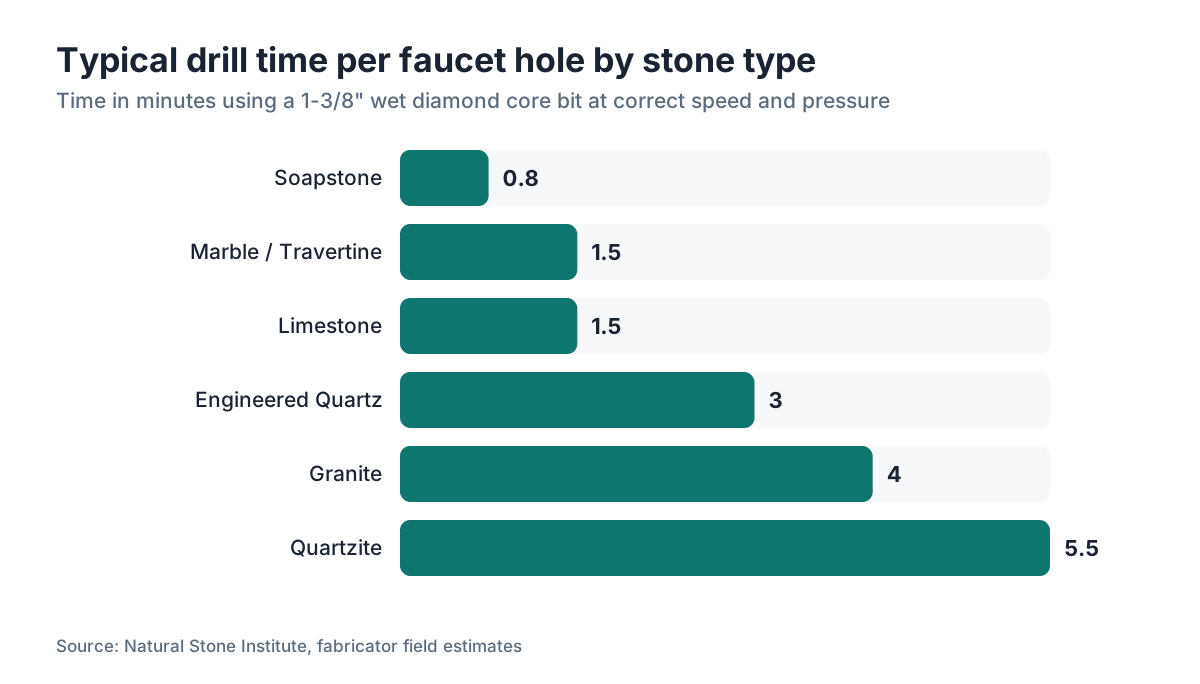
Harder stone means more bit wear and more time in the cut, which is why this matters at quoting time. A granite faucet hole takes 3 to 5 minutes with a sharp wet diamond bit. Marble takes 1 to 2. Engineered quartz sits in between. Track per-hole time against your real cost per bit and you can price faucet cutouts off data instead of gut feel; fabrication software like SlabWise is built to log exactly that.
| Stone Type | Mohs Hardness | Typical Drill Time (1-3/8" hole) | Bit Wear Rate |
|---|---|---|---|
| Soapstone | 1-2 | 30-60 sec | Very low |
| Marble / Travertine | 3-4 | 1-2 min | Low |
| Limestone | 3-4 | 1-2 min | Low |
| Engineered Quartz | 5-7 (composite) | 2-4 min | Moderate |
| Granite | 6-7 | 3-5 min | Moderate-high |
| Quartzite | 7+ | 4-7 min | High |
How much do diamond core drill bits cost and how long do they last?
Entry-level diamond core bits for stone run $15 to $30 each. Mid-range bits from Bosch, Diablo, or Toolocity land at $30 to $55 for a 1-3/8" size. Professional bits from fabrication suppliers like Diamax, Stadea, or MK Diamond cost $50 to $85 and last a lot longer [9].
Bit life is hard to pin down because it rides on technique, water management, and stone hardness. Fabricator estimates put a quality mid-range wet bit at 30 to 80 faucet holes in granite before it's too worn to cut clean. Cheap bits might give you 10 to 15. No manufacturer publishes a hole-count warranty, so treat these as shop experience, not spec sheet.
For a shop running several kitchens a week, the math is simple. A $60 bit that cuts 60 holes is $1 per hole in tooling. A $20 bit that dies at 12 holes is $1.67 per hole, plus more changeovers. Buy the better bit.
Drilling one or two holes in your life? A $20 to $30 bit is plenty. You'll probably never touch it again. Spend the extra attention on one thing: make sure the bit is rated for wet use on stone, more than ceramic tile. Read the package. It should say "granite," "marble," or "natural stone," not only "tile."
Can you drill a faucet hole in an already-installed countertop?
Yes. Fabricators do this all the time when a homeowner adds a soap dispenser or swaps to a three-hole faucet after install. The drilling is the same. Access and slurry are the parts that get harder.
The real headache is keeping water in the dam instead of draining into the cabinet below. Closed suction-cup water dams help, and towels stuffed in the cabinet catch the drips that escape. The cleanest setups pair the suction dam with a vacuum attachment that pulls slurry off as you cut.
Drilling over cabinets also limits your angle. You mostly have to come straight down from the top, so that 45-degree start to seat the bit isn't always an option with cabinet walls in the way. A drill guide that suctions to the surface and holds the bit perpendicular is easily worth its $20 to $40.
One real risk: vibration can open a crack at an existing weak point or near an undermount sink cutout. Keep the drill slow and steady. Never knock the core out by prying or hammering the bit sideways. Let the plug drop, or pull it with needle-nose pliers once you're all the way through.
If your top is granite, marble, or quartzite and you want to know what you're cutting before you start, our granite countertops and marble countertops guides cover the material properties.
What safety precautions matter when drilling stone?
Silica dust is the hazard that matters most. Cutting stone releases respirable crystalline silica, which CDC/NIOSH ties to silicosis and lung cancer with repeated occupational exposure [5]. OSHA's construction silica standard (29 CFR 1926.1153) requires engineering controls, including wet methods or local exhaust ventilation, when you cut stone [3]. For fabricators that's the law. For a homeowner doing one hole, wet drilling knocks down most of the airborne dust on its own, but an N95 or P100 respirator is cheap insurance.
Wear safety glasses. Slurry and stone chips fly out of the hole with real speed. Gloves do less for you than people expect against the bit itself, but they help you hold the drill against the torque.
Ground-fault protection is not optional any time water meets a power tool. The National Electrical Code (NFPA 70, Article 210.8) requires GFCI protection for receptacles serving kitchen and bathroom sink areas [4]. Use a GFCI outlet or a GFCI plug adapter.
Keep the cord away from the water dam. Set up your drip tray or towel system before you start, so you're not scrambling once slurry is running. Wet stone floors and wet counters are slick. Watch your footing.
Are there specific brands of diamond core bits fabricators actually trust?
A handful of names come up again and again in fabrication forums and supply houses.
Diamax bits are popular in pro shops for a consistent diamond bond and long life on granite. Stadea (part of the Signi Diamond family) covers the mid-range at fabrication pricing. MK Diamond has made masonry and stone cutting products for decades and stocks widely. Rubi is a Spanish brand with a strong footprint in tile and stone. On the mass-market side, Diablo (owned by Freud) and Bosch make stone-rated bits you can buy at most home centers, and they hold up fine for occasional use.
Bits sold under generic or unfamiliar names online are a gamble. Some are decent imports. Some run inconsistent diamond concentration that wears uneven and leaves rough holes. If you buy by the dozen, source from a stone supply distributor (Braxton-Bragg, MS International, and the like) where you can read the spec sheet and return a bad batch.
Doing your own countertop installation? A name-brand bit from a home center is the right call. It's traceable, it's returnable, and the package tells you exactly what it's rated to cut.
What happens if you use the wrong bit or wrong technique?
A few things go wrong, and they range from annoying to expensive.
The worst is a cracked slab. Cracks start when the bit torques sideways under too much lateral force, when you tilt the drill mid-cut, or when the bit catches a flaw (a crystal boundary in granite, a vein in marble). Once a crack runs from the hole toward an edge or an undermount cutout, the top usually has to be replaced. On a $3,000 granite slab, that's a costly mistake.
Chipping at the hole entry comes from dry bits, high speed, or no water. The diamonds skate across the surface instead of biting, and the polished face fractures at the rim. A faucet escutcheon plate hides minor chipping, but bad chipping shows even with the fixture on.
A ruined bit stings less but still costs money and time. A glazed bit that won't cut can sometimes come back after dressing on a soft abrasive. A bit that's shed its diamonds or warped its barrel is scrap.
Working on engineered quartz like Cambria countertops? The resin binder can gum up a bit faster than natural stone if water flow falls short. Keep the water moving and go easy on the pressure.
Do you need different bits for porcelain, ceramic tile, or laminate countertops?
Porcelain and ceramic show up in plenty of kitchens and bathroom vanities, especially older ones. Both are hard and brittle. Diamond core bits handle them well, and the same 1-3/8" wet bit you use on granite works on porcelain. Porcelain rates roughly 6 to 7 on Mohs at the glaze and body, so the technique matches: wet, slow, steady.
Laminate is a different animal. Laminate countertops (including Formica countertops) are paper and resin over particleboard or MDF. A regular hole saw, or even a sharp spade bit with a pilot hole, cuts them easily. No diamond needed. The risk with laminate is delamination at the cut edge if the blade is dull or if you cut from the face side. Most installers cut from underneath or run masking tape over the line.
Corian countertops and other solid-surface materials are acrylic-based and cut with standard woodworking hole saws. No diamond required.
Butcher block countertops are wood. A forstner bit or hole saw cuts clean.
The diamond core bit is for stone and equally hard mineral surfaces. Run one on softer material and it's overkill, but it won't hurt anything. Run a non-diamond bit on stone and you've made a mistake.
How do fabricators price faucet hole drilling into a quote?
Most shops charge per hole as a line item, separate from the square-footage price. Rates move by market and stone type, but a fair range for a single faucet hole is $25 to $75 in most U.S. regions, with harder stone and installed tops landing near the top.
That price covers bit wear, labor (usually 10 to 20 minutes per hole including setup and cleanup), water management, and the small but real risk of cracking a slab. Some shops fold the first hole into the base price and bill incrementally for each extra one (soap dispenser, air switch, filtered water line).
Shops that track tooling costs know how many holes a given bit lasts. If you run fabrication software like SlabWise to build quotes, logging per-hole bit cost next to labor turns a guess into real margin data. That's the line between knowing your profit and hoping for it.
Getting multiple quotes? Ask whether faucet holes are included or itemized. A quote that looks cheap sometimes prices the holes separately. A kitchen with a faucet, a soap dispenser, and a filtered water tap is three holes, and that can add $75 to $225 depending on the shop.
Frequently asked questions
What size diamond core bit do I need for a standard kitchen faucet hole?
The standard size is 1-3/8 inches (35mm). It fits the shank on most kitchen and bathroom faucets sold in North America. A few European or specialty faucets want 1-1/2 inch (38mm). Check the faucet installation instructions before ordering a bit, since a hole drilled too large can't be undone.
Can I drill a faucet hole in granite myself, or do I need a fabricator?
A careful DIYer can drill granite with a quality wet diamond core bit, a suction-cup water dam, a variable-speed drill, and patience. The risk is cracking the slab if the bit wanders or you press too hard. On an expensive slab, paying a fabricator to do it right often costs less than the gamble of a ruined countertop.
How long does it take to drill a faucet hole in granite?
With a sharp wet diamond bit and good technique, expect 3 to 5 minutes of active drilling per hole in granite. Setup, water dam, and cleanup add another 10 to 15 minutes. Quartzite runs 4 to 7 minutes per hole. Marble and softer stones drill faster, often under 2 minutes.
Do diamond core bits need water to drill stone countertops?
Yes, for stone. Water cools the bit and flushes slurry out of the cut, which prevents overheating and glazing. Dry diamond bits exist, but they wear faster and chip polished stone at the edge more often. Use a suction-cup water dam or a continuous drip, and never let the bit run dry in the hole.
How many holes can a diamond core bit drill before it wears out?
A quality mid-range wet bit typically cuts 30 to 80 faucet holes in granite before it's too worn to cut clean. Cheaper bits may give you 10 to 15. Soft stone like marble stretches bit life a lot. These are shop estimates, not manufacturer specs. Life depends heavily on technique and whether water flow holds throughout.
What RPM should I use when drilling a faucet hole in stone?
For a 1-3/8 inch diamond core bit in stone, 800 to 1,200 RPM is a practical target. Faster than that makes heat faster than water can dissipate it and burns off diamonds early. If your drill has a speed dial, set it to low or medium-low. Variable-speed trigger control works but is harder to hold steady.
Can diamond core bits crack a granite countertop?
Yes, bad technique can crack stone. The usual causes are tilting the drill under pressure (lateral torque), running dry, pressing too hard, or drilling near an existing crack or cutout edge. Keep the drill perpendicular, use water, and let the bit cut at its own pace. Near undermount sink cutouts, be extra careful.
What is a continuous-rim diamond bit versus a segmented diamond bit?
Continuous-rim bits have an unbroken ring of diamond matrix and leave smoother, cleaner hole edges. Segmented bits have gaps or slots that improve water and debris flushing and cut faster. For faucet holes in polished stone where the edge shows, continuous-rim is the better pick. Segmented bits suit sink cutouts and rough cuts where speed beats finish.
Do I need a diamond bit to drill a hole in quartz countertops?
Yes. Engineered quartz is 90 to 94% quartz particles by weight, which are extremely hard. Carbide or standard hole saws won't cut quartz reliably. Use the same wet diamond core bit setup you'd use on granite. Quartz's resin binder can gum up the bit if water flow is short, so keep water running through the whole cut.
What personal protective equipment do I need when drilling stone?
At minimum, safety glasses and an N95 or P100 respirator. Wet drilling suppresses most silica dust, but some still goes airborne. OSHA's construction silica standard (29 CFR 1926.1153) requires wet methods or ventilation for stone cutting on the job. Use a GFCI-protected outlet whenever water and a power tool meet near a sink.
Can you drill a faucet hole in a stone countertop that is already installed?
Yes. Fabricators drill installed tops all the time for added accessories. The drilling is the same, but water management is harder. Use a suction-cup dam to contain slurry and stuff towels in the cabinet below. Go slow near undermount cutouts. A drill guide that suctions to the surface helps hold the bit perpendicular when cabinet walls limit your angle.
What is the difference between a hole drilled for a faucet versus a soap dispenser?
Almost none in the drilling. Both usually use 1-3/8 inch (35mm) holes. The hardware you drop in differs, but the hole size, bit, and technique are identical. Quotes charge per hole regardless of what goes in it. A project needing three holes (faucet, soap dispenser, water filter) is three drilled holes on your bill.
Are there diamond core bits specifically for porcelain tile countertops?
The same wet diamond core bits used on stone work on porcelain. Porcelain rates about 6 to 7 on Mohs and wants the same wet approach. Bits labeled for tile-and-stone or granite are fine. Porcelain is more brittle than granite and chips at the edge more easily with a dull or dry bit, so keep water flowing and use a sharp one.
How much does it cost for a fabricator to drill a faucet hole?
Most shops charge $25 to $75 per hole, depending on stone type, region, and whether the top is already installed. Harder stone and installed countertops land toward the high end. Some shops fold the first hole into the base fabrication price and bill separately for extras. Always ask whether faucet holes are included in a quote or listed as add-ons.
Sources
- Bosch Tools, Diamond Core Bit Speed and Application Guide: Recommended RPM range for diamond core bits cutting stone is approximately 600-1,800 RPM depending on bit diameter.
- USGS, Mineral Resources Program: Hardness of Common Minerals: Granite typically ranges from 6 to 7 on the Mohs hardness scale due to its quartz and feldspar mineral content.
- OSHA, Occupational Exposure to Respirable Crystalline Silica in Construction (29 CFR 1926.1153): OSHA's construction silica standard requires engineering controls including wet methods or local exhaust ventilation when cutting stone.
- NFPA 70, National Electrical Code, Article 210.8 - GFCI Requirements: GFCI protection is required for receptacles serving kitchen and bathroom sink areas under the National Electrical Code.
- CDC/NIOSH, Silica Dust and Silicosis Hazard Review: Respirable crystalline silica generated during stone cutting is linked to silicosis and lung cancer with repeated occupational exposure.
- OSHA, Table 1 Specified Exposure Control Methods: Silica in Construction: Wet drilling is listed as an acceptable engineering control for silica exposure when cutting stone in construction operations.
- Natural Stone Institute, Stone Fabrication Safety Guidelines: Diamond core bits and wet drilling are the recommended method for hole cutting in natural stone countertops.
- USGS, Quartz Mineral Data: Quartz rates 7 on the Mohs scale, making quartzite and engineered quartz products among the hardest countertop materials to drill.
- Braxton-Bragg Stone Fabrication Supply, Diamond Tooling Product Catalog: Professional diamond core bits for stone fabrication range from approximately $50-$85 for 1-3/8 inch wet bits from leading fabrication brands.
- Natural Stone Institute, Technical Bulletin: Core Drilling Natural Stone: The standard faucet hole diameter in stone countertops is 1-3/8 inches (35mm) to accommodate most North American faucet shanks.
Last updated 2026-07-11