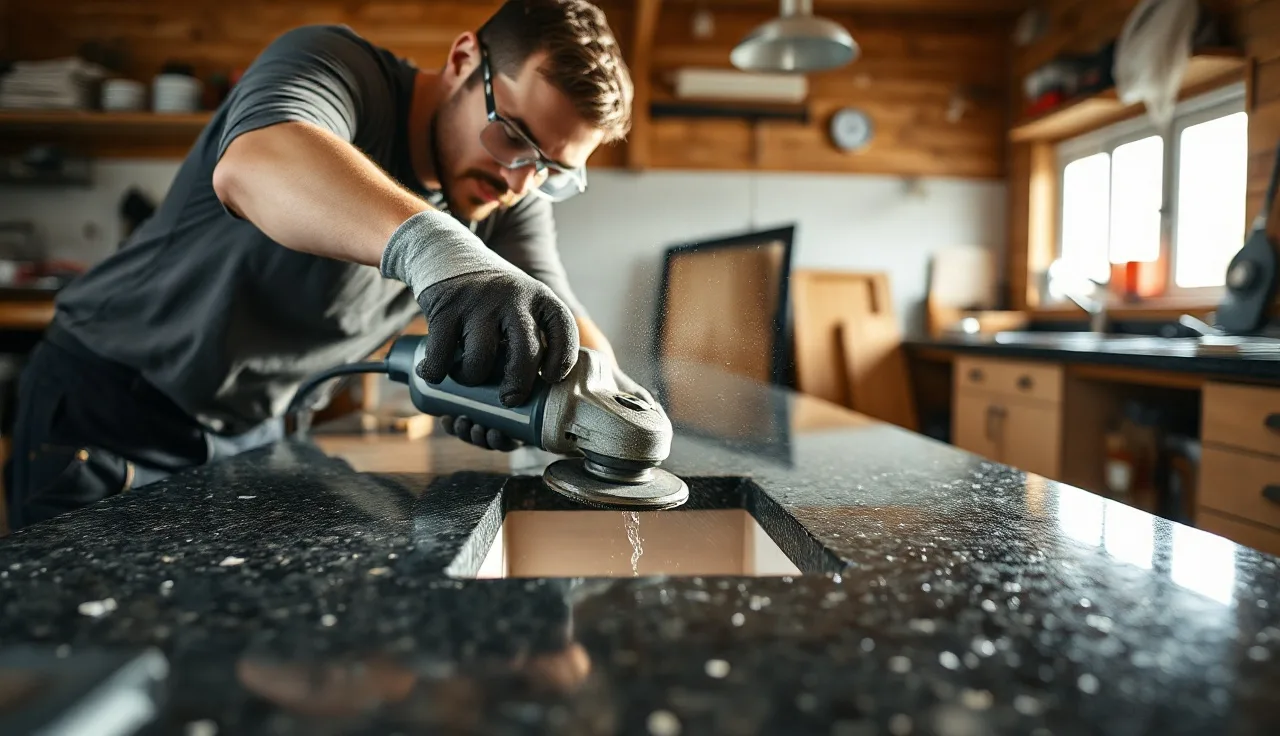
TL;DR
- Cutting granite around a cooktop without cracking comes down to three non-negotiable steps: drill a radius hole at every corner before you cut, keep the blade wet throughout, and never lift the blade mid-cut.
- Corners are where granite cracks.
- Get those right and the rest is slow, steady cutting with a diamond blade.
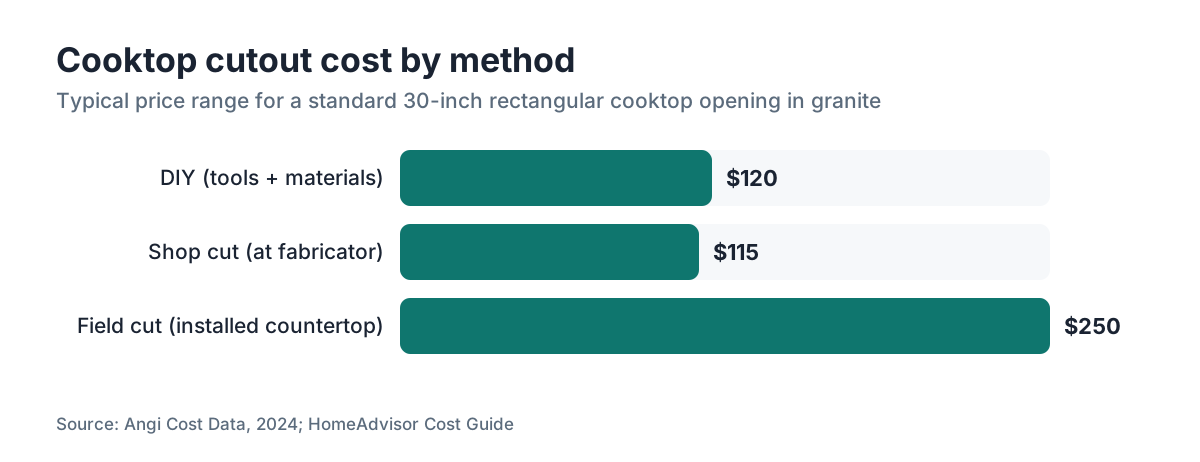
- Budget 2-4 hours if you DIY; fabricators charge $150-$350 for a cooktop cutout.
Why does granite crack when you cut a cooktop opening?
Granite cracks at corners. That's the short answer, and if you understand it, everything else about this process makes sense.
Granite is strong under compression but weak under tension. When a blade runs straight into a corner and stops, stress concentrates at that point. The stone has nowhere to go, so it fractures, often in a long diagonal crack that runs several inches into your countertop and ruins the slab. The crack usually shows up right away. Sometimes it waits until the cooktop is installed and a heavy pot lands nearby.
The second cause of cracking is a dry cut. Diamond blades cut granite by grinding, not slicing. That grinding makes heat. Without water cooling, the heat creates thermal stress in the stone, and that stress can fracture it, especially at thin sections near the cutout edge. A dry cut also burns through your blade faster, so there's no upside to skipping the water.
The third cause is vibration from stopping and restarting a blade inside the cut. Every time you lift the blade and re-plunge, you send a shock load into the stone. That's why pros run one continuous cut per side after drilling the corners.
Understand those three failure modes and you know exactly what you're defending against.
What tools do you actually need to cut granite around a cooktop?
You need a wet diamond blade setup, a drill with a diamond core bit, a template, and patience. Here's what each item does.
Diamond blade angle grinder or circular saw. A 4.5-inch or 5-inch angle grinder with a continuous-rim diamond blade is the most common DIY tool. A circular saw with a diamond blade works too, but the grinder is easier to steer in a tight kitchen. The blade must be rated for wet cutting or at minimum for stone. Dry-cut diamond blades exist, but wet cutting is safer for the stone and for the blade. Expect to spend $40-$80 on a decent continuous-rim diamond blade [1].
Diamond core drill bit. This is the tool most DIYers skip, and skipping it is why slabs crack. You need a 1/2-inch to 3/4-inch diamond core bit to drill a radius hole at each corner of the cutout before you make a single saw cut. A 5/8-inch bit is a good default. Core bits run $20-$60 at a tile or stone supply house [1].
A template. Your cooktop manufacturer supplies a cutout template in the box. Use it. The dimensions are specific to that model. Trace it onto the slab with a silver marker or chalk line, not a Sharpie (Sharpie bleeds into unsealed stone).
Water source. You need a continuous trickle of water on the blade while cutting. A garden hose at low pressure, a spray bottle worked by a helper, or a wet-cutting blade guard with an attached water tube all work. The goal is water on the blade at all times.
Masking tape. Lay two layers of painter's tape over your cut line before marking. The tape holds down chipping on the surface and gives you a cleaner edge.
Shop vacuum and dust mask. Even with water, granite dust escapes. Granite dust contains silica and is a documented occupational lung hazard [2]. Wear a P100 or N95 respirator, not a paper dust mask.
Eye protection and hearing protection. Not optional.
What is the right corner radius, and why does it matter so much?
The corner radius is the curved hole you drill at each corner of the cooktop cutout before you saw. It kills the crack that forms when two straight saw cuts meet at a sharp inside corner.
A 90-degree inside corner concentrates stress. When granite is under load, that point acts as a notch, and notches are where fractures start. Drill a radius hole and you replace the sharp corner with a curve. Curves spread stress over a larger area, so the crack has no focal point to start from.
The minimum practical radius for a cooktop cutout is about 1/4 inch, which matches a 1/2-inch core bit. A 3/8-inch radius (3/4-inch bit) is better. Fabricators sometimes go up to 1/2-inch radius on slabs they know are prone to cracking, like certain heavily veined or crystal-dense granites.
The drill hole has to sit entirely inside the cutout area, meaning the edge of the hole lands exactly on your cut line, not inside it. Drill the hole too far inward and you leave a sharp notch. Drill it too far outward and you breach the finished edge of the countertop.
Drill at low speed with water. Let the bit do the work. Pushing hard on a diamond core bit just strips it. A 5/8-inch hole through 3/4-inch granite should take 60-90 seconds with a good bit and steady water flow.
Step-by-step: how to cut a cooktop opening in granite
Here is the process in order. Read it all the way through before you pick up a tool.
Step 1: Measure and template. Pull the cooktop template from the box. Check it against the cooktop itself. Measure twice. Place the template on the countertop in the exact spot where the cooktop will sit. Most manufacturers want 1/8 inch to 1/4 inch of clearance between the cutout edge and the cooktop frame. Trace the cutout line clearly.
Step 2: Apply tape. Cover the entire cut area with two layers of painter's tape. Retrace the cut line on top of the tape.
Step 3: Drill corner holes. Set your drill to a slow, steady speed with water flowing. Place the center of your core bit so the bit's outer edge lands exactly on the corner of your traced line. Drill all four corners before you make any saw cuts. Keep water on the bit the entire time.
Step 4: Score the line. Before making a full-depth cut, run the blade at shallow depth (about 1/8 inch) along the cut line. This scoring pass holds down chipping on the surface of the stone.
Step 5: Cut each side in one continuous pass. Start from one drilled corner hole, keep water on the blade, and cut to the next corner hole without stopping. Do not lift the blade mid-cut. Do not stop mid-cut. If you have to stop, keep the blade running and back it out the way it came in. Repeat for all four sides.
Step 6: Support the cutout. Before the final cut closes the shape, stick a piece of painter's tape across the center of the cutout and prop a board underneath, held by a helper or a support. The cutout piece is heavy. If it drops, the sudden weight shift can crack the slab.
Step 7: Test fit. Drop the cooktop into the opening. Check clearance on all sides. Make minor adjustments with a diamond hand pad, working slowly and with water.
Step 8: Polish the edge. The cut edge inside the cooktop opening will be rough. Use a diamond hand pad (starting at 50-grit, working to 200-grit) to smooth and slightly bevel the inside edge. This drops the stress concentration and cleans up the look, even though the cooktop frame hides most of it.
What are the most common mistakes that cause cracks during this cut?
Skipping the corner holes is the most common mistake. Full stop. If you read nothing else in this article, drill the corners.
The second most common mistake is cutting dry. Some people think a quick cut is fine without water. It is not. Dry grinding builds heat in seconds on a slow cut through thick granite. You'll see the blade start to wobble and smell burning stone before you see a crack, but the crack is coming.
Third: cutting too fast. The blade needs time to grind through the material. Force it and you get lateral pressure on the stone and blade deflection that produces chipping and, on thinner sections, cracking.
Fourth: not supporting the cutout. A 12x18-inch cooktop cutout in 3/4-inch granite weighs roughly 6-8 pounds. When the last cut closes the shape, that piece drops. Even a 2-inch drop onto a cabinet below sends a shock wave into the slab that can crack a corner. Always support it.
Fifth: using the wrong blade. A segmented diamond blade is built for demolition and rough cutting. The gaps in the segments hammer impact loads into the stone surface. Use a continuous-rim blade for finish cuts in countertop work.
How long does it take and how hard is this really for a DIYer?
Honest answer: it's a medium-difficulty DIY job for someone who has used a grinder before, and genuinely hard for someone who hasn't.
Time-wise, plan for 2-4 hours the first time, including setup, cleanup, and the nervous pauses. A fabricator who does this daily can knock out a standard 30-inch four-burner cooktop cutout in 30-45 minutes.
The skills aren't exotic. You need to be comfortable running an angle grinder, handle a drill precisely, and work slowly and deliberately. What trips people up is that there's no undo. Crack a granite countertop and you've damaged a slab that probably cost $1,500-$4,000 installed [3]. Repair options are thin: epoxy and color-matched fill can hide small cracks, but structural cracks usually mean slab replacement.
For a homeowner who has never touched stone, I'd honestly hire a fabricator for this specific cut, even if you're doing the rest of the project yourself. The cutout fee ($150-$350, depending on region and complexity) is cheap insurance against a cracked slab.
If you do DIY it, run a practice cut on a scrap piece of stone first. Tile supply stores sometimes sell remnant granite cheaply for exactly this.
How much does a fabricator charge to cut a cooktop opening in granite?
Prices vary by region and shop, but the typical range for a field cooktop cutout (the fabricator comes to your home to cut it after the countertop is installed) runs $150-$350 [3]. Shop cutouts, done before installation, are often included in the fabrication quote or charged at $75-$150.
What pushes the price up: unusual cooktop shapes (round or multiple-cutout induction units), stone thickness above 3/4 inch, tight access in the kitchen, or stone that's particularly hard or heavily veined and prone to cracking.
What pulls it down: having the countertop at the shop before installation, simple rectangular openings, and competitive local markets.
Ask specifically whether the quote is for a shop cut or a field cut. Shop cuts carry less risk because the slab is fully supported on a stable surface and the fabricator has full access to all their equipment. Field cuts are riskier because the countertop is already on cabinets, the space is confined, and water management is harder.
If you're getting a full countertop fabrication quote, ask for the cooktop cutout to be included in the shop. It's the safest approach and usually the cheapest. Shops that run quoting software (like SlabWise) typically line-item cutouts separately so you can see exactly what you're paying for.
For context on what full granite countertop projects cost, see granite countertops and kitchen countertops.
Does the type of granite affect how likely it is to crack?
Yes, meaningfully.
Granite is not one uniform material. It's a family of igneous rocks with varying crystal structures, mineral compositions, and internal stress patterns [10]. Some granites are dense and homogeneous and cut cleanly. Others carry large feldspar crystals or quartz veins that create internal stress lines the blade can follow without warning.
These characteristics raise cracking risk:
Large visible crystals. Coarse-grained granites (the kind where you can see individual crystals 5-10mm across) have more intergranular fracture planes. The blade can follow a grain boundary instead of your cut line [10].
Visible veining. Veins are usually quartz or calcite intrusions. They expand and contract at different rates from the surrounding granite. Under the heat of cutting, they can separate.
Previously repaired slabs. If the slab has prior epoxy repairs, those areas are structurally weaker than virgin stone.
Thin slabs. Standard thickness is 3/4 inch (2 cm) or 1.25 inch (3 cm) [7]. A 2 cm slab near a cooktop cutout has less material to spread stress and cracks more readily than 3 cm.
A fabricator who has worked with your specific stone before knows its temperament. That's one more reason to hire out if you're working with an unfamiliar or exotic granite.
Can you repair granite if it cracks during the cooktop cutout?
Sometimes, depending on where and how bad.
Hairline surface cracks that don't go all the way through the slab can be filled with a color-matched epoxy or polyester adhesive. Fabricators use these products routinely for natural fissures and minor chips [4]. On a polished surface, a good color match makes the repair nearly invisible.
A crack that runs from the cutout edge to the outer edge of the countertop, or that goes through the full thickness, is a structural problem. Epoxy can stabilize it, but the slab is permanently compromised. Stress from heavy pots, thermal cycling from the cooktop, or even vibration from an under-counter dishwasher can push the crack farther over time.
If the crack runs more than 3 inches from the cutout, most fabricators recommend slab replacement. That's a hard conversation, but a structural crack in a countertop around a heat source is a real liability.
The best repair scenario is a crack caught immediately, before the slab has cycled through heat. Call a fabricator the same day and don't install the cooktop over a cracked slab until a professional looks at it.
For broader guidance on countertop installation and what to expect from a fabrication project, that's worth reading before you start.
What safety precautions matter most when cutting granite?
Silica dust is the serious long-term hazard. Granite holds crystalline silica, and cutting, grinding, or dry-sanding it releases respirable particles that cause silicosis, an irreversible and sometimes fatal lung disease [6]. The Occupational Safety and Health Administration sets the permissible exposure limit for respirable crystalline silica at 50 micrograms per cubic meter as an 8-hour time-weighted average [2]. A single dry-cut session can blow past that limit in minutes.
Wet cutting cuts airborne dust sharply but doesn't erase it. OSHA lists wet cutting as an accepted engineering control for stone countertop work when a blade-integrated water system or equivalent is used [8]. Wear a P100 respirator (not a dust mask, not an N95 if you can help it) any time you're grinding or cutting stone. Work outside or with maximum ventilation if you can.
Beyond dust:
Eye protection: grinding granite throws chips at high velocity. Use a full face shield or, at minimum, sealed safety glasses.
Gloves: the cut edge of granite is razor sharp. Handle the cutout piece carefully.
Knee protection: you'll likely be working at floor level or in an awkward position. Knee pads matter.
Water and electricity: you're running power tools with water nearby. Use a GFCI outlet or extension cord. Do not run water directly over an electrical outlet or panel.
Shop cut vs. field cut: which should you choose?
If you have any choice, get the cooktop cutout done at the shop before installation.
A shop cut happens while the slab lies flat and fully supported on a stable work surface. The fabricator has all their tools on hand, dust extraction, better water management, and good lighting. The slab isn't going anywhere. If something goes wrong, the shop catches it before you have an installed countertop to deal with.
A field cut (after installation) is necessary when a cooktop gets added to an existing countertop, when a homeowner changes appliance plans mid-project, or when a shop forgets to make the cut. It works, and skilled fabricators do field cuts regularly. But the risk climbs: the stone is on cabinets, access is limited, water management is harder (you're protecting cabinet interiors), and the consequences of a crack land immediately [9].
If you're getting new countertops and know your cooktop model, there's no good reason to field-cut. Give the fabricator the template and have it done at the shop. The shops that manage production with job-tracking software tend to catch missed cutouts before installation, which is exactly where something like SlabWise's production workflow keeps a shop from redoing work.
See countertop installation for more on how shop vs. field work affects your project timeline.
Are there alternatives to cutting granite for a cooktop installation?
A few, depending on your situation.
If you're replacing an existing cooktop with the same model or one with the same cutout dimensions, no cutting is needed at all. Verify the cutout size against the new appliance template before assuming.
If you're going from a 30-inch cooktop to a 36-inch cooktop (or any upsizing), the existing hole is smaller than you need. A fabricator can enlarge the cutout, which is easier than cutting from scratch because the existing hole gives you a built-in stress-relief point. The same corner-radius rules apply to any new corners you create.
If you're switching from a cooktop to a range (which means a full countertop cut, not a cutout) or from a cooktop to induction, note that induction units often have different cutout dimensions and some have unusual shapes. Always verify with the manufacturer template before cutting.
Some homeowners have switched to a cooktop that fits a smaller cutout and used a decorative trim ring to cover the gap. This works cosmetically but isn't a structural solution and isn't a good idea if the gap is wide enough to collect debris.
For those looking at different countertop materials entirely, butcher block countertops and laminate countertops are both easier to cut around cooktops than granite, though each has its own tradeoffs near heat sources.
Frequently asked questions
Can I cut granite with a regular circular saw?
Yes, if you fit it with a diamond blade rated for stone and use continuous water cooling. A standard wood-cutting blade will destroy itself in seconds and chip the granite badly. The angle grinder is easier to handle for this job, but a circular saw with the right blade and a straight edge as a guide can produce a cleaner, straighter cut. Never use a dry-cut diamond blade on an installed countertop.
How deep should each saw pass be?
Cut in passes no deeper than 1/4 inch at a time on material thicker than 3/4 inch. For standard 3/4-inch granite, many fabricators make one scoring pass at 1/8 inch and then a single full-depth pass. Shallow passes reduce blade deflection, reduce heat, and give you more control if the blade wants to wander.
What size diamond core bit do I need for corner holes?
A 5/8-inch core bit is a good default for cooktop cutouts. It gives you a 5/16-inch radius at each corner, which is enough to distribute stress and prevent cracking in most granites. For coarser-grained or more fragile stones, a 3/4-inch bit (3/8-inch radius) is better. The bit must be rated for granite or wet-cut stone, not tile.
Do I need to seal the cut edge inside the cooktop opening?
Yes. The raw cut edge is unpolished and porous. Apply a penetrating stone sealer to the inside edges of the cooktop opening after you finish the cutout and before installing the appliance. The edge is largely hidden under the cooktop frame, but sealing it prevents moisture infiltration from steam and spills. One coat of a standard impregnating sealer is enough.
Can I rent the tools I need instead of buying them?
Yes. Angle grinders are available at most tool rental shops for $25-$50 per day. Diamond blades are usually sold separately and are not returnable once used. Diamond core bits can sometimes be rented as part of a tile and stone kit. Confirm the blade and bit are rated for granite, more than tile, before you leave the rental counter.
How do I manage water when cutting on an installed countertop?
Stuff dry towels inside the cabinet below the cut area before you start. Use a helper with a spray bottle to keep water on the blade rather than running a hose, which creates more mess. Have a shop vacuum running nearby to pick up water and slurry as you cut. Protect the cabinet interior from saturation, because prolonged water exposure can swell MDF cabinet boxes.
My cooktop template has rounded corners. Do I still need to drill?
Yes. The template's rounded corners tell you the shape of the finished opening, but you still need to drill radius holes at the corners before sawing. Position the core bit so its outer edge sits on the curved corner of your template line. The drilled hole becomes the corner of the cut, and the saw runs into it cleanly from each side.
What happens if I cut too much and the opening is too large?
If the opening is slightly too large, most cooktop frames have a lip that spans at least 1/2 inch to 3/4 inch beyond the cutout, so minor overcuts stay hidden. If the opening is significantly too large, a fabricator can fill narrow gaps with color-matched epoxy or, in severe cases, a stone patch. This is expensive and rarely invisible. Measure twice, cut once.
Is it safe to run a gas cooktop over a granite countertop with a fresh cutout?
Yes. Granite is non-combustible and does not transmit heat readily [5]. The cutout itself doesn't create a safety issue for gas appliances as long as the cooktop is properly sealed to the countertop per the manufacturer's instructions to prevent gas from accumulating in the cabinet below. Follow the appliance installation manual exactly.
How much does a shop cooktop cutout cost compared to a field cutout?
Shop cutouts typically run $75-$150 when bundled with fabrication or done before installation. Field cutouts (on an already-installed countertop) run $150-$350 because of the added labor, access difficulty, and higher risk. If you're pricing new countertops, always ask to include the cooktop cutout in the shop quote. It's almost always cheaper and safer.
Can a cracked granite countertop be repaired after a bad cooktop cut?
Hairline cracks that don't penetrate fully through the slab can be filled with color-matched epoxy by a fabricator and are often nearly invisible. Structural cracks that run from the cutout to the edge of the countertop are a different problem. Epoxy can stabilize them temporarily, but thermal cycling from the cooktop tends to re-open them. Most fabricators recommend slab replacement for through-cracks longer than 3 inches.
What blade RPM should I use for cutting granite?
For a 4.5-inch diamond blade on an angle grinder, most manufacturers recommend running at 11,000-12,000 RPM, which is the standard no-load speed for a 4.5-inch grinder. The key is not to push the blade hard into the stone. Let the blade's own weight do most of the cutting, moving forward at a pace where the blade grinds steadily without bogging down.
Does granite thickness affect how I cut the cooktop opening?
Yes. Standard 3/4-inch (2 cm) granite cuts faster but has less margin for error at the edges. Thicker 1.25-inch (3 cm) granite requires slower passes and more water to manage heat. The corner-drilling rule matters even more on thick slabs because the stress concentration at an undrilled corner is higher with more material mass. Adjust your pass depth accordingly and take your time.
Sources
- Tile and Stone Tools Guide, This Old House: Diamond blade cost range $40-$80; diamond core bit cost range $20-$60 for stone cutting applications
- OSHA, Occupational Exposure to Respirable Crystalline Silica Final Rule (29 CFR 1926.1153): OSHA permissible exposure limit for respirable crystalline silica is 50 micrograms per cubic meter as an 8-hour TWA; granite cutting generates respirable silica dust
- HomeAdvisor, Granite Countertop Cost Guide: Installed granite countertop cost range $1,500-$4,000; cooktop field cutout range $150-$350
- Natural Stone Institute (formerly Marble Institute of America), Fabrication and Installation Manual: Color-matched epoxy and polyester adhesives are standard for filling natural fissures and minor chips in granite fabrication
- NFPA 54, National Fuel Gas Code (NFPA): Granite is a non-combustible material; gas cooktop installations require the appliance to be sealed to the countertop per manufacturer instructions to prevent gas accumulation
- NIOSH, Health Effects of Occupational Exposure to Respirable Crystalline Silica (Publication No. 2002-129): Silicosis is an irreversible and potentially fatal lung disease caused by inhalation of crystalline silica particles; stone cutting is a documented high-exposure task
- Natural Stone Institute, Dimensional Stone Design Manual: Standard granite countertop thicknesses are 2 cm (3/4 inch) and 3 cm (1.25 inch); thinner slabs have less material to distribute stress at cutout edges
- OSHA, Table 1 Specified Exposure Control Methods for Construction Work (29 CFR 1926.1153): Wet cutting methods are listed as an engineering control that satisfies OSHA silica requirements for stone countertop work when a blade-integrated water delivery system or equivalent is used
- Angi (formerly Angie's List), Countertop Installation Cost Data 2024: Shop cooktop cutout typically $75-$150 when included in fabrication quote; field cutout $150-$350 due to added labor and access constraints
- U.S. Geological Survey, Granite: A Natural Construction Material (Fact Sheet): Granite is an igneous rock with variable crystal grain size and mineral composition; coarse-grained varieties have more intergranular fracture planes that affect cutting behavior
Last updated 2026-07-09