
TL;DR
- Most commercial countertop projects take 4 to 16 weeks from signed contract to installed surface.
- Simple laminate jobs in stock colors can finish in 2 to 3 weeks.
- Large natural stone installations for hotels, hospitals, or multifamily buildings routinely run 10 to 16 weeks once you factor in material procurement, templating, fabrication queue, and phased installation.
- The biggest schedule killers are late template access and material back-orders.
What does 'lead time' actually mean for a commercial countertop job?
Lead time is the total calendar days between the moment a fabricator has a signed contract (or at minimum a confirmed purchase order and deposit) and the day the last countertop surface is installed and usable. It is not the same as fabrication time. Fabrication is one link in a longer chain.
The full chain looks like this: contract execution, then material sourcing and delivery to the shop, then template (field measuring), then fabrication, then delivery logistics, then phased installation. Each phase has its own timeline, and they don't always stack neatly. If the general contractor won't grant template access until cabinetry is set, the fabricator is sitting on your deposit waiting. That lag is still lead time from the owner's perspective.
Commercial projects add layers that residential jobs don't have. Multiple bid rounds, value engineering cycles, submittals and RFIs, union labor coordination, and phased occupancy schedules all stretch the clock. A hotel renovation might have 200 bathroom vanity tops across 6 floors, installed floor by floor so the hotel can stay partially open. Each phase needs its own template visit and delivery window.
Here's the honest number fabricators give their best commercial clients: plan for at least 8 weeks of float from contract to first install on any job over roughly 500 square feet of natural stone. Laminate and solid surface move faster, but they still have submittals and shop drawing approvals that eat 2 to 3 weeks on most general-contractor-managed projects.
How long does each phase of a commercial countertop project take?
Breaking the schedule into phases makes it easier to see where time actually goes.
| Phase | Typical duration | Notes |
|---|---|---|
| Contract / PO / deposit | 1 to 10 days | Depends on client procurement process |
| Material sourcing (natural stone slab) | 1 to 6 weeks | Varies by rarity of material and supplier location |
| Material sourcing (quartz / engineered) | 1 to 3 weeks | Distributors usually stock domestically |
| Material sourcing (laminate / solid surface) | 3 to 10 days | Most colors are stock items |
| Submittal and shop drawing approval | 1 to 3 weeks | Required on most GC-managed commercial projects |
| Template (field measure) | 1 day on site, 1 to 3 days processing | Must wait for substrates to be set |
| Fabrication queue | 1 to 4 weeks | Depends on shop backlog and job complexity |
| Delivery and installation | 1 to 5 days per phase | Depends on site access and crew scheduling |
Material sourcing is the most variable phase. A common white engineered quartz in 3cm might sit in a local distributor's warehouse and arrive at the shop in a week. An exotic quartzite or book-matched marble for a hotel lobby bar could require an overseas order with 6-week ocean freight, plus customs clearance [1]. Some fabricators keep slab inventory to compress this, but most commercial shops don't buy spec inventory in large quantities because the stone is usually owner-specified.
Shop drawing approval is often underestimated. On a project managed by a general contractor, the fabricator typically submits drawings showing edge profiles, sink cutout locations, seam placement, and material specs before cutting a single piece. The architect reviews, marks up, and returns. A single round takes 5 to 10 business days. Two or three rounds (not unusual when the architect is picky about seam placement on book-matched stone) burns 3 to 4 weeks before fabrication even starts [2].
Fabrication queue depends entirely on the shop's current backlog. During peak season, which in most U.S. markets runs March through October, a busy shop might be 3 to 5 weeks out. A slow January might mean your job starts cutting the week after template [3].
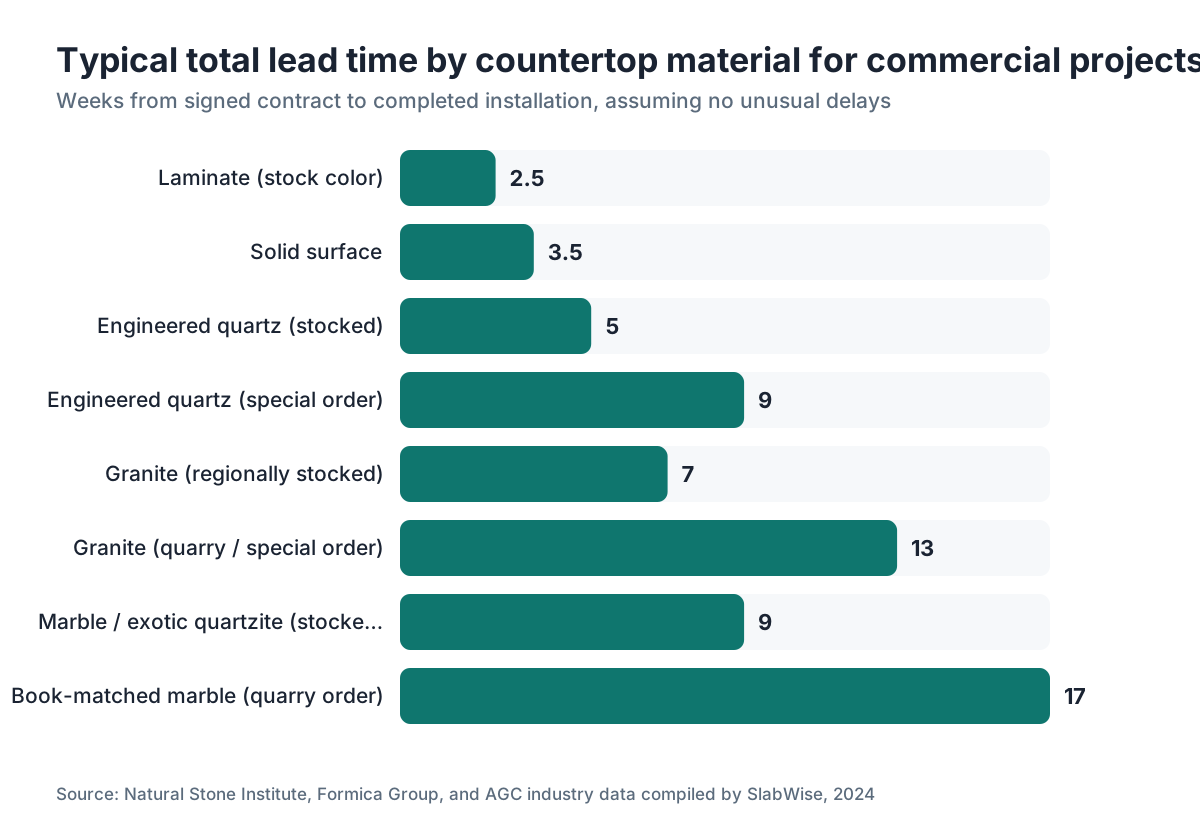
What are typical total lead times by material type?
Material choice is the single fastest lever an owner or project manager has to compress lead time. Here's what the industry actually sees.
Laminate countertops are the fastest. Standard colors from Formica, Wilsonart, and similar brands ship from distributor warehouses in days. A straightforward commercial laminate job (think office break room, school cafeteria serving line) can go from template to install in 1.5 to 3 weeks if the shop isn't backed up [4]. Specify a custom color or a solid-core laminate product and you add a week or two for the special order.
Solid surface (Corian and similar) is nearly as fast. The sheets are manufactured and held in distribution. Fabrication works differently than stone, but the total timeline lands close to laminate: 2 to 4 weeks for most commercial jobs.
Engineered quartz (brands like Cambria, Silestone, Caesarstone) typically takes 3 to 6 weeks total. Domestic distributors hold the most popular colors, but high-end or exclusive colorways sometimes ship from overseas manufacturing, which adds 4 to 6 weeks of its own.
Granite and standard quartzite run 4 to 8 weeks in most markets if the fabricator or a nearby slab yard stocks the material. If your spec calls for a specific granite origin or bundle match (slabs cut from the same quarry block so the pattern stays consistent across a long run), procurement alone can take 4 to 8 weeks.
Marble, book-matched marble, and exotic quartzite are the longest lead materials. A hotel lobby with floor-to-ceiling book-matched panels matched to countertops can easily require 10 to 16 weeks from contract, and that's with a competent procurement team. Book-matching means the fabricator receives the full slab order, inspects it, plans the layout, gets owner approval on the layout, then fabricates. That review step alone takes a week or two on complex jobs.
For a quick reference, see the kitchen countertops overview and the specific material guides for granite countertops and marble countertops, which cover material properties that affect workability and therefore shop time.
What specific project types have the longest lead times?
Not all commercial work is the same. A few project types consistently run long.
Hospitality (hotels, resorts). Phased renovation is the norm so the property can keep running. You might template floors 1 and 2, fabricate while floors 3 and 4 get rough-in complete, install floors 1 and 2, template floors 3 and 4, and repeat. The total calendar span from first template to last install on a 200-room renovation can stretch 6 months even when each individual batch takes only 4 to 6 weeks to fabricate [3].
Healthcare (hospitals, outpatient clinics, medical office buildings). Healthcare construction follows strict infection control protocols. Fabricators often can't reach the template area until dust barriers and ICRA compliance are signed off. Add submittal requirements specific to infection-control surfaces (joint-free specs, non-porous specs, sometimes antimicrobial product certifications), and you're looking at 8 to 14 weeks routinely.
Multifamily residential (apartments, condos). Large multifamily projects with 100+ units can order countertops for multiple buildings or phases at once. The fabrication volume alone may exceed a single shop's capacity, leading to multiple-shop sourcing or a phased fabrication schedule. Developers with tight lease-up schedules feel this acutely: delays in countertop installation can hold up certificate of occupancy.
Restaurants. Restaurant countertops often involve custom shapes (curved bars, pass-through cutouts, integrated drains), which take longer to fabricate than standard runs. NSF certification requirements for food-contact surfaces also affect material selection in ways that can limit what's available off the shelf [5].
K-12 and higher education. School projects are often publicly bid with long procurement cycles, and installation windows are limited to summer break. A school district that misses a fabrication start date in May might be waiting until the following summer.
What causes commercial countertop projects to run over schedule?
Most schedule overruns in commercial countertop work fall into a handful of predictable categories.
Late template access is the most common. A fabricator cannot accurately cut stone or solid surface until the substrate sits in final position. If cabinets are delayed, templating waits. Every week of cabinet delay is at least a week of countertop delay, sometimes more if the delay pushes the job into a busier point in the fabricator's queue.
Material back-orders and discontinued colors. Specifying a quartz color that the manufacturer has on allocation, or a natural stone bundle that requires quarry ordering, can add 4 to 10 weeks without warning. The fix is early procurement: confirm material availability at bid phase, not after the contract is signed.
Design changes after templating. If a sink location moves or a bar shape changes after the template is done, the template gets redone and fabrication restarts. On stone that's already been cut, the cost is lost material plus restart time. Changes after cutting typically add 2 to 4 weeks.
Slow submittal reviews. Architectural firms on large commercial projects can take 2 to 3 weeks per review cycle. If the fabricator's shop drawings get buried in a reviewer's queue or come back with substantive comments, the clock stops.
Site coordination failures. Countertops are often one of the last trades to install before a space opens. They're also fragile relative to other finish materials. If painting or flooring runs long and the fabricator's delivery window closes, rescheduling a commercial delivery (which often needs a lift gate truck, elevator reservations, and multiple installers) can take another week or two.
Labor shortages in the shop. Countertop fabrication is a skilled trade. CNC operators, waterjet programmers, and hand-edge finishers don't grow on trees. When a shop is short-staffed, queue times expand. The Bureau of Labor Statistics Job Openings and Labor Turnover Survey shows manufacturing vacancy rates stayed elevated after 2021, and stone fabrication is no exception [6].
How far in advance should you order commercial countertops?
The answer depends on material choice and project complexity, but here's a safe general rule: engage a fabricator no later than 12 weeks before your required installation date for any natural stone commercial project. For laminate or solid surface in standard colors, 6 weeks is workable if the shop isn't at peak capacity.
For complex jobs (book-matched stone, custom edge profiles, healthcare or food-service certification requirements), 16 to 20 weeks of lead time is not excessive. Some hotel projects with custom quarried stone spec'd at the design phase start procurement 6 months before the anticipated install date.
The key milestones to protect:
-
Material selection and specification locked before bid. Changing from one quartz color to another after contract award seems minor but can mean a completely different procurement chain.
-
Deposit paid the same week the contract is signed. Fabricators don't order material without a deposit, and the material order clock doesn't start until money changes hands.
-
Template date confirmed at contract signing. Even if the template hasn't happened yet, a confirmed date on the fabricator's calendar keeps your job from getting shuffled.
-
Submittal package sent to the GC or architect within the first week after contract. Every day of delay in submitting shop drawings is a day added to the end of the project.
For project managers tracking multiple trades, countertop lead time should appear explicitly in the construction schedule as a long-lead item, right alongside elevator equipment and custom millwork. Treat it as an off-the-shelf commodity and you'll delay your opening date.
How do fabricators manage capacity on large commercial orders?
A commercial shop handling a 5,000-square-foot hotel renovation runs its operation very differently from a residential shop doing 15 kitchen remodels a week. A few things worth understanding if you're the buyer.
Fabrication software and CNC scheduling. Most mid-size and larger commercial shops run CNC bridge saws and waterjet cutters on programmatic nesting layouts that optimize material yield. The programming and nesting step takes time but reduces waste on expensive stone. Shops using countertop fabrication software (like SlabWise, which is built for quoting and nesting optimization) can generate more accurate timelines at the bid stage because the software models actual cut sequences rather than guessing. Ask your fabricator their average shop throughput in square feet per week, then divide your project size by that number for a rough fabrication-only estimate.
Multi-shop sourcing. On very large projects (say, 10,000+ square feet of a single material), one shop may not have the capacity. Some fabricators have relationships with sister shops or broker work to another qualified fabricator for a portion of the job. This can compress the schedule but adds coordination complexity and potential inconsistency in edge profiles or finish quality.
Material staging. Experienced commercial fabricators stage material (have slabs on the shop floor) before the template date so fabrication can begin the moment template dimensions are confirmed. This requires the owner or GC to commit to the material selection and pay a material deposit well ahead of the template date, sometimes 8 to 10 weeks out on exotic stone.
Phased delivery and installation. On multi-floor or multi-phase projects, the fabricator cuts and delivers in phases coordinated with the GC's schedule. This demands tight communication: if one phase's installation slips, it can back up the fabrication queue for later phases. Good commercial fabricators build float into the phased schedule precisely because sites almost always run a week or two behind.
Does the countertop material affect installation time as well as fabrication time?
Yes, and it's a meaningful difference on large jobs.
Natural stone (granite, marble, quartzite) is heavy. A 3cm granite slab weighs roughly 18 to 20 pounds per square foot [7]. A commercial project with 500 square feet of 3cm granite countertops moves 9,000 to 10,000 pounds of finished stone into the building. That requires a lift gate truck, enough elevator capacity or stair-carry crews, and more installers per piece than laminate or solid surface. Installation on a large stone job can take 2 to 5 days where a laminate job of the same square footage might take 1 to 2 days.
Laminate installation is fastest because the sheets are lighter and can be cut and edged on site for minor adjustments, which softens the consequence of a slight measurement error. Fabricators of laminate countertops or Formica countertops will tell you the post-forming process is faster than stonework, and delivery logistics are simpler.
Solid surface has a longer installation process than laminate because seams are chemically bonded and sanded flush on site, which takes time. Corian countertops and similar products are popular in healthcare precisely because the joints can be made nearly invisible during field installation, but that process adds hours per linear foot of seam.
For any countertop type, access restrictions in occupied commercial buildings (elevator windows, no-work hours, noise ordinances in hospitality or healthcare settings) can stretch a 2-day install into a 4-day install with no change in the actual work content [8].
What should a commercial project RFP or bid spec say about lead time?
If you're on the owner or GC side writing specs or RFPs for commercial countertop work, the way you structure your bid documents directly affects how accurate the lead time commitments come back.
Include a required installation date and milestone schedule in the RFP. Ask bidders to confirm they can meet it and to name which milestones (template access, material procurement, submittal review return) sit on the critical path. A fabricator who bids without flagging risks is either confident or not paying attention.
Specify materials precisely. An RFP that says 'granite or equivalent' invites bidders to quote different materials with wildly different lead times, which makes bids incomparable. Lock the material, thickness, finish, and edge profile so every bidder prices the same lead time reality.
Require a submitted project schedule from each bidder. This forces fabricators to think through the phases explicitly. A fabricator who submits a realistic phased schedule (material order, submittal, template, fabrication, phase 1 install, phase 2 install) is showing operational competence. One who just writes '8 weeks from contract' without breaking it down is telling you they haven't thought it through.
Ask about material sourcing specifically. Where will the slabs come from? Are they in-country or overseas? Is the specific lot or bundle reserved or available? On natural stone, 'available' from a distributor can mean 10 slabs in Phoenix and 40 slabs you need to special-order. That's a 6-week difference in start date.
Build liquidated damages provisions for schedule-critical projects, but stay realistic about what's in the fabricator's control. Template access delays, GC-caused schedule shifts, and owner-directed changes are legitimate reasons for time extensions. Pure shop-caused delays are not.
For context on what countertop installation involves in terms of site coordination, that resource covers the residential side, but many of the coordination principles carry over to commercial work.
How can owners and GCs realistically compress commercial countertop lead times?
There are real levers here. Some cost money. Some just require early decisions.
Early material selection saves the most time. Switching from an exotic imported quartzite to a domestically warehoused engineered quartz can cut 4 to 6 weeks off the procurement phase alone, with no change to how the countertop performs in most commercial applications.
Paying for material early is the second-best move. If a fabricator waits for your deposit to order stone, every day you take to process the invoice is a day added to the end of the project. On a $150,000 countertop contract, a net-30 payment process is a 4-week schedule hit before any work starts. Pre-paying for material, or at minimum fast-tracking the material deposit, closes that gap.
Granting early template access compresses the schedule a lot. If the GC lets the fabricator template when substrates are 95% set rather than 100% complete, the fabricator can start CNC programming while the last few inches get finished. The risk is minor dimensional errors that need field adjustments. The reward is a week or two off the schedule.
Choosing a fabricator with in-house slab inventory for your specified material is ideal. Some commercial shops carry slow-turn but commonly specified materials, and they can skip the 2-to-6-week procurement phase entirely. Ask during bidding whether the shop has the material on hand or needs to order.
Avoiding design changes after contract is the most underrated schedule-compression strategy. Every change order resets the clock on whatever portion of the work it touches. Owners who lock design decisions before contract execution finish faster than those who iterate during fabrication.
What questions should you ask a fabricator before signing a commercial countertop contract?
Here are the questions that actually matter from a scheduling standpoint.
What is your current shop queue, and when would fabrication on my job start? A fabricator who can't answer with a specific week doesn't have visibility into their own shop capacity. That's a red flag for a large commercial project.
Where are you sourcing the material, and is it currently available? Get the distributor or quarry name. Confirm availability yourself if the stakes are high.
How many template visits will this project require, and what's your standard turnaround from template to fabrication start? Some shops process template data in 24 hours. Others take a week. On a phased project, that difference compounds.
Have you done a project of similar scale and type before? A shop that specializes in residential remodels and takes on a 100-room hotel renovation for the first time will learn on your schedule and your budget.
What's your plan if a slab arrives damaged or short? Material shortfalls happen. A fabricator who has a clear answer (backup supplier, how they'd handle the timeline impact) is more prepared than one who hasn't considered it.
What milestones require our team to act, and what happens to the schedule if we're late on those milestones? This aligns expectations early and keeps the fabricator from absorbing blame for delays that sit on the owner's side.
For a sense of what the quoting and shop management side looks like from the fabricator's perspective, SlabWise's demo walks through how shops track these milestones from quote to installation on commercial jobs.
Two final resources worth reading alongside this guide: the cambria countertops page covers lead time specifics for that brand's commercial program, and the broader kitchen countertops guide gives context on how residential timelines differ from commercial ones.
Frequently asked questions
How long does a commercial countertop project take from start to finish?
Most commercial countertop projects take 4 to 16 weeks from signed contract to final installation. Simple laminate jobs in stock materials can finish in 2 to 3 weeks. Large natural stone projects with phased installation, submittal requirements, and overseas material procurement regularly run 12 to 16 weeks. The biggest variable is material sourcing: domestically warehoused materials can arrive at the shop in under a week, while specialty quarried stone can take 6 weeks just to procure.
What is the lead time for granite countertops on a commercial project?
Commercial granite countertop lead times run 4 to 10 weeks in most U.S. markets when the material is available at a regional slab yard. If the spec calls for a specific color, origin, or bundle-matched lot that requires a quarry or overseas order, procurement alone adds 6 to 10 weeks. Fabrication after template typically takes 1 to 3 weeks depending on shop backlog. Budget 8 to 12 weeks total to be safe on any granite job over a few hundred square feet.
Can commercial countertops be installed in phases to avoid closing the whole space?
Yes, phased installation is standard practice on hospitality, healthcare, and multifamily projects. The fabricator templates one phase, fabricates it, installs it, then moves to the next. Each phase adds its own template-to-install cycle, typically 2 to 4 weeks per phase for stone. The total project calendar extends well beyond a single-phase job, but occupancy is maintained. The key is that the GC must grant template access on a phase-by-phase basis and keep each phase's substrate on schedule.
How long do submittals and shop drawing approvals take for commercial countertops?
One submittal review cycle typically takes 5 to 10 business days. Two or three review rounds, common on complex natural stone projects with book-matching or custom edge profiles, can consume 3 to 4 weeks before fabrication starts. Owners and GCs can compress this by using an architect experienced with stone fabrication and by giving complete design information to the fabricator at contract signing so the first submittal package is thorough.
What is the fastest countertop material for a commercial project with a tight deadline?
Laminate in a stock color is the fastest commercial countertop material, with total lead time of 1.5 to 3 weeks from template to install in most markets. Solid surface (Corian and similar) is nearly as fast at 2 to 4 weeks. Engineered quartz in popular colors runs 3 to 5 weeks. Natural stone is the slowest category. If your schedule is tight and aesthetics are flexible, specifying laminate or solid surface can save 4 to 8 weeks compared to granite or marble.
What causes commercial countertop projects to be delayed?
The most common causes of delay are late template access (usually because cabinets or substrates aren't ready), slow submittal review cycles, material back-orders or discontinued colors, and design changes after fabrication has started. Site coordination failures, like missing a delivery window in an occupied building, also add time. Owner-side delays in paying the material deposit are underappreciated: fabricators don't order stone without payment, so a slow accounts payable process directly extends the project schedule.
How far in advance should I order countertops for a hotel renovation?
Engage a fabricator and lock material selection at least 16 to 20 weeks before your required first installation date for a hotel renovation with natural stone. Book-matched marble or rare quartzite may require 6 months of advance planning, particularly if the stone needs to be quarry-ordered and shipped from overseas. Pay the material deposit immediately at contract signing. Template access for the first phase should be confirmed in the project schedule no later than 8 weeks before that phase's install date.
Do healthcare or hospital countertop projects take longer than standard commercial work?
Yes, healthcare projects consistently run 8 to 14 weeks and often longer. Infection control protocols (ICRA compliance) can restrict or delay template access. Material specifications are tighter: joint-free surfaces, non-porous surfaces, and sometimes NSF or antimicrobial certifications are required. Submittal requirements in healthcare construction run more extensive than standard commercial work. Occupied healthcare facilities also impose strict delivery windows and noise restrictions that stretch installation time.
What is a realistic fabrication queue time at a busy commercial shop?
During peak season (March through October in most U.S. markets), a busy commercial fabrication shop may be 3 to 5 weeks out from template to fabrication start. During slower winter months, that gap can shrink to 1 to 2 weeks. Large commercial jobs that exceed a shop's weekly square-footage capacity may push beyond those norms. Always ask the specific shop for their current queue time during the bid process rather than assuming the industry average applies.
How does book-matched stone affect the commercial countertop lead time?
Book-matched stone adds meaningful time compared to standard stone installation. The fabricator must receive the full slab order, inspect and inventory it, create a layout drawing showing how slabs will be matched and positioned, and get owner or architect approval of that layout before cutting begins. That review step typically takes 1 to 2 weeks. If the stone is quarry-ordered for a specific bundle, procurement adds another 4 to 8 weeks. Total lead time on a book-matched natural stone commercial project is commonly 14 to 20 weeks.
Can a commercial countertop project be expedited, and what does it cost?
Some phases can be expedited at a premium. Fabricators may offer priority queue placement for a fee, often 10 to 20 percent of the fabrication cost. Material can sometimes be air-freighted instead of ocean-shipped, though the cost climbs fast on heavy stone. Rush charges for expedited submittals or overtime fabrication are real and negotiable. The most cost-effective way to compress lead time is making all decisions early, not paying for rush services to recover from late decisions.
What's the difference between lead time and fabrication time for countertops?
Fabrication time is only the shop phase: the time from when a fabricator has your template dimensions to when your countertops are cut, edged, and ready to deliver. That's usually 1 to 3 weeks. Lead time is the full span from contract signing to installed surface and includes material procurement, submittal approval, templating, fabrication, and installation. On most commercial natural stone projects, fabrication time is roughly 20 to 30 percent of total lead time. The rest is procurement, approval, and logistics.
How does restaurant countertop work differ from other commercial projects in terms of schedule?
Restaurant countertops often involve complex custom geometry: curved bars, integrated drain slopes, pass-through cutouts, and service wells. That custom work takes longer to template accurately and longer to fabricate than straight runs. Food-contact surfaces may need to meet NSF/ANSI 2 certification requirements, which limits material choices and sometimes requires documentation that adds 1 to 2 weeks to the approval process. Budget 6 to 10 weeks for a full restaurant countertop package and more if the design is particularly complex.
What should a commercial countertop contract say about schedule and lead time?
A good commercial countertop contract should specify the anticipated template date, fabrication start date, delivery date, and installation date for each phase. It should identify which milestones are the owner's responsibility (template access, submittal review return, material deposit payment) and which are the fabricator's. It should address how time extensions are handled when owner-caused delays push the schedule. Contracts that only state a total completion date without milestone detail create disputes when phases slip.
Sources
- U.S. Customs and Border Protection, Basic Importing and Exporting: Imported stone slabs are subject to customs clearance timelines that affect material procurement lead times for commercial countertop projects.
- Construction Specifications Institute, Project Delivery and Submittal Process: Submittal review cycles in commercial construction typically run 5 to 10 business days per round, with multiple rounds common on specialty material specifications.
- Associated General Contractors of America, Construction Outlook Survey: Phased renovation projects in hospitality and multifamily sectors commonly have installation timelines spanning multiple months due to occupancy constraints.
- Formica Group, Product and Fabrication Resources: Standard laminate colors ship from distributor warehouses within days, allowing fast fabrication and installation on commercial projects.
- NSF International, NSF/ANSI 2 Food Equipment Standard: NSF/ANSI 2 certification requirements apply to food-contact surfaces in commercial restaurant settings and affect countertop material selection and approval timelines.
- U.S. Bureau of Labor Statistics, Job Openings and Labor Turnover Survey (JOLTS): Manufacturing sector vacancy rates remained elevated after 2021, affecting skilled trade availability in stone fabrication shops and contributing to extended queue times.
- Natural Stone Institute, Dimension Stone Design Manual: 3cm granite slabs weigh approximately 18 to 20 pounds per square foot, requiring specialized delivery equipment and additional installation labor for large commercial projects.
- U.S. Occupational Safety and Health Administration, Construction Industry: Occupied healthcare and hospitality construction environments impose access and noise restrictions that extend commercial countertop installation timelines beyond standard commercial work.
- Associated Builders and Contractors, Construction Backlog Indicator: Commercial construction backlogs in the U.S. have fluctuated between 8 and 10 months across recent years, reflecting broader scheduling pressures that affect subcontractor lead times including countertop fabricators.
- Natural Stone Institute, Stone Industry Resources: Specialty natural stone requiring quarry orders and international shipping commonly adds 4 to 8 weeks of procurement time compared to domestically warehoused materials.
Last updated 2026-07-11