TL;DR
- Commercial kitchen countertop jobs typically run $80, $250 per square foot installed, depending on material, edge complexity, cutout count, and site conditions.
- Fabricators should price off true shop cost (material + waste + labor + overhead + delivery), add a risk premium for commercial timelines, and quote every job in writing before templating.
- Homeowners comparing bids should ask for line-item breakdowns, not lump sums.
Why is commercial countertop pricing different from residential?
Commercial kitchens are not big residential kitchens. The differences hit your margin in ways that don't show up until you're already committed.
First, scale creates false confidence. A 200-square-foot restaurant prep counter feels like four residential jobs, but it often has more linear footage of demanding edges, more penetrations (hand sinks, prep sinks, gas lines, floor drains), and surfaces that must meet local health code for food contact areas. The Illinois Department of Public Health, for example, requires that food contact surfaces be "smooth, nonabsorbent, easily cleanable, and durable" [1]. That language rules out several popular residential materials and adds inspection risk if you spec the wrong product.
Second, the job site is almost never clean. Commercial builds have general contractors, plumbers, HVAC crews, and health inspectors all overlapping. Your install window may be a four-hour slot at 2 a.m. before a health inspection at 8 a.m. That kind of scheduling costs money. Put it in the quote.
Third, liability runs higher. A residential client whose seam opens up calls you frustrated. A restaurant owner who fails a health inspection because a prep counter has a crack in the food zone may come back with an attorney. Your contract language and your insurance need to match the job type.
What materials are actually approved for commercial kitchen food-contact surfaces?
The FDA Food Code is the baseline most state health departments adopt, and it defines a "safe material" as smooth, impervious, nonabsorbent, and resistant to corrosion [2]. That framework creates a short approved list and a longer list of "it depends."
Stainless steel is the gold standard. Most health departments accept it without question. It's priced by gauge and linear foot, not square foot, so you'll quote it differently.
Quartz (engineered stone) passes in nearly every jurisdiction because the resin binder makes the surface nonporous. Brands like Cambria Cambria countertops market straight to commercial operators on that basis. Installed cost runs $85, $180 per square foot for commercial quartz, depending on thickness and edge profile.
Granite is more complicated. Unsealed granite is porous and fails the impervious standard. Sealed granite may pass inspection in some states but not others. If you're quoting granite countertops for a commercial kitchen, get the local health department's written position before fabrication, not after.
Solid surface (Corian, similar) passes most codes and repairs easily if it gets damaged. Corian countertops run $60, $120 per square foot installed commercially. Joints can be heat-welded so no gap shows, which inspectors like.
Laminate is code-legal in many jurisdictions for non-food-prep areas (cashier counters, server stations) and is still widely used. Laminate countertops and Formica countertops cost $25, $60 per square foot installed and go in fast. Do not use them on a hot line or near fryers.
Butcher block is approved for cutting surfaces in some states, prohibited in others. The FDA Food Code language on wood is nuanced: it's permitted where "the nature of the food requires" it (think sushi bars, bread stations) [2]. Butcher block countertops need sealing protocols and stay maintenance-heavy in a commercial kitchen.
Marble almost always fails food-contact inspection. It's porous and acid-sensitive. Marble countertops are fine for a bakery display counter or host stand, but avoid quoting them for prep surfaces unless the client has written approval from their health inspector.
| Material | Typical installed cost (commercial) | Food-contact approved? | Notes |
|---|---|---|---|
| Stainless steel | $80, $140/lin ft | Yes, universally | Quoted by linear foot, 16 to 12 gauge |
| Engineered quartz | $85, $180/sq ft | Yes, universally | Most common commercial spec |
| Solid surface (Corian) | $60, $120/sq ft | Yes, most jurisdictions | Welded joints, repairable |
| Granite (sealed) | $75, $160/sq ft | Jurisdiction-dependent | Get written approval first |
| Laminate/Formica | $25, $60/sq ft | Yes, non-heat zones | Not for hot line or fryers |
| Butcher block | $55, $120/sq ft | Jurisdiction-dependent | Check state health code |
| Marble | $90, $200/sq ft | Rarely | Host stands, display only |
How do fabricators calculate the base material cost for a commercial job?
Start with your actual slab cost, not the price you hope to buy at. Pull a real purchase order from your supplier for the material specified. Everything else layers on top of that number.
Step 1: Measure net square footage. Template or measure the job, subtract sink knockouts, cooktop cutouts, and other penetrations. That's your net surface area.
Step 2: Apply a waste factor. Commercial jobs often have long continuous runs, which sounds efficient but throws off more offcut waste than short residential pieces. A realistic waste factor for commercial quartz or granite is 15 to 25%, higher if the material has strong veining that needs book-matching or pattern alignment [3]. So if your net area is 180 square feet, you're buying 207 to 225 square feet of material.
Step 3: Price the slab purchase. Multiply your waste-adjusted square footage by your actual wholesale slab cost per square foot. Do not use retail pricing. Do not use last quarter's pricing if material costs have moved.
Step 4: Add fabrication labor. This covers CNC time, polishing, seam prep, and any special work (drainboard grooves, integral drain slopes, radius corners). A commercial job with multiple tight-radius corners and coved backsplashes can easily double the fabrication labor of a straightforward residential slab.
Step 5: Add delivery and install labor. Commercial sites often need freight elevators, narrow service entrances, or after-hours install. Charge for all of it. If you need a crane lift or a rigging crew, get that sub-bid before you quote, not after you win.
The formula looks like this:
Total cost = (slab cost x waste-adjusted SF) + fabrication labor + overhead allocation + delivery + install labor + risk premium
Then apply your margin on top. Most fabricators work at 40 to 55% gross margin on residential jobs. Commercial jobs with higher risk, tighter timelines, and more potential rework justify staying at the top of that range or above it.
What is a realistic price range for commercial countertop installation?
The honest answer is wide, and anyone who gives you a single number without seeing the job is guessing.
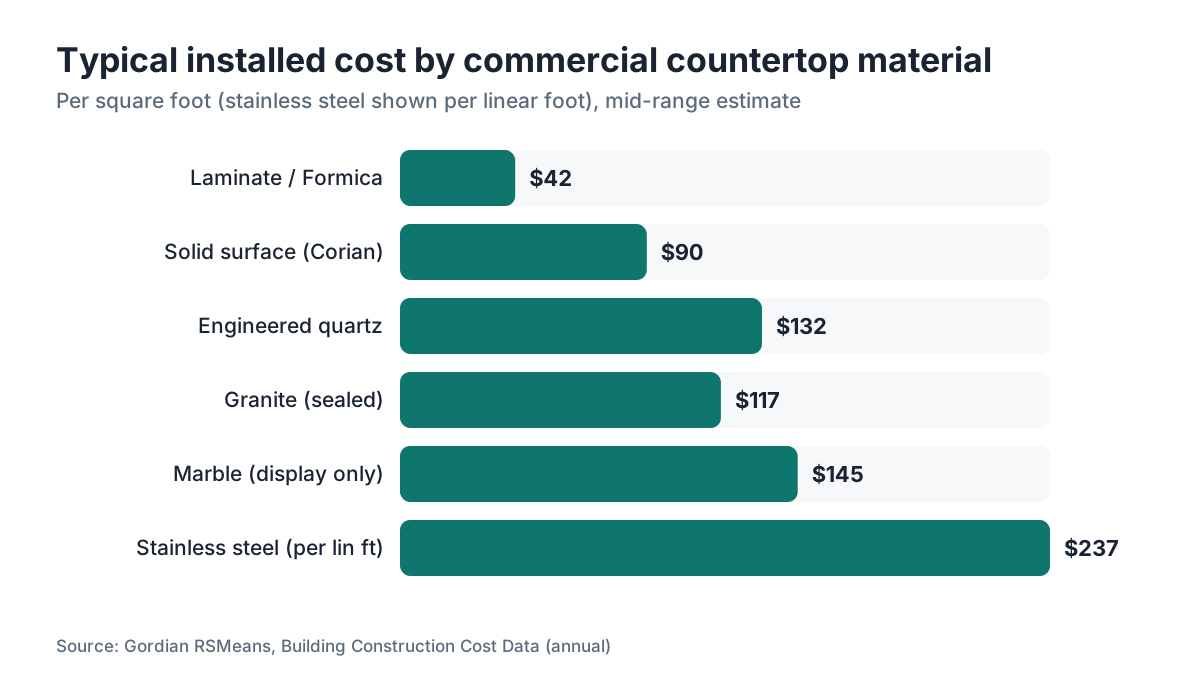
For engineered quartz in a restaurant prep kitchen, budget $100, $180 per square foot installed, including material, fabrication, delivery, and standard installation. A straightforward fast-casual restaurant with 150 square feet of quartz prep counters could run $15,000, $27,000 total.
For stainless steel, pricing shifts to linear footage. A standard 25-inch-deep, 14-gauge stainless counter with an integral backsplash runs $175, $300 per linear foot fabricated and installed. A 40-linear-foot prep line is a $7,000, $12,000 job at minimum.
Solid surface for a hospital or institutional kitchen (think school cafeteria, hotel banquet prep) tends to land $70, $130 per square foot installed, with the high end covering welded coved backsplashes and drain grooves.
These ranges come from RSMeans commercial construction cost data, the industry-standard reference for estimating [3]. RSMeans publishes annually and breaks costs by region, so a job in San Francisco will run 30 to 40% higher than the same job in Memphis.
The biggest variable after material choice is site complexity. A ground-floor install with dock access and a clean, cabinet-ready substrate is a completely different job from a third-floor hospital kitchen with existing equipment to work around, elevator-only access, and a two-hour install window.
How do cutouts, edges, and special features affect the price?
This is where quotes fall apart if you're not specific. Every line item below is a real cost that fabricators routinely undercharge on commercial jobs.
Sink cutouts: A basic undermount sink cutout runs $75, $150 in a residential shop. On a commercial job with a 3-compartment stainless sink or a hand-wash sink that has to sit in a code-specified spot, add 50% for the complexity and the risk of getting the dimensions wrong. Budget $100, $225 per commercial sink cutout.
Faucet holes and accessories: Each faucet hole is $15, $35. Pre-rinse sprayer holes, soap dispenser penetrations, and eyewash station cutouts are each additional charges. On a commercial quote, count every penetration one at a time.
Edges: A standard eased edge is basically free. A full bullnose or ogee adds $12, $25 per linear foot. A coved commercial backsplash (where the counter curves into the wall with no joint, required by many health departments) adds $30, $60 per linear foot to fabrication and is a selling point worth calling out in your proposal.
Drainboard grooves: Required on some commercial surfaces next to dish sinks. Add $8, $20 per linear foot for routed and polished grooves.
Seams: More seams mean more labor and more inspection points. On a commercial job, a seam in a food-prep zone should be filled with color-matched epoxy, polished flush, and noted in your documentation for the health inspector. Add $50, $150 per seam for the extra care.
Thickness: Most commercial counters go to 1.5 inches (3 cm) for durability. If a client spec calls for 2 cm and you're worried about the substrate or the load, push back. The difference in slab cost is real and so is the structural risk.
What overhead and risk factors should be priced into a commercial bid?
Overhead is the cost of running your shop whether or not any one job is in progress: rent, equipment payments, utilities, admin staff, software, insurance. Most fabricators calculate overhead as a percentage of direct costs or as a fixed dollar amount per shop hour.
A common approach: track your shop's total monthly overhead, divide by the number of billable shop hours in a month, and add that hourly overhead rate to every job's labor estimate. If your shop costs $40,000 a month to run and you bill 800 shop hours, your overhead rate is $50 per shop hour. A commercial job that takes 24 shop hours carries $1,200 in overhead before you've added a dollar of profit.
Risk premiums for commercial work:
Commercial jobs carry risks residential jobs don't, and those risks cost money even when nothing goes wrong.
- Schedule risk: A GC who pushes your install date costs you a remobilization trip. Price it in or add a reschedule fee to your contract.
- Inspection failure risk: If a health inspector rejects the install for a reason tied to your work, you're back on site. That's a real possibility. Add 5 to 10% to your commercial quote as a contingency line.
- Change order exposure: Commercial projects change. A client who adds a hand-wash sink after template costs you a return trip, a new cutout, and maybe a new piece of stone. Your contract needs a clear change order process with minimum fees.
- Payment risk: Commercial clients often pay on net-30 or net-60 terms. Residential clients pay on delivery. That float costs you. Price it in or negotiate a deposit structure (30 to 50% at contract, remainder at install is standard).
Insurance is not optional on commercial work. Your general liability policy should cover commercial fabrication and installation, and many GCs require certificates before they'll let you on site. The cost of that coverage belongs in your overhead calculation.
How should you structure a commercial countertop quote document?
A lump-sum commercial quote is an invitation to disputes. Line-item quotes protect you and build client trust.
A clean commercial quote includes:
- Project description: Job address, scope, material specified (full name, brand, finish, thickness), and any code requirements cited.
- Measurement basis: Square footage templated or estimated, with a note that final billing adjusts to templated measurements if you're pre-bid.
- Material line: Slab cost per square foot, quantity, total.
- Fabrication labor: By task if possible (edge work, cutouts, special features).
- Delivery and install: Separate line, with any after-hours or special access surcharges called out.
- Cutouts and penetrations: Each one, by count and type.
- Overhead and contingency: Some fabricators roll this in; others show it. Either is defensible, but don't hide it in the material markup where it can be argued down.
- Profit margin: You don't have to show this, but you need to know it going in.
- Exclusions: What's not in the quote. Substrate prep, cabinet leveling, plumbing reconnection, and haul-away of existing surfaces are common exclusions that create disputes when they're left off.
- Payment terms: Deposit amount, progress payment triggers, final payment timing.
- Warranty: What you warrant and for how long. Be specific.
Quoting software like SlabWise can generate line-item quotes with material costs, cutout pricing, and waste factors built into the calculation, which makes it much harder to accidentally underbid the details.
For the contract itself, the American Institute of Architects publishes standard subcontractor agreement forms (AIA Document A401) that many fabricators use as a starting point for commercial work [4]. They're not free, but lawyers wrote them and they hold up.
What labor rates should you use for commercial countertop installation?
Labor rates vary a lot by region, and there's no honest single national number. The Bureau of Labor Statistics tracks wages for tile and stone setters (SOC 47-2044) and for stonemasons, but countertop installers get classified differently depending on the job [5].
As a working range, commercial countertop installation labor runs $65, $120 per hour for lead installers in most U.S. markets, higher in coastal metros. The BLS Occupational Employment and Wage Statistics for tile and stone setters showed a median hourly wage around $24, $26 for the occupation as a whole in recent surveys [5], but that's the worker's wage, not what you charge the client. Your billing rate has to cover the worker's wage, payroll taxes, benefits, workers' comp, and overhead, then still leave room for profit.
A useful rule of thumb: your billable labor rate should be 2.5 to 3.5 times the worker's base hourly wage. A $28/hour installer costs you roughly $40/hour fully burdened (taxes, insurance, benefits). At 2.5x, you bill $70, $100 per hour.
For a commercial restaurant install, budget 0.5 to 1.5 hours of install labor per square foot depending on complexity. A simple straight run installs faster than a broken-up kitchen with multiple peninsulas, a pass-through window, and an expo line.
If the job requires prevailing wage (the Davis-Bacon Act applies to federally funded construction) [6], your labor costs go up and must be researched by ZIP code before you bid. Prevailing wage rates for stone and tile work in some metro areas run $70, $90 per hour in base wage alone.
Are there specific code or permit requirements that affect commercial countertop pricing?
Yes, and missing them costs more than finding them early.
The FDA Food Code (adopted in full or in modified form by most states) sets the material and installation standard for food-contact surfaces. The relevant language from the 2022 FDA Food Code is: "Equipment that is fixed because it is not easily movable shall be installed so that it is... sealed to adjoining equipment or walls, if exposed to spillage or seepage" [2]. That seal requirement means your backsplash termination detail and caulk spec are not decorative choices. They're code compliance.
Local building departments may require a permit for commercial countertop installation if it's part of a larger tenant improvement or new construction project. The permit process adds cost two ways: the permit fee itself (typically $100, $500 for countertop scope alone) and the inspection requirement, which means your install has to pass. If the inspector finds something, you go back.
ADA (Americans with Disabilities Act) requirements apply to surfaces the public can reach. The ADA Standards for Accessible Design require accessible counters to be no higher than 34 inches above the finished floor, and knee clearance must be provided at accessible workstations [7]. If your client runs a food service operation open to the public, accessible counter heights are not optional and they affect your template dimensions.
NSF International certifies equipment and materials for food safety. Some commercial specifications require NSF/ANSI 2 certification for food equipment, which applies to the countertop itself [8]. Most engineered quartz and solid surface products carry NSF certification; most residential granite and marble do not. Check the product data sheet before you spec.
How do you handle templating and measurement for commercial kitchen countertops?
Template first, quote final price after. On commercial jobs this rule matters more than on residential jobs because the substrate varies more and the penalty for wrong dimensions is steeper.
Many fabricators give a preliminary bid range based on square footage estimates from architectural drawings, then do a paid template to confirm final measurements. Charging $150, $400 for a commercial template visit is standard and reasonable. It also screens out clients who aren't serious.
Digital templating tools (laser measuring devices with software, or total stations for large commercial spaces) pay for themselves quickly on commercial work. A 200-square-foot job with six sink cutouts measured wrong by 1/4 inch in the wrong place is a very expensive mistake. Hand measuring with a tape is fine for simple residential work; it's a risk on complex commercial layouts.
When templating, document every condition that affects your work: substrate material (steel, concrete, framing), existing equipment that has to be worked around, wall conditions at backsplash terminations, out-of-plumb or out-of-level situations. Photograph everything. This documentation protects you if a dispute comes up later and helps you plan the install.
For countertop installation of large commercial slabs, the template also sets your cut plan and how much slab you actually need. Good templating software lets you nest pieces efficiently and calculate true waste before you order, which drives your material cost directly.
What margin should a fabricator target on a commercial countertop job?
There's no universal right answer, and anyone who says there is either hasn't done this long enough or has a simpler business than you do.
For residential countertop work, gross margins of 45 to 55% are common among well-run shops. Commercial work has more complexity, more risk, and often more room to charge accordingly. Targeting 50 to 60% gross margin on commercial work is reasonable, with the higher end applying to jobs with unusual difficulty, tight timelines, or specialized materials.
Gross margin here means: (revenue minus direct costs) divided by revenue. Direct costs include material, direct labor, and subcontractor costs. Overhead and profit come out of gross margin.
Don't confuse gross margin with net profit. If your overhead runs 30% of revenue, a 50% gross margin leaves 20% for profit. A 40% gross margin at the same overhead leaves 10%. That difference is the difference between a business that builds wealth and one that stays flat.
One practical check: after every commercial job closes, do a job cost analysis. Compare what you quoted to what you actually spent. If you're consistently running 10 to 15% over budget on material (waste was higher than expected) or on labor (installs took longer than planned), your estimating assumptions need updating. The only way to know if your margin targets are real is to track them job by job.
SlabWise's job costing tools are built to run exactly this comparison, which is why shops that quote accurately from the start tend to see job-cost variances shrink within six to twelve months of consistent tracking.
What are the most common mistakes fabricators make when pricing commercial kitchen jobs?
Fabricators who are good at residential work often underbid their first commercial jobs by 20 to 35%. The mistakes are predictable.
Underestimating site complexity. A floor plan looks simple. The actual site has a column in the wrong place, a drain that can't be moved, and cabinets that are 3/4 inch out of level. Add a complexity allowance for any commercial site you haven't personally walked.
Forgetting mobilization. A commercial install might need two trips: one to set and tack, one to finish after plumbing is connected. Price both from the start.
Not reading the spec book. Commercial projects often come with a spec book that names the exact material, finish, and performance standard required. If you bid something cheaper without flagging the substitution, you may be required to replace it at your cost.
Skipping the change order process. Commercial GCs will add scope. Every added piece of stone needs a signed change order before you start the extra work. "He said it was fine verbally" is not a payment mechanism.
Pricing material at current supplier cost without a price lock. If there's a long lead time between bid and purchase, material prices can move. Include an escalation clause in your contract or get a supplier price lock for the quote period.
Underinsuring. A standard residential fabrication policy may not cover commercial installation of food-contact surfaces. Call your broker before you bid your first commercial job, not after your first incident.
Ignoring warranty implications. Warrantying a residential countertop against defects for one year is low risk. Warrantying a restaurant prep counter for two years in a high-use environment is a different commitment. Read what you're promising.
Frequently asked questions
How much does a commercial kitchen countertop cost per square foot?
Installed commercial kitchen countertops typically run $80, $250 per square foot depending on material. Engineered quartz lands at $85, $180, solid surface at $60, $120, laminate at $25, $60, and stainless steel at $175, $300 per linear foot. Regional labor costs and site complexity push prices up or down by 20 to 40% compared to national averages. Always get a line-item quote tied to an actual template, not a per-square-foot estimate from plans.
What materials pass health department inspection for commercial kitchen countertops?
The FDA Food Code requires food-contact surfaces to be smooth, nonabsorbent, and easily cleanable. Engineered quartz and solid surface (Corian-type) pass virtually everywhere. Sealed granite passes in some jurisdictions but not all. Stainless steel is universally accepted. Marble almost never passes for food-prep zones. Laminate passes for non-food-prep areas. Always check with your local health department before specifying a material.
How do fabricators calculate material waste for a commercial countertop job?
Add 15 to 25% to the net square footage of the job to account for cutoffs, saw kerfs, and unusable offcuts. Jobs with book-matched veining, complex cuts, or unusual layouts run toward 25% or higher. Jobs with long straight runs and few penetrations may come in around 15%. Get this number wrong and your material cost is off before the job starts.
Do you need a permit to install commercial kitchen countertops?
Often yes, especially if the countertop work is part of a tenant improvement, new construction, or equipment change that requires a building permit. The permit covers the inspector's review of substrate, attachment, and code compliance. Permit fees typically run $100, $500 for countertop scope alone. Ask the GC or building owner before you bid so the cost and timeline land in your quote.
What is the ADA height requirement for accessible commercial countertops?
The ADA Standards for Accessible Design require that accessible counters be no higher than 34 inches above finished floor and that knee clearance be provided at accessible workstations for food service open to the public. This affects template dimensions and must be designed in from the start, not corrected after installation.
How do you charge for sink cutouts and penetrations on a commercial countertop quote?
Price each penetration individually. A standard undermount sink cutout runs $100, $225 on a commercial job (higher than residential because of complexity and code requirements). Faucet holes are $15, $35 each. Pre-rinse sprayer penetrations, soap dispensers, and eyewash station cutouts are all separate line items. Count every penetration before you finalize the quote.
What is a coved backsplash and why does it matter for commercial kitchens?
A coved backsplash is a curved transition from the countertop surface up the wall with no exposed joint. Many health departments require it because open seams collect bacteria and are hard to clean. Fabricating a coved backsplash adds $30, $60 per linear foot to the fabrication cost. It's a legitimate upcharge and a real health code requirement worth calling out clearly in your proposal.
How should a fabricator handle change orders on a commercial countertop job?
Never start extra work without a signed change order in hand. Set a minimum change order fee ($150, $250) to cover the administrative cost of any change, then price the actual added work on top. Commercial GCs expect this process; it's not unusual or aggressive to require it. Document the change in writing, get the client signature, and keep a copy before you order additional material or schedule return trips.
What payment terms are normal for commercial countertop fabrication jobs?
A 30 to 50% deposit at contract signing is standard, with the balance due at installation or within net-30 of completion. Avoid net-60 terms if you can. The cost of floating material and labor for 60 days on a $20,000 job is real. If a GC insists on net-60, either price that cost into the quote or require a smaller job deposit and a progress payment at template or material delivery.
Does prevailing wage (Davis-Bacon) apply to commercial countertop installation?
Davis-Bacon prevailing wage requirements apply to federally funded construction projects, including some school cafeterias, government buildings, and federally assisted housing. If your commercial countertop job is on a federally funded project, you must pay the prevailing wage rate for the applicable trade classification in that county. Prevailing wage rates for stone and tile work in metro areas can run $70, $90 per hour in base wage alone, which changes your labor cost significantly.
What gross margin should a fabricator target on commercial countertop work?
Targeting 50 to 60% gross margin on commercial work is reasonable for a well-run shop. That's higher than typical residential margins (45 to 55%) and justified by the added complexity, site risk, and potential rework exposure. Net profit after overhead depends on how your shop is structured. Track actual job costs against quoted costs on every commercial job so you know whether your margin targets are real.
How do NSF certification requirements affect commercial countertop material selection?
NSF/ANSI 2 certification covers food equipment including countertops. Some commercial specs, especially for hospitals, schools, and chain restaurants, explicitly require NSF-certified materials. Engineered quartz and solid surface products usually carry NSF certification; natural stone typically does not. Check the product data sheet before you spec a material for a project with NSF requirements.
What should be excluded from a commercial countertop quote?
Always list exclusions in writing: substrate preparation and leveling, cabinet repair or replacement, plumbing disconnection and reconnection, removal and disposal of existing countertops, tile or wall work at backsplash terminations, and any work above the countertop plane. Exclusions that aren't written down become disputes. A clean exclusion list protects you and tells the client what else they need to scope.
How long does a commercial kitchen countertop installation take?
Budget 0.5 to 1.5 installation hours per square foot, depending on complexity. A 150-square-foot quartz prep kitchen with six sink cutouts and a coved backsplash might take a two-person crew 8 to 12 hours. Add travel, setup, and cleanup. If the job needs after-hours access or multiple mobilizations (set counters, return after plumbing, final seal and inspect), price each trip separately.
Sources
- Illinois Department of Public Health, Food Service Sanitation Code: Food contact surfaces must be smooth, nonabsorbent, easily cleanable, and durable under Illinois health code.
- U.S. Food and Drug Administration, FDA Food Code 2022: FDA Food Code requires food-contact surfaces to be smooth, nonabsorbent, and easily cleanable; equipment shall be sealed to adjoining equipment or walls if exposed to spillage.
- Gordian RSMeans, Building Construction Cost Data (annual): RSMeans provides regional installed cost data for commercial countertop materials; regional multipliers show 30 to 40% variation between high-cost and low-cost markets.
- American Institute of Architects, AIA Contract Documents: AIA Document A401 is a standard subcontractor agreement form used as a starting point for commercial fabrication and installation contracts.
- U.S. Bureau of Labor Statistics, Occupational Employment and Wage Statistics, Tile and Stone Setters (SOC 47-2044): BLS OEWS data shows median hourly wages for tile and stone setters; billable rates are typically 2.5 to 3.5x base wages when fully burdened.
- U.S. Department of Labor, Davis-Bacon and Related Acts: Davis-Bacon prevailing wage requirements apply to federally funded construction projects and affect labor cost calculations for eligible commercial jobs.
- U.S. Department of Justice, ADA Standards for Accessible Design: ADA Standards require accessible counters to be no higher than 34 inches above finished floor with knee clearance at accessible workstations.
- NSF International, NSF/ANSI 2: Food Equipment Standard: NSF/ANSI 2 sets the certification standard for food equipment including countertops; some commercial specifications require NSF-certified materials.
- U.S. Department of Labor, Wage and Hour Division, Prevailing Wage Resource Book: Prevailing wage rates for stone and tile trades in metro areas can reach $70, $90/hour in base wage, significantly affecting labor cost on federally funded projects.
- U.S. Access Board, Architectural Barriers Act Accessibility Guidelines: Accessible design standards for public-facing food service counters including counter height and knee clearance requirements.
Last updated 2026-07-11