
TL;DR
- Commercial countertop bids require a precise square-footage takeoff, material and labor cost buildup, overhead allocation, and a written scope of work before you name a price.
- Most fabricators target 40-55% gross margin on commercial work.
- Miss any of those steps and you either lose the job on price or win it and lose money.
What makes a commercial countertop bid different from a residential one?
The short answer: scale, documentation, and risk.
On a residential job you might quote a kitchen and two baths over the phone and email a one-page proposal the same afternoon. A commercial project, say a hotel renovation, a hospital nurse station, or a restaurant chain rollout, can span dozens or hundreds of lineal feet of stone, multiple material specs, phased delivery schedules, and a general contractor (GC) who expects a formal bid package with insurance certificates and a signed subcontractor agreement before they even look at your number.
The documentation burden alone is real. Most commercial GCs require: a written scope of work, a unit-price schedule, a schedule of values, proof of general liability insurance (often $1 million per occurrence, $2 million aggregate [1]), and sometimes a surety bond on jobs over a certain dollar threshold. Some public projects trigger prevailing wage rules under the Davis-Bacon Act, which sets federally mandated labor rates by trade and county [2].
The margin math is also different. Residential shops often run 50-65% gross margin because material cost is a smaller share and the customer has limited ability to compare your price. Commercial buyers, especially GCs bidding competitively, shop hard. Margins compress to 35-50% gross on competitive commercial bids. You make it up on volume and repeat relationships, not on any single job.
Payment terms shift too. Residential jobs take a deposit and a balance at installation. Commercial jobs run net-30 or net-60 from invoice, sometimes with 5-10% retainage held until project closeout [3]. Your cash flow model has to account for that.
How do you do a commercial countertop takeoff correctly?
A takeoff is your count of every square foot and linear foot of countertop surface in the project, priced out before you ever touch a slab. Get this wrong and the entire bid is wrong.
Start with the construction drawings. Commercial projects always have architectural plans, usually in PDF or CAD format. The countertop surfaces are typically called out on the floor plan and in the interior elevations, with a finish schedule that names the material and edge profile for each area. If the GC hasn't sent drawings, ask for them before you quote. Bidding off a description or a photo is how you lose thousands.
For each counter surface, measure:
- Net square footage (length times width of the finished counter)
- Cutout count (sinks, cooktops, faucet holes, electrical pop-ups)
- Edge linear footage and which profile is specified
- Backsplash height and square footage if it's in scope
- Any waterfall ends or full-height panels
Add a waste factor on top of the net area. For natural stone with vein matching, 20-30% waste is realistic [4]. For solid surface or laminate with no pattern to match, 10-15% is typical. Porcelain slabs with book-matching can run even higher.
If you have access to templating software or a digitizer, use it. Manual tape-measure takeoffs on large commercial jobs pile up cumulative error. One mismeasured hotel bathroom repeated across 40 rooms is a real problem.
Once you have your total gross square footage (net plus waste), price it by material. Get a written quote from your stone supplier for the specific material and quantity, not a guess based on last month's pricing. Stone prices move with shipping costs and quarry availability, and supplier quotes are usually valid for 30 days [4].
What should your material cost estimate include?
Material cost is more than just the slab price. Missing the ancillary costs is one of the most common ways fabricators underbid commercial work.
Here is a full list of what belongs in your material line items:
| Line Item | Notes |
|---|---|
| Slab purchase price | Get a written supplier quote for the spec'd material and thickness |
| Freight / delivery from supplier | Often $150-$400 per slab depending on distance [4] |
| Sink and undermount hardware | If supply is in your scope |
| Edge profile tooling wear | Amortized cost per linear foot |
| Adhesives, epoxies, color-matched caulk | Easy to forget on large jobs |
| Backerboard or substrate | If wall-mounted backsplash is in scope |
| Sealer | First application is often the fabricator's responsibility |
| Disposal / offhaul of cutout material | Landfill fees apply |
For a job requiring, say, 40 slabs of 3cm quartz at $350-$500 per slab (a realistic mid-grade range in 2024 [4]), your raw slab cost alone runs $14,000-$20,000 before any processing. Add freight, consumables, and hardware, and material cost easily climbs 15-20% above the slab invoice.
Always get a line-item quote from your supplier in writing. If the GC's spec calls for a specific brand, say Cambria or Corian, you need pricing for that exact product, because substitutions on commercial specs usually require architect approval. You can learn more about Cambria countertops and Corian countertops to understand what those specs actually require of you during fabrication.
How do you calculate labor costs for a commercial bid?
Labor is where commercial bids get dangerous if you rely on gut feel instead of actual time tracking.
Break labor into three buckets: shop fabrication, templating, and installation.
Shop fabrication covers cutting, edging, polishing, and cutouts. A useful benchmark: a well-run shop can process roughly 80-120 square feet of finished stone per man-hour under normal conditions, but that drops fast with complex edges, full-height backsplash panels, or book-matched material [5]. If you don't have your own production data, you're guessing.
Templating on a large commercial job is its own line item. Digital templating with a Laser Products or Proliner system runs faster than tape-and-stick, but the setup, travel, and data-cleanup time still needs to be accounted for. Budget 1-2 hours of templating time per room or per distinct counter run, depending on complexity.
Installation labor depends heavily on access conditions. A hotel project on the 12th floor with elevator restrictions and tight corridors takes two to three times longer per square foot than an open-plan restaurant at grade. Walk the site before you bid if at all possible. If you can't, ask the GC for an access and logistics plan in writing, and include a change-order clause for any site conditions that materially differ from what was represented.
For prevailing wage jobs (federal or many state-funded projects), look up the applicable wage determination on the Department of Labor's Wage Determinations Online database before you set your labor rates [2]. The required wage for a tile and marble setter in a major metro can run $55-$85 per hour in base wages alone, not counting benefits and payroll burden.
Burden rate, meaning payroll taxes, workers' comp, health insurance, and other mandatory costs, typically adds 25-35% on top of base wages [6]. If you pay an installer $30/hour and forget burden, your real labor cost is $37.50-$40.50. On a 500-hour commercial job, that's a $3,750-$5,250 error.
How much overhead should you allocate to a commercial bid?
Overhead is every cost your shop has that isn't tied to a specific job: rent, utilities, insurance, equipment payments, office staff, software subscriptions, and owner salary (yes, that counts).
The standard approach is to calculate your overhead as a percentage of direct labor cost or of total job cost, then apply that rate to every bid. If your shop runs $300,000/year in overhead and $600,000/year in direct labor cost, your overhead rate is 50% of labor. A job with $10,000 in direct labor needs $5,000 added for overhead recovery.
Many small fabrication shops skip this step. They bid materials plus labor and think whatever's left is profit. It isn't. Overhead eats into that apparent margin silently, and shops that don't track it often find they're working hard, staying busy, and still not making money.
A useful sanity check: calculate your break-even revenue per shop hour (total annual costs divided by billable hours per year), and make sure every bid prices above it. If your shop runs 2,000 billable hours per year and your total costs (materials excluded) are $400,000, you need at least $200 per billable hour just to break even before material markup.
For commercial bids specifically, overhead allocation matters even more because payment terms stretch out. Carrying the cost of materials for 60-90 days while waiting for payment from a GC has a real financing cost, whether you draw on a line of credit or just eat the opportunity cost on cash.
What gross margin should you target on a commercial bid?
Gross margin on a countertop job is (selling price minus material and direct labor cost) divided by selling price.
Residential shops often run 50-60% gross margin. Commercial work is more competitive, and 35-50% is a more realistic target range, though the right number depends on your market, your shop's cost structure, and how badly you want the relationship with a particular GC.
Here's a simplified example of how a bid builds up:
| Item | Amount |
|---|---|
| Material cost (slabs, freight, consumables) | $22,000 |
| Direct labor (fabrication + template + install) | $14,000 |
| Total direct cost | $36,000 |
| Overhead allocation (50% of labor) | $7,000 |
| Total cost | $43,000 |
| Target price at 45% gross margin | $78,182 |
| Markup on cost to reach that margin | 82% |
Note the difference between margin and markup. A 45% gross margin requires an 82% markup on cost, not a 45% markup. Confusing the two is extremely common and will systematically underprice every job.
The formula: Selling Price = Total Cost / (1 - Gross Margin %). So $43,000 / (1 - 0.45) = $78,182.
Be honest with yourself about what margin you need. If your overhead is higher than average, your required markup is higher too.
How do you structure the bid document itself?
A professional commercial bid package typically includes several components, and presenting them clearly signals to the GC that you run a real operation.
The core components are:
-
Cover letter or bid form. One page, references the project name and bid date, names your company, license number, and the GC's invitation to bid number if there is one.
-
Scope of work. This is the most important document in the package. It spells out exactly what you are including and, critically, what you are not including. 'Supply and install all granite countertops per architectural drawings dated [date]' is a scope. 'Does not include plumbing disconnection or reconnection, substrate preparation, or removal of existing countertops' is equally important. Disputes on commercial jobs almost always trace back to an ambiguous scope.
-
Unit price schedule. On larger projects, GCs often want a breakdown: price per square foot installed by material type, price per linear foot of edge profile, price per cutout. This lets them compare apples to apples across bidders and adjust scope without requiring a full re-quote.
-
Schedule and lead times. State when you can start, how long fabrication will take, and what your installation duration is. Be realistic. Promising a 3-week fabrication on a 400-square-foot job and delivering in 6 weeks will cost you the relationship.
-
Exclusions and clarifications. Anything the drawings are ambiguous about should be listed here with your interpretation. If you're bidding on color TBD, say your price is based on mid-grade material and any upgrade is a change order.
-
Validity period. Commercial bids should state how long the price is valid. Thirty to sixty days is standard [3]. Material prices move, and you can't be held to a stone price six months after you quoted.
-
Payment terms. Net-30 from invoice is typical. If retainage applies, state the retainage percentage and the release condition.
For shops managing several commercial bids at once, quote and bid management software helps avoid the version-control nightmare of tracking which proposal went to which GC at what price. SlabWise, for instance, is built specifically for countertop fabricators and handles material pricing, square footage calculations, and proposal output in one workflow. That kind of tooling matters when you're juggling a hotel and two restaurant bids at the same time.
How do you handle phased or multi-location commercial projects?
Some of the most lucrative commercial countertop contracts are phased projects: a hotel brand doing 12 properties over 18 months, a healthcare system renovating floors in sequence, or a restaurant chain doing 30 locations nationally.
The bidding logic changes here. The GC or owner is often looking for a master pricing agreement, a set of unit prices that apply across all phases. You quote a per-square-foot installed price by material category, a per-cutout price, and an edge surcharge schedule. Then individual purchase orders release against that master agreement.
The risk: material prices change. A unit price locked in at Year 1 slab costs may be underwater by Year 2 if stone prices spike. Protect yourself with an escalation clause that allows price adjustment if your material costs rise more than a specified percentage (5-10% is common) from the date of the master agreement. Get that clause in writing.
The opportunity: multi-location agreements give you volume buying power with your stone supplier. If you can commit to purchasing 200 slabs of a specific material over 18 months, you can negotiate a better per-slab price than you'd get buying 15 slabs at a time. Model that negotiated price into your bid, and the margin improvement can be significant.
For phased projects, also think about tooling and template library reuse. If Location 1 and Location 5 have identical bathroom configurations, your template from Location 1 is usable at Location 5. That's real labor savings, and it should show up in your unit cost assumptions.
What are the biggest mistakes fabricators make when bidding commercial work?
The most expensive mistake is bidding without walking the site or reviewing the full construction documents. Architectural drawings for commercial projects routinely have revisions, and bidding on Revision A when Revision D is current means you're pricing the wrong scope. Always confirm you have the current drawing set before finalizing a number.
The second big mistake is ignoring payment risk. A GC who pays net-60 with 10% retainage is a very different customer than a homeowner who pays balance on delivery. Check the GC's payment history if you can. Ask other subs who've worked with them. Slow-pay GCs are a real threat to small fabrication shops, and the Prompt Payment Act (for federal construction contracts, codified at 31 U.S.C. 3901-3907) and various state-level equivalents create some protection, but collecting on a slow GC still burns time and money [7].
Third: underestimating installation complexity. Commercial sites have union labor restrictions on some trades (if you're in a union jurisdiction, confirm whether your installation crew can work there), freight elevator scheduling, floor protection requirements, and concurrent trades creating scheduling conflicts. These are all real costs that don't show up in a simple square-footage calculation.
Fourth: not understanding the material spec. 'Granite countertops' is not a spec. A commercial spec might call for a specific granite, a specific thickness, a specific finish, and a specific edge profile, all verified by the architect of record. If you substitute without approval and it fails the inspection, you own the cost of replacement. Read the spec section carefully, typically Spec Section 09 64 00 or 09 30 00 in CSI format for stone and tile work [8].
Fifth: forgetting warranty requirements. Commercial projects often require a written warranty on materials and labor, commonly 1 year on installation and whatever the manufacturer offers on the material. Make sure you know what you're committing to and that your supplier's warranty passes through to the owner.
How do you price material types for commercial projects?
Material choice drives a huge share of the bid cost and your competitive position. Commercial specs vary widely: a hospital break room might call for solid surface because it repairs cleanly and hides seams, while a hotel lobby calls for natural marble, and a restaurant chain calls for a durable engineered quartz.
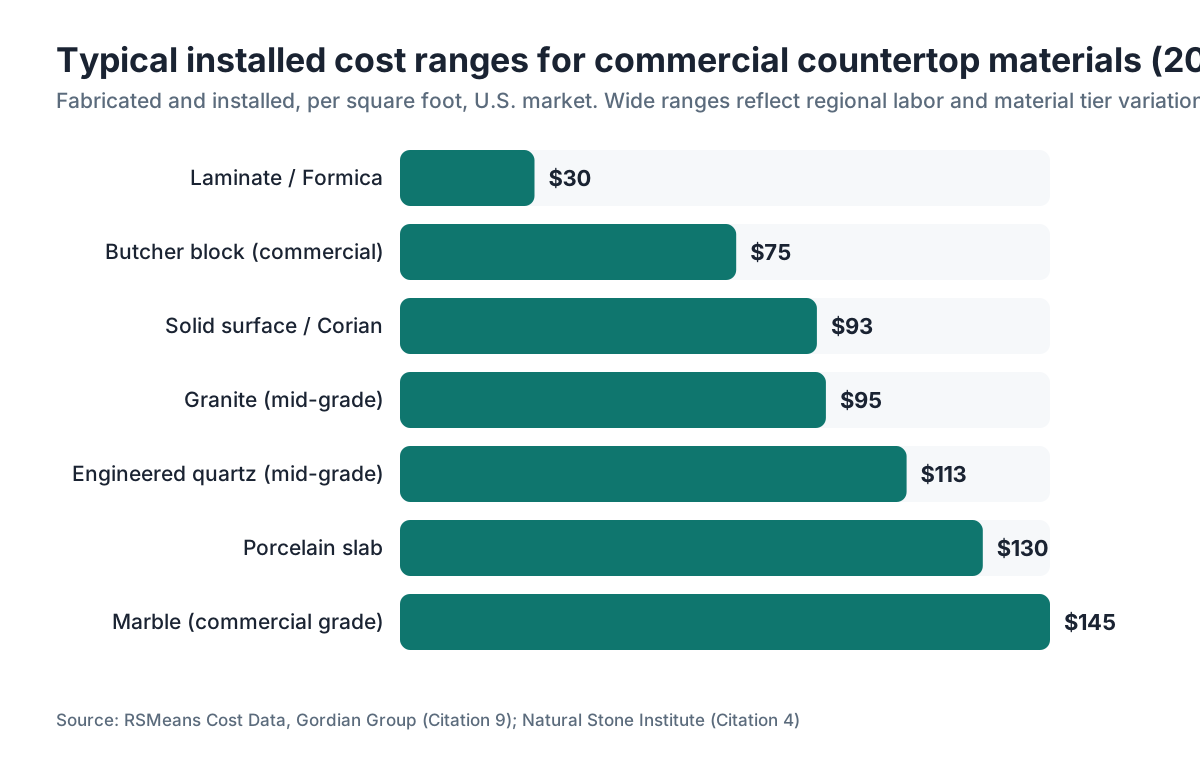
Here's a rough installed price range for common commercial countertop materials in the U.S. market as of 2024 (these are fabricated and installed, not slab-only prices, and regional variation is significant):
| Material | Installed $/sq ft (rough range) |
|---|---|
| Laminate / Formica | $20-$40 |
| Solid surface / Corian | $65-$120 |
| Granite (mid-grade) | $60-$130 |
| Engineered quartz (mid-grade) | $75-$150 |
| Marble (commercial grade) | $90-$200+ |
| Porcelain slab | $80-$180 |
| Butcher block (commercial grade) | $50-$100 |
These ranges are wide because material tier, edge complexity, and regional labor rates all move the number. A simple eased-edge laminate top in a break room and an ogee-edge marble top in a hotel lobby are both 'countertops' but they're not the same bid.
For lower-budget commercial specs, laminate countertops and Formica countertops are worth understanding in detail because they use different fabrication techniques and different skill sets than stone. For the stone end of the spectrum, understanding granite countertops and marble countertops at a material level helps you spot where your cost risk is before you commit a price.
One honest note: the ranges above are synthesized from supplier price lists and published trade data. Nobody publishes a nationally representative installed-cost survey for commercial stone work with any regularity. The closest data points are RSMeans construction cost data [9] and regional fabricator associations.
What insurance, licensing, and bonding do you need to bid commercial work?
This varies by state and by project type, but here is what commercial GCs almost universally require.
General liability insurance: most commercial subcontractor agreements require at minimum $1 million per occurrence and $2 million aggregate. Some require $2 million per occurrence on larger projects. The GC will want to be named as an additional insured on your policy [1].
Workers' compensation insurance: required in virtually every state for any business with employees. Sole proprietors may be able to opt out in some states, but the moment you have employees on a commercial site, you need active workers' comp coverage [10].
Contractor's license: requirements vary by state. California, for example, requires a C-54 (Ceramic and Mosaic Tile) or C-61/D-12 license for stone work depending on scope, issued by the California Contractors State License Board [11]. Texas has no statewide general contractor license but some municipalities require local registration. Know your state's requirement before you submit a bid.
Surety bond: on public projects over certain dollar thresholds, a payment bond and performance bond are often required under the federal Miller Act (40 U.S.C. 3131-3134) or its state equivalents, called Little Miller Acts [12]. The bond guarantees you'll pay your suppliers and complete the work. Bond premiums typically run 1-3% of the contract value for a creditworthy contractor.
Insurance certificates (ACORD 25 form for liability, ACORD 28 for property) are the standard delivery mechanism. Your insurance agent can issue these; budget a day or two for turnaround when you're assembling a bid package. Getting the insurance certificate delayed at the last minute is an avoidable way to miss a bid deadline.
How do you win against lower commercial bids without just cutting your price?
Price is what gets you considered. Reliability is what gets you hired again.
On a competitive bid, the GC is often looking at three to five numbers and picking the lowest qualified bidder. If you're mid-pack on price, here's what actually moves the needle:
Documentation quality. A bid package that is complete, clearly written, and includes a unit price schedule and an explicit scope of exclusions tells the GC that you've done this before and won't surprise them with change orders later. Sloppy bids, or bids that come in late, signal operational problems.
Referenced past work. If you've done similar commercial work (hotels, healthcare, restaurant chains), name it in your cover letter and offer a reference. GCs care more about comparable completed projects than about how many years you've been in business.
Schedule reliability. On commercial projects, schedule is often as valuable as price. If you can credibly commit to a specific installation window and you have a track record of hitting those windows, say so clearly. A GC managing 20 subcontractors on a hotel renovation will pay a modest premium for a stone sub who shows up on time and doesn't create scheduling conflicts for the plumber and finish carpenter.
Flexibility on phasing. If the project is phased, offer to price phases independently. That gives the GC flexibility and reduces their commitment risk on the back phases.
Change order process. Spell out in your bid how you handle changes: written change orders, signed before work begins, based on your unit price schedule. GCs who've been burned by subs who do verbal change-order work and then submit inflated invoices appreciate an explicit process.
You won't win every commercial bid, and you shouldn't try to. The jobs priced so low by the winning bidder that they can't possibly make money often end in disputes, liens, and damaged relationships. Know your number, bid it confidently, and walk away from jobs that require you to ignore your cost reality.
Should you hire a dedicated estimator for commercial countertop bids?
For a shop doing over $1.5-2 million in annual revenue, a dedicated estimator is probably worth it. Below that, the owner or shop manager typically handles estimating, and the question is how to do it efficiently without it eating all your time.
A full-time commercial estimator in the U.S. construction industry earns roughly $65,000-$90,000 per year in base salary depending on market and experience [13]. That's a real cost, and it only makes sense if you're bidding enough commercial volume that the estimator can win enough incremental work to pay for themselves.
The alternative is process. If you have a disciplined, repeatable takeoff and pricing process (material buildup, labor calculation, overhead allocation, margin application) documented and followed consistently, an owner-estimator can turn around a competent commercial bid in 4-8 hours on a mid-size project. Shops that spend 20+ hours on a single bid without a clear process are usually redoing work or hunting for missing data.
Software helps. Tools like SlabWise handle the square footage math and material pricing so the estimating work is actually thinking about scope, risk, and margin rather than arithmetic. A demo is worth 30 minutes of your time if you're doing more than two or three commercial bids per month.
Whatever you decide, track your bid-to-win ratio by project type and margin tier. If you're winning 80% of your bids, you're probably underpriced. If you're winning less than 20%, either your pricing is too high for your market or your bid presentation has problems. A healthy win rate on competitive commercial bids is somewhere in the 25-40% range [3].
Frequently asked questions
How long does it take to put together a commercial countertop bid?
A well-organized mid-size commercial bid (say, 500-800 square feet with a clear spec) takes 4-8 hours if you have the construction drawings, a current material quote from your supplier, and a systematic pricing process. Larger or more complex bids with multiple material types and phased delivery can take 15-20 hours. Shops without a repeatable process routinely spend twice as long on the same bid.
What is a unit price schedule and do I need one?
A unit price schedule lists your per-unit prices for each distinct line item: installed price per square foot by material, price per linear foot of edge profile by type, price per sink cutout, etc. Commercial GCs often require one because it lets them adjust scope and compare bids consistently. Even if not required, submitting one signals professionalism and makes change order pricing straightforward.
Do prevailing wage laws apply to commercial countertop installation?
Prevailing wage requirements apply to federally funded construction projects under the Davis-Bacon Act and to state-funded projects in states with their own prevailing wage laws (about 30 states have them). If the project receives federal or state money, check the wage determination for your trade and county before you set labor rates. Installing countertops in a privately funded hotel has no prevailing wage requirement.
What is retainage and how does it affect a countertop bid?
Retainage is a percentage of each progress payment (typically 5-10%) withheld by the owner or GC until project completion or substantial completion is certified. On a $100,000 countertop contract with 10% retainage, you'd receive $90,000 during the project and $10,000 at closeout, which could be months after your installation is done. Factor this into your cash flow before accepting retainage terms.
Should I require a deposit on commercial countertop contracts?
Deposits are harder to get from commercial GCs than from homeowners, because GCs operate on net terms and their contracts often don't allow advance payments to subs. A realistic approach: negotiate for early material payment (paying for slabs separately from labor) or a mobilization payment to cover your material purchase. If a GC refuses any accommodation and your material cost is high, price in the financing cost or walk away.
How do I handle a commercial spec that calls for a material I don't normally work with?
Read the spec section carefully first. If the spec is performance-based ('polished natural stone, min 3cm thickness, Class A fire rating'), you have flexibility on specific material. If it names a brand or product, substitutions require architect approval. For materials you haven't fabricated before, factor in a learning curve on your labor estimate and consider whether you need to outsource or rent specific tooling.
What is the difference between a lump-sum bid and a cost-plus contract on commercial countertop work?
A lump-sum bid fixes your total price for a defined scope. You absorb any cost overruns and keep any savings. A cost-plus contract reimburses your actual material and labor costs plus a fixed fee or percentage. Cost-plus is rare for countertop subs but appears on design-build or fast-track projects where scope isn't fully defined. Lump-sum is standard for competitive bid work.
How do I protect myself if material prices spike after I submit a bid?
Include a price validity period in your bid (30-60 days is standard) and an escalation clause in your contract for phased or long-duration projects. The escalation clause should specify the trigger (e.g., material costs increase more than 5% from bid date) and the adjustment mechanism (usually documented supplier invoice comparison). Get supplier quotes in writing with their own validity dates so you know your exposure window.
Can I bid commercial countertop work without a contractor's license?
It depends entirely on your state. Some states require a specific stone or tile contractor license to legally install countertops on commercial projects. Others have no license requirement. California, for example, requires a license from the Contractors State License Board for commercial installation work. Check your state's contractor licensing board before submitting a commercial bid. Working without a required license can void your contract and expose you to fines.
How do I calculate the waste factor for a commercial stone project?
Waste factor accounts for offcuts, vein-matching losses, and defect avoidance. For uniform engineered quartz with no pattern, 10-15% is typical. For natural stone without a specific vein-match requirement, 15-20% is a reasonable starting point. For book-matched or vein-matched natural stone, 25-30% or more is realistic. Calculate gross square footage as net area divided by (1 minus waste factor), then price the gross quantity with your supplier.
What should I do if I win a commercial bid but realize mid-project my costs are higher than estimated?
First, document why: was it a scope change, a site condition that wasn't represented, or an estimating error on your part? Legitimate scope changes support a change order; your own estimating errors generally don't unless you included explicit allowances for unknown conditions. Talk to the GC early. A conversation at 20% complete is manageable. A surprise invoice at project closeout is a relationship-ending event and often ends in a lien dispute.
What is a schedule of values and when do commercial countertop subs need one?
A schedule of values breaks your total contract value into line items tied to completion milestones, for example: 30% on material delivery, 50% on rough installation, 20% on completion and punch list. GCs use it to process progress billing. You'll need one on most commercial subcontracts over $50,000, and it's the basis for your monthly pay applications. Build it to match how you actually receive costs so your billing tracks your cash outflow.
Sources
- Small Business Administration, Managing Business Insurance: Commercial subcontractors typically need general liability insurance with $1 million per occurrence and $2 million aggregate minimums to work on commercial construction projects.
- U.S. Department of Labor, Davis-Bacon and Related Acts: The Davis-Bacon Act requires payment of prevailing wages on federally funded or assisted construction contracts exceeding $2,000; wage rates are set by county and trade classification.
- Associated General Contractors of America, Subcontractor Payment Practices Survey: Commercial subcontract payment terms commonly run net-30 to net-60, with 5-10% retainage held through project closeout; competitive bid win rates for qualified subs typically fall in the 25-40% range.
- Natural Stone Institute, Stone Industry Standards and Education: Waste factors for natural stone with vein-matching requirements commonly reach 20-30%; supplier quotes for stone are typically valid for 30 days due to material price volatility; freight per slab varies with distance.
- Marble Institute of America (now Natural Stone Institute), Fabrication Standards: Production rates in stone fabrication shops typically range from 80-120 square feet of finished stone per man-hour under standard conditions, declining significantly for complex edge profiles or book-matched material.
- U.S. Bureau of Labor Statistics, Employer Costs for Employee Compensation: Payroll burden (taxes, workers' compensation, benefits) adds approximately 25-35% above base wages for construction and manufacturing workers in the U.S.
- U.S. Department of the Treasury, Prompt Payment Act (31 U.S.C. 3901-3907): The federal Prompt Payment Act (31 U.S.C. 3901-3907) requires federal agencies to pay contractors on time and allows interest on late payments; similar state-level laws provide some protection on state-funded projects.
- Construction Specifications Institute, MasterFormat Division 09: Commercial stone countertop work is typically specified under CSI MasterFormat Section 09 30 00 (Tiling) or 09 64 00 (Natural Stone Flooring and Wall Coverings), with specific material, finish, and edge profile requirements called out therein.
- RSMeans Cost Data, Gordian Group: RSMeans construction cost data provides regional installed-cost benchmarks for countertop materials including stone, solid surface, and laminate, used by estimators as a third-party pricing reference.
- U.S. Department of Labor, Workers' Compensation Overview: Workers' compensation insurance is required in virtually every U.S. state for businesses with employees working on construction sites.
- California Contractors State License Board, License Classifications: California requires stone and tile installation contractors to hold a C-54 (Ceramic and Mosaic Tile) or applicable C-61 specialty license issued by the Contractors State License Board for commercial installation work.
- U.S. Bureau of Labor Statistics, Occupational Employment and Wage Statistics, Construction Estimators: Construction cost estimators in the U.S. earn a median annual wage of approximately $73,000-$80,000 depending on region and industry specialization, per BLS Occupational Employment and Wage Statistics.
Last updated 2026-07-11