
TL;DR
- The International Surface Fabricators Association (ISFA) is the main trade group for countertop and surface fabricators worldwide.
- It offers technical training, business templates, networking, and industry standards.
- Fabricator dues start around $400 to $500 a year for small shops.
- If you're serious about running a professional operation, membership usually pays for itself.
What is the ISFA?
The International Surface Fabricators Association, called the ISFA, is a non-profit trade group representing companies that fabricate and install countertops and other solid surfaces. It started in 1996 as the fabricator arm of the International Cast Polymer Association before spinning off on its own. Today it claims members in more than 50 countries [1].
The roster is a wide spread. One-person shops cutting granite in a garage. Mid-size regional fabricators running CNC lines. Large national operations with multiple showrooms. Suppliers, distributors, and equipment makers can join too, which gives the group a full-chain view that a fabricator-only club wouldn't have.
ISFA is headquartered in Pittsburgh, Pennsylvania, and runs on a mix of staff and volunteer leadership pulled from working fabricators. That matters. The people setting priorities are also the people running shops and eating the same margin pressure, labor shortages, and material cost swings that everyone else does.
The stated mission centers on education, advocacy, and community for the surface fabrication industry [1]. In practice that means technical courses, a certification program, an annual conference, regional events, online forums, and a library of business documents like contract templates and safety guides.
What materials and trades does ISFA cover?
ISFA covers the full range of surfaces a fabrication shop actually works with, from natural stone to laminate. It started with solid surface (Corian-type acrylic and polyester materials) and grew from there. The list now includes granite, marble, engineered quartz, porcelain slabs, ultra-compact surfaces, and even laminate countertops and butcher block countertops.
If your shop works mostly in granite, ISFA's stone-specific technical sessions and stone fabrication standards apply directly. Same goes for fabricators who specialize in marble countertops or engineered stone like Cambria countertops. The standards library covers fabrication tolerances, installation methods, and surface finishing for each material category [2].
What ISFA does not do is represent remodeling contractors or general kitchen designers in any real way. It's a fabrication trade group, full stop. If you're a homeowner asking whether your fabricator is ISFA-certified, that's a fair quality signal. If you're a designer looking for a business association, the National Kitchen and Bath Association (NKBA) is your group instead [7].
How much does ISFA membership cost?
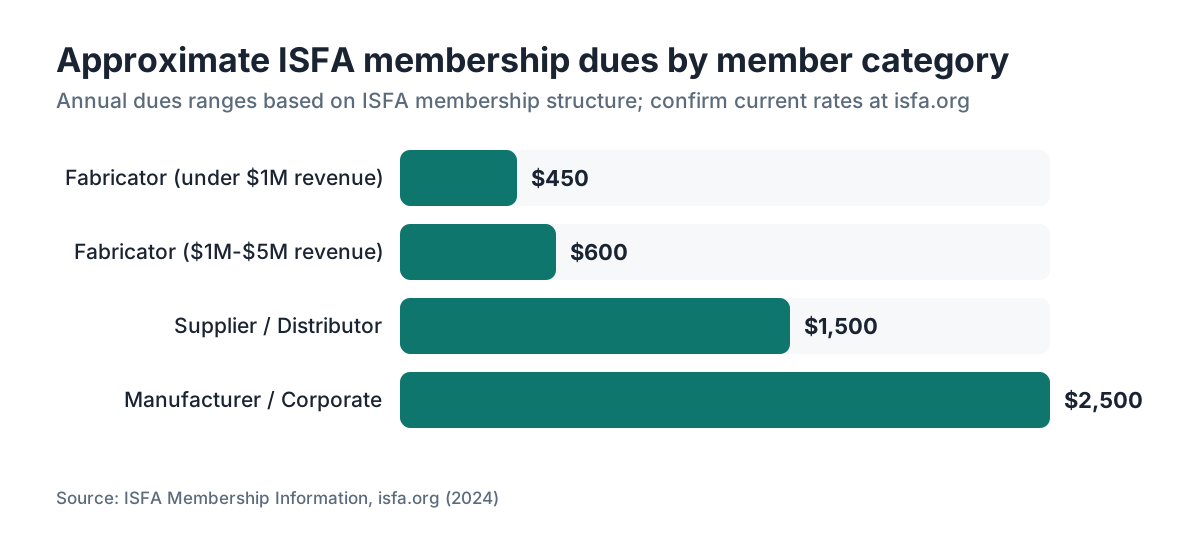
Fabricator membership runs roughly $400 to $700 a year depending on your revenue tier, based on the dues structure published on isfa.org [3]. ISFA sets dues by company category. Suppliers and manufacturers pay more, usually $1,000 to $3,000, because they're buying access to a concentrated audience of buyers.
Here's a rough tier breakdown based on ISFA's published structure:
| Member Category | Approximate Annual Dues |
|---|---|
| Fabricator (under $1M revenue) | ~$400-$500 |
| Fabricator ($1M-$5M revenue) | ~$500-$700 |
| Supplier / Distributor | ~$1,000-$2,000 |
| Manufacturer / Corporate | ~$2,000-$3,000 |
| International (outside USA) | Varies by country |
Those ranges come from ISFA's own membership pages and can change year to year, so confirm current pricing at isfa.org before you budget [3]. ISFA also runs promotional pricing around its annual conference, so timing your join can save a few hundred dollars.
For a shop doing $600,000 a year, $450 in dues is less than 0.1% of revenue. That's noise if you actually use the membership. The bigger cost is time: the hours to sit through webinars, work the forums, and send someone to the conference, which adds another $1,500 to $3,000 in travel and registration when it's all totaled up.
What do you actually get as an ISFA member?
Membership splits into a few buckets, and not all of them matter equally to every shop.
Education is the headline. ISFA produces technical courses on fabrication methods, tooling, surface finishing, and installation, plus business courses on sales, estimating, and shop management. Many run on-demand through the member portal. The annual conference (ISFA World) brings in hands-on demos and workshops you can't get from a webinar [1].
The ISFA Fabricator Certification is the credential homeowners and GCs recognize. Getting it means passing a written exam and proving fabrication skills against ISFA's technical standards. For a shop chasing work from high-end builders or commercial clients, that certification opens doors cold outreach can't.
Member resources include contract templates, OSHA compliance guides, safety data sheet libraries, and HR document templates. Any shop owner who has paid an attorney $500 to draft a basic fabrication contract knows what even simple legal documents cost. Access to ISFA's vetted templates alone can beat a year of dues.
Networking is harder to price, but active ISFA fabricators consistently name peer connections as the best part. Asking a member in a non-competing market how they run a specific edge profile or which CNC tooling they trust is the kind of knowledge that never shows up in a YouTube tutorial.
ISFA also runs a supplier directory and referral network, which helps a small shop find vetted material sources and the other way around.
What is the ISFA certification and is it worth pursuing?
ISFA offers a Certified Fabricator credential covering both technical and business skills. The process includes an online exam on material knowledge, fabrication standards, and customer service, plus a skills assessment [2]. Whether it's worth it depends heavily on your market.
In markets where homeowners comparison-shop hard, a certification badge on your site and in your showroom is a concrete differentiator. For commercial work, GCs and architects specifying surfaces sometimes require or strongly prefer certified installers, the same way tile work references NTCA membership.
Here's the honest caveat. Certification isn't recognized the way a contractor's license is. A homeowner in rural Kansas probably won't think to ask about it. But a kitchen designer at a high-volume design-build firm in a major metro almost certainly will, or at least warms up when you mention it.
Certification makes the most sense for shops trying to move upmarket, land commercial projects, or compete against bigger regional players. For a shop already maxed out on residential volume with a three-week backlog, it's a lower priority.
How does ISFA compare to other trade associations fabricators might join?
The alternatives worth weighing are the Marble Institute of America (now MIA+BSI after merging with the Building Stone Institute), the National Kitchen and Bath Association (NKBA), and regional stone associations. ISFA's edge over all of them is breadth: it's the only group that covers every surface material and treats fabrication operations as its main audience.
MIA+BSI focuses on stone: quarrying, distribution, and fabrication of natural stone. If your shop is 90% granite and marble, MIA+BSI gives you deeper stone-specific content and a more targeted network. The two aren't mutually exclusive, and plenty of serious stone shops belong to both [4].
NKBA leans toward designers and dealers rather than fabricators, so the overlap is thinner. Still, NKBA membership can help a fabricator build relationships with the designers who send templating leads [7].
If you work in multiple materials and want one association as home base, ISFA is the logical pick.
| Association | Primary Focus | Best Fit For |
|---|---|---|
| ISFA | All surface fabrication, operations | Multi-material shops, all shop sizes |
| MIA+BSI | Natural stone only | Stone-heavy shops, distributors |
| NKBA | Kitchen/bath design and dealing | Designers, showroom-heavy fabricators |
| Regional stone groups | Local networking | Shops wanting local referral networks |
Does ISFA membership help with hiring and shop operations?
Yes, and this is an underrated reason to join. Finding and keeping skilled fabricators is one of the hardest operational problems in the trade right now, and ISFA hits it from a few angles.
The ISFA job board lets members post openings to people who already know what surface fabrication is. That beats posting to a general job site and sorting through applicants who've never touched a wet saw. Member shops also get apprenticeship frameworks and training curriculum they can adapt for onboarding.
On operations, ISFA's benchmarking surveys give members data on what comparable shops charge per square foot, what labor rates look like by region, and how others structure their estimating. For an owner unsure whether their pricing is competitive or whether they're leaving money on the table, that data earns its keep [1].
ISFA also publishes OSHA-relevant safety guidance built for stone and solid surface shops. Silica dust rules from OSHA are strict and carry real penalties, so having plain-language guides and monitoring checklists is a practical compliance backstop [5].
Shops running countertop quoting and job management software, like SlabWise, can pair those tools with ISFA's pricing benchmarks to set rates against real market data instead of guessing.
What is the ISFA annual conference and is it worth attending?
ISFA World is the group's flagship event, usually held in the fall. It runs two to three days with education sessions, hands-on fabrication demos, a supplier expo, and networking events. All-in cost runs $1,500 to $3,000 per person depending on where it's held and how far you travel.
The expo floor is the real draw. Equipment makers, tooling companies, material distributors, and software vendors show up in force, and you can put hands on machinery and grill technical reps in a way no website replicates. If you're eyeing a CNC upgrade or sizing up a new saw brand, an hour on that floor beats a week of online research.
For a solo shop owner going alone, $1,500 to $3,000 is a real expense. For a shop sending two or three people, it's a chunk of money but still worth it if the sessions and connections turn into one better process or one new material relationship.
ISFA also runs regional events and webinars all year that skip the conference price tag. If you genuinely can't swing the annual event, the regional and online programming covers most of the educational value.
Are there any downsides or honest criticisms of the ISFA?
Yes, and a fair look has to name them.
ISFA's reach is stronger in the eastern US and larger metros. Fabricators in rural areas or the Mountain West sometimes report thin local chapter activity and a peer network too sparse to lean on day-to-day. If you're hoping for an active regional community and you're in a low-density market, temper your expectations.
The certification program is worthwhile but not mandatory and not universally recognized by end customers. Unlike a contractor's license, which carries legal weight in most states, ISFA certification is voluntary and worth only what market participants choose to give it. That may grow over time. Right now it's a soft credential.
For very small operations (one or two employees, under $300K in revenue), the dues-to-benefit math gets tight. The document templates and technical standards deliver value, but the networking and conference perks demand time a two-person shop often can't spare.
ISFA also runs on a supplier membership base that funds a good chunk of operations, which means some content and events carry a vendor presence not everyone finds neutral. That's true of most trade associations and isn't unique to ISFA, but you should know it going in.
How does a fabricator actually join the ISFA?
The process is simple. Go to isfa.org, pick your membership category, fill out a short application with your business info, and pay dues online [3]. There's no approval committee or vetting for basic fabricator membership. You pay, you're in.
Once you're a member you get login credentials for the member portal, which holds most of the document library, course catalog, and forum access. ISFA staff is reportedly quick to answer onboarding questions through the contact channels on the site.
Want the Certified Fabricator designation? That starts with a separate application and exam registration, also handled through the portal. Plan on a few weeks from application to scheduling the exam.
New members who aren't sure where to start usually get the most early value from the forums and document library before any events roll around. Download a few contract templates and post an intro question in the fabricator forum, and you've earned back the first month's share of dues right away.
Should homeowners care whether their fabricator is an ISFA member?
Homeowners shopping for kitchen countertops or countertop installation can treat ISFA membership as one signal among several. It's not a quality guarantee, but it tells you the shop chose to invest in professional development and stays connected to an industry community that sets and maintains technical standards.
A stronger signal is whether the fabricator holds the ISFA Certified Fabricator designation specifically, since that requires demonstrated skill rather than just paying dues. Ask to see the certification if a shop brings it up.
Plenty of excellent fabricators aren't ISFA members, and membership alone doesn't turn a mediocre shop good. Your usual checklist still runs: read reviews, ask for references on comparable projects, look at samples of their edge work, and get a detailed written quote. ISFA membership is a mild plus, not a shortcut past due diligence.
If you're weighing higher-maintenance materials like quartzite or soapstone, where proper sealing and finishing matter, reading guides on how to clean quartzite countertops and how to clean soapstone countertops will help you ask better questions of any fabricator you're vetting.
What does ISFA say about silica dust safety standards?
This section is for fabricators more than homeowners. OSHA's respirable crystalline silica standard (29 CFR 1926.1153 for construction and 29 CFR 1910.1053 for general industry) sets a permissible exposure limit of 50 micrograms per cubic meter of air as an 8-hour time-weighted average [5]. Stone shops, especially those dry-cutting granite or engineered quartz, fall squarely under this rule [6].
ISFA publishes guidance to help member shops build compliant silica programs, including exposure monitoring protocols, engineering control checklists, and medical surveillance guidance [1]. OSHA's own page on the standard states that "workers in construction, maritime, and general industry are exposed to respirable crystalline silica when working with materials like sand, stone, concrete, brick, block, and mortar" [5].
For fabricators this is a concrete reason to take ISFA's safety resources seriously. An OSHA inspection at a stone shop with no documented silica controls can trigger penalties that dwarf a year of dues. The ISFA templates at least give you a documented starting framework.
For any shop working natural or engineered stone, silica is one of the highest-stakes issues in the building, and ISFA addresses it more directly than most other resources you can find.
Frequently asked questions
What does ISFA stand for?
ISFA stands for International Surface Fabricators Association. It's a non-profit trade group representing fabricators and installers of countertops and other solid surfaces, including natural stone, engineered quartz, solid surface, porcelain, and related materials. It operates globally with members in more than 50 countries, though its programming and events are strongest in North America.
Is ISFA membership required to operate a countertop fabrication business?
No. ISFA membership is voluntary. There's no legal requirement to join, and many successful shops operate without it. Membership is a professional development and networking choice, not a licensing prerequisite. That said, some high-end builders and commercial clients prefer or request ISFA-certified fabricators, so it can carry indirect business development value.
How much does ISFA membership cost per year?
Fabricator membership typically runs $400 to $700 a year depending on your shop's annual revenue tier. Supplier and manufacturer memberships cost more. ISFA occasionally runs promotional pricing around its annual conference. Confirm current rates directly at isfa.org before budgeting, since dues structures can change annually.
What is the ISFA Certified Fabricator credential?
The ISFA Certified Fabricator designation requires passing an exam on material knowledge, fabrication standards, and installation practices, plus a skills assessment. It's the most recognized credential in surface fabrication and can help shops win work with GCs, architects, and high-end residential clients who want proof of quality beyond reviews and references.
Can a homeowner verify that a fabricator is ISFA-certified?
Yes. ISFA maintains a member directory at isfa.org where homeowners can search for certified fabricators by location. When vetting a fabricator, ask specifically whether they hold the Certified Fabricator designation rather than basic membership, since certification requires demonstrated skill while membership only requires paying dues.
Does ISFA cover all countertop materials or just stone?
ISFA covers all major countertop surfaces, including natural stone (granite, marble, quartzite, soapstone), engineered quartz, solid surface (Corian-type products), laminate, porcelain, and ultra-compact surfaces. It started with solid surface but has grown to represent the full range of what fabrication shops work with today.
How does the ISFA annual conference compare to other trade shows?
The ISFA World conference focuses on surface fabrication rather than the broader kitchen and bath industry, so the programming and expo vendors are more targeted. It's smaller than Surfaces or KBIS but more directly relevant for shop owners and fabricators. Expect to spend $1,500 to $3,000 all-in per attendee including travel, hotel, and registration.
Is ISFA worth joining for a small shop with under $500K in revenue?
It depends on how actively you engage. For a genuinely small operation, the document templates, silica compliance guides, and technical standards library can deliver value that exceeds the annual dues. The conference and certification are harder to justify at that revenue level unless you're specifically trying to grow into higher-end or commercial work.
What is the difference between ISFA and the Marble Institute of America (MIA+BSI)?
ISFA covers all surface fabrication materials and treats shop operations as its main focus. MIA+BSI focuses on natural stone from quarry through installation. Stone-heavy shops often belong to both. If you work primarily in granite and marble, MIA+BSI's stone-specific depth may be more useful. If you work across multiple materials, ISFA is the broader home.
Does ISFA help fabricators with OSHA silica compliance?
Yes. ISFA provides member resources addressing OSHA's respirable crystalline silica standard (29 CFR 1910.1053 for general industry), which governs stone fabrication shops. The resources include exposure monitoring frameworks, engineering control checklists, and medical surveillance guidance. For shops that haven't built a documented silica program yet, this is one of the most practically valuable membership benefits.
Can fabricators outside the United States join ISFA?
Yes. ISFA has members in more than 50 countries and offers international membership categories. Dues vary by country. The core education and document resources are available internationally through the online member portal, though live events and chapter activity are concentrated in North America.
How long does it take to get ISFA certified?
The timeline varies, but most fabricators finish the application, study, and exam within one to three months of starting. You can schedule the exam through the member portal after joining. If your shop already has strong technical practices, the study time is manageable. The skills assessment requires some coordination with an ISFA-approved evaluator.
Does joining ISFA directly bring in new customers?
Not directly. ISFA isn't a lead-generation platform. The business value is indirect: the certified fabricator directory brings some consumer traffic, and the credential can help you win bids with builders and commercial clients. Most shops report that networking with suppliers and peers yields more tangible value than the directory listing alone.
What resources does ISFA provide for fabricator business operations?
The member portal includes contract templates, HR document templates, estimating benchmarking data, pricing surveys by material and region, safety program frameworks, and fabrication technical standards. For owners who haven't had legal or HR help drafting operating documents, these templates alone can save several thousand dollars in professional fees over the first year or two.
Sources
- International Surface Fabricators Association (ISFA) - About ISFA: ISFA is a non-profit trade organization with members in more than 50 countries, focused on education, advocacy, and community for the surface fabrication industry
- ISFA - Certified Fabricator Program: ISFA's Certified Fabricator credential covers material knowledge, fabrication standards, and installation practices through exam and skills assessment
- ISFA - Membership Information and Dues: ISFA fabricator membership dues range by annual revenue tier; supplier and manufacturer categories are priced higher
- Marble Institute of America + Building Stone Institute (MIA+BSI): MIA+BSI focuses specifically on natural stone from quarry through fabrication and installation; overlapping membership with ISFA is common among stone shops
- U.S. Occupational Safety and Health Administration (OSHA) - Respirable Crystalline Silica Standard: OSHA's respirable crystalline silica standard (29 CFR 1910.1053) sets a permissible exposure limit of 50 micrograms per cubic meter as an 8-hour time-weighted average; workers cutting stone, concrete, and related materials are directly subject
- OSHA - 29 CFR 1926.1153 Silica Standard for Construction: Construction sector silica standard applies to employers whose workers cut, drill, or grind materials containing crystalline silica; stone fabrication operations fall under the general industry or construction standard depending on project type
- National Kitchen and Bath Association (NKBA): NKBA membership skews toward kitchen and bath designers and dealers rather than fabricators; it is a separate organizational home from ISFA with different programming focus
- U.S. Small Business Administration (SBA) - Trade Associations as Business Resources: Trade associations provide member benefits including networking, document templates, industry benchmarking data, and certification programs that help small businesses reduce operating costs and improve professional standing
Last updated 2026-07-11