
TL;DR
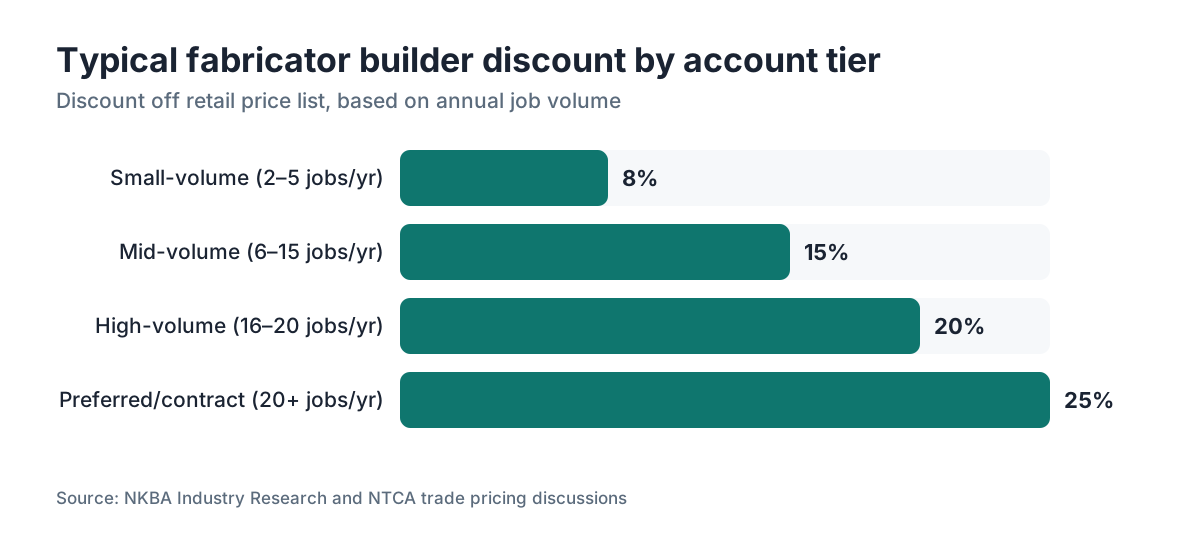
- Most fabricators give builder customers 10 to 25% off their retail price list, and 15 to 20% is the most common starting point.
- The right number comes from your actual job cost, not competitor rumor.
- Builders who deliver volume, simple layouts, and fast payment deserve more.
- Builders who cherry-pick slabs, demand rush installs, and pay net-45 deserve less, or nothing.
Why builder pricing is different from retail pricing
Retail customers are one-and-done. A builder repeats, and that changes the math. When a builder sends you 8 kitchens a month, your estimating time per job drops, your scheduler batch-runs similar templates, and your driver hits multiple stops in the same subdivision. Those are real cost savings, and sharing some of them back through a discount is fair.
But the relationship cuts both ways. Builders demand priority scheduling, expect you to absorb change orders, and sometimes pay slowly. Some squeeze you on price every single year. The discount you set now becomes a baseline they remember forever, and clawing it back is nearly impossible.
Here is the principle that keeps you solvent: any discount you offer should be smaller than the cost savings the builder actually generates for your shop. If volume and batching save you 12% per job, a 10% discount keeps 2% in your pocket. If the savings are only 6% but you're giving 15%, you're funding their margin out of yours.
What discount range do most fabricators actually offer builders?
Most fabricators land between 10% and 25% off retail, with 15 to 20% the most commonly cited starting point for a mid-volume builder. There is no industry-wide survey with tight confidence intervals on this. Anyone who tells you '18% is standard' is repeating shop-floor legend. The range comes from what fabricators describe in trade forums and industry groups [1].
Here is a rough breakdown of how the range maps to relationship type:
| Builder type | Typical discount off retail | Notes |
|---|---|---|
| Small-volume custom builder (2 to 5 jobs/yr) | 5 to 10% | Barely justifies a separate price tier |
| Mid-volume production builder (6 to 20 jobs/yr) | 10 to 18% | Most common scenario |
| High-volume tract builder (20+ jobs/yr) | 18 to 25% | Negotiated, often with material spec controls |
| National/regional builder with preferred vendor status | 20 to 30%+ | Rare; you may need to bid competitively |
Those top-end numbers get uncomfortable fast. A 30% discount off a retail price that already carries 35 to 40% gross margin leaves you at roughly 5 to 10% gross, which does not survive a templating error, a damaged slab, or a slow payment month.
NKBA industry cost data puts fabrication gross margins on installed countertops at 35 to 50% before overhead [1]. That ceiling matters. It tells you the maximum discount you could offer before going negative, and you need to stay well above zero.
How should a fabricator calculate a builder discount without losing money?
Start with job-costing, not gut feeling. For every job type you run for builders, you need four numbers: material cost, labor cost (template, cut, polish, install), shop overhead allocated to that job, and delivery cost. Add them up, subtract from your retail price, and that is your true gross margin on that job type.
Here is a simple formula:
Maximum safe discount = (Retail price - Total job cost) / Retail price - Target gross margin %
Example: A kitchen retails at $4,200. Your total job cost is $2,100. That is a 50% gross margin. If you need 30% gross margin to cover overhead and profit, you can discount up to 20% (50% margin minus 30% floor = 20% available to give away).
Most fabricators do not job-cost accurately, which is why they feel profitable but cannot explain where the money went. Software that tracks material yield, labor hours per job, and remnant waste helps a lot here. SlabWise, for example, ties quoting directly to material cost and nesting efficiency so you can see your actual margin before you commit to a price.
One more thing to cost: payment terms. If a builder pays net-30 instead of on delivery, and your line of credit costs 7% annually, that 30-day float costs you roughly 0.6% per job. Net-60 is 1.2%. It adds up fast across a high-volume relationship [8].
Should the builder discount apply to material, labor, or both?
This is one of the cleaner decisions you can make, and most fabricators get it wrong by accident rather than design.
Applying a flat percentage to the total invoice is simple but sloppy. You end up discounting both your material markup and your labor margin, and those have different cost structures. Your labor rate is not elastic. You pay your installers the same whether the job is for a retail customer or a builder [9].
A smarter structure: discount the material markup (the spread between what you paid for the slab and what you charge the builder for it), and discount labor by a smaller amount or not at all. Your material markup might be 40 to 60% above cost, so there is room. Your labor margin might be 25% above direct labor cost, so there is much less room.
Some fabricators handle this by building a separate builder price list that bakes the discount into stone grades rather than doing percentage math on the fly. You say 'Level 1 granite is $38/sq ft installed for builders, $48 for retail.' The builder sees a clean number. You know exactly what margin you kept.
What non-price terms matter as much as the discount percentage?
Experienced fabricators will tell you the discount number is almost secondary to the terms around it. Four terms move the needle most.
Payment terms. Net-30 is painful. Net-45 or net-60 is a slow bleed. Negotiate hard for net-15 or payment on substantial completion. If the builder insists on longer terms, shrink the discount to compensate.
Scheduling priority. Builders often expect to jump the queue. If they do, that costs you: you bump retail customers or run overtime. Either price it in explicitly (a scheduling fee) or define clearly that builder jobs go into the standard queue.
Slab selection rights. Some builders want to choose their own slabs from your inventory. That is fine until they cherry-pick the bookmatched piece you were saving for a $12,000 retail job. Specify in writing that builder material is drawn from your standard inventory at your discretion for a given grade, or that premium selection carries a premium.
Change orders. Kitchen designs change. Who eats the cost of re-templating or re-cutting? Define it upfront. A blanket '10% builder discount' that quietly includes unlimited change order absorption is a bad deal.
Does the material type change how much discount you can offer?
Yes, significantly. Your margin headroom is not the same across material types, so a flat discount policy across all materials is almost always wrong.
With granite, material costs vary a lot by origin and grade, but fabrication labor is fairly predictable once you know the edge profile and cutout count [6]. Mid-grade granite jobs often carry decent margin. On high-exotics (book-matched quartzite, rare marbles), your material cost is a much larger share of the total, so the same percentage discount hurts more in absolute dollars.
Engineered stone (quartz brands like Cambria or Silestone) tends to have tighter material cost spreads because it is manufactured to consistent thickness and sold through distribution at fairly fixed prices. Your margin lives mostly in labor efficiency. A 15% builder discount on quartz is a bigger bite than 15% on generic granite.
Laminate and butcher block countertops have low material costs and fast labor, so discount potential is higher in percentage terms, but the dollar amounts are smaller so the absolute gain for the builder is modest.
For marble countertops, the material is expensive and fragile. Mistakes cost more, so your contingency buffer needs to stay intact. Thin discounts or none on natural stone exotics is a defensible position.
Related reading: if you want the cost drivers behind specific stone types, granite countertops and kitchen countertops have the detailed breakdowns.
How do you structure a tiered builder pricing system?
A tiered structure rewards the builders who actually deliver volume without handing discounts to occasional customers who just claim to be builders. Here is one approach that holds up in practice.
Tier 1 (qualified builder, 1 to 5 jobs annually): 8 to 12% off retail. Requires a valid contractor license number and a completed credit application. This tier mostly exists to give builders the psychological win of a 'trade account' without you sacrificing much.
Tier 2 (active builder, 6 to 15 jobs annually): 13 to 18% off retail. Reviewed quarterly. If volume drops below threshold, the account reverts to Tier 1 for the next quarter.
Tier 3 (preferred builder, 16+ jobs annually or a committed volume agreement): 18 to 22% off retail. May include first-call scheduling and a dedicated project contact.
Put the tiers in a one-page agreement, not a verbal understanding. Specify the review period, what counts as a 'job' (signed contract, not estimate), and what happens when a builder's volume drops. Informal understandings dissolve when your contact leaves the builder's company or when a new owner buys the shop.
For countertop installation scheduling logistics specifically, keep your tier agreement separate from your installation contract so each document stays clean.
How should you handle a builder who asks for a discount deeper than you can profitably offer?
This happens constantly. A builder says they want 30% off or they will go to the shop across town. A few honest observations.
First, that threat is sometimes real and sometimes bluster. Large national builders have genuine bargaining power. A small custom builder with six jobs a year probably does not, because switching fabricators costs them time and risk on active projects.
Second, you can often offer value-equivalent concessions that cost you less than a deeper discount. Priority scheduling, a dedicated point of contact, faster turnaround on quotes, or a small remnant credit program can satisfy a builder who mostly wants to feel valued.
Third, walking away from a bad deal is a legitimate business decision. A customer who forces you to operate at near-zero margin will consume staff time, strain cash flow, and crowd out retail customers who pay better. Plenty of fabricators call letting a low-margin builder account go one of their best decisions in hindsight.
If a competitor is genuinely undercutting you by running at unsustainable margins, the fix is rarely to match them. Either they fail, or they are cutting corners somewhere that catches up with them.
What are the legal and tax considerations around builder pricing?
A few things worth knowing, though you need your own accountant or attorney for specifics.
Charging different customers different prices is legal for most small fabricators in most states, as long as it is not tied to a protected class and you are not a supplier covered by the Robinson-Patman Act [3]. That Act applies to sellers of goods in interstate commerce who sell to competing buyers at different prices. Most countertop shops sell locally and do not compete directly with their builder customers, so Robinson-Patman rarely applies. If your shop sells across state lines or your builder customers resell countertops competitively, ask your attorney.
On the sales tax side, many states have specific rules about whether countertop fabrication and installation is taxed as a service, a product, or a construction contract, and those rules affect how you quote builders differently from retail [4]. Some states treat a fabricator-installer as a contractor (who buys materials tax-free and charges no sales tax on the final job), others as a retailer. The answer changes the gross price you quote and therefore the effective discount you can offer while keeping the same net revenue.
The IRS requires that transactions between related parties (if you also hold an ownership stake in a builder company) be at arm's length fair market value [5]. That is an edge case but worth mentioning.
How do top-performing fabricators think about builder accounts differently?
The shops that do well with builder accounts share a few habits that separate them from shops that resent their builder customers.
They track profitability by customer, more than by month. They know which builder relationships make money and which ones feel busy but produce little net income. That sounds obvious, but most job-costing systems are set up by material type, not by customer.
They treat the relationship as a partnership rather than a discount negotiation. They show up to builder sales meetings, learn what the builder's buyers want (often specific finishes or edge profiles), and package their capabilities around that. That information advantage lets them spec materials the builder's customers will love without competing purely on price.
They set expectations in writing at the start, not after the first conflict. That means a signed trade account agreement, not a handshake and a price list.
If you want to model your own numbers before agreeing to a builder relationship, a quoting tool that shows margin by job type is worth having before you commit. That is exactly what SlabWise is built for. You can run a builder scenario with real material costs and see the margin impact before you sign anything.
When does it make sense to offer no builder discount at all?
Sometimes the right answer is zero.
If your shop runs near capacity with retail customers, your time is already spoken for. A builder's volume only helps you if you have room to absorb it. Giving away margin on work you could have sold at full retail is a purely negative trade.
If you specialize in high-end custom work, particularly unusual materials like quartzite or rare marbles, your value proposition is not price. A builder who wants the cheapest countertop will not be happy with your business model anyway. Keep your retail reputation intact.
If a builder is not credit-worthy or has a history of slow payment, the discount conversation is premature. Fix the payment terms first. A 20% discount on an invoice that takes 90 days to collect is often a worse deal than no discount with payment on delivery.
The trades tend to respect a firm 'our pricing is our pricing' stance more than a shop that folds under the first push. It signals that your price reflects real value.
Frequently asked questions
What is a reasonable builder discount for a fabricator just starting to work with builders?
Start at 8 to 12% off your current retail price list. That range is enough to make a builder feel they have a trade relationship without sacrificing significant margin. As you job-cost the first few projects and see what scheduling and material costs actually look like for that builder, you can adjust at the next contract renewal. Never lead with your maximum number.
Should a fabricator charge builders the same price for all stone types?
No. Your margin varies by material, so a flat percentage discount hits harder on high-cost stone. Build a builder price list by stone grade rather than applying a blanket percentage to every invoice. On exotic quartzite or premium marble, your contingency for mistakes is thinner, so discount less or not at all on those grades. Save the deeper discounts for mid-range materials where margin is more comfortable.
How do fabricators handle builders who pay slowly?
Price the float into your terms. If a builder pays net-45 and your cost of capital is roughly 7% per year, that 45-day float costs you about 0.9% of the invoice value. Reduce the discount by that amount, or better, negotiate net-15 or payment at installation as a condition of the trade pricing. A builder discount with net-60 terms is often worth less than no discount with payment on delivery.
Can a fabricator charge different builders different prices for the same material?
Yes, in most cases. Setting different prices for different customers is standard business practice and legal for local fabricators under U.S. commercial law, provided the difference is not based on a protected class. The Robinson-Patman Act restricts discriminatory pricing mainly for sellers competing in interstate commerce with buyers who resell competitively. Most local stone shops are not in that category, but confirm with your attorney if you sell across state lines.
How does scheduling priority factor into a builder discount negotiation?
Treat scheduling priority as a separate concession with a real cost. If a builder needs two-week turnarounds guaranteed, that may require you to hold capacity, run overtime, or push back retail customers. Either build a scheduling fee into the agreement or reduce the material discount to compensate. Giving a deep price discount AND priority scheduling is often a losing combination once you calculate total shop impact.
What should a fabricator put in a builder trade account agreement?
At minimum: the discount tier, the volume threshold that triggers it, the review period, payment terms, who absorbs change order costs, material selection rights (can the builder choose specific slabs or not), scheduling expectations, and what happens if volume drops. One to two pages is enough. A verbal agreement is fine until there is a conflict, at which point it is useless.
Is it better to offer a builder a volume discount or a lower base price?
A tiered volume discount is almost always better for the fabricator. A lower base price sets a permanent expectation regardless of whether the builder delivers the promised volume. A volume discount can be reviewed quarterly and shrinks automatically if the builder's activity drops. It also gives you a tool to reward builders who grow the relationship without handing margin to one who stays small.
How do fabricators avoid losing money on builder jobs with complex layouts?
Apply the builder discount only to standard layouts. Define 'standard' in your agreement: say, kitchens under a certain linear foot count with a specified maximum number of cutouts and a standard edge profile. Jobs outside that definition are quoted at retail or at a reduced discount. Complexity is where builder economics fall apart, because your labor time goes up while your discounted revenue stays flat.
Do fabricators give builders a discount on remnants?
Usually not, or at a smaller discount than the standard material rate. Remnants are already priced below standard slab cost to move inventory. Stacking a builder discount on top typically pushes the price below your break-even on that piece. Some shops offer builders right of first refusal on remnants at a fixed per-square-foot rate that still covers cost, without tying it to the main trade account discount.
How often should a fabricator renegotiate builder pricing?
Annually is a good baseline. Your material costs, labor rates, and shop overhead change, and your builder pricing should follow. Build the review into your trade account agreement from day one: 'Pricing is reviewed each January and adjusted for material cost changes.' That framing makes annual increases normal rather than confrontational. Fabricators who lock in a price and never revisit it watch their margins erode over years.
What percentage of a fabricator's revenue should come from builder accounts?
There is no universal right answer, but many experienced fabricators aim to keep builder revenue below 40 to 50% of total. When one builder represents a large share of your revenue, you become dependent, and that hands them bargaining power you cannot easily counter. Spreading revenue across retail, designers, and multiple builder accounts protects margin and keeps any single customer from dictating your terms.
How do fabricators verify that a builder qualifies for trade pricing?
Require a valid state contractor license number, a business entity name (LLC, corp, or DBA), and a completed credit application. You can verify contractor license status through most state licensing board websites for free. Some fabricators also ask for a few references from other trade suppliers. The goal is to screen out homeowners who claim to be contractors and to build a paper trail for the account.
Sources
- National Kitchen and Bath Association (NKBA), Industry Research: Fabrication gross margins on installed countertops typically run 35 to 50% before overhead, and builder/contractor discounts in the 10 to 25% range are described by NKBA members as the common trade pricing zone.
- Federal Trade Commission, Robinson-Patman Act guidance: The Robinson-Patman Act restricts price discrimination between competing buyers of goods in interstate commerce; most local fabricators selling regionally are not covered.
- Sales Tax Institute, Construction Contractor Sales Tax Rules by State: State sales tax treatment of fabrication and installation varies: some states treat the fabricator-installer as a contractor (no sales tax on the final job), others as a retailer, affecting how builder quotes are structured.
- IRS, Publication 550 and related arm's-length transaction guidance: Transactions between related parties must be at arm's-length fair market value; relevant if a fabricator has an ownership interest in a builder entity they supply.
- Marble Institute of America (MIA+BSI), Cost and Pricing Benchmarks: Material cost as a share of total job cost varies significantly across stone types, with premium natural stones having material cost representing a higher percentage of total, limiting discount capacity.
- National Tile Contractors Association (NTCA), Trade Pricing Discussion Resources: Industry peer discussions within NTCA and related trade groups describe 15 to 20% as a common starting point for mid-volume builder discounts.
- U.S. Small Business Administration, Managing Cash Flow: Extended payment terms (net-30, net-60) create real carrying costs for small businesses; the SBA identifies receivables management as a primary cash flow risk for trade contractors.
- Bureau of Labor Statistics, Occupational Employment and Wage Statistics: Stone Cutters and Carvers: Labor cost data for stone cutting occupations helps fabricators understand the labor component that is less discountable than material markup.
- Associated General Contractors of America, Contractor Licensing by State: State contractor license verification resources used to confirm builder qualification for trade accounts.
Last updated 2026-07-11