TL;DR
- Most countertop fabrication shops should target 45 to 55% gross margin on installed jobs.
- Commodity-heavy shops running laminate or basic granite often land near 40%.
- Premium stone and quartz shops with tight templating push 55 to 60%.
- Below 35%, almost nothing is left to cover overhead, and most shops down there are losing money without knowing it.
What does gross margin actually mean for a fabrication shop?
Gross margin is revenue minus the direct cost of goods sold, divided by revenue, as a percentage. For a countertop shop, cost of goods sold means slab material, consumables (blades, water, adhesive, sealer), and the direct labor of the people templating, cutting, polishing, and installing. It does not include rent, your office manager, truck insurance, or the CNC lease. Those are operating expenses that live below the gross margin line.
Here's why the distinction matters. A lot of owners confuse net margin with gross margin, or they bury overhead inside job costs and then wonder why the numbers look grim. Gross margin is your report card on the production floor. Net margin is your report card as a business.
Run the math. A shop doing $2 million at 50% gross margin has $1 million to cover rent, equipment, admin, and profit. That $1 million is gross profit. If overhead eats $800,000, net profit before tax is $200,000, or 10%. That's a solid small-business outcome. Now drop gross margin to 35% and gross profit falls to $700,000. Same overhead. Net profit collapses to $100,000, or 5%, which is one slow quarter from a cash crisis.
Track this number weekly, not at year-end.
What is the typical gross margin range for countertop fabricators?
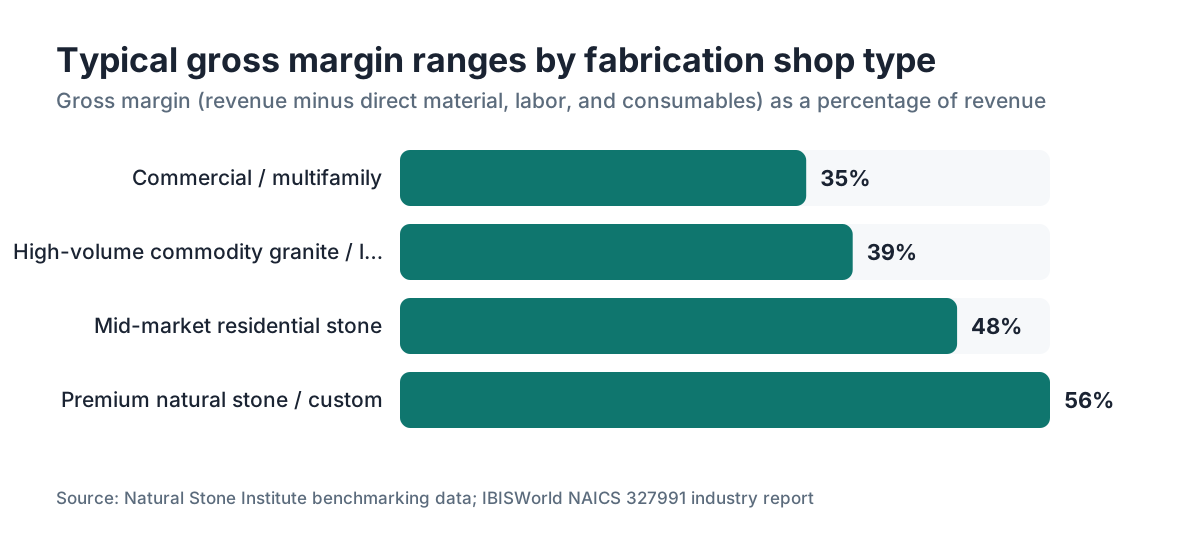
Most countertop fabricators run 45 to 55% gross margin, and a shop stuck below 40% for months is usually in trouble. The honest caveat: no large-sample, publicly available study surveys countertop fabricators specifically. The closest benchmarks come from IBISWorld industry reports on stone product manufacturing, profitability surveys circulated inside the stone industry, and financial data published by trade groups like the Natural Stone Institute.
Based on those sources plus the general construction trades literature, here's a reasonable picture:
| Shop Type | Typical Gross Margin Range |
|---|---|
| High-volume, commodity granite/laminate | 35 to 42% |
| Mid-market residential stone fabricator | 45 to 52% |
| Premium natural stone, custom work | 52 to 60% |
| Commercial/multifamily (thin margin, volume) | 30 to 40% |
Natural Stone Institute member benchmarking has historically shown top-quartile fabricators running gross margins above 55%, while the bottom quartile often sits below 38% [1]. IBISWorld's stone fabrication category (NAICS 327991) reports average net profit margins in the 7 to 10% range, which lines up with gross margins in the 45 to 55% zone after typical overhead [2].
Below 40% consistently? That's the first thing to investigate, before anything else in the shop.
What are the biggest cost drivers that compress gross margin?
Material cost is where you look first. Slab cost as a share of revenue swings hard by material. A basic 3cm Uba Tuba granite might cost a shop $8 to 12 per square foot wholesale, and selling it installed at $55 to 65 leaves a comfortable spread. A premium Calacatta marble slab can run $40 to 80 per square foot wholesale or more, and if the homeowner negotiated hard, the margin on that job gets thin despite the fat ticket price [3].
Waste and yield are the next killer. Most shops budget waste at 15 to 25% of slab area depending on layout complexity. A kitchen with multiple cutouts, a complicated island, and book-matched veining can push waste past 30%. If your quoting doesn't handle that slab by slab, you're giving away margin on every complex job. This is exactly where digital nesting earns its keep. A shop that drops waste from 22% to 17% on a $1.5 million revenue base recovers roughly $30,000 to $50,000 in material, depending on average slab cost.
Direct labor is the third lever. Labor as a share of revenue runs 15 to 22% in a well-run shop. Shops above 25% are usually fighting re-cuts, sloppy templating, callbacks, or jobs priced too low for the hours they eat. Every callback to redo a bad edge or a mis-templated sink cutout burns an hour or two of unbillable crew time.
Consumables cost more than most owners think. Blades, polishing pads, router bits, epoxy, and sealer together run $1.50 to $3.00 per square foot of finished stone, depending on material hardness and edge complexity. Quartzite and porcelain chew through tooling. Fabricate a lot of either and skip updating your consumable budget for two years, and your real job costs sit well above what your quotes assume.
How does material mix affect your gross margin target?
Your material mix drives margin as much as your pricing discipline does. Different materials carry different margin profiles, and chasing the high-ticket ones blindly is a common mistake.
Engineered quartz (Cambria, Silestone, Caesarstone) tends to give fabricators decent material margins because slabs are consistent and waste is predictable. But fabrication time can run higher than granite because quartz is hard, which pushes tooling and labor cost up. Shops running a lot of Cambria countertops should watch blade life closely.
Marble countertops carry higher slab costs and higher risk. Seams need to be perfect, homeowners get fussy about veining, and a chip or crack on a $900 slab is a painful loss. Shops that have mastered natural stone command higher prices and often beat commodity granite shops on margin, but the risk per job climbs with them.
Laminate countertops and Formica countertops have low material costs and low sale prices. Gross margin percentage can still look healthy (40 to 50%) if the shop is efficient, but the gross profit dollars per job are small, so you need volume. Corian countertops and other solid surfaces sit in the same spot.
The practical takeaway: don't chase a material category because the ticket looks big. Look at gross profit dollars per labor hour, not gross margin percentage. A $3,000 granite job that takes 6 shop hours makes $500 gross profit per hour at 50% margin. A $1,200 laminate job that takes 3 hours at 45% margin makes $180 per hour. Volume of the right jobs is what pays.
How should you calculate gross margin on a per-job basis?
Most shops that lose track of margin cost at the shop level monthly instead of at the job level in real time. The fix is simple, but it takes discipline. For each job, you need four numbers.
- Slab cost (what you actually paid for the slabs used, including any remnants allocated)
- Direct consumables (blades, pads, adhesive, sealer used on that job, estimated per square foot if you don't track job by job)
- Direct labor hours times loaded labor rate (wage plus employer taxes plus workers' comp, typically 1.25 to 1.35x the hourly wage) [10]
- Any subcontracted work (third-party install, plumbing disconnect and reconnect, and so on)
Job revenue minus those four items is job gross profit. Divide by revenue for job gross margin.
If you quote by hand in a spreadsheet, this kind of job-costing is tedious but doable. Once you're past 15 to 20 jobs a month, quoting and job-costing software that ties the estimate to actual costs pays for its subscription. SlabWise, for one, builds nesting and material cost into the quote, so your estimated margin at quoting time matches what the shop floor can actually hit instead of what looked good on paper.
The target: your actual job margin should land within 3 to 5 percentage points of your quoted margin. Quote 50% and land 42% over and over, and something in your estimating is broken. It's usually labor hours or waste.
What overhead costs live below the gross margin line?
Overhead is everything gross profit has to cover before you see a dollar of profit. Once you know your gross margin, map the buckets. For a fabrication shop, the common ones are:
- Rent or mortgage on the shop building
- CNC and waterjet payments or lease
- Shop utilities (a waterjet plus HVAC can make the electric bill surprisingly large)
- Vehicles and fuel for delivery and install trucks
- Office staff, estimators, and sales salaries (not direct labor)
- Marketing and advertising
- Software subscriptions
- Insurance (general liability, commercial auto; workers' comp sometimes lands here instead of direct labor depending on your accounting)
- Owner's salary above a reasonable owner-operator wage
A rule of thumb from the construction trades: total overhead (fixed plus semi-variable) often runs 30 to 40% of revenue for a small shop, and less for a larger shop that spreads the same fixed base over more revenue [4]. Overhead at 35% and gross margin at 50% gives you a 15% net operating margin before tax. That's a healthy shop.
Overhead at 35% and gross margin at 38%? You're losing money or barely breaking even. That's why the 45% gross margin floor isn't arbitrary. It's the minimum that gives a typical shop enough room above overhead to turn a profit.
What net profit margin should a fabrication shop expect?
A well-run countertop fabrication shop nets 8 to 15% pre-tax. IBISWorld data on stone fabrication (NAICS 327991) puts average pre-tax margins around 7 to 10% for the industry [2]. Top-quartile shops in Natural Stone Institute benchmarking have historically reported net margins above 12 to 15% [1].
For context, the broader construction and specialty trade contractor category averages net margins of 3 to 5% based on U.S. Census Bureau construction sector data [5]. Countertop fabricators, run well, beat that average because they control more of the value chain (material plus fabrication plus install) instead of performing a single trade.
Getting to 12 to 15% net usually needs gross margin above 50% and overhead below 38% of revenue. Both are doable. The gross margin side is mostly a quoting and waste discipline problem. The overhead side is mostly a fixed-cost problem.
Do the arithmetic. A $1 million shop at 12% net makes $120,000 pre-tax. A $2 million shop at 10% net makes $200,000. Growing revenue without protecting margin just buys you more work for the same or worse result.
How does pricing strategy affect gross margin?
Pricing is the fastest lever you have. A 5% price increase across all jobs, with no change in costs, drops almost entirely to gross profit. On a $1.5 million shop at 48% gross margin, a 5% price increase generates about $75,000 in extra gross profit, roughly a 10% jump in gross profit dollars.
Most fabricators undercharge for three things: complexity, speed, and edge profiles. A standard eased edge on 3cm granite is easy. A mitered waterfall island with book-matched veining, a farmhouse sink cutout, and a two-week turnaround is not. If your price sheet has a "waterfall edge" line but ignores the extra layout time, the waste on matched slabs, and the install complexity, you're selling that job below cost.
Edge profiles are a classic margin leak. Shops often bill edges at $10 to 15 per linear foot as an upcharge and treat it like a profit center. But a complex ogee or dupont edge on quartzite, priced at $12 per linear foot, can cost $6 to 8 in tooling wear and labor. That upcharge is thinner than it looks.
Tracking actual cost by edge type and material, then repricing your upcharges every year, is one of the highest-return habits an owner can build. Most shops that haven't done it in 18 months are leaving real money on the table.
For countertop installation specifically, plenty of shops underprice the install because they treat it as a cost center. Install is skilled work. Charging $8 to 12 per square foot for install labor on top of fabrication is common and defensible in most markets.
How do you benchmark your shop's gross margin against competitors?
Benchmarking is harder than it sounds because private fabrication shops don't publish financials. Start with these sources.
-
The Natural Stone Institute (naturalstoneinstitute.org) publishes member benchmarking surveys periodically. Members compare their margins against anonymous peer data segmented by revenue size [1].
-
IBISWorld industry reports on NAICS 327991 (Cut Stone and Stone Product Manufacturing) and related codes give average revenue per employee, cost of goods sold percentages, and profit margins. Treat these as directional, not precise [2].
-
Your accountant or business banker often has informal benchmarks for the trades. Ask directly: "What gross margin do your other specialty contractor clients run?"
-
Peer groups and buying groups, like those tied to ISFA (the International Surface Fabricators Association), sometimes share margin data informally among members.
The most useful benchmarking is internal. Track your own gross margin by job type, material, and crew over 12 months, and patterns show up. Almost every shop that does this finds certain materials or certain installers consistently drag margin down, and that single insight is worth thousands of dollars to fix.
ISFA (isfanow.org) is the main trade association for surface fabricators in North America, and the peer network alone is worth joining if you're serious about profitability [6].
What should you do if your gross margin is too low right now?
Below 40% gross margin? Work this sequence.
First, check whether your accounting even captures costs correctly. Many low-margin shops have overhead buried in cost of goods sold, or owner compensation dumped into direct labor. Clean up the categories before you assume your margin is really 37%.
Second, reprice a recent month of jobs from scratch using actual cost data. Pull five completed jobs, calculate what they truly cost in material, labor, and consumables, and compare to what you charged. Off by 8-plus points every time? Your quoting assumptions are the problem.
Third, look at waste. Pull a quarter of slab purchase invoices and compare total square footage purchased to total square footage billed to jobs. The ratio is your effective waste rate. Above 25% is the first thing to fix, and digital nesting is the fastest way to fix it.
Fourth, take your top five material and edge combinations by volume and confirm the pricing covers actual cost plus your target margin. If it doesn't, raise prices on those specific line items first.
Fifth, look at callbacks and warranty work. Track the cost of every return visit for 90 days. In a shop with quality problems, callback and warranty costs can quietly absorb 2 to 4% of revenue.
One more thing. If you're doing a lot of kitchen countertops in a crowded market, don't compete on price. The shops racing to the bottom on granite are usually the ones closing in three to five years. Compete on lead time, quality, and template accuracy instead.
Does shop size affect what gross margin is achievable?
Yes, but not the way most people expect. Bigger shops don't automatically post better gross margins. Very high-volume shops often give up margin to fill capacity, running commodity jobs at thin spreads just to keep the CNC and waterjet busy.
Small shops (under $750K revenue) sometimes beat mid-size shops on gross margin because the owner does much of the skilled work, knows every job cold, and prices carefully. The trap is that the owner's labor is often uncompensated or undervalued in the margin math. Price that owner-operator time at market rate and the advantage usually evaporates.
Mid-size shops ($1 to 3 million) have the hardest time. They've added overhead (a second truck, an estimator, a shop manager) but haven't built the volume to spread it efficiently. This is the stuck-in-the-middle zone. The fix is discipline on job selection and pricing, not more volume.
Large shops ($5 million and up) can post excellent margins with strong sales, real estimating systems, and buying power. An $8 million shop importing containers of granite direct from Brazil has a material cost advantage a $500K shop can't touch [3].
The short version: target 45 to 55% gross margin at any size. The path there looks different at each scale, but the target barely moves.
How does gross margin connect to the long-term value of your shop?
If you ever sell your fabrication business, gross margin drives the price. Small manufacturing and specialty trade businesses typically sell for 2.5 to 4x EBITDA (earnings before interest, taxes, depreciation, and amortization) [7]. A shop with $200,000 of EBITDA might sell for $500,000 to $800,000. A shop with $400,000 of EBITDA on similar revenue sells for $1,000,000 to $1,600,000.
The gap between those two outcomes is almost entirely gross margin discipline. A buyer underwriting your business asks for three years of financials and calculates your normalized gross margin in the first hour. A shop running 52% margins with a documented quoting process commands a premium. A shop running 38% with variable margins and no job-costing system gets discounted hard, or doesn't sell at all.
The U.S. Small Business Administration notes that most small manufacturing businesses are valued on owner's discretionary earnings or EBITDA multiples, and that documented financial systems raise the achievable multiple [8].
Good gross margin habits aren't only about surviving next quarter. They compound into equity. Every point of gross margin you improve today is worth several thousand dollars in enterprise value, well beyond its annual cash flow.
Want a clear view of how your quoting connects to actual job margins? A tool like SlabWise closes the loop between what you estimate and what you actually make, which is where most shops bleed margin without seeing it.
Frequently asked questions
What is a good gross margin for a small countertop shop doing under $500K in revenue?
At that revenue level, 45 to 52% gross margin is realistic and healthy. Small shops often have the owner doing skilled work directly, which keeps direct labor down. The main risks are underpricing complex jobs and missing waste in quotes. Track actual versus estimated margin on every job for 60 days and the patterns show up fast.
Should I include my own salary in direct labor when calculating gross margin?
It depends on whether you do production work. If you're on the floor templating and installing, your market-rate labor cost for those hours belongs in direct labor, and therefore in cost of goods sold. Your pay as owner-manager for running the business belongs in overhead. Mixing the two is one of the most common reasons fabricator gross margins look artificially good or bad.
What gross margin do commercial countertop projects typically produce?
Commercial and multifamily projects often run 30 to 40% gross margin. General contractors negotiate hard, specs are rigid, and sequencing delays pile on labor cost. Many experienced fabricators treat commercial work as fill-in volume to keep the shop busy, not as their main margin engine. Residential custom work almost always yields better margins if you can get the volume.
How does material waste percentage affect gross margin?
Directly and hard. If you waste 25% of slab material instead of 18%, and slab cost is 25% of revenue, that extra 7 points of waste costs you roughly 1.75 points of gross margin on every job. Across a $1.5 million shop, that's about $26,000 in lost gross profit a year. Better nesting and accurate per-job slab allocation are the fastest fixes.
What is the difference between gross margin and markup for countertop jobs?
Markup is profit divided by cost, expressed as a percentage above cost. Margin is profit divided by price. A 100% markup equals a 50% margin. A 67% markup equals a 40% margin. Many fabricators quote using markup but track financials using margin, which causes constant confusion. Pick one and stick with it. Most financial reporting uses margin, so learning to think in margin is worth the habit shift.
How often should a fabrication shop review its gross margin?
Monthly at minimum, weekly if your volume makes weekly numbers meaningful (roughly 20-plus jobs a month). Annual is not enough. A margin problem that starts in January can burn through cash reserves by April. Shops that track margin monthly catch pricing or waste problems within one or two billing cycles instead of at year-end.
Does offering sink cutouts, backsplash, or other upsells improve gross margin?
It can, if the upsells are priced to include actual labor and consumable cost plus your margin target. Sink cutouts get underpriced because shops treat them as a low-skill add-on, but an undermount cutout in quartzite with a precise fit and polished interior edge takes real time. Price it at $150 to 250 depending on material and you protect margin. Price it at $75 and it's a discount.
What is the typical labor cost as a percentage of revenue for a countertop fabricator?
Direct labor (shop floor and install crews) typically runs 15 to 22% of revenue in a well-run shop. Above 25% usually means inefficiency, excessive callbacks, or jobs priced too low for the hours they take. Tracking labor hours per square foot by job type is the best way to find where hours leak out.
Can a shop improve gross margin without raising prices?
Yes, though price is the fastest lever. The main cost-side wins are cutting material waste through better nesting and accurate job-level slab allocation, cutting callbacks through better templating accuracy, and managing consumable cost by tracking blade and pad life per material type. In a shop with real waste and callback problems, fixing those two issues alone can add 4 to 7 points of gross margin without touching the price list.
How do granite, quartz, and marble compare on margin potential?
Granite offers predictable margins because slab costs and fab times are well understood. Quartz has consistent slabs but harder tooling wear. Marble carries higher slab cost and more homeowner scrutiny, which raises re-do risk. Premium natural stone, priced correctly for the complexity, often produces the highest gross profit per job, and the highest variance. Diversifying across materials smooths the variance out.
What NAICS code covers countertop fabrication for benchmarking purposes?
Most countertop fabrication shops fall under NAICS 327991 (Cut Stone and Stone Product Manufacturing), or occasionally 238350 (Finish Carpentry Contractors) if the primary activity is installation rather than fabrication. IBISWorld and the U.S. Census Bureau publish financial benchmarks under these codes. Using the right code when you look up benchmark data makes a real difference in whether the numbers apply to your operation.
How does quoting accuracy affect gross margin over time?
Quoting accuracy is the single biggest factor in whether your actual margin matches your target. A shop that consistently quotes 50% but lands 43% has an estimating problem, not a pricing problem. The gap is almost always underestimated labor hours, unaccounted waste, or edge upcharges that don't cover tooling cost. Tracking quoted versus actual margin by job for 90 days pinpoints the specific line items causing the gap.
Is 60% gross margin achievable for a countertop fabricator?
Yes, for shops specializing in premium custom work, high-complexity natural stone, or niche materials where the market supports pricing well above commodity levels. At 60% gross margin, material plus direct labor equals only 40% of revenue, which needs either very high prices, very low material costs, or exceptional efficiency. It's achievable but not the norm. Top-quartile shops in Natural Stone Institute benchmarking approach this level.
Sources
- Natural Stone Institute, Business Benchmarking Program: Top-quartile fabricators run gross margins above 55%; bottom quartile often below 38%, based on NSI member benchmarking data
- IBISWorld, Cut Stone and Stone Product Manufacturing Industry Report (NAICS 327991): Average pre-tax profit margins for stone fabrication industry approximately 7 to 10% at the net level
- U.S. Geological Survey, National Minerals Information Center (Dimension Stone): Wholesale slab pricing and import volume data for dimension stone used in countertop fabrication
- Construction Financial Management Association: Total overhead (fixed plus semi-variable) often runs 30 to 40% of revenue for specialty trade contractors
- U.S. Census Bureau, Construction Sector Statistics: Broader construction and specialty trade contractor category averages net margins of 3 to 5%
- International Surface Fabricators Association (ISFA): ISFA is the primary trade association for surface fabricators in North America and publishes industry education and peer benchmarking resources
- BizBuySell Insight Report, Small Business Sale Multiples by Sector: Small manufacturing and specialty trade businesses typically sell for 2.5 to 4x EBITDA
- U.S. Small Business Administration, Business Guide: Documented financial systems and consistent earnings records meaningfully increase achievable sale multiples for small manufacturing businesses
- National Association of Home Builders: Countertop and cabinet costs as a share of total residential construction cost, providing context for material pricing in the residential market
- U.S. Bureau of Labor Statistics, Occupational Employment and Wage Statistics: Wage data for stone fabrication workers used to calculate loaded labor rate benchmarks
Last updated 2026-07-11