
TL;DR
- Nesting is arranging every countertop piece for a job onto a raw slab before the CNC starts cutting, so the least usable stone gets left behind.
- Good nesting cuts offcut waste by 10 to 30 percent.
- Software does the arranging today, but understanding the logic helps homeowners read a quote and helps shop owners protect their margin.
What does nesting mean in countertop fabrication?
Nesting is arranging cut pieces on a raw slab. Before a waterjet or bridge saw touches stone, a fabricator (or nesting software) places a digital outline of every countertop section, sink cutout, and small detail piece onto a scaled drawing of the slab. The goal is simple: leave the smallest possible patch of usable stone sitting unused at the end.
Think of it as a puzzle. You have a fixed board, the slab, and a set of oddly shaped pieces, the countertop sections. The job is to fit those pieces together with minimal gaps. The constraints go past geometry. Grain direction on marble or quartzite, vein continuity across seams, book-match requirements, and the natural fissures or color shifts in a slab all decide where pieces can legally go [1].
The word comes from sheet-metal manufacturing, where the same idea has been used for decades. Stone fabricators borrowed both the term and, eventually, the software. Nesting in stone is digital-first now. A shop draws the job in CAD or imports measurements from a laser template, and the software tries every workable arrangement to find the one that wastes the least stone.
How does CNC nesting actually work, step by step?
Here is how it runs in a modern shop.
First, the shop gets precise measurements of every section. That data comes from a physical paper template, a laser templating device that captures the room digitally, or a digital layout from the designer. Each section becomes a closed polygon in software: exact dimensions, sink cutout locations, edge profiles, and corner radii already defined.
Second, the software (or the programmer by hand in smaller shops) loads the slab dimensions. A standard granite or quartzite slab runs roughly 55 to 65 inches wide and 105 to 130 inches long, though oversized slabs push past 130 inches [2]. The software also notes any cracks, pits, or color boundaries that got photographed or marked at the stone yard.
Third, the algorithm places pieces. Modern software mixes heuristics and computational geometry to try thousands of arrangements in seconds. It respects the rules: vein direction (many customers want veins running consistently), grain matching across island and perimeter pieces, and a minimum bridge width between cuts so the slab does not crack during machining. Bridge widths in stone typically run 3 to 6 inches depending on material thickness, though shops set their own tolerances [3].
Fourth, a human reviews the layout. Software is good at geometry and blind to beauty. A fabricator will reject a layout if, say, a dramatic vein in a Calacatta slab ends up cutting across a sink base in an ugly way, even when the math said it fit fine.
Fifth, the approved layout goes to the CNC as a toolpath file. The waterjet or router cuts exactly what the plan dictated. Offcuts get labeled and sent to the remnant rack or tossed.
Why does nesting matter for material waste and cost?
Stone waste is one of the biggest costs a shop can actually control. An average kitchen job uses 45 to 65 square feet of finished countertop, but the raw slabs bought might total 80 to 100 square feet or more. The gap is waste from seams, cutouts, irregular slab edges, and sloppy nesting [4].
Poor nesting on a mid-grade granite at, say, $60 per installed square foot can mean $600 to $1,500 in extra material on one kitchen. Multiply that across dozens of jobs a month and the number gets ugly fast.
Good nesting software delivers material yield gains of 10 to 30 percent over manual layout, according to fabrication benchmarking data from the Natural Stone Institute (formerly the Marble Institute of America) [5]. That is not small. A 15 percent yield gain across a shop doing $2 million a year is real margin you keep instead of throwing on the scrap pile.
For homeowners, this matters because a fabricator who wastes stone either eats the loss on thin margins or passes it along as a higher price per square foot. Shops with strong nesting can quote sharper without cutting quality.
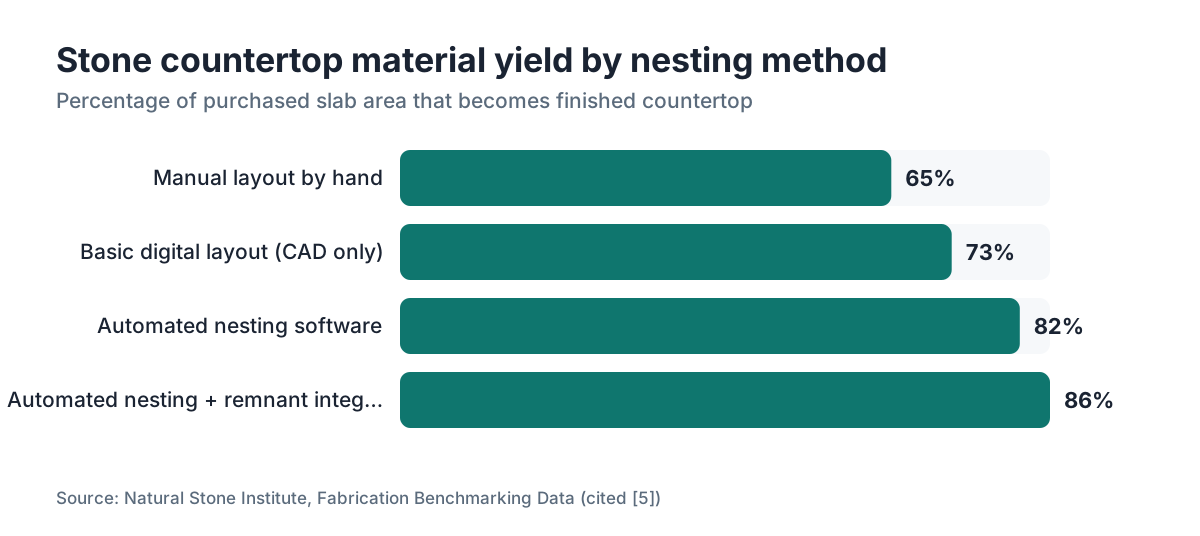
The chart below shows typical yield rates by nesting method, drawn from Natural Stone Institute data and industry benchmarks.
What is material yield and how is it measured in a stone shop?
Material yield is the share of purchased slab area that ends up in the finished countertop. Buy a 50-square-foot slab, produce 38 square feet of finished tops, and your yield is 76 percent. That is the whole game in one number.
Shops measure it two ways. Gross yield counts all stone bought against all finished product shipped. Net yield looks at job-level efficiency, ignoring remnants that get reused later. Both matter, because a shop can post good gross yield by reselling remnants hard while running poor job-level efficiency that inflates every material purchase.
Typical yields by method [5]:
| Nesting Method | Typical Yield Range |
|---|---|
| Manual layout by hand | 58% to 72% |
| Basic digital layout (CAD only) | 68% to 78% |
| Automated nesting software | 75% to 88% |
| Automated nesting + remnant integration | 80% to 92% |
These are industry estimates with real spread by slab size, job complexity, and material. A simple large-island job on a generous slab beats a busy perimeter kitchen with a farmhouse sink and curved peninsula every time.
Remnant integration, the last row, means the software also treats offcuts from earlier jobs sitting on the remnant rack as available stock for new jobs. That is where the gains get largest, and where software earns its keep.
What is the difference between manual nesting and software nesting?
Manual nesting means a layout person prints or draws the slab to scale and physically slides paper cutouts of each piece around until they fit. Some veteran fabricators do this fast and with real instinct. The best of them build a visual sense for how pieces stack that takes years to develop.
The limits are real. A human can weigh maybe a dozen arrangements before committing. Software weighs thousands in seconds, and it does not get tired at the end of a long shift. Manual nesting also chokes on remnant integration. Tracking 40 remnant sizes and pulling the right one for a small job is bookkeeping most shops do badly by hand.
Software has its own failure modes. It optimizes for geometry and whatever constraints you feed it, but it cannot see the slab. If a slab has a subtle color shift the shop never photographed or annotated, the software might nest a key piece right over the bad zone. Garbage in, garbage out.
Shops running the priciest materials, book-matched Calacatta marble or exotic quartzite where a single slab costs $3,000 to $8,000 or more [6], usually go hybrid. Software finds the efficient geometry, then a senior fabricator reviews aesthetics and defects before approving the cut file. That is where both approaches are at their best.
SlabWise builds nesting directly into its quoting workflow, so the layout and the price update together as pieces move. That kills a common error where the quote sat on one layout while the actual cut happened on a different one.
How does grain direction and vein matching affect nesting?
Most stone has visual direction. Granite reads as a fairly random crystalline pattern, so grain direction is a light constraint there. Marble, quartzite, and quartzite-look porcelain have distinct veining that runs at an angle across the slab, and that changes everything about the layout.
Customers almost always want veins running consistently in one direction. On a perimeter with three cabinet runs, they want veins moving parallel to the cabinets, not flipping direction at each corner. That locks piece rotation. You cannot spin a piece 90 degrees to make it fit better if that turns the vein crossways.
Book-matching is stricter still. A book-match pairs two consecutive slabs from the same block, opened like a book so the vein pattern mirrors. Nesting a book-match job means working with two specific slabs and putting the paired pieces in the correct spot on each one. Software that handles book-matching needs to be told which slabs are paired and which pieces land on which slab [1].
If you are ordering marble countertops or high-figure quartzite, these visual rules explain why your fabricator might come back saying they need an extra slab even when the square footage seems to fit. Vein constraints can force a layout that wastes usable stone geometrically. That is not padding the quote. That is the material telling you what it will and will not do.
What types of CNC machines use nesting files?
Three machine types in a stone shop consume nesting output.
A CNC bridge saw is the workhorse in mid-to-large shops. It makes straight cuts with a diamond blade along axes defined in the toolpath. Nesting for a bridge saw is simpler because cuts are rectangular, so pieces get arranged to allow efficient straight-line cutting sequences without wasted blade passes.
A CNC waterjet cuts with a high-pressure stream of water mixed with abrasive garnet. It follows any curve, so pieces do not need to be rectangles. Curved islands, radius corners, and organic shapes all come off a waterjet. Nesting here is more complex because arbitrary-shape pieces can be rotated and interlocked in ways a bridge saw's straight cuts never allow.
A CNC router (stone-capable, with diamond tooling) handles edge profiling, sink cutouts, and drilling. It usually gets the slab after the bridge saw or waterjet has roughed out the pieces. Nesting matters less at this stage since the router works on already-cut pieces.
Some shops run a combination: waterjet for rough cuts and tight nesting geometry, then router for edge detail. Others do everything on a 5-axis machining center. The nesting file feeds whichever first-cut machine the shop uses [3].
If you are trying to understand why countertop installation prices vary by shop, the machine mix is part of the answer. A waterjet shop can handle complex shapes and tighter nesting, which can mean less stone waste on an unusual kitchen.
How does nesting affect the countertop quote a homeowner receives?
Stone countertops get priced per square foot of finished surface. But the fabricator buys stone by the slab, a fixed cost no matter how much of it gets used. Nesting efficiency decides how many slabs the shop needs to finish your job, and that decides your price.
A poorly nested job might need three slabs where a well-nested job needed two. At $400 to $800 per raw granite slab (a rough industry estimate; pricing swings hard by material and region) [6], that extra slab either eats margin or gets baked into the per-square-foot number on your quote.
That is one reason quotes for the same square footage vary between shops. A shop with sharp nesting and good remnant reuse can price a job lower without cutting corners anywhere. A shop with manual layout and weak remnant tracking might quote higher, not for quality, but for waste it cannot avoid.
If you are collecting quotes for kitchen countertops and one comes in noticeably lower, ask the fabricator how they handle material yield and whether remnants from past jobs might cover any of your smaller pieces. Good shops answer clearly. Shops that never think about it answer vaguely.
Homeowners buying granite countertops on a budget should know that picking a material sold in larger slab sizes generally improves nesting and can cut the number of slabs you pay for.
What happens to the offcuts and remnants after nesting and cutting?
After a job is cut, the unused pieces become remnants. A well-run shop catalogs them: size, material, thickness, condition. Remnants sit on a rack and feed future nesting jobs, especially small bathroom vanity tops, bar areas, or laundry counters where one piece covers the whole job.
Some shops sell remnants straight to homeowners at a discount, usually 30 to 60 percent below full slab pricing. If you have a single bathroom vanity, a remnant can be a genuine deal. The catch is selection. You take what the shop has, not what you would pick from a full showroom.
Remnants under about 4 square feet often are not worth cataloging. Shops toss them, cut them into samples, or donate them to vocational programs. A few grind scrap into aggregate for concrete or landscape products, which at least keeps it out of the landfill. Efficient material use through better cutting layouts is a recognized waste-reduction strategy in manufacturing, per the EPA's Sustainable Materials Management program [8].
The best nesting software pulls the remnant rack directly into new job layouts. When a job comes in, the system checks whether any remnant on hand covers the smaller pieces, cutting how much new slab the shop buys. This remnant-aware nesting is where high-material-cost shops, the high-end marble and quartzite fabricators, see the biggest return on software.
Does nesting apply to materials besides natural stone?
Yes, though the economics and constraints shift.
Engineered quartz (Cambria, Silestone, and others) comes in standardized slab sizes, typically around 56 by 120 inches, with very consistent surface appearance [7]. Uniform surface means no vein-direction constraint. Nesting is purely geometric, so software finds near-optimal solutions easily. Yield on quartz runs higher than on natural stone for that exact reason.
Porcelain slabs follow similar logic to engineered quartz when the pattern is subtle. But large-format porcelain that mimics marble veining brings the vein-direction constraint right back. Nesting a porcelain Calacatta slab is about as involved as nesting the real thing.
Laminate countertops and Formica countertops are cut from sheet goods in standard 4-by-8 or 4-by-12 panels. Nesting applies here too, though the stakes are lower since sheet material costs far less than stone. CNC-routed laminate shops still nest to cut the number of sheets they buy.
Corian countertops and other solid surface materials are sheet goods with dynamics close to laminate, but they allow hidden seams by adhesive welding. That gives the nester more room to split pieces across sheets and join them invisibly.
Butcher block countertops are a different animal. They come in planks or pre-glued panels and get sized or joined during installation. CNC nesting in the same sense does not apply.
What should fabricators look for in nesting software?
Four things matter most.
First, integration with your templating and quoting workflow. If nesting lives in a separate program from your quote, you will fight constant gaps between what was priced and what actually gets cut. The best shops have nesting output feed the quote automatically, so material cost updates as the layout changes.
Second, remnant management. Software that cannot see your remnant rack is leaving yield on the table. A good system lets you photograph, measure, and catalog every offcut so it turns up when a new job needs it.
Third, constraint handling for vein direction and defect zones. If the software cannot respect grain direction and let you mark no-cut zones on a slab photo, your fabricators will override it constantly, which defeats the point of owning it.
Fourth, honest yield reporting. You want per-job yield, cumulative shop yield, and remnant utilization over time. Without that data, you are guessing whether the software actually helps. Small and mid-size shops can also pull productivity and waste-reduction benchmarking through the NIST Manufacturing Extension Partnership network [10].
SlabWise puts nesting inside its fabrication quoting platform, so the layout and the estimate stay linked from first measurement through final cut. If that sounds like the gap in your shop, the demo page is a reasonable next step to see whether it fits how you work.
Shops running simple jobs on common materials like polished granite can get by with cheaper or even free nesting tools. Premium software pays off most when you are regularly working expensive natural stone, running large-volume jobs, or sitting on a serious remnant inventory.
Are there limits to what nesting software can optimize?
Nesting software optimizes geometry. It cannot optimize everything.
It cannot account for structural weakness invisible in a slab photo. A hairline fissure through the center of a slab might be fine under a sink but catastrophic under an overhang, and the software will not know unless a human marks it. OSHA safety guidance stresses proper workpiece support during cutting to prevent slab cracking, which ties straight back to those bridge width rules [9].
It cannot predict which layout a homeowner will love. Two layouts might have identical yield, and the customer strongly prefers one because of how a single vein lines up at the sink. That preference has no number the algorithm can chase.
It also optimizes for one objective, usually maximum yield, unless you configure it otherwise. Some jobs call for optimizing cut sequence to cut machine time instead of squeezing every square inch. Software that cannot trade off those goals needs manual adjustment.
And nesting works only on the information you give it. Wrong slab dimensions, missing defect notes, or bad piece dimensions produce a bad layout, efficiently. The templating step upstream is where accuracy matters most. A laser template accurate to a few millimeters feeds far better nesting data than a hand measurement with a tape [3].
For homeowners, that is the reminder: a careful templating visit before fabrication is more than procedure. The accuracy of that visit directly drives how well your pieces nest, which drives material cost and whether your seams land exactly where you expected.
Frequently asked questions
What is nesting in CNC fabrication, in simple terms?
Nesting means arranging all the pieces of your countertop on a raw stone slab before any cutting happens, like fitting puzzle pieces together. The goal is to leave as little usable stone unused as possible. It happens digitally: software or a skilled layout person positions each countertop section on a scaled slab drawing, then sends that plan to the CNC machine as a cut file.
Does nesting affect how much my countertops cost?
Yes, directly. Fabricators buy whole slabs, and nesting efficiency decides how many they need for your job. A well-nested job might need two slabs where a poorly nested one needs three. At $400 to $800 or more per raw slab for granite or marble, that extra slab either raises your price or shrinks the shop's margin. Shops with good nesting can legitimately quote lower without cutting quality.
Can nesting software handle vein direction and book-matched stone?
Good nesting software can. You set a vein direction constraint so pieces cannot be rotated in ways that break the visual flow. For book-matched slabs, the software treats each slab as a paired set and assigns specific pieces to each. That constraint handling separates basic layout tools from real nesting software. Without it, fabricators override the software manually on every natural-stone job.
What is a good material yield percentage for a stone shop?
With automated nesting software, a well-run shop typically hits 75 to 88 percent yield on natural stone. Adding remnant-aware nesting can push that to 80 to 92 percent. Manual layout shops typically run 58 to 72 percent. The Natural Stone Institute has published benchmarking data in this range. Anything below 65 percent signals the shop has a real waste problem.
How is nesting different from templating?
Templating is the measurement step: capturing the exact dimensions of your countertop space, including walls, appliances, sink locations, and corner angles. Nesting comes after templating and uses those measurements. Templating tells the shop what pieces to cut. Nesting tells the shop where on the slab to cut them. Inaccurate templating produces bad nesting data, which is why laser templating has become standard in quality shops.
What happens to the stone left over after nesting and cutting?
Leftover pieces become shop remnants. Well-run shops catalog remnants by size and material, then feed them into future jobs for small countertop sections like bathroom vanities or bar areas. Homeowners can sometimes buy remnants directly at 30 to 60 percent below full slab pricing. Very small pieces are usually discarded, cut into samples, or occasionally recycled into aggregate materials.
Does nesting work for engineered quartz like Cambria?
Yes, and it is actually easier. Engineered quartz has a consistent, uniform surface with no vein-direction constraint, so nesting is purely geometric. Software finds near-optimal solutions quickly. Standard quartz slab sizes around 56 by 120 inches suit software nesting well. Yield on quartz jobs is typically higher than on natural stone for exactly this reason.
How long does nesting take in a modern shop?
Automated nesting for a standard kitchen takes the software seconds to minutes. Human review of the result takes 10 to 30 minutes depending on material complexity, vein considerations, and whether remnants are in play. Manual nesting by hand can take an experienced layout person 30 minutes to a couple of hours on a complex job. The time savings are real, but the review step cannot be skipped.
What is the minimum bridge width in stone nesting, and why does it matter?
Bridge width is the stone left between two adjacent cuts. If two pieces nest too close, the slab can crack during cutting as support disappears. Most shops require 3 to 6 inches of bridge between cuts, varying by material thickness and machine type. Nesting software must respect this or the output produces breakage on the CNC. Thicker slabs (3 cm) allow slightly tighter tolerances than 2 cm material.
Can I request to see the nesting layout before my countertops are cut?
Yes, and it is a reasonable request for high-value jobs, especially figured marble or exotic quartzite. Ask your fabricator to show you the proposed cut layout before fabrication begins. You can review vein direction, seam placement, and how prominent features of the slab align with key areas like the sink or island front. Most fabricators who do this already treat it as standard practice on premium material.
Does nesting apply to waterjet cutting and bridge saw cutting differently?
It does. Bridge saw nesting tends toward rectangular arrangements because the saw makes straight-line cuts along machine axes. Pieces must be oriented to allow efficient sequential straight cuts. Waterjet nesting is more flexible because the cut follows any curve, so irregular shapes can interlock tightly in ways a bridge saw cannot. Waterjet shops often see better yield on complex layouts as a result.
Is nesting software worth the cost for a small fabrication shop?
It depends on volume and material cost. A shop doing mostly standard granite on high-volume builder work with simple layouts may not see enough yield gain to justify premium software. A shop doing 20 or more custom natural-stone jobs per month, especially in expensive marble or quartzite, typically recovers software costs quickly through fewer slab purchases. Remnant management integration is where smaller shops often see the fastest payback.
How does nesting affect seam placement in countertops?
Seams happen where two countertop pieces meet, and nesting decides where those joints fall. Software can be constrained to place seams at specified spots, such as a cooktop edge rather than open field. Without that constraint, the optimizer might drop a seam wherever it is geometrically convenient, which could land it in an awkward or highly visible spot. Seam placement should always be a human-reviewed decision, never left entirely to the algorithm.
Sources
- Natural Stone Institute, Technical Bulletins: Vein direction, book-match requirements, and natural fissures restrict where pieces can be placed during stone nesting layout
- Natural Stone Institute, Dimension Stone Design Manual: Standard granite and quartzite slabs typically run 55 to 65 inches wide and 105 to 130 inches long
- Fabricators and Manufacturers Association, CNC Stone Fabrication Guidelines: Minimum bridge widths in CNC stone cutting typically range from 3 to 6 inches depending on material thickness and machine type; laser templating accuracy feeds better nesting data
- Natural Stone Institute, Stone Industry Education: An average kitchen job may require 80 to 100 square feet of raw slab material to produce 45 to 65 square feet of finished countertop
- Natural Stone Institute (formerly Marble Institute of America), Fabrication Benchmarking Data: Automated nesting software delivers material yield improvements of 10 to 30 percent compared to manual layout; yield ranges by method from 58-72% manual to 80-92% with remnant-aware software
- HomeAdvisor (Angi), Countertop Installation Cost Guide: Raw granite slabs cost roughly $400 to $800 each at the shop level; exotic natural stone slabs can reach $3,000 to $8,000 or more
- Cambria, Product Specifications: Engineered quartz slabs from Cambria are produced in standardized sizes, typically approximately 56 by 120 inches, with uniform surface appearance
- U.S. Environmental Protection Agency, Sustainable Materials Management: Waste reduction through efficient material use, including optimized cutting layouts, is a recognized strategy in sustainable manufacturing
- OSHA, Stone Fabrication Safety Standards: CNC stone fabrication safety includes proper workpiece support during cutting to prevent slab cracking, relevant to bridge width constraints in nesting
- National Institute of Standards and Technology, Manufacturing Extension Partnership: Small and mid-size fabricators can access productivity and waste-reduction benchmarking through the MEP National Network
Last updated 2026-07-10