TL;DR
- The standard deposit for countertop fabrication is 50% of the total, collected at signing before any slab gets ordered.
- Some shops run 40-60% depending on slab cost and how custom the work is.
- Several states cap contractor deposits by law.
- California limits them to 10% or $1,000, whichever is less, on home improvement contracts.
What deposit percentage do most countertop fabricators charge?
The most common number in countertop fabrication is 50%. Half up front, half on installation day. That split isn't arbitrary. Fabricators pay for the slab before they ever cut it, and stone wholesale pricing means the material alone can eat 30-50% of the job total. A 50% deposit usually covers the slab purchase and protects the shop if the homeowner walks after templating.
Some shops run 40%. Others push to 60-75% for highly custom work or exotic material orders. Quartzite slabs with unusual veining, large-format waterfall islands, and commercial builds with long-lead engineered stone are all cases where fabricators ask for more up front. The logic is plain. The riskier and harder to resell the material, the higher the deposit needs to be to cover the shop.
Very few reputable fabricators ask for 100% up front or take zero deposit. A contractor who wants full payment before lifting a tool is a red flag. A contractor who takes no deposit is either brand new or financially fragile, and that carries its own risk.
Are there legal limits on how much a fabricator can charge as a deposit?
Yes, and this is where homeowners need to pay attention. Contractor licensing laws in several states cap the deposit a home improvement contractor can collect, and those caps override any shop's standard policy.
California is the strictest. Under California Business and Professions Code Section 7159.5, a licensed home improvement contractor cannot accept a down payment that exceeds $1,000 or 10% of the contract price, whichever is less. [1] That applies to countertop fabricators doing residential work in California. The 50% industry standard is flatly illegal there for the first payment.
Other states with deposit caps or contract-threshold rules include:
| State | Deposit Cap / Rule | Governing Authority |
|---|---|---|
| California | 10% or $1,000, whichever is less | CA Bus. & Prof. Code §7159.5 [1] |
| Maryland | No more than 1/3 of contract price | MD Code, Bus. Reg. §8-508 [2] |
| Virginia | No explicit cap, but progress payments required for jobs over $1,000 | VA Code §54.1-1138 [3] |
| Texas | No statewide deposit cap, but written contract required over $5,000 | TX Bus. & Com. Code §53.001 [4] |
| Florida | Contractor cannot take >10% before obtaining permits; specific rules for large jobs | FL Stat. §489.126 [5] |
If your state isn't on this list, call your state contractor licensing board. Rules change, and a two-minute call beats finding out about a violation after a dispute. Get the contract in writing, because most states legally require one for any home improvement job over a fairly low dollar threshold.
Fabricators working across state lines have to know each state's rules. Charging a flat 50% everywhere is a compliance problem waiting to happen.
Why do fabricators require such a large deposit compared to other contractors?
Stone fabrication has a cost structure that makes high deposits rational, even when they feel steep to homeowners.
The slab is the biggest reason. A fabricator ordering a single remnant for a bathroom vanity might spend $200 on material. A fabricator ordering three matched slabs of book-matched marble for a kitchen island could spend $4,000 to $8,000 before touching a CNC machine. That material is yours the moment it leaves the yard. It's cut to your dimensions. Cancel, and the shop is sitting on custom-cut granite nobody else can use. The 50% deposit covers that exposure.
Templating costs money too. A digital template visit with a laser system runs 30 to 60 minutes of a skilled tech's time plus software and vehicle costs. Some shops bill templating separately. Others fold it into the job price. Either way, it happens after the deposit lands, and that deposit tells the fabricator the job is real before they schedule the template crew.
The structure protects homeowners too. Holding back 50% until installation gives you real bargaining power. If the edges are wrong, the seam placement is bad, or a piece cracks during install, you haven't paid in full yet. That retained balance is your one piece of negotiating power that actually works.
Is a 50% deposit refundable if you cancel or change your order?
Usually no, or only partly. And the timing of your cancellation matters more than anything else.
Most fabrication contracts say the deposit goes non-refundable once material is ordered. That's the logical cut-off. Before the slab is ordered, the shop's exposure is administrative time. After the slab is ordered, it's a custom purchase in your name.
Some shops stage the refund policy. A typical structure looks like this: full refund within 72 hours of signing (before templating), refund minus templating cost after the template visit, no refund once the slab is purchased, and no refund at all once fabrication (cutting and polishing) begins.
Read the contract. Ask plainly: what is the cancellation policy at each stage? A reputable fabricator answers without flinching. If the answer is vague or verbal only, get it in writing before you sign.
Change orders are separate. Change the sink cutout, edge profile, or square footage after fabrication starts, and expect to pay for the extra work right away. Expect too that some changes can't be reversed without cost.
What should a countertop contract include alongside the deposit terms?
The deposit percentage is one line in what should be a real contract. A countertop fabrication contract should spell out the following, at minimum:
- Total job price, itemized by material, fabrication, and installation.
- Deposit amount and when it's due.
- What triggers each later payment (delivery, installation completion, final inspection).
- The specific material: slab lot or bundle number if possible, minimum thickness, finish, and edge profile.
- Lead time from template to installation, given as a range, not a single date.
- What happens if the slab is damaged in fabrication (replacement timeline, liability).
- Warranty terms for fabrication defects versus natural stone variation.
- Cancellation and refund policy at each project stage.
For jobs over $500, most states require written home improvement contracts. In California the threshold is $500 [1]. Maryland requires written contracts for work over $50 [2]. The dollar thresholds vary, but a written contract protects both sides no matter what the law demands.
If you're comparing quotes, the countertop installation process has its own documentation you'll want to understand before you sign anything.
How does the material type affect the deposit amount?
It matters more than most homeowners realize.
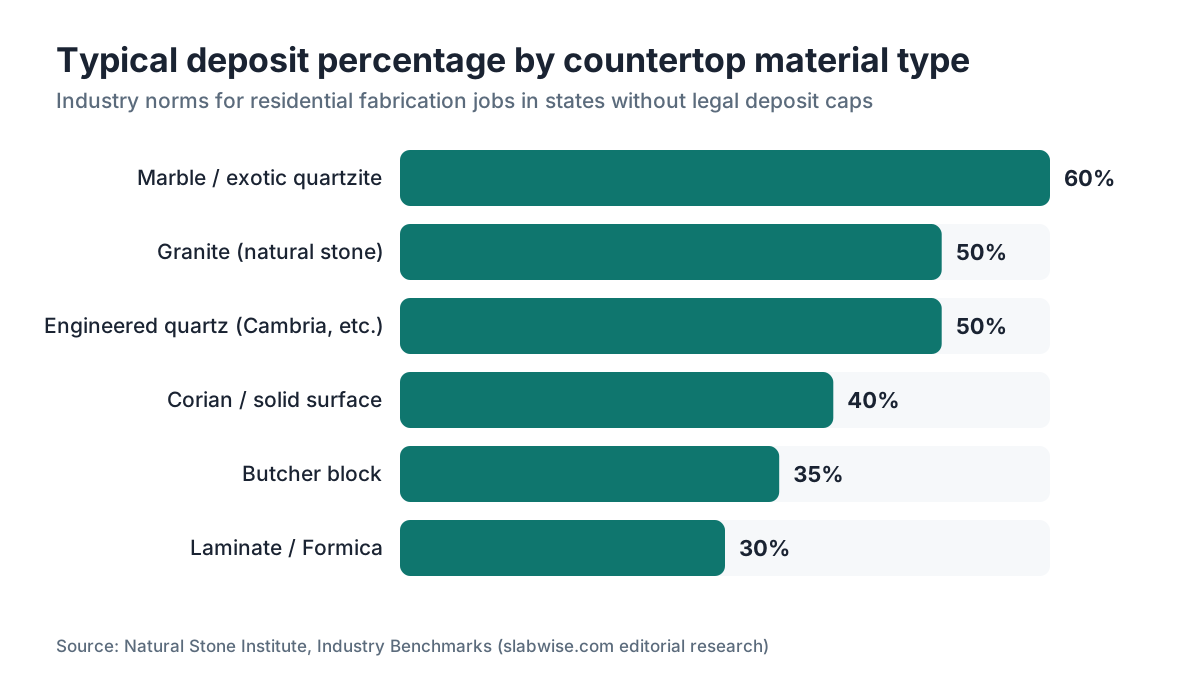
Natural stone, especially imported marble or rare quartzite, carries the highest material cost and the most risk for the fabricator. Order a slab of Calacatta Borghini marble and cancel after the stone is on order, and the shop has an $800 to $2,000 slab it has to sell as a remnant at a loss or hold in inventory indefinitely. High-value, hard-to-resell material justifies a higher deposit.
Granite countertops and standard engineered stone from major manufacturers are easier to source and more fungible. A shop that over-orders standard Uba Tuba granite can move the remnant without much trouble. Some fabricators reflect that in slightly lower deposits on standard-material jobs.
Marble countertops and Cambria countertops sit at opposite ends of the risk spectrum. Marble is natural stone with slab-to-slab variation. Cambria is engineered, consistent, and backed by the manufacturer. Deposits on engineered stone sometimes run a touch lower because material matching is less of a problem if something goes wrong.
Laminate countertops and Formica countertops usually come with lower deposits because material costs are a fraction of stone. A laminate job might run 25-33%, not 50%. Same logic applies to butcher block countertops in most cases.
The rough rule: the harder the material is to resell, and the higher the material cost relative to the total job, the higher the deposit the shop is justified asking for.
What's a fair payment schedule for a countertop job from start to finish?
The two-payment structure is the most common in the industry: 50% at signing and 50% on installation day. Simple, easy to track, and standard enough that most homeowners expect it.
For larger or more complex jobs, a three-payment schedule is common and arguably fairer to both sides:
| Payment | Timing | Typical % |
|---|---|---|
| Deposit | Contract signing | 40-50% |
| Mid-stage payment | After template or slab delivery | 25-30% |
| Final payment | Day of installation, after inspection | 20-35% |
The three-payment structure shows up most on commercial jobs or high-value residential projects over $10,000. It gives the fabricator cash flow through production and gives the customer more checkpoints before handing over the last dollars.
Avoid any schedule that asks you to pay 100% before installation. You lose every ounce of bargaining power once the shop is fully paid. That final payment is exactly what gets the crew back fast when there's a punch-list item to fix.
Can you negotiate the deposit percentage down?
Sometimes, but the room is usually narrow and the relationship matters more than the number.
A few things open a little space. Pay cash on a straightforward job with in-stock material, and a shop might take 40% instead of 50%. Repeat-customer status often earns goodwill. Larger jobs with multiple rooms might get a blended rate. If you're in a state with legal deposit caps, the fabricator has no choice but to accept a lower first payment, though they may restructure milestone payments to make up for it.
What won't work: talking down the deposit on custom or exotic material orders. The shop's financial risk is real and can't be negotiated away. Pushing hard on deposit terms with a shop that's already doing you a favor on lead time or price tends to sour the job before it starts.
If price is the real worry, the deposit percentage is the wrong lever. Total job cost and material selection move the number far more. An accurate quote up front is your best protection. Shops that run formal quoting software (SlabWise is one built specifically for stone fabrication) produce itemized quotes that show exactly what you're paying for, which makes the whole conversation about terms cleaner for both sides.
For homeowners, comparing quotes across two or three shops on the same material and edge profile does more for you than shaving 10 points off a deposit.
What are the warning signs that a deposit arrangement is a scam or a problem?
Most countertop fabricators are legitimate businesses with real overhead and real risk. But deposit disputes do happen, and a few patterns should put you on alert.
Red flags before you pay:
- No written contract offered before collecting a deposit.
- Pressure to pay cash with no receipt.
- No physical shop address or verifiable license number.
- The deposit is 100% of the job cost.
- The contractor can't tell you which stone yard supplies their material.
- No references and no online presence at all.
Red flags after you've paid:
- Missed template date with no proactive communication.
- Vague answers when you ask about slab lot numbers.
- A request for more money before the milestone that triggers the next payment.
- Resistance to putting a schedule in writing.
To verify a contractor's license, go straight to your state contractor licensing board. Most have online lookup tools. The California Contractors State License Board runs its lookup at cslb.ca.gov [6]. Texas uses the Texas Department of Licensing and Regulation at tdlr.texas.gov [7].
If a dispute can't be settled directly, state contractor boards usually have complaint processes. Small claims court handles most fabrication disputes under $5,000 to $10,000 without an attorney.
How should fabricators set deposit policy to protect their business?
This one is for shop owners. The homeowner question is "what's fair to pay." The fabricator question is "what deposit structure keeps the business solvent without scaring off customers."
Start with your actual cost exposure. For most stone jobs, the slab purchase is the biggest cash outlay. Calculate your average material cost as a percentage of average job revenue. If material typically runs 35-45% of revenue, a 50% deposit covers the slab with room for fabrication labor. If you run lean on competitive bids, you may need the deposit closer to 60%.
Know your state's legal limits before you set any policy. Getting this wrong isn't a customer-service headache. It's a licensing violation in states with hard caps.
Document the policy in the contract. Courts have repeatedly upheld deposit terms that are clearly stated in writing and signed by the customer. Verbal deposit agreements are nearly impossible to enforce.
To track which jobs are deposited and which are still outstanding, fabrication management software gives you a live view. The tighter your quoting, payment tracking, and scheduling connect, the fewer deposits slip through the cracks. SlabWise's demo is worth a look if your shop still tracks payments in spreadsheets.
Refund policies should be in writing and tiered by stage. A blanket "no refunds" line may not survive court if no work has been done. A tiered policy (full refund before template, partial after, none after fabrication) is both defensible and genuinely fair.
What happens to your deposit if the fabricator goes out of business?
This is a real risk most homeowners never think about until it's too late.
If a fabricator goes bankrupt or just closes before your job is done, your deposit becomes an unsecured claim against the business. In most bankruptcy proceedings, unsecured creditors (which is what a customer with a deposit is) recover very little. Recovery rates for unsecured creditors in Chapter 7 liquidations run below 10 cents on the dollar in asset-deficient cases. [9]
There are two practical protections. Pay your deposit by credit card. Chargebacks for services not rendered are one of the most reliable consumer protections you have. The dispute window is typically 60 to 120 days from the charge date, though for services (versus goods) some issuers extend it. Check your card's terms.
Second, find out whether your state requires contractors to carry a surety bond. Licensed contractors in many states post a bond exactly for situations like this. California, for one, requires licensed contractors to hold a $25,000 surety bond [1]. If the contractor is bonded and licensed, a claim against the bond is usually more recoverable than a bankruptcy claim.
One more reason to verify licensing before you pay a dollar.
How do countertop deposits compare to deposits for other home improvement trades?
Context helps. Stone fabrication isn't the only trade asking for a real deposit.
Kitchen cabinet makers and custom furniture builders often ask for 50% or more, for the same reason: custom material that can't be returned. HVAC contractors replacing full systems sometimes want 30-50% to cover equipment. General contractors on big remodels usually structure draws tied to milestones, with a first draw around 20-30%.
The outliers are trades with low material cost. A painter might ask for 0-20% since paint and supplies are small next to labor. An electrician might ask for zero on a standard service call.
Countertop fabrication sits at the high end of the residential deposit range because it carries the highest upfront material cost as a share of the total job. That's the honest answer. A 50% deposit for stone countertops isn't a fabricator being greedy. It's a fabricator covering an expense they eat the day your slab leaves the stone yard.
Frequently asked questions
Is a 50% countertop deposit standard or just what shops prefer?
50% at signing is the industry standard for stone countertop fabrication across most of the United States. It reflects the real material cost structure: the slab purchase is the biggest cash outlay and happens before any cutting. Some shops run 40-60% depending on material cost and job complexity. In states like California and Maryland, law caps deposits at lower amounts regardless of shop preference.
Can a countertop company legally require 100% payment upfront?
In most states no specific law bans 100% upfront on a home improvement contract, but it's a serious red flag. California explicitly caps first payments at 10% or $1,000 for licensed contractors. Florida restricts full upfront collection on jobs needing permits. Beyond legality, paying 100% before installation kills your bargaining power if the work is defective. Most consumer protection attorneys advise against it.
What happens if I cancel my countertop order after paying the deposit?
It depends on when you cancel and what the contract says. Cancel before the slab is ordered and you have the best shot at a refund, minus any templating already done. Once the slab is purchased for your job, most fabricators treat the deposit as non-refundable. Once fabrication begins, there's typically no refund at all. Read the cancellation policy before signing, and get any verbal promises in writing.
Should I pay a countertop deposit by credit card or check?
Credit card is almost always the better choice. If the fabricator fails to deliver, you can dispute the charge and recover through your card issuer. Checks and cash give you almost no recourse if things go wrong. The 2-3% processing fee a fabricator might pass on is cheap insurance. Some shops offer a small discount for check payment; whether that's worth it depends on your read of the contractor's reliability.
Do countertop deposits vary by material, like for granite versus laminate?
Yes, usually. Natural stone jobs (granite, marble, quartzite) typically command 50% deposits because slab costs are high and custom-cut stone can't be returned. Laminate, Formica, and Corian jobs often run 25-33% because material costs are lower and products are more standardized. Butcher block usually lands in between. Ask your fabricator directly, because shop policies vary even within the same material category.
What states have laws limiting countertop deposit amounts?
California caps home improvement deposits at 10% or $1,000 (whichever is less) under Business and Professions Code Section 7159.5. Maryland limits deposits to one-third of the contract price under MD Code Business Regulation Section 8-508. Florida restricts collection before permits under FL Stat. 489.126. Virginia requires progress payment structures on jobs over $1,000. Texas has no deposit cap but requires written contracts over $5,000. Check your state contractor board for current rules.
How do I verify my countertop fabricator is licensed before paying a deposit?
Go straight to your state contractor licensing board's website and use its license lookup tool. California uses the CSLB at cslb.ca.gov. Texas uses the TDLR at tdlr.texas.gov. Most states have free online lookups. Search by company name and the owner's name. Confirm the license is active, covers the right trade category, and that any required bond is current. Do this before signing a contract.
Is the deposit refundable if the fabricator makes a mistake on my countertops?
Yes. If the fabricator made a verifiable error, the deposit is not forfeited. Fabrication defects, wrong edge profiles, incorrect dimensions, or stone damaged during installation are the shop's responsibility no matter what the deposit policy says. Most reputable fabricators redo the affected piece at no charge. If they refuse, your remaining final payment is your first negotiating tool, and a credit card dispute or small claims action is next.
What's a reasonable deposit for a high-end custom countertop job over $15,000?
For large custom jobs with exotic stone, 50% is still the most common starting point, though many shops use a three-payment schedule: 40-50% at signing, 25-30% after template or slab delivery, and the balance at installation. The three-payment structure gives both sides milestones and is more common on jobs above $10,000. Ask for an itemized payment schedule tied to specific project events, not arbitrary dates.
Can I negotiate a lower deposit percentage with a countertop fabricator?
Sometimes, with limited room. Your position is strongest when the material is in stock and standard (easy to resell if you cancel), you're a repeat customer, or you're in a state with legal deposit caps. It rarely works on exotic or custom material orders where the shop's real exposure is high. Focusing on total price and material selection is almost always a better use of your energy than pushing the deposit down.
Do countertop deposits count toward the final price, or are they extra?
Deposits count toward the final price. They are not a separate fee. If your total countertop job is $4,000 and the shop requires 50%, you pay $2,000 at signing and $2,000 at installation. The deposit is credited against the total contract amount. If a fabricator tells you the deposit is on top of the quoted price, that's a contract red flag and not standard industry practice.
What should a countertop contract say about the deposit and payment schedule?
At minimum, the contract should state the deposit amount in dollars (more than a percentage), the event that triggers each later payment, the total contract price, the cancellation and refund policy at each stage, and the scope of work including material specifications. Many states legally require written home improvement contracts above a low dollar threshold. A contract without specific payment milestones is inadequate for the homeowner and the fabricator alike.
What recourse do I have if I paid a deposit and the fabricator disappeared?
First, dispute the charge with your credit card issuer if you paid by card. Second, file a complaint with your state contractor licensing board; if the contractor is licensed and bonded, you may be able to claim against their surety bond. Third, contact your state attorney general's consumer protection division. Small claims court works for amounts under your state's threshold, typically $5,000 to $10,000. Act quickly, because time limits apply to all of these.
Sources
- California Contractors State License Board, Business and Professions Code Section 7159.5: California limits home improvement contractor deposits to 10% of the contract price or $1,000, whichever is less, and requires licensed contractors to carry a $25,000 surety bond.
- Maryland Office of the Attorney General, Home Improvement Law MD Code Bus. Reg. §8-508: Maryland caps contractor deposits at no more than one-third of the contract price and requires written contracts for home improvement work above $50.
- Virginia Department of Professional and Occupational Regulation, VA Code §54.1-1138: Virginia requires progress payments structured into contractor agreements for home improvement jobs over $1,000, though no explicit deposit percentage cap is stated.
- Texas Department of Licensing and Regulation, TX Business and Commerce Code §53.001: Texas has no statewide deposit cap for home improvement contractors but requires written contracts for jobs exceeding $5,000.
- Florida Department of Business and Professional Regulation, FL Stat. §489.126: Florida law restricts contractors from collecting more than 10% of the contract price before obtaining required permits, with additional rules applying to large residential projects.
- California Contractors State License Board, License Lookup Tool: California provides a free online contractor license lookup tool through the CSLB allowing homeowners to verify license status, bond, and insurance before signing contracts.
- Texas Department of Licensing and Regulation, License Verification: Texas TDLR offers an online license lookup for registered contractors operating in the state.
- Federal Trade Commission, Home Improvement Contracts Consumer Guidance: The FTC advises consumers to get all contractor payment terms in writing and to avoid paying more than one-third upfront for home improvement projects as a general consumer protection measure.
- U.S. Courts, Chapter 7 Bankruptcy Trustee Reporting Data: Recovery rates for unsecured creditors in Chapter 7 bankruptcy liquidations are consistently low, often below 10 cents on the dollar in asset-deficient estate cases.
- Natural Stone Institute, Industry Statistics and Cost Benchmarks: Material cost (slab purchase) typically represents 30-50% of total job revenue for stone countertop fabricators, supporting the rationale for 50% deposits that cover material outlay before fabrication begins.
Last updated 2026-07-10