TL;DR
- A volume discount on stone slabs is a price cut a distributor or quarry gives a fabricator who commits to buying a minimum quantity of slabs, dollars, or containers in a set period.
- Typical discounts run 5% for modest monthly spend up to 25 to 30% for full container orders.
- Some are tiered, some get negotiated annually, and some require exclusivity.
What exactly is a volume discount on stone slabs?
A volume discount is a lower per-slab or per-square-foot price that kicks in when a buyer commits to purchasing above a defined threshold. In the stone trade that threshold can be measured in number of slabs, total square footage, dollar spend per month, or full shipping containers.
The logic is simple. A distributor's biggest cost headaches are inventory carrying costs, shipping logistics, and sales overhead. A fabricator who reliably pulls 50 slabs a month solves several of those at once. The discount is the distributor's way of paying for that reliability.
For fabricators, the flip side is real. A discount that looks great on paper can turn into a cash-flow problem if it forces you to hold more inventory than the shop can turn. A 15% price cut on slabs that sit in your yard for four months is not a 15% gain.
How do tiered pricing structures work?
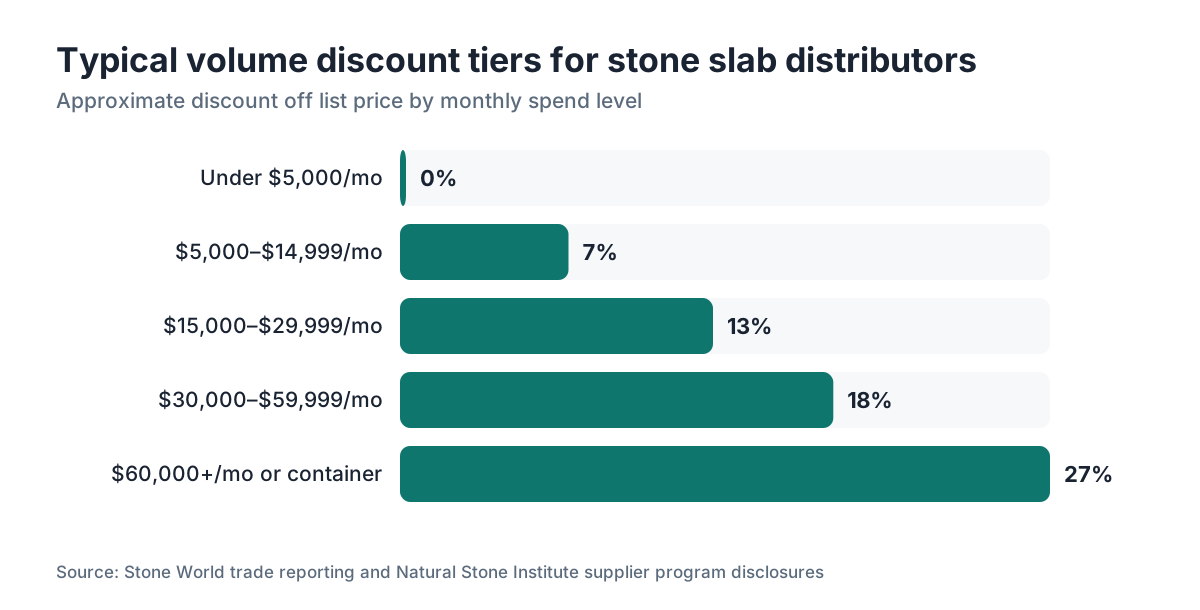
Most distributors use a tier table where the unit price drops as purchase volume climbs. A simplified version looks like this:
| Monthly Spend (USD) | Typical Discount Off List |
|---|---|
| Under $5,000 | 0% (list price) |
| $5,000 to $14,999 | 5 to 8% |
| $15,000 to $29,999 | 10 to 15% |
| $30,000 to $59,999 | 15 to 20% |
| $60,000+ or container buy | 20 to 30% |
These figures come from industry conversations and supplier program disclosures. Specific numbers shift by region, stone type, and market conditions, so treat them as a realistic range rather than a guarantee [1].
Some distributors reset tiers monthly. Others average over a quarter. A few use an annual true-up where they rebate the difference if you hit a higher tier by year-end. Know which model you're in before you sign anything. Quarterly averaging rewards steady shops. Monthly resets punish fabricators with seasonal swings.
What is a container buy and why does it matter?
A container buy means a fabricator (or a buying group of fabricators) purchases an entire shipping container of slabs directly from a quarry or overseas consolidator. A standard 40-foot high-cube container holds roughly 12 to 18 full bundles, depending on slab thickness and stone density. That works out to somewhere between 100 and 200 slabs for a typical 2cm or 3cm material [2].
Container pricing can be 25 to 35% below what the same stone sells for on a domestic distributor's floor. That spread exists because you're cutting out the domestic importer's margin and storage costs. You're also taking on the freight risk, customs clearance, and the chance that the stone in a sample photo doesn't match what arrives on the dock.
U.S. Customs and Border Protection requires an import bond and formal entry for commercial stone shipments above $2,500 in value [3]. If you've never done an import, a licensed customs broker charges $150 to $350 per entry and is worth every dollar the first few times.
Container buys make the most sense for a shop doing consistent volume in one material, say a shop that sells a lot of marble countertops or granite countertops and can reliably move a container's worth in 60 to 90 days.
What thresholds do distributors typically require?
Thresholds vary by distributor size, stone category, and whether the supplier is a regional warehouse or a national importer. Based on publicly available supplier program documents and industry reporting, common minimums look like this:
- Entry-level discount programs: $3,000 to $5,000 in monthly purchases.
- Mid-tier programs: $10,000 to $25,000 monthly, sometimes with a signed annual commitment.
- Preferred or platinum accounts: $50,000+ monthly, often with exclusivity clauses for certain product lines or geographic areas.
- Container/direct-import programs: usually a one-time minimum of 100 to 150 slabs or $20,000 to $40,000 per shipment [1].
Some programs also require minimum order frequencies, like at least two orders per month, on top of a dollar threshold. That detail matters because it changes how you batch jobs. A shop that buys everything for the month on one purchase order may not qualify even if the monthly dollar total clears the bar.
One more thing to check. Some distributors tie discount tiers to a specific product line. You might hit the $20,000 threshold across the whole catalog but only earn the elevated discount on materials from one quarry. Read the fine print.
Are volume discounts negotiable?
Yes. Almost always.
List-price tiers are a starting point. If you bring a distributor a clear picture of your annual spend, your average order frequency, and how much floor space you can dedicate to their product, you have real bargaining power. Distributors want predictable revenue, and a fabricator who can say "I'll pull 30 slabs of your Calacatta line every month for 12 months" is offering something the catalog doesn't account for.
The negotiation points that actually move the needle: payment terms (net-15 instead of net-30 is worth something to a distributor), exclusivity within a city or zip-code radius, co-op marketing arrangements, and whether you'll display their brand name in your showroom. None of those cost you cash. They all have value to the distributor.
Seasonal timing matters too. Distributors carrying heavy inventory going into winter deal harder than distributors running lean in a spring boom. Time a volume commitment conversation for October or November and you'll usually get a better outcome than in April.
How do buying groups and co-ops work for stone fabricators?
A fabricator buying group pools the purchasing power of multiple independent shops to hit volume thresholds none of them could reach alone. Members agree to direct a portion of their stone spend through the group's collective account, and the group negotiates rates that reflect total combined volume.
The Natural Stone Institute, a U.S.-based trade association for the stone industry, is one organization through which fabricators sometimes coordinate purchasing and supplier relationships [4]. Some regional fabricator associations run informal buying pools too.
The catch with buying groups is coordination overhead. If three shops split a container, someone has to manage the logistics, the receiving, the slab allocation, and the disputes when one shop takes slabs that another member wanted. That administrative cost is real. Shops with a designated operations manager can usually absorb it. Owner-operators doing everything themselves often find it isn't worth it.
Software that tracks inventory and job costing cuts some of that friction. If you're managing container splits, accurate slab counts per job matter. Tools like SlabWise, which handles quoting and nesting in one place, help shops track exactly which slabs are allocated to which jobs before a container even arrives, which reduces the guesswork when material hits the yard.
Co-ops structured as formal legal entities are different. A purchasing co-op has members, bylaws, and often a paid coordinator. The National Cooperative Business Association publishes federal-level guidelines on how purchasing co-ops operate [5].
What stone types see the biggest volume discount opportunities?
Commodity materials with high import volume, mainly granite and standard quartz, tend to have the steepest volume discount curves. There are multiple competing importers and the margins are thinner to start with. A shop buying commodity granite in volume has real room to negotiate because the distributor is fighting for the account.
Exotic natural stones work differently. Think rare quartzite varieties or ultra-premium marble. The supply is thinner, the quarry controls more pricing power, and the distributor may not have room to discount deeply even at high volume. You might get better payment terms or preferred allocation of limited material instead of a straight price cut.
Engineered quartz brands like Cambria run their own authorized dealer programs with set discount tiers. You can read more about how that product category is positioned in our Cambria countertops guide. Those programs are usually less flexible than commodity stone negotiations because the brand controls pricing to protect dealer margins.
For a general kitchen material comparison, see our kitchen countertops overview, which covers how material type affects the installed cost range customers actually see.
How should a fabricator calculate whether a volume discount is actually profitable?
The math has three parts: the discount value, the carrying cost of the extra inventory, and the opportunity cost of the cash tied up.
Discount value is easy. If list price on a slab is $200 and you're getting 15% off, you save $30 per slab. At 100 slabs a month that's $3,000 in monthly savings.
Carrying cost is where shops get tripped up. The industry rule of thumb for warehoused inventory is that holding costs run 20 to 30% of inventory value a year, once you count storage space, insurance, breakage, and the cost of capital [6]. So a $20,000 container of slabs that sits for three months costs roughly $1,000 to $1,500 in carrying costs before you sell a single piece.
Opportunity cost is the subtlest factor. Cash locked in inventory can't go toward equipment, marketing, or labor. A shop with thin working capital can price itself into a cash crunch by over-buying on discount.
Here's a simple break-even test. Divide the total discount dollars by the daily carrying cost rate. If you save $3,000 and your daily carry cost on the inventory is $50, you need to turn the inventory within 60 days to come out ahead. If your average slab sits 90 days, that discount actually costs you money.
Job costing your slab spend accurately is the foundation of this analysis. Knowing your real cost per square foot, including carrying time, changes what a volume discount is worth.
What are the risks of committing to a volume purchase agreement?
The most common problem is demand forecasting error. A fabricator commits to $25,000 a month in stone spend based on a strong Q2 pipeline, then the market softens in Q3 and they're contractually stuck buying at a pace that outstrips their job volume. They end up owning expensive inventory with nowhere to put it.
A second risk is quality inconsistency across lots. Natural stone is not a manufactured product. A quarry can shift extraction zones between your first container and your second, and the color or veining can change enough to cause problems on matched slab jobs. Always get lot numbers and request photos of actual slabs, not catalog images, before committing to a repeat order.
Contract language is the third risk area. Some distributor agreements include minimum purchase penalties, auto-renewal clauses, or provisions that tie your discount status to buying specific product lines you may not want. Have someone with legal literacy review any agreement with dollar commitments above $50,000 annually.
Last, watch for geographic exclusivity clauses that run both directions. A distributor might offer you an exclusive territory as part of a volume deal, which sounds good. But the same clause might block you from sourcing competing products, even materials the distributor doesn't carry. That limits your ability to serve customers who want materials outside the distributor's catalog.
How do volume discounts affect the quote you give homeowners?
Ideally, volume discounts improve margin without dropping the price you show the customer. If the market rate for a kitchen in a given material is $65/sq ft installed and your material cost falls from $18 to $14 per square foot through a volume deal, that $4 spread goes to margin, not automatically to a lower quote.
That said, a shop with steady volume discounts can afford to quote more aggressively on price-sensitive jobs when it makes strategic sense, without killing profitability. That flexibility is a real competitive edge.
For homeowners reading this and wondering what's happening on the other side of the counter: the installed price you're quoted includes material at whatever cost the fabricator paid, plus their labor, overhead, and margin. A fabricator with good supplier relationships may or may not pass any of that savings to you. Some do, some don't. The best way to pressure-test a quote is to get three from shops of similar quality, not to ask whether your fabricator has a volume deal.
Fabricators who use quoting software can track their actual material cost per job and see in real time whether their discount tiers are being applied correctly to job-level pricing. That visibility matters more as shop volume grows. SlabWise's quoting tools are built around exactly this, connecting slab cost to job margin without manual reconciliation.
For homeowners curious about how countertop installation pricing breaks down, that guide explains the full cost stack from material to labor to edge work.
What should fabricators ask a distributor before signing a volume agreement?
Go in with a checklist. These are the questions that actually matter:
- What is the exact threshold to hit each tier, and is it measured monthly, quarterly, or annually?
- Is the threshold based on orders placed or orders received? (Matters if lead times are long.)
- What happens if I miss the threshold in a given period? Do I drop back to list price immediately, or is there a grace period?
- Are there minimum order frequencies separate from the dollar threshold?
- Does the discount apply to everything you stock, or only designated lines?
- Is there an exclusivity clause, and does it bind both parties or just me?
- What are the payment terms and do I get a better rate for faster payment?
- How do returns and damaged slabs work? Do they count toward or against my volume?
- Is pricing guaranteed for the contract term, or can you raise list prices and effectively shrink my net discount?
- What lot-consistency protections exist on repeat orders of natural stone?
A distributor who can't answer these clearly is telling you something about how that relationship will go when a problem shows up.
Frequently asked questions
What is a typical volume discount percentage on stone slabs?
Typical volume discounts run 5 to 8% at modest monthly spend levels up to 20 to 30% for full container purchases direct from importers. Mid-tier programs offering 10 to 15% off list are the most common for established fabrication shops with $15,000 to $30,000 in monthly stone spend. Actual percentages depend on the supplier, stone type, and what terms you negotiate.
Do small fabricators qualify for volume discounts on stone?
Some do. Several regional distributors have entry-level programs starting at $3,000 to $5,000 in monthly spend. Joining a fabricator buying group is the most practical route for shops below that threshold, because pooled orders can reach tier minimums that no single small shop could hit alone. The Natural Stone Institute is one place to find peer networks for this.
Can I negotiate a volume discount without a formal written agreement?
Yes, though it's riskier. Verbal or handshake deals are common in regional stone markets, but they leave you unprotected if the sales rep who made the deal leaves or the distributor is acquired. Even a one-page letter of understanding documenting the tier thresholds, discount rates, and term length is worth having. The bigger the commitment, the more you want it in writing.
What is the difference between a volume discount and a rebate program?
A volume discount applies at the point of purchase: the invoice already reflects the lower price. A rebate program charges full list price upfront and issues a credit or check at the end of a period once you've proven you hit the volume threshold. Rebates are fine for cash-rich shops but create a cash-flow gap for shops that need the savings to offset current expenses.
How does buying a full container of slabs compare to buying from a domestic distributor?
Container buys can save 25 to 35% versus domestic floor pricing, but require handling customs clearance, import bonds, freight logistics, and the risk that stone quality doesn't match expectations. Domestic distributors charge more but absorb those risks and offer credit terms. For shops new to importing, the break-even analysis often favors domestic sourcing until volume and confidence are high enough to justify the complexity.
Do volume discounts apply to quartz as well as natural stone?
They apply to both, but the structure differs. Natural stone distributors have more pricing flexibility. Engineered quartz brands often set tiered dealer programs with fixed discount levels that are less negotiable, since the manufacturer controls pricing to protect dealer margins. Some quartz brands also require annual sales minimums to keep dealer status, which is a de facto volume commitment.
What is a preferred vendor or platinum account in the stone industry?
These are the top tier in a distributor's customer ranking, usually reserved for shops spending $50,000 or more per month. Benefits typically include maximum discount percentages, first access to limited or new inventory, dedicated account managers, extended payment terms, and sometimes co-op marketing dollars. The exclusivity requirements at this tier can be significant, so read contracts carefully.
How do fabricators track whether they're hitting volume discount thresholds?
The most reliable method is connecting your stone purchasing data to your job costing software so you can see spend by supplier in real time, more than at month-end. Spreadsheet tracking works at low volume but breaks down as order frequency climbs. Shops using dedicated fabrication management software can often generate supplier spend reports automatically, which also helps when negotiating with distributors.
Can volume discounts on stone slabs help fabricators compete on price with big-box stores?
To a degree. Big-box countertop programs negotiate at national scale, so a single regional fabricator won't match their material cost. But a fabricator with solid volume discounts and low overhead can offer competitive installed prices plus design flexibility that big-box programs don't match. The advantage is in margin management and service quality, not raw price-per-square-foot.
What happens to my discount tier if my volume drops temporarily?
It depends on the agreement. Monthly-reset programs drop you to the lower tier immediately. Quarterly-average programs give you a buffer. Some distributors have written grace provisions for one missed period per year. This is exactly the clause to negotiate before signing, because seasonal slow periods are a reality for most fabrication shops and a rigid monthly reset punishes shops for conditions they can't control.
Are there tax or customs considerations when importing stone slabs for a volume buy?
Yes. Commercial stone slab imports to the U.S. above $2,500 in value require formal customs entry and a continuous or single-entry import bond through U.S. Customs and Border Protection. Granite slabs from certain countries have historically carried antidumping or countervailing duties. CBP's online CROSS database lets you look up current duty rates by Harmonized Tariff Schedule code before committing to an import order.
How does a fabricator joining a buying co-op affect their individual supplier relationships?
Usually not badly, as long as the co-op agreement doesn't require exclusivity with co-op suppliers. Many fabricators run parallel relationships: co-op pricing for commodity volume and separate direct accounts for specialty or exotic materials. Problems arise when a distributor learns you're pooling purchases and feels undercut. Being upfront about your buying structure tends to preserve those relationships better than letting them discover it later.
Sources
- Stone World, supplier discount program reporting (industry trade publication): Volume discount tiers for stone distributors typically range from 5% at entry levels to 25 to 30% for container or high-volume accounts
- U.S. Customs and Border Protection, Importing Into the United States guide: Commercial imports above $2,500 in value require formal entry and an import bond
- U.S. Customs and Border Protection, Bond information for importers: Importers must post a continuous or single-entry bond as a condition of formal customs entry for commercial goods
- Natural Stone Institute, member resources: The Natural Stone Institute is the principal U.S. trade association for the stone industry, including fabricators and distributors
- National Cooperative Business Association, cooperative principles: Purchasing co-ops operate under defined governance structures including member agreements and bylaws
- MIT Sloan Management Review, Inventory Carrying Costs: Industry rule-of-thumb for inventory holding costs is approximately 20 to 30% of inventory value annually, including capital cost, storage, insurance, and obsolescence
- U.S. International Trade Commission, Harmonized Tariff Schedule: Stone slab imports are classified under specific HTS codes that determine applicable duties, including any antidumping or countervailing duty orders
- U.S. Customs and Border Protection, CROSS Ruling Search Database: CBP's CROSS database allows importers to look up current duty rates and binding rulings by Harmonized Tariff Schedule code
- U.S. Small Business Administration, Managing Inventory: Inventory management and carrying cost control are identified as key profitability factors for small manufacturing and fabrication businesses
- Marble Institute of America (now Natural Stone Institute), stone industry statistics: Container shipments of natural stone slabs typically contain 100 to 200 slabs depending on thickness and density
Last updated 2026-07-11