TL;DR
- For viewing stone slabs accurately, use LED lights with a Color Rendering Index (CRI) of 95 or higher and a color temperature between 3500K and 4000K.
- That range balances warm and cool tones so veining, movement, and surface finish appear close to how they'll look in a real kitchen.
- Avoid cool-white or blueish lights above 5000K; they wash out warm stones and lie about color.
Why does showroom lighting matter so much for stone selection?
Stone is one of the few materials where the same slab looks like two different products under lights placed three feet apart. A Calacatta marble that reads crisp white under 4000K LEDs turns dingy yellow under old halogen floods. Absolute black granite disappears under badly aimed downlights, then comes alive when light rakes across it at an angle.
This matters because most homeowners make a $3,000 to $15,000 decision based on what they see in the showroom, then live with the result under recessed kitchen LEDs, south-facing windows, or warm pendants. If showroom light differs from real-world conditions, buyers get surprised after install. In stone countertops, surprise usually means regret.
Fabricators carry a different stake in the same problem. Bad lighting produces more "the slab doesn't look like what I approved" calls. Every callback costs time and money. Getting the display area right is about as close to free insurance as a shop can buy.
The physics underneath is color rendering: how faithfully a light source lets your eye tell colors apart relative to a reference illuminant (usually noon sunlight or a calibrated blackbody). The metric is the Color Rendering Index, or CRI, scored from 0 to 100. Closer to 100 means more accurate color. [1]
What CRI rating should showroom lights have for stone viewing?
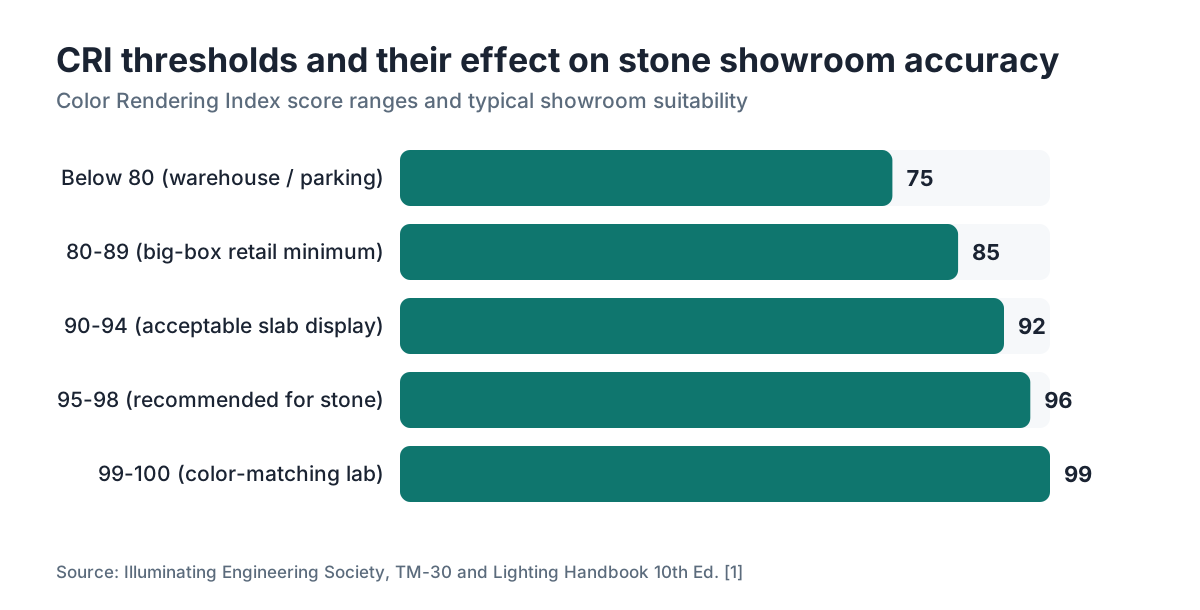
CRI 90 is the floor anyone serious about color accuracy quotes. CRI 95 and above is where stone starts to look honest. [1]
Here's the number that makes the case. Under a CRI 80 source, two colors that look clearly different in natural light can read as identical. That's what most commercial office lighting meets, and it's genuinely inadequate for material selection. Museums use CRI 95 or higher for the same reason showrooms should. [2]
High-CRI LEDs cost more upfront, roughly $40 to $120 per fixture versus $15 to $40 for standard commercial LEDs, but they last 50,000 hours or more and the five-year operating cost difference is small. [3] The return in buyer confidence and fewer after-sale problems is real.
Check one more spec beyond the headline CRI: the R9 score. CRI is averaged across eight standard color samples (R1 through R8), and none of them is saturated red. R9 measures red rendering by itself. Stones with pink, salmon, rust, or burgundy veining, think Pink Juparana granite or certain quartzites, look muted or shifted when R9 is low. Aim for R9 above 50; above 80 is better. Most LED spec sheets list R9 separately now. [1]
| CRI Range | What it means for stone | Typical application |
|---|---|---|
| Below 80 | Colors shift; warm stones look muddy | Warehouse, parking garage |
| 80-89 | Acceptable for general retail | Grocery, big-box stores |
| 90-94 | Good, appropriate minimum for slab display | Many tile showrooms |
| 95-98 | Excellent; veining and finish read accurately | Museum quality, premium stone showrooms |
| 99-100 | Near-daylight reference | Color-matching labs |
Source: Illuminating Engineering Society [1]
What color temperature works best for stone slabs in a showroom?
Color temperature is measured in Kelvin (K) and tells you whether a light looks warm (reddish-orange, low K) or cool (bluish-white, high K). For stone showrooms, the working range is 3500K to 4000K. [4]
3000K and below (standard "warm white") flatters warm undertones but lies about cool and gray stones. A gray quartz can read almost beige under 2700K pendants.
4000K to 4500K is what most designers call "neutral white." It reads close to midday daylight indoors and renders the full range of stone, from cool blue quartzites to warm creams, without pushing color one way or the other. Plenty of high-end slab showrooms sit right at 4000K for their primary display lighting.
Above 5000K ("cool white" or "daylight" LEDs) shifts everything blue. Dark granites look colder than they are. White marbles turn slightly clinical. Some fabricators run 5000K to 6500K for cut-edge inspection because it reveals micro-cracks and saw marks fast, but it's the wrong light for color selection.
Carrying a wide mix of stone? Split the floor into two zones. Run 3500K for warm-toned stones (golds, creams, browns) and 4000K for neutral and cool stones (grays, whites, blacks, blues). Walking a customer between zones beats one compromise setting.
For outdoor or naturally lit areas, north-facing skylights give the most neutral, steady light. They've been the standard for color evaluation in the art and printing trades for more than a century. Direct south or west sun swings color temperature hard across the day and fights every material decision you try to make under it. [5]
Does the direction and angle of light change how a slab looks?
Yes, and the effect is bigger than most people expect.
Grazing light, aimed at a low angle close to parallel with the slab face, is the most revealing light for texture and finish. Polish, hone, leathered, and brushed finishes look dramatically different under grazing light versus straight overhead light. A leathered surface that reads flat under downlights gets real dimension and shadow under a light angled at 15 to 20 degrees. [6]
Overhead downlights are the most common showroom fixture and the most deceptive for stone. They flatten texture and hide pitting, fissures, and finish variation that would be obvious in a kitchen under undercabinet lighting.
Good practice is at least one wall-mounted or track-mounted light that can graze across a displayed slab, on top of the overhead ambient. That's the setup that actually tells a customer what they're buying.
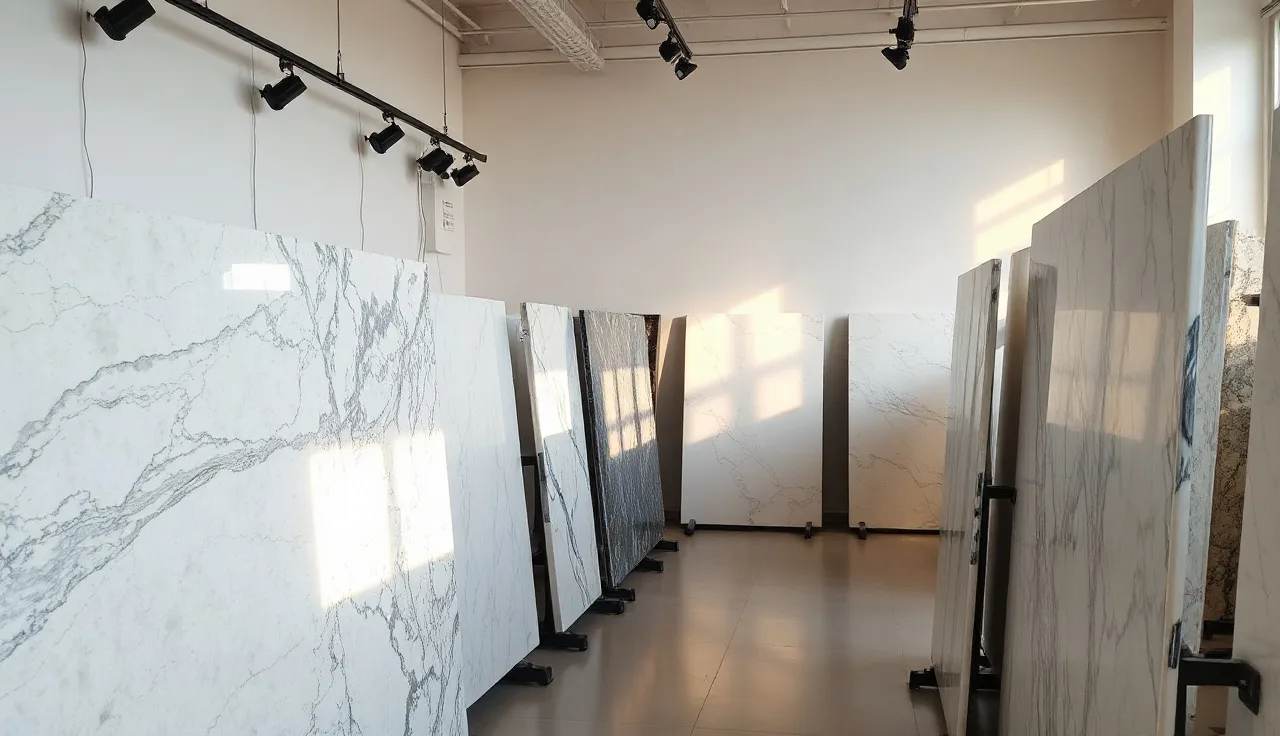
For vertical slab storage, wall-wash fixtures mounted above the rack and angled toward the slabs do a decent job. Skip downlights positioned directly over slabs laid flat on an A-frame. The light hits at 90 degrees and kills all surface character.
Some showrooms build a dedicated selection table: a large horizontal surface under good adjustable track lighting, where a customer's chosen slab lies flat, gets lit from several angles, and sits next to cabinet doors and flooring samples. That table does more to prevent buyer regret than any single fixture choice.
How should a showroom light different stone types, like granite versus quartz versus marble?
Different stone types reward different lighting, though a well-calibrated 4000K, CRI 95+ setup handles most of them acceptably.
Granite has crystalline structure that bounces light in many directions. It looks best under light from more than one source. Under a single downlight, some granite reads flat. Under cross-lighting from two or three directions, you see depth in the crystal. That's exactly why the standard for photographing granite is three-point lighting.
Marble has translucency in thin sections and a surface that reacts strongly to specular (direct) versus diffuse (scattered) light. Polished marble under a point-source direct light shows more glow from inside the stone. Showrooms selling high-end marble sometimes use one tight-beam directional light per slab to demonstrate that translucency. Buyers should know that's intentionally flattering light and ask how the stone looks under diffuse kitchen lighting too.
Engineered quartz (like Cambria) is more consistent than natural stone, but color accuracy still counts. The binders and resins reflect light differently than a mineral surface, and some quartz colors photograph beautifully yet carry a faint plasticky sheen under certain LEDs. View from multiple angles, and check for that sheen under a raking light.
Dark absolute granites and soapstones are light traps. They need more lumens, not fewer, to show character. A display area at 300 lux (about 28 foot-candles) might be fine for white marble but starves a dark stone. Target 500 lux at the slab surface for dark materials.
Quartzite and soapstone usually go to buyers who specifically want natural stone character. Show them under accurate, slightly warmer neutral light. Don't blast them with clinical-white LEDs.
What are the common showroom lighting mistakes that mislead buyers?
The most common mistake is running warm decorative lighting, 2700K to 3000K pendants or incandescent-equivalent LEDs, across the whole floor because it feels inviting. Inviting and accurate are two different things. That warm light makes every stone look warmer and richer than it is. A buyer takes a cream marble home, puts it under 4000K undercabinet LEDs, and wonders why it turned gray.
Second is inconsistent light across slabs in the same comparison area. When one slab sits under a bright spot and its neighbor sits in shadow, the bright one wins every time. Buyers think they're comparing stones. They're comparing light levels. Matching illuminance across a comparison zone is basic and often ignored.
Third is using only downlights with no angled component. This conceals finish texture and can make honed, leathered, or brushed finishes look nearly identical to polished ones.
Fourth is skimping on CRI. Low-CRI lighting is cheaper and common in building-supply retail. A showroom that buys beautiful slab inventory and then lights it with CRI 80 LEDs is leaving money on the table. The slabs look worse than they are, and that stings in a category where price is high and the decision is emotional.
Last: not letting buyers bring material samples. No showroom light exactly matches a customer's home. Ask them to bring a cabinet door, a paint chip, or a flooring sample, and view those together under the showroom light. That beats pretending the showroom is a controlled lab.
How many lumens and what illuminance level should a slab display area have?
The Illuminating Engineering Society (IES) publishes recommended illuminance by task. Retail display of high-value goods lands in the 500 to 1000 lux range (roughly 46 to 93 foot-candles) at the viewed surface, with critical color-matching tasks recommended at 1000 lux or above. [7]
For a slab display, 500 lux at the slab face is a solid working target. That's bright enough to see surface detail and color without the fatigue of a very high-intensity room. Final-decision zones, where a buyer chooses between two slabs, do better brighter, in the 700 to 1000 lux range.
How that turns into fixture count depends on lumen output, beam angle, ceiling height, and how much surrounding surfaces reflect. A rough rule for a fabricator setting up a display: a 1000-lumen, 4000K, CRI 95+ LED PAR30 flood (80-degree beam) mounted 8 feet above a horizontal slab gives roughly 300 to 400 lux at the surface. Two in an overlapping pattern gets you to 500 to 700 lux, depending on aim. For real calculations, most LED makers provide photometric files (.ies files) any lighting designer can drop into calculation software. [8]
Contrast between the display and the surrounding space matters too. A slab that's 3 to 5 times brighter than its surroundings reads as the focal object. If the whole showroom is equally bright, the display loses its hierarchy.
Run a quick light meter check across your display slabs. A basic lux meter costs $25 to $50 online, gives you real numbers, and catches fixture burnouts before customers do.
Should a stone showroom have natural daylight, or is controlled artificial light better?
Both carry real advantages and real problems.
Natural daylight from north-facing windows or skylights gives the closest read on how stone will look in a well-lit home. North light is diffuse and steady through the day, which is why artists and gemologists have always faced their studios north. [5] For stone evaluation, unobstructed north daylight is genuinely excellent.
The downsides are the obvious ones. It changes with time of day, cloud cover, and season. A buyer visiting at 4 PM in December gets completely different information than one visiting at 10 AM in June. Showrooms open on evenings or overcast days have no usable natural light. A floor that depends entirely on the sun is a hostage to weather.
Full-spectrum artificial lighting at CRI 95+ and 4000K approximates daylight closely enough for accurate selection and works the same at midnight as at noon. That consistency is its biggest edge over natural light.
The practical answer for most showrooms is both. Pull in north-facing natural light where the building allows, supplement with high-CRI 4000K LEDs to hold illuminance steady, and add directional grazing fixtures for texture. That mix gives customers accurate information whenever they walk in.
One thing to avoid on purpose: south- or west-facing glass walls with no shading. Direct afternoon sun pouring across slabs creates extreme contrast, blows out highlights, and makes every slab look better than it is. If direct sun is unavoidable, diffusing window film that scatters light without cutting much of it is a reasonable fix.
How can homeowners compensate for showroom lighting that might not match their home?
The honest answer: no showroom perfectly replicates your home's lighting, so the move is to shrink the gap, not close it.
The single most useful thing you can do is bring samples. A cabinet door, a flooring tile, a paint chip of the wall color you plan to use. Viewing the stone against those under showroom light beats staring at isolated slabs by a wide margin.
Second most useful: ask for a sample piece. Most fabricators can hand you a small offcut, 4 to 6 inches, to take home. Set it on your actual counter or island, under your actual kitchen lights, at different times of day. That's worth more than any amount of showroom viewing. Some slab yards charge a small deposit ($10 to $25); some give samples free. Ask.
If your kitchen runs 2700K to 3000K warm pendants, look at the slab under the showroom's warmer fixtures or decorative zone instead of the main display lights. If your kitchen is all 5000K daylight LEDs (less common, but some modern kitchens go that way), view slabs in the brightest, coolest part of the floor.
Photographing the slab on your phone and comparing it to kitchen photos helps for proportion and scale, but it's unreliable for color. Phone cameras auto-correct white balance hard, so the photo won't represent color temperature differences. Don't make a color call from photos alone.
Shops running quoting software like SlabWise can sometimes share high-resolution images of the actual slab bundle, which beats a generic product photo, but still isn't a substitute for the real stone under real light.
What about lighting for outdoor slab yards or covered storage areas?
Outdoor slab yards are common at stone distributors, and the lighting is usually whatever the sky gives you. During the day in open sun, color temperature runs from roughly 5500K at noon to 3000K at golden hour. [9] That's a big swing, and it means the same slab looks different depending on when you see it.
Visiting a yard to pick stone? Aim for late morning on an overcast day if you can. Overcast sky gives the most even, diffuse light with minimal shadow and a color temperature near 6500K. Cool, yes, but consistent, and it reveals fine veining and color variation better than direct-sun contrast. [9]
For fabricators with covered or semi-covered storage, high-bay LEDs at CRI 90+ and 4000K improve both the customer selection experience and the accuracy of workers managing inventory. Warehouse high-bay LEDs typically start at 10,000 lumens per fixture and come in high-CRI versions from most commercial suppliers.
One practical issue in outdoor and semi-outdoor areas is color shift from surrounding surfaces. Green vegetation nearby throws greenish light onto stone. Bare concrete reflects neutral gray. Painted walls reflect their own color. If your covered storage sits among strongly colored surfaces, that cast changes what buyers see. Neutral gray or matte white surroundings give the most accurate background for stone.
What should fabricators and showroom owners actually buy, and what does it cost?
For most stone showrooms, the right fixture is an adjustable LED track light at CRI 95+ and 4000K. Track wins for display because slabs move, storage changes, and being able to aim a fixture at the actual slab face (instead of a fixed spot) makes a real difference.
Brands that consistently produce high-CRI track lighting at commercial grade include WAC Lighting, Elco Lighting, and Soraa (Soraa specializes in near-perfect color rendering and shows up in museums). Expect $80 to $200 per track head meeting CRI 95+ spec, plus track and installation. A 300-square-foot display area with 8 to 12 fixtures runs $1,500 to $3,000 in hardware alone, plus electrical labor. [3]
For horizontal display tables or mockup areas, recessed adjustable trims in CRI 95+ give a clean look. Lumens needed depend on ceiling height. Get enough to hit 500 lux at the counter surface.
No budget for a full relight? The highest-return move is replacing whatever sits directly over the primary comparison area with high-CRI fixtures, even just two or three, and leaving the rest of the floor alone. That targeted upgrade costs a few hundred dollars and immediately sharpens the accuracy of the decision zone that matters most.
Shops that also use software to streamline quoting and shop operations, including tools like SlabWise, often find that cutting post-sale callbacks from lighting-induced color surprises pays back the lighting spend inside a year. The math is simple. One avoided callback on an $8,000 job covers a lot of LED fixtures.
For countertop installation decisions more broadly, accurate showroom viewing also cuts field-measurement second-guessing, because the buyer walks in with correct color expectations.
How does showroom lighting affect the appearance of different countertop finishes?
Finish, the surface treatment of the stone, is one of the most lighting-sensitive traits any slab has. The same stone in polished and honed finish looks almost like two materials under direct overhead light, and different again under grazing light.
Polished finish has a mirror-like reflective surface. Under a direct overhead downlight, a polished slab reflects the light source as a bright hot spot, and the rest goes dark. The stone's real color and pattern are hard to read off that reflection. View polished stone from an angle that dodges the direct reflection, or under diffuse light with no hard specular hot spots.
Honed finish is matte to satin. It shows color and veining more evenly under most sources because it doesn't create specular reflections. Honed reads accurately under almost any reasonable lighting, which makes it the easiest finish to judge in a showroom.
Leathered and brushed finishes have texture. As covered earlier, they need grazing light to show character. Under overhead downlights they look nearly flat. If a showroom has no grazing light, a customer looking at a leathered quartzite is getting less than half the story.
Satin or soft-polished finishes (common on engineered quartz like Cambria countertops) sit between polished and honed. They throw some specular reflection but diffuse it, and they read fairly accurately under most 4000K showroom lighting.
The practical takeaway: keep a handheld flashlight or a portable directional LED at the selection counter. Customers who want to see texture in leathered or brushed stone can rake that light across the slab face themselves. It takes 30 seconds and instantly shows the finish character overhead lighting hides.
Frequently asked questions
What is the ideal color temperature for a stone slab showroom?
3500K to 4000K is the practical ideal. That range reads as neutral white, renders both warm and cool stones accurately, and is close to what buyers see under most modern kitchen lighting. Lights below 3000K skew warm and flatter cream stones while misrepresenting gray and white ones. Lights above 5000K push everything blue and make warm stones look colder than they are.
What CRI do I need to see stone colors accurately?
CRI 95 or higher gives accurate color rendering for stone selection. CRI 90 is the acceptable minimum. CRI 80, standard in most commercial buildings, is not sufficient for material decisions; it causes measurable color shifts between samples that look identical in the store and different in the customer's home. Check that the fixture also has an R9 score above 50 for accurate rendering of red and pink tones.
Should I view stone slabs in natural light or artificial light at the showroom?
Both are useful, but diffuse natural light from north-facing windows is the most accurate single source. The problem is it varies by time of day and weather. High-CRI 4000K LED lighting is consistent and close to neutral daylight. The best showrooms use both: north-facing natural light supplemented by artificial lighting that matches it, so the buying experience holds steady whenever a customer visits.
Why does my granite countertop look different at home than it did in the showroom?
Showroom lighting almost certainly has a different color temperature and intensity than your kitchen. Warm pendants (2700K to 3000K) make gray or cool stones look warmer. Cool undercabinet LEDs (4000K to 5000K) shift warm stones toward gray. The fix going forward is to bring a sample piece home before committing and view it under your actual lights at different times of day.
How do I evaluate a stone finish like honed or leathered in a showroom?
Ask staff for a directional or angled light source, or bring a small flashlight. Honed finishes read accurately under most overhead lighting. Leathered and brushed finishes need light aimed at a low angle across the surface (grazing light) to show texture. Under straight overhead downlights, a leathered finish looks nearly flat and you can't evaluate what you're actually buying.
What lumens or foot-candles should a stone showroom aim for?
500 lux (about 46 foot-candles) at the slab face is a solid working target for general display. Final-decision zones benefit from 700 to 1000 lux. The IES recommends 500 to 1000 lux for high-value retail display and 1000 lux or above for critical color-matching tasks. Running a $25 lux meter across your display area gives you real numbers instead of guesses.
Do different stones need different showroom lighting?
Somewhat. Dark stones like absolute black granite or soapstone need more lumens to show character; 500 lux is a minimum for them. Crystalline granites benefit from multi-directional light to show depth. Marble with translucency shows best under a single tight directional source. Polished finishes need diffuse or angled light to dodge blinding specular reflections. A 4000K CRI 95+ setup handles most stones, with directional supplements for specific needs.
Is LED lighting bad for stone colors, or is it accurate?
LED quality varies enormously. A poor LED (CRI 80, 3000K) gives inaccurate stone colors. A high-quality LED (CRI 95+, 4000K) is as accurate as natural daylight for stone selection, and more consistent in some ways. The technology is not the issue; the spec of the specific fixture is. Ask about CRI and color temperature, more than whether something is LED.
What should homeowners bring to a stone showroom to compare with slabs?
Bring a cabinet door sample, a flooring tile or sample, and a paint chip of your primary wall color. Viewing the stone against those materials under showroom light, even imperfect showroom light, gives far more useful information than looking at the stone in isolation. Ask for a small slab offcut to take home and check under your kitchen lighting. Many fabricators provide these free or for a small deposit.
How do track lights compare to recessed downlights for slab display?
Track lights are better because they're adjustable. As slabs move around the floor and storage changes, you re-aim track heads to follow the actual stone. Fixed recessed downlights often end up over the wrong spot after a single inventory rearrangement. For texture and finish, track lights can also angle to graze across slab surfaces, which fixed downlights cannot do.
What lighting should I avoid in a stone showroom?
Avoid CRI 80 or below fixtures for any display area. Avoid color temperatures below 3000K (warm decorative lighting) or above 5000K (cool daylight LEDs) as primary display light. Avoid using only overhead downlights with no angled or grazing component. Avoid inconsistent light levels across a comparison zone, where one slab is brighter than its neighbors, which creates a false impression of quality differences.
Does it matter what color the showroom walls and floors are for viewing stone?
Yes. Strongly colored walls or floors reflect that color onto slabs and shift what buyers perceive. Neutral gray or matte white surroundings give the most accurate slab color. Bright white walls reflect more total light, raising the ambient level, which is generally good. Dark painted walls, saturated wall colors, or wood floors with a warm orange tone all add a color cast that changes how stone reads.
What lighting is best for a stone yard or outdoor slab storage?
Late morning on an overcast day gives the most neutral and even natural light for outdoor slab viewing. For covered or semi-covered storage, high-bay LEDs at CRI 90+ and 4000K provide consistent illumination. Avoid late-afternoon direct sun, which shifts color temperature toward warm orange and throws harsh shadows. If you must view slabs in direct sun, keep the sun behind you, not at a steep angle across the face.
How much does it cost to install proper lighting in a stone showroom?
Hardware for a 300-square-foot slab display using CRI 95+ adjustable track LEDs runs roughly $1,500 to $3,000, plus electrical installation. A targeted upgrade over a primary comparison zone, two to four high-CRI track heads, runs $300 to $800 in hardware. Museum-grade fixtures from brands like Soraa push toward the top of those ranges. The payoff in fewer post-sale callbacks and stronger buyer confidence shows up within the first year.
Sources
- Illuminating Engineering Society, "Approved Method: Color Rendition of Light Sources (IES TM-30)": CRI measures how faithfully a light source renders colors relative to a reference illuminant; R9 measures saturated red rendering specifically; CRI 95+ is the recommended threshold for accurate color evaluation.
- American Alliance of Museums, "Lighting in Museums" resources: Museums use CRI 95 or higher for display and conservation lighting to accurately render colors in artifacts and materials.
- U.S. Department of Energy, "LED Lighting" (Office of Energy Efficiency and Renewable Energy): Quality LED fixtures deliver rated lifetimes of 50,000 hours or more, and higher upfront cost is offset by long service life and low operating cost.
- U.S. Department of Energy, "Correlated Color Temperature" lighting guidance: Correlated color temperature is measured in Kelvin and describes whether a light source appears warm or cool; neutral white around 3500K to 4000K approximates midday interior daylight.
- ASTM International, Standard D1729: Standard Practice for Visual Appraisal of Colors and Color Differences of Diffusely-Illuminated Opaque Materials: North-facing diffuse natural daylight is the reference standard for visual color evaluation of opaque materials; direct sun is explicitly excluded as a reference illuminant due to its variability.
- Tile Council of North America, "Specification Handbook" (surface finish evaluation guidance): Grazing or raking light at low angles reveals surface texture, finish variation, and lippage in stone and tile products that straight overhead light conceals.
- Illuminating Engineering Society, "The Lighting Handbook, 10th Edition" (IESNA HB-10): IES recommends 500 to 1000 lux for high-value retail display and 1000 lux for critical color-matching tasks at the work surface.
- Illuminating Engineering Society, IES LM-63 photometric data file format standard: Manufacturers publish standardized photometric (.ies) files that lighting designers use to calculate illuminance from specific fixtures at a given mounting height and beam angle.
- National Institute of Standards and Technology (NIST), "Colorimetry" technical notes: Direct sunlight color temperature ranges from approximately 5500K at solar noon to below 3000K at golden hour; overcast sky produces approximately 6500K diffuse illumination.
- Natural Stone Institute, "A Fabricator's Guide to Natural Stone": Different stone surface finishes (polished, honed, leathered, brushed) have fundamentally different light reflectance properties that require different lighting approaches to evaluate accurately.
- Lawrence Berkeley National Laboratory, "Windows and Daylighting" research group: North-facing glazing provides the most consistent and neutral quality daylight for interior color evaluation, with minimal direct sun penetration and low seasonal variation in diffuse light quality.
Last updated 2026-07-11