TL;DR
- A suction cup lifter uses a vacuum pad to grip polished stone, glass, or engineered surfaces so one or two people can lift and position heavy slabs without touching the finished edge.
- Single-pad hand tools hold 90 to 150 lbs.
- Paired or frame-mounted systems handle 400 to 2,000 lbs.
- Use one any time you move a finished slab without a full crew and a mechanical lift.
What exactly is a suction cup lifter for stone?
A suction cup lifter is a vacuum-grip tool that sticks to a dense, non-porous, smooth surface and lets you lift or carry it without clamps, straps, or edge contact. You press the pad onto the stone, pump a lever or squeeze a trigger to pull air out of the chamber, and atmospheric pressure holds the pad in place. Flip a valve and the vacuum drops instantly.
The principle is simple physics. Standard atmospheric pressure at sea level is about 14.7 psi [1]. Pump the air out of the cup's chamber and the outside air pushes back hard against the pad. A pad with 10 square inches of contact and a moderate vacuum holds well over 100 lbs from that pressure difference alone.
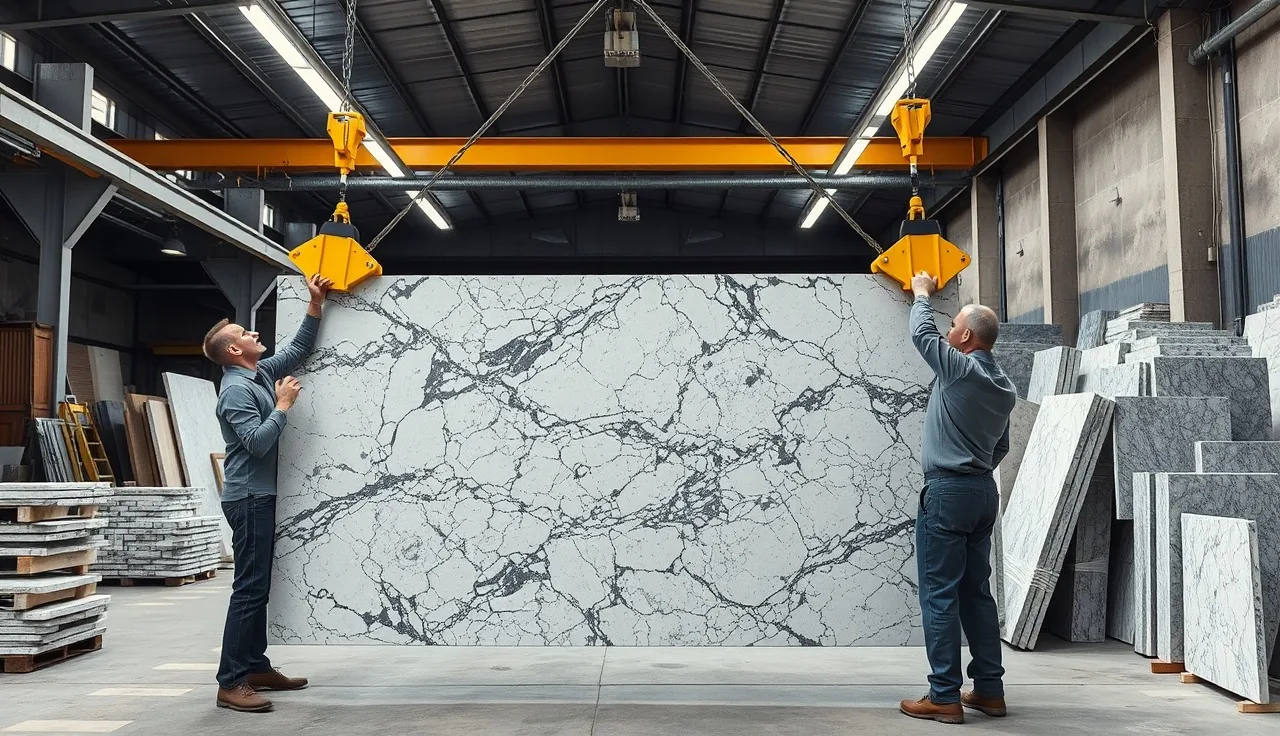
Stone lifters come in a few forms. The classic single-handle hand cup looks like a fat toilet plunger with a pistol grip. You see them in every glass shop and stone yard. Double-cup carriers put two pads on a shared handle so the load stays balanced. Frame lifters bolt two or four pads to a steel yoke that hooks to a crane or gantry. Vacuum lifting beams span a full slab and connect to a forklift or overhead bridge crane, so one operator moves a 600-lb granite slab across the shop floor without ever touching the stone's edge.
How does the vacuum hold so much weight?
The holding force is the pressure difference between the outside air and the evacuated chamber, nothing more. Force equals pressure times area. A cup with 20 square inches of contact and a vacuum depth of 12 psi (easy to reach with a hand pump) theoretically holds 240 lbs [1]. Manufacturers then build in a safety factor, usually 2:1 to 4:1, so a cup rated at 150 lbs sits well below the point where the vacuum breaks.
The real limit is seal quality. Rough stone, textured finishes, porous surfaces, or any moisture or oil under the pad cuts effective contact area and starts a slow leak. Most hand lifters have a visual indicator, a color-coded gauge or a pop-up button, that shows vacuum level. If that indicator moves while the load is in the air, set the slab down right away.
Temperature matters more than people expect. Cold stone off a delivery truck in winter contracts the pad slightly and drops seal pressure. Schmalz publishes correction factors for cold conditions, and the shop rule of thumb is to derate your working load by 10 to 15% below 40 degrees F [8].
Surface finish matters a lot too. Polished granite, polished quartz, and honed stone with surface roughness below about Ra 0.8 microns all hold well. Leathered, flamed, or heavily brushed textures can cut effective contact by 30% or more [8]. If the surface looks like it would let air whistle past, it will.
What weight can a suction cup lifter actually handle?
Here is a practical range, because the numbers matter before you buy or rent:
| Tool type | Typical rated capacity | Best use case |
|---|---|---|
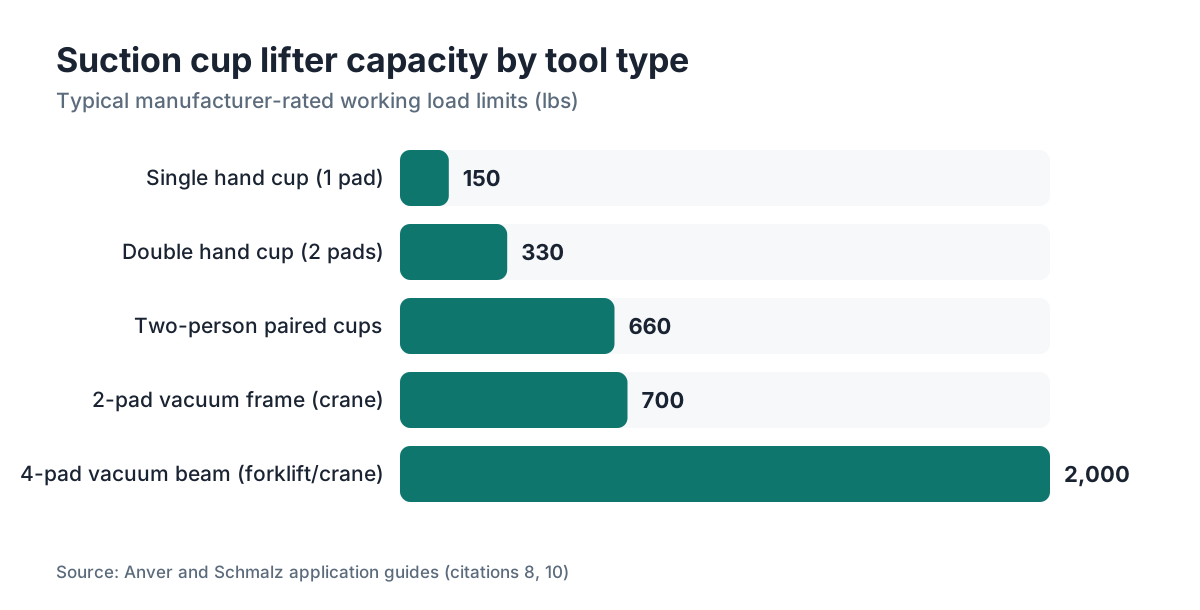
| Single hand cup (1 pad) | 90 to 150 lbs | Moving cut pieces, backsplash tiles, glass |
| Double hand cup (2 pads, shared handle) | 150 to 330 lbs | Repositioning a countertop section on a bench |
| Two-person paired cups | 200 to 330 lbs per cup | Two techs carrying a full slab section to the install site |
| 2-pad vacuum frame (crane mount) | 400 to 700 lbs | Shop crane lifts, loading and unloading slabs |
| 4-pad vacuum beam (forklift/crane) | 800 to 2,000 lbs | Full 3cm granite or quartz slabs, monolithic pieces |
Those are manufacturer-rated working load limits, not theoretical maximums [10]. Smart installers knock 20% off when working overhead or in awkward positions, because a slip that tilts the pad even slightly kills contact area fast.
A standard 3cm polished granite slab runs about 18 to 20 lbs per square foot [3]. Take a 10-foot island top, say 10 ft by 3.5 ft at 3cm. It weighs roughly 630 to 700 lbs. You are not hand-carrying that with two single cups. A 4-pad vacuum beam on a shop crane is the right tool, full stop.
What surfaces can a suction cup lifter grip, and what surfaces won't work?
Polished stone is the ideal surface: tight pores, smooth enough to form an airtight seal. Polished granite, polished quartz (engineered stone like Cambria, Silestone, or Cambria countertops), polished marble, and honed marble all grip well. Tempered and coated glass are the other main application; glass shops have used suction cups since the 1950s.
Here is where suction cups fail or turn unreliable:
- Leathered or brushed stone finishes. The micro-texture breaks the seal.
- Flamed granite. Thermal spalling leaves an irregular surface full of voids.
- Sandblasted or matte acid-etched surfaces. Same problem.
- Natural cleft slate or quartzite with visible surface relief.
- Any wet, oily, or dusty surface. A light film of fabrication dust kills the seal.
- Unfinished concrete.
- Butcher block countertops and other wood surfaces. Grain porosity lets air in.
- Laminate countertops with textured embossing.
The field test: hold a flat sheet of paper against the surface and press lightly. If it stays, a suction cup will probably work. If air gets under it and it falls, the cup will slide off too.
One thing people get wrong: porous stone that has been fully sealed with an impregnating sealer. The sealer fills the pores, but the surface texture stays exactly the same. A leathered quartzite is still leathered after sealing. The cup still won't grip.
When should you actually use a suction cup lifter?
Use one any time you move finished stone and edge contact would chip the piece, you don't have enough hands, or you need to position something with no room to get fingers underneath.
In a fabrication shop, the common job is moving cut and finished pieces from the CNC table or bridge saw to the polishing station, then to staging. Bare hands or metal clamps on a finished edge risk chipping the polish or the profile. A vacuum cup touches only the face.
During install, suction cups let two people carry a heavy section down a hallway and set it onto cabinets without dragging it across the cabinet top or pinching fingers. They also handle fine positioning. Once a slab is roughly in place, a single-cup handle lets you nudge a 200-lb piece an inch left without lifting the whole thing.
For templating and dry-fitting, cups let you test how a piece lands on the cabinet run before you commit. Lifting and repositioning a dry piece goes much faster with cups than with clamps.
Tight jobsites benefit too. Spiral staircases, narrow galley kitchens, and bathrooms with no swing room all make hand-carrying slabs dangerous. Cups give you positive control without needing wide clearance for your elbows.
Shops that track slab handling report fewer edge chips and lower breakage once they add vacuum systems. Hard data is thin. Anver's technical references cite reduced handling damage as the main reason stone fabricators buy their equipment [10].
When should you not use a suction cup lifter?
Skip the cup when the finish won't hold a seal (leathered, flamed, sandblasted), or when the slab has a through-crack. A vacuum cup puts the whole load at one grip point. A cracked slab can sit fine on a bench and then tear through the crack under its own weight the moment you lift it.
Don't use a hand cup overhead without a mechanical backup. OSHA's overhead crane standard (29 CFR 1910.179) requires rated rigging on crane lifts and control of suspended loads to prevent swing [4]. A hand-pumped vacuum cup with no safety tether is not rated rigging. For any overhead lift, use a certified vacuum lifting device stamped with a working load limit and pair it with a mechanical safety hook or a secondary sling in case the vacuum drops.
Skip the cup on slabs you haven't inspected for hidden cracks. Wipe a wet sponge across the surface and watch where it dries fast; those lines can be hairline cracks invisible on a dry slab. A hairline running perpendicular to the lift direction is a real risk.
Rough stone straight off the slab saw is a poor candidate too. The saw leaves slurry residue and micro-scratches that block a clean seal. Clean and dry the surface first.
How do you use a suction cup lifter safely?
The sequence matters. Clean the stone first and wipe off dust and moisture. Press the cup down firmly and pump the lever until the indicator sits in the green zone. Then run a tug test before you commit: pull 20 to 30 lbs of downward force for a couple of seconds. If the indicator moves or you hear air, reposition and try again.
For two-person carries with individual cups, confirm both cups are green before either person takes weight. Agree on a step count before you move. Stone is heavy, and a communication miss mid-carry is how slabs hit the floor.
Keep the load hanging as close to straight below the cup as you can. Suction cups are rated for vertical tension, the force pulling straight down. Side-load, where the slab tilts and tries to peel the pad off at an angle, drops effective capacity hard. Schmalz rates side-load capacity at 30 to 50% of vertical [8].
Release the vacuum on purpose. Use the release valve, don't yank the cup off. Yanking can pop a stress crack in brittle stone.
Inspect the pad before every use. Rubber pads collect cuts, dried slurry, and hardening over time, and a cracked or stiff pad won't seal. Most manufacturers say replace pads every 6 to 12 months in heavy shop use.
If you run a shop and want to connect quoting and nesting to what happens on the floor, SlabWise tracks slab movement, job status, and cut yields. That is where lift planning and slab sequencing decisions actually live.
What types of suction cup lifters are available and how do they differ?
Hand cups are the entry point. Single-pad versions from brands like Wood's Powr-Grip start around $40, with a basic 150-lb-rated unit closer to $80. Two-pad balanced carriers that let one person handle a larger piece run $100 to $250. These ride in every stone installer's van.
Pneumatic cups connect to a shop air compressor and hold vacuum continuously instead of relying on a mechanical pump. They win for repeated shop lifts because you skip the re-pump between moves. Expect $200 to $600 for a pneumatic hand unit.
Vacuum frame lifters, the yoke-and-beam systems that hook to a crane, run $800 to $3,500 depending on pad count and capacity. At 4 pads and a 1,500-lb WLL, these are what production shops and stone yards use for full-slab moves.
Powered vacuum generators pull a deep, steady vacuum with an electric motor or a venturi off shop air. They live on CNC loading tables and automated handling lines. These are fixed shop equipment, not portable tools, and they run $2,000 to $15,000 depending on the integration [10].
For most installers, a pair of quality hand cups (one per person) plus a two-pad carrier for solo bench work covers 90% of jobsite needs. Renting a frame lifter for a large whole-slab install beats buying one; many rental shops and stone supplier yards rent vacuum frame systems for $50 to $150 a day.
How are stone suction lifters different from glass suction lifters?
Side by side they look almost identical. The engineering differences are small but real.
Glass lifters are rated for smooth non-porous glass and often use softer pad compounds to avoid scratching coatings. Stone lifters run firmer pads and sometimes a larger pad diameter to cover minor surface variation. The holding principle is the same.
The bigger difference is application angle. Glaziers often carry panels nearly vertical. Countertop installers mostly carry slabs horizontal or at a slight tilt. A lifter's rated capacity is specified for a given orientation, so confirm the tool's rating matches how you'll actually carry the load.
Some glass lifters have an articulating swivel that lets the operator tilt the load without peeling the pad. Handy for setting glass into frames, less useful for countertops.
For granite countertops or marble countertops, buy a stone-rated vacuum cup. Don't grab a cheap glass cup made for hanging bathroom mirrors; those top out around 50 to 70 lbs and don't have the vacuum depth for heavy stone.
What do countertop installers actually use on the job?
Talk to experienced installers and you hear the same short list. Two single-pad Wood's Powr-Grip or Bainbridge hand cups ride in every tool bag. One double-cup carrier lives in the van for tricky solo moves. On island tops over 200 lbs, most crews either bring a third person or rent a frame system.
For countertop installation on full slabs, a two-person team each carrying a single cup on their end is the standard field method. It keeps fingers off the polished edge, saves the wall paint from elbow scrapes, and gives each person directional control to micro-position the slab.
Good installers check the vacuum indicator every single time they set the slab down and pick it back up. Vacuum can bleed off between moves if the pad rests on rough cabinet wood or drywall and the seal picks up grit. A fresh pump before each lift takes five seconds and prevents a drop.
One step people skip under time pressure: the tug test. It sounds obvious, but on a busy job people cut corners. The tug test on a 300-lb granite section costs ten seconds. A drop costs you the slab, the cabinet, maybe someone's foot, and a warranty call that eats a full day.
How much does a suction cup lifter cost, and is it worth buying vs. renting?
For a homeowner doing a one-time move or replacement, renting is almost always the answer. A basic hand cup pair rents for $15 to $30 at equipment shops. A frame lifter for a large slab job rents for $50 to $150 a day. Buying that same frame outright runs $800 to $3,500, and it sits unused for years.
If you fabricate or install weekly, buy your own hand cups now. A $150 pair of quality cups pays back the rental cost in five or six jobs. The frame lifter is the bigger call. Shops doing more than two or three large slab moves a week should own one.
Quality matters here. A $25 cup from a big-box store is built for sheet goods and drywall, not polished granite. The pad compound is softer, the vacuum seal is shallower, and the indicator (if it has one) is unreliable. For stone, buy from Wood's Powr-Grip, Schmalz, Anver, or a stone industry supplier. Spend the $80 to $150 for a properly rated cup. A broken slab starts at $300 and climbs fast.
For kitchen countertops, the value is obvious: a 10-foot quartz run at 3cm weighs 400 to 600 lbs and has to land precisely on the cabinets. The right tool turns that into a 20-minute job instead of an all-day wrestling match.
Are there safety standards or regulations that apply to stone vacuum lifters?
Yes, several apply depending on context.
OSHA 29 CFR 1910.179 governs overhead and gantry cranes in general industry and requires that lifting attachments, including vacuum lifters on cranes, be rated and labeled with a working load limit [4]. The regulation states that "the rated load of the crane shall be plainly marked on each side of the crane," and no crane shall be loaded beyond its rated capacity.
ANSI/ASME B30.20 covers below-the-hook lifting devices, which includes vacuum lifting frames. It requires a minimum design factor of 3:1 (the device must hold three times its rated load before failure), annual inspection by a qualified person, and documentation of every inspection [5].
For portable hand cups not used on a crane, OSHA's general duty clause (Section 5(a)(1) of the Occupational Safety and Health Act) applies: employers must provide a workplace free from recognized hazards [6]. In practice that means using tools within their rated capacity, maintaining equipment, and training workers on correct use. OSHA's material handling standard, 29 CFR 1910.176, backs this up with rules for safely moving heavy materials [9].
The Natural Stone Institute (formerly the Marble Institute of America) publishes handling guidelines that reference these ANSI standards and recommend vacuum lifter inspection before each shift for shop use [7].
For a homeowner doing a one-time DIY install, these regulations don't directly apply, but the engineering behind the safety factors still does. Don't exceed the rated working load limit, inspect the pad before use, and never lift overhead without a secondary backup.
Frequently asked questions
Can I use a suction cup lifter on a leathered or brushed granite countertop?
No, not reliably. Leathered and brushed finishes have a micro-textured surface that stops the pad from forming an airtight seal. You may get partial suction, but the vacuum bleeds slowly and the cup can release without warning under load. Use edge clamps or a carrying frame instead. To reposition a leathered slab, a furniture dolly and three people is safer than a cup.
How do I know if the suction is strong enough before I lift?
Check the vacuum indicator, usually a color gauge or pop-up button on the cup body, and confirm it sits in the green or hold zone. Then run a tug test: pull 20 to 30 lbs of downward force for 3 to 5 seconds and watch the indicator. If it holds steady, lift. If it moves even slightly, the seal is compromised. Clean the surface and reposition the cup before you go.
How much weight can a single suction cup hold?
A standard hand-pump stone suction cup is rated at 90 to 150 lbs of working load. That figure already includes a 2:1 to 4:1 safety factor over theoretical maximum. For heavier pieces, use a two-pad balanced carrier (150 to 330 lbs), a two-person paired cup method, or a crane-mounted vacuum frame rated up to 1,000 to 2,000 lbs.
Can two people use individual suction cups to carry a large granite slab?
Yes, this is the standard method for most countertop installs. Each installer grips their end of the slab with a single cup, confirms it's in the green zone, and coordinates the carry. The weight limit is the lower of the two cups' ratings, and both must stay green through the whole move. For slabs over 300 lbs, add a third person or use a carrier frame.
Do suction cups work on quartz countertops like Cambria or Silestone?
Yes. Polished engineered quartz has a very tight, non-porous finish that seals exceptionally well. Most fabricators find vacuum cups grip engineered quartz more consistently than natural stone because there's no variation in surface porosity. Standard stone-rated hand cups work fine. Just clean off any slurry or fabrication residue first.
What's the difference between a suction cup and a vacuum lifter?
The terms overlap. Suction cup usually means a hand-pump portable tool with one or two pads. Vacuum lifter more often means a powered or crane-mounted system with a generator that holds continuous vacuum. Both grip surfaces the same way. The powered version wins for repeated heavy lifts in a shop; the hand cup wins for portable jobsite work.
Can a homeowner safely use a suction cup to install countertops without a contractor?
For light pieces, yes. A polished stone section under 150 lbs on a flat surface is manageable for a careful homeowner with a quality cup and a helper. Beyond that, the risks stack up: heavy stone dropped from cabinet height causes serious injury and property damage. For full slabs, most homeowners are better off hiring an installer than managing 400-lb pieces with hand tools.
How do I clean and maintain a suction cup lifter?
After each use, wipe the pad with a damp cloth to remove slurry, dust, and oils. Let it dry fully before storage. Inspect the rubber pad for cuts, cracks, or hardening; a stiff or cracked pad won't seal. Lightly dust the pad with talc or cornstarch for storage so the rubber doesn't stick to itself. Replace pads every 6 to 12 months in regular shop use.
Will a suction cup damage or scratch a polished countertop surface?
A quality stone cup with a clean rubber or polyurethane pad should not scratch polished stone; the pad is softer than the stone. The risks are a faint ring impression on very soft stones like some marbles, and micro-scratching if grit gets trapped under the pad. Wipe both the stone and the pad clean before each use and you'll have no issues.
What brands of suction cup lifters are most trusted in the stone industry?
Wood's Powr-Grip is the most commonly cited brand in North American stone shops; they've made vacuum handling tools since 1964. Schmalz (German-made) and Anver are widely used for industrial vacuum frames and crane systems. Bainbridge and GGR Group show up in stone yard equipment too. Avoid unbranded or hardware-store cups for stone; they lack the vacuum depth and pad quality for safe slab handling.
Can a suction cup work on wet stone or wet surfaces?
Water actually helps seal a cup for a moment because it fills micro-gaps, but it also lubricates the pad and makes it far more likely to slide off under side load. Net result: wet surfaces are unreliable. Some glaziers use a damp pad on glass to improve initial grip, but for stone, dry the surface thoroughly first. Fabrication slurry is the worst; its abrasive particles damage the pad.
How is a suction cup lifter used differently in a stone fabrication shop versus on a jobsite?
In a shop, cups get used repeatedly for short moves between machines and workstations, often with pneumatic or powered vacuum systems for consistent grip. Safety frames and crane mounts handle full slabs. On a jobsite, installers use portable hand cups to carry finished pieces through doorways, down stairs, and onto cabinets. The same physics apply, but the gear tends to be lighter and more portable.
Are there suction cups that work on vertical stone like wall tile?
Yes, but capacity drops hard. A cup rated at 150 lbs for a horizontal lift (vertical tension) is typically rated at 50 to 75 lbs for a vertical application (side load). Wall tile suction cups exist and get used constantly in large-format tile work. For heavy stone wall cladding panels, specialized side-grip vacuum tools with angled pad mounts are made for that exact job.
Sources
- NASA Glenn Research Center, 'Atmospheric Pressure': Standard atmospheric pressure at sea level is approximately 14.7 psi, the basis for calculating suction cup holding force.
- Natural Stone Institute, 'Natural Stone Weight Reference': Granite at 3cm thickness weighs approximately 18-20 lbs per square foot.
- OSHA, 29 CFR 1910.179 Overhead and Gantry Cranes: All overhead crane lifting attachments must be rated and labeled with a working load limit; cranes shall not be loaded beyond rated capacity.
- ASME B30.20 Below-the-Hook Lifting Devices standard summary, ASME: ASME B30.20 requires a minimum 3:1 design factor for below-the-hook vacuum lifting devices and annual inspection by a qualified person.
- OSHA, General Duty Clause Section 5(a)(1), Occupational Safety and Health Act: Employers must provide a workplace free from recognized hazards likely to cause death or serious physical harm.
- Natural Stone Institute, Fabrication and Installation Handling Guidelines: Stone industry guidelines recommend vacuum lifter inspection before each shift for shop use and reference ANSI handling standards.
- Schmalz Vacuum Technology, Suction Cup Selection and Application Guide: Side-load capacity of suction cups is typically rated at 30-50% of vertical tension capacity; surface roughness above Ra 0.8 microns significantly reduces effective contact area; cold conditions require derating of working load.
- OSHA, Materials Handling and Storage, 29 CFR 1910.176: General industry material handling regulations require safe methods for moving heavy materials and adequate training for workers using lifting equipment.
- Anver Corporation, Vacuum Lifting Equipment Technical Reference: Vacuum frame lifters for stone slabs are available with ratings from 400 lbs to over 2,000 lbs; pneumatic and electric vacuum generators used for continuous industrial lifts.
Last updated 2026-07-10