TL;DR
- A sandblasted finish blasts abrasive media, usually aluminum oxide or silica-free glass beads, at a stone surface under high pressure.
- You get a matte, slightly rough texture that scatters light, hides fingerprints, and grips well when wet.
- Fabricators use it most on granite, quartzite, and marble for outdoor counters, shower ledges, and rustic kitchen surfaces.
What exactly is a sandblasted countertop finish?
A sandblasted finish is a texture made by firing a pressurized stream of abrasive particles at a stone slab. The particles hit the polished or honed face and knock tiny chips out of the crystal structure. What you're left with is a matte, slightly pitted surface that looks almost frosted from across the room.
The work happens inside a contained blast cabinet or an open blast room with real dust collection. The operator holds the nozzle at a steady distance, usually 6 to 10 inches, and controls how long it dwells on each spot. Go too slow and you get deep pitting. Move too fast and you barely touch the surface.
Media choice drives everything. Plain sand is done. Responsible shops stopped using it because free silica dust causes silicosis [1]. Most fabricators now run aluminum oxide grit (36 to 80 mesh for countertops), steel shot, garnet, or silica-free glass beads. Each one leaves a different character. Aluminum oxide cuts hard and leaves an angular micro-texture. Glass beads peen the surface instead of cutting it, so you get a softer, satin-ish look.
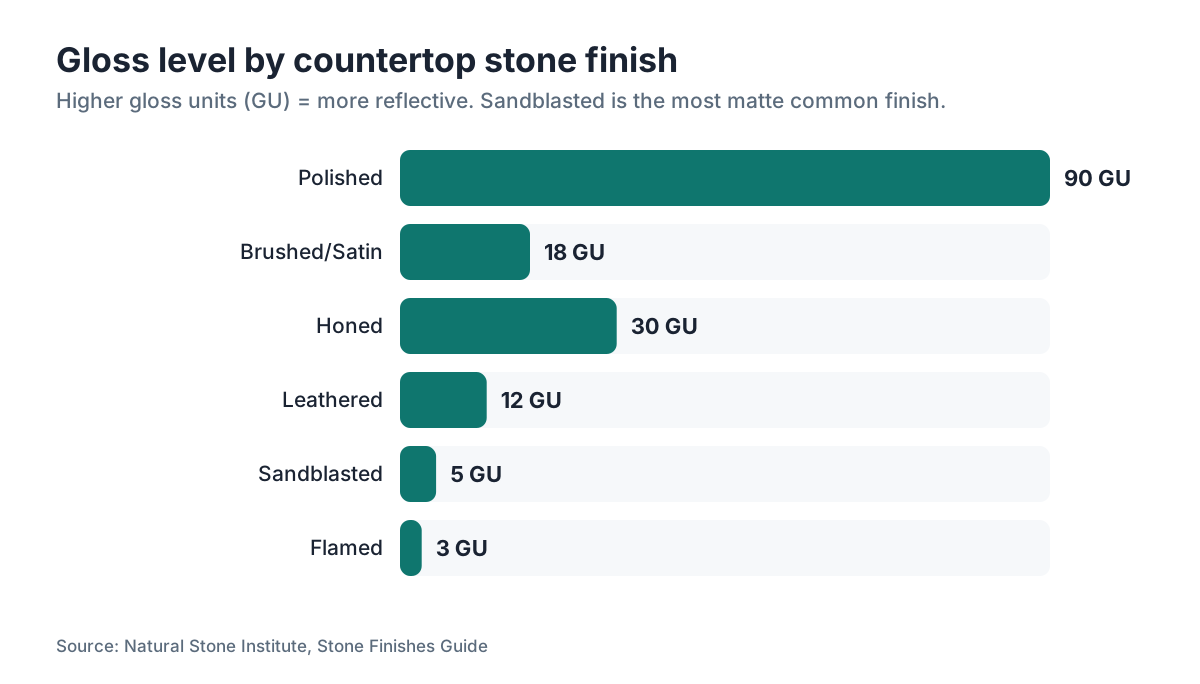
The result sits somewhere between honed and leathered on the tactile scale, but reads more matte than either to the eye. A polished granite surface usually measures 85 to 95 GU (gloss units). Blast it and the same stone drops to 2 to 8 GU depending on media and dwell time [2]. That's a huge optical swing from one process.
How does sandblasting differ from polished, honed, and leathered finishes?
Countertop finishes run from mirror-bright to aggressively textured, and sandblasted lives near the rough end. Here's how it stacks up against the four other common options.
| Finish | Gloss (GU) | Texture feel | Fingerprints visible | Typical use |
|---|---|---|---|---|
| Polished | 85-95 | Smooth, slick | Very visible | Formal kitchens, bathrooms |
| Honed | 20-40 | Smooth, matte | Somewhat visible | Contemporary kitchens, marble |
| Leathered | 5-20 | Slightly bumpy | Mostly hidden | Rustic, dark granites |
| Sandblasted | 2-8 | Rough, porous feel | Nearly invisible | Outdoor, industrial, specialty |
| Brushed | 10-25 | Linear, directional | Mostly hidden | Modern, wood-look stones |
Polished and honed finishes come from grinding with progressively finer diamond abrasives. Leathering uses diamond bush-hammer heads or wire brushes to raise the natural crystal texture. Sandblasting is the odd one out: it works by knocking material off through abrasive impact, not by grinding the surface smooth.
That difference shows up in maintenance. Polished and honed surfaces seal at a tight, mostly non-porous face. Sandblasting opens the micro-porosity wide, so the stone drinks up sealer, oil, and staining agents much faster. A sandblasted black granite might need two or three coats of sealer before it stops absorbing, where the same stone polished takes one [3].
People mix up leathered and sandblasted all the time, and I get why. Both look rustic and both hide handprints. But leathered stone has raised ridges that follow the crystal boundaries, while sandblasted stone is uniformly pitted with no directional pattern at all. Run your palm across each one. You feel the difference in a second.
What stone types can be sandblasted?
Almost any natural stone takes a sandblasted finish. Some just take it better than others.
Granite is the usual pick. The interlocked crystal structure is hard enough that blasting gives you a uniform matte without fragile flaking. Coarse-grained granites like Blue Bahia or Absolute Black develop especially good texture because the different minerals blast at slightly different rates, which builds visible depth. Granite countertops in outdoor kitchens get sandblasted for exactly this: the texture grips when wet and the matte face never shows the UV hazing a polished surface picks up.
Marble blasts easily, but the soft calcite matrix leaves an almost chalky look. Some designers love that for a European farmhouse feel. Others find it too casual. Marble countertops that are sandblasted also etch less visibly, because the surface is already matte, so acid marks from lemon juice or wine don't leave the dull spots they carve into a polished top.
Quartzite handles blasting well and often ends up looking like aged limestone with quartzite toughness underneath. How to clean quartzite countertops shifts once the finish is sandblasted: more sealer, applied more often.
Soapstone almost never gets blasted. The soft, homogeneous structure abrades unevenly, and soapstone's whole appeal is that silky surface anyway. How to clean soapstone countertops explains why the finish you pick changes the care routine.
Engineered quartz (Silestone, Caesarstone, Cambria) can technically be blasted, but doing any finish work past the factory surface usually voids the warranty. Cambria countertops ship in set finish options and Cambria doesn't approve field blasting. Porcelain slab takes a light blast for texture, but it's thin and brittle, and pushing the pressure too high cracks it.
Concrete countertops get sandblasted to expose aggregate or strip the slick form face, but that's a separate conversation from natural stone.
When should you actually choose a sandblasted finish?
Sandblasted finishes aren't for every kitchen. They solve specific problems, and they're worth the money when your situation matches one of these.
Outdoor kitchens and bar tops. Polished stone outdoors goes slippery when wet, hazes from UV, and shows water spots all day. Sandblasted granite or quartzite stays matte, grips wet hands or rain, and never hazes. This is where blasting genuinely earns its cost.
Shower benches and ledges. The micro-texture adds real grip without the skin-scraping bite of a bush-hammered or flamed finish. Designers put it on shower seats and linear ledges where polished stone would be a slip hazard. It hides soap scum better too, since the matte face doesn't show the film contrast a polished surface does.
Industrial or raw-look kitchens. Restaurants and homes chasing an exposed-concrete, factory-loft feel reach for sandblasted dark granite or basalt. The finish reads as intentionally rough instead of unfinished.
High-traffic counters where fingerprints drive you nuts. A polished island in a busy family kitchen shows every handprint. Sandblasted granite doesn't. That's a real quality-of-life win if you cook a lot and hate wiping down constantly.
Custom signage and inlaid panels. Sandblasting is the main way to cut text and images into stone. Fabricators mask the slab with vinyl stencils, blast the exposed areas to depth, then peel the mask. You get crisp lettering or imagery in stone. It's different from a full-surface blast but runs on the same equipment.
When it's the wrong call: white or very light stone, where the opened porosity soaks up food stains fast. Indoor kitchens where you won't keep up with heavy sealant maintenance. Any engineered stone with a warranty you'd rather keep.
How is sandblasting done in a shop?
Most shops that offer blasting do it after cutting and edging but before install. The slab or cut piece goes into a blast room or cabinet, and the operator masks off anything that should keep its original finish with adhesive-backed vinyl, tape, or rubber sheeting.
Blast pressure runs roughly 60 to 90 PSI for most stone [4]. Softer stone like marble gets lower pressure. Hard granite takes higher. The nozzle diameter (usually 3/8 to 5/8 inch) and the standoff distance together set how much material comes off per pass. Shops running aluminum oxide reclaim and recycle the media through a cyclone separator, which matters for both cost and waste.
A full surface on a standard 25-square-foot slab takes about 30 to 60 minutes of actual blast time, depending on how hard the stone is and how deep you want the texture. Add masking and cleanup and you're at 2 to 3 hours of shop time per slab.
Dust is the real hazard. Even silica-free media kicks up stone dust from the substrate, and granite dust carries crystalline silica [1]. OSHA's permissible exposure limit for respirable crystalline silica is 50 micrograms per cubic meter of air, averaged over an 8-hour shift [5]. A shop doing this work needs supplied-air respirators or powered air-purifying respirators (PAPRs) at minimum, an enclosed blast room under negative pressure, and dust collection rated for fine particulate. Nobody should improvise this in a driveway.
If you're quoting the process, the time and PPE cost add real dollars. U.S. shops typically charge $8 to $18 per square foot on top of polished pricing for a full-surface blast, with big regional swings. Masking and carving push it higher.
What does a sandblasted countertop finish cost?
Cost splits into two pieces: the stone and the finishing upcharge. The stone doesn't cost more because of the finish. A polished Black Galaxy slab and a sandblasted one start from the same raw material. You're paying extra only for the finishing labor and the media.
For residential work, expect fabricators to add roughly $8 to $18 per square foot for a standard full-surface blast on most granites and quartzites, based on shop rate surveys in the stone trade [6]. Marble costs a little less to blast because it's softer and processes faster. Specialty work like deep-carved lettering or partial masking for a two-finish design can run $20 to $40 per square foot or more for the blast portion alone.
On a typical 40-square-foot kitchen counter, the blast upcharge by itself runs $320 to $720. That's real money, but it's not prohibitive, and it usually beats switching to a whole different stone species to get a different look.
Sealing adds a bit more. A sandblasted surface wants two to three rounds of penetrating sealer at install, then annual resealing instead of the every-two-to-three-years pace you'd run on polished [3]. Budget $50 to $150 per sealing depending on the product and whether you DIY it.
For fabricators tracking this through the shop, blast time is the number that eats your margin when you underquote it. If you're building quotes in countertop fabrication software like SlabWise, set up the sandblast process as its own line with real shop hours attached, not a lazy per-square-foot add-on.
Installed cost for sandblasted granite countertops, stone plus fabrication plus blasting plus edging plus installation, typically lands at $75 to $150 per square foot depending on stone and region [6].
How do you seal and maintain a sandblasted stone countertop?
Maintenance is where sandblasted counters ask more of you than polished ones. The blasted texture opens the stone's surface, raises the effective surface area, and speeds up absorption. Skip sealing and oils, wine, and citrus soak in fast.
At install, put down a high-quality penetrating (impregnating) sealer. Products built on fluoropolymer or siloxane chemistry work well for thirsty stone. Apply it, let it sit 10 to 15 minutes, then wipe off the excess. Repeat until the stone stops absorbing. For a lot of sandblasted granites that's two or three coats in one day.
Day to day, treat a sandblasted surface the way how to clean stone countertops lays out: pH-neutral stone cleaner or diluted dish soap and water. Stay off acidic cleaners (vinegar, citrus, bleach) because they attack the mineral binders. The rough texture traps debris more than a polished top does, so a soft nylon brush helps you get down into it while you clean.
Reseal once a year for kitchen surfaces, every six months if the counter takes a beating. The water bead test tells you when: drop water on the surface, and if it soaks in within 5 minutes instead of beading, reseal.
The upside is worth saying plainly. Sandblasted stone shrugs off scratches and light etching far better than polished stone. The surface is already visually busy, so minor damage disappears into it. You won't be chasing scratch marks the way you would on polished marble [2].
One practical tip: keep silicone-based sealers off deeply textured sandblasted surfaces. They fill the texture and leave a patchy sheen that's a pain to strip. Penetrating sealers that don't change the surface look are the right move.
Is a sandblasted finish safe for food-contact surfaces?
The finish itself, once the stone is clean and sealed, is safe for incidental food contact. The rough texture doesn't harbor bacteria any differently than other countertop surfaces in a kitchen that gets cleaned properly. So the short answer is yes for a home kitchen.
The catch is the micro-porosity. Raw meat juices or other contamination penetrate more easily than on a polished surface if the stone isn't well sealed. The FDA's Food Code sets the bar for commercial food contact surfaces, calling for materials that are "smooth, easily cleanable, and nonabsorbent" [7]. Under that language, an unsealed sandblasted surface in a commercial kitchen is a problem. A well-sealed one sits in a gray zone that different health departments read differently.
Residential kitchens live by a looser standard. Most people use cutting boards anyway, and a sealed sandblasted granite isn't meaningfully worse than any other porous countertop material. Fabricators should know that laminate countertops and solid surfaces like Corian countertops are actually smoother and less porous than any natural stone, blasted or not, which is why they run most commercial food service. If a client insists on stone in a commercial kitchen, call the local health authority before you spec a sandblasted finish.
For a home: seal it well, use cutting boards, wipe spills quickly, and a sandblasted finish is fine.
Can sandblasting be done on an already-installed countertop?
Rarely, and not well. For most situations the honest answer is no.
Blasting in place means hauling a blast pot, compressor, media, and containment into a finished kitchen or bath. The dust is brutal. Even with tarps and tape, fine stone dust works its way into cabinets, appliances, HVAC returns, and upholstery. The cleanup cost often runs past the value of the work itself.
The right move is always to blast in the shop before install. If a client already has polished counters and wants the blasted look, the realistic path is removal, shop refinishing, and reinstallation. That's a big project number, not a quick refresh.
Exceptions exist. A small spot like a single bathroom vanity top can sometimes be done in place with a portable blast cabinet pressed against the surface plus aggressive tape-and-plastic containment. Outdoor surfaces are easier in place because containment matters less out there. But for a full kitchen run, in-place blasting isn't a service most shops offer, and that's for good reason.
If you're a fabricator getting this ask after install, be straight about the limits. Quoting it as a simple upcharge is how shops end up with an angry client and a dust-coated kitchen.
How does sandblasting compare to other textured finishes like brushed or flamed?
Fabricators and designers often choose between sandblasted, brushed (also called satin or antique), and flamed for the same job. Each looks different, feels different, and gets made a different way.
Brushed or leathered finishes use mechanical abrasion, usually rotating wire or diamond brushes, to raise the stone's natural crystal texture. The result has a directional grain and a slightly bumpy but soft feel. Brushed shows up a lot on darker granites and quartzites in contemporary or industrial kitchens.
Flamed finishes (also called thermal) heat the surface fast with a torch, so different minerals expand and spall at different rates and leave a rough, pockmarked texture. Flamed granite is common on exterior paving and building fronts where grip beats looks. It's too aggressive for most indoor countertops: very rough, hard on your skin, and tough to keep clean in a kitchen.
Sandblasted sits between leathered and flamed for roughness. It's more uniform than flamed and less directional than brushed. For an outdoor counter that needs grip without the flamed bite, sandblasted is usually the pick.
Here's how the three compare on the attributes fabricators and clients ask about most.
| Sandblasted | Brushed/Leathered | Flamed | |
|---|---|---|---|
| Slip resistance | High | Medium | Very high |
| Maintenance difficulty | Medium-high | Medium | High |
| Indoor kitchen suitability | Fair | Good | Poor |
| Outdoor suitability | Excellent | Good | Good |
| Cost upcharge ($/sqft) | $8-18 | $6-15 | $5-12 |
| Typical gloss (GU) | 2-8 | 5-20 | 1-5 |
What should fabricators know about health and safety requirements for sandblasting?
This is the part most articles skip, and it's the part that can shut your shop down or hurt your people.
OSHA has specific rules for abrasive blasting under 29 CFR 1910.94 for general industry and 29 CFR 1926.57 for construction [8]. They require ventilation or enclosure of blast operations, respiratory protection for workers in the blast area, and controls to keep bystanders out of the abrasive dust.
The silica rule is separate and strict. OSHA's Respirable Crystalline Silica Standard (29 CFR 1910.1053) set an action level of 25 micrograms per cubic meter and a permissible exposure limit of 50 micrograms per cubic meter as an 8-hour TWA [5]. Stone dust from granite and quartzite carries a lot of free crystalline silica, and blasting throws off high concentrations of respirable fine particles.
The controls compliant shops actually run: a fully enclosed blast room under negative pressure with HEPA-rated dust collection, supplied-air respirators or PAPRs rated at APF 1000 or higher, no entry during active blasting without the right PPE, and regular air monitoring to confirm exposure stays under the action level.
The move off silica sand toward aluminum oxide, garnet, or glass bead media came partly from the silicosis risk and partly from OSHA tightening enforcement on stone fabrication shops through the 2010s [9]. Even with silica-free media, the dust off the stone itself still contains silica. The media swap cuts the risk. It doesn't erase it.
For a shop adding blasting as a service, a proper blast room with dust collection runs $15,000 to $50,000 or more depending on size and equipment [6]. That's a real barrier, and it's why plenty of fabricators farm blast work out to specialty shops instead of doing it in-house. If you're a shop owner weighing capacity against process cost, job costing software like SlabWise can help you figure out whether the volume justifies the equipment.
OSHA keeps its silica guidance for stone fabrication on the agency's silica page [5].
Does sandblasting work on countertop materials other than natural stone?
It does, with real caveats.
Concrete countertops often get sandblasted to strip the form face and expose aggregate, which gives a terrazzo-ish or industrial look. Pressure has to stay controlled because concrete porosity and strength vary from pour to pour.
Ceramic and porcelain tile can take a light blast to knock down gloss or add grip, but porcelain slabs used as countertops usually run 6mm to 12mm thick, and heavy blasting cracks or chips them. Thin slabs are the most vulnerable.
Engineered quartz like Cambria, Silestone, or Caesarstone can't be field-sandblasted without voiding the warranty. The factory surface is part of the performance spec. Some makers now offer matte or suede factory finishes that get you close to the sandblasted look without the field work.
Butcher block countertops and Formica countertops are not candidates. Wood distresses unpredictably under abrasive blast, and laminate just delaminates.
Solid surfaces like Corian can be lightly abraded to change the sheen, but that's done with abrasive pads, not a blast pot. People in the solid surface world sometimes say "sandblasted" loosely to mean a factory-applied matte surface. That's a different process entirely.
For countertops, sandblasting is almost entirely a natural stone operation.
Frequently asked questions
Is a sandblasted countertop finish slippery?
No. Sandblasting gets chosen precisely where slip resistance matters, like outdoor counters, shower benches, and wet bar tops. The micro-rough texture grips even when wet. It's much less slippery than polished stone under wet conditions, which is the main practical reason to pick it for exterior or wet-area work.
How long does a sandblasted stone countertop last?
The finish is permanent. You can't un-sandblast stone. Unlike polished stone that dulls over time and gets re-polished, a sandblasted surface doesn't change texture with normal use. The ongoing job is keeping the sealer intact, since the open surface absorbs sealer and contaminants faster. With annual resealing, a sandblasted granite looks essentially the same in 20 years as it did at install.
Can you polish a sandblasted countertop back to a polished finish?
Yes, but it takes real work. A fabricator has to grind back the blasted surface layer with coarse diamond abrasives, then work through finer grits to bring the polish back. That's several hours of labor and costs roughly as much as a full fabrication. If you think you might want polished later, treat sandblasting as a one-way decision, not a reversible one.
Does sandblasting weaken the stone?
Not meaningfully for countertops. The process removes a thin surface layer, usually less than 1mm for a standard blast. That has no practical effect on the strength of a full-thickness slab. It only matters structurally on very thin stone (under 3/4 inch) or when you blast the same spot repeatedly, and neither is a normal countertop scenario.
What is the best sealer for sandblasted granite?
Use a penetrating impregnating sealer built on fluoropolymer or siloxane chemistry, not a surface topcoat. Look for one rated for high-absorption or porous stone. Aqua Mix Sealer's Choice Gold, Tenax Ager, and Miracle Sealants 511 all get used in the trade. Apply multiple coats until the stone stops absorbing. Skip silicone-based topcoats because they fill the texture and leave shiny patches.
How often do you need to reseal a sandblasted stone counter?
Annually for kitchen counters, every six months for high-use or outdoor installs. That's more often than polished or honed stone (usually every two to three years) because the open texture absorbs sealer faster. The test is simple: drop water on the surface and time how long until it soaks in. If it penetrates in under five minutes instead of beading, reseal.
Will a sandblasted finish hide scratches better than polished stone?
Yes, by a lot. Scratches on polished stone stand out because they break the smooth reflective surface. On a sandblasted surface the texture is already busy, so minor scratches blend into the background. That's one reason blasted finishes work so well on outdoor counters or commercial-style kitchens where heavy use is expected and a pristine look matters less.
Is silica sand still used for sandblasting countertops?
Responsible shops don't use silica sand because it throws off free crystalline silica dust, which causes silicosis. OSHA's respirable crystalline silica PEL is 50 micrograms per cubic meter over an 8-hour shift. Modern shops run aluminum oxide grit, garnet, or silica-free glass beads instead. Even with safe media, stone dust off the substrate still contains silica, so full respiratory PPE and enclosed blast rooms are required.
Can you sandblast just part of a countertop to create a two-finish design?
Yes. It's a common trick: a waterfall edge stays polished while the counter face is blasted, or a polished border wraps a sandblasted field. Fabricators mask the areas that stay polished with adhesive-backed vinyl or rubber sheeting before blasting. The alignment has to be clean because the finish boundary is very visible. Partial masking adds labor time and cost over a full-surface blast.
Does a sandblasted finish show stains more easily?
It can, if the stone isn't sealed properly. The micro-texture opens the surface porosity, so oils and liquids absorb faster than on polished stone. With good initial sealing (two to three coats) and annual resealing, staining performance is close to honed stone. Dark stones like black granite show stains less than light stones regardless of finish, so color matters as much as finish here.
How do you clean a sandblasted stone countertop day to day?
Use a pH-neutral cleaner or diluted dish soap with a soft nylon brush to get into the texture. Rinse and dry. Skip vinegar, citrus cleaners, and bleach because they attack stone mineral binders. The rough texture traps crumbs more than polished stone, so a quick brush-wipe after cooking beats just a damp cloth. A soft nylon brush replaces the sponge as your daily tool.
What edge profiles work best with a sandblasted countertop finish?
Eased, straight, or slightly beveled edges look best because they match the utilitarian, matte feel. A highly polished ogee or bullnose looks off next to a matte blasted face. Most fabricators either blast the edge to match the face or run a simple honed edge on the same stone. A polished edge against a blasted face can work as deliberate contrast, but get client sign-off on the sample first.
Is sandblasting available from most countertop fabricators?
Not all of them. Full blasting needs a blast room with proper dust collection and respiratory PPE, which is a capital investment plenty of smaller shops skip. In metro areas you can usually find a fabricator who offers it or one who outsources to a specialty facility. Expect to call several shops before you find in-house blast capability. Rural areas may mean shipping the cut stone out and back.
How does a sandblasted finish affect the color of granite or marble?
Sandblasting lightens the apparent color, similar to honing. Polished stone looks darker and more saturated because the smooth surface bounces light straight back at your eye. Blast it matte and light scatters every direction, so the stone reads lighter and less vivid. Dark granites hold their drama better than light ones after blasting. Between a polished and a blasted sample, the blasted one always looks lighter.
Sources
- CDC NIOSH, Silica page: Free crystalline silica dust from abrasive blasting with sand causes silicosis; silica sand is no longer recommended as blast media.
- Natural Stone Institute, Stone Finishes Guide: Polished stone surfaces read 85-95 GU; sandblasted surfaces read 2-8 GU; sandblasted stone has significantly lower scratch visibility than polished stone.
- Natural Stone Institute, Sealing and Maintenance of Natural Stone: Sandblasted and other textured finishes require more frequent sealer application than polished stone due to increased surface absorption; polished stone may need one coat where sandblasted needs two to three.
- Natural Stone Institute, Technical resources: Abrasive blast pressure for stone finishing typically runs 60 to 90 PSI, with softer stone blasted at lower pressure and harder granite at higher pressure.
- OSHA, Crystalline Silica page (Respirable Crystalline Silica Standard 29 CFR 1910.1053): OSHA's permissible exposure limit for respirable crystalline silica is 50 micrograms per cubic meter of air as an 8-hour TWA; the action level is 25 micrograms per cubic meter.
- Stone World Magazine, Countertop Fabrication Cost and Pricing coverage: Sandblast finish upcharges for countertops typically range from $8 to $18 per square foot in U.S. shops; blast room equipment costs $15,000 to $50,000; total installed sandblasted granite runs $75-$150 per square foot.
- FDA, Food Code page: FDA Food Code requires food contact surfaces to be smooth, easily cleanable, and nonabsorbent; unsealed porous stone surfaces do not meet this standard in commercial food service.
- OSHA, 29 CFR 1910.94 Ventilation for Abrasive Blasting: OSHA 29 CFR 1910.94 requires ventilation or enclosure of abrasive blast operations and respiratory protection for workers in the blast area.
- CDC NIOSH, Silica page: The shift from silica sand to aluminum oxide, garnet, and glass bead blast media followed documented silicosis risk and tighter enforcement on stone fabrication shops.
- Natural Stone Institute, Technical Manual for Stone Installation: Flamed, sandblasted, and leathered finishes all increase stone surface porosity and require penetrating impregnating sealers rather than topcoat sealers for best performance.
Last updated 2026-07-11