TL;DR
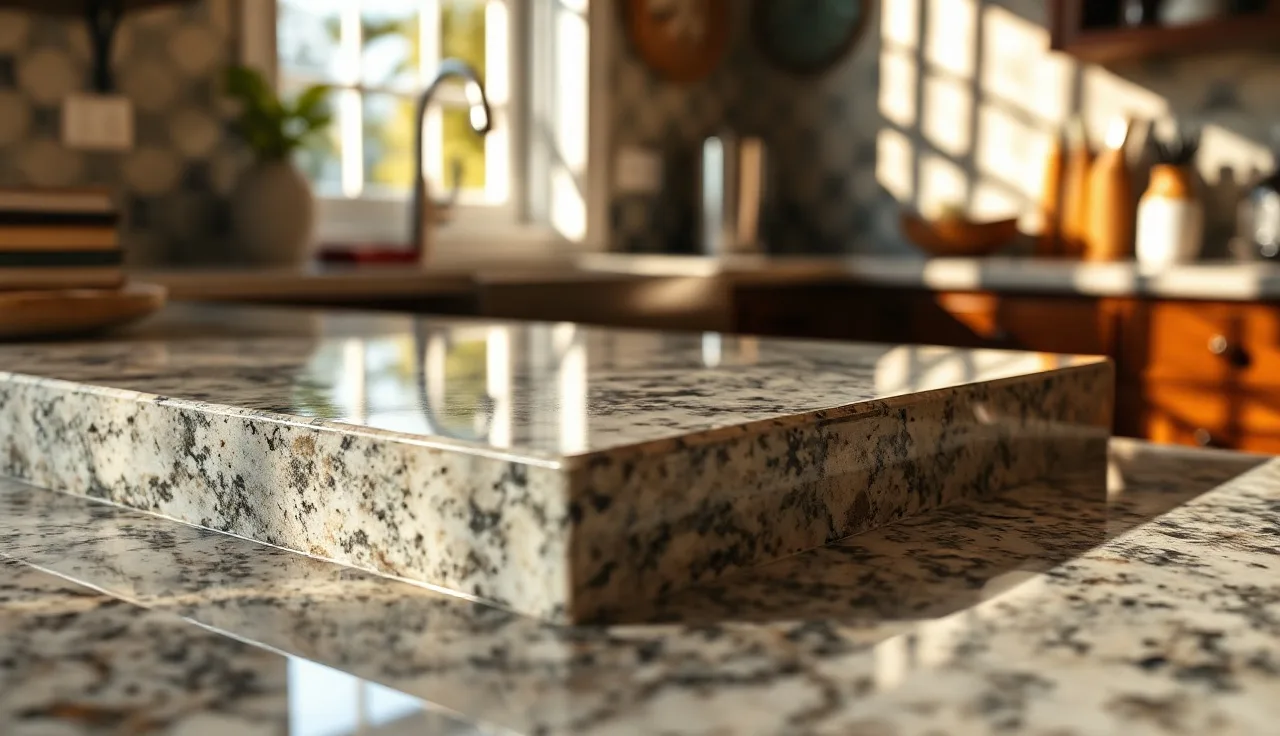
- A regular dupont edge has a flat vertical face with a small top bevel, then a step and short reveal near the bottom.
- A cove dupont adds a concave scoop at the top before that classic step, so the edge reads softer and more sculpted.
- The cove takes extra grinding and polishing, so it usually costs $5 to $15 more per linear foot than a standard dupont.
What does a dupont edge actually look like?
The dupont is one of the older profiles in the countertop playbook. The shape goes like this: the top surface meets a small flat or slightly angled bevel, the stone drops down a vertical or near-vertical face, then there is a small inward step near the bottom, and the edge finishes with a short reveal that angles or curves back under the slab. That step-and-reveal combination is what makes a dupont a dupont. It has a vaguely Art Deco feeling. A little architectural, a little old-world European kitchen.
Fabricators call the dupont a compound profile because the tool path changes direction more than once. A simple eased edge or a half-bullnose is one continuous curve or one flat grind. A dupont involves at least two distinct shape changes, which means more passes and more time at the CNC or the edge polisher.
The name is shop slang, not a trademark or a standardized term. Different shops call slight variations by the same word, which trips up homeowners who show a photo to a fabricator in a different city and get a blank stare. Always ask to see a physical sample edge or a detailed profile drawing before you sign off on any compound profile.
What makes the cove dupont different from a standard dupont?
The cove dupont keeps everything about the classic dupont and adds a concave scoop at the very top, right where the flat counter surface rolls into the vertical drop. Instead of flat-then-straight-down, it goes scoop-then-straight-down-then-step. That one change does a lot to the look.
The concave top softens the hard corner you get on a standard dupont. Light catches the scoop differently than it catches a flat bevel, so the edge reads as more dimensional, almost jewelry-like when you run a finger across it. On a 3 cm slab (standard thickness for stone countertops), the cove adds depth without making the edge feel heavy or fussy.
Here is what a fabricator notices at the machine. The cove needs a dedicated concave wheel on top of the wheels the standard dupont already uses. That means one more tool change and one more polishing pass. On a CNC edge machine, programming the cove radius is straightforward. On a manual edge polisher, holding a consistent radius across a long run is slow and unforgiving. A flat spot in a hand-ground cove jumps out, because your eye follows the curve and stops right where it fails.
Because of that extra work, a cove dupont runs $5 to $15 per linear foot above a standard dupont at most U.S. shops, and the gap widens on very thick material or hard stones like quartzite [1].
How do fabricators actually machine the cove dupont?
On a CNC edge machine, the cove dupont runs as a multi-step profile. The machine uses a ball-nose or cove wheel for the top concave section, then a flat wheel for the vertical face, then a step wheel or a combination of passes for the notch and lower reveal. The full sequence takes three to five separate tool passes depending on the tooling setup.
Manual fabrication, meaning a hand-guided edge polisher on a bridge saw table, is harder to keep consistent. Good fabricators use a profile gauge and check the cross-section every few feet to make sure the cove radius hasn't drifted. On a 10-foot run that might mean six or seven checks. Small errors stack up, and raking light finds every one of them.
Some shops split the difference: rough the profile on the CNC, then finish by hand with progressively finer pads. You get CNC-accurate geometry with the hand-polished surface some clients want on natural stone.
Shops quoting cove dupont at volume should track real time-per-foot by stone type. Granite and quartz are predictable. Quartzite and dolomite swing hard on hardness, so a flat per-foot price can eat margin before you notice. Fabrication software like SlabWise lets you attach edge-specific time and cost modifiers to each profile so the quote matches what the shop actually spends.
Which stones work best with a cove dupont edge?
The cove dupont shows up most on granite and engineered quartz, the two most common countertop materials in U.S. homes [2]. Both machine and polish predictably, and the concave section comes out with an even sheen.
Marble is a natural match on looks. The traditional European kitchen feeling the dupont family carries fits marble's character. The catch is hardness. Marble sits around Mohs 3 to 4 against granite's roughly 6 to 7, so the tight inside corner of the scoop can chip during fabrication if wheel speed and feed rate aren't dialed in [3]. A fabricator who works marble often handles this fine. A shop that rarely touches it can hand you a chipped cove.
Quartzite and other hard natural stones are where the labor gets expensive. Some quartzites test above 7 on the Mohs scale, so wheel wear is high and polishing drags. The extra passes for the cove can add 20 to 30 minutes per linear foot over a simple eased edge. That cost belongs in the quote, not the owner's memory.
Soapstone and softer limestones carve to a cove dupont easily, but the same softness means the inside corner chips in daily use more than in the shop. Bang pots against a soft-stone cove and it will wear in that scoop over time.
For granite countertops specifically, the cove dupont is a safe pick. Granite's hardness holds a clean inside corner without chipping under normal use.
How much does a cove dupont edge cost compared to other profiles?
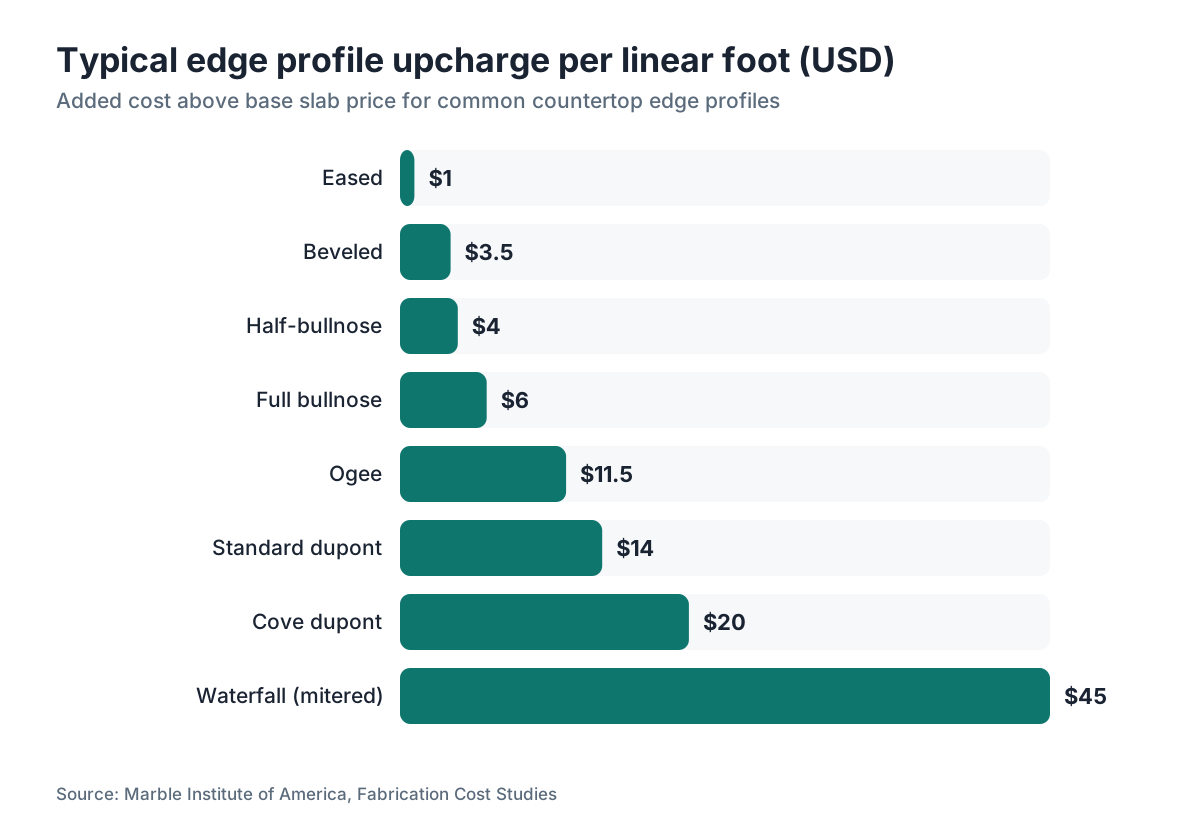
Edge pricing moves with region, shop overhead, and material, but the table below shows where the cove dupont sits against other common profiles. These figures are the edge upcharge above the base slab cost per linear foot, based on typical U.S. shop pricing reported by the Marble Institute of America and common shop rate surveys [1][4].
| Edge Profile | Typical Upcharge (per linear foot) | Relative Fabrication Complexity |
|---|---|---|
| Eased (flat with soft top break) | $0, $2 | Very low |
| Beveled (flat face, angled top) | $2, $5 | Low |
| Half-bullnose | $2, $6 | Low |
| Full bullnose | $4, $8 | Medium |
| Ogee | $8, $15 | Medium-high |
| Standard dupont | $10, $18 | High |
| Cove dupont | $15, $25 | High |
| Waterfall (mitered) | $30, $60+ | Very high |
The cove dupont sits about $5 to $7 per linear foot above a standard dupont in most shops, and the gap grows on difficult stones. A kitchen with 30 linear feet of edge would run $150 to $210 more for a cove dupont than for a plain eased edge, and $150 to $300 more than a standard dupont [1][4].
Here is a line item people forget. Many shops charge a flat setup fee for complex profiles, sometimes $50 to $100, covering the time to program the CNC or change tooling. Ask about it upfront so the quote holds no surprises.
Is a cove dupont edge harder to clean and maintain?
Any concave geometry collects more grime than a flat or convex edge. The scoop at the top of a cove dupont is a natural landing spot for crumbs, cooking residue, and cleaner buildup. Not a dealbreaker. You just have to wipe into the curve on purpose instead of swiping across the face.
A damp microfiber cloth folded to a point, or a soft toothbrush, gets into the cove without scratching the polish. On polished granite or quartz, the sealed surface wipes down fast. On honed or leathered finishes, the texture in the cove holds more residue and needs a more careful pass.
For stone-specific cleaning guidance, see how to clean stone countertops.
Sealing matters too. On porous natural stone, the inside corner of the cove holds moisture longer than the flat surface, so an under-sealed stone stains there first. The Marble Institute of America recommends penetrating (impregnating) sealers over topical coatings for natural stone [10]. Those protect from within instead of forming a film that can crack right at the curve.
The lower step and reveal, the part shared with a standard dupont, is barely a cleaning issue. It faces down and doesn't catch debris the way the upward-facing cove does.
When should a homeowner choose a cove dupont over a standard dupont?
Choose the cove dupont if you want a sculptural, high-end edge and you're willing to pay for the extra work. It reads more custom than a standard dupont, especially on thick slabs where the top-of-edge detail sits at eye level when you're seated at an island.
Stick with the standard dupont if you want a classic traditional look without the upcharge, or if the stone is hard and brittle enough that you'd rather skip the extra passes. The standard dupont is also the safer call when your fabricator is newer or light on CNC experience with compound concave profiles.
For kitchen countertops in a transitional or traditional style, either profile fits. Contemporary and minimalist kitchens read better with simpler edges (eased, beveled, or mitered), so if your kitchen runs modern, neither dupont is the natural pick.
One honest note. The difference between these two profiles is subtle enough that most people who visit your home will never notice it. The choice matters to you, the person who looks at and touches the counter every day. If you find the cove dupont beautiful and the budget allows, get it. If you're indifferent, save the money and spend it on a better stone or a thicker slab.
Does the cove dupont work on all countertop thicknesses?
The cove dupont is built for standard 3 cm slabs (roughly 1.25 inch). At 3 cm there is enough vertical height on the edge face to fit the cove, the straight drop, the step, and the reveal without anything looking squeezed.
At 2 cm the profile is possible but compromised. The cove radius has to shrink, the step gets shallower, and the whole thing loses the proportion that makes it worth paying for. Many fabricators steer you away from a full cove dupont on 2 cm material. They're right to.
Mitered or laminated edges, where two pieces of stone are joined to fake extra thickness, sometimes give a 2 cm slab a 3 cm or even 5 cm face. You can absolutely run a cove dupont on a laminated edge, but the miter seam has to land where the profile geometry hides it, which takes planning during templating. A good fabricator handles this without being asked. Confirm it at the template visit anyway.
On very thick furniture-edge slabs at 4 to 5 cm, the cove dupont scales up and looks dramatic, especially on marble countertops with strong veining that a thick profile puts on display.
How do fabricators quote and template for a cove dupont edge?
At templating, the fabricator measures the linear footage of edge that gets the profile. That usually covers the exposed front edge and any visible sides, and skips the backsplash edge and the wall-side edges nobody sees.
For the cove dupont, the templater should flag inside corners, like the elbow of an L-shaped kitchen. Inside corners on compound profiles need special attention. Machining a cove dupont on both legs means two complex profiles meet at a 90-degree interior angle. A CNC router handles that. A manual edge machine can't do it cleanly without custom grinding. Some shops charge a per-corner premium for inside corners on complex profiles.
On the quoting side, edge costing is one of the spots where shops quietly lose money. Quote every complex profile at the same rate and you underprice the cove dupont while overpricing the simpler ones, which warps the whole business. The Marble Institute of America has noted that edge profiling is one of the most variable cost centers in a fabrication shop, with labor time differences of 2x to 4x between simple and complex profiles on the same material [4].
Shops running quoting software can tag the cove dupont as its own line item with its own per-foot rate and setup fee, so every quote prices it right on its own. That level of job-costing separates a shop that knows its margins from one that hopes for the best.
Are there other edge profiles similar to the cove dupont that homeowners confuse it with?
Yes, and the confusion is fair, because shops don't share standard profile names across the industry. Here are the profiles people mix up with the cove dupont most often.
The standard dupont is the parent. No cove at the top. Just a flat or slightly beveled top edge into the vertical drop and step.
The ogee is the one people confuse it with most. An ogee is a single flowing S-curve, convex on top and concave below (or the reverse). It has no step-and-reveal, which is exactly what defines a dupont. Ogees look classical and ornate. Duponts look architectural.
The cove ogee (sometimes called a reverse ogee with cove) is a different animal. It opens with a cove at the top, rolls into a convex bulge, and finishes at the bottom. No dupont step. It gets tangled with the cove dupont because both start with a scoop.
The waterfall edge is a mitered edge where the slab wraps over the front and drops to the floor. Nothing to do with dupont geometry, but clients sometimes ask for it after seeing dupont in a design article and misreading a caption.
The fix for all of this is simple. Ask the fabricator for a physical sample block or a precise cross-section drawing labeled with the name they use. A photo is second-best, because lighting angle distorts how an edge reads. If you're working from a photo you found online, bring it to the shop and hold it up against their sample edges before you commit.
For engineered stone like Cambria countertops, the manufacturer may have its own named edge profiles, some of which look like a cove dupont under a proprietary name.
What do fabricators and designers actually think of the cove dupont?
Opinions split, which is the honest answer. Among fabricators, the cove dupont has a reputation as the profile that separates shops with good tooling from shops without. A clean cove dupont is genuinely beautiful. A bad one, with a wandering cove radius or a chipped inside corner, looks worse than a plain eased edge. There is no hiding sloppy work on a compound concave profile.
Designers reach for it in traditional and transitional kitchens and baths, where the client wants something richer than a bullnose but not as ornate as a full ogee. It pairs well with raised-panel cabinetry and furniture-style islands. In a contemporary space it can look out of place.
Some fabricators avoid recommending it, not over quality but over throughput. A cove dupont on a full kitchen (30-plus linear feet) ties up the CNC or edge polisher a lot longer than an eased-edge job. For a busy shop on a tight schedule, that time is real.
Homeowners who choose it and get clean work almost always love it. The profile has a tactile quality. Running your hand along a polished cove dupont in granite feels different from any flat edge, and that difference reads as quality even to people who can't name what they're touching.
For countertop installation in general, pick the edge profile before the template visit, not after. Switching from a cove dupont to a standard dupont after the slab is cut and roughed is possible, but it burns shop time and can shift the slab's dimension if more material has to come off.
Frequently asked questions
Is a cove dupont edge the same as an ogee edge?
No. An ogee is a continuous S-curve with no step or reveal at the bottom. A cove dupont has a concave scoop at the top, then a vertical drop, then a distinct horizontal step, then a lower reveal. The ogee looks flowing and classical. The cove dupont looks architectural. They use different wheel profiles and are not interchangeable terms.
Can a cove dupont be done on quartz or engineered stone countertops?
Yes, and it's common. Engineered quartz machines consistently because it's homogeneous, so the cove radius stays even across the run. Major quartz brands including Silestone, Cambria, and Caesarstone are fabricated on CNC edge machines, and cove dupont is a standard option at most authorized fabricators. Expect the same $5 to $15 per linear foot premium over a standard dupont that you'd pay on natural stone.
How do I ask my fabricator for a cove dupont without using the wrong name?
Ask for a cove dupont, then describe it: a concave scoop at the top of the edge, then a straight vertical drop, then a step near the bottom with a small lower reveal. Better yet, ask to see their physical sample boards. Profile names vary by region and shop, so a sample removes all doubt. If they show you an ogee and call it a cove dupont, you'll spot the difference right away.
Does a cove dupont edge chip more easily than a flat edge?
The inside corner of the cove is the weak point. On hard stones like granite and quartzite it holds up well in normal use. On softer stones like marble (Mohs 3 to 4) and soapstone, the scoop can chip if someone hits it hard with a pan or tool. Clean fabrication leaves no micro-fractures in the cove, which cuts chipping risk. A poorly machined cove corner on soft stone chips faster.
How long does it take a fabricator to machine a cove dupont edge?
On a CNC edge machine with proper tooling, a cove dupont runs roughly 2 to 3 minutes per linear foot including polish passes, against under a minute for a simple eased edge. On a manual polisher, budget 4 to 6 minutes per foot or more on hard stone. For a 30-foot kitchen, that's the difference between a 30-minute edge job and a 90 to 150-minute one, which is where the upcharge comes from.
Can I get a cove dupont on a laminate countertop?
No, not a true one. Laminate countertops use post-formed plastic edges or applied edge banding, and neither replicates a compound stone profile. Some high-end laminate products offer decorative edges, but those are molded plastic shapes, not ground stone. If a cove dupont matters to you, you're in natural stone, engineered quartz, or solid surface, not laminate.
What is the standard size (radius) for the cove in a cove dupont?
There is no industry-standard radius. Typical cove radii run from about 3/8 inch to 5/8 inch depending on the shop's tooling and the profile's proportions on a given slab thickness. A larger radius looks softer and more pronounced. A tighter one reads as a subtle detail. Ask your fabricator to show samples with different cove sizes before you choose.
Is the cove dupont a good choice for a bathroom vanity top?
It's a solid pick for a traditional or transitional bathroom. A vanity usually has under 6 linear feet of exposed edge, so the total upcharge stays modest, often under $100 for the whole job. The cleaning caveat holds: the cove collects toothpaste and soap residue, so wipe it with a pointed cloth or soft toothbrush. On a marble vanity, confirm the fabricator has machined concave profiles in marble without chipping.
Does a cove dupont edge affect how the countertop looks from a seated position at an island?
Yes, and that's the strongest argument for it on an island. At seated eye level (roughly 28 to 30 inches off the floor on a counter-height island), you see the edge profile head-on. The cove dupont's complexity reads as a design detail from that angle in a way it doesn't when you're standing over the counter. If your island gets regular barstool use, the cove dupont shows its best side.
How does a cove dupont edge hold up over 10-plus years?
On granite, quartz, or hard quartzite, a properly machined cove dupont holds its shape indefinitely. The polish in the scoop may need refreshing after 10 to 15 years depending on use and cleaning habits, but the geometry doesn't move. On marble or softer stones, expect some rounding and minor wear in the tight corners over a decade of daily use. That's mostly aesthetic and easily refinished by a stone restoration pro.
What is the difference between a cove dupont and a double dupont edge?
A double dupont repeats the step-and-reveal geometry twice on the same edge face, giving you two stacked notches on a thick slab. There is no concave cove at the top. It looks more ornate than a single dupont. A cove dupont has exactly one dupont step but adds the scoop at the top. Different profiles, though both are compound profiles that need multiple passes.
Does edge profile choice affect countertop resale value?
No reliable data shows any specific edge profile adds measurable resale value. Research on kitchen renovations points to material quality and countertop condition as what buyers notice, not profile style. A clean, unchipped cove dupont on good granite reads as a quality kitchen. A chipped or poorly polished profile on any stone reads as deferred maintenance. Condition beats profile choice every time.
Sources
- Marble Institute of America (MIA), Dimensional Stone Design Manual: Edge profile upcharge ranges and fabrication complexity classifications for common stone countertop profiles
- U.S. Census Bureau, American Housing Survey: Granite and engineered quartz are the two most common countertop materials in U.S. homes
- National Institute of Standards and Technology (NIST), Mohs Hardness Scale reference: Marble hardness approximately Mohs 3 to 4; granite approximately Mohs 6 to 7, affecting fabrication chipping risk
- Marble Institute of America (MIA), Fabrication Cost Studies: Labor time differences of 2x to 4x between simple and complex edge profiles on the same material, and edge profiling as a variable cost center in fabrication shops
- U.S. Geological Survey, Mineral Commodity Summaries (Stone, Dimension): Production and use data for granite, marble, and other dimension stones used in countertop fabrication
- National Kitchen and Bath Association (NKBA), Kitchen and Bath Market Index: Edge profile selection trends and countertop style preferences in kitchen and bath remodeling
- Occupational Safety and Health Administration (OSHA), Silica in Construction: Stone Fabrication: Stone fabrication work including edge grinding and polishing generates respirable crystalline silica dust, a regulated workplace hazard
- Home Innovation Research Labs, Annual Builder Practices Survey: Countertop material market share data showing quartz and granite as leading materials in new construction and remodeling
- Harvard Joint Center for Housing Studies, Improving America's Housing (kitchen remodeling cost-value data): Kitchen renovation resale value data showing material quality and condition matter more than specific design details like edge profile
- Marble Institute of America (MIA), Care and Cleaning Guide for Natural Stone: Penetrating (impregnating) sealers recommended over topical coatings for natural stone, especially in concave profile areas prone to moisture retention
Last updated 2026-07-11