TL;DR
- A DuPont edge stacks three shapes: a narrow flat land on top, a concave cove in the middle, and a rounded roundover at the bottom.
- Cutting one on granite takes a CNC router or a skilled hand grinder with a matched DuPont diamond bit, a grit sequence from 50 up to 3,000, and roughly 20 to 40 minutes per linear foot by hand.
What exactly is a DuPont edge on granite?
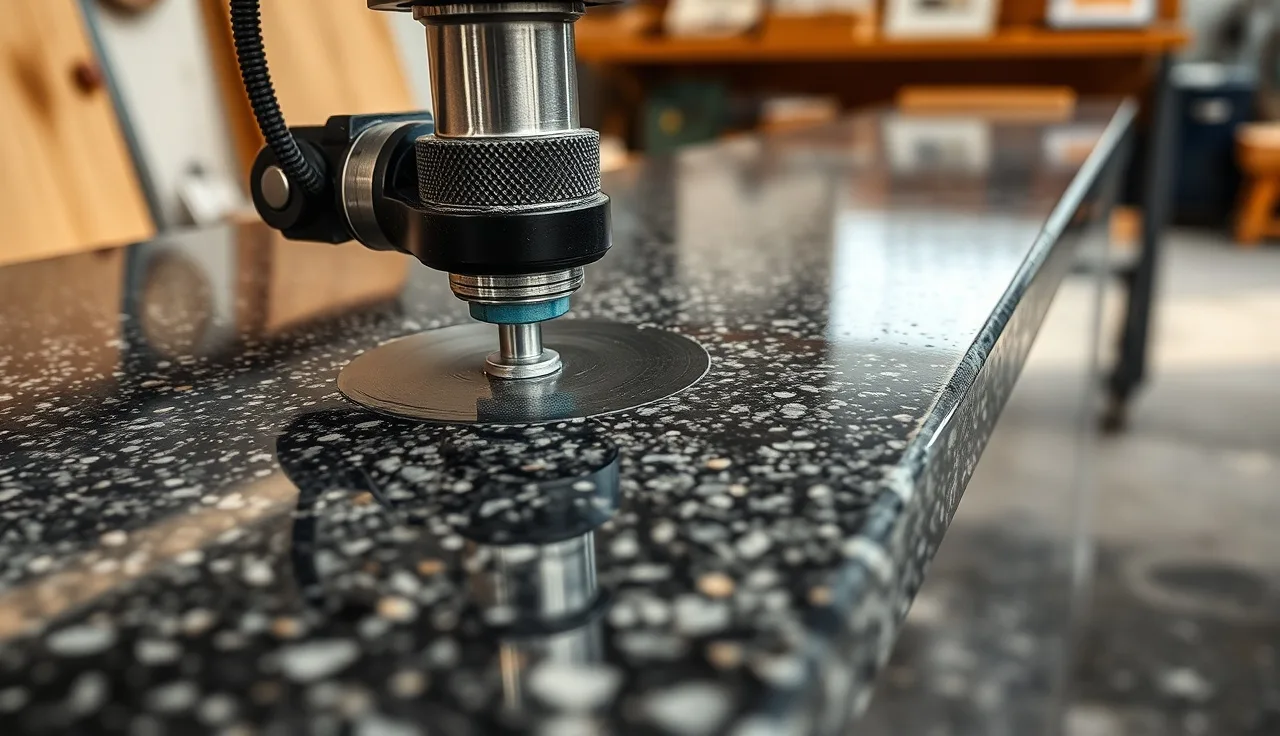
A DuPont edge is three shapes stacked on the front face of the slab. From top to bottom: a narrow flat land (usually 1/8 to 3/16 inch), a concave cove that sweeps inward, then a full convex roundover at the bottom. Look at it from the side and it reads like furniture trim.
People mix it up with the ogee. An ogee has an S-curve, no flat land, no cove before the roundover. The DuPont packs more into less space. It changes geometry three times in about 3/4 to 1-1/4 inches of vertical face, and the exact height depends on slab thickness and the bit profile you order.
Stone tooling catalogs put the DuPont near the top of the request list. Suppliers like Weha and Alpha Professional Tools stock it as a standard premium profile. The Natural Stone Institute (formerly the Marble Institute of America) documents it in its Technical Manual as a compound edge profile that needs multi-step tooling [1].
Why is granite harder to profile than limestone or travertine? Hardness. Granite sits at roughly 6 to 7 on the Mohs scale, limestone at 3 to 4 [2]. Harder stone chews through tooling faster, punishes bad water flow, and chips in ways you cannot hide. One careless pass on the cove or the flat land is a mistake you carry to install day.
What tools do you need to fabricate a DuPont edge?
Two real paths exist: a CNC router or a hand router with an angle grinder for cleanup. Here is the honest comparison.
| Tool path | Upfront cost | Time per linear foot | Consistency | Skill floor |
|---|---|---|---|---|
| CNC bridge saw + router | $60,000-$200,000+ | 5-12 min (machine time) | Very high | Low (once programmed) |
| Pneumatic hand router + DuPont bit set | $800-$2,500 (tooling) | 25-45 min | Moderate | High |
| Angle grinder with profile cup wheels | $200-$600 (tooling) | 35-60 min | Low-moderate | Very high |
CNC work needs a DuPont profile file loaded into your CAM software and a matched DuPont router bit. Weha, Alpha, and Stadea all sell DuPont profile bits for CNC spindles, usually $90 to $250 per bit depending on diameter and bond type [7].
Hand work needs less money and more skill. The core kit: a pneumatic or electric hand router (Mako, Flex, and Metabo are common shop picks), a DuPont profile bit matched to your slab thickness (3/4 inch or 1-1/4 inch), a fence guide or router table if you want any repeatability, and a polishing pad set running from 50 grit up through 3,000 or 8,500 grit depending on the finish you want.
Water is not optional. Dry cutting granite throws silica dust that causes silicosis, a scarring lung disease that has no cure and keeps progressing even after the exposure stops [6]. Every pass runs wet, roughing and polishing alike. A recirculating system or a continuous drip cools the bit and holds the dust down.
Safety gear runs short but matters: a NIOSH-approved N95 or better respirator, a face shield, ear protection (pneumatic routers hit 90 to 100 dB), and water-resistant gloves. OSHA's silica rule, 29 CFR 1926.1153, caps respirable crystalline silica at 50 micrograms per cubic meter as an 8-hour time-weighted average [3].
What is the step-by-step process for routing a DuPont edge?
Square the edge first. Before a router bit touches stone, the slab has to be cut to final size and the front face has to sit at a true 90 degrees. A bowed or out-of-square starting edge telegraphs through every step that follows. Run a straightedge along the cut face and fix any waves before you profile.
Step 1: Rough profile pass. Mount the DuPont bit. Set depth so the bit removes stock without trying to hog the whole profile at once. On granite you take two roughing passes, one at about 60 percent depth and one at full depth. Feed rate decides everything here. Too fast chips the cove. Too slow burns the bit and glazes the stone. Most hand fabricators hold around 2 to 3 inches per second on the rough pass.
Step 2: Check the profile. Stop. Dry the edge. Look at it in raking light. The flat land, the cove, and the roundover should all read clearly and sit in proportion. If the cove is undercut or the flat land vanished, your depth was wrong.
Step 3: Run the grit sequence. Switch to profile polishing pads matched to your DuPont geometry. The order most granite shops use: 50 grit for scratch removal, then 100, 200, 400, 800, 1,500, and 3,000, followed by a polishing compound or a buff pad. On very hard granite some fabricators jump 50 to 200 because the middle grits cut too slow to earn their time. Test on scrap from the same slab before you commit.
Step 4: Polish to match the face. A polished edge should read at the same reflectivity as the polished face of the slab. This is where good DuPont edges separate from great ones. The cove fights you because your pad has to bend into the concave shape. Flexible profile pads (sometimes called finger pads or flexible snail lock pads) exist for exactly this.
Step 5: Final inspection. Wet the edge, drop the light to a low angle, and look. Scratches from a skipped grit show up as haze or lines. See any, and you go back two grit steps and work forward again.
Step 6: Seal if the spec calls for it. Many shops seal the edge with the field of the slab after install. On the edge, watch the cove, which holds water if it goes unsealed.
How long does it take to fabricate a DuPont edge on granite?
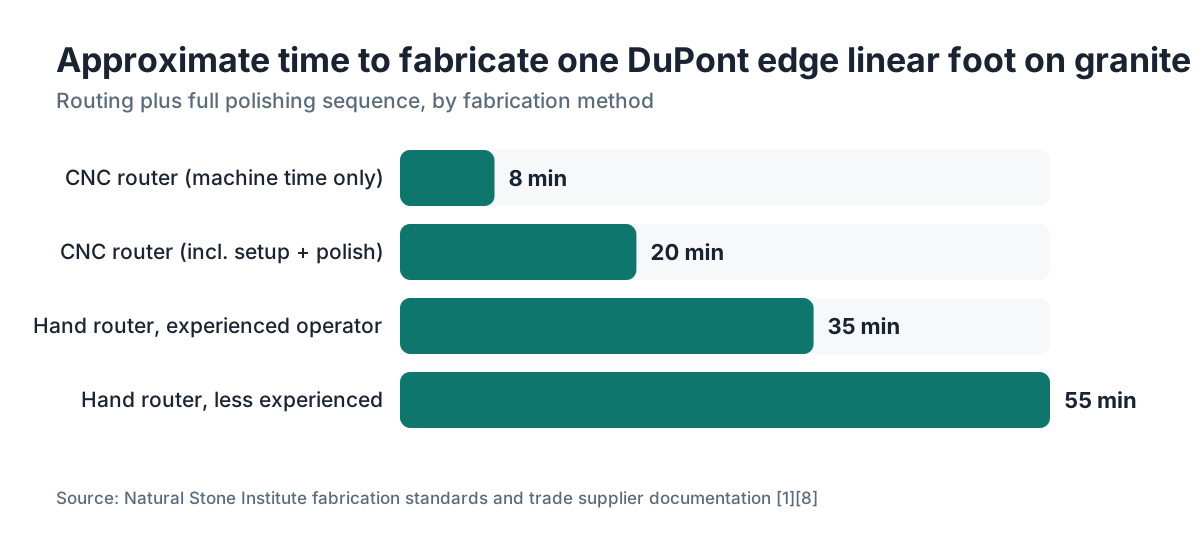
By hand, an experienced operator runs 25 to 45 minutes per linear foot. That is the honest range. A fabricator doing their first DuPont edges should budget 45 to 60 minutes per foot and expect to waste a practice piece or two.
CNC cuts machine time to roughly 5 to 12 minutes per linear foot, but setup, program checks, and polishing still eat the clock. A typical kitchen with 25 linear feet of DuPont edge takes 3 to 5 hours of CNC time plus polish and cleanup. The same job by hand is an 8 to 15 hour effort.
The cove is the time sink. A flat or round surface polishes fast. A concave cove that has to come up to mirror without burning the flat land next to it or thinning the roundover is where hours disappear. Plenty of experienced fabricators spend as much time polishing the profile as they spent routing it.
On price: moving from a standard eased or beveled edge to a DuPont usually adds $10 to $30 per linear foot to a quote, depending on shop location, machine type, and market. High-cost metros run $35 to $50 per foot for compound profiles like this. Those are rates seen across fabricator forums and bid comparisons. No single industry body publishes a formal survey of edge upcharges, so treat them as directional, not gospel.
What are the most common mistakes when cutting a DuPont edge?
Trying to cut the whole profile in one pass. Granite chips clean under an overloaded bit, and the thin flat land at the top of the DuPont is the first thing to go. Take two passes. Always.
Using the wrong bit for the slab thickness. A DuPont bit built for 3/4-inch material run on a 1-1/4-inch slab leaves the bottom roundover unfinished and throws the whole proportion off. Measure the slab before you order tooling.
Starving the cove of water. The cove is a narrow channel and water does not always reach into it. Some fabricators aim a small second water feed straight at the cove during routing. Others tilt the slab so gravity carries the flow in. Either works. Doing nothing does not.
Rushing the polish. Jump from 100 grit to 1,500 grit and the scratches show. A 100-grit pad leaves scratches around 100 microns wide; a 1,500-grit pad clears scratches around 10 microns wide. You cannot remove a 100-micron scratch with a 1,500-grit pad in any time you can afford.
Skipping the cove when you seal. That concave channel collects water and food. Granite porosity swings hard from slab to slab (some seal tight, some drink), and an unsealed cove can stain faster than the open field of the slab.
Can a homeowner fabricate a DuPont edge, or does it require a professional?
Honest answer: almost no homeowner should try this. Here is why.
Tooling alone runs $500 to $2,500 for bits and pads if you buy it right. You will ruin at least one practice piece before the profile comes out clean, and granite remnants run roughly $5 to $30 per square foot [4]. The silica hazard during any hand grinding is real, and it needs respiratory protection most homeowners neither own nor want to wear through a long session [6].
Now, if you run a fabrication shop and want to add DuPont profiles to your menu, the skill is learnable. Most fabricators who have already done eased and ogee edges pick up the DuPont in a few practice sessions on remnants. The muscle memory for feed rate and pad pressure carries straight over.
For homeowners, spend your energy on picking the right fabricator and learning what a well-cut DuPont edge should look like, so you can judge the work before you sign off. The sections above on common mistakes and the grit sequence give you the eye to inspect it.
Comparing bids or trying to see how edge upgrades move your total? granite countertops breaks down how profile complexity feeds into pricing, and countertop installation covers what happens on install day.
What router bits work best for a DuPont edge on granite?
You need a DuPont-profile diamond router bit rated for hard stone (granite, quartzite, engineered stone). A carbide bit built for wood will not survive one pass on granite.
Diamond stone bits come in two bond types. Sintered bits are hot-pressed, with diamond abrasive running all the way through the metal bond. Electroplated bits carry a single layer of diamond crystals nickel-bonded to a steel shank. For granite edge profiling, sintered bits win: they last longer and hold their shape through the full grit sequence. Electroplated bits cost less but wear faster and can lose profile accuracy in the middle of a project, which is the worst time to find out.
The shank has to match your collet. Most hand routers in stone shops run a 5/8-inch-11 thread. CNC spindles take the machine's collet size, usually 1/2 inch or 20mm depending on brand.
Brands that come up over and over in fabrication forums: Alpha Professional Tools, Weha, Stadea, and Makita-compatible sets from distributors like Braxton-Bragg [7][8]. A sintered DuPont bit for hand routers runs roughly $90 to $180, CNC-grade bits $150 to $280. Those are mid-2025 prices, and bit prices track diamond commodity costs, which move.
A sintered DuPont bit handles 300 to 600 linear feet on granite before the profile visibly degrades. That number swings with granite hardness, water cooling, and operator technique, so track your footage per bit and swap it before quality drops, not after you find a bad edge on an installed piece.
How do you polish a DuPont edge to a mirror finish on granite?
A mirror finish on a DuPont edge runs the same grit progression you use on the slab face, but the shape makes it harder. The cove is concave and narrow, so a flat pad cannot touch it evenly.
The fix most fabricators reach for is a flexible profile pad, sometimes called a finger pad or a profile-specific flexible pad. These come cut to the full DuPont profile and bend into the cove while still riding the flat land and the roundover. Alpha and Weha both sell DuPont-specific flexible polishing sets [7][9].
The grit sequence for a high polish on granite: 50 grit to set the scratch, then 100, 200, 400, 800, 1,500, and 3,000, then a polishing compound (tin oxide or cerium oxide slurry) on a buff pad. Some shops add an 8,500-grit or a burnishing step at the very end. The Natural Stone Institute's Technical Manual recommends reaching at least 1,500 grit before any final compound goes on polished granite [1].
RPM matters at every step. Roughing passes run 2,000 to 3,500 RPM. Polishing pads run 3,000 to 5,000 RPM, depending on what the pad maker says. Push a flexible pad too fast on a concave surface and the heat can start micro-cracking in some granites.
Water stays on through the grit sequence, though some fabricators shift to damp-only for the final two steps to read the finish better.
The finished cove should reflect light exactly like the flat land and the roundover. Hold a flashlight at about 10 degrees to the edge and hunt for haze in any zone. Haze means the previous grit needs more time.
How does a DuPont edge hold up over time, and is it hard to clean?
Durability is good, with one weak spot: the thin flat land at the top. On a well-cut DuPont that flat runs 1/8 to 3/16 inch wide, and a hard hit (a cast iron pan dropped straight on the edge) can chip or crack it. Eased and bullnose edges shrug off impacts better because they have no abrupt geometry to catch the blow.
For daily use the DuPont on granite holds up fine. Granite resists scratching at Mohs 6 to 7 [2]. The polish itself protects the crystal structure, and as long as you keep the polish up, the edge behaves like any polished granite surface.
Cleaning comes down to the cove. Grease, food, and mineral scale from water build up in that concave channel. A soft brush (a toothbrush does it) with mild dish soap clears it without scratching. Keep abrasive scrubbers off the polished surface. For maintaining stone surfaces generally, how to clean stone countertops covers safe products and what to skip.
Reseal the cove along with the rest of the counter. Stone care guidelines recommend resealing granite every 1 to 3 years depending on porosity and use [5]. Put sealer on the edge with a light hand and wipe the excess off the vertical face before it dries, or you get streaking on the polish.
How does a DuPont edge compare to similar profiles like the ogee or the waterfall?
| Profile | Geometry | Visual weight | Difficulty | Typical upcharge ($/LF) |
|---|---|---|---|---|
| Eased | Slightly softened top corner | Minimal | Low | $0-$3 |
| Beveled | Flat angled cut at top | Light | Low | $2-$8 |
| Bullnose | Full half-round | Rounded, soft | Medium | $5-$12 |
| Ogee | S-curve | Traditional, ornate | Medium-high | $8-$18 |
| DuPont | Flat land + cove + roundover | Layered, formal | High | $10-$30 |
| Waterfall/Mitered | Slab runs vertical to floor | Dramatic | Very high | $40-$150+ |
The DuPont sits above the ogee in difficulty because it changes shape more times in a shorter vertical run. The ogee's S-curve is one continuous compound curve. The DuPont has a distinct flat land that has to stay flat and a distinct cove that has to stay concave and polished, and neither forgives a wandering pass.
Visually the DuPont reads more formal and more like furniture than an ogee. Designers tend to spec it on thick slabs (1-1/4 inch, or mitered to look like 2 or 3 inches) where the stacked look shows best. On a 3/4-inch slab the profile compresses, so confirm slab thickness before you commit.
Comparing edge styles as a homeowner? The ogee is a fair middle ground: complex enough to look premium, easier to cut, a little cheaper. If the DuPont pulls at you for looks, make sure your fabricator has cut it before and can hand you a physical sample, more than a catalog photo.
How do fabricators price and quote a DuPont edge job accurately?
Edge profiles are one of the most underpriced lines in stone fabrication. Shops set a flat per-foot rate and never account for the real time and tooling gap between an eased edge and a compound one.
For a DuPont, the cost drivers are slab hardness (exotic granites with heavy quartz veining eat bits faster), total footage (more feet spreads the setup cost), machine type (CNC versus hand), and whether the edge needs a mitered laminate to build the full look on a thin slab.
A CNC shop can price DuPont edges tighter because machine time is predictable and repeatable. A hand shop has to price the operator's time plus tooling wear. The honest per-foot cost to a hand shop on granite is roughly $8 to $20 in labor and tooling alone, assuming a $25 to $40 per hour effective shop labor rate and 25 to 45 minutes per foot, before overhead.
Quoting software lets shops build each edge profile as its own line item with its own per-foot rate. SlabWise, for one, lets you set separate per-foot pricing for each profile, so a DuPont prices out differently from an eased or bullnose automatically when a quote builds off a template. That keeps margin steady across jobs without hand-recalculating every bid.
Homeowners: ask for edge pricing as a separate line, not baked into the square-foot number. Then you can compare bids straight across and dial the edge up or down without touching your slab choice.
What granite characteristics make a DuPont edge look better or worse?
Granite is not one material. It runs from tight-grained black absolute to coarse exotics carrying 2 to 3 inch crystals and heavy veining, and the DuPont shows differently on each.
Tight, uniform granites (Black Galaxy, Uba Tuba, Absolute Black) take a DuPont beautifully. Fine grain means all three zones polish to mirror with little chipping risk, and the narrow flat land holds together because there are no big crystal boundaries for a fracture to run along.
Coarse-grained granites with large feldspar or quartz crystals (Blue Bahia, some Azul Imperials, Juparana varieties) chip more easily on the flat land and at the cove transition. A good fabricator still gets a clean DuPont out of them, but it costs a slower roughing pass and more polishing time.
Veined granites (anything with obvious movement) add a look variable. The cove cuts across the vein pattern and gives the edge a different texture than the flat face. Some people love how the veins wrap the profile. Others find it busy. Get a sample with the actual edge cut before you pair a heavy vein with a DuPont.
For how granite type feeds into other maintenance and appearance questions, see granite countertops.
Frequently asked questions
Can you put a DuPont edge on a 3/4-inch granite slab?
Yes, but it looks compressed. The DuPont's three zones (flat land, cove, roundover) want at least 1-1/4 inches of vertical face to display well. On a 3/4-inch slab the profile is still correct, but the cove goes very narrow and the effect turns subtle. Most fabricators recommend either a 1-1/4-inch slab or a mitered laminate to add apparent thickness before cutting the profile.
How much does a DuPont edge cost compared to a standard eased edge?
A standard eased edge adds $0 to $3 per linear foot over the base slab price. A DuPont adds $10 to $30 per linear foot at most shops, with some high-cost metros charging $35 to $50. On a typical kitchen with 25 linear feet of edge, that is $250 to $750 more for the DuPont upgrade. Pricing swings with shop type, machine capability, and local market.
What grit do you start polishing a DuPont edge on granite?
Start at 50 grit after routing to clear the rough tooling scratches, then work through 100, 200, 400, 800, 1,500, and 3,000, finishing with a polishing compound. Skip grits and the scratches show as haze at an angle. The cove needs flexible profile polishing pads, because a flat pad cannot touch the concave surface evenly.
How do you keep water flowing into the cove section during routing?
The cove's concave shape can shadow itself from a top-mounted water feed. Fabricators handle it by aiming a second water nozzle straight at the cove zone, or by tilting the slab so gravity carries water into the channel. Some shops use a foam water guide wrapped around the router base to direct flow toward the bit contact point.
What is the difference between a DuPont edge and an ogee edge?
An ogee is one continuous S-curve with no flat land. A DuPont has a flat land at the top, a concave cove in the middle, and a convex roundover at the bottom. That makes the DuPont more complex to cut and requires a specific multi-geometry bit instead of a standard ogee bit. Visually the DuPont reads more layered and formal; the ogee is softer and more flowing.
How long does a DuPont router bit last on granite?
A sintered diamond DuPont bit lasts 300 to 600 linear feet on granite before the profile visibly degrades. Electroplated bits wear faster, sometimes under 150 feet. Bit life swings with granite hardness, water flow, and feed rate. Track footage per bit and replace it before quality drops, because a worn bit produces an inconsistent profile that is hard to catch until the piece is installed.
Is a DuPont edge more likely to chip than a bullnose or eased edge?
Yes, modestly. The thin flat land at the top is the weak point. A hard impact there can chip it, while a bullnose deflects impacts across a rounded surface with no abrupt transitions. For homes with kids or heavy pot and pan traffic near the edge, a bullnose or eased profile is more forgiving. The DuPont is fine for typical adult household use.
Do you need a CNC machine to cut a DuPont edge, or can it be done by hand?
It can be done by hand with a pneumatic or electric hand router and a matched DuPont diamond profile bit. Hand work takes 25 to 60 minutes per linear foot versus 5 to 12 minutes of CNC machine time. CNC produces more consistent geometry, especially across long runs. Hand work is viable for skilled fabricators but hard for beginners, because feed rate and depth control are entirely manual.
Should a fabricator seal the DuPont edge after polishing?
Yes. The cove traps water and food residue, and granite porosity varies by slab. Apply a penetrating stone sealer to the edge as part of the same process used on the slab face. Pay attention to the cove zone, and wipe excess sealer off the vertical face within the manufacturer's dwell time to prevent streaking or haze on the polished surface.
What OSHA silica rules apply to dry-routing granite edges?
OSHA's standard 29 CFR 1926.1153 sets the permissible exposure limit for respirable crystalline silica at 50 micrograms per cubic meter as an 8-hour time-weighted average. Dry grinding granite generates silica dust well above that threshold. Wet cutting with continuous water suppression is the primary engineering control. Shops must also offer medical surveillance to employees with significant silica exposure under the same rule.
Can a DuPont edge be repaired if it chips?
Small chips in the flat land or at the cove transition can sometimes be filled with color-matched epoxy adhesive, but the repair usually shows on close inspection, especially on polished dark granites. Larger chips may force a re-route from scratch, which removes material and can throw off the fit at seams or against adjacent surfaces. Careful handling during fabrication and install is the best repair strategy.
How do you inspect a DuPont edge to make sure the fabricator did it correctly?
Check three things: geometry, finish, and proportions. For geometry, look at the edge from the side in good light. The flat land, cove, and roundover should read clearly and stay consistent along the full length. For finish, wet the edge and drop a light to a low angle. Haze or visible scratches mean the polish was incomplete. For proportions, the cove should not go so narrow it disappears, especially on thick slabs.
Sources
- Natural Stone Institute (formerly Marble Institute of America), Technical Manual: The DuPont is documented as a compound edge profile requiring multi-step tooling; the Technical Manual recommends reaching at least 1,500 grit before applying final compound on polished granite.
- U.S. Geological Survey, Mohs Hardness Scale reference: Granite sits at roughly 6 to 7 on the Mohs hardness scale; limestone is approximately 3 to 4.
- OSHA, 29 CFR 1926.1153 Respirable Crystalline Silica Standard for Construction: OSHA's silica rule sets the permissible exposure limit at 50 micrograms per cubic meter as an 8-hour time-weighted average and requires wet methods as an engineering control for stone cutting.
- U.S. Bureau of Labor Statistics, Producer Price Index for dimension stone: Granite remnants range roughly $5-$30 per square foot depending on material, region, and supplier; BLS PPI data tracks stone material price trends.
- Marble Institute of America / Natural Stone Institute, Stone Care and Maintenance Guidelines: Stone care guidelines recommend resealing granite every 1-3 years depending on porosity and use patterns.
- NIOSH, Hazard Review: Health Effects of Occupational Exposure to Respirable Crystalline Silica (DHHS Pub. No. 2002-129): Silicosis is a permanently scarring lung disease caused by respirable crystalline silica exposure; it has no cure and is progressive even after exposure ends.
- Alpha Professional Tools, Diamond Tooling Product Catalog: Alpha lists DuPont-profile sintered diamond bits for hand and CNC stone routers, with pricing in the $90-$250 range per bit.
- Braxton-Bragg, Stone Fabrication Tools and Supplies Catalog: Braxton-Bragg distributes DuPont profile bits and polishing pad sets for granite edge fabrication, listing sintered and electroplated options with footage estimates.
- Weha USA, Stone Router Bit and Profile Tooling Product Pages: Weha lists DuPont-specific flexible profile polishing pad sets and CNC-grade router bits for compound granite edge profiles.
- OSHA, Silica in Construction: Frequently Asked Questions: OSHA confirms that wet cutting and water suppression are the primary engineering controls required under the crystalline silica standard for stone fabrication operations.
Last updated 2026-07-11