TL;DR
- A countertop fabrication work order is the internal shop document that travels with a job from the signed deposit through installation.
- It records the customer, the material and slab IDs, edge profiles, cutouts, exact dimensions, sink and faucet specs, install date, and assigned crew.
- Leave a field blank the day the saw runs, and somebody eats the cost of a wrong cut.
What is a fabrication work order, exactly?
A fabrication work order (some shops call it a shop order, job ticket, or cut sheet) is the binding internal document that tells the shop what to make, from what material, to what dimensions, by what date, and for whom. It is not a quote. It is not a contract. It takes an approved quote and translates it into shop language.
Here is the split that matters. The quote is a conversation with the homeowner. The work order is a conversation with the saw operator, the CNC programmer, the edge polisher, and the install crew. Those two audiences need completely different information, and confusing them is one of the most common reasons a shop cuts the wrong piece.
The work order gets created the moment a customer signs their approval and pays a deposit. From that point on, no field a saw will act on should ever read "TBD." Every blank that survives to the day the slab gets cut is a callback waiting to happen.
Why does a work order matter so much in countertop shops?
Stone does not forgive. You cannot weld a granite piece back together after you cut it six inches short. A misread edge profile on a quartz slab means either chasing the supplier for a replacement from the same lot (if one still exists) or eating the rework yourself. The Natural Stone Institute, the industry trade group formed from the old Marble Institute of America, has long pointed at poor communication between the sales side and the shop floor as a leading cause of remakes.
A good work order pays for the ten minutes it takes to fill out because it stops the crew from guessing. Guessing costs money. A single slab of 3cm granite for a typical kitchen runs roughly $400 to $1,200 at wholesale depending on material and region [1], and exotics climb well past that. One bad cut can wipe out the margin on the whole job.
Homeowners, this cuts your way too. Knowing what a work order holds tells you exactly what to confirm before you sign. If the document your fabricator shows you does not match what you talked about, speak up then. Not after the slab is on the saw table.
What fields does a countertop work order need?
There is no federally mandated format. What follows is the set of fields experienced shops include, drawn from fabrication workflow guides and shop management software conventions.
Customer and project identification Full name, address (both billing and install site if they differ), phone, email, and a unique job number. That job number ties every downstream document, from the original quote to the install checklist, back to one record.
Material specification Material type (granite, quartz, quartzite, marble, porcelain, laminate, Corian, Cambria), manufacturer or supplier name, color or SKU, thickness (2cm vs 3cm is a fabrication decision, more than a looks decision), and finish (polished, honed, leathered). If the slab is already picked, add the slab ID, lot number, and yard location.
Slab inventory details Which specific slabs go to this job. Most shops chalk or sticker a job number on the slab the moment it is pulled. Record the slab number, the slab dimensions as measured in the yard, and any natural features (veins, pits) the template or customer flagged.
Dimensions and layout Every piece listed separately: piece name (island top, perimeter left, perimeter right), finished dimensions in inches or millimeters (pick one and never mix them), and the grain or vein direction relative to the longest edge. A sketch or a reference to an attached template drawing works here. Many shops clip the paper or PDF template layout right to the packet.
Edge profiles Edge type (eased, beveled, bullnose, ogee, waterfall miter) for every exposed edge on every piece. Mark which edges are finished (exposed) and which sit against a wall (unexposed). One piece can carry three different profiles on three different sides. Spell it out.
Cutouts Every hole or recess the saw or CNC has to make:
- Sink: undermount or drop-in, manufacturer, model, and exact model dimensions ("standard undermount" means nothing, because there is no such thing)
- Faucet holes: number, diameter (usually 1-3/8 inch), and placement from the sink centerline
- Cooktop: same as the sink, manufacturer and model dimensions
- Soap dispenser, air gap, hot water dispenser: each its own entry with diameter and location
- Outlet cutouts if the design calls for them
Edge treatment on cutouts The inside edge of a sink cutout or cooktop opening needs a finish spec too. It usually gets polished smooth even where nobody will ever see it, because a rough inside edge helps cracks travel. Note it.
Splash and windowsill details Backsplash pieces and windowsill returns get their own rows: dimensions, edge profiles on all four sides where they apply, and whether they are separate pieces or run continuous with the top.
Installation details Install date and time window, site contact name and phone (often not the billing contact), access notes (apartment building, freight elevator, parking limits), demo of the existing top (yes or no, and who owns it), and cabinetry status (confirmed level and secure, or still getting adjusted).
Crew assignment Which installer or crew has the job. Some shops also note the truck.
Approval and sign-off fields A line for the sales rep and the shop floor supervisor to initial that they reviewed the order before anyone touches the slab. Add a customer signature line here too if the customer made last-minute changes after signing the original contract.
Notes field Free text for anything the structured fields miss: a customer's dust allergy (rare but real), a neighbor's landscaping that blocks the driveway, a request to call 30 minutes out. This field does not replace a missing structured field. It catches the honest edge cases.
How is a work order different from a quote or a contract?
The quote is what the customer sees before they say yes. It lists pricing, material options, and lead times. It sells the job.
The contract, or sales agreement, is the legally binding document the customer signs. It usually references the quote by number, states payment terms, spells out what happens if the customer changes their mind mid-fabrication, and may carry limitation-of-liability language. State contract law varies, but in most states a signed quote with payment terms attached can act as a contract [2].
The work order is an internal operations document. The customer rarely sees it in full, though walking a curious customer through the relevant sections builds trust and is good practice. It does not replace the contract, and it should not be the thing you hand a customer to sign in place of a real contract.
Some shops skip a proper contract and run on the signed quote plus the work order. That can work, but it leaves the dispute-resolution question wide open. If a homeowner swears the agreed edge was different from what got cut, three documents that all say the same thing (quote, contract, work order) make your position hard to argue with.
What does a good work order template look like?
Below is a representative structure for a paper or PDF work order. The exact layout shifts from shop to shop, but the fields should be there no matter the format.
| Section | Fields included |
|---|---|
| Header | Job number, date created, salesperson, shop location |
| Customer | Name, address, phone, email |
| Install site | Address, contact, access notes |
| Material | Type, supplier, color/SKU, thickness, finish, slab IDs |
| Pieces | Piece name, length, width, grain direction |
| Edges | Profile per edge, exposed vs unexposed |
| Cutouts | Type, manufacturer, model, dimensions, placement |
| Splash/Returns | Dimensions, edge profiles, mounting method |
| Install schedule | Date, time, crew, truck, demo responsibility |
| Approvals | Sales rep initials, shop supervisor initials, date |
| Notes | Free text |
That is a starting point. Kitchen countertop jobs carry the heaviest cutout sections. A simple granite countertop swap in a laundry room may need only half these fields. Scale the template to the job. Just never delete a field because it usually sits empty.
How do you write the dimensions section correctly?
Dimensions are where most errors live. The classic mistake is writing one overall dimension for a complex piece instead of breaking it into separate pieces.
Say a perimeter has an L-shaped run: 94 inches along the back wall and 62 inches along the right return, both 25.5 inches deep. Do not write "L-shape, 94x62." Write two rows: "Back: 94" x 25.5", Right return: 62" x 25.5"." The saw operator will thank you.
Always say whether the number is net finished size or rough size with trim left on. Most shops work in net finished size because the template captures exact measurements. If a dimension comes from an estimating stage before templating, flag it as an estimate in plain words.
Write the grain or vein direction. For marble or natural quartzite where veining sells the job, the customer may have signed off on a specific orientation. Note it as "vein running parallel to length" or "vein running 45 degrees," with a pointer to the customer approval.
Round to the nearest 1/16 inch at minimum. Some shops work to 1/32 inch, especially on waterfall miters where the top and the side panel have to meet clean. Mixing inches and millimeters in one document is a documented source of measurement error, which is why NIST measurement standards exist in the first place [8].
What are the most common mistakes on fabrication work orders?
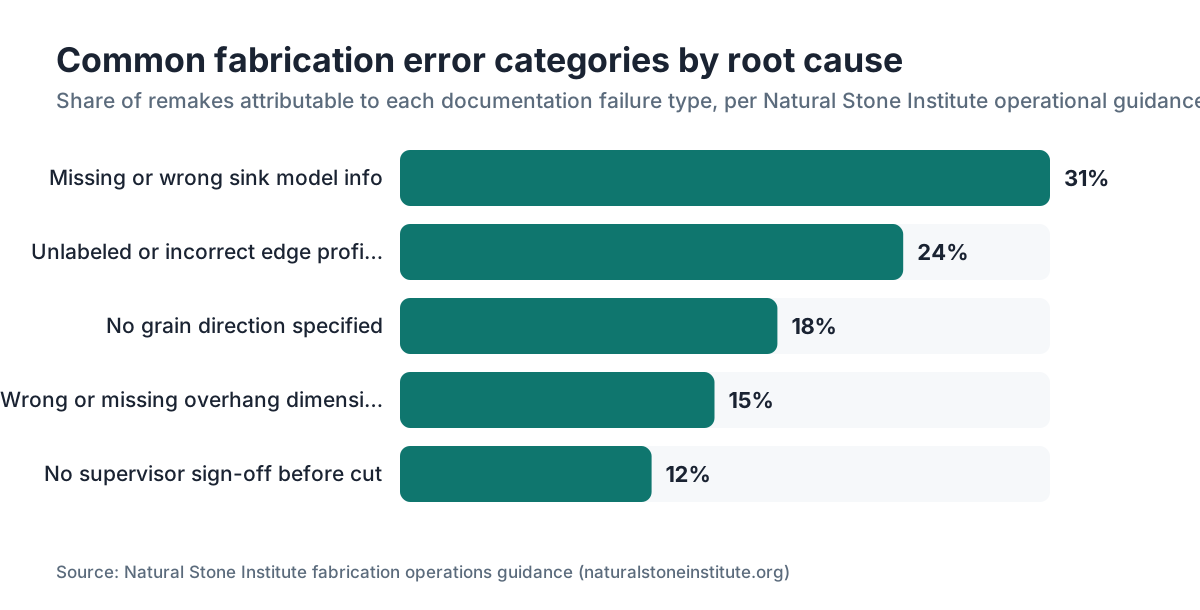
Missing sink model information is the single most expensive mistake. "Undermount single basin" does not cut it. Two sinks from two manufacturers with identical bowl dimensions can have different clip depths, different rim widths, and different cutout templates. The fabricator needs the exact manufacturer and model number to pull the right template or CNC file.
Second most common: an unlabeled edge. Every edge on every piece gets marked exposed/finished or unexposed/unfinished. Nobody should have to infer that from a sketch.
Third: no grain direction on veined material. This bites hardest on quartzite and marble, where book-matching and vein alignment make or break the look.
Fourth: a missing or wrong overhang dimension. Standard overhang past the cabinet face is 1.5 inches, but islands often run a seating overhang of 12 to 15 inches on one side, which changes how the piece has to be supported [6]. Overhang past 12 to 14 inches on natural stone should point to an engineered support bracket spec [7].
Fifth: no sign-off before the saw runs. A work order without a supervisor's approval is just a suggestion. Build the sign-off in as a hard gate, not a nice-to-have.
How should a shop manage work orders digitally vs on paper?
Paper work orders are still everywhere, especially in smaller shops. They ride with the job, get penciled up by the saw operator, and end up clipped to the finished piece for the installer. Anyone can touch and mark one without a device. The catch: paper is hard to search, easy to lose, and does not update itself when the customer calls at 4pm the day before fabrication to change the backsplash height.
Digital work orders, generated by shop management or quoting software, solve the update problem. Change the quote and the work order follows. Version history shows exactly what changed and when. The rep in the showroom and the supervisor on the floor read the same document.
Shops using software like the kind SlabWise offers can tie the work order straight to the original quote and the nesting layout, so slab utilization and cut dimensions sit in one connected record instead of three separate files somebody has to keep in sync by hand.
The middle ground most shops land on: generate the order digitally, print one copy for the shop floor packet, keep the digital version as the master. Any change goes into the system first, then reprints if the floor needs a fresh page.
For countertop installation jobs that mix materials (a quartz perimeter with a butcher block island), one digital work order covering both materials in a single job record beats two paper sheets that can drift apart.
What should a homeowner look for on a work order before approving?
Ask your fabricator to walk you through the key fields before you sign anything. You do not need to read every shop notation, but confirm these four yourself:
- The material is listed by exact color name and supplier, more than "white quartz."
- The sink make and model match what you actually bought or plan to buy. If you have not bought the sink yet, do not approve the work order. Coming back after fabrication to say "I changed my sink" is an expensive conversation.
- The edge profile is the one you picked. If the written name means nothing to you, ask to see a physical sample.
- The install date and site address are right.
If anything reads "TBD" or sits blank, ask why. A finished work order has no open fields except maybe the crew assignment if scheduling has not happened yet.
How do work orders connect to quoting and job costing?
A quote estimates what a job costs to produce and what to charge for it. A work order specifies what actually gets made. The gap between those two documents is where margin lives or dies.
When the work order carries more complexity than the quote captured (more cutouts, a longer edge run, a splash piece added during templating), you need a change order process that updates both documents together. Let the work order drift from the quote without a formal change order and you end up doing unbilled work.
Job costing shows up after the job closes and asks: did we spend what the quote predicted? Material waste, labor hours, and any remakes all log against the job number. That job number on the work order is the link between the operational record and the financial one.
Shops that track this find patterns. Certain edge profiles and certain sink configurations consistently blow past their quoted labor hours. That data sharpens the next quote.
Nobody has clean industry-wide numbers on average fabrication rework rates. The Natural Stone Institute's operational guidance points to poor shop-floor documentation as a leading remake cause, with undocumented shops running materially higher error rates than shops with disciplined processes [3][10].
How do you handle work order changes after fabrication has started?
This is what separates organized shops from chaotic ones. Once a slab is on the saw table, a change to dimensions, edge profiles, or cutout placement may be flat-out impossible. The work order has to reflect a clear policy.
Any change after the work order is signed and before fabrication starts needs a written change order signed by the customer and initialed by the supervisor. The change order references the original job number and names the exact field, the old value, and the new value.
Any change after fabrication starts gets judged case by case. If the slab is not cut yet, many changes still work with a new change order. If the piece is already cut, tell the customer immediately what is and is not physically possible, quote any added cost, and get written approval before you do anything.
Never let a verbal change drive a shop floor action with no paper trail. Even a text or email confirming the change should get printed and stapled to the work order. Plenty of shop disputes that land in small claims court come down to "she told me on the phone" against "we have no record of that."
Frequently asked questions
Is a fabrication work order the same as a purchase order?
No. A purchase order is what a shop sends a supplier to buy materials. A fabrication work order is an internal document telling the shop floor what to make from materials already on hand. Some shops use the terms loosely, but keeping them separate avoids real confusion. A PO goes outbound. A work order stays internal and rides with the job through production.
Do small one-person fabrication shops need formal work orders?
Yes, arguably more than big ones. When one person is the salesperson, the cutter, and the installer, memory stands in for documentation, and that holds up right until you have four jobs running at once. A written work order forces the details out of your head and onto paper before they slip. It also protects you legally if a customer disputes what was agreed.
What should I do if my fabricator does not have a work order for my job?
Ask for one in writing before you approve anything. A reputable shop can produce a document, even a simple one, listing your material, dimensions, edge profile, and sink cutout details. If the shop cannot or will not, treat that as a warning sign. You have almost no recourse in a dispute when there is no written specification to point to.
How detailed does the edge profile description need to be on a work order?
Very. Writing 'eased edge' is fine for a simple 1/8-inch break. But 'ogee' alone is not enough, because there are multiple ogee variations. Specify it: ogee with a 3/4-inch top radius and a 1/2-inch cove, or whatever the customer approved. If your shop keeps a numbered profile catalog, reference the number. Attach a photo if there is any ambiguity at all.
Can a work order serve as a legal contract with the customer?
It can act as evidence of agreement, but it should not replace a proper sales contract. Work orders are operational documents written for the shop floor, not for dispute resolution. A signed quote with clear payment terms and a change-order clause gives you stronger protection. Check your state's contractor licensing or consumer protection statutes for what written agreements your jurisdiction requires [2].
How long should a shop keep completed work orders?
The IRS recommends keeping business records for at least three to seven years depending on the record type and tax situation [9]. Statutes of limitations for written contract disputes commonly run three to six years by state [2], so many attorneys land on four to seven years for job records. Digital storage makes this trivial. Paper shops should scan completed orders at job close into a folder by job number and year.
What information about the slab itself belongs on the work order?
The supplier name, color or product name, lot or bundle number, and the specific slab number if the shop tags individual slabs. Add the slab's as-received dimensions, because the fabricator needs to know there is enough material before cutting. If the customer picked a slab from the yard, note any natural features they want oriented a certain way.
How do I write the cutout section for a farmhouse apron sink?
List the sink manufacturer, model name, and model number. Note that it is an apron-front design, which changes how the cabinet opening and the stone get coordinated. Include the exact opening width and height from the manufacturer's installation template. Say whether the stone needs a dropped front edge or a flush cut. Attach the manufacturer's installation guide PDF to the job packet.
Should the work order include the customer's quoted price?
That is a shop-culture call. Some shops include pricing so the install crew knows the job value and treats it accordingly. Others keep pricing off the floor document to avoid awkward moments if the customer is home at install and asks the crew what they paid. A middle ground is noting the tier or job category with no dollar figure. There is no universal standard.
What is the difference between a work order and a templating report?
A templating report documents what the template tech measured on site: room dimensions, cabinet heights, wall irregularities, sink position, existing conditions. That report feeds the work order but is a different document. The work order absorbs the templating data and adds material specs, edge profiles, and production assignments. Keep both in the job packet.
How do countertop work orders handle seam placement?
Seam location goes on the work order or an attached layout drawing. Note the distance from a reference point (usually a corner or the sink centerline), the seam type (standard butt seam, Domino-joined seam), and any customer preferences or restrictions. Seams in front of the cooktop, for example, are generally avoided for both looks and structural reasons.
Do work orders need to address substrate or support requirements?
Yes, especially for overhangs over 12 inches or materials prone to cracking under unsupported spans [7]. The work order should note whether support brackets are required, who supplies them (fabricator or GC), and whether the cabinetry is confirmed level and plumb. For porcelain slab, support requirements differ a lot from natural stone.
Can a homeowner request a copy of the work order after the job is done?
Yes, and most shops will hand one over. A post-job copy helps if you ever need to match material for a repair, reference the exact sink cutout dimensions, or pull warranty documentation. Ask for a copy at close-out while the job file is still fresh. Shops on digital systems can email a PDF the same day.
Sources
- HomeAdvisor (Angi), Granite Countertops Cost Guide: Wholesale granite slab prices typically range from $400 to $1,200 per slab depending on material grade and region
- U.S. Small Business Administration, Business Guide: State contract law governs what constitutes a binding written agreement; statutes of limitations for written contracts commonly run three to six years
- Natural Stone Institute (formerly Marble Institute of America): Poor shop-floor documentation is cited as a leading cause of remakes, with undocumented shops seeing significantly higher error rates
- Occupational Safety and Health Administration (OSHA), Crystalline Silica: OSHA regulates silica dust exposure in stone fabrication shops under the respirable crystalline silica standard (29 CFR 1910.1053)
- U.S. General Services Administration, Federal Acquisition Regulation: Federal procurement definitions distinguish a work order as an internal task authorization distinct from a contract or purchase order
- National Kitchen and Bath Association (NKBA): Standard countertop overhang past cabinet face is 1.5 inches; seating overhangs of 12 to 15 inches require additional structural support per NKBA guidelines
- Natural Stone Institute, Dimension Stone Design Manual: Unsupported stone overhangs beyond 12 to 14 inches require engineered support brackets; the manual specifies cantilever limits by thickness and material type
- National Institute of Standards and Technology (NIST), Weights and Measures: NIST provides measurement standards relevant to dimensional accuracy in fabrication; mixing unit systems (inches vs. millimeters) in the same document is a documented source of error
- Internal Revenue Service (IRS), Small Business and Self-Employed: The IRS recommends keeping business records for at least three to seven years depending on the type of record and potential tax implications
- Natural Stone Institute, Stone Industry Resources: Industry guidance indicates that shops with disciplined work order documentation see significantly lower remake rates than those relying on verbal or informal instructions
Last updated 2026-07-10