TL;DR
- A color seam kit is a set of tinted adhesive compounds, mixing tools, and color pigments for repairing chips, fabrication seams, and small cracks in quartz countertops.
- Most kits pack a clear or white UV-cure or two-part epoxy base, a range of colorant pigments, a spatula, and a color guide.
- A good match reads invisible at arm's length.
What exactly is a color seam kit?
A color seam kit is a repair package built for engineered stone like quartz. Here's the logic. Quartz is a manufactured material with its color and pattern baked all the way through, so any chip, crack, or seam exposes a raw interior, usually white or gray, that looks nothing like the finished surface. The kit gives you a filler that cures hard and, if you blend the pigments right, reads as the same color as the stone around it.
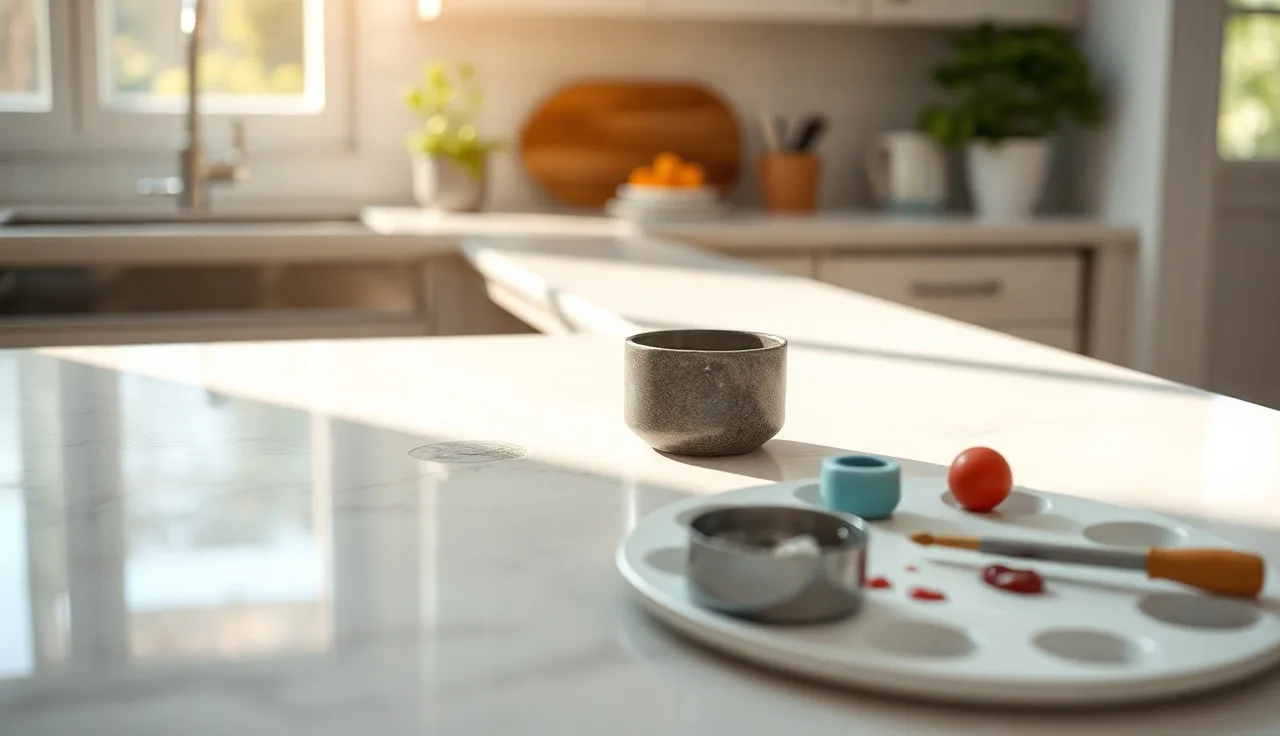
Most kits contain a base adhesive (a UV-cure acrylic, a two-part epoxy, or a polyester resin), a set of color pigments running from white and black to earth tones and sometimes translucent tints, a plastic spatula or putty knife, mixing pads or a palette, a razor blade for leveling, and some polish or compound for blending the cured repair into the surrounding finish [1].
The name "seam kit" is a bit of a misnomer that stuck in the trade. Fabricators reach for these kits on all sorts of surface defects, not mainly on field seams where two slabs meet: corner chips, edge chips, fabrication nicks, small cracks, even the pinholes left by air bubbles in cheaper quartz. So when a homeowner searches "color seam kit," they almost always mean a general quartz repair kit, not something reserved for the joints between slabs.
What's inside a color seam kit and what does each part do?
Components vary by brand, but the working parts split into three groups: the carrier, the colorants, and the finishing tools.
The carrier is the glue-like base that fills the void. UV-cure acrylics are popular in shops because they stay workable until you hit them with a UV lamp or direct sunlight, so you get unlimited time to mix color. Two-part epoxies (resin plus hardener) cure by chemical reaction, usually in 5 to 30 minutes depending on formula, which is faster but less forgiving [2]. Polyester-based fillers are rare in premium kits and common in budget sets and big-box repair kits.
The colorants are the whole reason these kits exist. A solid white quartz and a white-with-gray-veining quartz look nothing alike, and a blob of plain white filler in a veined stone screams "repair." Good kits include 10 or more pigments. You mix small amounts into your carrier, then layer them to build depth. Some repairs take three or four separate color passes to fake a vein running through the stone.
The finishing tools handle leveling and sheen matching. The spatula, razor blade, and polish. Quartz finishes range from polished to honed to leathered, and the cured filler has to reach the same sheen or the repair stays visible even when the color is dead-on. That's why many kits toss in a small syringe of polish and a felt buffing pad.
How is a color seam kit different from regular epoxy or superglue?
Hardware store epoxy is built for bond strength. Color seam kits are built for visual match. That's the whole difference, and it matters more than you'd think.
Standard clear epoxy cures to a slight yellow over time, worse under UV near a window. It carries no pigment, so the repair reads like a shiny, faintly discolored window down into the substrate. Superglue (cyanoacrylate) is worse still for countertops: it flashes white with moisture, forms a brittle bond, and won't take tint [3].
Color seam adhesives also cure to a hardness close to the quartz composite itself. Quartz surfaces score about 7 on the Mohs scale [4]. A repair that cures too soft scratches and dishes out over the years; one that cures too hard cracks under thermal or mechanical stress. The better products aim for a middle range that flexes slightly with the slab.
For anyone repairing a kitchen countertop that takes daily abuse, that hardness calibration is the line between a repair that lasts five years and one that fails in six months.
What types of quartz damage can a color seam kit fix?
Color seam kits handle four damage types well and fall flat on a fifth.
Edge and corner chips are the most common repair. Quartz is hard but brittle, and polished edges are the most exposed points on the whole counter. A dropped pan or a delivery bump can leave a void anywhere from 1mm to 15mm across. These fill cleanly as long as the void has a defined edge for the filler to key into.
Fabrication seams, the joints where two pieces meet in an L-shaped run or around a sink, get filled during install with a color-matched adhesive. When that fill shrinks, discolors, or gets gouged, a seam kit lets you dig out the old material and replace it. This is one of the most common repairs homeowners try themselves.
Small surface cracks, sometimes called crazing or stress cracks, fill fine if they're under about 1mm wide. Wider cracks are a structural problem no surface fill will solve. If the crack crosses a seam or reaches an edge, call a fabricator.
Pinholes from air inclusions in the manufacturing process show up now and then and respond well to a thin-fill technique.
The category where these kits reliably fail is deep or running cracks that mean the slab is flexing. Filling the surface does nothing if the structure underneath is unsupported or the slab went in without support at key spans [5]. Fill a structural crack and watch it reopen, and you've got a cabinet or installation problem, not a stone problem.
How do you use a color seam kit step by step?
The job takes patience, not talent. Every fabricator will tell you color matching is 80% of it.
Clean the repair area first. Grease, soap residue, or moisture will kill adhesion. Isopropyl alcohol at 90% or higher is the standard prep solvent [11]. Let it fully evaporate before you touch the surface again.
For a chip, lightly abrade the edges of the void with 220-grit sandpaper so the filler has something to grip. Vacuum or blow out the dust.
Mix your color before the filler ever touches the stone. Dispense a small amount of carrier onto your mixing pad, then add pigments one drop at a time. Hold the mixed color against the undamaged surface in the same light you'll work under. Daylight is the best light for color matching; LED shop lighting can fool you badly. Keep adjusting until the wet mix matches the base tone. If the quartz has veining, you'll lay a second tinted pass over the cured base to mimic the veins.
Apply the filler slightly proud, meaning a hair higher than the surrounding stone. Cured fillers shrink a little, and you want extra material to work with when you level.
For UV-cure systems, expose the repair to a UV lamp (most kits include one, or a cheap nail-lamp UV light works) for the specified time, usually 30 to 90 seconds. For two-part epoxy, give it the full cure time before leveling, even if it feels solid to the touch.
Level with a sharp razor blade held at a low angle, then work through wet-and-dry paper: 400-grit, then 600, then 800, then finish with the included polish. The whole point of the polish stage is to match the sheen of the surrounding stone. A honed surface needs far less polish work than a high-gloss one.
How long does a color seam kit repair last?
Honest answer: a clean repair on a well-supported counter can last the life of the stone. A bad repair in a high-stress spot might fail in weeks.
Three things drive it. Adhesion quality, filler hardness relative to the stone, and whether you actually fixed the cause of the damage. A chip from a one-time impact on a stable counter is a great candidate for a permanent repair. A crack that formed because the counter lacks a support rail under a heavy overhang will re-crack after any fill you put in it.
Shop-grade UV-cure systems generally outlast the consumer polyester kits from hardware stores. The consumer kits are fine for edge chips and cosmetic seam touch-ups. For anything structural, or anything near a cooktop where thermal cycling never stops, use a product built for those conditions.
Integra Adhesives and Tenax both make adhesives used by professional fabricators, with color libraries running to hundreds of formulations matched to specific quartz brands. Consumer kits from MagicEzy or SuperSeal are a reasonable start for homeowners, but plan on spending more time getting the color right.
Can homeowners use a color seam kit, or is this a job for a fabricator?
Edge chips are a legitimate DIY project for a patient homeowner. Seam repairs and crack fills go either way, depending on how busy the veining is.
The honest ceiling for DIY seam work is solid or near-solid colors. Silestone Blanco Zeus, Caesarstone Pure White, or any quartz with a uniform color and minimal pattern can be matched by a careful amateur. Marble-look quartz with gray, gold, and white veining is genuinely hard. Fabricators spend years learning to layer pigments into natural-looking stone movement, and even they miss on the first try sometimes.
Working on a Cambria countertop with a dramatic vein, or a quartz that fakes Calacatta marble? I'd get a professional quote before touching it. A bad amateur repair can be harder to fix than the original damage, because now you've got cured filler jammed in the void that has to be fully dug out before a clean fill is even possible.
For shop owners fielding repair calls, quoting tools that track material and labor on repair work the same way they do on new fabrication save real time. SlabWise is built for that quoting workflow.
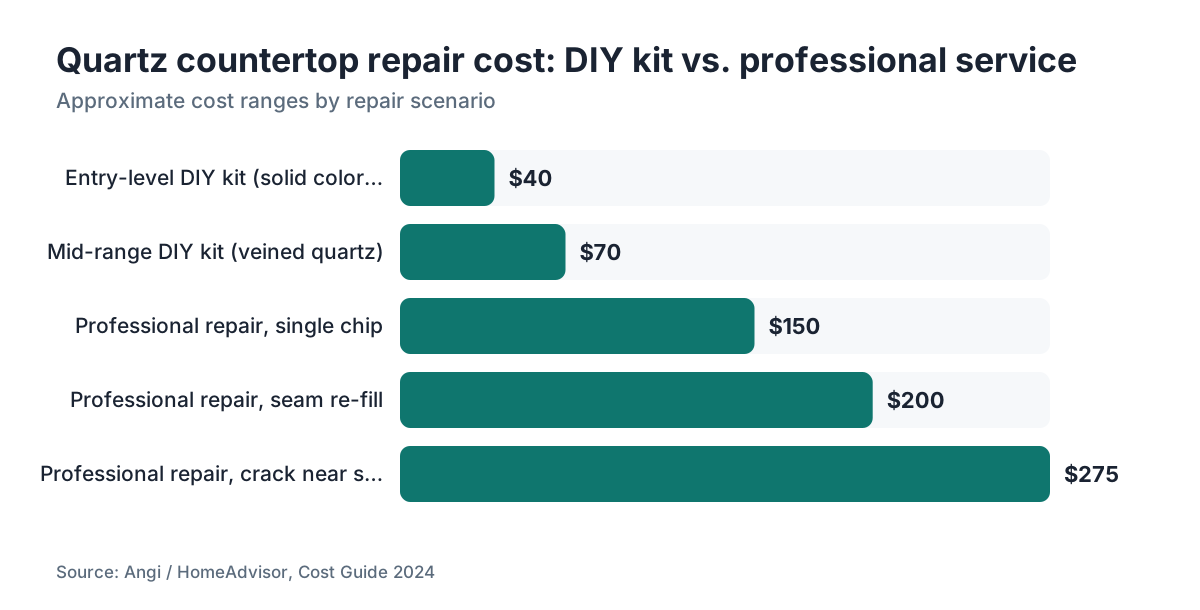
A professional repair typically runs $100 to $300 for a single chip or seam, depending on location and complexity [6]. DIY kits run $20 to $80. The math favors DIY for simple repairs and a pro for anything visible or complex.
How do you choose the right color seam kit for your quartz?
Start with your quartz manufacturer. Cambria, Caesarstone, Silestone, and MSI all have authorized dealers, and some sell repair kits or can point you to a distributor with a color library matched to their slabs. That's the shortest path to a correct base color.
If your quartz is discontinued or you can't ID the exact color, choose by repair type. For edge chips on a polished surface, a UV-cure kit buys you the working time to nail the color. For fast seam repairs where you want to be done in under 30 minutes, a two-part epoxy works well.
The size of the pigment library matters a lot. A kit with only five pigments leaves you stuck matching basic whites and blacks. Kits with 10 or more pigments, ideally including translucent tints, pearl, and gray tones, cover most quartz colors sold today.
Check the cure hardness if the spec is listed. You want something in the 70 to 85 Shore D range for countertop work. Softer than that and the repair scratches easily; harder and it turns brittle.
Read the finish options. Some kits include both a semi-gloss and a matte finishing compound. If your quartz is leathered or honed, you need the matte option or the repair stands out under raking light even with a perfect color match.
What does a color seam kit cost, and is it worth buying?
Entry-level consumer kits from hardware stores or Amazon run $20 to $40. These usually give you one or two base colors, a handful of pigments, and basic tools. Fine for a small corner chip on a light-colored quartz.
Mid-range kits with broader pigment sets, UV-cure carriers, and better finishing tools run $50 to $80. This is what I'd point most homeowners toward for a real repair.
Professional systems from Integra or Tenax cost more per unit, usually sold to the trade, and deliver steadier results plus color libraries in the hundreds of formulations. Some fabricators offer repair-only service using these systems.
For a single chip on a solid-color quartz, a $40 kit is worth it. A pro would charge a minimum service call of $150 or more for the same job. For a complex marble-look quartz with multiple colors and veining, that $40 kit is probably wasted money unless you're willing to practice the color mixing on scrap first.
The table above shows rough costs across repair scenarios to help you decide.
What's the difference between a seam kit for quartz versus other stone types?
Quartz-specific kits differ from natural-stone repair systems mainly in cure chemistry and pigment range.
Granite has pores and a crystalline structure that takes epoxy differently than a sintered quartz composite. Granite kits often use a lower-viscosity resin that wicks into fine cracks. Quartz composites are denser and less porous, so you want a paste-consistency filler that stays put rather than a thin penetrating resin. For the full picture on working with natural stone, the granite countertops guide covers those repair differences.
Marble and quartzite have their own chemistry, partly because those stones are softer and partly because their translucency means a perfectly matched but opaque filler still looks wrong under light. A quartz seam kit reads flat and lifeless in a marble repair. The marble countertops article gets into marble-specific approaches.
Solid surface like Corian uses a completely different method: a router, a patch plug, and a solvent-based adhesive made from the same material. A quartz seam kit won't bond to solid surface properly. See the Corian countertops guide if that's your material.
Laminate and Formica are a different world. You can't meaningfully repair a chip in laminate with a stone seam kit; the materials don't work together. A badly chipped laminate countertop or Formica countertop usually means replacement.
Are there any safety or health considerations when using a seam kit?
Yes, and they deserve real attention.
Two-part epoxy resins contain compounds that sensitize skin and airways. The hardener in particular can cause contact dermatitis with repeated exposure. The American Contact Dermatitis Society tracks epoxy hardeners as a common occupational sensitizer [7]. Wear nitrile gloves and work with ventilation. Once cured, the material is inert, but the uncured components need respect.
Polyester-based fillers off-gas styrene as they cure. The National Toxicology Program lists styrene as "reasonably anticipated to be a human carcinogen" [8]. For a single occasional repair in a ventilated kitchen, exposure is minimal. For fabricators running dozens of repairs a week, ventilation and respiratory protection matter.
UV-cure acrylics carry lower acute hazard than the two-part systems, but some still contain sensitizing methacrylates. The product Safety Data Sheet, required under OSHA's Hazard Communication Standard (29 CFR 1910.1200) [9], is the authoritative source for whatever kit you buy. Read it before you open the box.
For disposal, fully cured epoxy or acrylic repairs are generally inert solid waste. Uncured material, mixed leftover adhesive, and contaminated mixing pads should be handled as chemical waste per your local rules. The EPA's Safer Choice program evaluates adhesive ingredients for health and environmental hazard if you want to compare products [12].
When should you skip the DIY kit and call a professional fabricator?
Call a professional if the damage sits in a highly visible area and the quartz has a busy pattern. A repair that's 95% invisible on solid white quartz is a win. That same 95% on a dramatic book-matched Calacatta-look quartz still reads as a repair.
Call a professional if the crack runs longer than about 3 inches, crosses a seam, or you've watched it grow. Growing cracks point to an installation or support issue that surface repair won't touch. A good fabricator checks the cabinet support, the overhang spans, and the sink cutout edges before going near the crack itself.
Call a professional if the countertop is under a manufacturer warranty. Some quartz warranties, including Cambria's transferable lifetime warranty, require authorized repair methods. A DIY repair with an incompatible product could complicate coverage [10].
For countertop installation context or a local repair quote, get multiple bids. Repair pricing swings hard by market.
Fabricators who want to track material costs on repair jobs and build accurate quotes can run a free demo of SlabWise's quoting software and see how it handles repair line items alongside full fabrication projects.
Frequently asked questions
Can I use a color seam kit on quartz that has a honed or matte finish?
Yes, but finish matching is the tricky part. After the filler cures and you level it flush, you dull the repair to match the matte or honed sheen. Use 600 to 800-grit wet sandpaper without polish rather than buffing to a shine. Some kits include a matte finishing compound for exactly this. Skipping the gloss-building polish step usually gets you close enough on a honed surface.
How do I know what color pigments to mix for my quartz?
Start with a clear or white base and bring it toward the background color of your stone first. Hold the wet mix against the countertop in natural light, not LED shop light, before you commit. Photograph the unmixed surface and zoom in to separate the base tone, mid-tone, and vein colors. Build each layer on its own. If your quartz brand is known, check whether the manufacturer publishes a repair color guide.
What's the difference between a UV-cure kit and a two-part epoxy kit for quartz repairs?
UV-cure systems stay workable until you expose them to UV light, so you get unlimited time for color mixing and positioning. They're better for complex color work. Two-part epoxy kits mix and cure by chemical reaction in 5 to 30 minutes, which is faster but leaves less room to correct. UV-cure systems need a UV lamp. Two-part systems work anywhere but force you to move quickly once mixed.
Will the repair be completely invisible after using a color seam kit?
In good light, with a careful color match, a seam kit repair is invisible at normal viewing distance on solid or near-solid quartz. Complex veined quartz is harder: a pro can often reach "invisible unless you're looking for it," but homeowners should expect "not noticeable from 18 inches." Cured repairs are permanent, so if the color match is off, you'll have to excavate and redo the fill.
How long does a color seam kit repair take to complete?
Plan for one to three hours including prep, color mixing, application, cure, and finish work. UV-cure repairs cure in under two minutes of UV exposure, so most of your time goes to prep and color matching. Two-part epoxy kits need 15 to 60 minutes of cure before leveling. The finish sanding and polish stage takes 20 to 40 minutes no matter which adhesive you use.
Can a color seam kit fix a crack in a quartz countertop near the sink?
A surface crack near a sink cutout can be filled, but check whether the crack comes from the cutout lacking support or the sink weight stressing the stone. If the cause is structural, fill the crack with color-matched filler and also add a support rail or apron under the cutout edge. Filling without fixing the cause means the crack reopens, usually in the same spot.
Are color seam kits sold at hardware stores, or do I need a specialty supplier?
Entry-level kits from MagicEzy and SuperSeal are on Amazon and at some home centers. Professional systems from Integra Adhesives or Tenax sell through stone fabrication supply distributors, not retail. For complex repairs, ordering a professional-grade kit online from a stone supply distributor gives you a better pigment range and more reliable cure chemistry than big-box options.
Does using a color seam kit void my quartz warranty?
It depends on the brand and the damage. Cambria's warranty, for example, covers manufacturing defects and requires repairs by an authorized installer using approved methods. Using an incompatible third-party kit on a defect that would otherwise be a warranty claim could complicate the claim. For damage from impact or misuse rather than a defect, warranty protection usually doesn't apply anyway.
Can I use a color seam kit on quartz countertop seams that have turned yellow?
Yes. Yellowed or discolored seam adhesive is one of the most common quartz repair jobs. Score out the old fill with a sharp utility knife, clean the joint with isopropyl alcohol, and refill with fresh color-matched adhesive. The new fill won't yellow as fast if you use a UV-stable adhesive rather than a polyester-based one, which tends to amber with age and UV exposure.
What's the best way to practice with a color seam kit before working on my actual countertop?
Ask your quartz supplier or fabricator for offcuts of the same material. Most shops have a scrap bin and will hand over small pieces. Chip a corner on purpose with a hammer, then run the full repair sequence on the offcut. This is genuinely the best prep. You'll learn how fast your adhesive sets, how your pigments mix, and whether your color ratio is right before you touch the real thing.
How is repairing quartz different from repairing quartzite?
Quartz countertop is an engineered composite, about 90 to 95% ground quartz bound with polymer resin. Quartzite is a natural metamorphic rock. Repairing quartzite is closer to repairing granite: you want a low-viscosity penetrating resin rather than a paste filler, and the surface is typically sealed rather than sealed-in at the factory. A kit built for engineered quartz won't behave the same in quartzite. Check a quartzite care guide for material context first.
How do fabricators use color seam kits differently from homeowners?
Fabricators use professional UV-cure systems with color libraries matched to specific quartz brands, sometimes hundreds of formulations. They work on slabs before installation under controlled shop lighting, and they use CNC-routed repairs on larger damage rather than hand-fill. Homeowners are almost always working in the field, after installation, in kitchen light, on a single repair. Same technique; different tools and color libraries.
Sources
- Integra Adhesives, Product Overview: Professional color seam kits include UV-cure or two-part epoxy carrier, pigment sets, spatulas, and finishing tools
- Tenax USA, Stone Repair Products: Two-part epoxy stone adhesives cure by chemical reaction, typically in 5 to 30 minutes depending on formulation
- Henkel / Loctite, Cyanoacrylate Adhesive Technical Data: Cyanoacrylate adhesives produce whitening in the presence of moisture and form brittle bonds unsuitable for filled repairs
- Natural Stone Institute, Quartz Surface Technical Resources: Engineered quartz surfaces score approximately 7 on the Mohs hardness scale due to their high quartz mineral content
- National Kitchen and Bath Association, Kitchen Planning Guidelines: Countertop overhangs and sink cutouts require structural support; unsupported spans can cause stress cracking in stone surfaces
- Angi, Countertop Repair Cost Guide: Professional countertop chip and seam repairs typically cost $100 to $300 per incident depending on location and complexity
- American Contact Dermatitis Society, Allergen of the Year Archives: Epoxy hardener compounds are recognized occupational skin sensitizers associated with contact dermatitis with repeated exposure
- National Toxicology Program, 15th Report on Carcinogens: Styrene: Styrene, present in polyester-based fillers, is listed as reasonably anticipated to be a human carcinogen by the National Toxicology Program
- U.S. Occupational Safety and Health Administration, Hazard Communication Standard 29 CFR 1910.1200: OSHA's Hazard Communication Standard requires manufacturers to provide Safety Data Sheets for chemical products including adhesive repair systems
- Cambria, Warranty Documentation: Cambria offers a transferable lifetime warranty that requires authorized repair methods; incompatible repair products may affect warranty claims
- Caesarstone, Care and Maintenance Guide: Caesarstone recommends isopropyl alcohol at 90% or higher for surface prep before adhesive repair work on quartz
- U.S. Environmental Protection Agency, Safer Choice Program: EPA Safer Choice program evaluates adhesive chemical ingredients for human health and environmental hazard in consumer and professional products
Last updated 2026-07-10