TL;DR
- A farmhouse (apron-front) sink cutout adds roughly $150 to $400 to a countertop quote, sometimes more for hard stone or complex edges.
- You pay for the revealed apron face, the modified front cabinet rail, extra templating time, and edge profile work on the exposed cutout perimeter.
- This guide breaks down every line item, for homeowners and fabricators alike.
What makes a farmhouse sink cutout different from a standard sink cutout?
A standard drop-in or undermount sink sits entirely below the countertop. The surface just gets a hole, usually 20 to 22 inches wide, with a polished reveal around it. The cabinet below stays intact.
A farmhouse sink, also called an apron-front sink, breaks that pattern. The front face of the sink is exposed and sticks forward of the cabinet face frame. To make that work, the fabricator cuts the countertop back further than usual so the stone doesn't run over the top of the exposed apron. The front edge of the countertop, right above the sink, becomes a raw cut edge that needs finishing. That edge work is real labor and real cost.
The cabinet needs work too. The horizontal rail directly above the sink opening usually gets cut out or routed back so the sink can drop in from above. That's typically a carpenter or installer task, but it matters for the countertop quote because it changes where the stone ends and what support it has at the front.
From a quoting standpoint, you're dealing with three cost drivers that don't exist in a standard cutout: the apron relief cutout on the underside of the slab, the finished front edge above the sink opening, and the extra labor time to template and fit a reveal that has to be precise.
How do you measure a farmhouse sink for a countertop quote?
Get the sink in hand before you template. That's not optional. Apron-front sinks run from about 24 inches to 36 inches wide, 8 to 10 inches deep, and the apron height varies too. Every dimension affects where the stone gets cut and how the front edge is exposed.
The five measurements you need are:
- Overall sink width. This sets the width of the cutout opening in the countertop.
- Apron height. This tells you how tall the exposed front face is, which determines how far back from the cabinet face the countertop front edge sits.
- Deck thickness. The flat ledge at the top of the sink where the countertop rests. Most are 3/4 inch to 1 inch. This is the reveal you'll see between the countertop underside and the sink deck.
- Reveal setback. How far the front edge of the countertop sits behind the cabinet face. Typically 1/8 to 3/16 inch proud of the apron face, but confirm with the homeowner.
- Faucet hole location. Many farmhouse sinks are single-basin with no pre-drilled holes. Extra faucet holes in the stone cost $65, $120 each.
Skip any of these and you're guessing. A bad template on a farmhouse cutout can mean a slab that doesn't fit, or worse, one that cracks when the installer tries to force it. [1]
For fabricators: take the actual sink to the job or to the shop. If the homeowner hasn't bought it yet, push the template date. Quoting off spec sheets alone is risky, because manufacturer specs for apron dimensions can run 1/4 inch off from actual castings.
What does a farmhouse sink cutout cost, and what drives the price?
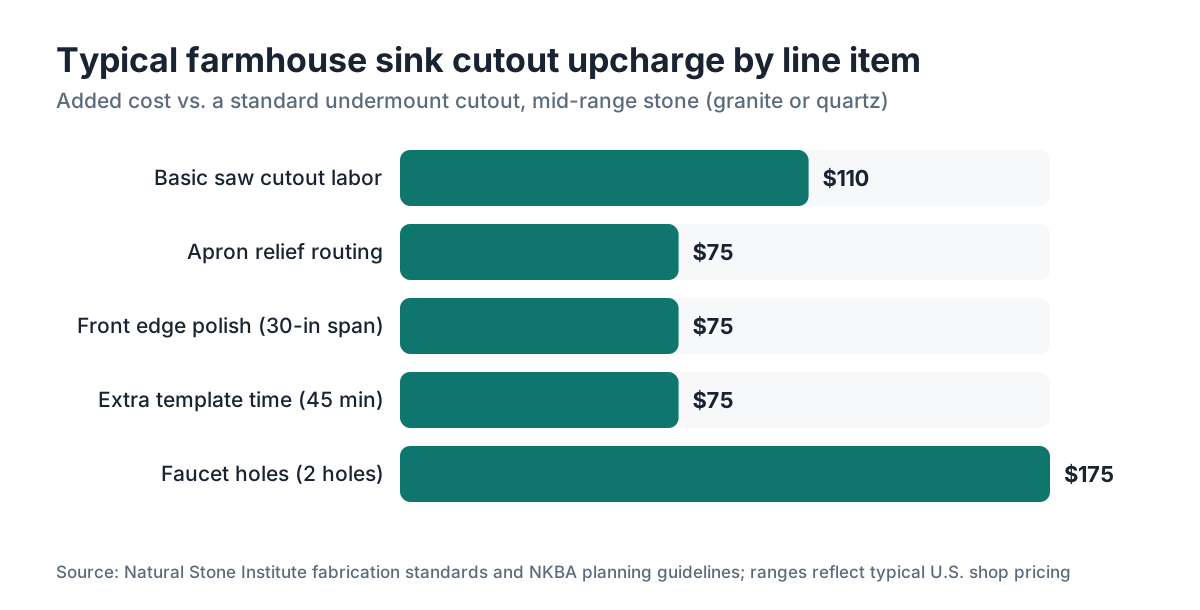
The honest answer: the upcharge ranges from about $150 on the low end (a simple straight-edge cutout on thinner material like laminate or quartz) to $400 or more for a mitered front edge on thick granite or quartzite. Some shops charge separately for each line item. Others roll it into a single cutout fee.
Here are the typical line items:
| Line item | Typical range |
|---|---|
| Basic cutout fee (saw work) | $75, $150 |
| Front edge polish on cutout (per linear foot) | $20, $40/LF |
| Apron relief underside routing | $50, $100 |
| Extra template time (farmhouse adds 30 to 60 min) | $50, $100 |
| Faucet holes (each, if needed) | $65, $120 |
| Total typical upcharge vs. standard undermount | $150, $400+ |
Material matters a lot. Granite and quartzite are harder to cut and polish, so the edge work on the cutout costs more. Quartzite in particular is dense and can crack unpredictably around cutouts, which adds risk. Quartz engineered stone is more consistent but still needs the same edge work. Butcher block is the cheapest to cut and finish by far, but it also sees the fewest farmhouse installations because of water exposure at the front edge.
Edge profile complexity is the other big driver. A simple eased edge on the cutout front is fast. An ogee or stacked laminated edge matching the perimeter profile can add another $80, $150 just for that section.
For homeowners: if a fabricator gives you a single-line quote that says "sink cutout included" without spelling out what that covers for a farmhouse sink, ask them to break it out. Otherwise you may get surprised when the edge work is billed separately at installation.
How should fabricators structure a farmhouse sink quote line by line?
The biggest quoting mistake fabricators make with farmhouse sinks is treating them like an undermount and slapping on a flat $100 upcharge. That works until you catch a job with a 36-inch fireclay sink, a mitered front edge, and granite that takes 45 minutes just to polish the cutout perimeter. Then you're eating real money.
A cleaner structure breaks the quote into four components:
1. Slab material and square footage. Price the countertop normally. A farmhouse cutout doesn't reduce the slab area meaningfully, because the removed section is usually 20 to 30 square inches, well below any minimum charge threshold.
2. Cutout labor. Separate from material. This includes the saw work to open the countertop and the underside routing for the apron relief. Quote it per job, not per square foot.
3. Edge work on the cutout perimeter. Linear-foot pricing on the exposed front edge above the sink. Measure it and charge it exactly like perimeter edge work.
4. Template surcharge. If your standard template fee doesn't cover the extra time for a farmhouse fit, add a line item. Thirty to sixty minutes of a templater's time at shop rates is real cost.
Some shops using quoting software, like SlabWise, can tag cutout types and auto-add the relevant edge-work line items when a farmhouse sink is selected. That removes the risk of forgetting to charge for edge polish on a job where the estimator was in a hurry.
One more thing: put in writing who modifies the cabinet rail. If that's the customer's cabinet installer, say so explicitly. If your crew does it, price it. Ambiguity here turns into change orders or unpaid disputes.
Does material choice change how you quote the farmhouse cutout?
Yes, a lot. Each material cuts differently, takes different edge-finishing time, and carries a different crack risk around openings.
Granite is the most common farmhouse material. It's hard, the cutout edges need wet polishing, and there's real crack risk if the slab isn't well-supported during cutting. Budget for more time. Granite countertops with visible movement or fissures need extra care at the corners of the cutout.
Quartz (engineered stone) cuts cleanly and consistently. Edge polishing is faster than natural stone. The quoting risk with quartz is the corner radii: most manufacturers recommend a minimum 1/4-inch radius at inside corners of any cutout to reduce stress cracking, and farmhouse cutouts have inside corners.
Quartzite is denser than granite and can be unpredictable. Some fabricators add a material risk surcharge of $50, $100 for quartzite cutouts because scrap risk is higher.
Marble polishes beautifully but chips at cutout edges if the tool speed is off. A skilled operator can do it cleanly. An inexperienced one can ruin a $1,200 slab. Marble countertops with a farmhouse cutout are a job for your most experienced saw operator.
Laminate and Formica are cheap and fast to cut. The front edge of the cutout can be covered with matching edge banding or a hardwood strip. Laminate countertops rarely get specified with farmhouse sinks in practice, but it happens in budget renovations.
Soapstone is relatively soft and easy to cut but needs a hand-polished edge. How to clean soapstone countertops comes up a lot because soapstone is porous, and the front cutout edge on a farmhouse installation is directly exposed to water.
Corian and solid surface can be glued and seamed at the cutout edge, which is unique. The edge routes and polishes in-shop. Corian countertops may actually give one of the cleanest farmhouse cutout results, because the material is non-porous and the edge is easy to refinish.
What edge profile options work for the farmhouse cutout front edge?
The front edge of the countertop above the apron sink is visible, gets wet constantly, and has to match (or intentionally contrast with) the rest of the counter edge. You have real choices here.
The most common option is a straight eased or beveled edge. It's fast, inexpensive, and practical. Water runs off cleanly.
A bullnose works too, and it looks intentional. It's slightly harder to keep clean because water can wick under the curve and drip onto the apron.
A mitered edge (where the countertop top edge and the front face join at 45 degrees to create a thick-slab look) adds real cost: $100, $200 for the cutout section alone, plus the seaming work. Mitered edges look great with farmhouse sinks, especially on darker stones, but quote them carefully. The miter seam on a farmhouse cutout front sees more water than a perimeter miter.
A chiseled or leathered edge is sometimes requested for a farmhouse look. That's hand work and should be priced by time rather than linear foot.
One practical note: whatever edge you put on the cutout front, it has to be completely polished and sealed before installation. You cannot get to that edge after the sink is in.
How does the cabinet modification affect the countertop quote?
The farmhouse sink, the cabinet, and the countertop all depend on each other. The countertop quote should address the cabinet even if the fabricator isn't doing that work.
Most standard base cabinets have a horizontal stretcher rail at the top front. That rail has to come out to accommodate the apron. If it doesn't, the countertop can't sit at the right height and the apron won't be exposed correctly. This work is typically done by the cabinet installer or a carpenter before the countertop gets templated.
Why does this matter for quoting? Because if the cabinet modification isn't done before template, the template is wrong. The countertop gets fabricated to a configuration that doesn't match the finished cabinet opening. The fix is either a return trip (time and cost) or fabricating the stone twice (material waste).
Best practice: include a pre-template checklist in your quote paperwork. For farmhouse sink jobs, the checklist should confirm the sink is on-site, the cabinet is modified, and the base is level. Make the quote contingent on those conditions being met before the template date. Some shops charge a re-template fee of $75, $150 if they show up and the job isn't ready.
Homeowners reading this: do not let your cabinet installer and your countertop fabricator schedule independently without coordinating. The cabinet work has to be finished before the countertop template.
How long does a farmhouse sink cutout add to the fabrication timeline?
Compared to a standard undermount cutout, a farmhouse cutout adds roughly two to four hours of shop time across all the steps: extra saw time, edge polishing on the cutout perimeter, and fit verification. That's a real addition, but not a huge one, to a typical two-to-three-day fabrication cycle for a kitchen.
The template appointment itself takes 30 to 60 minutes longer than a standard job. You need to verify the apron reveal, the cabinet modification, and the exact setback. Rushing this step is how you end up with a slab that doesn't fit.
Installation adds time too. Fitting a farmhouse sink means lowering the sink into the cabinet, setting it to height with shims or adjustable feet, then dropping the countertop over it. The countertop has to clear the apron without binding. If the fabrication is off by more than about 1/8 inch in the reveal, it shows, and the homeowner will see it every day.
For scheduling purposes, add one day to your standard lead time to cover template and shop complexity. Don't promise a farmhouse job in three days when your standard is four.
What are the most common mistakes in farmhouse sink quotes that cost fabricators money?
A few patterns come up again and again:
Forgetting to charge for cutout edge work. A fabricator quotes a flat $150 "sink cutout" fee, which covers the saw work, but doesn't add the edge polishing on the 24-inch front edge. At $25, $35 per linear foot, that's $50, $70 left on the table per job. Small by itself. Painful over 50 jobs a year.
Quoting before the sink is selected. The customer hasn't bought the sink yet. The fabricator quotes based on a "standard" farmhouse size, and then the customer shows up with a 36-inch double-basin fireclay unit. Now the cutout is bigger, the edge work is longer, and the cabinet modification is more complex. Get the sink spec in writing before quoting.
Not specifying who modifies the cabinet. This causes disputes at installation. Every farmhouse job quote should carry a one-line note: "Customer is responsible for cabinet rail modification prior to template date" or "Cabinet modification included, priced separately."
Underestimating template time. Sending a template crew to a job where the cabinets aren't modified, the sink isn't there, or the reveal spec isn't agreed on means a wasted trip. Charge a re-template fee and include that policy in the quote.
Ignoring corner crack risk. The inside corners of a farmhouse cutout are stress points. Fabricators who don't router a proper radius at the corners, or who rush the cut without proper slab support, risk cracking. Cracking means a new slab. That's a shop process issue, not a quoting issue, but it starts with understanding why farmhouse cutouts deserve more care than a standard undermount.
How should homeowners read and compare farmhouse sink quotes?
If you get three quotes for a kitchen with a farmhouse sink and one is $400 lower than the other two, dig in before assuming it's the better deal. Check whether the low quote includes edge work on the cutout, the apron relief routing, and extra template time. Often a suspiciously low number means those line items are missing, and they'll reappear as change orders after the template.
Ask each fabricator to answer these questions explicitly:
- Is the front cutout edge polished, and does it match my countertop edge profile? At what cost?
- Is the apron relief included?
- What happens if the cabinet isn't modified before the template date?
- Who supplies the sink reveal spec, and how is it verified?
For more context on how countertop installation is quoted, the countertop installation section of this site has pricing breakdowns across material types.
One practical tip: ask the fabricator if they've done farmhouse sink installations before, and ask to see a photo. It's not a technically exotic job, but it takes more attention to fit and reveal than a standard sink. A shop that does it regularly will have a clear process. One that hasn't done many is more likely to cut corners on the reveal fitting or fail to ask for the right measurements up front.
For a broader look at how kitchen countertop projects get scoped and priced, kitchen countertops covers the full picture.
If you're a fabricator looking for a faster way to structure quotes like this one, with cutout types, edge-work line items, and material-specific pricing built in, SlabWise is worth a look.
What should a farmhouse sink cutout quote document actually say?
A good quote document for a project with a farmhouse cutout leaves no ambiguity. Here's what to include:
Project scope: Describe the specific sink make/model or at minimum the exact dimensions (width x depth x apron height) the quote is based on. If the sink changes, the quote changes.
Cutout spec: State the exact reveal setback (e.g., "countertop front edge to sit 3/16 inch proud of apron face"), the inside corner radius (e.g., "minimum 1/4-inch router radius at all inside cutout corners"), and the edge profile on the cutout front.
Line items: Separate saw work, edge polish, apron relief, template surcharge, and any faucet holes. Even if you bundle them into one number, show the components.
Conditions: State clearly that the quote is valid only if (a) the sink is on-site at template, (b) cabinet modification is complete before template, and (c) no material changes after the template deposit is paid.
Change order policy: What happens if the homeowner changes the sink after template? A restocking or re-fabrication policy written into the quote protects you.
Warranty: What's covered if the stone cracks at the cutout corners? Most fabricators cover defects in workmanship but not damage from cabinet settling or improper support after installation. Say so.
A written quote with those elements isn't bureaucratic overhead. It's the thing that keeps a disputed job from becoming a negative review or a small-claims case.
Frequently asked questions
How much extra does a farmhouse sink cutout cost compared to a regular undermount?
Expect to pay $150 to $400 more than a standard undermount cutout, depending on stone type, edge profile complexity, and whether faucet holes are needed. The extra cost comes from saw work on the apron relief, polishing the exposed front cutout edge, and additional template time. Hard stones like quartzite or thick granite sit at the high end of that range.
Do fabricators charge for the edge on a farmhouse sink cutout?
They should, but not all do. The front edge of the countertop above a farmhouse sink is a fully exposed edge that needs polishing and profiling like any counter edge. At $20, $40 per linear foot, a 30-inch wide cutout front is $50, $100 in edge work. If your quote doesn't list this, ask about it before signing.
Can I get a countertop quote before I've picked out my farmhouse sink?
You can get a rough estimate, but a firm quote needs the actual sink dimensions. Apron height, width, and deck thickness vary enough between brands and models that a quote based on "a typical 30-inch farmhouse" can be off by $75, $150. Get the sink spec sheet at minimum, or ideally have the sink purchased, before locking in a quote.
Who cuts the cabinet rail for a farmhouse sink? Is that part of the countertop quote?
Usually the cabinet installer or a carpenter does it, not the countertop fabricator. But this must be confirmed and documented in the quote. If the cabinet rail isn't removed before the countertop template, the template will be wrong. Most fabricators charge a re-template fee of $75, $150 if they arrive and the cabinet isn't ready.
What's the reveal setback for a farmhouse sink countertop?
Standard practice sets the countertop front edge 1/8 to 3/16 inch proud (in front of) the apron face. This lets you see a clean sliver of the apron without the stone overhanging it. The exact setback should be agreed upon and written into the quote before templating, because changing it after fabrication means re-cutting the stone.
What inside corner radius is needed at a farmhouse cutout?
Most fabricators use a minimum 1/4-inch router radius at inside corners of any sink cutout, including farmhouse openings. Sharp inside corners concentrate stress and are a common crack point. Some shops go to 3/8 inch for brittle materials like quartzite. The radius should be specified in your quote or shop drawings.
Does the edge profile on a farmhouse cutout have to match the rest of the countertop?
Not technically, but it usually should. If your perimeter edge is an ogee, putting an eased edge on the farmhouse cutout front looks inconsistent. Matching the profile adds cost because it needs the same tooling and polishing steps on a tighter piece of work. Ask your fabricator to confirm the cutout edge profile in writing and verify it matches what you expect.
How long does fabrication take when a farmhouse sink is involved?
Add one day to whatever your fabricator's standard lead time is. The template takes 30 to 60 minutes longer, the shop adds two to four hours of saw and edge work, and installation fitting is more careful than a standard undermount. Most shops won't call this out unless you ask, so factor it into your kitchen renovation schedule.
Can all countertop materials handle a farmhouse sink cutout?
Most can, but the risk and cost vary. Granite, quartz, and soapstone are commonly done and well-understood. Quartzite adds crack risk and cost. Marble works but needs an experienced operator. Butcher block is easy to cut but problematic at the exposed front edge because of water exposure. Laminate and solid surface are the simplest to cut and finish.
Is a farmhouse sink cutout more likely to crack than a regular undermount?
Yes, slightly. The apron relief creates a long unsupported span at the front of the countertop, and the inside cutout corners are stress points. Proper corner radii, full cabinet support, and careful handling during installation reduce the risk significantly. Skipping the corner radius routing is the most common cause of cutout cracks.
What happens if my farmhouse sink cutout doesn't fit at installation?
If the stone is cut too tight, the installer can sometimes grind a small amount of material from the opening. If it's off by more than about 1/8 inch, the slab may need to go back to the shop, which delays the job by days and typically costs $150, $300 in additional labor. This is why getting the sink on-site before templating matters.
Do I need a special quote for a double-basin farmhouse sink versus a single basin?
The cutout process is similar, but the opening is wider and there may be a center divider to work around. Most double-basin farmhouse sinks are 36 inches wide versus 30 inches for single basin. The wider opening means more front edge to polish (roughly 20% more linear footage) and a longer unsupported span in the stone, which increases handling care.
Should fabricators quote differently for fireclay versus stainless farmhouse sinks?
The stone work is the same regardless of sink material. But fireclay and cast iron sinks are heavier and need stronger cabinet support, which the fabricator should flag to the customer. The weight of the sink doesn't directly change the countertop quote, but it affects whether the cabinet can hold the assembly, which is a related concern.
How do I know if a fabricator's farmhouse quote is complete or missing line items?
Ask them to confirm in writing that the quote includes: saw work for the cutout, apron relief routing, edge polishing on the cutout front at the same profile as the perimeter, and any additional template time. If they can't confirm those items specifically, the quote likely doesn't cover all of them.
Sources
- National Kitchen and Bath Association (NKBA), Planning Guidelines and Access Standards: Sink installation requires the physical fixture to be on-site or specified in exact dimensions before cabinet modification and countertop template for proper fit verification.
- Marble Institute of America (now Natural Stone Institute), Fabrication Standards: Inside corners of stone cutouts require a minimum radius to reduce stress concentration; sharp corners are a leading cause of cutout cracking in natural stone countertops.
- Natural Stone Institute, Dimension Stone Design Manual: Polishing cutout edges in granite and quartzite requires wet grinding and multiple polishing steps, adding significant shop labor time compared to engineered stone.
- U.S. Bureau of Labor Statistics, Occupational Employment and Wages: Stone Cutters and Carvers: Stone cutter and carver labor rates inform shop-time cost estimates for cutout and edge work in countertop fabrication.
- U.S. Census Bureau, American Housing Survey: Kitchen renovation expenditures include countertop replacement as one of the most common single-trade costs, with stone countertops representing the majority of installed value.
- NSF International, NSF/ANSI 51 Food Equipment Materials Standard: Countertop and sink surfaces in food preparation areas must be non-porous or sealed; relevant to material selection and edge sealing at farmhouse cutout perimeters.
- Home Innovation Research Labs (formerly NAHB Research Center), Remodeling Market Report: Countertop replacement with sink cutout modification is among the most frequently cited sources of change orders in kitchen remodeling projects.
- Occupational Safety and Health Administration (OSHA), Silica in Construction Standard 29 CFR 1926.1153: Stone cutting and grinding operations including sink cutout work on silica-containing materials require engineering controls and exposure monitoring under federal OSHA standards.
- National Association of Home Builders (NAHB), Cost of Constructing a Home: Countertop and sink installation represent a measurable line item in kitchen construction costs, with specialty sinks adding to both material and labor estimates.
- Caesarstone technical installation guidelines: Engineered quartz manufacturers recommend minimum 1/4-inch radius at all inside cutout corners to prevent stress cracking; sharp corners void manufacturer warranty on some products.
- NKBA, Kitchen Planning Guideline 9 (Sink Placement and Cabinet Preparation): Apron-front sink installations require base cabinet modification including removal of the front stretcher rail before countertop template and installation.
- U.S. Environmental Protection Agency (EPA), Renovation, Repair and Painting Rule (RRP) 40 CFR Part 745: Cabinet modification work in homes built before 1978 may trigger lead paint RRP requirements, relevant when cabinet rail removal is part of a farmhouse sink installation project.
Last updated 2026-07-09