TL;DR
- Granite countertops pair best with a backsplash that either pulls one color from the stone or steps back and lets the granite lead.
- Subway tile, natural stone, and glass mosaic are the most popular choices.
- Budget $5, $50 per square foot installed for tile, and set the backsplash after the countertop is in so you can scribe cleanly to the stone edge.
Why does the backsplash choice matter so much with granite?
Granite is loud. Even a quiet, consistent slab has movement, depth, and at least two or three colors pulling at the eye. Whatever you put on the wall behind it either lives peacefully with that or fights it constantly. Unlike a solid-color quartz where almost anything works, granite narrows your backsplash options faster than most homeowners expect.
The wall behind a standard 10-foot run of countertop is roughly 15 to 20 square feet (18 inches tall, full width). Small canvas. But it sits exactly at eye level, and every guest at your island looks straight at it. A bad pairing gets noticed fast.
Fabricators and designers work off a simple rule: the backsplash should share at least one color with the granite, or match its undertone (warm vs. cool), or be so neutral it disappears entirely. Any of those three strategies works. The mistake is picking a backsplash that introduces a fourth color the granite never suggested.
One more practical angle. Grout joints collect grease and steam. A surface you can wipe flat, like large-format porcelain or a granite slab splash, needs less upkeep than a dense mosaic with thin grout lines. Worth thinking about if you cook hard.
What backsplash materials work best with granite countertops?
Several materials work well, and a few work poorly. Here is how the main options actually perform.
Ceramic and porcelain tile cost $2, $15 per square foot for the tile itself, with installation pushing the total to roughly $10, $30 [1]. Porcelain is denser and less porous than ceramic, which matters in a kitchen that sees real cooking. A 3x6 subway tile in a soft white or warm cream is the most forgiving choice with almost any granite because it recedes and lets the stone carry the room.
Natural stone tile (marble, travertine, slate, or matching granite pieces) costs $5, $20 per square foot for material, installed totals reach $15, $40 [1]. Matching the granite with pieces cut from the same slab or a complementary stone creates continuity. Some fabricators offer offcuts from your countertop slab for a slab backsplash, which is exactly what it sounds like: a full piece of granite covering the wall to the underside of the upper cabinets. It kills grout lines entirely and reads beautifully, though it adds $10, $20 per linear foot above a tile option.
Glass tile and mosaic cost $7, $30 per square foot for material, installed totals $20, $50 [1]. Glass reflects light and makes a kitchen feel larger. The catch behind granite is contrast: a bold glass mosaic in teal or deep blue next to a busy granite like Bianco Romano or Uba Tuba creates visual noise. Glass works best with simpler granites, or in a very small accent band.
Subway tile alternatives including elongated subway (3x12), beveled subway, and stacked patterns cost roughly the same as standard subway but read differently. A stacked vertical pattern next to a heavily veined granite can feel restless. A horizontal offset pattern feels calmer.
Peel-and-stick panels and thin vinyl options cost $1, $5 per square foot and are not worth it in a kitchen with granite. The adhesive fails from heat and steam, and peeling panels next to permanent stone look bad fast.
| Material | Material cost/sq ft | Installed total/sq ft | Grout lines? | Best with granite type |
|---|---|---|---|---|
| Standard ceramic subway | $2, $8 | $10, $22 | Yes | Any |
| Porcelain large-format | $3, $15 | $12, $30 | Minimal | Busy/colorful granite |
| Natural stone tile | $5, $20 | $15, $40 | Yes | Complementary stone |
| Glass mosaic | $7, $30 | $20, $50 | Yes (thin) | Simple/darker granite |
| Granite slab splash | $15, $35 | $25, $55 | None | Any |
| Peel-and-stick | $1, $5 | $1, $5 | None | Not recommended |
How do you match a backsplash color to your granite?
Pull a color from the granite rather than trying to match it exactly. Exact matches are nearly impossible because stone is not uniform, and a tile that almost-matches reads as a mistake. A color that clearly echoes one of the secondary tones in the granite reads as intentional.
Here is the method. Take a physical sample of your granite slab (ask the fabricator for a remnant chip, most will give you one) to a tile showroom. Hold tiles directly against the stone in natural light and overhead light both, because the colors shift between them. The tile that looks right in the showroom's warm track lighting can look greenish under your kitchen's cool LED strips.
Warm granite (golds, ambers, reds, like Santa Cecilia, Venetian Gold, or Giallo Ornamental) pairs naturally with cream, ivory, warm beige, or soft gold tile. A cooler gray tile next to these granites looks disconnected.
Cool-toned granite (whites, grays, blacks with silver or blue, like Alaska White, Steel Gray, or Black Galaxy) pairs well with white subway, cool gray porcelain, or crisp glass in silver or blue-gray tones.
Green or brown-toned granite (Uba Tuba, Verde Butterfly, Baltic Brown) is trickier. These stones have such complex coloring that almost any tile either clashes or disappears. Neutral cream or warm white tile lets the granite be the focal point, which is usually the right call.
Undertone discipline matters more than most people realize. Every neutral tile has either a warm (yellow, pink, beige) or cool (blue, green, gray) undertone. A warm-looking granite next to a cool-toned white tile makes one or both look wrong. This is the single most common backsplash mistake, and it is easy to avoid with physical samples in your actual light.
What is the right installation order: countertop first or backsplash first?
Countertop first. Always.
The countertop goes in, the templater or fabricator confirms the stone sits level and is silicone-sealed to the wall, and then the tile installer sets the backsplash down to the top surface of the granite. This way the tile can be scribed to the stone's natural edge, grout fills any tiny gap between tile and stone, and there is no risk of tile adhesive or grout landing on an already-polished surface.
Tile first creates two problems. The tile edge becomes your height reference, and if the countertop lands slightly high or low (stone is heavy, slabs shift), the joint between tile and stone looks uneven. You also risk cracking tile when the installers set the slab and it comes down hard on tile that is already up.
The exception is a full slab backsplash cut from the same material as the countertop. The fabricator templates and cuts those pieces together, and installation runs in one trip. Even then, the countertop slab goes in first.
Leave 1/8 to 1/4 inch between the bottom tile row and the top of the granite. The tile installer caulks this joint (not grout) with silicone matched to the grout color. Caulk flexes and handles the movement between a rigid stone slab and a tiled wall. Grout in that joint cracks within a year because the two surfaces move slightly at different rates. Tile Council of North America installation standards call for this [2].
How high should a backsplash go with granite countertops?
Standard backsplash height is 18 inches from the countertop surface to the underside of the upper cabinets. That fills the space between the counter and the uppers, which is the typical kitchen layout.
A full-height backsplash (floor to ceiling on a wall without upper cabinets, or ceiling to countertop on an open wall) adds visual drama and cuts the need to paint. It costs more in material and labor, but it removes a painted surface that gets grimy near the stove.
Some kitchens have no upper cabinets on a wall, open shelving instead, or a window above the sink that stops the tile run. In those cases the height is whatever makes visual sense: to the windowsill, to the underside of the shelf, or all the way to the ceiling.
On a range or cooktop wall, some homeowners extend the tile or stone from countertop to the bottom of the range hood, creating an accent panel. This is called a range backsplash or cooktop backsplash panel. It usually runs 24 to 36 inches wide and 18 to 36 inches tall, and it can be a different material or pattern than the rest of the backsplash.
For granite slab backsplashes, the slab typically runs 18 inches tall to match standard cabinet height, though some kitchens with extra ceiling height go taller. The fabricator cuts the pieces when they cut the countertop, which trims waste.
How much does a backsplash for granite countertops cost in total?
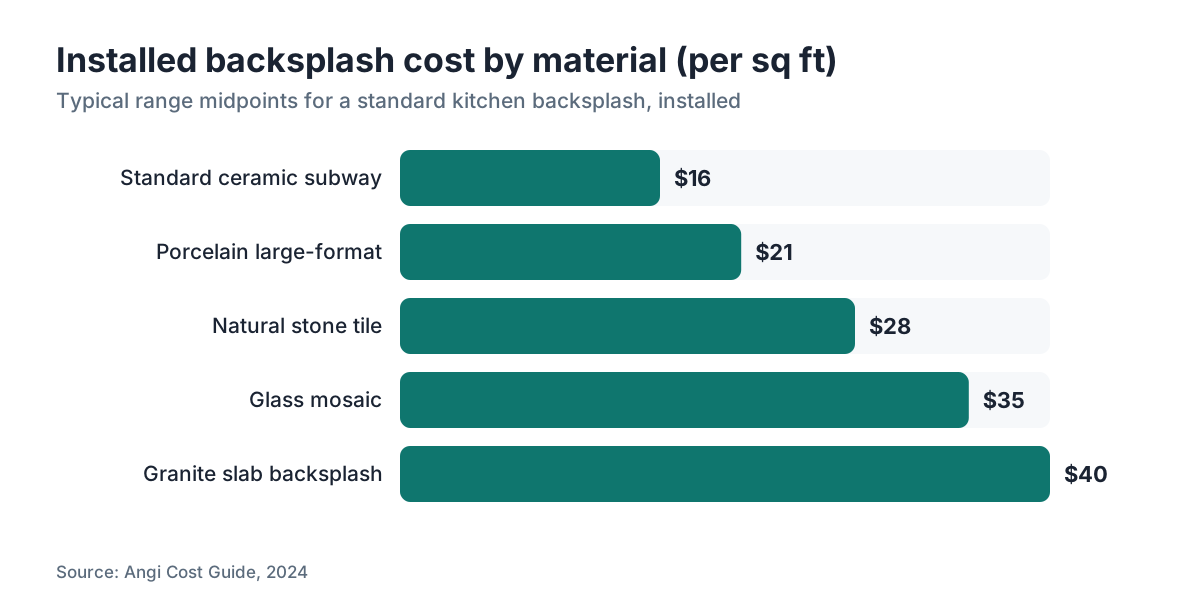
For a typical kitchen with 15 to 20 square feet of backsplash area, here are realistic total installed costs by material type [1][3].
Basic ceramic subway tile: $150, $440 total installed. Mid-range porcelain or stone tile: $225, $800 total installed. Glass mosaic or designer tile: $300, $1,000 total installed. Granite slab backsplash (coordinated with the countertop): $375, $1,100 total installed.
These numbers assume a standard kitchen, no major demo, and reasonably accessible walls. Costs climb with complex patterns (herringbone runs 20 to 30% more in labor than straight-set), multiple outlets and switches that need tile cut around them, and any existing backsplash that needs removal first.
Labor alone typically runs $10, $15 per square foot for a basic straight-set tile job [1]. Skilled mosaic or detailed pattern work can run $20, $30 per square foot in labor.
One cost many homeowners miss: outlet box extensions. When you add 3/8 to 1/2 inch of tile to a wall, every electrical outlet box may need an extension ring to bring it flush with the new surface. Electricians charge $25, $75 per outlet for this [3]. A typical kitchen backsplash wall has 2 to 4 outlets.
Do not forget the countertop itself. A full granite countertop installation for an average kitchen (40 to 50 square feet of stone) runs $2,000, $4,500 installed, depending on slab choice, edge profile, and number of cutouts [4]. The backsplash is a modest addition to that total.
Should the backsplash match the granite or contrast with it?
This is the question that starts the most arguments among designers, and honestly both approaches work when executed well.
The case for matching (or coordinating): granite already has a lot going on. A backsplash that picks up one of its quieter tones, like the cream ground of a Santa Cecilia or the gray veins in a Colonial White, lets the room breathe. Visitors see the granite clearly. The backsplash supports it without competing.
The case for contrast: a backsplash with clear contrast (white tile behind a very dark granite, or a deep charcoal tile behind a white granite) builds visual structure. The surfaces read as clearly different and clearly intentional. This works well in modern or contemporary kitchens where clean lines and defined zones drive the design.
What usually fails is accidental contrast. That is when the backsplash and the granite both try to be the main event: a busy, multicolored mosaic behind a veined, multicolored granite. Neither wins. The kitchen looks chaotic.
A practical guide: if your granite has more than three distinct colors, the backsplash should be quieter. If your granite is fairly simple (a consistent black, a white with minor movement, a gray with minimal variation), the backsplash can carry more personality.
For more on how granite looks in different kitchen contexts, see our full guide to granite countertops and the broader overview of kitchen countertops.
What tile patterns and formats work best with granite?
Pattern choice changes how busy or calm the backsplash reads, independent of color.
Straight-set (running bond) is the standard subway pattern with each row offset by half a tile. Safest choice, cheapest to install, works with almost any granite.
Stacked (grid) pattern sets tiles in straight vertical and horizontal lines. It reads more modern and geometric. One caution: stacked patterns need perfectly plumb and level installation, and any deviation shows clearly.
Herringbone creates a diagonal V pattern. It is visually active, which means it competes more with a busy granite. Save herringbone for simpler stone, or use it only as an accent strip.
Brick pattern (1/3 offset) is less common than standard running bond but reads as a slightly more upscale version of the classic look.
Large-format tile (12x24 or larger porcelain) has minimal grout lines and a very clean, quiet look. It is excellent behind busy granite because it fills wall space without adding visual noise.
Scale matters too. A 1x1 inch mosaic behind a granite with large, dramatic movement is a clash of scales. A 12x24 porcelain slab behind a granite with fine, dense patterning is a calming counterpart. Match scale: busy stone pairs with large, quiet tile; quiet stone can handle smaller, more detailed tile.
For other surface comparisons, marble countertops face similar backsplash pairing decisions, while surfaces like laminate countertops or formica countertops give you more backsplash latitude because the surface itself is less dominant.
Can you use a granite slab as a backsplash?
Yes, and it is one of the cleanest-looking options available. A granite slab backsplash uses pieces cut from the same slab or a coordinating slab, typically running the full height from countertop surface to underside of the upper cabinets. No grout lines. One continuous surface. Very easy to wipe down.
Fabricators fold slab backsplash cuts into the template and cutting stage, which keeps the seams aligned with any seams in the countertop. The pieces are typically 3/4 inch thick (same as the countertop slab) and polished on all four edges that will show.
Cost-wise, a granite slab backsplash adds roughly $10, $20 per linear foot above a standard tile option, because it uses material from the slab you are already buying (less waste cost but more cutting and polishing labor). For a 10-foot kitchen run, that is an extra $100, $200 over tile. For the cleanliness and visual continuity, many fabricators and homeowners think it is worth it.
One limit: a slab backsplash needs a wall that is flat and plumb. Wavy or uneven drywall creates gaps that are hard to caulk cleanly. Tile is more forgiving of wall imperfection because the setter can skim-coat and level the surface first. If your walls are old or wavy, confirm wall prep with your installer before committing to a slab splash.
To see how different stone surfaces compare on upkeep, our guide to how to clean stone countertops covers what to expect from sealed granite over time.
What grout color should you use with a granite backsplash tile?
Grout color does more work than most people expect. It can make the tile pattern pop or make it disappear, and it decides how much maintenance you are signing up for.
General guidance: match the grout to the tile color for a cohesive look where the tile reads as a surface instead of a grid. Contrast the grout slightly (a few shades darker than the tile) if you want the pattern to show. Go darker still for a very deliberate, graphic look.
For granite pairings, the safer move is grout that matches or closely follows the tile. A cream tile with cream grout reads as a quiet backdrop for the stone. A white tile with dark charcoal grout reads busier and pulls attention.
Maintenance matters here. Light grout shows grease stains and discolors faster in a kitchen, especially near the range. Darker grout hides cooking residue better. Epoxy grout costs more ($5, $12 per square foot in material vs. $1, $3 for sanded cement grout) [5] but does not absorb stains and does not need sealing. For a kitchen you actually cook in, epoxy grout is worth considering, particularly around the range.
Sanded grout is standard for joints wider than 1/8 inch. Unsanded grout is used for joints narrower than 1/8 inch, which applies to some glass tile and small mosaic. The wrong type causes cracking or staining, so confirm with the tile manufacturer.
After installation, cement grout should be sealed within the first week and annually after that. Granite surfaces (countertop and slab backsplash) should be resealed every 1 to 3 years depending on stone density and sealer type [6].
How does a backsplash affect granite countertop resale value?
Nobody has clean data isolating backsplash material from overall kitchen remodel value, but the broader kitchen picture is well-documented. The Remodeling 2024 Cost vs. Value Report [7] puts the average return on a minor kitchen remodel at roughly 85 to 96% nationally, while a major upscale kitchen remodel returns 38 to 54% depending on market. The backsplash is a small slice of that total cost.
What appraisers and agents consistently report (though these studies are observational, not controlled) is that backsplash and countertop combinations that look outdated or mismatched get flagged as kitchen deficiencies in buyer feedback. A dated ceramic backsplash in a kitchen with premium granite reads as an unfinished renovation. Buyers notice, and they mentally budget a replacement.
From a resale angle, the smartest move is a clean, neutral backsplash that does not polarize buyers: white or cream subway tile, large-format neutral porcelain, or a granite slab backsplash in the same stone as the countertop. These options appeal broadly and photograph well in listing photos, which is where most buyers first decide whether to visit a home.
Avoid highly personal choices (mural tile, very unusual color combinations, heavily patterned mosaic) if resale is on your mind. Those choices may be exactly right for you and exactly wrong for the next buyer.
For fabricators using software to build quotes that include backsplash cuts alongside countertop slabs, SlabWise handles slab nesting and job costing in one place, which helps when a customer wants a coordinated slab splash priced into the same quote.
What are the most common mistakes when pairing a backsplash with granite?
Choosing tile from a photo online rather than against a physical sample of the actual slab is the number one mistake. Granite color varies between slabs, and even between areas of the same slab. A tile that looked perfect against a stock photo of your granite variety can clash with your real slab. Always get a remnant chip.
Ignoring undertone is close behind. Warm granite with cool-toned tile (or the reverse) looks like a mistake even when both materials are attractive on their own.
Grouting the joint between the backsplash tile and the countertop surface. That joint needs caulk, not grout. Grout cracks within a year as the two surfaces flex and settle at different rates. Tile Council of North America (TCNA) standards call for caulk at all changes of plane and at joints between dissimilar materials [2].
Installing the backsplash before the countertop. The countertop must go in first so the tile can be scribed to it.
Skipping outlet extensions. When the tile thickness pushes outlet faces back from flush, the electrical box needs an extension ring. Skipping this violates code in most jurisdictions and creates a fire hazard [8].
Choosing a backsplash material that is hard to source for future repairs. Discontinued tile lines are very common. Buy 10 to 15% extra tile and store it, so you have matching material if you ever need to replace a cracked piece.
For installation process context, see our guide to countertop installation for the full sequence from template to final caulk.
Frequently asked questions
What color backsplash goes best with black granite countertops?
White, cream, or light gray tile is the most common and most effective pairing. The contrast is sharp and intentional. Glass tile in silver or pale blue also works well. Avoid anything too dark or it blurs the countertop edge visually. A simple 3x6 white subway tile in a straight-set pattern is a reliable choice that photographs well and reads as contemporary without being trendy.
Should the backsplash match the granite or the cabinets?
The backsplash should first coordinate with the granite, since both share the same sightline. The cabinets set the room's dominant tone, but the backsplash sits right above the stone. Pull a secondary color from the granite and make sure it does not fight the cabinet color. Most backsplash materials in cream, white, or soft gray work with either light or dark cabinets, which is why neutral choices are a good starting point.
Can you put peel-and-stick tile behind granite countertops?
Technically yes, but it is a poor choice. Kitchen walls near the stove reach temperatures and humidity that cause peel-and-stick adhesive to fail within a year or two. Peeling panels next to a permanent granite surface look bad and are hard to remove cleanly. Budget tile with thinset and grout is more durable and costs very little more once you factor in re-doing peel-and-stick after it fails.
How do you fill the gap between granite countertop and backsplash tile?
Fill it with a silicone caulk matched to the grout color, not with grout. The joint between the countertop surface and the tile is a change-of-plane joint where two different materials meet. Both expand and contract at different rates. Grout is rigid and cracks within months. Silicone caulk flexes with movement. Tile Council of North America installation standards specify this caulk joint in all interior corner and change-of-plane applications.
How wide should the backsplash be behind a kitchen island with granite?
Kitchen islands usually do not have a wall behind them, so a traditional tile backsplash does not apply. Instead, you might see a low granite backsplash (2 to 4 inches tall) along the back edge of the island countertop to protect walls or cabinetry from moisture where the island meets a wall. If the island does sit against a wall, tile that wall from countertop to the height of the upper cabinets or ceiling using the same approach as a standard run.
Does a backsplash have to go all the way to the ceiling?
No. Standard backsplash height fills the 18-inch space between the countertop surface and the underside of upper cabinets. Full-height tile to the ceiling is a design choice that works well on walls without upper cabinets. It adds cost but removes painted drywall in a space that gets greasy over time. Most kitchens use the 18-inch standard and paint the wall above the upper cabinets a coordinating color.
What backsplash works best with white granite countertops?
White granite like Alaska White, Colonial White, or River White usually has gray, beige, or subtle brown veining. Coordinating with gray or warm beige tile lets the veining lead. A bright white subway tile creates strong contrast and a clean modern look. Avoid very busy tile patterns since white granite is already visually active. Large-format pale gray porcelain is a popular current choice that cleans easily and reads calm.
Can you use stone tile as a backsplash behind granite countertops?
Yes, and it can look excellent. Travertine, marble, or slate tile all work. A marble tile behind a gray or white granite creates a sophisticated, cohesive look. Travertine behind a warm-toned granite (Santa Cecilia, Giallo Ornamental) reads naturally warm. The main consideration is maintenance: natural stone tile also needs sealing and is more porous than porcelain. Epoxy grout helps in wet or greasy kitchen areas.
Is it cheaper to do the backsplash yourself or hire someone?
DIY tile saves $10, $15 per square foot in labor on a basic straight-set job. For 15 to 20 square feet, that is $150, $300 in savings. It is a reasonable DIY project if you have tiled before, have a wet saw, and are comfortable working around outlets. Complex patterns, stone tile, or glass tile are harder to cut cleanly and more likely to crack if handled wrong. Most first-time DIYers underestimate cutting waste, so buy 15% extra tile.
How long does a backsplash installation take?
A standard 15 to 20 square foot kitchen backsplash takes one to two days for a professional tile setter: a half to full day to set the tile and a second day to grout after the thinset cures (typically 24 hours). DIY jobs often stretch to a weekend. Add time for outlet extensions (electrician visit), any wall prep like skim-coating, and letting grout sealer cure 48 to 72 hours before getting the surface wet.
Do I need to seal granite backsplash tile the same way as the countertop?
If the backsplash is cut from the same granite slab, yes: apply the same penetrating sealer you use on the countertop. Walls see less moisture than countertops, so resealing every 2 to 3 years is usually enough rather than annually. Natural stone tile backsplash (travertine, marble, slate) should also be sealed. Porcelain and ceramic tile are non-porous and do not need sealing, though the grout joints do.
What is a short backsplash versus a full backsplash?
A short or 'pencil' backsplash is a 4-inch strip of material (often granite or matching stone) that sits directly behind the countertop and gives a water barrier between the counter surface and the wall. It is common in bathrooms. A full backsplash fills the entire wall between the countertop and upper cabinets (typically 18 inches). In a kitchen with real cooking traffic, the full backsplash is more protective and more practical.
Can you mix two different backsplash materials in the same kitchen with granite?
Yes, and it is done often, particularly on a range wall where the main backsplash is tile and the zone directly behind the cooktop is a different material (slab stone, stainless steel, or decorative tile). The key is to make the transition intentional: align it with a natural break like a cabinet edge or a range hood column. Mixing two competing tile patterns on the same continuous wall rarely looks planned.
Sources
- HomeAdvisor (Angi), Backsplash Installation Cost Guide: Installed backsplash tile costs range from $10, $50 per square foot depending on material, with labor typically $10, $15 per square foot for standard ceramic tile
- Tile Council of North America (TCNA), Handbook for Ceramic, Glass, and Stone Tile Installation: TCNA standards require caulk (not grout) at changes of plane and at joints between dissimilar materials, including the joint between a tile backsplash and a stone countertop
- HomeAdvisor (Angi), Electrician Cost Guide: Electricians charge $25, $75 per outlet for extension ring installation when tile adds thickness to a wall surface
- HomeAdvisor (Angi), Granite Countertop Cost Guide: Average installed granite countertop cost for a typical kitchen runs $2,000, $4,500 depending on slab, edge profile, and cutouts
- HomeAdvisor (Angi), Epoxy Grout vs. Cement Grout: Epoxy grout costs $5, $12 per square foot in material versus $1, $3 for sanded cement grout and does not require sealing
- U.S. Environmental Protection Agency, Indoor airPLUS and building materials guidance: Sealed natural stone surfaces should be maintained per manufacturer schedules to keep stain and moisture resistance in kitchen environments
- Remodeling, 2024 Cost vs. Value Report: Minor kitchen remodel returns 85 to 96% of cost nationally; major upscale kitchen remodel returns 38 to 54% depending on market
- National Fire Protection Association, NFPA 70 National Electrical Code: NEC Article 314 requires electrical boxes to be flush with or not more than 1/4 inch behind a noncombustible finished surface; tile that pushes a box face back typically requires an extension ring
- U.S. Geological Survey, National Minerals Information Center, Dimension Stone: Granite is among the most commonly used dimension stone for residential kitchen applications in the United States
- Natural Stone Institute, technical resources and care guidance: Natural stone tile backsplash materials including travertine and marble are porous and require sealing; installation standards match those for stone countertop surfaces
Last updated 2026-07-09