TL;DR
- Instagram works for countertop fabricators because the product photographs beautifully and homeowners actively hunt renovation content there.
- Post job-site photos and Reels of slab reveals, use location tags and material hashtags, engage with local design accounts, and treat Stories as a sales tool.
- Posting 4 to 5 times a week usually produces measurable lead inquiries within 60 to 90 days.
Does Instagram actually bring in countertop leads, or is it just vanity?
It brings leads. But only if you treat it like a sales channel and not a scrapbook.
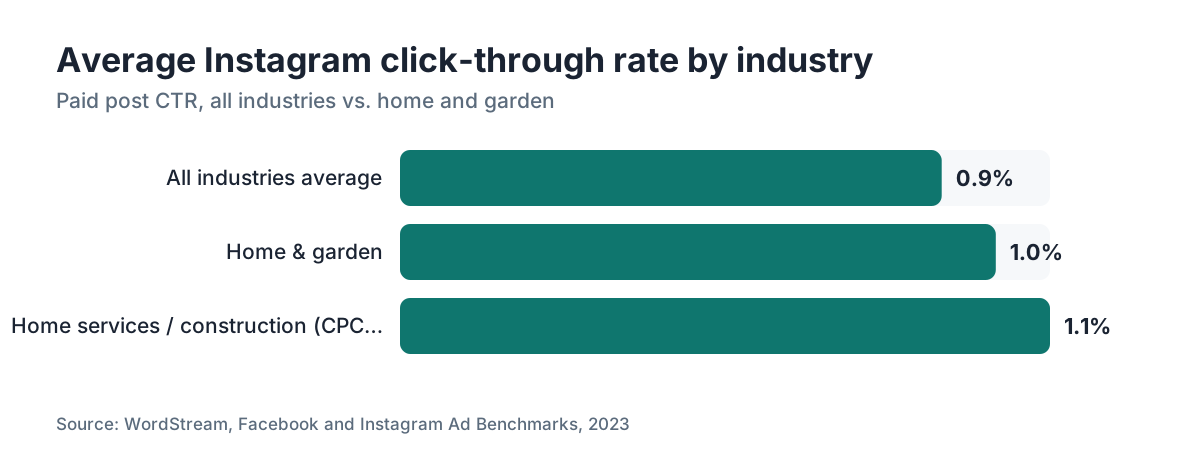
Instagram works for fabricators because countertops photograph beautifully. A finished waterfall edge in Calacatta marble, a leathered black granite island, a butcher block still catching the light with fresh oil on it. These images stop scrollers cold. The Pew Research Center reports that about 47 percent of U.S. adults use Instagram, and usage skews toward the exact adults renovating homes [1]. Paid home and garden content on Instagram runs a click-through rate near 0.99 percent versus the all-industry average of about 0.90 percent, per WordStream's ad benchmarks [2]. Organic reach in a tight visual niche can beat both.
What turns a follower into a customer is three things working together. Trust signals (real finished jobs, never stock photos). Geographic relevance (location tags so the algorithm shows you to people in your metro). A clear path to inquiry (a link in bio, a DM prompt, a quote ask in every caption). Fabricators who skip any one of those report the same thing: an active-looking feed that produces zero phone calls.
So yes, it works. It just takes a system, more than good taste.
What kind of content performs best for a stone or countertop shop?
Five content types reliably perform for fabricators, and they are not equally effective. Job reveals do the heavy lifting.
A clean before-and-after pair, or a short Reel panning across a finished kitchen, beats every other format on engagement and saves. Saves matter because Instagram treats a save as a strong intent signal. A homeowner who saves a countertop reveal is mentally shopping. Meta's creator guidance reports that Reels receive on average 22 percent more interaction than standard video posts [3]. Film the reveal on installation day. Thirty seconds of footage is enough.
Process content is underused and it works. A twenty-second clip of a CNC machine cutting a sink opening, or a waterjet slicing an inlay, pulls huge curiosity engagement from homeowners who have no idea how fabrication happens. It signals craftsmanship without you saying a word about quality. Show the shop. Show the tools. Show the slab yard.
Material education posts do two jobs at once. They answer common homeowner questions (Is quartz or quartzite better for a kitchen? How do you care for marble countertops?) and they mark your shop as the expert before anyone calls. A single carousel comparing the maintenance of five materials can get shared into dozens of renovation Facebook groups by homeowners who found it useful.
Customer milestones, posted with permission, build social proof no copywriting can match. A homeowner tagging your shop in their own post after installation is worth ten of your own posts.
Behind-the-scenes shop life fills out the feed and makes the business feel real. New slab arrivals, templating day, a tricky radius cut. Don't underestimate it.
How often should a fabricator post on Instagram?
Four feed posts a week is the realistic, sustainable target for a fabricator, plus daily Stories when you can. The research on frequency is genuinely all over the place, and anyone selling a single magic number is selling something.
The most credible data comes from Hootsuite's annual social benchmarks, which found business accounts posting 3 to 5 times a week on feed with daily Stories see the highest average engagement compared to both lighter and heavier schedules [4]. Here is a weekly rhythm that holds up:
- Monday: process or shop content (a clip from the week's work)
- Wednesday: material education carousel or before-and-after
- Friday: job reveal (the strongest day for home content, anecdotally)
- Weekend: one Story or casual behind-the-scenes post
Consistency beats frequency. Posting daily for three weeks and then going dark for a month is worse than three solid posts a week without fail. Instagram deprioritizes accounts with a ragged cadence, and homeowners who find you mid-renovation expect to see current work.
Batch-shooting saves you. Block two hours every Friday on-site during installations and shoot everything. That bank feeds the next two weeks and means you are not scrambling for material on a Tuesday morning.
Which hashtags and location tags actually help countertop shops get discovered?
Location tags matter more than hashtags for a local service business, so tag a location on every single post. Hashtags still help discovery in niche markets, they are just weaker than they were in 2019 to 2021.
The mistake most fabricators make is leaning only on massive generic tags like #kitchen or #interiordesign, where your post vanishes in seconds. Mix the tiers instead. Later's hashtag research found posts using 10 to 15 tags across broad, niche, and local tiers outperform posts using fewer or more for local service businesses [5].
| Tier | Example tags | Approximate post count | Purpose |
|---|---|---|---|
| Broad material | #granitecountertops, #quartzitecountertops | 500K-2M | Reach homeowners searching materials |
| Niche material | #calacattamarble, #leatheredgranite | 10K-200K | Less competition, higher conversion intent |
| Local | #[cityname]kitchens, #[cityname]remodel | 1K-50K | Geographic targeting |
| Trade | #stonefabrication, #countertopreplacement | 5K-100K | Reach designers and contractors |
| Your brand | #[yourshopname] | Grows over time | Build a searchable archive |
Use 10 to 15 tags per post. More looks spammy. Fewer than 5 wastes the discovery mechanism.
Tag your city, your metro, and the neighborhood when you can. Instagram's location surfacing puts your posts in front of people physically in the market you serve. For Reels, add trending audio too. A neutral, mildly upbeat clip boosts distribution even when the content has nothing viral about it. Renovation footage does not need a soundtrack, but the algorithm rewards the trending audio anyway.
How do you convert Instagram followers into actual quote requests?
Send people straight to the thing they need to do next: a quote request form, a material selector, or a booking page. A link to your homepage is almost useless. Engagement is not revenue, and the gap between a like and a phone call is where most fabricator strategies fall apart.
Linktree and similar tools let you offer several destinations, but one well-chosen link outperforms a menu every time. Pick the single next step and point everything at it.
Caption CTAs matter more than most fabricators realize. End every caption with a direct ask, not a vague one. Something like: "DM us your kitchen dimensions for a ballpark range," or "Drop your material in the comments and we'll tell you what maintenance looks like." Those prompts generate DMs that turn into leads.
Instagram Stories with a "Book a Consult" link sticker are consistently the highest-converting Story format for service businesses. Post two or three Stories a week with a clear action. "Two template slots open this month. Tap the link to hold yours." Scarcity and specificity both lift click rates.
Reply to every comment and DM within 24 hours. This is non-negotiable. Meta's business guidance ties fast, consistent replies to better messaging performance, and its Instagram for Business materials describe the tools that surface active conversations [6]. More to the point, a homeowner who DMs you and hears nothing for 48 hours has already called someone else.
Running a serious operation? The U.S. Small Business Administration advises tracking marketing spend against actual sales to confirm return [10]. Add a UTM parameter to your Instagram bio link so Google Analytics can confirm which leads came from the platform. Gut feel about "Instagram leads" is notoriously unreliable without that data.
Should a countertop shop use Instagram ads, and what do they cost?
Test paid promotion once your organic content is solid, and never run ads on a mediocre feed. Ads amplify what is already there. They do not fix bad content.
Two ad types make sense for a local fabricator. Boosted job reveals (take your best organic post and put $5 to $10 a day behind it with a tight geographic radius). Lead generation ads (Meta's native lead form, which keeps people inside the app and captures name, phone, and email without a click away to your site).
On cost, Meta's average cost per click across all industries was $1.72 in 2023, per WordStream's benchmarks [2]. Home services and construction average around $2.93 per click. Lead form ads typically produce a cost per lead of $15 to $40 for a local home service business, though that swings hard with market size, targeting, and creative quality. Nobody has clean public data specifically on countertop fabricators, so treat these as directional, not guaranteed.
A realistic test budget is $300 to $500 per month for 60 to 90 days. That is enough volume to see whether leads convert to jobs at a rate that justifies the spend. If your average job is $4,000 to $6,000 and you close 30 percent of leads, you only need 3 to 4 leads a month to make $300 in ad spend look very sensible.
Always set a geographic limit. A shop in Denver has no business paying to reach someone in Florida. Set the radius to your actual service area, usually 25 to 40 miles for a residential fabricator.
How should a fabricator shoot photos and video with just a phone?
Light is the only thing that truly matters in countertop photography. You do not need a photographer. You need good light, a clean composition, and ten minutes of intent on each job site.
Natural window light, or the overhead shop lights at noon, both work. Avoid shooting under warm tungsten bulbs alone; they turn white quartz yellow and flatten stone. If the kitchen has good windows, shoot toward the window, not away from it. The reflected light on the surface is what makes stone look dimensional.
For Reels, stabilize your phone on the countertop edge or use a $15 mini tripod. Do a slow pan from one end of the island to the other. That motion shows scale and material better than any static frame. Keep clips to 7 to 15 seconds each and cut them together in Instagram's built-in editor or CapCut, which is free.
Shoot before the sink and faucet go in, then again after. The before-and-after sequence is the single most saved format in home renovation content.
For countertop installation clips, ask your installer to narrate briefly. "This is a mitered edge detail on Calacatta Borghini" beats silence, and that kind of specific language helps your Reel surface when someone searches that material.
Clean the surface first. Every fingerprint shows. Bring a microfiber cloth to every install and wipe the slab before you pull out your phone.
What should a fabricator's Instagram bio and profile say?
Your bio is a search result and a landing page at once. It has 150 characters to do two jobs: tell someone what you do and where, and give them a reason to click the link.
A strong fabricator bio reads like this:
Custom stone countertops. [City, State]. Quartz, granite, marble, quartzite. Free estimates. [Link to quote form]
That is it. The material list matters because people search Instagram by keyword and material names in bios are indexed. City and state drive local discovery. "Free estimates" is a soft CTA that lowers friction.
Your profile photo should be your logo, or a tight crop of your best finished countertop if the logo is not legible at small size. Skip the photo of your truck or your building. Neither tells a homeowner who has never heard of you anything useful.
The account name and display name fields should carry keywords when possible, because Instagram searches both. "Denver Stone Works" is more discoverable than "DSW Fabrication" to a homeowner looking for stone fabricators in Denver.
Pin three posts to the top of your grid. Make them your three best job reveals. First impressions happen in about two seconds of grid-scanning, and pinned posts control what someone sees first.
How do you build a local audience and get referrals from designers and contractors?
The highest-value leads for a fabricator often come from interior designers, kitchen designers, general contractors, and remodeling firms who refer over and over, not from homeowners directly. Instagram is a real channel for those relationships.
Follow every local designer, kitchen showroom, cabinet maker, and GC in your market. Engage genuinely by leaving specific comments, not "love this!" but things like "that perimeter tile pairs perfectly with the movement in that slab." Designers notice who pays attention and who has taste.
Tag collaborators when you post a job with multiple trades. Tag the cabinet maker, the designer, the tile installer. Those tags land your post in front of their audiences and often get reshared. A single reshare from a designer with 8,000 local followers is worth three months of organic posting.
DM designers with a brief, clear value pitch. "We're a fabrication shop in [city] with fast turnaround and a Cambria sample kit in the showroom. Happy to walk you through our process whenever you have a project that needs stone." Direct, not pushy. Most designers will at least save your contact.
For kitchen countertops projects, tag the appliance, faucet, or cabinet brand in the post. Those brand accounts sometimes have hundreds of thousands of followers and occasionally reshare. It is a long shot and costs nothing.
What Instagram metrics actually matter for a fabrication shop?
Saves, profile visits, link clicks, DM volume, and reach are the metrics that track to real business. Follower count is largely a vanity number for a local shop. Chasing followers without tracking lead quality is how fabricators spend a year on Instagram and get nothing.
| Metric | Why it matters | What to aim for |
|---|---|---|
| Saves per post | High-intent signal; people save content to act on later | 1-3% of reach |
| Profile visits from posts | Indicates real discovery interest | Track week-over-week growth |
| Link in bio clicks | Direct conversion intent | Track via UTM or Linktree |
| DM volume | Direct lead indicator | Track source of inquiry |
| Reach (not impressions) | Unique accounts seeing your content | Growth matters more than absolute number |
| Reel plays | Distribution indicator | Aim for 2-5x your follower count |
A fabricator in a mid-size city with 600 highly local followers will out-earn one with 6,000 followers scattered across other states and industries. Local relevance beats raw count every time.
Check insights weekly, not daily. Daily swings are noise. The pattern over 30 to 90 days is signal. If saves and profile visits are climbing, the strategy is working even if phone calls have not caught up yet. That lag is normal. The average homeowner researches countertops for months before deciding.
Shops running quoting and operations software like SlabWise can tag Instagram as a lead source in their CRM or job notes. That is the most accurate way to eventually see whether social is closing jobs at a rate worth the time.
Are there Instagram strategies specific to different countertop materials?
Yes, and they matter because the homeowner audience for each material is a little different. Match the message to the buyer.
For granite countertops, push durability and value. The granite buyer is practical and slightly skeptical of trends. Posts showing granite holding up in a busy family kitchen, or comparing real installed costs, beat aspirational lifestyle shots.
For marble countertops, lean into the luxury look. Marble buyers are already sold on beauty; they need reassurance about maintenance. Carousels that honestly cover etching and sealing while still showing stunning results build the trust that converts a marble prospect.
For quartz and Cambria countertops, education wins because these are brand names with marketing budgets behind them. Homeowners already know the brand, so your content can position your shop as the expert installer rather than compete on material identity.
For laminate countertops and Formica countertops, show the value angle without apology. There is a real, growing audience for high-design laminate installs, especially in rental renovations and budget remodels. That audience is underserved on Instagram right now, which means less competition for your posts.
For butcher block countertops, process content dominates. Homeowners are fascinated by the finishing steps. A clip of oiling a freshly installed butcher block surface pulls enormous organic engagement.
In every case, link the caption to care and maintenance content when it fits. A quartzite install post that links to how to clean quartzite countertops or how to clean stone countertops helps the homeowner and keeps them in your content longer.
How long does it take to see real results from Instagram for a countertop shop?
Plan on 90 to 120 days of consistent posting and active engagement before you see real leads. Less if you have an existing customer base to jump-start social proof. Longer if you are starting from zero in a competitive metro with a shaky schedule.
The first 30 days are foundation. Your feed starts to look like something, the algorithm figures out your niche and location, and you learn which content types your audience actually responds to. Do not expect leads in month one. That is normal.
Days 30 to 90 are when profile visits and DMs typically start. Homeowners in active renovation mode find your content, save it, visit your profile, and a small percentage reach out. This is also when local designers and contractors start noticing you exist.
After 90 days of real effort, most fabricators following a genuine strategy report 2 to 5 qualified Instagram leads a month in a mid-size market. In a large metro with strong local content and sharp hashtag targeting, that can hit 10 to 20. In a very small market, 1 to 2 a month may be it, but those leads often close at higher rates because there is less local competition.
Give it a 6-month timeline before you judge the channel. Social is slow to build and fast to lose. The shops that quit at month three and call it a failure are usually the same ones who would have landed their first design-firm referral in month four.
Pairing strong marketing with clean operations matters here. Running quoting and templating through software like SlabWise means that when Instagram leads land, you can turn around a professional quote fast enough to close them before they shop the next fabricator.
Frequently asked questions
How many followers does a countertop shop need before Instagram is worth the time?
Follower count is the wrong threshold to wait for. A shop with 200 highly local followers, posting consistently and engaging with designers and contractors in its market, generates more real leads than one with 5,000 out-of-area followers. Focus on local relevance and engagement rate, not total count. You can start seeing DM inquiries within 60 days of consistent, location-tagged posting no matter where your count starts.
Should a fabricator use a personal Instagram account or a business account?
Business account, always. It gives you Instagram Insights (the native analytics), the ability to run ads, a contact button so homeowners can call or email straight from your profile, and a category label like 'Stone & Tile Store' under your name. There is no downside and no meaningful difference in organic reach between business and personal profiles since 2022, per Meta's Instagram for Business materials.
What is a good engagement rate for an Instagram account in the home trades?
For accounts under 10,000 followers, a 3 to 6 percent engagement rate (likes plus comments divided by reach) is solid for a home trades business, per Hootsuite's industry benchmarks. Accounts between 10,000 and 100,000 followers typically see 1 to 3 percent. Reels tend to run lower engagement rates but higher reach. If your rate stays below 1 percent, the content is not landing or your audience has drifted out of your local market.
Do countertop shops need to post Reels, or do photos still work?
Both work, but Reels currently get 22 percent more interaction than standard video posts per Meta's creator guidance, and the algorithm pushes Reels to non-followers more aggressively than static images. That said, a great job-reveal photo still beats a sloppy Reel. Do both. Post 2 Reels a week and 2 static posts, then track which format drives more saves and profile visits in your own account.
Is it worth paying for Instagram followers or engagement?
No. Paid followers are bots or junk profiles that never convert to leads, and they wreck your engagement rate by inflating your count without adding real interactions. Instagram regularly purges fake accounts, so paid followers disappear anyway. Worse, a high count with low engagement is a visible red flag to designers and contractors who might otherwise refer jobs to you. Never buy followers or engagement.
How do you handle negative comments or bad reviews on Instagram?
Reply calmly and briefly, acknowledge the concern, and invite them to contact you directly to sort it out. Never argue publicly. A measured, professional response to a complaint often builds more trust than the complaint did damage, because prospects can see how you handle problems. Delete comments only if they are spam or genuinely abusive. Hiding a legitimate complaint looks worse than addressing it.
Can a countertop shop run Instagram and Facebook from the same account?
Not the same account, but you can connect them so Instagram content auto cross-posts to your Facebook Page. Set this up through Meta Business Suite. Facebook still has a notably older average user base and is where many homeowners aged 45 to 65 spend time, so cross-posting costs nothing and reaches a complementary audience. Just make sure your captions still read naturally on Facebook, where hashtags are less useful.
What is the best time of day to post for a countertop fabrication audience?
Sprout Social's timing data points to Tuesday through Friday between 9 a.m. and noon in your local time zone for the highest initial engagement. For home renovation content, Saturday mornings also perform well because that is when homeowners plan projects. Avoid posting after 8 p.m. or on Monday mornings. Your own Instagram Insights will show your specific audience's active hours after 30 days, and those should override any general benchmark.
Should a fabricator collaborate with interior designers on Instagram?
Yes, and it is one of the highest-return moves available. A collab post (both accounts listed as creators) distributes to both audiences at once. Finish a kitchen with a local designer and ask them to do a collab post. One well-placed collab with a designer who has 4,000 local followers can generate more qualified leads than a month of solo posting. Bring a printed photo of the finished job when you pitch it; designers respond to visual quality.
How do you create Instagram content during slow seasons when there are fewer jobs?
Slow seasons are for educational and behind-the-scenes content that needs no finished job. Film the slab yard. Do a materials comparison with samples from inventory. Explain how templating works. Post a time-lapse of a CNC cutting a complex shape. Rerun throwback reveals from old jobs with fresh captions. None of this requires a live installation, and all of it builds the account while competitors go quiet.
How much should a countertop shop budget for Instagram marketing per month?
For a shop starting out, the budget can be zero beyond staff time. Organic Instagram for a local service business with good content costs only the 3 to 5 hours a week to shoot, edit, caption, and engage. Once organic is producing leads, a paid budget of $300 to $500 a month for boosted posts and lead-gen ads is a reasonable test. Scale up only if you can track that Instagram leads close into jobs profitably. Plenty of successful shops run entirely on organic.
What equipment does a fabricator need to make professional-looking Instagram content?
A modern smartphone (iPhone 13 or newer, or an equivalent Android flagship), a $15 to $30 mini tripod, one clip-on wide-angle lens for shop shots, and a free editing app like CapCut or Lightroom Mobile. That is genuinely all you need. Natural light on the job site and overhead fluorescents in the shop cover most situations. A simple ring light ($40 to $60) helps for edge-profile detail shots in darker shops. Professional photography is worth it for website hero images but overkill for daily Instagram.
Does Instagram actually help with SEO for a countertop shop's website?
Indirectly, yes. Instagram links are 'nofollow' so they pass no direct link authority. But a strong presence lifts branded search volume (people Googling your shop name after seeing you), and Google reads rising branded search as a trust signal that can improve rankings over time. Instagram posts also show up in Google image search for some queries. The clearest benefit is the traffic from your bio link, which tells Google your site has real, active users.
Sources
- Pew Research Center, Social Media Fact Sheet: Roughly 47% of U.S. adults report using Instagram, with usage concentrated among adults in prime home-renovation age ranges
- WordStream, Facebook and Instagram Ad Benchmarks by Industry 2023: Home and garden Instagram ads average a click-through rate near 0.99% versus an all-industry average around 0.90%; Meta average cost per click was $1.72 in 2023, with home services and construction near $2.93
- Meta for Creators, Reels best practices and performance data: Reels receive on average 22% more interaction than standard video posts on Instagram
- Hootsuite, Social Media Trends Report 2024: Business accounts posting 3-5 times per week with daily Stories see the highest average engagement rates
- Later, Instagram Hashtag Strategy research: Posts using 10-15 hashtags across broad, niche, and local tiers outperform posts using fewer or more tags for local service businesses
- Meta, Instagram for Business overview: Instagram business accounts have access to Insights analytics, ad tools, and direct contact buttons unavailable to personal accounts, and fast messaging response supports better conversation performance
- Sprout Social, Best times to post on Instagram: Tuesday through Friday between 9 a.m. and noon local time produces the highest initial engagement for business posts on Instagram
- Meta Business Suite, Cross-posting Instagram to Facebook: Content posted to Instagram can automatically cross-post to a connected Facebook Page via Meta Business Suite
- Hootsuite, Instagram engagement rate benchmarks by industry: For accounts under 10,000 followers in home services, a 3-6% engagement rate is considered solid
- U.S. Small Business Administration, Marketing and sales guidance: Small businesses are advised to track marketing spend against actual sales conversions to confirm return on investment
- U.S. Census Bureau, Quarterly Retail E-Commerce and consumer data: The U.S. Census Bureau tracks household spending and home improvement retail activity, useful for sizing a local renovation market
- Federal Trade Commission, Endorsement guides for social media: The FTC requires clear disclosure of material connections in endorsements and paid partnerships posted on social media
Last updated 2026-07-11