TL;DR
- Scaling a countertop fabrication business into commercial work means upgrading to larger CNC and waterjet capacity, securing a contractor's license and commercial bond, building a dedicated estimating function, and restructuring cash flow to survive 30-to-90-day payment terms.
- Most shops that succeed start with one GC relationship and one small multifamily project before chasing hotels or hospitals.
What does 'commercial work' actually mean for a countertop fabricator?
Commercial countertop work covers any project where the end client is a business, institution, or developer rather than a homeowner. That includes multifamily apartment buildings, hotels, hospitals, office tenant improvements, restaurants, and retail. The defining difference is not the material (you'll still cut granite and quartz) but the delivery model.
On a residential job, you quote one kitchen, collect a deposit, install in a day, and get paid the balance at the door. On a commercial job, you might quote 200 identical bathroom vanities for a 14-floor hotel, stage delivery in phases tied to the GC's schedule, and wait 60 days after your invoice clears the owner's requisition cycle before you see a dime. The volume is real. The cash timing is brutal.
The other big difference is the procurement chain. Residential clients call you directly. Commercial clients come through general contractors (GCs), construction managers, or occasionally architects who spec the material. You're not selling to the person who will touch the countertop every day. You're selling reliability, schedule adherence, submittals, and insurance certificates to a project manager who has 40 other subcontractors to worry about.
That one distinction drives everything else in this guide.
Is your shop actually ready to handle commercial volume?
Before you chase a hotel bid, do an honest capacity audit. Here's the minimum threshold most shops hit before commercial work stops being a money-loser.
Production capacity. A CNC bridge saw or a waterjet with a cutting envelope of at least 126 inches handles the full-slab runs commercial work requires without constant re-setup. If you're still using a handheld circular saw for most cuts, commercial volume will wreck your throughput. A mid-range CNC bridge saw (think a Park Industries Titan or similar) runs roughly $150,000 to $250,000 new; used units in good condition go for $60,000 to $120,000 [1].
Workforce. You need at least two dedicated fabricators plus a full-time installer crew. Running a four-person shop at 100% utilization on residential and then dropping a 200-piece commercial order on top will blow up your residential backlog, which kills referrals.
Storage and staging. Commercial projects require slab inventory tied to a specific job lot. You need covered, organized storage where you can quarantine material by project number. Shops that mix job inventory lose time, break wrong slabs, and land in ugly warranty disputes.
Systems. This is where a lot of owner-operators hit a wall. Commercial GCs expect submittals (shop drawings, material samples, cut sheets), RFIs, and documented change orders. If your quoting and order management is still a spreadsheet and a handshake, a GC's project manager will lose confidence in you fast. Shops that move to purpose-built fabrication quoting software find it much easier to generate the documentation commercial jobs require without adding office headcount.
What licenses, insurance, and bonds do commercial fabricators need?
This is the part that catches residential shops off guard. Requirements vary by state, but the general framework holds across most of the US.
Contractor's license. Most states require a specialty contractor's license for commercial installation. In California, that's a C-54 (Ceramic and Mosaic Tile) or C-61/D-12 depending on scope [2]. In Florida, a State Certified Specialty Contractor license covers stone and tile installation [3]. Check your state licensing board. Operating unlicensed on a commercial project can void your contract and expose you to fines.
General liability insurance. Residential shops often carry $1M per occurrence / $2M aggregate. Commercial GCs typically require $2M per occurrence / $4M aggregate at minimum, and hospital or government work can require $5M or more [4]. Get a certificate of insurance naming the GC and owner as additional insureds. This is non-negotiable and the GC will ask for it before you're ever on a job.
Workers' compensation. You already need this if you have employees. On commercial jobs, the GC's insurance auditor will verify your coverage. A lapse mid-project can get you removed from the site.
Performance and payment bonds. Public projects (schools, government buildings) and some large private projects require a performance bond and a payment bond under the Miller Act (for federal projects) [5] or its state equivalents (called Little Miller Acts). A performance bond guarantees you complete the work; a payment bond protects your material suppliers. Bond premiums typically run 1% to 3% of the contract value for a first-time bonded subcontractor [6]. Your surety company will want to see two to three years of financial statements and a clean credit history.
Mechanics lien rights. On commercial jobs, your right to file a mechanics lien to secure payment is governed by state lien law. Most states require a preliminary notice (sometimes called a pre-lien notice or notice to owner) sent within 20 to 30 days of first furnishing materials or labor [7]. Miss that window and you've lost your lien rights. Set a calendar reminder for every single commercial project.
How do you price commercial countertop work without losing money?
Commercial pricing is structurally different from residential pricing, and shops that just slap their residential markup onto a commercial bid get burned.
Here's why. On a 200-unit apartment building, your stone cost per piece might be similar, but your overhead load is much heavier. You're running submittals, chasing a GC schedule that changes weekly, doing phased deliveries, and often dealing with field modifications after rough-in dimensions shift. A residential job priced at $85 per square foot might need to be $95 to $105 per square foot on a commercial multifamily project once you account for those costs (this range is industry-common; actual numbers vary a lot by market and material type).
Key line items residential estimators often miss on commercial bids:
- Submittal preparation. Budget two to four hours of drafting time per submittal package. On a large hotel, you might do six submittal rounds.
- Phased delivery logistics. Trucking costs stack up when you're delivering to an active construction site in three or four phases. Add a line item for each trip.
- Field measurement contingency. Rough-in dimensions on commercial projects drift. Price in a buffer for field templating on at least 10% of pieces.
- Payment terms carrying cost. If you're on net-60 terms and your material cost is $200,000, you're essentially lending that money to the project for two months. Factor in your cost of capital.
- Retainage. Many commercial contracts hold back 5% to 10% of each payment until project completion [8]. That's cash you won't see for six to eighteen months on a large project.
A useful rule of thumb experienced commercial subs use: your commercial bid should carry gross margin of at least 35% before overhead, compared to the 25% to 30% many residential shops run on. The higher margin is not greed. It's covering real risk you're taking on.
For shops moving to systematic commercial estimating, software that handles takeoffs and generates itemized proposals with material, labor, edge, and delivery broken out separately makes it much easier to audit your own bids before they go out the door. Tools like SlabWise are built for exactly this kind of line-item discipline.
How do commercial payment terms work, and how do you survive them?
This is the most common reason residential fabricators fail when they enter the commercial market. They win a big job, buy a lot of material, do the work, then run out of operating cash waiting for payment.
Here's how commercial payment cycles typically run. The GC submits a Schedule of Values at the start of the project. Each month (or at agreed milestones), subcontractors submit pay applications against that schedule. The GC reviews, the owner reviews, and payment flows down. On private commercial projects, net-30 to net-60 from the GC's receipt of your pay application is common. On public projects, state prompt payment laws set outer limits. California's Prompt Payment Act, for example, requires the public agency to pay within 30 days of an undisputed invoice, and the GC to pay subs within 7 days of receiving funds [9]. But "undisputed" is doing a lot of work in that sentence.
Retainage (the 5% to 10% withheld each pay period) means you may not collect your full contract amount until 30 to 90 days after substantial completion of the entire project, well past your own scope. On a $500,000 subcontract with 10% retainage, that's $50,000 sitting in escrow for potentially a year.
Survival strategies:
- Negotiate retainage down. Some GCs will accept 5% retainage with release upon completion of your scope, not the whole project. Push for it.
- Front-load your Schedule of Values. Price early-phase work (template, material procurement) at a higher percentage of the contract than late-phase work (final installation). This is legal and common.
- Get a line of credit before you need it. A business line of credit sized at 20% to 30% of your expected annual commercial revenue gives you the float to run jobs without stressing payroll [11]. Banks want to see the credit facility established before you're under pressure.
- Confirm joint check agreements if your material supplier is on the hook for a large slab order. A joint check from the GC payable to both you and the supplier protects the supplier and cuts your capital exposure.
What equipment upgrades do you need for commercial fabrication?
Equipment gaps show up fast when you take on commercial volume. Here's what actually matters.
CNC machining center. If you're running a basic bridge saw, you can do commercial work, but you'll be slow on edge profiles and cutouts. A CNC machining center (Intermac, Biesse, or similar) adds automated edge profiling, sink cutouts, and mitered edges without manual setups. New units start around $200,000; used ones run $80,000 to $150,000 [1].
Material handling. Commercial slabs are heavy and the pace is fast. A vacuum lifter rated for 800-plus pounds and a proper slab rack system cut breakage and injury risk. A slab rack that holds 40 to 60 slabs organized by job lot is not optional once you're running multiple commercial projects at once.
Templating technology. Digital templating (LT-55, Prodim Proliner, or similar laser templating systems) produces CAD files that feed directly into your CNC, cutting re-entry errors and speeding up the fabrication-to-installation cycle. On commercial projects where you're templating 50 bathrooms in a day, digital templating pays for itself quickly. Systems range from $10,000 to $30,000 [1].
Delivery vehicles. A sprinter van works for residential. Commercial deliveries often need a flatbed or box truck with a lift gate, rated for multi-slab loads. Budget $60,000 to $90,000 for a new truck or $25,000 to $45,000 used.
The sequencing matters. Most shops that scale well buy the digital templating system first (low cost, quick payback), then add CNC capacity as commercial volume justifies the capital, then upgrade vehicles as project size grows.
For countertop installation work on commercial sites, you'll also need to think about OSHA 10 or OSHA 30 certifications for your crew. Many commercial GCs require it before workers can access the site [12].
How do you find commercial GC relationships and bid commercial jobs?
Residential shops get work from Houzz, Google, and word of mouth. Commercial work runs on a completely different pipeline.
Start with GCs you already know. If you've done work on a residential project where a GC was the owner's builder, that's your warmest lead. Call them directly. Ask if they have any multifamily or light commercial projects coming up where they need a stone sub.
Invitation-to-bid platforms. GCs post bid invitations on platforms like iSqFt (now ConstructConnect), BuildingConnected (owned by Autodesk), and Dodge Data & Analytics. Many are subscription-based. BuildingConnected has a free tier for subcontractors that gets you access to bid invitations from GCs in your area [10].
Plan rooms and public bid boards. Public projects (schools, courthouses, transit facilities) are required to advertise bids publicly. Your state's procurement portal and local municipality websites list active solicitations. Responding to public bids is time-intensive but teaches you commercial bid format fast.
Prequalification. Before a GC puts you on their bid list for a serious project, they'll ask you to fill out a prequalification (prequal) form. This covers your company history, bonding capacity, insurance limits, key personnel, and a list of comparable completed projects. Have this information organized and ready. A GC who gets a professional, complete prequal from a new sub will be more inclined to give you a shot.
Your first commercial job should be small. A 20-unit multifamily renovation or a single-floor office tenant improvement is a better first project than a 200-room hotel. You want to learn the submittal process, the pay application cycle, and phased delivery logistics on a project where a mistake is recoverable.
How do you manage submittals, RFIs, and commercial project documentation?
Submittals are the documentation you provide to the GC and architect proving that the material and workmanship you plan to install matches the project specifications. For countertops, a typical submittal package includes product data sheets for the stone or engineered product, color and finish samples, shop drawings showing edge profiles and cutout locations, and on some projects material certifications.
The architect reviews the submittal and stamps it "Approved," "Approved as Noted," or "Revise and Resubmit." You cannot order material or start fabrication until you have an approved submittal. On a fast-track project, a slow submittal cycle can hold up your start date and create schedule conflicts downstream.
RFIs (Requests for Information) are formal written questions you send to the GC or architect when the drawings or specs are unclear. Something like: "The plan shows a 1.5-inch eased edge on all vanities, but the finish schedule references a full bullnose. Please confirm." Document everything in writing. Verbal answers on a commercial job are worth nothing if there's a dispute.
Change orders are formal written modifications to your contract scope or price. If the GC asks you to add 15 more vanities mid-project, that's a change order. Do not do the extra work on a handshake. Get a signed change order with a price before you fabricate an extra piece. Shops that skip this on commercial jobs often end up doing 20% more work than their contract covered and collecting for none of it.
The documentation burden is real. It's also why commercial margins need to be higher than residential. You're paying for office time that has no equivalent in a residential shop.
How should you restructure your team to handle commercial and residential at the same time?
Running both channels at once is the goal during the transition, because you can't afford to drop residential revenue while you build a commercial pipeline. But running both out of the same unstructured team is how shops create chaos.
The practical answer is to designate a commercial project coordinator as early as you can justify the hire. This is the person who owns submittals, tracks the GC's schedule, manages pay applications, and is the point of contact for the GC's project manager. It does not need to be a full-time hire at first. A strong office manager or senior estimator can carry this role for the first one or two commercial jobs.
On the production floor, create job-lot discipline from day one. Every slab for a commercial project gets a job number label and a dedicated staging area. Commercial pieces do not get mixed with residential pieces. This sounds obvious but falls apart fast in a busy shop without a written procedure.
Driver scheduling needs to separate residential and commercial. A residential install crew optimizes for tight geographic routing and same-day calls. A commercial crew optimizes for site access windows, elevator scheduling, and coordinating with the GC's site super. Different skills, different mindsets.
As commercial revenue grows to 30% or more of total revenue, the org chart starts to need a formal split: a residential sales and install manager and a commercial project manager. That split usually happens around $3M to $5M in annual revenue for shops in mid-sized markets, though the threshold varies widely based on market rates and job mix.
What materials are most common in commercial countertop projects?
The material mix in commercial work is different from residential, and understanding that changes your slab buying strategy.
In multifamily (apartments, condos, student housing), quartz engineered stone dominates because of consistency across hundreds of identical units and low maintenance for tenants. Brands like Cambria, Silestone, and Caesarstone run commercial pricing programs for fabricators doing volume. Cambria countertops in particular has a formal trade program worth registering for if you're moving into multifamily.
In hospitality (hotels), the picture is more mixed. Public spaces (lobbies, bars, reception desks) often specify natural stone, marble, or quartzite for looks. Guest bathrooms and room vanities lean toward quartz or compact surface for durability and consistency. Granite countertops still show up in hospitality, particularly in kitchens and back-of-house areas.
In healthcare (hospitals, medical offices), the spec increasingly calls for solid surface materials like Corian because of hygiene requirements and the way you can join it to sinks with no visible seam. Corian countertops and similar solid surfaces are genuinely different to fabricate than stone. You need trained thermoforming capability and adhesive joinery skills, more than saw-and-polish.
In restaurant and food service, laminate countertops and butcher block countertops appear often in prep areas where NSF compliance matters. Stone gets used at host stands, bars, and customer-facing surfaces.
The implication for your slab inventory: commercial work rewards tight SKU discipline. Pick two or three quartz programs (one mid-tier, one premium) where you can negotiate volume pricing, and stock them consistently rather than carrying 40 different materials in small quantities.
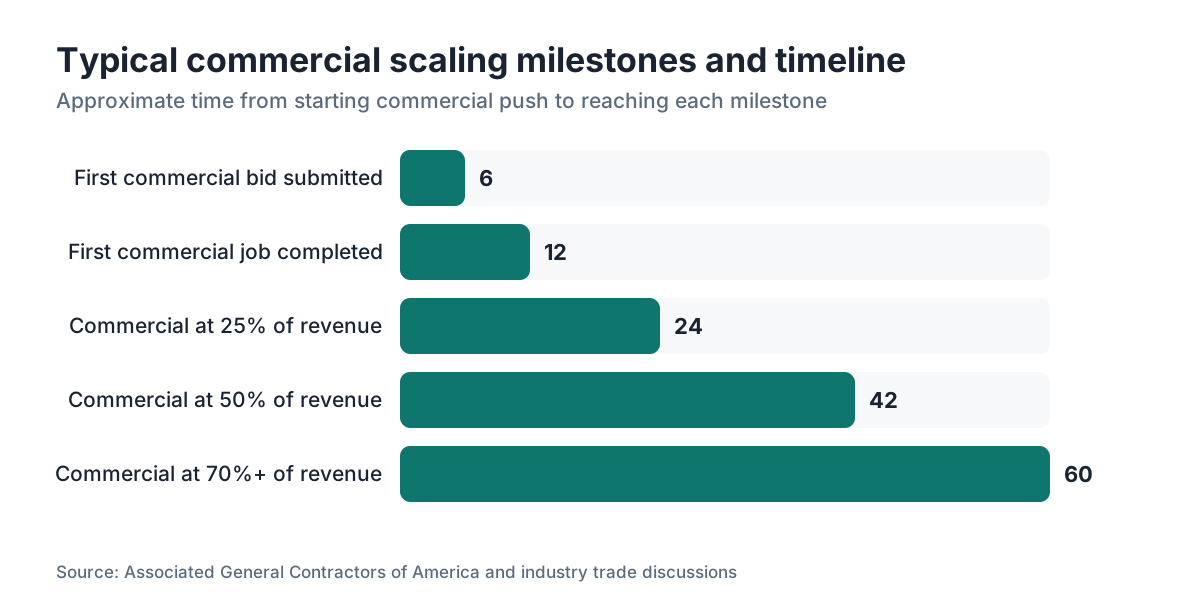
What does a realistic commercial growth timeline look like?
Nobody has published a rigorous longitudinal study on fabrication shop scaling timelines, so what follows is based on the patterns that show up repeatedly in industry discussions and trade association resources, not a controlled dataset.
Year 1 of the commercial push: You take one or two small commercial jobs (under $100,000 contract value each) through GC relationships you already have. You lose a little money on the first one because of the learning curve on submittals and phased delivery logistics. You make it up on the second. You build your prequalification package and get on the bid list for two or three GCs.
Year 2: Commercial work reaches 15% to 25% of revenue. You hire a part-time commercial coordinator. You start bidding multifamily projects in the $150,000 to $300,000 range. Cash flow is tight because commercial receivables are slow; you draw on your line of credit for the first time.
Year 3: Commercial is 35% to 50% of revenue. You've added one CNC machine or upgraded your digital templating. You have a go-to GC relationship that gives you regular bid opportunities. Your residential work is still profitable and funds the commercial growth without requiring outside capital.
| Milestone | Typical timeline | Key requirement |
|---|---|---|
| First commercial bid submitted | Month 3-6 | Prequalification package ready |
| First commercial job completed | Month 6-12 | Contractor's license, insurance cert |
| Commercial at 25% of revenue | Year 2 | Part-time coordinator, credit line |
| Commercial at 50% of revenue | Year 3-4 | CNC upgrade, dedicated crew |
| Commercial at 70%+ of revenue | Year 5+ | Full PM staff, bonding capacity |
Some shops move faster. Some stall at 25% commercial because the GC pipeline is slow to develop. The honest answer is that the timeline depends heavily on your local market, your existing GC relationships, and how hard you push prequalification.
How do you use software and systems to manage the commercial workload without drowning in admin?
Administrative overhead is the hidden cost that kills commercial profitability for shops that scaled production but not systems. A commercial project generates five to ten times the paperwork of a comparable residential job.
The minimum systems stack for a commercial fabricator:
Estimating software that generates line-item proposals with material, labor, edge work, delivery, and miscellaneous broken out. Commercial GCs often need to see itemized breakdowns, not a single price. If you bid with one number and a GC asks for your breakdown, you need to produce it quickly and accurately.
Job costing. Know your actual cost on every commercial job after the fact. The only way to improve your commercial bidding over time is to compare what you bid to what a job actually cost. Shops that skip job costing are flying blind.
Submittal tracking. A simple spreadsheet with submittal number, date submitted, review deadline, and current status is enough to start. As volume grows, purpose-built construction management tools like Procore (which many GCs already use) have sub-facing modules that handle this.
Pay application tracking. Know exactly where every pay application sits in the approval cycle at all times. Late submissions push your payment out by a full billing cycle. Missing a billing cycle on a large project can mean 30 extra days of float you weren't planning for.
Tools like SlabWise handle the fabrication-side quoting and material tracking that feeds into all of this. The point isn't to sell any one system. It's that running commercial work on memory and sticky notes is not a strategy. It's a liability.
Frequently asked questions
How much does it cost to get bonded as a countertop fabrication subcontractor?
Bond premiums for first-time bonded subs typically run 1% to 3% of the contract value, according to industry surety sources. A $300,000 subcontract bond might cost $3,000 to $9,000 in premium. Your surety company will require two to three years of financial statements, a clean credit record, and a list of comparable completed work. Once you have a bonding history, rates usually improve.
What insurance limits do commercial GCs require from countertop subs?
Most commercial GCs require general liability of at least $2M per occurrence and $4M aggregate, plus workers' compensation and auto liability. Hospital or government projects often require $5M or more. The GC will ask for a certificate of insurance naming them and the owner as additional insureds before you're allowed on site. Residential shop limits of $1M/$2M are usually not enough.
Do I need a contractor's license to do commercial countertop installation?
In most states, yes. Requirements vary: California requires a C-54 or C-61/D-12 specialty license for commercial stone installation; Florida requires a State Certified Specialty Contractor license. Operating unlicensed on a commercial project can void your contract and result in fines. Check your specific state licensing board before submitting your first commercial bid.
What is a mechanics lien, and how does it protect a fabricator on commercial jobs?
A mechanics lien is a legal claim against the property securing your right to payment for labor and materials. If you're not paid, a properly filed lien can force the property owner to pay, even when the GC is the one who owes you. Most states require a preliminary notice sent within 20 to 30 days of first furnishing materials. Miss that window and you lose lien rights entirely.
What is retainage, and how much should I expect on a commercial countertop contract?
Retainage is a percentage of each payment the GC withholds until project completion, typically 5% to 10% of your contract value. On a $400,000 subcontract with 10% retainage, that's $40,000 you won't collect until the project's final completion, which can be 12 to 18 months after you finish your own scope. Negotiate for retainage reduction or early release tied to completion of your specific work.
How is commercial countertop pricing different from residential?
Commercial pricing needs to cover submittal prep, phased delivery logistics, field measurement contingency, and the carrying cost of slow payment terms. Most experienced commercial subs target gross margin of at least 35% before overhead, versus 25% to 30% on residential work. The extra margin covers real administrative and financial risk, not extra profit. Shops that price commercial jobs at residential margins usually lose money on them.
What materials do commercial countertop projects specify most often?
Multifamily projects lean heavily on quartz engineered stone for consistency across many identical units. Hospitality projects mix natural stone in public areas with quartz in guest rooms. Healthcare specs often call for solid surface like Corian for hygiene and joinery that hides the seam at the sink. Food service uses laminate and butcher block in prep areas where NSF compliance matters. Knowing the spec before you bid helps you price material accurately.
How do I find commercial GCs to bid countertop work to?
Start with GCs you already know from residential projects. Then register on platforms like BuildingConnected (free subcontractor tier) or ConstructConnect to receive bid invitations. Public projects are advertised on state procurement portals. Prepare a professional prequalification package (company history, bonding capacity, insurance, project list) before reaching out. GCs who get a complete, professional prequalification respond faster to new subs.
What is a submittal, and what does a countertop fabricator typically include in one?
A submittal is a documentation package you provide to the GC and architect proving your planned materials and methods match the project specs. For countertops, it typically includes product data sheets, color or finish samples, shop drawings showing edge profiles and cutout locations, and material certifications if required. You cannot legally start fabrication or order material until you have an architect-stamped approved submittal.
How many employees does a shop need before commercial work makes sense?
There's no fixed number, but a practical minimum is two dedicated fabricators and a full install crew, plus at least one office person who can handle documentation. Running commercial off a four-person shop that's already at capacity on residential will wreck both channels. Most shops that scale successfully into commercial have at least six to eight people before they take on a project above $150,000 in contract value.
What CNC equipment do I need to compete on commercial countertop jobs?
A CNC bridge saw or machining center with a cutting envelope of at least 126 inches is the practical baseline. New units run $150,000 to $250,000; used machines in good condition go for $60,000 to $120,000. Digital templating systems like the LT-55 or Prodim Proliner ($10,000 to $30,000) have a faster payback and are often a better first investment than a new CNC for a shop starting to test commercial volume.
How long does it take to go from a residential-only shop to having commercial work at 50% of revenue?
Based on patterns in industry discussions, most shops take three to four years to reach 50% commercial revenue, assuming they actively pursue GC relationships from year one. Year one is usually one or two small jobs and a lot of learning. Year two brings the first real commercial pipeline. Year three is when the split becomes meaningful. Shops in high-growth markets with strong GC networks can move faster.
Do state prompt payment laws help fabricators get paid faster on commercial jobs?
Yes, but the protection varies. California's Prompt Payment Act requires public agencies to pay within 30 days of an undisputed invoice and GCs to pass funds to subs within 7 days of receiving payment. Most states have similar prompt payment statutes. Private commercial projects are governed more by contract terms. Knowing your state's law and referencing it in your subcontract gives you a stronger hand if a GC is slow to pay.
Is it worth hiring a dedicated commercial estimator, or can the shop owner handle it?
On your first few commercial bids, the owner handling estimating makes sense because you need to learn the format. Once commercial bidding takes more than 10 to 15 hours per week, a dedicated estimator pays for itself. Commercial estimates are more complex than residential and a missed line item on a $500,000 job hurts badly. Most shops hire a dedicated estimator when commercial revenue crosses $1M to $1.5M annually.
Sources
- Park Industries, equipment pricing reference pages: CNC bridge saws and machining centers for stone fabrication range from $150,000 to $250,000 new; digital templating systems range from $10,000 to $30,000
- California Contractors State License Board, license classifications: California requires a C-54 Ceramic and Mosaic Tile or C-61/D-12 specialty contractor license for commercial stone installation
- Florida Department of Business and Professional Regulation, Contractor Licensing: Florida requires a State Certified Specialty Contractor license for commercial stone and tile installation
- OSHA, General Industry Standards, Subpart E: Commercial GCs typically require $2M per occurrence and $4M aggregate general liability; hospital and government work often requires $5M or more
- U.S. Congress, Miller Act, 40 U.S.C. §§ 3131-3134: The Miller Act requires performance bonds and payment bonds on federal construction contracts over $150,000
- Surety Information Office, Small Contractor Bonding Guide: Performance and payment bond premiums for first-time bonded subcontractors typically run 1% to 3% of the contract value
- American Subcontractors Association, Lien Law Resource: Most states require a preliminary notice within 20 to 30 days of first furnishing labor or materials to preserve mechanics lien rights
- Associated General Contractors of America, Subcontractor Payment Practices Survey: Many commercial contracts hold back 5% to 10% retainage from each payment until project completion
- California Legislative Information, California Public Contract Code Section 7107 (Prompt Payment Act): California's Prompt Payment Act requires public agencies to pay within 30 days of an undisputed invoice and GCs to pay subs within 7 days of receiving funds
- U.S. Small Business Administration, Business Line of Credit guidance: A business line of credit sized at 20% to 30% of expected annual revenue is a standard approach for managing construction subcontractor cash flow
- OSHA, Construction Industry Standards, OSHA 10 and OSHA 30 training requirements: Many commercial GCs require OSHA 10 or OSHA 30 certification for workers before they can access a commercial construction site
Last updated 2026-07-11