TL;DR
- For granite finishing, use a wet resin-bond diamond pad set running from 50 or 100 grit up through 3000 grit, then a buff pad.
- Alpha, Weha, and Stadea are the most-used brands in professional shops.
- Dry pads handle jobsite touch-ups, but wet pads cut faster, run cooler, and last longer on hard stone like granite.
What makes a diamond polishing pad work on granite?
Granite ranks 6 to 7 on the Mohs hardness scale [1]. Only industrial diamonds cut and polish it efficiently. A diamond polishing pad is a flexible disc, usually 4 or 5 inches across, with synthetic diamond crystals bonded into a resin or metal matrix on one face. Run it over the stone and those diamonds micro-abrade the surface, first removing saw marks and scratches, then refining the granite step by step until it reflects light evenly.
Bond type matters as much as grit. Resin-bond pads are the standard for polishing because the softer matrix releases worn diamonds and keeps exposing fresh ones. Metal-bond pads are harder and meant for aggressive grinding or shaping, not finishing. Hybrid pads sit in between and turn up in some medium-grit steps.
Pad diameter changes how the grinder behaves. Four-inch pads on a 4-inch angle grinder or variable-speed polisher are the shop default for countertop work. Five-inch pads cover flat slabs a little faster. Smaller pads, down to 2 inches, handle edge work and tight inside corners.
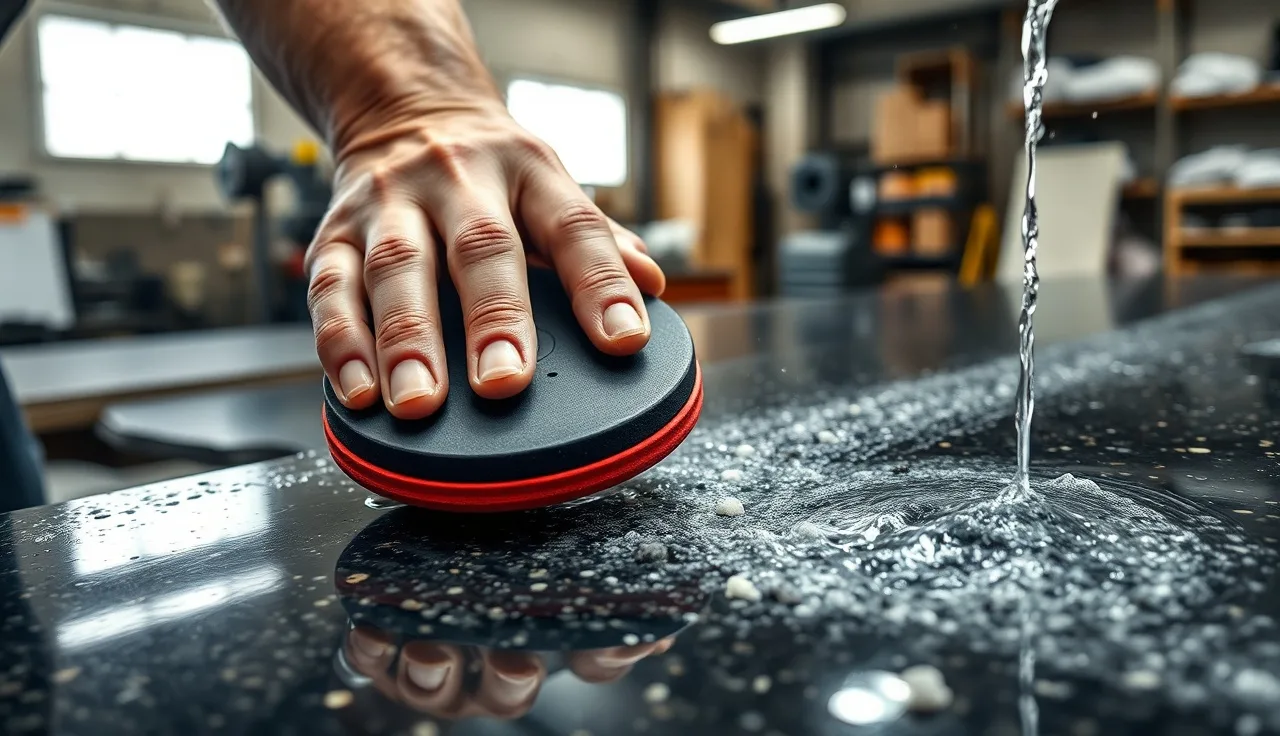
Granite is dense, so it heats up fast under friction. Heat kills resin bond and burns the stone. That's the whole reason wet polishing is the professional standard. Water floods the pad continuously, cools the stone, flushes the slurry, and stretches pad life way out.
What grit sequence should you use for granite polishing?
The grit sequence is the one variable that decides everything. Skip grits and you get haze instead of a mirror. Each pad removes the scratches the last one left, and if you jump too far, you're asking a fine pad to chase coarse scratches it can't reach quickly.
A standard professional sequence for granite looks like this:
| Step | Grit | Purpose |
|---|---|---|
| 1 | 50 or 100 | Remove saw marks, flatten surface |
| 2 | 200 | Remove 50/100 scratches |
| 3 | 400 | Refine surface, begin to develop sheen |
| 4 | 800 | Surface becomes semi-reflective |
| 5 | 1500 | High-gloss development |
| 6 | 3000 | Near-mirror finish |
| 7 | Buff pad | Final polish with compound |
Some fabricators add a 50-grit step before 100 on a freshly cut slab edge with rough blade marks. Others jump from 400 to 1500 on resawn surfaces that are already fairly flat. That shortcut works on softer granites but leaves micro-haze on very dense black or blue stones.
Doing a small repair or reviving a countertop that just lost its shine? Start at 400 or even 800. You only need the aggressive early grits when you're removing real material.
One benchmark repeated all over the fabrication trade, though no single published study pins it down, is that roughly doubling the grit number each step keeps removal rates matched. Jump from 200 straight to 800 and that 800-grit pad works three or four times as hard and takes proportionally longer.
Wet vs. dry diamond pads: which is better for granite?
Wet pads win for granite almost anytime water is manageable. The physics are simple. Water lubricates the cut, drops surface temperature, and carries away the granite slurry that would otherwise clog the pad face and turn your polisher into a burnisher.
Dry pads use a ventilated or segmented design so air cools the face. They're handy on a jobsite where you don't want water near finished flooring or cabinets, and they work for quick touch-up grinding on installed countertops. But they run hotter, wear faster, and on dense granite they just don't match the consistency of wet pads.
If you run volume work in a shop, wet polishing is the only sensible approach. A wet variable-speed grinder (sometimes called a wet polisher) with a water feed ring costs roughly $150 to $350 depending on brand, and a full set of wet resin pads in the sequence above runs $40 to $120 [2]. That pays back in pad life alone.
Doing a one-time repair at home? A dry set avoids the mess, but run the tool under 3000 RPM and keep the pad moving to stop heat from building. Never park the pad on one spot. A dry pad that stops on dark granite for two or three seconds can leave a ghost ring that takes real work to remove.
Which brands of diamond polishing pads do professionals use most?
No independent study ranks pad brands by popularity in fabrication specifically, so what follows comes from supplier catalogs, professional forum threads, and trade show floors.
Alpha Professional Tools is probably the most recognized name in granite fabrication. Their Alpha, CPA, and Ceramica lines cover granite-specific work at most grits. Alpha pads sell through major stone supply distributors and run roughly $8 to $15 per pad in single quantities [2].
Weha is another steady pick in professional shops, known for transitional wet/dry pads and full system kits that bundle grits 50 through 3000 with a buff pad. Weha's pricing tracks close to Alpha.
Stadea sits at a lower price point, often $3 to $8 per pad, and its quality-per-dollar reputation is solid for shops burning through high volumes. Stadea lacks Alpha's brand cachet, but fabricators doing production work often switch to it for grinding and mid-grit steps while keeping premium pads for the finishing sequence.
Diamante Brasil and Diteq also sell through stone supply distributors and show up in larger shops. Both make full systems.
Bigger doesn't mean better here. A $6 Stadea 400-grit pad does the same job as a $12 Alpha 400-grit in most shop use. The real gap between brands shows at the finishing steps, 1500 and 3000, where premium pads cut more consistently and leave fewer swirl marks.
For a granite countertops shop running 20 or more slabs a week, most owners I've seen buy name-brand pads for 1500 and 3000 and use mid-tier pads for everything below that.
What RPM and tool settings should you use?
Pad speed matters, and most fabricators get it wrong at some point. Too slow and you're rubbing, not cutting. Too fast and you heat the stone, burn the bond, and risk lifting the pad backing.
For wet polishing granite with 4-inch resin pads, the general trade guidance runs like this:
| Grit | Recommended RPM (wet) |
|---|---|
| 50-100 | 1500-2000 |
| 200-400 | 2000-2500 |
| 800-1500 | 2500-3000 |
| 3000 + buff | 3000-3500 |
These ranges come from what major pad manufacturers publish in their product instructions and what turns up in stone fabrication training materials [3]. The logic: finer pads need more surface speed to cut, while coarse pads generate too much heat at high RPM.
A variable-speed wet polisher is basically required for this work. A single-speed grinder locked at 10,000 RPM with a dry pad is a rough-grinding tool, not a finishing tool. Makita, Dewalt, Flex, and Metabo all make variable-speed polishers in the 600W to 1200W range that fabricators run daily.
Pressure matters too. Let the pad do the work. Heavy downward pressure compresses the resin, cuts less, and kills pads faster. Light, steady pressure while you move the grinder in overlapping circles or figure-8 patterns beats leaning on it.
Water flow should stay steady but not flood. A trickle that keeps the pad face visibly wet is plenty. Too much water dilutes the slurry too fast and weakens the cut of the finest grits.
How do you choose pad diameter and backer for different granite applications?
The backer pad, also called a velcro backer or hook-and-loop backer, connects the polishing pad to your grinder. It has to match the pad diameter and fit your grinder's spindle. Most professional wet polishers take a 5/8-11 threaded spindle, the standard in North America [3].
For flat slab polishing, a 4-inch or 5-inch pad on a rigid backer works well. For edge profiling, a softer, flexible backer lets the pad follow the curve of an ogee, bevel, or bullnose. Skip the flexible backer on curved edges and you get uneven contact and streaks.
Two-inch pads on a small die grinder handle inside corners and tight radius work where a 4-inch pad can't reach without chewing up the wrong surface.
Pad thickness matters for edges specifically. Thicker pads (sometimes called snail-lock or thicker-profile edge pads) straddle an edge and polish all faces of the profile in one pass. These differ from flat polishing pads and sell as edge polishing pads at most major suppliers.
Reviving an installed countertop instead of fabricating from raw slab? A 4-inch pad set on a handheld variable-speed polisher is the right tool. The top is already flat, the edge is already shaped, and you're just restoring the surface.
How long do diamond polishing pads last on granite?
Pad life is a real cost line in a production shop, and nobody publishes precise independent data because it swings too much with stone type, water volume, RPM, and technique. The trade numbers are rough estimates.
For wet resin pads on granite, a mid-tier pad in careful hands might last 300 to 500 linear feet of edge polishing before it stops cutting well. That's a week or two of work in a busy shop. Coarse grits wear slower because they cut aggressively and use a harder bond. The finest grits, 3000 and buff, wear faster and need replacing more often.
Signs a pad is done: it takes noticeably more passes for the same result, the face looks glazed and plasticky instead of abrasive, or swirl marks start appearing that weren't there before.
Don't try to re-face a dead resin pad. It doesn't work like a sharpening stone. Once the diamonds wear below the resin surface, the pad is finished.
Multipacks cut per-pad cost hard. A 10-pack of 3000-grit wet pads from a major supplier runs roughly $50 to $80, versus $12 to $15 each for singles [2]. If you're running any real volume, buying bulk for the high-consumption grits is just math.
To track consumable costs against job materials, some shops use quoting software like SlabWise to build pad cost into per-job material rates, so consumable overhead doesn't quietly eat margin.
Can you use diamond pads on other stone, or just granite?
Diamond pads work on all natural stone, but the grit sequence and technique have to change. Marble and limestone are much softer than granite, around 3 to 4 on the Mohs scale [1], so you rarely start below 200 grit and you watch pressure and heat far more carefully.
Quartzite is nearly as hard as granite (Mohs 7) and polishes with the same sequence. Soapstone is soft (Mohs 1 to 2) and needs a gentler approach and tooling. For how to clean quartzite countertops and general stone care, hardness is the first thing to understand, because it drives every choice after it.
Concrete countertops also polish with diamond pads, but concrete needs metal-bond pads at the grinding stages and a different chemistry for the compound step. Stone resin pads will work on concrete eventually, they just wear faster.
Engineered quartz, like the material in Cambria countertops, is extremely hard and can technically take diamond pads, but the resin binders behave differently from natural crystal, and many fabricators use quartz-specific pad formulas to avoid surface contamination. Engineered quartz also scratches or chips at edges more easily than granite, so the touch stays lighter.
For softer surfaces like laminate countertops or Corian countertops, diamond pads are the wrong tool. Those materials use sandpaper or specific solid-surface polishing pads.
What finishing compounds and powders work with diamond pads on granite?
Diamond pads alone take granite to a high gloss if you finish the full sequence through 3000 grit. But a polishing powder or compound at the buff stage pushes the result further and can rescue a surface that stalled just short of a mirror.
Tin oxide powder is the traditional granite compound. It's a mild abrasive that, used with a buff pad and a little water, gives a final sheen noticeably deeper than pad polishing alone. Tin oxide is cheap, around $10 to $20 per pound, and a pound lasts a long time on countertop work.
Antique White Powder (calcium carbonate based) is used for honed or matte finishes on marble and limestone but isn't right for granite. Granite's crystalline structure responds best to tin oxide or to commercial compounds like Viper Hone or StoneTech's stone polishing products.
For edge profiles specifically, some fabricators use a polishing cream instead of powder because it stays on a curved vertical surface without flinging off under the grinder. The active compound is similar, the carrier is just thicker.
One thing to know: compounds don't fix what the pads should have fixed. Swirl marks or haze visible at the 3000-grit stage will still be there under the shine after you buff with compound. Go back to 1500 and work forward again.
What's the actual cost of a complete granite polishing pad set?
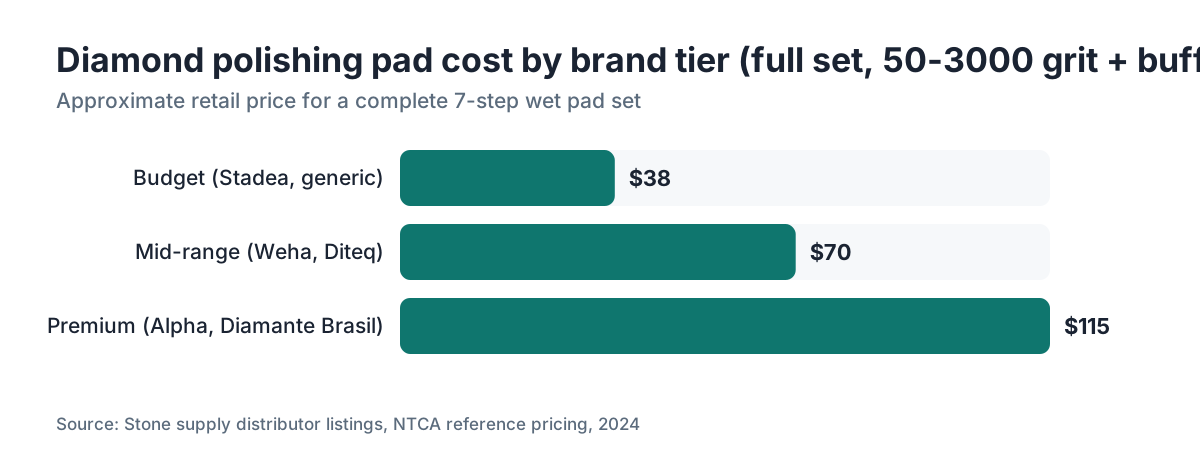
Cost swings by brand tier and where you buy. Here's an honest range based on publicly listed prices from major stone supply distributors [2]:
| Pad tier | Full set (50-3000 + buff) | Per-pad avg |
|---|---|---|
| Budget (Stadea, generic) | $25 to $50 | $3 to $7 |
| Mid-range (Weha, Diteq) | $50 to $90 | $7 to $12 |
| Premium (Alpha, Diamante) | $80 to $150 | $10 to $20 |
For a one-time home job, a budget or mid-range set gets it done. For a production shop, the math on pad life beats the sticker price. A premium pad that lasts twice as long at 1.5 times the price is a better deal. A premium pad that lasts the same number of uses as a budget pad is just marketing.
You'll also need a variable-speed wet polisher if you don't have one. Entry-level units run $150 to $250. Professional-grade Flex and Metabo wet polishers run $350 to $600 [2]. Renting from a tool rental shop makes sense for a single home project.
Total cost for a homeowner buying a mid-range pad set, a basic wet polisher, and tin oxide compound is roughly $200 to $350. A professional shop reordering consumables spends maybe $50 to $150 a month on pads, depending on volume.
How do you know when granite is fully polished?
You're done when you can read your reflection in the stone. Sounds obvious, but that's the actual test. Hold a light source, a shop light or even a phone flashlight, at a low angle across the surface and watch for haze, swirl patterns, or flat spots that scatter light instead of bouncing it back cleanly.
Professional fabricators also use a gloss meter to put a number on it. A fully polished granite surface typically reads 80 to 90 gloss units (GU) or higher on a 60-degree gloss meter [4]. Honed finishes target 10 to 30 GU on purpose. If you want gloss and your meter reads 50, you didn't spend enough time at 3000 grit.
No gloss meter? The reflection test is reliable. Move the light slowly across the surface. Any haze or cloudiness at low angles means more time at 3000 grit, or back up to 1500 and repeat.
Edges are harder to judge by eye than flat tops because the profile curves. Run a fingernail across the polished edge. A properly polished granite edge feels glassy with almost no drag. Any roughness you can feel is roughness you'd eventually see.
After polishing, a sealer protects both the finish and the stone from staining. The Natural Stone Institute recommends sealing granite after any polishing operation [5]. For ongoing care of any stone countertops, routine sealing is the single most effective maintenance step.
What safety steps matter when polishing granite?
Granite dust is a real health hazard. Granite contains crystalline silica, and OSHA sets a permissible exposure limit for respirable crystalline silica at 50 micrograms per cubic meter of air as an 8-hour time-weighted average [6]. That limit tightened sharply from earlier standards, with enforcement rolling out in 2016 and 2018.
Wet polishing cuts airborne dust dramatically because water captures the granite slurry before it goes airborne. NIOSH reports that wet methods substantially reduce airborne crystalline silica compared to dry cutting and grinding [7]. That's one more reason wet polishing is the professional standard, beyond pad life and finish quality.
For any dry grinding or dry polishing, respirator protection rated N95 or better is required, and in commercial shops OSHA's silica standard requires a written exposure control plan, a designated competent person, and medical surveillance for workers at or above the action level [6].
Eye protection matters too. Even wet polishing throws slurry. Safety glasses or a face shield are standard.
Gloves guard against the abrasive slurry and cuts from stone edges. Basic shop practice.
For homeowners: run water constantly and wear an N95 dust mask even for wet work. Don't dry-sand or dry-grind granite indoors without serious ventilation.
For shops, OSHA's silica standard (29 CFR 1926.1153 for construction and 29 CFR 1910.1053 for general industry) applies directly to countertop fabrication [6]. Non-compliance carries real fines, and the health stakes are permanent. Silicosis doesn't reverse.
Frequently asked questions
What grit do you start with when polishing granite countertops?
Start at 50 or 100 grit on a freshly cut or rough slab with saw marks. For an existing countertop that just needs its shine restored, 400 grit is usually a reasonable start. The rule: begin at the coarsest grit that matches the damage, then work up through the full sequence to 3000 grit and a buff pad.
Do you need a special polisher for diamond pads, or can you use a regular angle grinder?
A variable-speed wet polisher is strongly recommended. A standard angle grinder runs at a fixed high RPM with no water feed, so it runs too hot for resin pads and gives inconsistent results on granite. Variable-speed wet polishers from Makita, Flex, or Metabo run $150 to $600 and let you match speed to grit. That's the difference between a mirror finish and a hazy one.
How many polishing pads do you need to polish one granite countertop?
A standard 7-step set (100, 200, 400, 800, 1500, 3000, buff) is enough for one countertop if the pads are new and you're working a single 25 to 40 square foot slab. High-production shops replace pads more often. For a home job, one kit is typically enough. Buy an extra 3000-grit pad, because the final step usually takes more passes than you expect.
Can diamond polishing pads fix granite that has been etched or scratched?
Yes, for scratches or surface damage that doesn't go deep into the stone. Diamond pads remove the damaged layer and re-polish back to original gloss. Deep chips or cracks need color-matched epoxy fill before polishing. If a scratch is visible to the eye but you can't catch it with a fingernail, starting at 800 grit and working up to 3000 usually removes it.
Are velcro-backed pads better than hook-and-loop pads, or are they the same thing?
They're the same thing. Velcro, hook-and-loop, and quick-change all name the same attachment system, where the pad has a fabric loop backing that grabs a hook-covered backer pad on the grinder spindle. All major pad brands use it. Match backer diameter to pad diameter (4-inch backer for 4-inch pads) and match spindle thread to your polisher (5/8-11 is standard in North America).
What's the difference between polishing pads for granite vs. marble?
Marble is much softer than granite (Mohs 3-4 vs. 6-7), so marble pads often use a softer bond that releases abrasive more readily. Granite pads work on marble but cut less efficiently. More important, you never start marble below 200 or 400 grit, since it scratches easily and coarse pads remove too much material. The finish sequence is shorter on marble.
How do you clean diamond polishing pads to extend their life?
Rinse pads with clean water after each use and store them flat or hanging, not stacked face-down. Dried slurry clogs the diamond matrix. If a pad feels slow but isn't visibly worn, running it briefly over a dresser block or rough concrete can open the bond and expose fresh diamonds. Don't use solvents or high-pressure washers on resin pads.
Can you polish granite countertops yourself as a homeowner, or is it a job for a fabricator?
A homeowner can absolutely polish granite. You need a variable-speed polisher, a pad set, a water supply, and patience to work the full grit sequence. The skills are manageable, but the mistakes are hard to fix if you skip grits or overheat the surface. For a large kitchen top that needs full refinishing, renting the polisher and buying a quality pad set is worth it. For a single scratch, it's a straightforward DIY.
What happens if you skip a grit when polishing granite?
The next pad has to remove scratches too deep for it to reach efficiently. The result looks polished at 3000 grit but carries a faint haze that shows up in raking light. The only fix is to go back to the last grit where the surface looked clean and work forward again without skipping. This is the single most common polishing mistake.
How long does it take to polish a granite countertop?
A full sequence on a 30-square-foot top, starting from 100 grit, takes 2 to 4 hours for an experienced operator. First-timers should plan 4 to 6 hours to avoid rushing grits. Edge polishing adds time, especially on complex profiles (ogee, dupont). A simple eased edge on a straight run adds maybe 30 to 45 minutes to the total.
Do diamond pads wear differently on black granite vs. light granite?
Yes. Dense black granites like Absolute Black and Galaxy Black are often harder and more homogeneous than lighter stones, and they're brutally unforgiving about haze, since any flaw shows against the dark background. Pad wear isn't necessarily faster, but you need more passes at 1500 and 3000 grit, and swirl marks show instantly. Premium finishing pads make a bigger difference on dark stone than on light.
What OSHA rules apply to granite polishing in a fabrication shop?
OSHA's respirable crystalline silica standard under 29 CFR 1910.1053 (general industry) applies to countertop fabrication shops. The permissible exposure limit is 50 micrograms per cubic meter over an 8-hour shift. Shops must keep a written exposure control plan, use engineering controls (wet methods, local exhaust), provide medical surveillance for exposed workers, and keep records. Wet polishing is the primary engineering control and cuts airborne silica sharply.
Is it worth buying a full pad kit or just individual grits?
Buy a full kit for your first project or when stocking a new shop. Individual pads make sense when you're replacing the grits you burn through fastest, usually 1500 and 3000. Most fabricators end up with a mix: full kits to start, then bulk individual buys of the high-consumption grits. Budget kits from brands like Stadea run $25 to $50 complete and are a reasonable start before you know your own usage.
Do you need to seal granite after polishing it with diamond pads?
Yes. Polishing opens the pore structure slightly and strips any old sealer. Apply a penetrating impregnating sealer within a day or two. The Natural Stone Institute recommends sealing after any polishing operation. Most granite sealers need reapplication every 1 to 3 years depending on use and porosity. Dark granites tend to be denser and absorb less sealer; lighter granites are usually more porous.
Sources
- U.S. Geological Survey, Mineral Resources and Mohs Hardness reference: Granite ranks 6 to 7 on the Mohs hardness scale; marble ranks 3 to 4; soapstone ranks 1 to 2
- National Tile Contractors Association, diamond tool and pad pricing reference: Diamond polishing pad sets range from $25 to $150 depending on brand tier; wet polishers run $150 to $600; tin oxide polishing powder runs $10 to $20 per pound
- Natural Stone Institute, Dimension Stone Design Manual and fabrication guidance: Recommended RPM ranges by grit for wet polishing granite and 5/8-11 spindle thread as North American standard for wet polishers
- ASTM International, ASTM D523 Standard Test Method for Specular Gloss: Fully polished granite surfaces typically read 80 to 90 gloss units at 60 degrees on a standard gloss meter
- Natural Stone Institute, Care and Maintenance Guidelines for Natural Stone: The Natural Stone Institute recommends sealing granite after any polishing operation and periodically thereafter to protect the surface
- OSHA, Occupational Exposure to Respirable Crystalline Silica (29 CFR 1910.1053 and 29 CFR 1926.1153): OSHA PEL for respirable crystalline silica is 50 micrograms per cubic meter as an 8-hour TWA; shops must have written exposure control plans, use engineering controls including wet methods, and provide medical surveillance
- CDC/NIOSH, Silica hazards in stone fabrication: Wet polishing methods substantially reduce airborne crystalline silica compared to dry cutting and grinding of stone
- Natural Stone Institute, Dimension Stone Design Manual: Granite hardness and density characteristics governing tool selection and polishing approach in fabrication
- OSHA, Crystalline Silica Rule for general industry and enforcement timeline: OSHA silica standard enforcement for general industry shops including countertop fabrication began in 2018
Last updated 2026-07-10