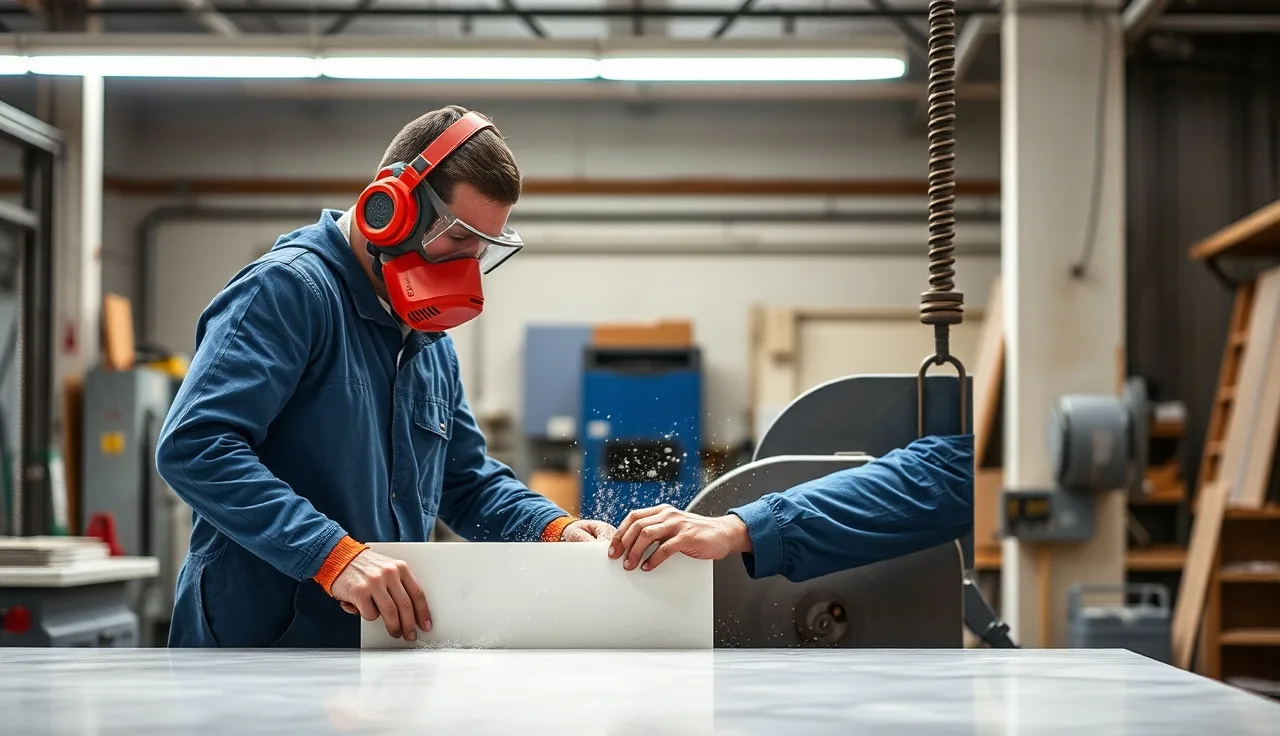
TL;DR
- OSHA's silica standard (29 CFR 1926.1153) requires engineering controls first, but when residual silica dust exposure exceeds the action level of 25 µg/m³, workers must use NIOSH-approved respirators.
- For dry cutting quartz, a P100 half-face respirator is the practical minimum.
- Wet cutting with adequate ventilation may drop exposure below levels requiring respiratory protection, but most fabricators use P100 or supplied-air respirators as standard practice.
Why does cutting quartz create a serious dust hazard?
Quartz countertops are engineered stone, typically 90 to 95 percent crystalline silica by weight [1]. Cut, grind, or profile that material with a dry blade, or even a wet saw running short on water, and you release respirable crystalline silica (RCS) particles smaller than 10 microns. Those particles reach deep into the lungs. They can cause silicosis, an irreversible and sometimes fatal scarring disease.
Silicosis is not a distant occupational risk. A 2019 investigation by NIOSH and CDC researchers identified a cluster of young engineered stone fabricators diagnosed with accelerated silicosis, some in their 20s and 30s [2]. The disease moved faster than classic silicosis from quarry work, probably because engineered stone throws off far higher silica concentrations than cutting natural granite or marble.
For context, engineered quartz dust has been measured at silica concentrations above 80 to 90 percent, compared to roughly 20 to 45 percent for granite [3]. That gap changes every exposure calculation and drives respirator selection.
Homeowners often ask whether cutting one sink hole or doing a small repair really counts as dangerous. It does. A single short cut without wet suppression can spike airborne silica far above OSHA's permissible exposure limit. Chronic daily exposure is the bigger driver of disease, but protecting yourself for even the occasional cut with a proper respirator is cheap insurance.
What does OSHA actually require for silica dust exposure from quartz?
OSHA's Construction Silica Standard (29 CFR 1926.1153, effective June 23, 2017) is the controlling rule for fabrication shops doing construction-related work [4]. The General Industry standard (29 CFR 1910.1053) covers shops that OSHA classifies as general industry rather than construction [5]. Both standards share the same exposure limits.
The permissible exposure limit (PEL) is 50 micrograms of respirable crystalline silica per cubic meter of air (50 µg/m³), as an 8-hour time-weighted average. The action level, the threshold that triggers the full compliance program, is 25 µg/m³ TWA [4].
OSHA's hierarchy of controls tells you to use engineering controls (wet methods, local exhaust ventilation) before you reach for a respirator. The rule requires employers to use engineering and work practice controls to hold exposure to the PEL, and only when those controls fall short do respirators come in as a supplement or interim measure [4]. Quartz fabrication almost always needs respiratory protection anyway, because even wet cutting on a standard bridge saw still produces measurable silica during blade changes, dry positioning, and edge work.
OSHA also gives you Table 1 in 29 CFR 1926.1153, a specific list of tasks and the required controls and respirators for each. Handheld grinders used on mortar or masonry are on that table. Stationary wet saws with water flow rates that meet the standard's requirements can qualify for no required respirator, but only when the equipment performs exactly as specified and no dry cutting happens [4]. Most shops cannot promise that on every operation.
Which specific respirator is required for cutting quartz?
The minimum respirator required depends on your actual exposure level, measured in µg/m³, relative to the PEL.
| Exposure level (8-hr TWA) | Minimum NIOSH-approved respirator required |
|---|---|
| At or below 25 µg/m³ | No respirator required (but controls must be in place) |
| 25 to 50 µg/m³ (at or below PEL) | Half-face APF 10: N95, R95, or P100 half-mask |
| 50 to 500 µg/m³ (up to 10x PEL) | Half-face APF 10 minimum; P100 recommended |
| 500 to 1,250 µg/m³ (up to 25x PEL) | Full-face air-purifying with P100, APF 50 |
| Above 1,250 µg/m³ or unknown | Supplied-air respirator (PAPR or SCBA), APF 1,000+ |
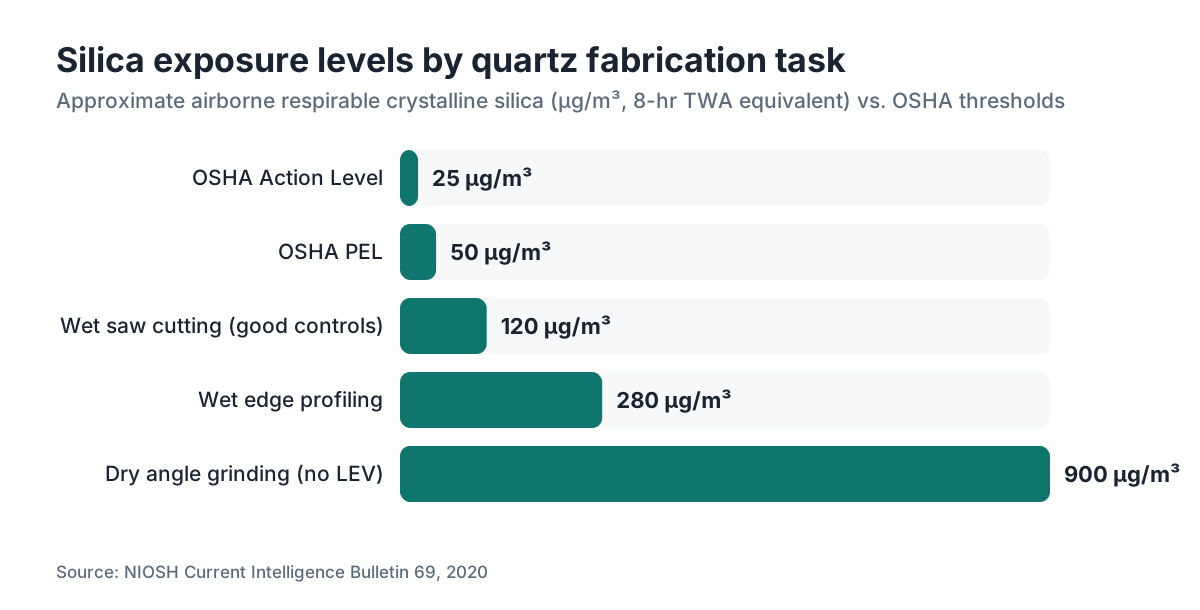
Dry cutting or grinding quartz without water suppression routinely measures well above 500 µg/m³, sometimes far past 1,000 µg/m³ [3]. That puts dry operations in supplied-air territory under OSHA's assigned protection factor (APF) framework [6].
Wet cutting on a bridge saw with proper water flow and good shop ventilation is a different story. Many studies land exposures closer to the 50 to 200 µg/m³ range, which means a P100 half-face respirator (APF 10) is technically compliant, though a powered air-purifying respirator (PAPR) with P100 filters gives more protection and rides easier over a full shift.
The P100 half-face respirator is the working standard in fabrication shops. A P100 filter removes at least 99.97 percent of airborne particles, silica included, and it has no time-based degradation (unlike R95, rated for 8 hours with oil-based aerosols). The 3M 7502 half-face with 2091 P100 filters is one commonly referenced setup, but any NIOSH-approved combination delivering P100 filtration from a reputable maker works [6].
Never use a paper dust mask, an N95 rated for nuisance dust, or a surgical mask for quartz cutting. None of them substitute for a properly fitted P100 respirator.
Is an N95 enough, or do you need a P100?
An N95 filters at least 95 percent of airborne particles and is NIOSH-approved for silica in principle, but the protection margin is much thinner than a P100. N95s are rated for environments that are not strongly oil-based and carry an APF of 10, the same as a P100 half-face. So on paper, at exposures near the PEL, an N95 is technically compliant.
The real problem is fit and field performance. An N95 that is not properly fit-tested leaks around the seal and delivers actual protection well below 10x. A P100 cartridge respirator with a rigid facepiece and a proper fit test seals more reliably. OSHA's respiratory protection standard (29 CFR 1910.134) requires fit testing for any tight-fitting respirator, N95s included, before use [6].
For quartz work specifically, NIOSH has told people to move past N95 minimums. The 2020 NIOSH Current Intelligence Bulletin 69 on engineered stone says workers should use P100 or higher respiratory protection, and that supplied-air respirators may be needed for high-exposure tasks like dry grinding [3].
Use a P100. N95 is not enough for daily quartz fabrication, and for occasional DIY cuts, the price gap between an N95 and a reusable P100 half-face is small enough that there is no good reason to pick the weaker option.
What is the difference between a half-face P100 and a full-face respirator for quartz work?
A half-face respirator covers the nose and mouth and carries an APF of 10, meaning it is assumed to cut exposure by at least a factor of 10. A full-face air-purifying respirator (FFAPR) with P100 cartridges covers the whole face including the eyes and carries an APF of 50. A PAPR (powered air-purifying respirator) with a tight-fitting or loose-fitting hood runs an APF of 25 to 1,000 depending on configuration [6].
For most wet-saw work in a reasonably ventilated shop, a half-face P100 is fine if your exposure measurements confirm levels below 500 µg/m³. For dry grinding, angle grinder use on quartz edges, or work in tight, poorly ventilated spaces, step up to a full-face P100 or a PAPR. Full-face units also shield your eyes from flying chips, which is a real bonus on a fabrication floor.
PAPRs have caught on in shops over the last few years because they are easier to wear all shift, they cut breathing resistance, and they work for guys whose facial hair kills a tight N95 or half-face seal. CDC and NIOSH both say plainly that no air-purifying respirator protects adequately when facial hair crosses the sealing surface [6].
Run a busy shop and it pays to buy PAPRs for your dustiest jobs (dry edge profiling, core drilling sink holes). The gear is expensive up front. Silicosis disability claims and OSHA penalties cost far more.
Does wet cutting quartz eliminate the need for a respirator?
No. Wet cutting slashes airborne silica compared to dry cutting, but it does not zero it out. Research measuring silica during wet bridge saw cutting of engineered stone has found concentrations from roughly 40 to over 200 µg/m³, depending on water flow rate, blade condition, ventilation, and material [3]. At those levels, exposure clears OSHA's action level and often the PEL even with water running.
OSHA's Table 1 for wet saws does allow a "no respirator required" outcome, but only when specific water flow thresholds are met and held, dry cutting never happens, and tasks stay inside what Table 1 lists [4]. Engineered stone fabrication involves more than saw cuts. Edge profiling, seaming, grinding, polishing, sink cutouts with core bits, and dry fitting all pile on exposure. Very few real shops run entirely inside Table 1's assumptions.
Treat wet cutting as a control that reduces but never eliminates silica, and keep P100 respirators on during any operation that throws off visible dust or a mist with suspended particles. Water knocks down the largest particles best. The fine respirable fraction can still be significant even when you cannot see obvious dust.
What engineering controls does OSHA require before relying on a respirator?
OSHA's hierarchy puts respirators last, not first. Before you can require workers to wear respirators, you have to put feasible engineering controls in place [4] [5]. For quartz fabrication, those controls include:
Wet cutting methods. Water at the blade, running continuously through every cutting operation. OSHA's Table 1 sets minimum water flow rates for various equipment types.
Local exhaust ventilation (LEV). Vacuum shrouds on angle grinders, on-tool dust extraction during edge profiling, and shop ventilation that captures dust at the source before it drifts.
Work practice controls. No dry sweeping (use wet methods or HEPA vacuums), fewer workers in high-dust areas, task rotation to shorten individual exposure time.
Air monitoring. OSHA requires employers to assess exposures. For tasks on Table 1 performed exactly as specified, exposure assessments are not required for those tasks. For anything outside Table 1, periodic air monitoring is required to confirm exposures stay below the PEL [4].
When engineering controls drop exposure below 25 µg/m³, respirators are not required. When they land it between 25 and 50 µg/m³, respirators supplement the controls. When controls cannot reach the PEL, respirators go on in addition to whatever controls are feasible, not instead of them.
Fabricators running shops that handle countertop installation work alongside fabrication should note that installers cutting in the field have fewer engineering control options. That makes proper respirator selection even more important on job sites.
How does OSHA's silica rule apply to a small fabrication shop?
Small shops are not exempt. OSHA's construction silica standard applies to any employer with workers in construction-related silica activities, no matter the business size [4]. The general industry standard applies to shops OSHA categorizes as general industry [5].
For a two-person shop, the requirements include a written exposure control plan, a designated competent person who understands silica hazards, access to medical surveillance for workers exposed above the action level 30 or more days a year, and a respiratory protection program with fit testing, training, and medical evaluations [4] [6].
Medical surveillance under 1926.1153 has to include a medical exam by a physician or licensed health care professional (PLHCP), a chest X-ray read by a NIOSH-certified B-reader, and lung function testing (spirometry). It is offered within 30 days of initial assignment if exposure runs above the action level 30 or more days a year, then every 3 years [4].
OSHA can and does cite small shops. Between 2016 and 2023, OSHA issued thousands of silica-related citations across general construction and general industry [7]. Penalties for willful violations reach tens of thousands of dollars each. Buying P100 respirators and running wet saws right costs almost nothing next to OSHA penalties and workers' comp claims from silicosis.
What are the OSHA penalties and enforcement trends for silica violations in fabrication shops?
OSHA sorts silica violations as serious, willful, or repeat depending on the circumstances. Serious violations carry penalties up to $16,550 per violation (as of 2024, after annual inflation adjustments) [7]. Willful or repeat violations can reach $165,514 per violation [7].
Enforcement has climbed sharply since the silica rule took full effect. OSHA's National Emphasis Program (NEP) for silica, updated in 2020, targets stone fabrication among other industries [8]. Inspectors look for dry cutting, missing wet suppression, no written exposure control plan, and no respirator program.
Real shops have paid heavy settlements. One California engineered stone fabricator paid hundreds of thousands of dollars in combined Cal/OSHA penalties and wrongful death settlements after worker silicosis deaths in the early 2020s, though specific settlement terms are often confidential.
California, Washington, and other states with their own OSHA plans sometimes go stricter than federal OSHA. California's Cal/OSHA silica standard is at least as protective as the federal standard, and Cal/OSHA runs its own inspection program to enforce it [9].
Does silica dust from quartz affect homeowners doing DIY countertop work?
Yes, and most people underrate it. A homeowner cutting a sink hole in a quartz slab with a rented wet saw or an angle grinder and a diamond blade faces the same silica exposure a fabricator does. OSHA rules do not cover homeowners doing their own work, but the dust hazard is identical.
For a single DIY cut, the lifetime silicosis risk from one exposure is low but not zero, especially for the fine particle fraction that reaches deep lung tissue. More to the point, plenty of homeowners make multiple cuts during a kitchen remodel, and some try edge profiling, which throws off very high concentrations.
For any DIY quartz cut, wear a P100 half-face respirator. Wet suppression helps. Work outdoors or with good ventilation if you can. A reusable half-face P100 respirator runs $25 to $45; the cartridges cost $10 to $20 a pair. That is the right investment before cutting kitchen countertops or any engineered stone surface.
Quartzite (a natural stone) and marble countertops also carry significant crystalline silica and need the same respiratory care during cutting or grinding. Granite countertops have lower but still meaningful silica content and deserve similar protection. Natural stones like soapstone sit at the low end, with very little crystalline silica.
How do you fit-test a respirator and why does it matter for silica work?
Fit testing is not optional for workers required to wear respirators under OSHA. The respiratory protection standard (29 CFR 1910.134) requires fit testing before first use and every year after [6]. A fit test checks whether a specific make, model, and size of respirator seals properly on one worker's face.
There are two kinds. Qualitative fit testing (QLFT) uses a challenge agent (usually saccharin or Bitrex) that the wearer tastes or smells if the seal fails. It is acceptable for N95 and half-face respirators up to APF 10. Quantitative fit testing (QNFT) uses a machine to count actual particles inside and outside the respirator, and it is required for full-face respirators and any respirator run at higher protection factors [6].
A worker with a beard cannot get a proper seal on any tight-fitting respirator. Period. Bearded workers need a loose-fitting PAPR, not a tighter strap.
Fit test records have to stay on file. OSHA inspectors ask for them. More to the point, a respirator that does not fit protects far less than its rating implies. A poorly fitted P100 can deliver effective protection closer to a factor of 2 or 3, not 10.
Many industrial hygiene consultants and some safety supply companies run fit testing. It usually costs $25 to $75 per worker per year, which is nothing next to a silicosis claim.
What about air quality and silica exposure for workers at adjacent stations in a shop?
Silica dust does not stay at the source. Fine respirable particles hang in the air for a long time and travel the whole shop. A CNC operator 20 feet from a wet saw still picks up measurable silica if shop ventilation is weak. NIOSH measurements in fabrication shops have found elevated silica concentrations well away from the cutting source [3].
This shapes both shop layout and OSHA compliance. Run multiple cutting stations, quartzers, and polishers in one open space, and everyone in that space belongs in your exposure assessment. You cannot assume workers at desks near the shop floor breathe clean air.
General dilution ventilation (throwing open a bay door) is far weaker than local exhaust ventilation for controlling silica. It knocks the concentration down some, but rarely enough to reliably hold every worker below the action level in a busy shop. Put LEV at the source, and actually run it.
Fabricators juggling quoting, templating, and shop operations alongside floor work might find that software like SlabWise, which tracks job operations and throughput, helps spot when and where high-dust jobs stack up, so it is easier to schedule respiratory protection across shifts.
For shops running a mix of materials, note that cambria countertops and other engineered quartz brands all carry the same high silica content and the same hazard. Lower-silica materials like laminate countertops and Corian countertops do not generate crystalline silica dust and sit in a much lower respiratory hazard category.
How often should P100 cartridges be replaced for silica work?
P100 cartridges have no fixed replacement schedule tied to silica exposure the way activated-carbon cartridges do for chemical vapors (silica is a particle, not a gas). A P100 filter does not saturate with silica and suddenly fail. It keeps filtering until the physical filter medium is damaged or breathing resistance climbs too high.
OSHA requires employers to set a cartridge change-out schedule based on objective information or data [6]. For P100 particulate filters in silica work, the practical rule is to swap cartridges when breathing resistance rises noticeably, when they are physically damaged or wet, or on the manufacturer's recommended schedule. Many shops replace P100 cartridges weekly or after 40 hours of use as a conservative call.
Store used cartridges in a sealed bag between shifts to keep moisture out. Do not share respirators between workers without full cleaning and fresh cartridges. Clean and inspect the facepiece before each use, and check the elastomeric seals for cracks or deformation.
Look for these on the NIOSH approval label: "P100" or "HE" (high efficiency) are the designations you want. "R100" is also acceptable but rated for one shift only. Skip anything labeled "nuisance dust" or missing a NIOSH approval number on the packaging.
Frequently asked questions
Can I use an N95 mask to cut quartz countertops?
An N95 is technically NIOSH-approved for silica at low exposure levels, but NIOSH's 2020 guidance on engineered stone specifically recommends P100 or higher protection for quartz fabrication. N95 filters at 95 percent efficiency vs. P100's 99.97 percent, and seal failures are more common with the lighter N95 facepiece. Use a P100 half-face respirator instead. It costs only a little more and protects much better.
Is dry cutting quartz ever allowed under OSHA rules?
OSHA does not explicitly ban dry cutting, but its silica standards require engineering controls before respiratory protection. Dry cutting quartz generates airborne silica that typically runs far past 10 times the PEL, which demands supplied-air respiratory protection under OSHA's APF framework. Dry cutting without a supplied-air respirator (PAPR or SCBA) is very hard to defend as compliant. Most insurers and safety professionals treat dry quartz cutting as prohibited without supplied-air equipment.
What is the OSHA permissible exposure limit for silica dust?
OSHA's PEL for respirable crystalline silica is 50 micrograms per cubic meter of air (50 µg/m³), measured as an 8-hour time-weighted average. The action level that triggers full program requirements (air monitoring, medical surveillance, respiratory protection) is 25 µg/m³ TWA. Both the construction standard (29 CFR 1926.1153) and general industry standard (29 CFR 1910.1053) use these same thresholds.
Does a homeowner need a respirator to cut quartz for a DIY kitchen remodel?
OSHA rules do not cover homeowners, but the silica dust hazard is the same. Any cut in engineered quartz releases respirable crystalline silica particles that cause silicosis. For even a single sink cutout or trim cut, wear a properly fitted P100 half-face respirator and use wet suppression. The respirator costs $25 to $45 and the filters another $15. Cheap protection against a serious, irreversible lung disease.
What is a P100 respirator and how is it different from N95 or R95?
The number is filtration efficiency: 95 means 95 percent, 100 means 99.97 percent. The letter is oil resistance: N means not oil-resistant, R means oil-resistant for one shift, P means oil-resistant (persistent). Silica is not oil-based, so N95 or P100 both filter the particle well, but P100's higher efficiency and sturdier facepiece make it the standard recommendation for engineered stone work. R-series filters are rated for one shift only.
How do I know if my shop's silica exposure is above OSHA's action level?
You need air monitoring. OSHA requires employers to assess silica exposures using either personal air monitoring (a worker wears a pump and filter cassette during a shift) or objective data for tasks on OSHA's Table 1. Samples go to an accredited laboratory for respirable crystalline silica analysis. Industrial hygienists perform this service; cost is typically $200 to $500 per sample including lab analysis. OSHA's method reference is NIOSH Method 7500 or 7602.
Does OSHA require medical exams for quartz fabrication workers?
Yes. Workers exposed to silica at or above the action level (25 µg/m³) for 30 or more days a year must receive medical surveillance under 29 CFR 1926.1153 or 1910.1053. That includes a medical history, physical exam, chest X-ray read by a NIOSH-certified B-reader, and spirometry (lung function test). The initial exam is required within 30 days of assignment, then every 3 years. The employer pays for all of it.
What respirator should an installer use when cutting quartz on a job site?
Job site cutting is covered by OSHA's construction silica standard (29 CFR 1926.1153). Engineering controls are harder in the field, so respiratory protection matters even more. A P100 half-face respirator is the minimum for wet cutting in good conditions. For any dry cut, grinding, or drilling without water suppression, a PAPR or supplied-air system is the right choice. Installers should get respirators fit-tested before working with engineered stone.
Can workers with beards use a P100 half-face respirator for quartz cutting?
No. Facial hair that crosses the respirator's sealing surface breaks the seal on any tight-fitting respirator, including P100 half-face and full-face designs. NIOSH and OSHA both make this clear. Bearded workers must use a loose-fitting powered air-purifying respirator (PAPR) with a hood, which does not depend on a face seal. Loose-fitting PAPRs carry an APF of 25 and suit most wet fabrication tasks.
How often should I replace P100 cartridges when cutting quartz?
P100 particulate cartridges have no fixed replacement interval tied to silica loading the way chemical cartridges do. Replace them when breathing resistance rises noticeably, when they are damaged or have been wet, or on a conservative schedule such as weekly for full-shift fabrication. Store them sealed between uses to keep moisture out. Always check for and record a valid NIOSH approval number on the cartridge packaging.
Is quartzite the same silica hazard as engineered quartz countertops?
Quartzite is a natural metamorphic rock that can run 80 to 99 percent crystalline silica, making it a serious hazard during cutting. Engineered quartz is 90 to 95 percent crystalline silica. Both need P100 respiratory protection when cut or ground. Quartzite has different mineralogy and hardness from engineered quartz but essentially the same respirable silica exposure profile. Use identical respiratory precautions for both.
What does OSHA's National Emphasis Program for silica mean for fabrication shops?
OSHA's National Emphasis Program (NEP) on silica, updated in 2020, directs OSHA area offices to run programmed inspections of high-risk industries, stone fabrication included. Shops can be inspected without a complaint or incident trigger. Inspectors check for exposure assessments, written exposure control plans, wet methods, respirator programs with fit testing, and medical surveillance records. The NEP sharply raises inspection odds for fabricators.
Do natural stones like granite and marble require the same respirator as engineered quartz?
Granite runs 20 to 45 percent crystalline silica and needs respiratory protection during cutting and grinding. Marble is mostly calcite (calcium carbonate) with low silica, though some marbles carry more. Neither reaches engineered quartz's 90 to 95 percent silica, so exposure from granite and marble cutting is generally lower. A P100 respirator is still the right choice for regular fabrication work on any silica-containing stone.
Sources
- NIOSH, Engineered Stone: Silica Exposure: Engineered quartz countertop slabs are typically 90 to 95 percent crystalline silica by weight
- CDC MMWR, Morb Mortal Wkly Rep 2019; Silicosis in Engineered Stone Countertop Workers: A 2019 CDC/NIOSH investigation identified a cluster of young engineered stone fabricators with accelerated silicosis, some in their 20s and 30s
- NIOSH Current Intelligence Bulletin 69: Preventing Silicosis and Deaths in Workers Who Use Manufactured Stone: Engineered stone generates dust with silica concentrations exceeding 80 to 90 percent; wet cutting still leaves measurable silica exposure; NIOSH recommends P100 or higher for engineered stone work
- OSHA, 29 CFR 1926.1153 Respirable Crystalline Silica in Construction: OSHA PEL is 50 µg/m³ TWA; action level is 25 µg/m³; Table 1 specifies task-based controls; engineering controls required before respirators
- OSHA, 29 CFR 1910.134 Respiratory Protection Standard: Fit testing required before first use and annually; APF values assigned by respirator type; cartridge change-out schedule required; facial hair prohibition for tight-fitting respirators
- OSHA, Maximum Penalty Amounts by Violation Type: Serious violations up to $16,550 per violation; willful or repeat violations up to $165,514 per violation as of 2024 after inflation adjustments
- OSHA, National Emphasis Program for Respirable Crystalline Silica (CPL 03-00-023): OSHA NEP for silica updated in 2020 targets stone fabrication shops for programmed inspections
- California Department of Industrial Relations, Cal/OSHA Silica Standard: Cal/OSHA silica standard is at least as protective as the federal standard and is actively enforced with its own inspection program in California
- NIOSH, Hierarchy of Controls: NIOSH hierarchy of controls places respirators as the last administrative/PPE layer after engineering and work practice controls
Last updated 2026-07-11