TL;DR
- Diamond router bits for stone last 50 to 500 linear feet of cut.
- Stone hardness, water flow, spindle speed, and feed rate decide where you land in that range.
- Keep the bit cool, run correct RPM, never plunge dry, and dress the bit the moment it glazes.
- Do those four things and you can triple or quadruple bit life versus running a bit wrong.
Why do diamond router bits wear out so fast on stone?
Diamond bits don't cut stone the way a steel blade cuts wood. The diamonds in the segment get exposed by wear. As you grind, the metal bond matrix wears back and fresh diamond crystals come forward to do the cutting. When conditions are wrong, one of two bad things happens. Either the matrix wears too fast and diamonds fall out before they can work, or the matrix doesn't wear at all and the diamonds polish flat. Both kill a bit early.
Heat is the enemy. Without enough cooling, the bond matrix softens, diamonds detach, and you can ruin a $40 to $200 bit in a single pass [1]. A dry plunge into granite at even 12,000 RPM makes enough heat to delaminate a segment in under 30 seconds.
Abrasiveness is the other factor. Quartzite and granite sit high on the Mohs scale (typically 6 to 7 for granite, 7 and up for quartzite) and chew through the bond matrix fast [2]. Softer stones like marble and limestone are easier on bits but cause glazing, because the matrix doesn't wear away fast enough to expose fresh diamonds. Each problem has a different fix. That's why one-size bit maintenance doesn't work.
What RPM and feed rate should I use to protect diamond router bits?
Running the wrong speed burns through bits faster than anything else. Most 1/2-inch to 1-inch profiling bits for countertop work run between 4,000 and 10,000 RPM on a wet router, but the right number depends on bit diameter. Smaller diameter, higher allowable RPM. Larger diameter, lower RPM. Manufacturers publish surface feet per minute (SFPM) targets, usually 1,500 to 2,500 SFPM for diamond tooling on stone [3].
Here's the math. RPM = (SFPM x 3.82) / bit diameter in inches. A 3/4-inch bit targeting 2,000 SFPM needs roughly 10,160 RPM. Run that same bit at 3,000 RPM and your surface speed is only about 590 SFPM, way too slow to cut. The bit rubs and glazes instead of grinds.
Feed rate matters as much as RPM. Move too slow and you generate heat even with water cooling, because the bit sits in contact with the same material longer. Move too fast and you get chipping plus mechanical stress on the segments. A good starting feed for granite profiling is roughly 10 to 18 inches per minute. For marble, 15 to 25 inches per minute. Those are starting points. If the bit sounds like it's grinding hard, or you see smoke, slow down and check water flow first.
| Stone Type | Mohs Hardness | Recommended SFPM | Starting Feed Rate (in/min) |
|---|---|---|---|
| Marble | 3 to 4 | 1,500 to 2,000 | 15 to 25 |
| Limestone | 3 to 4 | 1,500 to 2,000 | 15 to 25 |
| Granite | 6 to 7 | 1,800 to 2,500 | 10 to 18 |
| Quartzite | 7+ | 2,000 to 2,500 | 8 to 15 |
| Engineered quartz | 5 to 6 | 1,800 to 2,200 | 12 to 20 |
How much water cooling does a diamond router bit actually need?
You need a continuous, uninterrupted flow of water at the cutting zone for the whole cut. Not a drip. Not a mist. A steady stream that floods the bit and carries swarf (the stone dust and slurry) away from the edge.
Tooling manufacturers put the minimum at 1 to 2 gallons per minute at the bit for hand-held wet routers, and CNC wet systems often run 2 to 4 GPM aimed at the toolpath [3]. Under-cooling happens more than people admit. Operators throttle water down to fight the mess, or a line clogs and nobody notices.
A few checks. Run the water before the bit touches stone, not after. Keep water running for 10 to 15 seconds after the bit exits so residual heat can dissipate. On recirculating systems, watch the tank temperature. Water above 100 degrees F loses much of its cooling power and can promote thermal cracking in both the stone and the bond matrix.
One trick fabricators use: tilt the nozzle so the stream hits just ahead of the bit's leading edge. That pre-floods the material before the diamond contacts it, instead of trying to cool something that's already hot.
What does it mean to dress a diamond router bit, and when should you do it?
Dressing means deliberately wearing away the bond matrix to re-expose fresh diamonds. When a bit glazes, the diamonds are still there, just buried under a polished metal surface that slides across the stone without cutting. The bit gets hot, leaves a rough or burned finish, and the motor bogs.
You dress a bit by running it across a soft, abrasive material. A dressing brick (silicon carbide or aluminum oxide, typically 60 to 80 grit) is the standard tool [4]. Wet sandstone or a piece of concrete block works in a pinch. Run the bit at normal operating speed with water flowing and make 5 to 10 passes across the brick. You'll feel it start cutting aggressively again when it's dressed.
How often depends on the stone. Soft materials like marble glaze bits faster. Rule of thumb: if the bit is taking longer than usual to remove material, or the finish looks burnished instead of ground, dress it before you keep going. Plenty of shops dress bits at the start of every shift on marble work.
Dressing is free and takes two minutes. Pushing a glazed bit harder instead is one of the most expensive habits in a fab shop.
Does bit quality actually affect how long diamond router bits last?
Yes, and the gap is wide. Diamond router bits run from roughly $15 for import economy bits to $200 or more for good electroplated or sintered segments from established tooling companies [5]. What separates them is diamond concentration (carats per cubic centimeter of segment), diamond grit size, and bond hardness.
High-concentration bits cost more upfront but can last three to five times longer per linear foot in demanding materials like granite or quartzite. On simple marble work the gap narrows, because the material is soft.
Bond hardness has to match the stone. A hard bond matrix (labeled H or J on the manufacturer's scale) works best on soft, abrasive stone where the matrix needs to resist wear. A soft bond (B or C) works better on hard, dense stone, because it wears fast enough to keep exposing fresh diamonds. Running a hard-bond bit on granite is a common mistake. The diamonds glaze and you swear the bit is dull, when really the bond is too hard for the job [4].
For shops running 10 or more slabs a week on granite, premium sintered bits from suppliers like Weha, Tenax, or similar makers usually pay back the premium within 20 to 30 slabs versus economy bits. For lower-volume shops, or marble-only work, mid-range bits often make more sense.
How should you store and handle diamond router bits to prevent damage?
Diamond segments can chip, crack, or delaminate from impact long before the diamonds wear out. Drop a bit on a concrete floor, or throw it loose into a drawer, and it can lose a segment and become junk. Storage is cheap insurance.
The basics. Store bits in individual slots, on a rack, or in the original case. Never toss multiple bits loose in a bucket where they knock into each other. Keep them dry between uses. Corrosion on the shank reduces clamping force in the collet, which causes runout (vibration), which speeds up uneven wear across the segment [5].
Before every use, inspect the shank for corrosion, check that all segments are intact, and look for cracks in the core. A cracked core is a safety issue. A segment that's partly delaminated will grab, cause chipping, and can fly off at speed. See it, pull the bit.
One underrated thing: collet condition drives bit life. A worn or dirty collet holds the bit off-center, generating runout that makes one side of the bit hit the stone harder than the other. That uneven load wears one side of the segment faster. Clean collets with a brass brush and collet cleaning solution, and replace any collet that shows measurable runout (a dial indicator should read under 0.001 inch TIR for most CNC work) [6].
Is a wet router or dry router better for bit life on stone?
Wet routing wins, and it isn't close. Heat is the main mechanism of early bit failure, and water cooling attacks heat directly. Diamond tooling on stone was built around wet cutting. Dry diamond bits exist for certain jobs (handheld grinding, some portable work), but they use different bond formulas, have to be used in bursts so the bit air-cools, and still wear much faster than wet-cut equivalents [1].
Doing any volume of countertop fabrication? You need a wet router. Water also controls silica dust. Cutting granite, quartzite, or engineered quartz without water throws off respirable crystalline silica dust, regulated by OSHA under 29 CFR 1910.1053 with a permissible exposure limit of 50 micrograms per cubic meter as an 8-hour time-weighted average [7]. Wet cutting suppresses airborne silica at the source. That's a legal and health requirement for commercial shops, not a bonus.
For occasional field cuts, a dry diamond bit with continuous air movement and a NIOSH-approved P100 respirator is acceptable for short durations. Even then, wet methods beat dry if any water source is around.
How do you know when a diamond router bit is actually worn out vs. just needs dressing?
This is the judgment call that separates experienced fabricators from beginners. A glazed bit and a worn-out bit look the same on the surface: slow cutting, heat, rough finish. The tell is what happens after you dress it.
Dress the bit. If it cuts aggressively again, the diamonds are still there and it was glazing. If dressing does little or nothing, the segments are depleted, meaning the diamonds are gone and you're cutting with metal bond only. The bit is done.
You can also measure segment height. Most new diamond profiling bits have segments 5 to 10mm tall. When segment height wears to 1 to 2mm or goes flush with the core, replace the bit no matter how it cuts [4]. Some manufacturers engrave a wear indicator line into the segment. Others don't, so you're measuring with calipers.
A third signal: if the bit is producing a profile that's visibly off (edge radius wrong, flat too narrow), the segment shape has worn unevenly. At that point even a good-cutting bit produces bad edges and should be pulled.
Tracking bit life in a shop log (stone type, linear feet per bit, which machine) takes five minutes per job and gives you real data for purchasing decisions. Most shops skip it. The ones that don't negotiate better on tooling and predict replacement costs accurately.
What maintenance should the router itself get to protect diamond bits?
Bit life is a system problem more than a tooling problem. The machine running the bit causes more early wear than most operators realize.
Spindle bearings come first. Worn bearings create runout, runout creates vibration, and vibration makes the bit hit the stone unevenly and chip segments. Check spindle runout with a dial indicator at the collet. Anything above 0.002 inch TIR on a CNC router is worth investigating. On handheld routers the tolerance is looser, but you can feel and hear excessive wobble [6].
Collet torque matters too. Under-tightened collets let the bit slip and micro-reciprocate, which wears the shank and eventually leads to catastrophic bit pull-out. Over-tightening deforms collets over time. Use a torque wrench when the manufacturer specifies one. Most don't. But if you're replacing collets more than once a year, over-tightening is a likely culprit.
Water delivery needs regular cleaning. Algae and mineral buildup in recirculating systems clog nozzles and starve the bit of flow. Flush the tank weekly in high-volume shops, check nozzle angles before each shift, and change water every 3 to 5 days or when the slurry gets thick. Shops running quoting and production tracking through management software like SlabWise can schedule tool maintenance as a recurring task inside the same system that tracks job flow, so it stops falling through the cracks.
Last, check that the table or fixture holding the stone is rigid. Slab flex during routing makes the bit chatter, which chips edges and wears segments unevenly. On CNC tables, verify vacuum hold-down pressure before each job.
Does the type of stone material change how you should treat your bits?
Absolutely. The approach that works on marble wears out your bits fast on quartzite. Stone type is the first variable to set, before anything else.
For soft stones (marble, limestone, travertine), glazing is the main risk. Use softer bond bits, dress more often, and keep feed rates up so the matrix wears the way it should. Running these materials too slow on a hard-bond bit produces heat and glazing with no upside [2].
For hard stones (granite, quartzite), heat and segment loss are the risks. Use harder bond bits rated for hard stone, max out water flow, and keep RPM at the low end of the range to cut heat. Run a marble-rated bit on granite and you'll watch the segments disappear. On quartzite specifically, some fabricators drop feed rate 20 to 30 percent below their granite settings and run extra water to offset the stone's extreme hardness.
For engineered quartz (Cambria, Silestone, and similar), the binder resins load up bit segments with debris faster than natural stone does. Flush with extra water and dress bits more often than you would on natural stone of the same hardness. Some fabricators keep a dedicated set of bits for engineered quartz because the loading behavior is different enough to justify it. If you work on granite countertops and marble countertops in the same shop, labeled bit sets by stone family are worth the effort.
Sintered diamond bits (diamonds pressed into the bond under heat and pressure) generally beat electroplated bits on harder stones. Electroplated bits carry a single layer of diamonds, and once that layer wears, the bit is spent. Sintered bits have diamonds through the full segment depth and can be dressed over and over [5].
What are the most common mistakes that shorten diamond router bit life?
In no particular order, these are the mistakes that come up most:
Dry plunging. Touching the bit to stone before water flow is established. One dry plunge can delaminate a segment or start micro-cracks that lead to segment loss later in the job.
Running glazed bits instead of dressing them. Described above. The habit of pushing harder when a bit seems dull, rather than dressing it, causes more segment loss than almost anything else.
Using the wrong bond for the stone. Hard bond on hard stone, soft bond on soft stone is backwards. Match bond hardness to material hardness.
Ignoring collet and spindle condition. A bad collet costs $20 to $60 to replace and will burn through bits far faster than its own price if you leave it in service.
No bit tracking. Shops that don't know how many linear feet a bit has seen don't know when it's near end of life. Bits run past their service life fail without warning, producing bad edges or losing a segment mid-cut.
Storing bits wet. Shank corrosion is slow but it adds up. Dry bits after use.
Buying on price alone. The cheapest bits per unit often cost the most per linear foot. Running cost per foot instead of cost per bit changes purchasing decisions in most shops.
For homeowners doing a one-time tile or stone job, renting quality tooling from a stone tool supplier almost always beats buying a cheap bit that dies mid-project. If you're researching countertop installation as a DIY project, tool quality matters even on small jobs.
Frequently asked questions
How many linear feet should a diamond router bit last on granite?
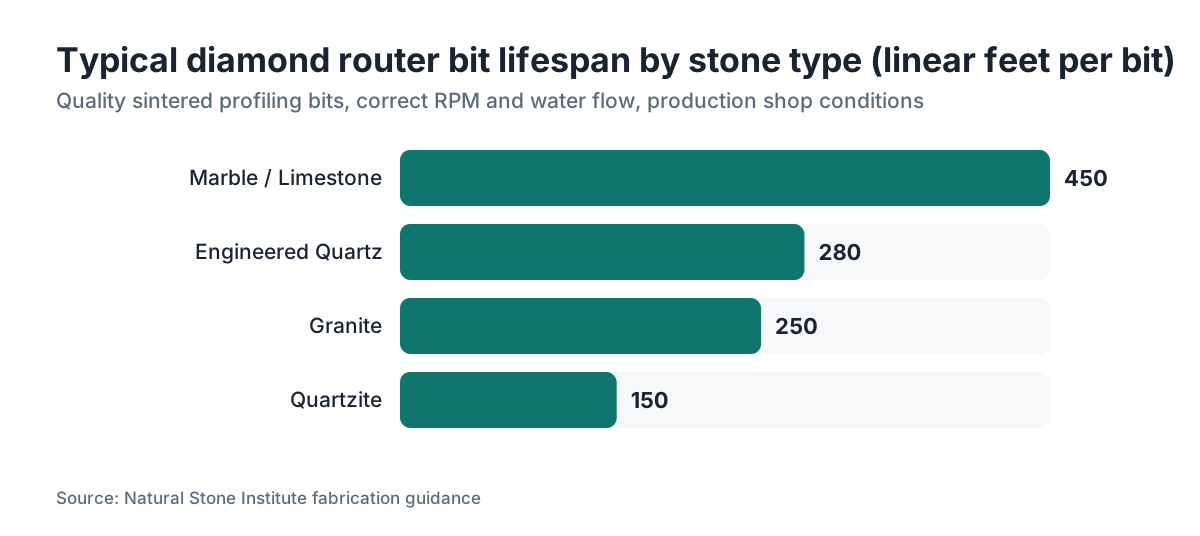
On granite, a quality sintered diamond profiling bit typically cuts 150 to 400 linear feet before replacement, depending on diamond concentration, bond hardness, water flow, and feed rate. Economy import bits may last only 50 to 100 feet on the same material. Keeping exact shop records by bit model and stone type gives you real numbers for your setup rather than manufacturer estimates.
Can I use a diamond router bit for stone on a regular wood router?
Only if the router runs wet and can hold the required RPM range. Most standard wood routers run 20,000 to 25,000 RPM, far too high for diamond stone bits, and will overheat them into rapid segment loss. Dedicated wet routers for stone typically run 3,000 to 12,000 RPM. Running diamond stone bits dry on any router also generates hazardous silica dust, which violates OSHA's silica standard for commercial work.
How do I know if my diamond bit is glazed or just worn out?
Dress the bit on a silicon carbide dressing brick with water flowing. If it cuts aggressively after dressing, it was glazed and still has usable diamonds. If dressing makes little difference, the segment is depleted. You can also measure remaining segment height with calipers. Less than 1 to 2mm of segment left means the bit is done regardless of how it cuts.
What is the best way to dress a diamond router bit in the field?
A silicon carbide dressing brick (60 to 80 grit) is the standard option and costs under $20 at most stone tool suppliers. Run the bit at operating speed with water flowing and make 10 to 15 passes across the brick. A piece of concrete block or wet sandstone also works. Never dress a bit dry. Dressing itself makes heat, and the water keeps segments from overheating during re-exposure.
Does water temperature affect how long diamond bits last?
Yes. Water above roughly 100 degrees F loses cooling efficiency fast. In hot climates, or on recirculating systems that heat up over a long shift, the tank water can reach temperatures that no longer cool the cutting zone. Check recirculating water temperature during long production runs and add ice or switch to fresh cool water if the tank warms up.
How often should I replace the collet on my wet router?
There's no fixed interval, but check collet runout with a dial indicator every 6 to 12 months in a production shop. If runout at the collet nose exceeds 0.002 inch TIR on a CNC machine, replace it. Signs of wear include visible scoring in the collet bore, bits that feel loose at rated torque, or a history of bits slipping. Collets cost $20 to $60 and routinely save 3 to 5 times their price in bit life.
Is it safe to cut quartzite with the same bits I use on granite?
Technically yes, but quartzite runs much harder than most granite (Mohs 7 or higher vs. granite's 6 to 7). Bits rated for granite wear faster on quartzite. Cut your feed rate 20 to 30 percent below your granite settings, max out water flow, and plan to dress bits more often. Some high-volume shops keep a dedicated quartzite bit set and replace on a shorter interval to avoid in-progress segment failures.
Can diamond router bits for stone be resharpened or repaired professionally?
Dressing (re-exposing diamonds) is something you do yourself in the shop and isn't the same as resharpening. True resharpening or re-tipping of diamond segments by a tooling service is uncommon for router profile bits, because the segment geometry is complex and the cost often approaches a new bit. For large core bits and saw blades, re-tipping is practical. For countertop profiling bits under $150, replacement is almost always the right call.
What RPM should I run a 3/4-inch diamond router bit at for granite?
Targeting 1,800 to 2,500 SFPM for granite, a 3/4-inch bit should run roughly 9,200 to 12,800 RPM. Use the formula RPM = (SFPM x 3.82) / diameter in inches. Start at the low end, confirm water flow is established, and adjust feed rate until the bit cuts cleanly without excessive noise or heat. Always follow the manufacturer's specific RPM rating, which takes priority over this general calculation.
How does silica dust exposure relate to the way I run diamond bits on stone?
Cutting granite, quartzite, or engineered quartz without adequate wet suppression generates respirable crystalline silica dust. OSHA's current permissible exposure limit is 50 micrograms per cubic meter as an 8-hour time-weighted average under 29 CFR 1910.1053. Wet cutting is the primary engineering control. Running bits with proper water flow protects both your workers and your bits at once, which makes it one of the highest-return practices in any shop.
Why does my diamond bit leave a rough or burned finish even with water running?
The likely causes are glazing (dress the bit), feed rate too slow (increase slightly), RPM too high (reduce and recalculate SFPM for your bit diameter), or water flow inadequate at the cutting zone (check nozzle position and GPM). A burned look with water running usually points to glazing or too little water at the actual contact point, not at the stone surface in general.
Do I need different diamond bits for profiling vs. drilling holes in stone?
Yes. Profiling bits (ogee, bullnose, bevel, flat) shape edges and run on a router at specific lateral feed rates. Core drill bits drill sink cutouts and plunge-cut, and they need different RPM and water delivery setups. Using a profiling bit to drill, or a core drill to profile, produces poor results and speeds up wear. Match the bit type to the operation.
How do I track bit life to make better purchasing decisions in my shop?
Keep a simple log: bit model, date put in service, stone types cut, and estimated linear feet per job. Tally linear feet when you retire each bit. After 10 to 20 bits you'll have real cost-per-foot data by brand and stone type. That data usually shows premium bits have a lower cost per foot on hard stone even though they cost more upfront. Most shop software can add a tool tracking field to job records.
Sources
- OSHA, Crystalline Silica overview page: Heat is the primary cause of diamond bond matrix failure; dry cutting accelerates delamination and also generates hazardous silica dust.
- USGS, National Minerals Information Center (Mohs hardness of common minerals): Granite rates 6 to 7 on the Mohs scale; quartzite rates 7 or higher; marble rates 3 to 4.
- Natural Stone Institute (fabrication guidance): Recommended water flow for wet diamond tooling is a minimum of 1 to 2 GPM at the cutting zone; surface speed targets for diamond tooling on stone are generally 1,500 to 2,500 SFPM.
- Natural Stone Institute (diamond tooling selection and maintenance guidance): Bond hardness must match stone hardness; dressing with a silicon carbide brick re-exposes diamonds on glazed segments; segment height below 1 to 2mm indicates end of bit life.
- Natural Stone Institute (diamond tooling construction guidance): Electroplated bits have a single diamond layer; once worn, the bit is spent. Sintered (metal-bond) bits have multi-layer diamond segments suitable for dressing. Bit prices range from about $15 to $200 or more depending on diamond concentration and construction.
- SME (Society of Manufacturing Engineers) tooling and machining resources: Collet runout above 0.002 inch TIR causes uneven segment wear; collets should be inspected and replaced when runout is measurable; clean collets with brass brush to prevent corrosion-induced runout.
- OSHA Respirable Crystalline Silica standard, 29 CFR 1910.1053: The permissible exposure limit for respirable crystalline silica is 50 micrograms per cubic meter of air as an 8-hour time-weighted average under 29 CFR 1910.1053.
- NIOSH (National Institute for Occupational Safety and Health): Wet cutting suppresses airborne silica at the source during stone fabrication; engineered stone cutting produces high silica concentrations requiring wet suppression or local exhaust ventilation.
Last updated 2026-07-11