TL;DR
- Granite edge profiling requires diamond-coated router bits, not standard carbide.
- Common profiles include bullnose, eased edge, bevel, ogee, and dupont, and each uses a different bit geometry.
- A full set of granite profiling bits costs $300 to $1,200 depending on brand and grit count.
- Dry bits work on hand routers; wet bits run on CNC and bridge-saw routers with water cooling.
Why granite needs diamond router bits instead of carbide
Granite sits between 6 and 7 on the Mohs hardness scale, sometimes touching 7 on quartzite-heavy slabs [1]. Carbide router bits, the standard for wood and MDF, dull almost immediately against that hardness. Grinding hard silicate minerals throws off heat that wrecks a carbide edge in minutes.
Diamond is the only material that cuts granite reliably at production speed. Granite profiling bits use a steel or aluminum body with diamond segments or a continuous diamond rim bonded to the cutting face. The diamonds do the abrading. The steel and aluminum just hold the geometry.
Two bonding methods show up. Sintered (metal-bonded) bits hold diamonds in a metal matrix that wears away to expose fresh diamonds, so the bit stays sharp longer and suits high-volume shop use. Electroplated bits carry a single layer of diamond on a nickel bond. They cut faster at first, but once that layer is gone the bit is done. For edge profiling on a CNC router or bridge saw, sintered is almost always the right call.
Carbide does earn a spot in granite work for one task: trimming laminated edges before the profiling step, where you're cutting softened adhesive and thin stone overhangs at very slow feed rates. For the profile cut itself, carbide is the wrong tool.
What are the main types of granite profiling router bits?
Router bits for granite edge profiling fall into a few functional categories based on how they mount and how they're cooled. The split that matters most is dry versus wet.
Dry diamond router bits mount on a standard angle grinder or hand router with an M14 thread (the international standard) or a 5/8-11 thread common in North America. They run without water. Friction heats the bit, so manufacturers add air slots that act like a fan to pull heat away. These are the bits a one-man shop or a finish carpenter uses to hand-profile a piece on the job site. They work, but bit life is shorter and you have to keep moving to avoid burning a spot.
Wet diamond router bits are built for bench-top or CNC routers that flood the cutting zone with water. Water cools the diamond segments, flushes granite dust, and stretches bit life well past what dry bits manage. If you're running a CNC bridge saw or a dedicated profiling machine, wet bits are the default. Most wet profiling bits also carry an M14 or 5/8-11 arbor but are tuned for the RPM ranges of those machines, usually 3,000 to 6,000 RPM depending on bit diameter.
Drum-style bits are large-diameter cylinders used mainly on CNC profiling machines for flat or chamfer edges. They run at lower RPMs and remove a lot of material per pass.
Profile bits (shaped bits) are the ones that produce the visual edge. They come pre-ground to the exact geometry of a bullnose, ogee, bevel, or other profile. Run the bit in one or two passes along the edge and the geometry is set.
Grinding wheels and flap discs are not technically router bits, but they belong to the same edge-finishing workflow for smoothing and polishing after the profile bit shapes the stone. They don't go in a chuck, but a fabricator buying profiling bits will buy these at the same time.
Which router bit profile should you use for each edge style?
The profile you want on the finished countertop decides which bit you buy. Here's how the common profiles map to bit geometry:
| Edge Profile | Bit Type | Notes |
|---|---|---|
| Eased / Straight | Flat drum or straight profile bit | Most common; removes sharp 90° corner only |
| Bevel / Chamfer | Angled bevel bit, typically 22° or 45° | Single pass; fast; popular on contemporary kitchens |
| Bullnose (half-round) | Half-round profile bit | Requires 2-3 passes; softest look |
| Ogee | Ogee profile bit (S-curve geometry) | Traditional; one of the harder profiles to run cleanly |
| Dupont / Waterfall | Dupont profile bit | Combines a flat top with a quarter-round bottom drop |
| Pencil Edge | Small-radius round-over bit | Subtle easing; common on bathroom vanities |
| Full bullnose | Full-round bit on laminated edge | Needs laminated slab; bit wraps full circle |
| Mitered / Laminated | Flat miter bit on bridge saw + profiling bit | Miter cut first, then profile on laminated piece |
For most residential kitchens, the eased edge and the bullnose account for probably 60-70% of all jobs. The ogee and dupont profiles run in traditional and transitional kitchens. Contemporary design has pushed the pencil edge and bevel hard over the last decade.
One warning on full bullnose: it needs a laminated edge, meaning two layers of stone glued together so the finished thickness is enough to show the full curve. You don't just run a full-round bit on a standard 3/4-inch slab. Make sure the client understands that a full bullnose on a 3cm slab costs more because you're building up the edge.
For more on how these profiles change the look of a finished kitchen, see our guide to granite countertops and the broader overview of kitchen countertops.
What grit sequence do fabricators use for granite edge profiling?
Granite edge profiling is not a one-pass job. You shape the profile with a coarse or medium grit bit, then step through finer grits until the edge matches the polished face of the slab. Skip a step and it shows.
A typical wet production sequence looks like this:
- 30 to 60 grit shape pass: removes bulk material and sets the profile geometry
- 120 to 150 grit pass: removes scratches from the shape pass
- 220 to 400 grit pass: smooths further; the stone starts to show some sheen
- 800 to 1,500 grit pass: semi-polish
- 3,000 to 8,000 grit pass: final polish; matches the slab face
Some fabricators condense this to three or four passes using combination bits or wide grit jumps, and you can get away with that on softer stones or matte finishes. On a highly polished black granite or a glossy white with tight crystals, skipping grits leaves a haze line on the edge. Don't skip.
Dry hand-routing for small jobs or job-site repairs often drops to two or three passes because you're working at lower feed rates. The friction does more blending work, and so does the operator's skill.
The grit count is also why a complete edge profiling bit set costs what it does. You're not buying one bit. You're buying a matched set of the same profile at five to seven different grits.
How much do granite profiling router bits cost?
A single dry profile bit in a basic shape runs $40 to $120. A full grit-sequenced wet set for one profile runs $350 to $700, and a multi-profile shop kit can hit $1,200 to $2,500. Price tracks bond quality and grit count more than brand name.
For a single dry profile bit in a shape like a bullnose or bevel, expect $40 to $120 from mid-tier suppliers. A matched set of the same profile at five grits runs $180 to $400. Quality matters here: cheap electroplated bits from no-name suppliers may last one or two slabs before the diamond layer is gone.
Wet profile bits for CNC or bench routers run $80 to $250 per individual bit. A full grit-sequenced set for one profile from a supplier like Alpha, Weha, or Stadea runs $350 to $700 [11]. Want multiple profiles? A complete shop kit covering four or five common profiles with full grit sequences runs $1,200 to $2,500.
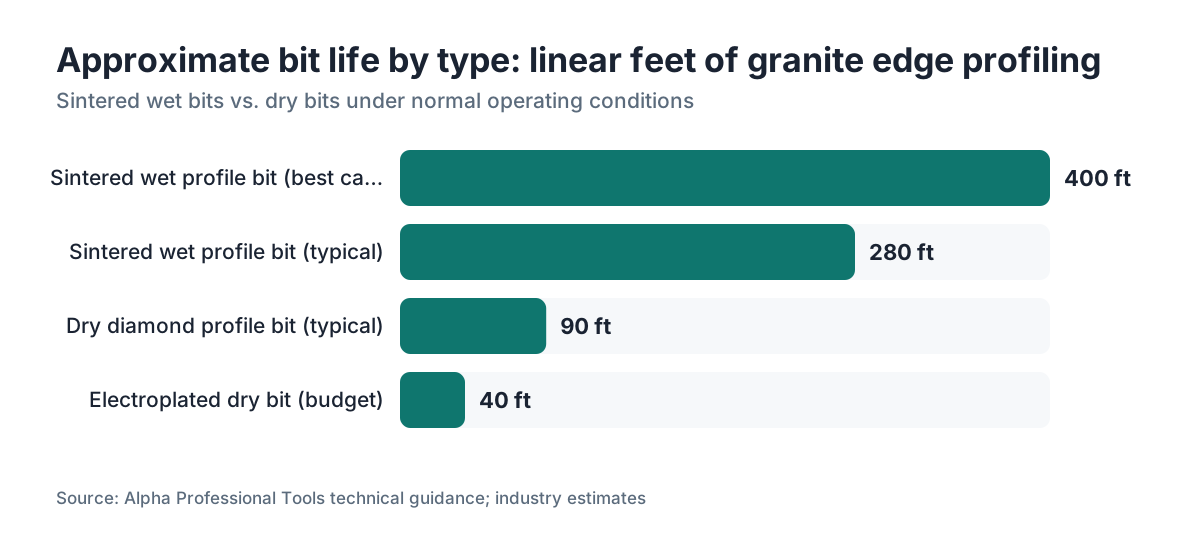
Bit life is a real variable. A quality sintered wet bit, properly cooled and run at correct RPMs on black granite, might profile 200 to 400 linear feet before it needs replacing [2]. A dry bit on the same stone might do 50 to 100 linear feet. Numbers move with slab hardness, feed rate, and machine condition. Nobody has clean industry-wide data on this; the figure suppliers cite most often is that dry bits last roughly one-quarter to one-third as long as equivalent wet bits.
Bit wear is a real line-item cost when you price a job. If a wet bullnose bit set lasts 300 linear feet and costs $500, that's about $1.67 per linear foot in bit cost alone, before machine time, labor, and abrasives.
Fabricators who want to track tooling costs per job without a spreadsheet can use shop management software like SlabWise to log bit usage against individual quotes, which keeps that cost line honest over time.
What RPM should granite profiling bits run at?
RPM comes from the bit manufacturer and changes with bit diameter. The general rule: larger diameter bits run at lower RPMs to keep the surface speed at the cutting edge in the right range. Match the spec sheet, not a habit.
For hand grinders and small routers with dry bits:
- 1.5-inch to 2-inch diameter bits: 7,000 to 10,000 RPM is typical
- Smaller bits up to 1 inch: some run as high as 12,000 to 15,000 RPM
For wet CNC and bench router bits:
- Most profiling bits in the 3-inch to 6-inch range run at 3,000 to 6,000 RPM
- Drum bits and larger-diameter wheels often run at 1,500 to 3,000 RPM
Too fast throws off heat even with water cooling, and heat causes thermal cracking in the granite and premature diamond loss from the bit. Too slow on a dry bit causes glazing, where the bond matrix hardens without exposing fresh diamond and the bit stops cutting.
Always check the bit manufacturer's spec sheet. Alpha Professional Tools, Weha, and Stadea all publish recommended RPM ranges for their bits [3]. A bit with no documentation is a warning sign about quality.
Water flow rate matters as much as RPM for wet bits. Most CNC profiling setups aim for at least 1 to 2 gallons per minute directed at the cutting zone. Too little water and the bit runs hot even at correct RPMs.
Can you profile granite with a standard angle grinder?
Yes. A standard angle grinder with an M14 spindle (most corded and cordless grinders sold in North America use this thread) accepts dry diamond profile bits and cup wheels directly. That's how job-site profiling, small-shop work, and repairs get done.
You won't run a kitchen's worth of edge work through a hand grinder profitably in a production shop. For one piece, a field repair, or a bathroom vanity, a 4.5-inch or 5-inch grinder works fine.
Safety matters more with a hand grinder than with a fixed machine. OSHA's standard for abrasive wheel machinery (29 CFR 1910.243) requires that grinding wheels be guarded and run within the rated speed [4]. Diamond router bits follow the same logic: running a bit rated for 10,000 RPM on a grinder that spins at 12,000 RPM is a real hazard. Check the bit's max RPM against the grinder's no-load RPM. The bit's rating has to exceed the grinder's speed.
Wear eye protection and a dust mask rated N95 or better. Granite dust contains crystalline silica, which causes silicosis with repeated exposure. OSHA has a specific standard for occupational silica exposure (29 CFR 1926.1153 for construction) that applies to stone fabrication work [5]. A one-time cut outdoors is low risk. Doing this daily in a closed shop without respiratory protection is not.
What's the difference between CNC router bits and hand router bits for granite?
CNC profiling bits and hand bits share the same diamond abrasive principle but differ in size, mounting, and cooling design. CNC bits are bigger, wetter, and cost three to ten times more per bit. Hand bits are compact and forgiving.
CNC bits often run 3 to 8 inches in diameter for drum or profile wheels, need high water flow, and depend on consistent feed-rate control. They're built for volume: a CNC granite router might turn out 20 to 40 linear feet of profiled edge per hour, far past what hand routing sustains.
Hand router bits are compact (typically 1 to 3 inches), lighter, and balanced for the variable pressure and angle of human operation. They tolerate slightly irregular feed rates and skip the coolant hookup.
On a CNC machine you set spindle speed, feed rate, depth of cut, and coolant flow once per profile program and the machine repeats it identically. That repeatability is why CNC shops jump grit to grit in one program run. A skilled hand operator matches that quality on a good day, not on every piece.
For shops deciding between CNC and manual equipment, the break-even point rides on job volume. Estimates vary, but a commonly cited rough threshold is around 15 to 20 slabs per week before a CNC profiler starts paying for itself against skilled manual labor [6]. Below that, a good bench router and hand tools often make more financial sense.
How do you profile a granite edge without a CNC machine?
Most small to mid-size fabrication shops profile edges with a bench-top wet router, hand grinders, and polishing pads. CNC is the premium path, not the only path. Entry-level wet bench routers start around $2,000 to $5,000 new.
The bench-top wet router is a fixed machine with a water-fed spindle and a guide fence or template system. You run the slab (or a piece of slab) along the fence while the spinning wet profile bit shapes the edge. Faster and more consistent than pure hand work, far cheaper than a CNC machine.
After the shape pass, hand grinders with sequential grit pads or flap discs handle the polishing steps. A skilled fabricator can hand-polish a bullnose to a very high gloss this way. It just takes more time and more attention per piece.
Templating accuracy affects edge quality even on a manual setup. If the slab is cut to size with a loose, inconsistent edge, the profile bit has to fight more variation and the finished edge shows it. A clean, consistent cutline off the bridge saw makes every later step easier.
For how countertop installation fits with edge work, the profile is almost always done in the shop before the slab leaves, not on site after install.
What safety equipment do you need when routing granite edges?
Granite edge routing throws off two hazards: flying stone fragments and silica dust. Both are real. The dust one is the more dangerous long-term.
For eye protection, ANSI-rated safety glasses or goggles are the minimum. A face shield over safety glasses is better on a hand grinder. Bit failures happen with worn or overloaded bits, and they send fragments at speed.
For respiratory protection, the hazard is crystalline silica. NIOSH recommends an N95 respirator as the minimum for silica-generating tasks, and a half-face elastomeric respirator with P100 filters for regular shop work [6][7]. OSHA's silica standard for general industry (29 CFR 1910.1053) sets a permissible exposure limit of 50 micrograms per cubic meter as an 8-hour time-weighted average [8]. Wet cutting cuts airborne dust sharply compared to dry cutting, which is another argument for wet bits in a production setting.
Hearing protection matters for sustained machine work. Angle grinders and CNC spindles often run at 85 to 100 dB at the operator's ear, above OSHA's action level of 85 dB for an 8-hour shift [9].
Grounding and water safety apply to wet machines: running electrical equipment near water requires proper grounding and GFCI protection. This isn't optional, and it isn't something to improvise.
Stone handling and sealing carry their own considerations, covered in the guide on how to clean stone countertops.
How do you choose the right diamond router bit for your specific job?
Four factors drive the choice: stone hardness, profile geometry, machine type, and required finish quality. Get those four right and the rest is catalog shopping.
Stone hardness matters because softer stones like marble, travertine, and limestone wear bits more slowly than granite and quartzite. A bit rated for granite works on softer stones too, but a marble-rated bit on granite wears out fast. Check the bit packaging or spec sheet for the stone types it covers.
Profile geometry is fixed by what the customer wants. You can't fake a dupont with a bullnose bit. Buy the right profile for the job.
Machine type sets whether you need wet or dry, what arbor size you need (M14 vs. 5/8-11), and what maximum RPM the bit has to tolerate. Measure your machine's spindle thread before ordering.
Finish quality depends on whether the edge matches a polished face or a honed face. Matching a high-polish face on black absolute granite or Nero Marquina takes more grit steps than matching a honed finish on a softer limestone. Budget time and bits accordingly.
Buying cheap on a job with an expensive slab is the wrong trade. A $25 no-name electroplated bullnose bit on a $2,000 leathered quartzite slab that you then chip or scratch costs far more than the $150 bit you should have used. Buy quality bits for hard stones and premium finishes. Save the budget options for practice cuts and soft stones.
Shops working marble countertops or other softer natural stones can often run lighter-duty bit sets than shops processing granite or quartzite every day.
Where do fabricators buy granite profiling router bits?
The main professional suppliers for diamond granite bits in North America are Alpha Professional Tools, Weha (sold through multiple distributors), Stadea, Braxton-Bragg, and Toolocity. All of them carry full profile lines in wet and dry versions with multiple grit options.
Home improvement retail (Home Depot, Lowes) carries a small selection of dry diamond bits and grinding cups, mostly aimed at DIY tile work. These will technically cut granite but aren't built for edge profiling, and the choice of profile shapes is thin. For a small DIY edge repair, that might be enough. If you're a fabricator, buy from a stone industry supplier.
Online options like Amazon carry bits from both reputable brands and unverified offshore suppliers. The reputable brand bits on Amazon are the same product at similar prices to buying direct. The unknown-brand bits are a gamble.
Buying decisions for fabricators running production volume usually come down to bit life per dollar, not sticker price. Asking a supplier for actual linear-footage data per bit gives more useful information than catalog specs alone.
For shops scaling up and wanting to track tooling spend against job profitability, tools like SlabWise let you build tooling costs into quotes from the start, so bit replacement costs show up in your margin math instead of as surprise expenses at month end.
Frequently asked questions
Can I use a wood router to profile granite edges?
No. A standard wood router lacks the power, RPM range, and spindle strength to run diamond profiling bits safely. Wood router bits are carbide, which dulls almost instantly on granite. You need either an angle grinder with an M14 spindle and a diamond dry profile bit, or a machine rated for stone work. Using a wood router on granite risks bit failure and injury.
How long do diamond router bits for granite last?
Wet sintered profile bits typically last 200 to 400 linear feet on granite when run at correct RPMs with proper water cooling. Dry bits last roughly one-quarter to one-third as long. Actual life depends on slab hardness, feed rate, cooling, and bit quality. Hard stones like quartzite and black absolute granite wear bits faster than softer granites. There is no universal figure; supplier claims vary widely.
What is an M14 thread on a granite router bit?
M14 is a metric thread standard (14mm diameter, 2mm pitch) used on the arbors of most angle grinders and stone-profiling hand routers sold internationally. Nearly all granite profile bits for hand tools carry an M14 or a 5/8-11 UNC (the US standard) threaded stud. Check your grinder's spindle thread before ordering bits. Adapters exist but add runout and cut into the safety margin.
What's the difference between sintered and electroplated diamond bits?
Sintered bits embed diamonds in a metal matrix that wears to expose fresh diamonds, giving longer bit life and consistent performance. Electroplated bits carry one layer of diamonds on a nickel bond, which cuts aggressively at first but is finished once that layer is gone. For production granite profiling, sintered is the right choice. Electroplated bits cost less and work fine for occasional use or softer stones.
Do I need to use water when routing granite edges?
Wet cutting is strongly preferred for production work. Water cools the diamond segments, extends bit life a lot, and suppresses silica dust, which is the main health hazard. Dry bits are designed for situations without water access. If you do dry-route, use respiratory protection rated at least N95 and work outdoors or with strong extraction ventilation. OSHA's silica standards apply to granite dust generated in dry cutting.
How many passes does it take to profile and polish a granite edge?
Typically five to seven passes using a grit sequence from around 30-60 grit for shaping to 3,000-8,000 grit for final polish. Some fabricators condense to three or four passes for honed finishes or softer stones. Matching the high polish on a slab face takes more steps. Skipping grit steps shows as a haze line or visible scratches on the finished edge, especially on dark or glossy stones.
What profile edge is cheapest for granite countertops?
The eased edge (a slightly rounded 90-degree corner) is the least expensive because it needs minimal material removal and the fewest profiling passes. It's often included in base fabrication pricing. Complex profiles like ogee, dupont, or full bullnose need more bit passes, more time, and sometimes laminated edges, all of which add cost. Most fabricators charge an upcharge of $10 to $25 per linear foot for complex profiles above an eased edge.
Can you profile granite edges by hand without power tools?
Technically yes, using silicon carbide rubbing bricks or diamond hand pads, but it's extremely slow and impractical for anything larger than a small repair. Rubbing bricks can smooth and slightly round an edge. They cannot produce a clean ogee or dupont geometry. For any edge profiling beyond a very slight easing of a sharp corner, you need a diamond router bit running on a power tool.
Does the type of granite affect which router bit you need?
Yes, in terms of bit life but not bit geometry. The profile shape you need depends on design, not stone type. Harder granites and quartzites wear bits faster and may call for more conservative feed rates. Black absolute granite is particularly abrasive. For hard stones, use sintered wet bits from a reputable brand and expect shorter bit life per linear foot than you'd get on softer granite varieties.
What causes chipping on a granite edge profile?
Chipping usually traces to one of four causes: a worn-out bit with too little diamond exposure, too aggressive a feed rate on the first shape pass, running the bit at the wrong RPM, or a pre-existing fissure in the stone at the edge. Start with a fresh or recently dressed bit, take the first shape pass slowly, and inspect the raw edge before profiling to spot natural voids or cracks that need filling first.
How do edge profiles differ between granite and quartz engineered countertops?
The profiles themselves look the same. The fabrication process differs slightly because engineered quartz (like Cambria or Silestone) has consistent hardness throughout, while natural granite has varying crystal density and occasional soft spots. Quartz also throws off finer dust during cutting. The same diamond profiling bits work on both materials, though some fabricators keep separate bit sets for natural and engineered stone to manage wear more predictably.
What is a dupont edge on a granite countertop?
A dupont edge (sometimes called a waterfall edge) has a flat top surface that drops to a small step and then curves down with a quarter-round to the bottom. It's a transitional profile between the classic bullnose and a straight eased edge. It needs a specific dupont-profile diamond bit. The profile is popular on kitchen islands and contemporary designs where you want visual interest without the full curve of a bullnose.
Is it safe to dry-route granite indoors?
It's a significant health risk without proper controls. Dry routing granite pushes airborne crystalline silica dust past OSHA's permissible exposure limit of 50 micrograms per cubic meter (29 CFR 1910.1053) quickly in an enclosed space. If you must dry-route indoors, use a P100 respirator, run strong local exhaust ventilation, and keep bystanders out of the area. Wet cutting is the practical fix.
Sources
- USGS Minerals Information: Granite: Granite hardness ranges from approximately 6 to 7 on the Mohs scale due to its quartz and feldspar mineral content
- Alpha Professional Tools product documentation and technical guidance: Quality sintered wet profile bits can achieve 200 to 400 linear feet of granite edge profiling per bit under proper operating conditions
- Weha USA diamond tooling product specifications: Manufacturer-published RPM ranges for CNC and hand-router profile bits vary by bit diameter, typically 3,000 to 10,000 RPM for granite profiling applications
- OSHA Standard 29 CFR 1910.243: Guarding of portable powered tools: OSHA requires abrasive wheels and grinding equipment to be guarded and operated within rated speed limits
- OSHA Standard 29 CFR 1926.1153: Respirable crystalline silica in construction: OSHA's construction silica standard applies to stone fabrication and cutting operations generating crystalline silica dust
- NIOSH Silica topic page (CDC): NIOSH recommends N95 respirator as minimum protection for silica-generating tasks; wet methods recommended as engineering control to reduce airborne dust
- NIOSH Respirators topic page (CDC): NIOSH recommends a half-face elastomeric respirator with P100 filters for regular occupational exposure to silica dust in fabrication environments
- OSHA Standard 29 CFR 1910.1053: Respirable crystalline silica in general industry: OSHA permissible exposure limit for respirable crystalline silica is 50 micrograms per cubic meter as an 8-hour time-weighted average
- OSHA Occupational Noise Exposure Standard 29 CFR 1910.95: OSHA's action level for occupational noise exposure is 85 dB for an 8-hour time-weighted average, triggering hearing conservation program requirements
- Braxton-Bragg stone industry tooling catalog: Full profile diamond bit sets for wet granite profiling range from approximately $350 to $700 per profile across five to seven grits from major suppliers
Last updated 2026-07-11