TL;DR
- Swirl marks on polished countertops are micro-scratches left by abrasive particles trapped in cloths, gritty cleaners, circular scrubbing, or dulled fabrication tooling.
- On natural stone, they also show up when sealer residue clouds the surface.
- Granite and quartz marks usually polish out.
- Marble is soft enough that home remedies deepen the damage, so it needs professional re-polishing.
What are swirl marks, exactly?
Swirl marks are a pattern of micro-scratches arranged in arcs or circles across a polished surface. They look different from straight scratches, which usually come from dragging one sharp object. Swirl marks form when abrasive particles move in a rotary or wiping motion, each tiny particle cutting its own curved groove into the finish.
The reason they show up so clearly on polished stone is physics. A high-gloss finish reflects light at a tight angle, so any disruption in that flat reflective plane scatters light and reads as haze or patterned dullness. The same scratches on a honed or leathered surface would be nearly invisible. That's one reason those finishes do well in busy kitchens.
Swirl marks are not etching. Etching is a chemical attack on the stone's calcium carbonate, leaving a dull patch with no texture. Swirl marks are mechanical. You can feel the faintest ones with a fingernail dragged slowly across the surface. That distinction decides which fix you reach for.
What are the most common causes of swirl marks on granite and quartz?
The biggest cause in real kitchens is a dirty cloth or sponge. A cloth that picked up fine grit, dried food particles, or residue from a previous job drags those abrasive bits across the surface in whatever motion you wipe. Wipe in circles, get swirl marks. Microfiber beats terry-cloth rags, but a microfiber cloth left on a dusty counter and then reused is no safer than cotton.
Gritty or acidic cleaners are the second major cause. Many all-purpose sprays carry mild abrasives or surfactants that leave a fine powdery residue after the liquid evaporates. Wipe that residue dry and you're sanding the surface with very fine particles. Cleaners marketed as "natural" or "powder" types are the worst offenders here. The safest daily cleaner for polished stone countertops is plain dish soap diluted in water, wiped with a clean damp cloth, then dried.
Green scrubbing pads, the Scotch-Brite type, put swirl marks into granite or quartz fast. They run around a 100-grit abrasive equivalent, far coarser than the 3,000-to-8,000-grit compound used for a factory polish. Even the white "non-scratch" versions dull a high-polish finish over time [1].
On quartz countertops like Cambria, the binder resin sits slightly softer than natural stone crystals, so abrasive marks appear faster. On granite countertops, hardness varies a lot by mineral. Feldspar zones are softer than quartz zones, so you'll sometimes see swirl marks concentrated in the lighter areas of the slab.
Can fabrication tooling cause swirl marks during manufacturing?
Yes, and homeowners rarely think to look until the slab is home. Shop-made swirl marks usually show in raking light before installation. They cluster near the edges where hand polishing happened, or run in broad arcs across the field where an angle grinder or orbital polisher used a worn or mismatched pad.
The fabrication polishing sequence runs coarse to fine, often 50, 100, 400, 800, 1500, and 3000 grit, sometimes with a final buffing compound. Skip a step or swap a pad out of order and the finer pad can't fully erase the scratches the coarser one left. You see the leftover arc pattern. A dull diamond pad is another common culprit. A worn pad skips and drags instead of cutting cleanly, leaving irregular swirls.
Water-jet cutting tables can throw swirl-like marks near cut lines if the abrasive garnet in the stream blows back across the polished face. That's rare on a machine set up correctly, but worth checking if you see arc marks clustered near a seam or cutout.
Shops that quote and track jobs in detail, the kind using software like SlabWise to log which materials and tooling went into each job, tend to catch these before delivery because QC is built into the workflow. A shop running on paper tickets skips the final raking-light inspection more often.
If your slab arrives with fabrication swirl marks, that's a real warranty conversation. Document it with photos in raking light within the first few days. A single flashlight held low at one end of the counter is the easiest method [2].
Why does marble get swirl marks so much more easily than other stones?
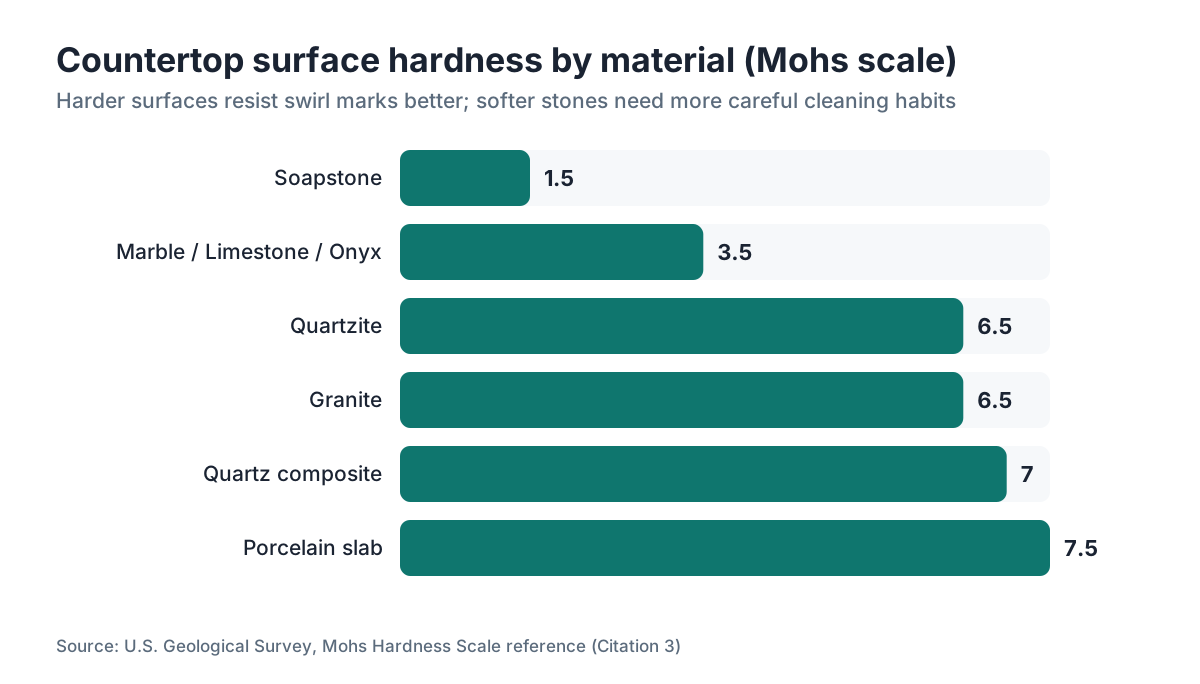
Marble rates 3 to 4 on the Mohs hardness scale, against granite at 6 to 7 and quartz composite around 7 [3]. That lower hardness means almost anything harder than the stone, including a stiff sponge with grit embedded in it, cuts into the polished surface.
The polished finish on marble countertops comes from physically abrading the stone to a progressively finer texture until it reflects light evenly. Because marble is soft, that mirror finish is genuinely delicate. A dry wipe with a paper towel carrying fine kitchen dust leaves micro-scratches over months of use.
Etching makes it worse. Acidic liquids (lemon juice, vinegar, wine, tomato sauce) dissolve the calcite in marble and leave a dull patch. Homeowners often scrub at those etch marks, adding mechanical swirl marks on top of the chemical damage. By the time they call a restoration pro, the surface has two problems to solve.
The honest advice for marble in a kitchen: expect a lived-in patina and plan on professional re-polishing every few years if you want the high-gloss look. The Italian stone industry body Confindustria Ceramica publishes no specific re-polish interval, but US stone restoration contractors quote 3 to 7 years depending on use, which lines up with guidance from major stone trade groups [4].
Does sealer cause or hide swirl marks on stone countertops?
Sealer itself doesn't cause swirl marks, but applying or removing it wrong absolutely does. Let a penetrating impregnator dry on the surface instead of wiping it off before it cures and you get a smeared film. Buff that off with a circular motion and a coarse cloth, and you drive swirl marks into the stone beneath.
Topical sealers and wax coatings are a separate issue. These sit on the surface instead of soaking into the pores, and they stack up in layers over time. Each layer traps fine particles from the air, and those particles then act as an abrasive between cloth and surface on the next cleaning pass. Strip old topical sealer and you often find swirl marks the cloudy buildup was hiding.
Penetrating (impregnating) sealers are the right choice for natural stone. The Marble Institute of America recommends impregnating sealers specifically because they don't build up on the surface [4]. Apply the sealer, let it soak for the manufacturer's dwell time (usually 5 to 20 minutes), then wipe completely dry with a clean lint-free cloth. Don't let it sit overnight. Don't use circular buffing motions with a rough cloth during removal.
How do circular cleaning motions make swirl marks worse?
The direction of your wipe matters more than people think. Scrub in circles and every abrasive particle in the cloth or on the surface traces an arc. Those arcs register as the classic swirl pattern. Straight back-and-forth passes still leave scratches, but they blend into the overall reflectivity instead of forming an obvious circular pattern.
This is why car detailers dropped the hand-wax circular buff for straight machine passes or random-orbital polishers. A random-orbital motion (as opposed to a purely rotary one) randomizes scratch direction so no single arc dominates. Most professional stone polishing machines use an orbital or planetary head for exactly this reason [5].
For everyday cleaning, the fix is simple. Switch to straight wipes, front-to-back or side-to-side, with a clean, damp, lint-free cloth. It feels unnatural at first because circular scrubbing seems more thorough. For countertops, that circular motion is doing most of the damage.
Which surfaces are most and least vulnerable to swirl marks?
Materials react differently. The table below ranks them by surface hardness and finish type.
| Material | Mohs approx. | Swirl mark risk | Notes |
|---|---|---|---|
| Marble | 3-4 | Very high | Soft calcite scratches easily; etching compounds damage |
| Limestone / travertine | 3-4 | Very high | Similar to marble; often honed so marks less visible |
| Soapstone | 1-2 | High | Extremely soft; usually oiled not polished |
| Onyx | 3-4 | High | Thin slabs, very soft |
| Quartzite | 6-7 | Moderate | Harder than marble; often confused with marble |
| Granite | 6-7 | Moderate | Softer minerals in some granites still vulnerable |
| Quartz composite | ~7 | Moderate | Resin binder softer than stone particles |
| Porcelain slab | 7-8 | Low | Very hard surface; edge profiles more vulnerable |
| Laminate | N/A | Moderate-high | Depends on wear layer; see laminate countertops |
| Solid surface (Corian) | N/A | Moderate | Scratches easily but can be sanded out; see Corian countertops |
| Butcher block | N/A | Low-mod | Wood grain hides random scratches; see butcher block countertops |
The upside with solid surface materials like Corian: they're repairable at home with fine sandpaper and a buffing compound, something you cannot do with natural stone without risking more damage [6].
Can wrong cleaning products chemically cause swirl marks?
Chemical attack and mechanical scratching are different mechanisms, but they feed each other. Acidic cleaners (pH below 7) etch calcite-based stones by dissolving the surface molecules. Alkaline cleaners above pH 10 strip sealers and soften resin binders in quartz composites over time. Neither chemical effect looks like a swirl mark on its own, but they weaken the surface so the next mechanical contact cuts deeper.
Vinegar is a common offender on marble and quartzite. People reach for it because it's natural and works on calcium deposits. On calcite-bearing stone it micro-pits the surface matrix. Not swirl marks exactly, but a result that looks similar: cloudy, dull patches that don't respond to simple polishing. The Marble Institute of America specifically advises against vinegar, lemon juice, and other acidic cleaners on polished stone [4].
For quartzite countertops, the risk depends on whether the stone is true quartzite (mostly quartz, pH-neutral safe) or a quartzite-marketed marble (calcite-bearing, acid-sensitive). A simple acid drop test tells them apart. A drop of muriatic acid or even lemon juice on an inconspicuous spot bubbles on calcite-based stone and does nothing on true quartzite.
High-concentration bleach discolors the resin binders in quartz composite slabs and leaves a hazed, swirl-adjacent look. Diluted bleach (10:1 water to bleach) is generally fine for quartz per most manufacturers, but read your specific warranty first [7].
How do you remove swirl marks from polished stone countertops?
It depends entirely on how deep the marks are and what material you have.
For quartz and granite with light swirl marks (visible in raking light but not obvious in normal lighting), a granite-specific polishing compound on a clean soft cloth in straight passes, not circular, will often reduce or clear them. Products from Tenax, Akemi, or StoneTech are common in the trade. Apply, let dwell for the stated time, buff off with a clean cloth.
For moderate swirl marks on granite or quartz, a handheld polisher with a 3,000-grit or finer diamond pad can take off a thin layer and re-establish a flat reflective plane. This needs care. Work in small sections, keep the pad flat, don't bear down. A random-orbital polisher is less risky than a straight rotary one, for the reason above.
For marble with any real swirl marks, or swirl marks plus etch damage, call a stone restoration professional. They have wet-polishing equipment and a full coarse-to-fine diamond pad sequence that brings the surface back to factory condition. DIY abrasive polishing on marble without that gear usually makes the area bigger and less uniform. Professional marble re-polishing in the US runs roughly $5 to $15 per square foot depending on region and severity, per pricing reported by the Natural Stone Institute [4].
For soapstone countertops, almost always oiled rather than machine-polished, swirl marks just re-oil out. The oil darkens the stone and visually fills the scratches. One of the easier fixes in the stone world.
How do you prevent swirl marks from coming back?
Prevention beats repair, and most of it comes down to what touches the surface.
Use clean cloths every time. Shake out or rinse cloths before wiping a counter. One piece of fine grit from a flour spill, left in a cloth, traces arcs every time you use it. Keep a separate set of microfiber cloths for countertop duty and wash them without fabric softener (softener cuts microfiber's ability to trap particles without scratching).
Choose the right cleaner. For daily stone use, diluted pH-neutral dish soap is genuinely the best option. For granite countertops and most stone, skip anything that advertises grease-cutting power through abrasion or acidity. Stone-specific sprays are fine if they're pH-neutral and leave no residue.
Switch to straight wipe motions. It takes about a week to retrain the habit.
Use cutting boards. Not because stone is fragile, but because knives and ceramic dragged across stone leave straight scratches that cluster into a swirl-like haze over years in the same spot.
Check the pad on any orbital cleaning tools. Robotic floor cleaners and countertop gadgets sometimes end up on stone. Make sure the pad is rated for stone and holds no abrasive fibers.
For fabricators, prevention is process discipline. Keep diamond pads in sequence, replace worn pads before they skip, run a raking-light QC check before the slab leaves the shop. A job management system that logs pad replacement intervals and inspection sign-offs makes this systematic instead of memory-dependent. That's the kind of workflow tracking SlabWise's fabrication software is built around, for shops that want the QC step to happen every time, more than when someone remembers.
When should you call a professional stone restoration specialist?
Call a pro for any of these: swirl marks over more than a few square feet, swirl marks combined with etch damage on marble or limestone, swirl marks that survive one careful pass with a polishing compound, or any damage on an expensive slab where a DIY mistake would cost more than the fix.
Professional restoration specialists run a wet-polish sequence with equipment and diamond abrasives you won't find at a home improvement store. The Natural Stone Institute keeps a directory of certified stone restoration professionals in the US [4]. Certification isn't a quality guarantee, but it means the person passed a practical exam on stone-specific techniques.
Get a written quote that spells out the process (which grit sequence, how many passes, whether sealer is included) and check references for jobs on your stone type. A restorer who's excellent on marble may have little experience with the harder quartzite finishes that need different tooling.
For kitchen countertops that cost a lot to install and are showing swirl marks within the first year, reopen the conversation with your fabricator. Fabrication swirl marks are a real quality defect. Most reputable shops fix them at no charge inside a reasonable window after installation [2].
Frequently asked questions
Can swirl marks on granite be polished out at home?
Light swirl marks on granite can often be reduced with a pH-neutral granite polishing compound and a clean soft cloth, using straight (not circular) strokes. For deeper marks, a random-orbital polisher with a fine diamond pad works, but requires care. If marks cover a large area or you're not confident with the tool, a professional stone restoration specialist is the safer choice. Expect to pay roughly $5 to $15 per square foot for professional re-polishing.
Why do swirl marks appear on quartz countertops after cleaning?
Quartz composite surfaces have a resin binder softer than the stone particles embedded in it. Abrasive particles in a dirty cloth, gritty spray residue, or a scrubbing pad coarser than about 1,500-grit equivalent cut into that binder and leave arc-shaped micro-scratches. Switching to a clean microfiber cloth, a pH-neutral spray, and straight wipe strokes usually stops new marks from forming.
Is there a way to tell if swirl marks are from fabrication or from cleaning habits?
Fabrication swirl marks tend to be uniform in width and concentrated in consistent arcs that match machine pad size, often visible near edges or cutouts. Cleaning-habit swirl marks are more random in pattern, show up across the whole field, and worsen gradually over months. Check for fabrication marks in raking light right after installation. If you see them before the counter was ever cleaned, that's a fabrication QC issue.
Do swirl marks on marble mean the countertop is permanently damaged?
No. Swirl marks on marble are mechanical scratches in the surface, not structural damage. A professional stone restoration specialist can wet-polish the surface back through a sequence of diamond pads, restoring the original gloss. The fix is labor-intensive and costs more than on harder stones, but it's completely possible. Combining swirl marks with etch damage from acids in the same area is more work, but still restorable.
Can paper towels cause swirl marks on polished stone?
Yes, over time. Paper towels are wood cellulose fibers stiff enough to scratch soft stones like marble (Mohs 3-4). On granite or quartz they're much less of a risk for a single wipe, but using paper towels regularly on any polished stone will contribute to gradual dulling. A clean, damp microfiber cloth is better for daily use.
Does sealing a countertop prevent swirl marks?
Penetrating impregnating sealers soak into the pores of stone and don't create a film on the surface, so they don't prevent mechanical scratches or swirl marks. Topical wax coatings add a thin protective layer, but they cloud with wear and can make the surface look worse. The best prevention for swirl marks is clean cloths, appropriate cleaners, and straight wiping motions, not any sealer product.
Are swirl marks the same as etching on marble?
No. Swirl marks are mechanical: tiny scratches from abrasive particles moving in arcs. Etching is chemical: acidic liquids dissolve the calcite in marble, leaving a dull spot with a slightly rough, pitted texture but no scratch pattern. They can look similar in low light. To tell them apart, run a fingernail very lightly across the spot. Swirl marks have a faint ridged texture; etch spots feel slightly rough but without directional scratch grooves.
What grit compound do fabricators use to polish countertops, and how does this relate to swirl marks?
The typical fabrication polishing sequence for granite and quartz runs from around 50-grit rough grinding up through 100, 400, 800, 1500, and 3000 grit, sometimes finishing with a buffing compound above 3000 equivalent. Swirl marks appear when a step is skipped, a pad is worn, or a coarser pad is used out of sequence, leaving arc scratches a finer pad can't fully remove. Each step should erase the previous step's marks before moving forward.
How often do polished marble countertops need professional re-polishing in a typical kitchen?
Most stone restoration professionals quote a re-polish interval of 3 to 7 years for marble in an active kitchen, depending on how carefully it's cleaned and whether acidic foods stay off the surface. A marble island used for prep work, where citrus and wine regularly contact the surface, may need attention every 2 to 3 years. A marble bathroom vanity used with care can go much longer between polishing visits.
Can I use a buffer or orbital polisher from an auto detailing kit on my stone countertop?
A random-orbital polisher is the safer tool compared to a straight rotary buffer, for the same reason professionals prefer it: the random path minimizes the consistent arc that creates swirl marks. The pads matter enormously though. Stone polishing needs wet-use diamond resin pads at the right grit, not car-polish foam pads. Using a car-detail foam pad with stone polishing compound can work for very light marks but won't cut enough to remove significant swirl damage.
Do honed or leathered finishes get swirl marks?
Technically yes, the same micro-scratches form, but they're nearly invisible because honed and leathered surfaces already have a non-reflective texture. That texture diffuses light in all directions regardless of scratch orientation, so swirl marks don't create the visible contrast that makes them obvious on a mirror-polished surface. If low maintenance and a forgiving appearance are priorities, a honed or leathered finish is worth considering, especially for marble.
Will Magic Eraser or melamine foam remove swirl marks from stone?
Melamine foam (Magic Eraser and similar products) works as a micro-abrasive, so it can lightly buff away very shallow marks on some surfaces. On polished stone it's risky because the abrasive action is uncontrolled and can dull the surrounding area, creating a larger dull patch instead of solving the problem. Avoid it on marble and high-gloss quartz. On solid surface materials like Corian, it can actually help as part of a buffing sequence.
Is there a type of countertop that is essentially immune to swirl marks?
Porcelain slab countertops rate around 7 to 8 on the Mohs scale and have a fired-on glaze that is genuinely hard to scratch under normal kitchen conditions. Stainless steel is another surface where the brushed finish absorbs random scratches invisibly. No material is completely scratch-proof, but for households that cook heavily and want minimal surface maintenance, porcelain or stainless are the most practical choices if mirror polish durability is the priority.
Sources
- 3M Company, Scotch-Brite abrasive product information: Scotch-Brite green scrubbing pads are rated in the 100-grit abrasive equivalent range, well coarser than stone polishing finishes.
- National Kitchen and Bath Association (NKBA), Industry Standards and Guidelines: Fabrication defects including surface finish issues are a legitimate warranty item; documentation at delivery is standard practice.
- U.S. Geological Survey, National Minerals Information Center (Mohs Hardness Scale reference): Marble rates 3-4 on the Mohs scale; granite rates 6-7; quartz mineral rates 7.
- Natural Stone Institute, Care and Maintenance of Stone Surfaces: The Marble Institute of America (now Natural Stone Institute) recommends impregnating sealers and advises against acidic cleaners including vinegar on polished stone; professional re-polishing costs approximately $5-$15 per square foot.
- Society of Tribologists and Lubrication Engineers (STLE), Surface Finishing Technology overview: Random-orbital polishing motion reduces directional scratch patterns by randomizing the abrasive path across the surface.
- Corian Design (DuPont) Care and Maintenance Guide: Solid surface materials including Corian can be repaired from scratches and marks using fine sandpaper and buffing compound without professional equipment.
- Cambria, Care and Maintenance guidance: Diluted bleach at 10:1 ratio is generally acceptable for quartz composite surfaces; concentrated bleach can discolor resin binders.
- U.S. Geological Survey, Mineral Resources Program, Dimension Stone statistics: Granite and quartzite are classified as dimension stone with documented hardness and mineral composition ranges used in fabrication industry.
- National Institute of Standards and Technology (NIST), Surface Roughness and Finish Standards: Surface finish measurement standards establish that micro-scratch depth and direction affect light reflectivity and visual appearance of polished surfaces.
- Natural Stone Institute, technical documents on etch mark vs. scratch identification: Etch marks are chemically distinct from mechanical swirl marks and require different remediation approaches; the two are frequently confused by homeowners.
Last updated 2026-07-10