TL;DR
- A granite vanity countertop runs $200 to $1,200 installed.
- What moves the number: slab grade, sink cutout count and type, edge profile, and your local labor rate.
- Most bathroom vanities use 2cm or 3cm (about 3/4 inch to 1-1/4 inch) granite.
- The stone shrugs off heat, but it needs resealing every one to three years to keep bathroom water and soap out of the pores.
What does a granite vanity countertop cost?
Most bathroom vanity jobs land between $200 and $1,200 fully installed [1]. The range is wide because the inputs swing hard: slab grade, linear footage, number of sink cutouts, edge profile, and your local labor rate all push the number around.
At the low end, a single 24-inch vanity with a prefab top and no custom edge work runs $200 to $350. At the high end, a 72-inch double-sink vanity with an ogee edge, a book-matched premium slab, and two undermount cutouts clears $1,000 without anyone blinking.
Material alone, before fabrication and installation, runs roughly $40 to $200 per square foot by grade [1]. Entry-level Level 1 granite (thin slabs, common movement, usually imported) sits at the bottom. Level 3 or 4 granite with dramatic veining or a rare color runs $100 to $200 per square foot. Fabrication and installation add another $35 to $85 per square foot on top.
Do the math on a real top. A standard 25-inch-deep by 49-inch-wide vanity is about 8.5 square feet of stone. At mid-grade all-in pricing of $70 to $120 per square foot, that one vanity costs $595 to $1,020. Those figures track real quotes, not manufacturer estimates.
How does granite compare to other vanity countertop materials?
Granite holds up well in a bathroom. It is not your only reasonable choice. Here is how it stacks against the common alternatives on the metrics that matter in a wet, high-use space.
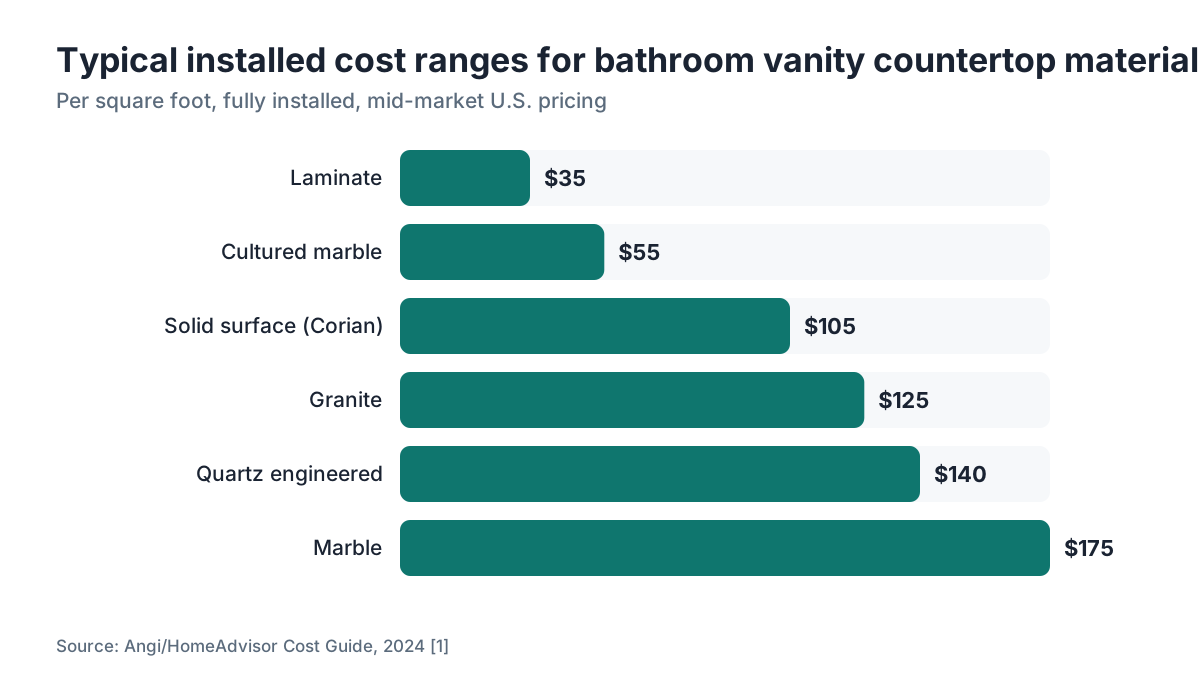
| Material | Installed cost (sq ft) | Water resistance | Heat resistance | Maintenance |
|---|---|---|---|---|
| Granite | $75, $200 | Good (sealed) | Excellent | Seal every 1 to 3 years |
| Quartz engineered | $80, $200 | Excellent (non-porous) | Moderate | Wipe clean, no sealing |
| Marble | $100, $250 | Poor (very porous) | Good | Seal frequently, etches easily |
| Laminate | $20, $50 | Fair (seams leak over time) | Poor | Replace when damaged |
| Cultured marble | $30, $80 | Good (gel-coat surface) | Poor | Polish, avoid abrasives |
| Solid surface (Corian) | $60, $150 | Excellent | Moderate | Sand out scratches |
Granite sits in a useful middle. It is less porous than marble, cheaper than most premium quartzite, and more heat-resistant than engineered quartz [2]. The one knock against it versus quartz is the sealing, which matters more in a bathroom than a kitchen because water pools around the faucet and basin every single day.
Hate the idea of sealing? Then quartz or a solid surface like Corian suits you better. Want natural stone and have room in the budget? Marble countertops look stunning and ask for more upkeep. On a tight budget, laminate countertops or Formica still work fine in low-moisture spots.
What thickness should a granite vanity countertop be?
The two standard thicknesses are 2cm (about 3/4 inch) and 3cm (about 1-1/4 inch). Most residential vanity fabricators default to 3cm. It supports itself without a plywood substrate, and it looks proportionally right on a standard 34-inch vanity [3].
2cm granite is thinner and lighter. It works, but it needs a full plywood backer, especially on any span over 18 to 24 inches without cabinet support underneath. Skip the backer and a thin slab can flex and crack under a point load, like someone leaning their full weight on the front edge or a heavy soap pump dropped from height.
3cm is the honest pick for most bathrooms. The material costs a bit more, but you skip the substrate work and the edge reads more substantial. On a small vanity the gap between 2cm and 3cm is often $30 to $80 total. Pay it.
Vessel sink setups are the exception. When the countertop is mostly decorative under a raised basin, 2cm works if the fabricator builds in proper support. Ask about it specifically. Thickness rules of thumb shift by stone type because granite's modulus of rupture is different from marble or quartzite [3].
What sizes and dimensions do granite vanity tops come in?
Prefabricated granite vanity tops come in a handful of stock sizes: 25x22, 31x22, 37x22, 49x22, and 61x22 inches are the common ones. They match same-named vanity cabinets and give you a 1-inch overhang on the front and sides.
Custom-cut granite opens up any dimension. Fabricators cut to order, so an odd size for a built-in niche, a floating vanity, or a custom double-sink layout is routine work. The practical minimum a shop will cut is around 12 by 12 inches. Below that, remnant scraps get sold as-is or turned into shelves.
Depth is almost always 22 inches on a standard vanity. Vessel setups sometimes use a shallower top, 18 to 20 inches, to bring the basin to a comfortable height without raising the cabinet. Confirm your finished height before ordering. Countertop plus basin plus rough plumbing has to land somewhere comfortable, which for most adults is 32 to 36 inches off the floor [4].
On a double-sink vanity over 60 inches, seams become a real question. Quarry slabs typically run 9 to 10 feet long and 4 to 5 feet wide, so most single-sink vanities come from one piece. A long double-sink run may need a seam. A good fabricator hides it under the faucet deck or between the two sinks.
What edge profiles work best on a bathroom vanity?
Edge profiles are half looks, half practicality. In a bathroom you want an edge that wipes clean and does not trap soap scum in carved grooves.
Eased or straight edges (a square cut with a slight chamfer on the top corner) are the cheapest and the most practical, usually baked into the base fabrication price. One wipe and they're clean. They read modern.
Bullnose edges (fully rounded top and bottom) stay popular on traditional and transitional vanities. Easy to clean, comfortable to lean against, soft-looking. Figure $10 to $20 per linear foot over an eased edge.
Ogee and dupont edges look ornate and belong in formal bathrooms. They carve concave and convex curves into the stone. The catch: those curves collect toothpaste and soap, and cleaning them takes real attention. Add $20 to $40 per linear foot in fabrication.
Bevel and waterfall edges split the difference. A bevel is a 45-degree chamfer that catches light without holding grime.
For a kids' bath or a hard-used powder room, go eased or bullnose. For a primary bath you'll clean carefully, an ogee earns its keep. The upgrade premium on a 49-inch top (roughly 12 linear feet of edge) runs $120 to $480 depending on profile. That is not a trivial line in the budget.
How do you choose the right granite for a bathroom vanity?
Picking granite for a bathroom is a different problem than picking it for a kitchen. Bathrooms bring sustained humidity, standing water around the faucet, and chemical exposure from cleaners, perfume, hairspray, and nail polish remover.
Porosity matters more here. Tight-grained granites seal better and hold the seal longer. Absolute Black, Black Galaxy, and most dark granites are dense and do well in wet rooms. Lighter granites with visible crystal structure, the classic whites and grays, tend to run more porous and want more frequent sealing [5].
Color is personal, but two practical notes. Light granite shows water spots and hard-water mineral deposits. Dark granite shows soap scum. Mid-tone, busy patterns like Santa Cecilia or Venetian Gold forgive both because the movement hides minor buildup between cleanings.
Think about what it has to live next to. Vanity granite never sits alone. It works with the floor tile, the wall color, the cabinet finish, and the fixtures. Bring a cabinet door sample, a tile swatch, and a photo of your fixture finish to the stone yard when you shop slabs.
For how grades and quarry origin drive pricing across every application, the granite countertops guide goes deeper on slab selection.
How do you seal and maintain a granite vanity countertop?
Sealing bathroom granite is not optional. Water, soap, and cosmetics find every unsealed pore and stain or degrade the stone over time [5].
Seal new granite before first use, then retest every 12 to 24 months. The water test is the field standard: pour a few tablespoons of water on the surface and wait 30 minutes. If the stone darkens, it is drinking the water and needs resealing. If the water beads and sits, the seal is holding [6].
Use a penetrating impregnator, not a topical coating. Topical sealers sit on top and wear off fast from daily wiping. Impregnators fill the pore structure. Follow the label: usually wipe on, let it penetrate 10 to 15 minutes, wipe off the excess, then give it 24 hours to cure.
Daily care is easy. Wipe spills right away, especially acidic ones like mouthwash, toners, and some cleaners. Use a pH-neutral stone cleaner or plain dish soap and warm water. Keep bleach, vinegar, and abrasive pads off it. Those break down the sealer and can etch the surface [6].
For stain removal and what quietly kills a sealer, the how to clean stone countertops guide covers products and technique in detail.
Can you install a granite vanity countertop yourself, or do you need a fabricator?
A prefab granite vanity top is the one case where a confident DIYer can self-install without special tools. These come factory-cut, pre-drilled for standard faucet holes, pre-finished on the edges, and sized to drop onto a stock cabinet. The job is basically: set the top in silicone, connect the plumbing, caulk the backsplash seam, done. Weight is the real challenge. A 49-inch granite top weighs 70 to 100 pounds [7].
Custom granite is another animal. It means templating (measuring the exact cabinet and wall geometry), cutting the stone, polishing the edges, and cutting for the sink and faucet layout. Get any of those wrong and you're out a $400 to $800 slab that can't be un-cut.
Most shops recommend professional installation for custom work, and that is the right call for most people. The installer handles the stone safely, sets it correctly in adhesive, and usually warrants the job. Supply-and-install cost normally rolls into the per-square-foot quote.
Prefab top, comfortable with basic plumbing and silicone? DIY away. Going custom? The shop's fabrication-and-install package is the lower-risk path. The full countertop installation walkthrough covers what a pro install should look like.
What sink types work with a granite vanity countertop?
The sink you pick shapes both the fabrication work and the final look.
Undermount sinks pair with granite most often. The bowl mounts below the stone, leaving a clean polished edge around the opening. Water wipes straight into the basin with no lip to catch grime. The tradeoff: undermount cutouts need precise cutting and polishing of the inside edge, which adds $75 to $150 per cutout depending on the shop [1].
Drop-in (overmount) sinks sit in the cutout and rest on the surface with a rim. That rim hides the cut edge, so the inside doesn't need polishing. Cheaper to fabricate, works fine, but the rim collects soap scum and is harder to keep clean.
Vessel sinks sit fully on top. The granite needs only a small faucet hole and maybe a drain hole. Simplest fabrication of the bunch, but you have to size the countertop so the raised bowl lands at a comfortable use height. A vessel on a striking slab looks great.
Integral sinks, where the basin is carved from the same stone, are possible with granite but rare because granite fights smooth bowl curves. You see integral basins more in travertine or soapstone. If that look pulls you, soapstone carves into basins more readily.
How do fabricators price and quote a granite vanity top?
Fabricator reading this: the pricing logic on vanity tops is worth spelling out, because it doesn't behave like kitchen work.
Vanity tops are small, a few square feet against the 30 to 50 square feet of a kitchen. That makes them expensive per square foot, because your fixed costs (templating, CNC setup, delivery truck, install labor) don't shrink with the job. Plenty of shops set a $300 to $500 minimum job charge to cover those fixed costs on small vanity work.
The cost drivers you have to price cleanly: slab material and grade, sink cutout count and type (undermount costs more than drop-in), edge profile (eased is base, fancy profiles add labor), faucet holes ($20 to $40 each), backsplash (stone adds material and finish work), and whether templating is in the number or billed separately.
High-volume vanity shops lean on templating and quoting software to keep small jobs profitable. Tools like SlabWise generate accurate quotes fast, which matters when a vanity quote eats the same back-office time as a kitchen quote and brings in a fraction of the revenue. Right the first time protects the margin.
Homeowners: get three quotes. Make each one specify the same granite grade, edge profile, sink cutout type, and whether install is included. Mismatched specs make quotes impossible to compare.
What are the most common problems with granite vanity countertops?
Granite is tough, but vanity installs have a few failure modes that show up more than people expect.
Chipping at the sink cutout edge is the most common. The polished inside edge of an undermount cutout is thinner than the field of the slab, and a dropped soap dish or a heavy wrench during a plumbing repair can chip it. You can fill a chip with color-matched epoxy, but it shows on close inspection.
Cracking near the faucet hole is second. Faucet holes concentrate stress. Cut with a dull or poorly cooled bit, or left with weak cabinet support nearby, and a crack can spread over time. That is a fabrication quality problem, not a material one, so technique matters when you pick a shop.
Staining around the faucet from hard-water deposits and soap buildup is a maintenance issue, not a material failure. It responds to a poultice (a drawing compound that lifts stains out of the pores) if you catch it before the deposit sets hard [6].
Loose or lifting tops trace back to the install: too little silicone, an unlevel cabinet, or bad shimming. A properly set top should not move at all.
New crack or chip? Talk to a stone restoration pro before you reach for epoxy. Color matching is an art, and a bad repair looks worse than the chip it covers.
Is granite a good choice for a small bathroom vanity or powder room?
Yes, and small is exactly where granite turns into a value play. Remnants, the leftover pieces from bigger kitchen jobs, sell at 30 to 70 percent below full slab pricing [8]. A vanity that needs 6 to 10 square feet fits a remnant perfectly.
For a powder room, a single-sink vanity in the 24 to 36 inch range, a striking remnant in a premium granite you could never afford for a whole kitchen runs $150 to $400 in material. Add fabrication and install and you can put a dramatic stone top in a powder room for $350 to $700 total.
The math flips on a double-sink primary bath with a 72-inch run. At that scale you're buying full-slab territory, install needs two people, and the project starts to resemble a scaled-down kitchen job.
To see how the same material behaves in a heavier-use room, the kitchen countertops guide covers granite in the kitchen.
Frequently asked questions
How much does a granite vanity countertop cost installed?
Most homeowners pay $200 to $1,200 installed, depending on slab grade, size, edge profile, and local labor rates. A simple single-sink 25-by-22-inch prefab top runs $200 to $350 on the low end. A custom 72-inch double-sink vanity with an upgraded edge can top $1,000. Pull three quotes with matching specs to calibrate your local market.
Is granite good for bathroom vanities?
Granite works well in bathrooms when it's sealed. It resists heat, handles daily use, and is harder and more stain-resistant than marble. The one limit is porosity: unsealed or poorly sealed granite absorbs water, soap, and cosmetics over time. Sealed correctly and maintained every one to three years, it holds up excellently. Dense, fine-grained granites like Absolute Black perform best in wet rooms.
What thickness of granite is best for a vanity countertop?
3cm (about 1-1/4 inch) is the pick for most vanities. It supports itself without a plywood substrate, looks proportionally right on a standard vanity, and costs only $30 to $80 more than 2cm on a typical job. 2cm works but needs a full plywood backer and is more prone to cracking under point loads. Most fabricators default to 3cm on new residential work.
How often does a granite vanity countertop need to be sealed?
Usually every one to three years, based on granite density and how hard the vanity gets used. The water test tells you when: pour a few tablespoons on the stone, wait 30 minutes, and check for darkening. Darkening means it's absorbing and needs resealing. Dense dark granites may go three-plus years; lighter, more porous types may want annual attention.
Can granite vanity countertops be cut for undermount sinks?
Yes. Undermount cutouts are standard granite fabrication. The shop cuts the basin opening, then polishes the inside edge to a finished profile, usually matching the top surface. Undermount cutouts add roughly $75 to $150 per cutout. You get the cleanest look and the easiest daily cleaning of any mounting style with granite.
What edge profile is most popular for granite vanity tops?
Bullnose and eased edges lead for bathroom vanities. Bullnose is rounded, comfortable to lean against, and wipes clean. Eased (straight with a slight chamfer) reads minimal and modern. Both come in base pricing or carry a small upcharge. Ogee and dupont profiles look formal but have carved recesses that catch soap scum and demand more careful cleaning.
How do you clean a granite vanity countertop?
Wipe daily with a soft cloth, warm water, and a few drops of pH-neutral dish soap or a stone cleaner. Dry around the faucet and sink edges to head off mineral buildup. Skip vinegar, bleach, abrasive pads, and most multi-surface bathroom sprays, which run too acidic or alkaline and degrade the sealer. For hard-water deposits use a stone-safe mineral remover; for stains, a poultice pulls material out of the pores.
Can you get a granite vanity top from a remnant slab?
Yes, and it's one of the best value moves in stone countertop work. Fabricators and stone yards sell remnants (leftover pieces from bigger kitchen cuts) at 30 to 70 percent below full slab pricing. A single-sink vanity needs 6 to 10 square feet, which fits remnant territory easily. You can often score a premium-grade granite for a powder room for $150 to $400 in material by shopping remnants.
How do granite vanity countertops compare to quartz?
Quartz engineered stone is non-porous and never needs sealing, a real edge in a bathroom. Granite wants sealing every one to three years but gives you natural variation no engineered product fully copies. Both are durable and heat-resistant, though quartz can discolor under sustained high heat. Cost is close: both run $80 to $200 per square foot installed for mid-to-premium grades. It comes down to maintenance tolerance and the look you want.
What is the standard size for a granite vanity countertop?
Prefab granite vanity tops most often come in 25x22, 31x22, 37x22, 49x22, and 61x22 inches, with a small front overhang over the cabinet. Custom-cut granite hits any dimension. Depth is almost always 22 inches on a standard vanity. Finished height, cabinet included, should land at 32 to 36 inches off the floor for comfortable use.
Is it hard to install a granite vanity countertop yourself?
A prefab granite vanity top is DIY-friendly: it arrives pre-cut, pre-drilled, and pre-finished, and install is mostly setting it in silicone and connecting plumbing. Weight (70 to 100 pounds for a 49-inch top) is the main challenge. Custom granite is not a DIY job: measurement and cutting errors are costly and can't be reversed. For custom work, professional fabrication and install is the safer path.
Does granite increase bathroom resale value?
Natural stone countertops, granite included, consistently rank as a bathroom feature buyers like, though ROI data is mixed. Remodeling magazine's Cost vs. Value report tracks bathroom remodel ROI broadly but doesn't isolate countertop material as a single variable. Treat granite in a bathroom as a feature that helps the home sell, not one that returns its full cost at closing.
What are the best granite colors for a bathroom vanity?
Mid-tone granites with busy patterns, like Santa Cecilia, Venetian Gold, or Bianco Romano, forgive a bathroom because the movement hides soap residue and water spots between cleanings. All-white or all-black granites look striking but show residue more. For a small powder room, a bold statement granite works well because you're buying only a small area of a premium stone.
How long does a granite vanity countertop last?
Installed and maintained right, a granite vanity lasts the life of the house. The stone has no meaningful wear-out timeline. The practical limits are chipping at sink cutout edges (from impact) and sealer degradation if you neglect resealing. Chips take color-matched epoxy. Keep the sealer up and the surface itself won't degrade from normal bathroom use.
Sources
- HomeAdvisor (Angi), Granite Countertops Cost Guide: Granite countertops cost $40 to $200 per square foot for material; installed costs range from approximately $200 to $1,200 for vanity-scale projects
- U.S. Geological Survey, Dimension Stone Statistics and Information: Granite is a hard igneous rock with high heat resistance and density, relevant to its performance characteristics as a countertop surface
- Natural Stone Institute (formerly Marble Institute of America), Dimension Stone Design Manual: 3cm is the industry-standard thickness for residential countertops that do not require a plywood substrate; 2cm requires substrate support for spans over 18 to 24 inches
- U.S. Access Board, ADA Accessibility Guidelines, Lavatories and Sinks: Comfortable finished vanity countertop height for most adults falls in the 32 to 36 inch range from the floor
- University of Minnesota Extension, Natural Stone Countertop Selection and Care: Granite porosity varies by type; denser dark granites seal more effectively than lighter, more crystalline varieties; bathroom applications require more frequent sealing due to sustained moisture exposure
- Natural Stone Institute, Care and Maintenance Guidance: The 30-minute water drop test is the standard method for determining whether granite requires resealing; penetrating impregnator sealers are recommended over topical coatings for bathroom applications
- U.S. Geological Survey, Dimension Stone Statistics and Information: Granite density is roughly 165 to 170 pounds per cubic foot, putting a 49-inch 3cm vanity top in the 70 to 100 pound range
- National Kitchen and Bath Association (NKBA): Remnant stone pricing is typically 30 to 70 percent below full slab pricing; small vanity projects are well-suited to remnant purchases from fabricators
- Remodeling Magazine, Cost vs. Value Report, Bathroom Remodel: Bathroom remodel projects return a portion of costs at resale; natural stone countertops are cited as a buyer appeal feature but ROI varies by market and scope
- EPA, Indoor Air Quality: Granite countertops have been assessed for radon and radiation emissions; EPA guidance indicates granite countertop emissions are generally within normal background radiation ranges and not a significant health concern
Last updated 2026-07-09