TL;DR
- Quartz countertops run $50 to $200 per square foot installed, and most homeowners land between $75 and $150.
- A standard 40-square-foot kitchen comes in around $3,000 to $6,000 all in.
- Bathrooms cost less in total but more per square foot because small cuts and extra sink holes waste material.
- Brand, thickness, edge profile, and your region move the number the most.
What is the typical cost of quartz countertops per square foot?
The honest range is $50 to $200 per square foot installed. That spread is real, not a hedge. At the low end you get entry-level quartz from brands like MSI or Silestone in solid or lightly veined colors, installed in a plain kitchen with no tricky angles. At the high end you get thick Calacatta-look slabs from Cambria or a premium Silestone Eternal series, with a waterfall edge on a big island, in a high-labor metro.
Most residential jobs settle between $75 and $150 per square foot installed. Get a quote of $45 installed and you should ask hard questions about slab origin and installer experience. Get a quote of $220 and the shop had better have a very specific slab and a very specific design in mind.
The material alone, without labor, edge work, or cutouts, runs $25 to $120 per square foot depending on brand and tier. Labor to template, fabricate, and install adds roughly $35 to $85 per square foot in most U.S. markets. In San Francisco or New York, labor alone can push past $100. [1]
Countertops are the single biggest line item in a full kitchen remodel. The National Kitchen and Bath Association's 2023 Kitchen and Bath Market Index puts surfaces at roughly 10 to 15% of total project cost. [2]
How much does a full kitchen quartz countertop project cost?
A typical kitchen has 40 to 60 square feet of countertop. Run those numbers against the $75 to $150 installed range and you get $3,000 to $9,000 for most kitchens. The broad middle, a 45-square-foot kitchen with mid-grade quartz at around $100 per square foot installed, lands at $4,500.
A handful of decisions move that number.
Island size. A large island with a waterfall on one or both ends can add $1,500 to $4,000 by itself, mostly because waterfall panels waste slab material and take longer to miter cleanly.
Edge profile. A standard eased or beveled edge is usually in the base price. A full bullnose, ogee, or mitered edge adds $15 to $30 per linear foot. A 10-foot run of complex edge work is $150 to $300 more.
Sink cutout. One cutout runs $150 to $350 depending on sink type. Undermount sinks need polished edges inside the cutout, and that takes real time on a CNC router.
Cooktop or farmhouse sink. Both add another $150 to $400 for the cutout and any special fit work.
Backsplash. A short quartz splash 4 inches above the counter usually comes included. A full-height quartz backsplash to the upper cabinets gets priced as extra square footage and can add $600 to $2,000 depending on height.
Shops that run software to cut slab waste, like SlabWise, can sometimes buy fewer slabs and pass the savings on. Ask any fabricator how they handle nesting and remnants. [3]
What does quartz cost for bathroom countertops?
Bathroom quartz usually costs more per square foot than kitchen quartz, not less. Vanities are small, so you get more cuts per finished foot, more relative waste, and the same shop overhead spread across fewer billable feet. A single-sink vanity top might be 12 to 18 square feet. A double-sink master bath runs 25 to 35 square feet.
Expect $80 to $180 per square foot installed for bathroom quartz in most markets. A small guest bath vanity (14 square feet, one sink cutout) runs $1,200 to $1,800 total. A large master bath with two sinks and a vessel cutout can hit $2,500 to $5,500. [1]
Two things push the per-foot cost up: vessel sink cutouts and faucet holes. Each faucet hole costs $50 to $125. A three-hole faucet setup adds $150 to $375, and many fabricators set a minimum of two to three holes on a single quote.
Against the alternatives, the closest competition is marble (a bit more expensive, needs sealing), solid surface like Corian (generally $40 to $85 installed, lower ceiling), and prefab cultured marble tops (as low as $200 total, but no customization). Quartz sits in the middle of the premium range.
Quartz bathroom countertops cost comparison:
| Material | Installed cost (per sq ft) | Maintenance |
|---|---|---|
| Quartz | $80, $180 | None beyond cleaning |
| Marble | $100, $250 | Annual sealing |
| Granite | $65, $175 | Annual sealing |
| Corian/Solid surface | $40, $85 | Minor repairs possible |
| Cultured marble (prefab) | $15, $40 (total unit) | Low |
| Laminate | $20, $50 | Replace if damaged |
For a full comparison of marble countertops vs. quartz in wet areas, the sealing requirement is the deciding factor for most busy households.
What factors drive quartz countertop prices up or down?
Five variables explain most of the spread between a $55 job and a $175 job.
1. Slab tier and brand. Quartz is manufactured, so brand positioning matters a lot. Cambria, an American-made brand, charges a premium for its warranty and domestic production. Silestone and Caesarstone sit in the mid-to-premium range. MSI, Vadara, and house brands from big-box distributors sit lower. The gap between an entry-level slab and a premium slab can be $30 to $60 per square foot in material alone. [4]
2. Thickness. Standard residential quartz is 3 cm (roughly 1.25 inches) thick. Some budget projects use 2 cm material with a laminated edge to fake a 3 cm look, which shaves $5 to $15 per square foot. True 3 cm is what most fabricators recommend for kitchen durability.
3. Pattern complexity. Solid colors and simple salt-and-pepper patterns are cheapest because grain matching doesn't matter. Large-format veined slabs meant to mimic Calacatta marble force the fabricator to book-match or flow-match veins across seams, which takes time and wastes material. That pattern work can add 20 to 40% to fabrication cost.
4. Labor market. A skilled fabricator in rural Tennessee charges far less than one in suburban Boston. The Bureau of Labor Statistics wage data for stone cutters shows median hourly pay running from under $18 in some Southern states to over $30 in the Northeast and on the Pacific Coast. [5] Shop overhead, insurance, and equipment costs track the same geography.
5. Job complexity. Straight runs with no cutouts are easiest. Irregular shapes, multiple corners, curved edges, and lots of cutouts all add time. Every seam is time. Every substrate problem discovered at template is more time. Complexity adds up faster than most homeowners expect.
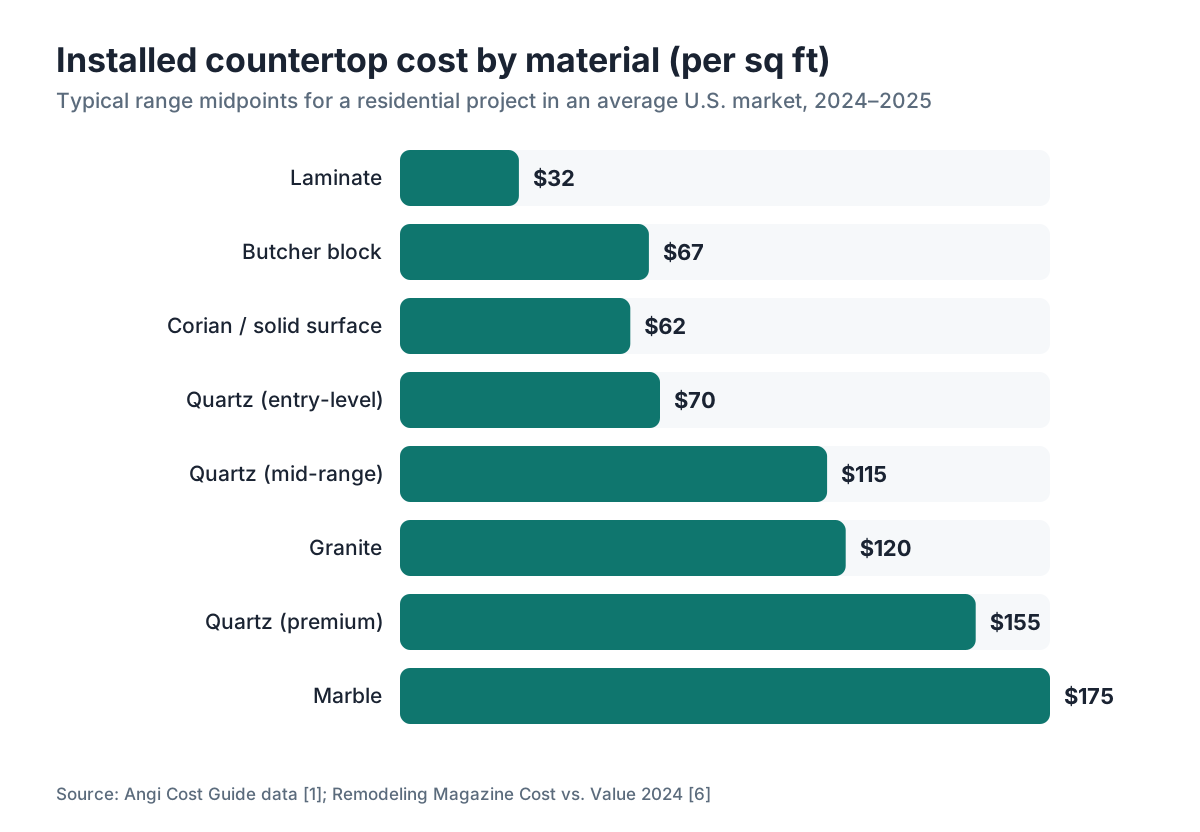
How does quartz compare in cost to granite, marble, and laminate?
Quartz sits in the middle-to-upper range of countertop materials. Here's an honest comparison of installed costs in a typical U.S. market.
| Material | Installed cost range (per sq ft) | Sealing required? | Repairability |
|---|---|---|---|
| Laminate | $15, $50 | No | Poor (chips, swells) |
| Formica/Laminate premium | $20, $65 | No | Poor |
| Butcher block | $35, $100 | Yes (oil or finish) | Good (sand and refinish) |
| Corian / solid surface | $40, $85 | No | Good (buff scratches) |
| Quartz (entry-level) | $50, $90 | No | Fair (chips hard to hide) |
| Quartz (premium) | $90, $200 | No | Fair |
| Granite | $65, $175 | Yes (annual) | Poor-fair |
| Quartzite (natural stone) | $80, $200 | Yes (frequent) | Poor |
| Marble | $100, $250 | Yes (frequent) | Poor |
Granite countertops cost about the same as mid-range quartz installed, but they need periodic sealing and are more sensitive to certain acids. Laminate countertops cost far less and won't survive a hot pan or a dropped knife the way quartz does. Marble countertops look stunning and etch and stain fast in a kitchen where anyone actually cooks. For households that want the stone look without the maintenance worry, quartz is the safe pick.
Cambria countertops sit at the high end of the quartz range, typically 15 to 30% above comparable Silestone or Caesarstone, mostly for the lifetime warranty and domestic production.
Does quartz cost more or less at big-box stores vs. fabricators?
The answer is more complicated than the big-box stores want you to think. Their advertised starting prices look cheap, but they apply to a narrow tier of slabs and the install quality depends on whichever local sub they send.
Home Depot and Lowe's both sell and install quartz through subcontracted fabricators. Advertised prices often start around $60 to $70 per square foot installed, which sounds competitive. Pick anything more interesting than a house-brand slab and the price climbs fast.
Independent fabricators have more pricing flexibility. They source from a broader range of distributors, they're easier to hold accountable (it's their name on the truck), and they handle more complex work. Their base per-square-foot number might look higher, but it's often all-in, while big-box quotes tack on tearout, haul-away, and other line items that weren't in the first number.
For a simple kitchen replacement with a standard slab, big-box can deliver fine results at a competitive price. For any job with an island waterfall, pattern matching, unusual angles, or a tight tolerance around an apron-front sink, use an independent fabricator.
Learning the basics of countertop installation before you get quotes helps you ask sharper questions either way.
Is quartz more expensive than quartzite?
Often yes, but not always. People mix these up constantly because the names sound identical, and they behave nothing alike.
Quartz (engineered) is a manufactured slab: 90 to 95% ground quartz aggregate bound with polymer resins and pigments. Quartzite is a natural metamorphic stone, quarried in slabs, and it needs sealing because it's porous.
Entry-level quartz runs $50 to $90 installed. Entry-level quartzite runs $80 to $130. Premium quartzite, especially the white Brazilian varieties that read like Calacatta marble, can hit $200 to $250 per square foot installed. Premium quartz tops out around $200.
The overlap in the middle catches people off guard. A mid-grade Silestone quartz at $110 installed and a mid-grade quartzite at $120 installed are close in price, but the quartzite still needs sealing and etches more easily. Our guide on how to clean quartzite countertops spells out exactly what that maintenance involves.
What does quartz countertop removal and demo cost?
Demolition and haul-away of old countertops runs $3 to $12 per square foot, and it often gets quoted as a separate line. For a standard 45-square-foot kitchen, that's typically $150 to $400.
Removing old laminate is fast. Removing old granite or quartz takes longer because of the weight and the care needed to disconnect the sink, faucet, and any clips or adhesive.
If the old surface is tile, you also risk damaging the drywall or backer board underneath, which may need patching before the new surface goes in. Add $200 to $600 for substrate repair in a bad tile teardown.
Some fabricators include tearout in their quote. Ask two specific things: is tearout included, and does that also cover haul-away? Those are separate jobs and both cost money.
How can I get an accurate quartz countertop quote?
The most reliable quote comes from a professional template, not from eyeballing a floor plan. At template, the fabricator's tech comes to your space, laser-measures every run, records cabinet heights and irregularities, confirms sink and appliance locations, and produces the exact cut files for fabrication.
Before the template, you can get a ballpark if you hand a shop accurate measurements. Measure your counter runs in inches, add up total square footage, and ask for a budgetary range. Just don't make purchase decisions on a ballpark. Make them on a templated quote.
Confirm these in any written quote:
- Square footage being charged (measure yourself to verify)
- Slab name and thickness
- Edge profile included and any upcharge options
- Number of cutouts and their cost
- Whether tearout and haul-away are included
- Lead time from template to install
- Payment terms
Fabricators running quoting software, like SlabWise, can turn out itemized quotes faster and with fewer transcription errors, which cuts the odds of a surprise invoice at the end. Shop owners trying to tighten their quoting process can usually make a tool like that pay for itself fast.
Get at least three quotes. Countertop pricing is not standardized, and shops vary more than most homeowners expect.
Does quartz hold its value in a home?
Countertop material alone won't move your resale number dramatically, but the presence of stone or quartz versus laminate is something buyers notice. The ROI question deserves an honest answer, and the honest answer is modest.
Harvard's Joint Center for Housing Studies tracks remodeling spending alongside Remodeling Magazine's annual Cost vs. Value report. The 2024 report found a midrange kitchen remodel recoups roughly 49.5% of its cost at resale nationally, and an upscale kitchen remodel recoups about 37.7%. [6] Those are sobering numbers. A countertop is not a wealth-building move on its own.
Still, buyers actively reject homes with damaged or dated counters. Quartz reads as low-maintenance and modern to most buyers right now, which helps a home sell faster even when it doesn't add dollar-for-dollar value.
Remodeling to sell in the next 12 months? Mid-range quartz, not the priciest slab, is the right call. It photographs well, appeals broadly, and doesn't cost so much you'll never recoup the gap over laminate.
Are there ways to reduce quartz countertop costs without sacrificing quality?
Yes, and several of them work well in practice.
Buy from remnant stock. Fabricators pile up leftover slab pieces from bigger jobs. A bathroom vanity, a small laundry top, or even a modest kitchen can come out of remnant material at 30 to 60% off slab price. You give up color choice, but the material is identical to a new slab.
Choose a simpler edge. Eased or bevel edges are standard. Upgrading to an ogee or full bullnose on a 25-linear-foot kitchen adds $375 to $750 that most people stop noticing after two months of living with it.
Stick to in-stock colors. Special-order slabs add lead time and sometimes a premium. Shops already running a given slab get better pricing on it.
Minimize seams strategically. Sometimes a small design change, moving a cooktop a few inches or trimming an overhang by two inches, lets the fabricator cut your job from one slab instead of two. Ask.
Skip the full-height backsplash. A 4-inch quartz splash is practical and included in most quotes. Running quartz to the upper cabinets doubles or triples backsplash material cost. Tile or paint up top with a quartz surface below is a legitimate, handsome option.
Compare butcher block countertops for lower-traffic areas. An island with a prep sink, a bar top, or a laundry room in butcher block can cut total cost while the main kitchen perimeter stays in quartz.
How long does quartz installation take, and does timing affect price?
The install itself is usually one day for a typical kitchen once the crew is on-site. The full timeline from first shop visit to finished countertops runs 2 to 4 weeks: shop visit and selection (same day), templating (a separate appointment, 1 to 3 days after slab confirmation), fabrication (5 to 10 business days after template), and installation (1 to 2 days).
Rush jobs are possible if a shop has open schedule time and your slab is in stock. Expect a 10 to 20% rush premium if you need it in under a week.
Seasonal pricing exists in this trade, though it's not dramatic. Spring and fall run busier (they track home sale seasons), and some shops charge a little more or quote longer lead times during peak. January and February are usually the slowest months, which is when you have the most room to negotiate on price and timeline. Nobody has great published data on this. It's a consistent observation from fabricators.
For kitchen countertops timelines and planning, coordinate the install with your cabinet installation, and never schedule counters first.
Frequently asked questions
How much do quartz countertops cost per square foot in 2025?
Quartz countertops run $50 to $200 per square foot installed in 2025. Most residential kitchens land between $75 and $150 per square foot. Entry-level quartz with a standard edge and simple shape sits at the low end. Premium branded slabs with veining, waterfall edges, or complex fabrication push toward the top.
What is the average total cost to install quartz countertops in a kitchen?
A typical kitchen (40 to 55 sq ft) costs $3,000 to $8,000 installed, with $4,500 to $6,000 being the most common range for mid-grade quartz. Islands with waterfall edges, multiple cutouts, or pattern-matched slabs push the total higher. Get at least three quotes from fabricators after a proper template measurement.
How much do quartz bathroom countertops cost?
Quartz bathroom countertops cost $80 to $180 per square foot installed. Small vanity tops often carry a minimum charge of $800 to $1,200 regardless of square footage because of setup and cutout costs. A double-sink master bath vanity runs $2,500 to $5,500 depending on size, edge profile, and how many faucet holes are needed.
Is quartz more expensive than granite?
They're close. Granite runs $65 to $175 per square foot installed; quartz runs $50 to $200. In the middle range, where most projects land, they're nearly identical in cost. Quartz needs no sealing, which saves $50 to $150 per year in maintenance. Granite has a wider range of natural patterns. Neither is clearly cheaper overall.
Does Home Depot or Lowe's offer cheaper quartz installation than independent shops?
Big-box stores advertise starting prices around $60 to $70 per square foot, but those apply to a narrow tier of slabs. Once you choose a better material or add complexity, their prices match or exceed independent fabricators. Independent shops often deliver better accountability and can handle more complex work. For a simple job with a standard slab, big-box is competitive.
What edge profile is included in a standard quartz quote?
Most fabricators include an eased edge (a slightly softened 90-degree corner) or a beveled edge at no upcharge. Bullnose, ogee, mitered, and waterfall edges are upgrades that typically add $15 to $30 per linear foot. On a 25-linear-foot kitchen perimeter, a complex edge upgrade can add $375 to $750 to the total.
What is the cost difference between 2 cm and 3 cm quartz?
Three-centimeter quartz costs $5 to $15 more per square foot than 2 cm material. Most fabricators recommend 3 cm for kitchen counters because it's structurally stronger and doesn't need a substrate for support. Two-centimeter quartz shows up in bathroom applications or with a laminated edge to mimic the 3 cm profile at lower cost.
How much does a quartz island countertop cost?
A standard island top (roughly 20 to 30 sq ft, no waterfall) adds $1,500 to $3,500 to a project. An island with a waterfall on one side adds $2,000 to $5,000 because waterfall panels waste slab and require precise miter work. The waterfall is one of the most expensive single decisions in a kitchen remodel relative to its square footage.
Does quartz countertop cost include removal of old countertops?
Often no. Demo and haul-away typically runs $3 to $12 per square foot, or $150 to $400 for a standard kitchen. Always confirm in writing whether tearout and disposal are included. Tile removal costs more than laminate because of the risk of drywall damage underneath, which may require substrate repair before installation.
Are Cambria quartz countertops worth the higher price?
Cambria runs 15 to 30% higher than comparable Silestone or Caesarstone products. The premium buys a full lifetime warranty, domestic (Minnesota) manufacturing, and pattern exclusivity. For buyers who want that warranty and like Cambria's specific patterns, it can be worth it. For buyers prioritizing cost, mid-range Silestone or Caesarstone delivers comparable durability at lower cost.
Can I save money buying quartz remnants?
Yes, a lot. Remnant quartz from a fabricator's leftover slabs typically costs 30 to 60% less than full slab pricing. Bathroom vanity tops, laundry rooms, and small prep areas are ideal candidates. You're limited to whatever remnants are on hand, so color selection is restricted. Quality is identical to new material. Call local shops directly and ask what's in their remnant yard.
How do I get an accurate quartz countertop quote?
Measure your counter runs in inches and calculate square footage, then get ballpark estimates from three fabricators. Don't make final decisions on ballparks. After you select a slab, schedule a professional template, which uses laser measurement to produce exact cut files. Your binding quote should itemize square footage, slab name, edge profile, cutout counts, tearout, and lead time.
Is quartz a good investment for resale value?
Quartz improves buyer perception and helps homes sell faster, but don't expect dollar-for-dollar return. Remodeling Magazine's 2024 Cost vs. Value Report puts a midrange kitchen remodel at about 49.5% cost recouped at resale nationally. Quartz reads as modern and low-maintenance to buyers, which matters more in how fast you sell than in how much you net.
What quartz countertop brands are most affordable?
MSI, Vadara, and store-brand programs from major distributors like Floor & Decor and Home Depot's in-house lines sit at the affordable end, often $25 to $50 per square foot in material before fabrication. Mid-range brands include Caesarstone and Silestone. Cambria and Ann Sacks sit at the premium end. All engineered quartz uses similar resin-and-aggregate construction; the differences are warranty terms, pattern libraries, and slab sizing.
Sources
- HomeAdvisor (Angi), Quartz Countertops Cost Guide: Installed quartz countertop costs ranging $50, $200 per sq ft, with bathroom vanity tops running on the higher end per square foot due to setup minimums and cutout labor
- National Kitchen and Bath Association, Kitchen and Bath Market Index 2023: Countertops and surfaces represent the single largest line item in a full kitchen remodel, typically 10 to 15% of total project cost
- SlabWise, Countertop Fabrication Software: Fabrication software that handles quoting and nesting to minimize slab waste
- Cambria, Product Warranty and Origin Information: Cambria quartz is manufactured in the United States and carries a full lifetime warranty; pricing sits at the premium tier of engineered quartz
- U.S. Bureau of Labor Statistics, Occupational Employment and Wage Statistics, Stone Cutters and Carvers: Median hourly wages for stone sawyers and fabricators range from under $18 in some Southern states to over $30 in the Northeast and Pacific Coast regions
- Remodeling Magazine, 2024 Cost vs. Value Report: A midrange kitchen remodel recoups roughly 49.5% of its cost at resale nationally; an upscale kitchen remodel recoups about 37.7%
- U.S. Geological Survey, National Minerals Information Center: Silica (quartz) is a primary raw material in engineered stone production; USGS tracks domestic production and pricing of industrial silica annually
- Harvard Joint Center for Housing Studies, The State of the Nation's Housing 2023: Home improvement and remodeling spending trends, including countertop replacement as one of the most common kitchen remodel investments
- Silestone by Cosentino, Product Specifications and Pricing Tiers: Silestone quartz available in multiple price tiers; the Eternal series is positioned in the premium segment with pricing above entry-level lines
- U.S. Environmental Protection Agency: Engineered stone fabrication produces respirable crystalline silica dust; EPA and OSHA have documented exposure risks in stone fabrication workplaces
- OSHA, Crystalline Silica Rule (29 CFR 1910.1053): OSHA's silica rule sets a permissible exposure limit for silica in fabrication workplaces, directly affecting quartz shop operating costs and compliance overhead
- National Association of the Remodeling Industry, Consumer Research on Kitchen Remodeling Costs: Average kitchen countertop replacement project costs and consumer satisfaction data for stone vs. non-stone materials
Last updated 2026-07-09