TL;DR
- The 10 main countertop types are granite, quartz, marble, quartzite, soapstone, laminate, solid surface, butcher block, concrete, and porcelain.
- Installed costs run from about $20/sq ft for laminate to $250+ for exotic stone.
- Each material trades off hardness, porosity, maintenance, and looks against the others.
- No single material wins on every axis.
Quick answer: Quartz is the simplest all-around choice for many indoor kitchens because it needs no sealing and offers consistent patterns. Granite and quartzite suit buyers who want natural stone and can follow material-specific care. Laminate is the strongest budget choice. Porcelain and sintered surfaces are worth comparing for outdoor or sun-exposed installations. The right answer depends on budget, heat exposure, sunlight, maintenance tolerance, and who will fabricate the job.
What are the main types of countertops available today?
About ten materials cover the vast majority of countertop installs in American homes. They sort into a few families: natural stone (granite, marble, quartzite, soapstone, slate), engineered stone (quartz), solid surface (Corian and its rivals), laminate, wood (butcher block), and poured or fabricated surfaces (concrete, porcelain, stainless steel).
Each family behaves differently once it's living in a real kitchen. Natural stone is porous to varying degrees, so sealing and cleaning routines actually matter. Engineered quartz is nonporous but can yellow from UV if it sits under a skylight. Laminate costs a fraction of stone but chips at edges and can't be repaired invisibly. Butcher block is warm and workable but needs oiling, and it hates standing water next to the sink.
The decision is almost never about picking the best material in the abstract. It's about matching a material's real weaknesses to how your kitchen actually gets used. A baker who wants a cool pastry surface might lean toward marble or quartzite despite the sealing work. Someone who just wants to stop thinking about maintenance usually ends up with quartz.
For how these materials compare in kitchen applications specifically, the kitchen countertops guide covers layout and workflow that matter as much as the surface itself.
Which countertop material should you choose?
Use the shortlist below before comparing colors or brands:
| Your priority | Start with | Check before buying |
|---|---|---|
| Lowest routine maintenance | Engineered quartz or solid surface | Heat limits, finish care, and warranty exclusions |
| Natural stone character | Granite, quartzite, marble, or soapstone | Absorption, acid sensitivity, slab variation, and sealer guidance for the exact stone |
| Lowest upfront price | Laminate | Edge construction, sink detail, and moisture exposure |
| A refinishable wood surface | Butcher block | Species, grain construction, finish, and water management |
| Outdoor or high-UV use | Porcelain slab or an outdoor-rated sintered surface | Product approval for the climate and an experienced fabricator |
| Custom shape or seamless sink | Solid surface or concrete | Heat limits, repair method, and installer experience |
This is a starting point, not a substitute for the technical sheet and warranty for the exact product. Material families can contain products with meaningfully different limits.
How much do different countertop materials cost?
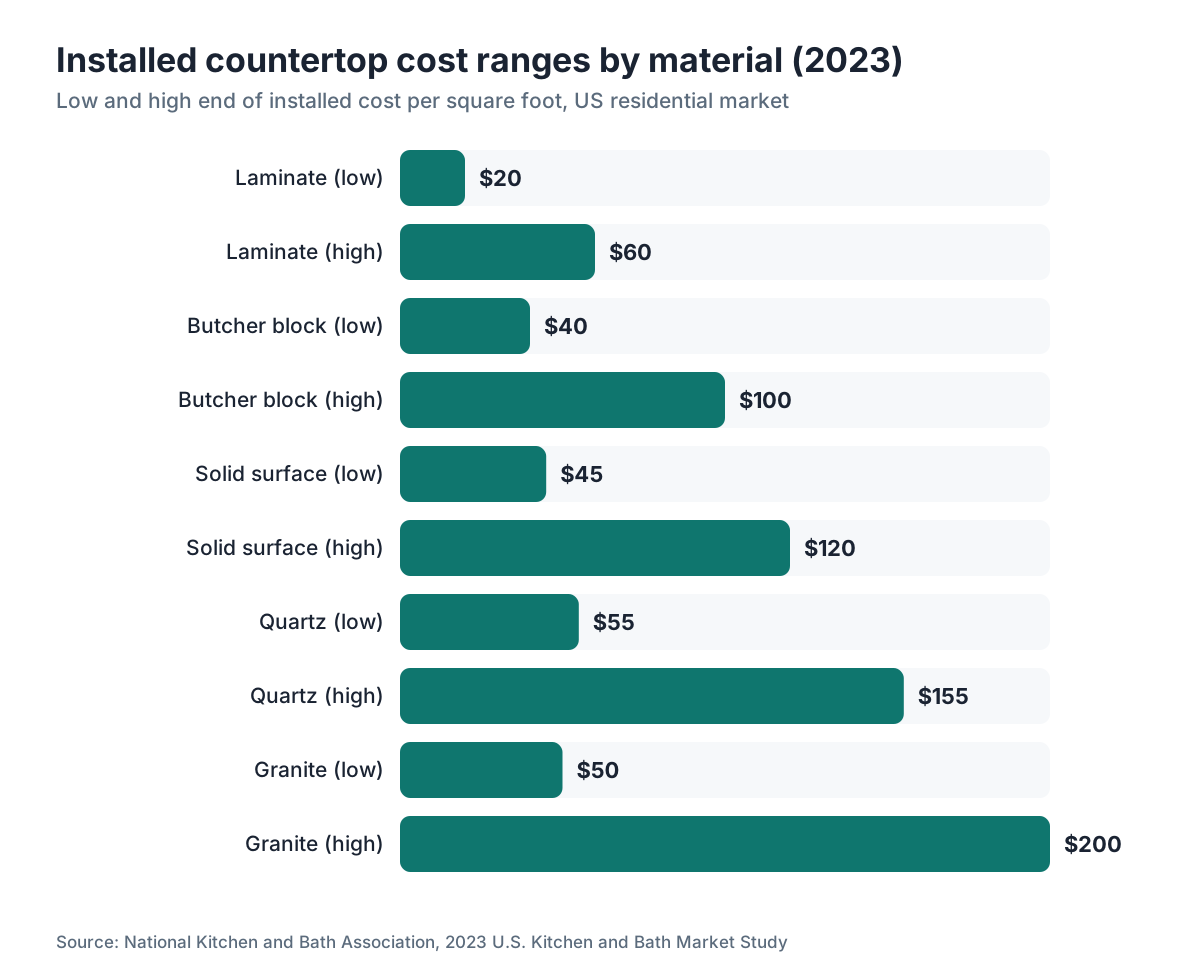
Installed cost varies enormously, and the spread inside a single material category is often as wide as the spread between categories. The numbers below reflect installed cost in the United States as of 2023, meaning fabrication, edge profile, and a standard sink cutout are included but backsplash, demolition, and plumbing disconnects are not [1].
| Material | Low ($/sq ft installed) | High ($/sq ft installed) | Why the range is wide |
|---|---|---|---|
| Laminate | $20 | $60 | Post-form vs. custom edge; brand tiers |
| Butcher block | $40 | $100 | Domestic hardwood vs. exotic species, thickness |
| Solid surface (Corian, etc.) | $45 | $120 | Complexity of seams, brand |
| Quartz (engineered) | $55 | $155 | Thickness, brand, pattern complexity |
| Granite | $50 | $200 | Slab rarity, movement, origin |
| Marble | $75 | $250 | Vein pattern, source quarry, finish |
| Quartzite | $70 | $220 | Often mistaken for marble; harder, pricier to cut |
| Soapstone | $70 | $180 | Thickness; quarries are limited |
| Concrete | $80 | $250 | Poured in place vs. precast; colorant complexity |
| Porcelain slab | $55 | $175 | Slab size, thickness, pattern |
| Stainless steel | $80 | $200 | Gauge, fabrication complexity |
These ranges come from industry survey data compiled by the National Kitchen and Bath Association [1]. Your actual quote depends on your market's labor rates, slab availability, and how complex the job is. A kitchen with seven corners and an undermount sink costs more to fabricate than a single run with a drop-in cooktop, even at identical square footage.
The cheapest way to overspend on countertops is to pick a material that needs professional repair every few years, or one so cheap you replace it in eight years instead of twenty. Total cost of ownership matters as much as the sticker price.
What are the pros and cons of granite countertops?
Granite is igneous rock. It cooled slowly from magma and ended up dense and hard, which the U.S. Geological Survey confirms in its dimension stone classification [10]. It ranks around 6 to 7 on the Mohs scale, well above most kitchen tools. Knives won't scratch it. Hot pans won't hurt it. It takes daily abuse without complaint.
Granite absorption varies by stone, treatment, and finish. The Natural Stone Institute says many granite countertops do not need sealing, while some benefit from an impregnating sealer that improves stain resistance rather than making the stone stain-proof [2]. Ask the supplier whether the exact slab was resin-treated or sealed, then follow the product-specific guidance instead of using an automatic annual schedule.
Granite comes in hundreds of patterns because every quarry produces slightly different stone. Great for design, harder for price comparison. Two quotes for "granite" can sit $80/sq ft apart because one slab is a common Brazilian tan brown and the other is a rare Norwegian blue.
Fabrication is labor-heavy. Granite is heavy, it chips if cut wrong, and edges like ogee profiles eat machine time. Those factors are priced in by the time you see a quote, which is why granite install costs don't compress much even in competitive markets.
More on evaluating slabs is in the granite countertops guide, including slab thickness and what "Level 1 vs. Level 3" pricing actually means.
Is quartz better than granite for most homeowners?
Engineered quartz combines quartz minerals with binders and pigments, with composition varying by manufacturer and product line [3]. It is nonporous, does not need sealing, and offers more pattern consistency than natural stone. Those traits make it easy to specify across a large kitchen or a later replacement section.
The trade-offs are real. Quartz is not heatproof. The resin binder can scorch, bubble, or discolor from sustained heat above about 300 degrees F (150 C), so trivets are a requirement, not a suggestion [3]. Most natural stone handles direct heat better, though thermal shock can crack any countertop if you drop a 500-degree pan on a cold surface.
Quartz also has a UV problem. Several major brands saw warranty claims after customers put quartz under skylights or in outdoor kitchens. Months of direct sun make the resin yellow or bleach. Most manufacturers now explicitly exclude outdoor use from their warranties.
For a kitchen with heavy daily use and no serious sun exposure, quartz is the easiest material to live with. It's what I'd pick for a rental or a busy family kitchen where sealing schedules will never actually happen.
The quartz countertops guide covers brand comparisons, warranty differences, and whether cheaper off-brand quartz is really the same product.
What's the difference between marble, quartzite, and soapstone?
These three get confused constantly, partly because showrooms sometimes mislabel quartzite as marble and partly because Instagram blurs the real differences.
Marble is metamorphic limestone. It's beautiful, cool to the touch, and genuinely classic. It's also soft (Mohs 3 to 4), acid-sensitive, and porous, which the Natural Stone Institute documents in its hardness and acid-sensitivity guidance [9]. Lemon juice, vinegar, tomato sauce, even sparkling water will etch marble if left sitting. Etching is not staining. Staining is a color change from absorption; etching is a surface chemistry reaction that dulls the finish and can't be wiped away. You fix etches by repolishing, which is a real task. Want marble and accept those trade-offs? It's a spectacular surface. Want marble looks without marble headaches? Look at quartzite or good porcelain slabs.
Quartzite is metamorphic sandstone. It's mostly quartz, which makes it much harder than marble (Mohs 7+) and far more acid-resistant [9]. The confusion is that quartzite often looks like marble, with flowing veins and pale backgrounds. Some quartzite reads nearly identical to Carrara at a glance. The practical difference is real: quartzite shrugs off acidic spills and doesn't etch the same way. It still needs sealing because it can be porous, and some stone sold as quartzite is closer to dolomitic marble, so ask for an acid test before you commit. Care details are in the how to clean quartzite countertops guide.
Soapstone is talc-schist. It's dense, nonporous, and acid-resistant, which is why it shows up in chemistry labs and old farmhouses alike. It's dark, usually gray-green to black, and shows scratches easily because talc is one of the softest minerals. Those scratches sand out. You oil soapstone periodically to even out the oxidation patina. The how to clean soapstone countertops guide covers the oiling schedule and scratch repair.
Want dark natural stone with no maintenance fuss? Soapstone beats marble on every practical axis. It just doesn't come in light colors.
Are laminate countertops still a reasonable choice?
Yes, and the stigma is mostly outdated. Modern high-pressure laminate (HPL) looks a lot better than the plastic of the 1980s. Wilsonart and Formica both make patterns that convincingly mimic stone at $20 to $50 per square foot installed, which is half to one-fifth the cost of the real thing [1].
Laminate's real limit is the substrate. The decorative surface is a thin sheet bonded to particleboard or MDF. Water that reaches exposed edges or seams swells the substrate, and that damage doesn't repair. Undermount sinks are nearly impossible with laminate because the cutout's front edge exposes substrate to constant moisture. Most laminate kitchens use drop-in sinks for that reason.
Laminate scratches and chips at corners. Once chipped, the chip stays visible. You can't sand or polish laminate back to original the way you can with solid surface or stone.
For a tight budget, a rental, or a basement bar where looks come second, laminate is a rational choice and nothing to apologize for. For a primary kitchen you expect to keep twenty-five years, the edge and moisture weaknesses become a compromise you'll notice.
The laminate countertops and Formica countertops guides go deeper on grades, edge treatments, and where laminate holds up fine versus where it fails.
What is solid surface (Corian) and where does it make sense?
Solid surface is an acrylic or polyester composite that runs all the way through the material, edge to edge. Corian, developed by DuPont, launched the category in the 1970s, and there are now dozens of brands including Avonite, HiMacs, and Staron [4].
The defining feature is repairability. Scratches, chips, and minor burns sand out with fine-grit paper and a scotch-brite pad. An experienced fabricator can make a solid-surface counter look essentially new after years of use. No stone product matches that.
Solid surface joins without visible seams. Pieces are chemically fused and sanded flush, so a 15-foot run can hide every joint, which stone can't do without an obvious line. Integrated sinks are standard: the sink bonds into the counter from the same material, no edge to catch grime.
The drawbacks. Solid surface is soft (Mohs roughly 2 to 3), so sharp knives and heavy pots leave marks without care. It's not heat-resistant either, and most manufacturers recommend nothing above 212 degrees F placed directly on the surface for long [4]. For a bathroom vanity, a school, or a healthcare counter where cleanability and repairability beat heat resistance, solid surface is often the right call.
More on what it looks like in practice, with edge options, is in the Corian countertops guide.
Is butcher block a practical kitchen countertop or just a trend?
Butcher block has been a practical kitchen surface for well over a century. Commercial butchers used thick end-grain maple blocks because end grain is hard, somewhat self-healing, and easy to refinish. The versions sold for residential counters are usually edge-grain or face-grain, less durable than end-grain but much cheaper to make.
The case for it: warm, good-looking in almost any kitchen style, and you can cut on it without worrying about your knives. Prices run about $40 to $100 per square foot installed, competitive with entry-level quartz.
The case against it: wood moves with humidity. Install it with too little overhang, seal it poorly, or leave standing water next to the sink, and butcher block will crack, warp, or rot. The USDA Forest Products Laboratory documents how wood expands and contracts with moisture, which is exactly why oiling matters [5]. Most fabricators and wood suppliers recommend a food-safe oil (mineral oil is standard) every month for the first year, then a few times a year after. Skip that in a busy household and it'll look bad within a few years.
Many homeowners split the difference: quartz or stone for most of the counter, butcher block for one prep section or the island top. You get the warmth and a cutting surface without putting wood next to the sink.
The butcher block countertops guide covers species comparisons, oiling products, and sanding out deep knife marks.
What about concrete, porcelain slab, and stainless steel countertops?
These three don't get much airtime in the standard comparison, but each has a real use case.
Concrete counters can be poured in place or precast in a shop. Poured-in-place is genuinely custom: embed objects, cut unusual edge profiles, match any color. But poured concrete is porous and cracks if the substrate moves. Sealing is non-negotiable. Most concrete installs use a penetrating sealer plus a topical sealer, and those topical sealers scratch and need renewal every two to three years, per Portland Cement Association guidance [6]. Cost runs $80 to $250 per square foot installed depending on complexity. For a design-forward kitchen where the look specifically calls for concrete, it works. For a practical kitchen, most people find quartz easier.
Porcelain slabs (sometimes called sintered stone, a slightly broader category that includes Dekton and Neolith) are a newer option that deserves attention. Fired at very high temperatures, they're harder than granite (Mohs 7 to 8), nonporous, UV-stable, and heat-resistant. Dekton's technical data sheet lists heat resistance to 300 C (572 F) for short contact [7]. The catch is brittleness: thin porcelain cracks if the substrate isn't perfectly even, and cutting it takes diamond blades and experience. Fabrication costs more than quartz. But for an outdoor kitchen, a sunny bathroom, or a surface that has to take heavy use with zero maintenance, porcelain slabs are underused.
Stainless steel counters show up most in professional kitchens and industrial-style homes. They're hygienic, heatproof, and durable. They also show every scratch and fingerprint, and they're loud when you set things down. Gauge matters: 16-gauge is much stiffer than 18-gauge. Weld seams need proper finishing or they trap bacteria, which kills the hygiene argument. Where the aesthetic fits, stainless works. As a general residential choice, most homeowners find the scratch visibility too frustrating.
Which countertop material is easiest to maintain?
For pure low-maintenance daily life, engineered quartz wins easily. No sealing, nonporous, cleans with soap and water, no acid sensitivity, no oiling. The only real rules are to skip abrasive cleaners that dull the finish and keep it out of sustained direct sun.
Solid surface is a close second for households where repairability matters. A scratched quartz counter stays scratched; a scratched Corian counter sands back.
At the other end, marble asks for the most active management: sealing at least once a year, fast cleanup of acidic spills, and acceptance that etches will appear. Concrete needs regular sealer maintenance. Butcher block needs oiling. Soapstone needs oiling too, though it forgives a skipped cycle. You get uneven oxidation, not damage.
For cleaning guidance across stone types, the how to clean stone countertops guide covers pH-safe products and what common household cleaners actually do to natural stone.
One thing fabricators nearly all agree on: the biggest maintenance mistake isn't neglecting the stone, it's using the wrong cleaner. Bleach-based products strip sealers. Vinegar etches stone. Plenty of hardware-store "granite cleaners" carry surfactants that leave residue. Plain dish soap diluted in water works on virtually every countertop type.
How do fabricators actually price countertop jobs, and what affects the quote?
Fabricators price countertops by square footage as a shorthand, but the real cost drivers are edge lineal footage, number of cutouts, layout complexity, and the material. A simple 40-square-foot galley kitchen with one straight run and a drop-in sink is far cheaper per square foot than a 40-square-foot L-shaped kitchen with four corners, an undermount sink, a cooktop cutout, and a waterfall edge.
Edge profiles add cost. A standard eased edge is usually in the base price. A full bullnose, ogee, or waterfall profile needs more machine time and hand-finishing. Shops running CNC equipment produce most profiles efficiently, but hand-polished edges on unusual stone still take time.
Cutouts almost always show up as a separate line item. Undermount sinks, cooktop cutouts, and outlet strips each need precise cutting, grinding, and polishing that costs real time. The International Surface Fabricators Association publishes fabrication standards that spell out these steps [12].
Material waste is priced into the slab cost but moves the overall quote. Shops that do their own nesting can cut waste, especially where pieces nest efficiently from a slab. Software like SlabWise (slabwise.com) helps fabricators lay out cuts to minimize waste before the job hits the saw, which can shift final pricing on expensive stone.
Fabrication safety belongs in the buying decision too. Cutting, grinding, and finishing natural or engineered stone can create respirable crystalline silica. OSHA's 2026 countertop hazard guidance recommends controls such as wet methods, local exhaust ventilation, and process isolation [13]. Homeowners should hire a shop that can explain its dust-control process. Fabricators should follow the applicable OSHA standard and the current product safety data, not a consumer article.
For homeowners comparing quotes, the one thing that matters most is comparing the same scope. Get each fabricator to itemize edge profile length, cutout count, and whether sink polishing is included. Two quotes for the same kitchen can look $600 apart yet cover identical scope, or look $200 apart while one quietly leaves a service off the sheet.
What countertop type adds the most resale value to a home?
Appraisers don't add a fixed dollar amount for any specific countertop material, so "countertops add value" claims are always relative and market-dependent. What's documented is that buyers in the $300,000-and-up market increasingly expect stone or engineered stone in the kitchen, and laminate or tile grout-line surfaces at that price range can hurt a sale price or force a concession [8].
The National Association of Realtors' Remodeling Impact Report has surveyed buyers on kitchen features. The 2022 report found a minor kitchen remodel (countertop replacement included) recovers roughly 75 to 77% of its cost at resale on average, one of the better-performing interior upgrades [8].
Still, nobody has clean data showing marble recovers more than quartz, or granite beats solid surface at resale, because those comparisons require controlling for neighborhood, price tier, and how dated the surrounding finishes are. The honest answer: in most markets, any non-tile, non-laminate counter reads as an upgrade to buyers. The specific material matters much less than whether it looks current and well kept.
Don't overimprove. A $15,000 marble install in a $200,000 house is unlikely to pay back at resale. Match the material tier to the home value tier.
What countertop material works best for bathrooms vs. kitchens?
Kitchens demand heat resistance and durability under continuous use. Bathrooms are gentler: lower heat, lighter daily impact, but higher sustained humidity in some layouts and exposure to personal care products that can be acidic or harsh.
For bathroom vanities, the full spectrum of stone works, and marble's acid sensitivity matters less because bathroom use rarely involves cooking acids. What matters is water resistance around the sink. Well-sealed stone handles that fine. Quartz is again the low-maintenance winner.
Solid surface is especially popular in bathrooms because integrated sinks are standard, the joint-free surface wipes clean, and repairability helps in spaces that get touched constantly.
Laminate is common in builder-grade bathrooms and holds up reasonably if you manage water infiltration around the sink. The same edge-moisture issue applies.
One thing unique to bathrooms: thickness and cantilever read differently because vanities are often narrower (21 to 22 inches) than kitchen counters (25 to 26 inches), so overhang and thickness affect visual proportion more noticeably.
Frequently asked questions
What is the most popular countertop material in the US right now?
Engineered quartz is the top-selling countertop material by volume in the United States, a position it's held since surpassing granite around 2018 to 2019 according to industry tracking by the National Kitchen and Bath Association. Its nonporous surface and low maintenance drive preference in the mid-to-upper-mid price range, roughly $55 to $155 per square foot installed.
What is the cheapest countertop option that still looks decent?
High-pressure laminate from Wilsonart or Formica gives you the best looks-per-dollar, with installed cost as low as $20 to $40 per square foot. Modern stone-pattern prints convince at normal viewing distance. The practical limit is edge chipping and moisture infiltration at seams over time. For a tight budget without wrecking the look in a low-use space, laminate is hard to beat.
How long do different countertop materials last?
Granite, quartzite, marble, and soapstone last indefinitely if not physically broken; the stone itself doesn't wear out. Quartz lasts 20-plus years with normal care, though resin can discolor under UV. Solid surface lasts 20-plus years and can be refinished. Butcher block lasts decades with regular oiling but fails early if exposed to standing water. Laminate typically needs replacement in 10 to 20 years depending on edge and moisture conditions.
Can you put hot pots directly on quartz countertops?
No, and this is the most common quartz damage complaint. The polymer resin binder in engineered quartz can scorch, crack, or discolor from sustained heat above roughly 300 degrees F (150 C). Most manufacturers explicitly exclude heat damage from warranties. Trivets are required, not optional. Natural stone handles brief direct heat better, though no surface is built for a 500-degree cast iron skillet placed and left.
What is quartzite vs. quartz? They sound the same but are different.
Quartzite is natural stone, a metamorphic rock formed from sandstone under heat and pressure, mined in slabs like granite or marble. Engineered quartz is a manufactured product: ground quartz mineral bound with polymer resin, made in a factory. Quartzite is harder, can be polished to a veined marble-like look, and needs sealing. Engineered quartz is nonporous and factory-consistent but carries UV and heat limits that natural stone doesn't.
Do marble countertops stain and etch easily?
Yes. Marble is porous and reacts chemically with acids. Lemon juice, tomatoes, vinegar, wine, even sparkling water can etch the polished surface within minutes, leaving dull spots. Etching differs from staining: you can't wipe or seal it away; it needs repolishing. Sealed marble resists staining better than unsealed, but sealing doesn't stop etching. For marble looks without those trade-offs, honed marble (less visible etching) or quartzite are practical alternatives.
Is concrete a practical countertop choice or mostly for show?
Concrete counters are fully functional but need more maintenance than stone or quartz. They require penetrating and topical sealers that scratch and wear down over two to three years. They can crack if the substrate shifts. Poured-in-place concrete allows custom shapes and embedded objects no other material matches. For a design-forward kitchen where the homeowner will maintain the sealer, it works well. For pure practicality, quartz or granite is easier.
What countertops are safe for food prep directly on the surface?
Nonporous surfaces are safest for direct food contact. Quartz, stainless steel, and solid surface are nonporous and easy to sanitize. Properly sealed granite and soapstone work fine but depend on sealer integrity. Marble is porous and can harbor bacteria if not sealed and maintained. Butcher block from food-safe wood (maple, walnut) and properly oiled is fine for cutting. Laminate is nonporous but seams and chips can trap food particles.
How do I know if a countertop labeled 'quartzite' is actually quartzite?
The field test is a drop of muriatic acid, or even vinegar, on an inconspicuous spot. True quartzite has no reaction. Marble and dolomitic marble fizz or etch noticeably. Many slabs sold as quartzite are actually soft dolomitic marble that will etch in use. Ask your supplier to run the test at the slab yard, or do it yourself before you commit. A reputable fabricator won't object.
What is the best countertop for an outdoor kitchen?
Porcelain slabs (including Dekton and Neolith) are the strongest outdoor choice. They're UV-stable, frost-resistant in most climates, nonporous, and heat-tolerant. Granite works outdoors in temperate climates but can crack in freeze-thaw cycles if water enters seams. Quartz is explicitly excluded from most manufacturer warranties outdoors due to UV discoloration. Concrete and stainless steel are also common outdoor choices depending on the design.
How thick should countertops be?
The North American standard for stone and engineered quartz is 3cm (roughly 1.25 inches). Some jobs use 2cm with laminated edges to mimic 3cm. Thicker slabs (4cm, 5cm) exist for statement waterfall islands or heavy commercial work but cost more and add weight. Laminate and solid surface typically run 1.5 inches including substrate. Butcher block ranges from 1.5 to 3 inches, with thicker end-grain blocks being heavier and pricier.
What countertop type is best for resale value?
No single material guarantees a higher return. The National Association of Realtors' data shows a minor kitchen remodel including countertop replacement recovers roughly 75 to 77% of its cost at resale on average. In markets with homes above $300,000, buyers expect stone or engineered stone; laminate and tile grout-line counters can require a price concession. Match the material quality to the price tier of the home; over-improving rarely pays back fully.
Can I install countertops myself to save money?
Laminate post-form counters (the pre-made L-shapes from big-box stores) are genuinely DIY-friendly with basic tools. Butcher block is manageable for a handy homeowner with a circular saw and patience. Stone and engineered quartz are not practical DIY jobs: slabs weigh 400 to 800 pounds, cutting needs diamond saws and polishing gear, and a bad cut wastes an expensive slab. Solid surface gets DIY-installed occasionally, but seam work needs experience. For stone, hire a fabricator.
What is the difference between honed and polished stone finishes?
Polished stone has a mirror-like glossy surface that shows veining dramatically and reflects light. Honed stone has a flat, matte look from a lower-grit final polish. Honed marble is preferred by many people specifically because etches are far less visible on a matte surface. Honed granite and quartzite give a softer aesthetic. The trade-off: honed surfaces can absorb stains more readily and need more frequent sealing on porous stones.
Sources
- National Kitchen and Bath Association, 2023 U.S. Kitchen and Bath Market Study: Installed countertop cost ranges by material type in the US residential market
- Natural Stone Institute, Sealing Natural Stone Countertops: Many granite countertops do not require sealing; an appropriate impregnating sealer can increase stain resistance for stone that benefits from it
- Caesarstone, Quartz Care and Maintenance: Manufacturer guidance on quartz composition, nonporosity, routine care, cutting boards, and trivets
- Corian Design, Solid Surface Care and Maintenance: Manufacturer guidance on heat protection, cutting boards, cleaning, and repairability
- USDA Forest Products Laboratory, Wood Handbook: Wood as an Engineering Material: Wood moisture relationships, dimensional stability, and material performance
- Portland Cement Association, Concrete Countertop Technical Resources: Concrete countertops require sealer renewal every two to three years; porosity and crack risk with substrate movement
- Cosentino Group, Dekton Technical Data Sheet: Product test data for water absorption, thermal shock, abrasion, frost, and chemical resistance
- National Association of Realtors, 2022 Remodeling Impact Report: Minor kitchen remodel including countertop replacement recovers roughly 75-77% of cost at resale on average; buyer expectations for stone surfaces in mid-to-upper markets
- Natural Stone Institute (formerly Marble Institute of America), Dimensional Stone Design Manual: Marble Mohs hardness 3-4; acid etching reactions from common kitchen liquids; quartzite Mohs 7+ and acid resistance comparison
- U.S. Geological Survey, National Minerals Information Center: Dimension Stone: Granite defined as igneous rock; quartzite defined as metamorphic sandstone; soapstone composition as talc-schist; stone quarry production statistics
- NSF International, NSF/ANSI 51 Food Equipment Materials Standard: Food-contact surface safety standards for countertop materials including nonporous requirements
- International Surface Fabricators Association (ISFA), Countertop Industry Standards and Fabrication Guidelines: Standard countertop thickness is 3cm for stone and engineered quartz in North American residential applications; edge profile and cutout cost factors
- OSHA, Worker Exposure to Silica During Countertop Manufacturing, Finishing and Installation: Current worker-safety guidance for controlling respirable crystalline silica during countertop fabrication and installation
Reviewed and updated 2026-08-01