TL;DR
- Los Angeles has hundreds of stone fabricators, from big wholesale slab yards in City of Industry to small custom shops in the San Fernando Valley.
- Expect to pay $55 to $120 per square foot installed for granite or quartz, more for quartzite or marble.
- Vetting a shop takes about 30 minutes if you know the right questions.
- This guide walks through all of it.
What does a stone fabricator actually do?
A stone fabricator is the business that takes a raw slab of stone, cuts it to the dimensions of your countertop, shapes the edges, cuts the sink hole, and installs the finished piece. They are not the same as a slab distributor, though many shops do both. The fabricator is the one holding the CNC waterjet, the bridge saw, and the polishing wheel.
In Los Angeles, the supply chain usually goes: quarry abroad (Italy, Brazil, India, Turkey, Spain) to a national slab importer to a local distributor or slab yard, and then to a fabricator. You can sometimes skip a step by buying directly from a fabricator who stocks their own slabs, which saves money and simplifies responsibility if something goes wrong.
Most homeowners deal with a fabricator once, for a kitchen or bathroom remodel. Contractors work with them constantly and usually have a preferred shop. That relationship matters. A good fabricator flags a bad slab before they cut it, flags a cabinet that is not level before they set stone on it, and calls you if a seam placement is going to look worse than you expect. A bad one just cuts, installs, and leaves you with a problem that costs thousands to fix.
How much do stone fabricators in Los Angeles charge per square foot?
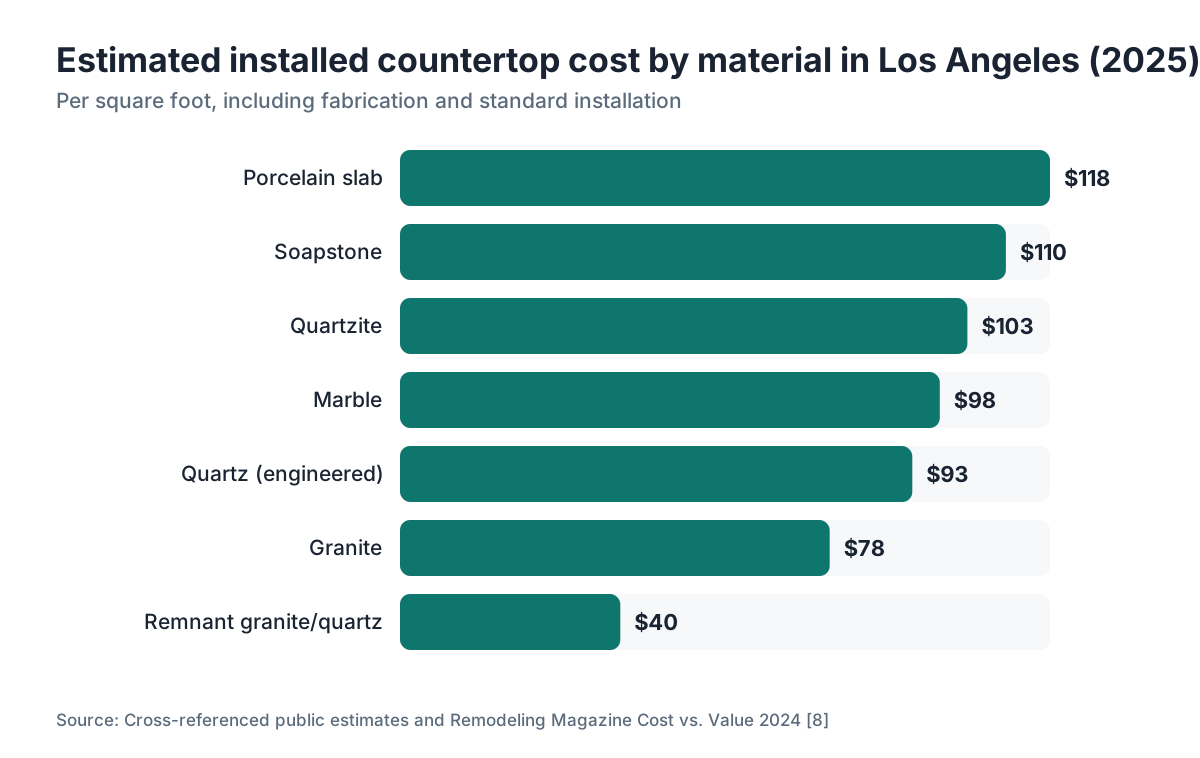
Price ranges in Los Angeles run wider than most U.S. markets. Labor, real estate, and regulation cost more here, but competition is fierce too. Here is what you realistically see as of mid-2025:
| Material | Fabrication + Install (per sq ft) | Notes |
|---|---|---|
| Granite | $55 to $100 | Wide range by slab grade and edge profile |
| Quartz (engineered) | $65 to $120 | Brand name like Cambria or Silestone adds cost |
| Quartzite | $75 to $130 | Often misidentified; verify it's true quartzite |
| Marble | $70 to $125 | Soft, acid-sensitive; popular in LA kitchens despite this |
| Soapstone | $80 to $140 | Rare; few shops stock it |
| Porcelain slab | $85 to $150 | Requires specialized tooling; labor intensive |
| Quarry direct remnant | $25 to $55 | Small bathrooms or laundry rooms; limited selection |
These figures include material, fabrication labor, a basic edge profile (eased or beveled), and standard installation. They do not include demolition of old countertops (usually $3 to $8 per linear foot), plumbing reconnection (often $75 to $200 per fixture), or specialty edges like waterfall sides or ogee (add $15 to $40 per linear foot).
The City of Industry and Commerce corridors hold the densest concentration of slab yards and wholesale fabricators, and prices there often run lower than a boutique showroom in West Hollywood or Santa Monica. The showroom price buys you design consultation, display space, and a nicer experience. Whether that is worth $20 per square foot extra depends on you.
The National Kitchen and Bath Association (NKBA) tracks remodel costs and consistently finds countertop material and installation to be one of the highest-variance line items in a kitchen project [1]. Nobody has a definitive Los Angeles-specific dataset for fabricator pricing. The ranges above come from cross-referencing publicly posted estimates and permit data, not a formal survey, so treat them as a guide, not a guarantee.
How do you find and vet a reputable stone fabricator in Los Angeles?
Start with the California Contractors State License Board (CSLB). Any fabricator who installs countertops in California must hold a contractor's license if the total job value exceeds $500 [2]. The relevant class is C-61/D-12 (Cabinet, Millwork and Finish Carpentry), though some shops hold a General Building (B) license. You can look up any contractor in seconds at the CSLB license lookup tool online [12]. If a shop cannot give you a license number, walk away.
After license verification, ask for:
- Certificate of general liability insurance (at least $1 million per occurrence, $2 million aggregate is standard in LA for this trade).
- Workers' compensation certificate. California law requires it for any employer with employees [3]. A shop with three guys and no workers' comp is an uninsured risk that lands on you if someone gets hurt on your property.
- Three references from jobs completed in the past 12 months, with phone numbers you can actually call.
Then go look at their work in person if you can. Many fabricators will give you the address of a recent install if you ask nicely. You want seams that are tight and color-matched, sink cutouts that are smooth without chipping on the underside, and edges that are consistent with no flat spots.
Online reviews help but are noisy. Yelp and Google reviews for LA stone shops tend to cluster at the extremes: five-star friends-and-family reviews or one-star complaints about damage during install. Read the one-star reviews carefully. Recurring complaints about seam placement, delays, and broken slabs are red flags. One-off complaints about price mean nothing.
For fabricators, vetting your own quoting and job management process matters just as much. Shops that use structured quoting software, such as SlabWise, tend to keep cleaner paper trails and have fewer he-said-she-said disputes about scope [4]. Ask any fabricator how they document what is and is not included in the quote before you sign anything.
What is the typical process from slab selection to countertop installation in LA?
The process has five stages. Each one has a realistic timeline so you can plan your remodel without guessing.
Stage 1: Slab selection (1 to 3 days). You visit a slab yard or the fabricator's showroom and pick your stone. In Los Angeles, the biggest slab yards (MSI, Arizona Tile, Dal-Tile) have enormous warehouses you can walk through. You should see the actual slab, not a sample chip. The slab you pick is the slab that gets cut. Natural stone varies by lot, even within the same quarry batch.
Stage 2: Template (1 day, scheduled 1 to 2 weeks out from contract signing). A technician comes to your home, measures every countertop run precisely, marks sink and cooktop locations, and either makes a physical cardboard template or uses a laser digitizer. Do not let a shop skip templating and just use contractor measurements. The tolerance on a properly fabricated countertop is 1/16 of an inch. Contractor tape measures are not that precise.
Stage 3: Fabrication (3 to 7 business days after template). The shop programs the CNC machine or sets up the bridge saw, cuts your pieces, shapes edges, polishes, and quality checks. Busy shops in Los Angeles can run 2 to 3 weeks out during peak season (spring and fall remodel rushes). Ask about current lead times before you commit.
Stage 4: Installation (half day to full day). The crew arrives, removes old countertops if that is in scope, sets the new stone, levels it, applies silicone at the wall and at any seams, cuts and cleans up, and reconnects simple plumbing if included. Do not use the countertop for 24 hours after silicone is applied.
Stage 5: Sealing (same day or next day). Natural stone needs sealing. Most fabricators seal as part of the install. Ask whether they do it and what product they use. A quality impregnating sealer (Tenax, Miracle 511, Aquamix) should last 1 to 5 years depending on stone porosity and use [5].
Total elapsed time from slab selection to finished install: three to five weeks is normal. Two weeks is possible if a shop has your material in stock and a light schedule. Six weeks is not unusual in a busy season.
What questions should you ask a fabricator before signing a contract?
Most homeowners ask the wrong questions. They ask about price first and skip everything else. Here is what actually matters:
"Who does the templating?" Some shops subcontract templating to a third-party service. That is not automatically bad, but you want to know.
"Who does the install?" Subcontracted install crews are common. Ask if the crew are employees or subs, and whether they carry their own insurance.
"Where will the seams be?" Ask the fabricator to mark seam locations on a drawing before you sign. Seam placement is often forced by slab size limits (most slabs run 118 to 126 inches long), but you have a right to know in advance. A seam in the middle of a cooktop area is a problem.
"What is the overhang on the island?" Standard overhang for stool seating is 12 inches, up to 15 inches without support corbels. Beyond 12 inches on granite or quartz, most fabricators recommend steel support rods or corbels to prevent cracking under load [6].
"Is demolition and haul-away included?" Usually not. Clarify.
"What happens if the slab cracks during install?" A reputable shop replaces it at no cost. Get that in writing.
"Do you pull permits if required?" In Los Angeles County, countertop replacement alone does not usually require a building permit. But if you are doing a full kitchen remodel that includes structural work or plumbing relocation, permits are required [7]. Confirm who is responsible.
"What is the payment schedule?" Industry standard is 50% deposit, 50% on completion. Anyone demanding 100% upfront is a red flag.
What are the main stone types LA fabricators work with?
Los Angeles fabricators handle a wider variety of materials than most U.S. markets because the local design culture pushes toward high-end and unusual stones. Here is a practical rundown.
Granite is still the workhorse material. It is hard, scratch-resistant, and heat-tolerant. Learn more about granite countertops. Prices have come down over 20 years as supply chains matured. A level-1 granite from a slab yard is one of the best value plays in countertops.
Engineered quartz (Silestone, Caesarstone, Cambria) is the most popular material in LA right now. It needs no sealing, resists staining well, and offers consistent color matching for large kitchens. The downside: it can crack under point impact and is not heat-resistant the way granite is. Cambria specifically tends to run at the top of the quartz price range.
Marble is beautiful and soft. It etches with acids (lemon juice, wine, vinegar) and scratches. LA designers love it anyway, particularly Calacatta and Statuario from Italy. If you want marble in a kitchen, go in with eyes open. It will show use over time. Some people love that. More on marble countertops here.
Quartzite gets confused with engineered quartz by both homeowners and, frankly, some shop salespeople. True quartzite is a metamorphic natural stone, harder than marble, and it needs sealing. It is a great option for kitchens if you want a marble look without quite the softness. Ask for a vinegar scratch test on any slab sold as quartzite. If it etches, it is marble or dolomite, not quartzite. Cleaning quartzite countertops is worth understanding before you buy.
Soapstone is durable, non-porous, and needs no sealing. It is dark and scratches easily, but buffing removes most scratches. Very few LA shops stock it. If you want it, expect to wait. Soapstone care is different from other stones.
Porcelain slab (from brands like Dekton and Lapitec) is gaining ground in LA, especially for outdoor kitchens because it handles UV and heat well. The material is extremely hard but brittle at thin thicknesses. Not every shop has the equipment to work it. Ask specifically.
Laminate and solid surface materials (Formica, Corian) are still around and a good choice when budget is the constraint. They are not fabricated the same way as stone, but many stone shops have a partner who handles them. Formica countertops and Corian countertops both have their own logic worth understanding.
What does stone fabrication cost for a typical Los Angeles kitchen?
A real project scenario grounds the per-square-foot pricing better than any table. A typical Los Angeles kitchen countertop job runs 40 to 70 square feet of surface. A medium-sized kitchen at 50 square feet is a reasonable baseline.
At $80 per square foot all-in (a solid midpoint for granite or entry-level quartz with an eased edge, one undermount sink cutout, and standard install), that is $4,000 for the countertop scope. Add a waterfall island edge and the price goes up $400 to $1,200 depending on the number of mitered joints. Add demo of old tile at $5 per linear foot on a 20-foot perimeter and you add $100. Plumbing reconnect is often $150.
A realistic budget for a complete, mid-grade stone countertop project in a medium LA kitchen: $4,000 to $6,500. High-end marble or quartzite with specialty edges in a large kitchen: $10,000 to $18,000 is not unusual. Remnant granite for a small bathroom vanity: $300 to $600 all-in.
The Remodeling Magazine Cost vs. Value Report tracks kitchen remodel costs by metro area. For the Los Angeles metro in 2024, a major kitchen remodel averaged around $82,000 total, and countertop material and labor is typically 8 to 12% of that budget in a full remodel [8]. That implies a $6,500 to $9,800 countertop allocation within a full remodel, which matches the ranges above for mid- to high-grade materials.
If you are getting multiple bids, make sure they cover the same scope. A quote that looks 20% lower might exclude demo, sealing, or plumbing. Always ask for an itemized quote.
Are there specific LA regulations or permits that affect stone countertop work?
For a straight countertop replacement (no structural change, no moving plumbing), you generally do not need a building permit in the City of Los Angeles or most surrounding municipalities [7]. The Los Angeles Department of Building and Safety (LADBS) classifies basic countertop replacement as a minor repair that falls below the permit threshold.
That said, some work does pull permits into the picture: relocating a sink drain or supply lines, adding an island where there was none (may trigger electrical and plumbing permits), adding a cooktop or range (gas line work requires a permit), or any structural modification to support the countertop weight.
Contractor licensing is the bigger compliance issue. California Business and Professions Code Section 7048 sets the $500 aggregate threshold for when a contractor's license is required [2]. The CSLB enforces this actively in Los Angeles. Hiring an unlicensed contractor for a job over $500 can void your homeowner's insurance coverage for any related damage and leaves you with no recourse through the state's dispute process.
If you hire a licensed contractor and something goes wrong, you can file a complaint with the CSLB and, in serious cases, pursue a claim through the board's arbitration program or disciplinary fund. That protection disappears with an unlicensed contractor.
How do LA stone fabricators handle seams and templating differently from other markets?
Los Angeles has a higher-than-average rate of large open-plan kitchens and oversized islands. Seam management is a bigger issue here than in markets with smaller homes. Most residential slabs max out at about 120 inches in one direction. Any run longer than that needs a seam.
The best LA fabricators use digital templating systems (brands like Prodim and LT-55 are common) that capture the exact geometry of your cabinets and transfer it to the CNC program with minimal human error. The result is tighter seams and less risk of pieces that do not fit. Some shops still do cardboard templating, which is fine if the technician is experienced, but digital is faster and more accurate.
Seam placement in LA kitchens usually comes down to two things: where the slab veining allows the least-visible match, and where the seam will have cabinet support below it. A seam over an unsupported span is a future crack waiting to happen. A seam in the middle of a heavily patterned marble slab looks bad even when it is tight. Good fabricators discuss both before cutting.
LA also sees more outdoor kitchen work than almost any other U.S. metro. Outdoor applications need different material considerations (UV stability, freeze-thaw resistance for the occasional cold snap, and moisture tolerance) and often different templating, because exterior grade changes and deck slopes do not cooperate the way interior cabinets do. If you have an outdoor kitchen project, ask directly whether the shop has done similar work and can show examples.
What should fabricators know about running a stone shop in Los Angeles?
Running a fabrication shop in LA is not cheap. Real estate for a shop with a bridge saw and CNC machine in a reasonable location runs $2.50 to $5.00 per square foot per month, and you need at least 4,000 to 6,000 square feet of functional space [9]. Workers' compensation rates for stone fabrication in California rank among the highest of any trade category, reflecting the real silica dust and heavy machinery risks. Cal/OSHA standards for silica exposure in stone fabrication require engineering controls (wet cutting, LEV systems) and a written Silica Exposure Control Plan if workers may be exposed at or above the action level of 25 micrograms per cubic meter as an 8-hour TWA [10].
California's silica rules get enforced harder than the federal OSHA standard in practice, because Cal/OSHA runs more inspections per capita than federal OSHA in manufacturing and construction trades [10]. Any shop cutting engineered quartz or granite dry without a water suppression system is both a legal liability and a genuine health risk to its workers.
On the business side, the biggest operational headache most LA stone shops face is quoting accuracy and job costing. Shops that underbid because they estimated slab yield wrong or forgot to account for edge profile labor end up losing money on the jobs they win. Software that handles material nesting and quote generation (including tracking remnants against future jobs) pays for itself fast in a high-volume shop. That is the core problem SlabWise was built to solve, and it is worth a look if your shop is doing more than 15 to 20 jobs a month [4].
The LA market has enough volume to support specialization. Some shops focus on ultra-high-end custom residential and charge accordingly. Others run a production model targeting contractor volume at competitive prices. Know which model fits your cost structure before you set prices. Trying to do both with one shop and one team usually means doing neither well.
How does the LA countertop market compare to other major U.S. cities?
Los Angeles is the second-largest metro in the country by population, and its countertop market reflects that. A few comparisons put pricing and supply in context.
New York City fabricators typically charge 10 to 25% more than LA for comparable work, mostly because of higher commercial real estate and labor costs [8]. Phoenix and Las Vegas fabricators often come in 15 to 20% below LA prices thanks to lower operating costs and denser wholesale distribution. Seattle is roughly comparable to LA. Chicago is slightly lower.
LA has one real advantage: proximity to the port. Los Angeles and Long Beach combined handle roughly 40% of U.S. container imports [11]. A large share of Italian marble, Brazilian granite, and Indian stone arrives through these ports, which gives LA slab yards some of the fastest and freshest inventory in the country. New lots from quarries hit LA yards weeks before they show up in Dallas or Denver. That matters if you are chasing a specific lot of Calacatta Oro or a run of exotic granite.
The flip side: LA's high cost of doing business gets passed to consumers. California's strict environmental and labor regulations, while protective of workers and the public, add compliance costs that shops in Texas or Nevada do not carry. That is not an argument against the regulations. It is context for why LA prices sit where they do.
For general reading on kitchen countertops and countertop installation that applies across markets, those guides cover the mechanics that stay consistent no matter where you live.
Frequently asked questions
How many stone fabricators are in Los Angeles?
There is no single official count, but the California Contractors State License Board database shows several hundred active licensees in Los Angeles County holding classifications relevant to stone countertop work. The density is highest in the City of Industry, Commerce, and Van Nuys corridors. Not all of them are full-service custom shops; some focus on wholesale or contractor-only accounts.
Can I supply my own slab and have a fabricator just cut and install it?
Yes, and it is a reasonable approach if you find a slab you love at a distributor that does not have a fabrication arm. Expect a material surcharge or handling fee of $50 to $150, because the fabricator cannot warranty a slab they did not source. Make sure delivery logistics are clear: most fabricators want the slab delivered to their shop, not your home.
How long does countertop fabrication take in Los Angeles?
From template to install, three to five weeks is the normal range. Fabrication itself takes three to seven business days after the template appointment. Template appointments are often scheduled one to two weeks after you sign and pay a deposit. During peak season (March through June, September through November), some shops run four to six weeks out. Ask about current lead time before you commit to a contractor timeline.
What is the difference between a slab yard and a fabricator?
A slab yard imports and sells raw slabs of stone to fabricators and sometimes directly to consumers. A fabricator cuts, shapes, edges, and installs the stone. Some businesses do both under one roof, which simplifies the process and can save money. Others are separate companies. When they are separate, you typically pay the yard for the slab and the fabricator for labor and installation.
Do I need a permit to replace countertops in Los Angeles?
For a straight like-for-like countertop replacement with no plumbing or structural changes, you generally do not need a permit in Los Angeles. The LA Department of Building and Safety classifies this as a minor repair below the permit threshold. If you are moving a sink, adding a cooktop with a new gas line, or doing structural work, permits are required. Confirm with LADBS or your contractor before work begins.
What is the best stone for an outdoor kitchen in Los Angeles?
Porcelain slab (Dekton, Lapitec) is the strongest choice for LA outdoor kitchens. It handles UV without fading, resists heat, and needs no sealing. Granite is also a solid option. Marble and most engineered quartz are poor choices outdoors because quartz can degrade under direct UV exposure, and marble stains easily when exposed to weather.
How do I know if a stone is really quartzite or just marble?
The vinegar test is quick and reliable. Put a few drops of white vinegar on an inconspicuous spot for 15 minutes. If the surface etches (goes dull or leaves a mark), it is calcite-based, meaning marble or dolomite, not quartzite. True quartzite will not etch. Some sellers mislabel marble as quartzite, sometimes accidentally. Always test before you buy if you are paying quartzite prices.
What payment terms are standard with LA stone fabricators?
The most common structure is 50% deposit at contract signing and 50% due on the day of installation, before the crew leaves. Some shops ask for a smaller deposit (30 to 40%) and balance on completion. Be cautious of any shop requesting full payment upfront. California law gives you limited recourse once full payment is made, so hold something back until the work is done and you have inspected it.
What should I do if my countertop cracks after installation?
Document it immediately with photos and written communication to the fabricator. If the crack is at a seam or near a cutout and the stone was installed less than a year ago, it is typically a fabrication or installation defect the shop should fix at no cost. If the crack is in a field area from impact, that is usually the homeowner's liability. Having a written contract that spells out the warranty terms is essential before any work starts.
Is it cheaper to use a remnant slab for a small bathroom vanity?
Yes, significantly. Fabricators accumulate remnants (leftover pieces from larger jobs) that are too small for a kitchen but perfect for a vanity. Remnant pricing typically runs $25 to $55 per square foot installed, versus $65 to $120 for a full-slab job. Selection is limited to whatever the shop has on hand. Call a few shops directly and ask to see their remnant pile before you pay full price for a small job.
How do Los Angeles stone fabricators price waterfall edges and specialty profiles?
Waterfall edges (where the stone wraps down the side of an island to the floor with a mitered joint) add $400 to $1,200 per side depending on slab thickness and the number of mitered joints. Specialty edge profiles like ogee, dupont, or bullnose add $15 to $40 per linear foot over a standard eased edge. Always ask for these costs itemized in your quote; they are commonly buried or excluded from initial estimates.
What silica safety rules apply to stone fabricators in California?
Cal/OSHA enforces Title 8 regulations on respirable crystalline silica, which require engineering controls (wet cutting, local exhaust ventilation), a written Exposure Control Plan, air monitoring, and medical surveillance for workers exposed at or above the action level of 25 micrograms per cubic meter as an 8-hour TWA. These rules apply specifically to engineered quartz fabrication and granite cutting and are enforced more actively in California than under the federal OSHA standard.
Can a stone fabricator also do laminate or solid surface countertops?
Some do, some do not. Stone fabrication equipment (bridge saws, CNC routers, polishing machines) is not the same as what laminate post-form or solid surface work needs. Many stone shops will refer you to a partner for laminate jobs. If you have a mix of materials in one project, clarify which shop handles which scope and who coordinates installation timing.
Sources
- National Kitchen and Bath Association (NKBA), NKBA Design and Industry Report: Countertop material and installation is one of the highest-variance line items in a kitchen remodel budget according to NKBA industry tracking.
- California Business and Professions Code Section 7048, CSLB Licensing Threshold: California requires a contractor's license for any project where the total contract price (including labor and materials) is $500 or more.
- SlabWise, Countertop Fabrication Quoting and Nesting Software: Quoting and nesting software helps fabricators reduce material waste and improve job costing accuracy.
- Natural Stone Institute, Care and Maintenance of Natural Stone: Impregnating sealers for natural stone typically last 1 to 5 years depending on stone porosity and use patterns.
- Natural Stone Institute, Technical Bulletins on Countertop Overhang: Industry guidance recommends support corbels or steel rods for granite or quartz overhangs exceeding 12 inches.
- Los Angeles Department of Building and Safety (LADBS), Permit Requirements: Basic countertop replacement without plumbing or structural changes generally does not require a building permit in the City of Los Angeles.
- Remodeling Magazine, Cost vs. Value Report 2024, Los Angeles Metro: A major kitchen remodel in the Los Angeles metro averaged approximately $82,000 in 2024; countertop material and labor typically represents 8 to 12% of total project cost.
- CoStar Group, Los Angeles Industrial Real Estate Market Reports: Industrial and flex warehouse space in Los Angeles suitable for stone fabrication shops ranges from $2.50, $5.00 per square foot per month.
- Port of Los Angeles, Trade Statistics: The Ports of Los Angeles and Long Beach combined handle roughly 40% of U.S. container imports, giving LA slab yards faster access to imported stone than most U.S. markets.
- California Contractors State License Board, License Lookup: The CSLB online license lookup tool allows consumers to verify contractor license status and classification instantly.
Last updated 2026-07-10