TL;DR
- The Stone Fabricators Alliance (SFA) is the main US trade association built specifically for independent stone countertop fabricators.
- It offers group purchasing discounts, silica-dust and OSHA compliance help, business education, and peer networking.
- Annual dues run roughly $300 to $600 depending on shop size.
- For most small and mid-size shops, the purchasing discounts alone cover membership inside the first big order.
What is the Stone Fabricators Alliance?
The Stone Fabricators Alliance, usually called the SFA, is a US trade association built almost entirely around independent stone fabrication shops. That narrow focus is what sets it apart from broad construction-trade groups and distributor associations. Its members are fabricators: the shops that cut, polish, edge, and install granite, quartz, marble, quartzite, and similar stone for homes and commercial jobs.
It started as a way to give small and mid-size shops some of the buying power that big national fabricators already have. A one-location shop buying tooling and abrasives alone pays retail or close to it. A few hundred shops buying together can push pricing that actually changes the math on consumables, blades, and materials. That group-buying function was the original engine of the organization, and it's still one of the most concrete member benefits today [1].
The SFA also works as a knowledge-sharing and advocacy group. Stone fabrication carries real occupational hazards, silica dust chief among them, and the SFA has been one of the louder voices pushing fabricators toward compliant dust control ahead of OSHA's tighter crystalline silica standard [2]. That's not marketing talk. OSHA's standard (29 CFR 1926.1153 for construction, 29 CFR 1910.1053 for general industry) reached full enforcement for small shops in 2018, and the SFA published guidance keyed to those exact dates [2][3].
How is the SFA different from other stone industry groups?
The stone industry has several organizations, and they serve genuinely different audiences. New to the trade? They're easy to mix up.
The Natural Stone Institute (NSI) is the largest and oldest US stone trade group, formed by the 2015 merger of the Marble Institute of America and the Building Stone Institute [4]. NSI leans toward quarries, importers, distributors, and larger fabricators. Its technical standards (the Dimension Stone Design Manual, for one) are excellent and widely cited, but the organization's center of gravity sits above the local fabrication shop in the supply chain. NSI dues also cost more, and the networking mostly happens at bigger trade shows.
The International Surface Fabricators Association (ISFA) covers a wider set of countertop materials, including solid surface, laminate, and quartz on top of natural stone [5]. If your shop works heavily in Corian or engineered surfaces alongside stone, ISFA may fit you better. The SFA is for shops where natural stone, engineered stone, or both are the main product.
The Marble Institute of America (now folded into NSI) used to be the dominant accreditation body. The Certified Fabricator designation it created still lives under NSI's umbrella [4]. The SFA does not offer a comparable fabricator-accreditation credential right now, which is a real gap if that credential matters to your commercial bid work.
Short version: NSI for technical standards and supply-chain ties, ISFA for mixed-material shops, SFA for fabricator peer community and group purchasing. Plenty of shops belong to two of the three.
What does SFA membership actually include?
SFA membership centers on five things, and they are not equally valuable to every shop.
Group purchasing is the headline. Members get negotiated pricing on tooling, abrasives, blades, chemicals, and consumables through SFA's supplier partners. The real savings depend on what you buy and from whom, but fabricators who have written publicly on trade forums usually cite 10 to 20 percent off street pricing on high-volume items like diamond blades and polishing pads. Run the numbers on your own annual consumable spend before you sign up. For a shop dropping $40,000 to $80,000 a year on consumables, even a 10 percent bump is real money.
Education and training cover webinars, recorded sessions, and written guides on shop safety, business operations, customer communication, and technical fabrication. The safety content earns its keep for shops building a silica compliance program for the first time [2][3].
Peer networking is informal, and long-term members cite it more than anything else. The SFA runs regional events and an active online community where fabricators trade pricing questions, equipment picks, and operational headaches. Because the membership is fabricators and not suppliers, the information stays fairly unfiltered.
Supplier connections run through SFA's directory and event structure. Tooling reps, stone distributors, and equipment vendors show up at SFA events, so members get face time in a setting where the talk is about fabricator needs instead of a sales pitch.
Advocacy is the fifth area, mostly around OSHA silica compliance and the occasional consumer-safety story (the radon-in-granite question comes up now and then). This is the least tangible benefit day to day, but it matters when regulations start moving.
Who gets the least out of SFA? Either very large shops (they already have buying power) or very small, early-stage shops (they haven't built the consumable volume that makes group purchasing pay).
How much does SFA membership cost?
SFA dues are tiered by shop size, usually by employee count or annual revenue. The SFA does not post a fixed public price list I can link to, so the figures below come from member-reported data on trade forums and industry discussions, not an official fee schedule. Treat them as a realistic range, not a quote. Contact the SFA directly for current pricing [1].
A small shop (1 to 5 employees) has historically paid $300 to $400 a year. Mid-size shops (6 to 20 employees) have typically paid $400 to $600. Larger operations pay more. Associate and supplier memberships are priced differently.
That range is low enough that group purchasing savings on one big tooling order can cover the annual fee. The catch: the math depends entirely on whether you buy from SFA's supplier partners. If your shop already has strong direct supplier relationships and good volume pricing, the purchasing benefit shrinks, and the networking and education have to carry more of the weight.
Many fabricators treat the SFA fee the way they treat a trade show registration. It's a business development and learning expense, more than a purchasing card. That framing fits best for shops that actually show up in the online community and at events.
What is the SFA's role in silica dust and OSHA compliance for stone shops?
This is probably where the SFA has had its biggest industry-wide impact, and it deserves a fuller explanation.
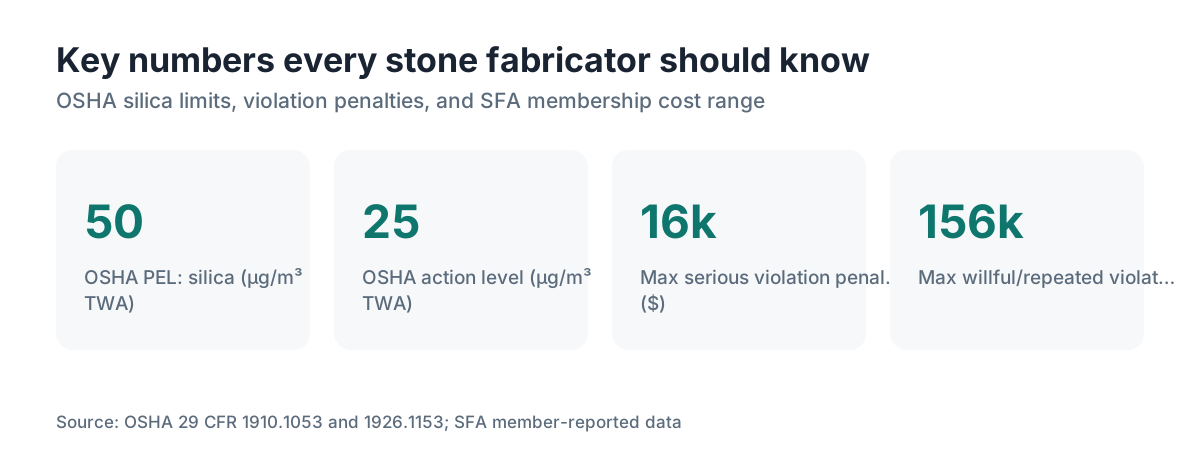
Crystalline silica is a serious occupational health hazard in stone fabrication. Cutting, grinding, and polishing natural stone throws off fine silica dust, and chronic inhalation causes silicosis, an irreversible and sometimes fatal lung disease [9]. OSHA's updated crystalline silica standard (29 CFR 1910.1053 for general industry, 29 CFR 1926.1153 for construction) dropped the permissible exposure limit (PEL) to 50 micrograms per cubic meter of air as an 8-hour time-weighted average, with an action level of 25 micrograms per cubic meter [2][3].
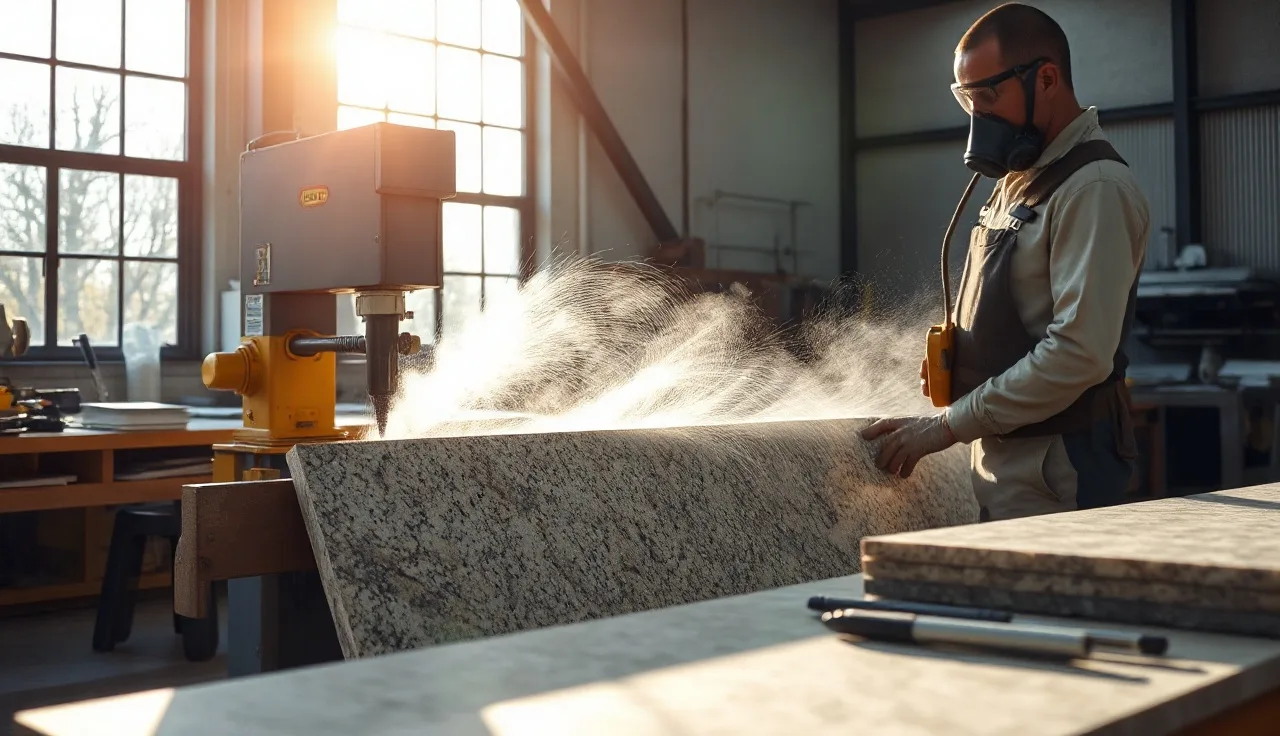
For fabrication shops, the standard requires wet cutting, local exhaust ventilation, or a mix of engineering controls to stay under those limits. Shops above 10 employees had to be in compliance starting June 23, 2018. Smaller shops phased in after that [2].
The SFA published compliance guidance, checklists, and webinars to help members figure out what the standard actually meant for their specific operations. That mattered because OSHA's own documents are dense regulatory text, not shop-floor instructions. The SFA turned the requirements into fabricator language: what equipment to use, how to document exposures, when medical surveillance kicks in.
This is where membership has genuine value on its own, separate from purchasing discounts. Getting silica compliance wrong opens a shop to OSHA citations that run up to $15,625 per serious violation and up to $156,259 per willful or repeated violation under current penalty amounts [3].
Engineered quartz makes the stakes higher. It can hold 90 to 95 percent crystalline silica by weight, more than most natural stone, and researchers have documented clusters of accelerated silicosis among fabricators cutting it, especially in Australia and Spain [6]. As the 2020 review in Occupational and Environmental Medicine put it, artificial stone silicosis is "an emerging and preventable occupational lung disease."
How does the SFA help fabricators with business operations and quoting?
Stone fabrication is a skilled trade. Running a stone fabrication business is a separate skill, and a lot of owners came up cutting stone rather than keeping books. The SFA's education content hits that gap more directly than the technical standards from NSI or ISFA.
The business content covers pricing strategy, shop efficiency, customer communication, and job costing. The peer community is the liveliest version of it: fabricators share what they charge per square foot in their market, how they handle bad installs, what their waste percentages look like, and which software they use to quote and track jobs.
Quoting accuracy is a real pain point. Stone jobs carry a pile of variables: slab yield, edge profile labor, sink cutouts, seam complexity, travel time for templating and install. Shops that quote by gut feel or a flat square-foot rate leave money on the table or, worse, win jobs they lose money on. SFA community threads circle this topic constantly.
If you want more structure in your quoting, shop management software built for countertop fabrication (SlabWise, for one, handles quoting, nesting, and job tracking in one place) can back up what the peer community offers as advice by doing the math automatically. A free demo shows whether the workflow fits your shop.
The SFA also runs marketing content, much of it about helping member shops explain the quality gap between professional fabrication and big-box countertop programs. That helps shops competing for homeowners who are comparison-shopping kitchen countertops across several sources.
Does the SFA offer training or certification for stone fabricators?
The SFA offers education and training resources, but it does not offer a formal fabricator certification with the kind of industry-wide recognition NSI's Certified Fabricator program carries [4]. That's a real limitation if you bid commercial work where a third-party credential helps close contracts.
What the SFA does well is practical, operational education. Webinars on shop safety, tooling technique, business development, and compliance land more usefully for a working owner than classroom certification hours. The forum works as ongoing peer training.
For formal credentials, NSI's Accredited Business (AB) program and the Certified Fabricator designation still carry more weight in commercial and institutional bidding. Plenty of fabricators hold SFA membership for community and purchasing while chasing NSI credentials for the formal recognition [4].
Homeowner trying to size up a fabricator? Ask these instead: Do they wet-cut for silica control? Do they template before they cut? How do they handle seams, and where will seams land in your kitchen? SFA membership says the shop takes the trade seriously. It isn't a quality guarantee the way a formal accreditation might be.
What do fabricators say about whether SFA membership is worth it?
Nobody has clean survey data on SFA member satisfaction that I can cite here. What exists is a scattered record of fabricator comments on trade forums like Stone Fabricators Elite on Facebook, the old StonePros.com boards, and similar communities. The pattern breaks down roughly like this.
Fabricators who actively work the events and the peer community consistently say it's worth the cost. The networking value, especially for shop owners without many local peers to compare notes with, comes up over and over. Owners in smaller markets or rural areas often say the online community is the main reason they renew.
Fabricators who joined only for group purchasing savings are more mixed. If their go-to suppliers aren't SFA partner vendors, or if they already have direct volume pricing, the discount doesn't show up the way they expected.
A smaller group, usually at larger shops, says they outgrew the community and find NSI or ISFA more relevant to where the business sits now. That's fair. The SFA skews toward independent shops rather than large regional fabricators.
Honest assessment: own a shop with 2 to 15 employees, cut stone as your main product, and lack a strong local network of other fabricators to talk shop with? SFA membership is very likely worth the fee. Running a high-volume operation with locked-in supplier deals and chasing formal accreditation? Your money probably goes further on NSI membership and the Certified Fabricator program.
How does the SFA interact with suppliers and the broader stone industry?
The SFA works partly as a bridge between fabricators and the supplier world. Tooling makers, abrasives companies, stone distributors, and equipment vendors show up at SFA events specifically to reach fabricators in a setting where a distributor isn't in the middle.
That creates some interesting tension. SFA's group purchasing deals get negotiated with those same suppliers, so there's a relationship to protect. The SFA has generally kept that commercial tie from bleeding into its educational content, but you should understand the structure. Suppliers who offer SFA discounts benefit from membership growth because it steers volume their way. That's not a corruption of the mission. It's just how trade associations run.
For fabricators sourcing granite countertops, marble countertops, or engineered quartz slabs, the SFA's supplier network can be a shortcut to vetted vendors. The distributor relationships members have built collectively help smaller shops get access to slab lots that would otherwise go to higher-volume buyers first.
The SFA also engages the broader industry on consumer-safety messaging. When stories about radon in granite or formaldehyde in laminate run, the SFA sometimes joins industry responses alongside NSI. The natural stone cleaning and care category is one where fabricators field homeowner questions long after installation, and the SFA has produced some consumer-facing guidance member shops can share.
How do you join the Stone Fabricators Alliance?
Joining is straightforward. The SFA's website (stonefabricatorsalliance.com) has a membership application. You pick a tier by shop size, pay the annual fee, and get the member portal, the peer community, and the group purchasing program.
A few practical notes from the fabricator community:
Pin down which supplier partners matter to you before you sign up. Ask the SFA directly which vendors are in the group purchasing program and which categories they cover. If your biggest consumable spend goes to a vendor who isn't in the program, the math changes.
Plan to actually participate. The members who report the best experience are the ones who show up to webinars, post in the forums, and hit at least one in-person event in year one. Passive membership, paying dues and never engaging, feels like wasted money no matter what the organization offers.
The SFA periodically runs membership promotions, often around trade shows like the SURFACES show. If you're at a major industry event and the SFA has a booth or session, that's a natural moment to sign up and meet the staff in person.
Want to see how other shops handle quoting and job management software? The SFA community threads are a good source of real-world comparisons. SlabWise's demo is free at slabwise.com if you want to test what you're running now against software built for countertop fabrication.
What should homeowners know about the SFA when hiring a fabricator?
Getting quotes for countertop installation? You may never have heard of the SFA, and that's fine. It's a business-facing group. But knowing what it stands for helps you ask sharper questions.
A fabricator who belongs to the SFA has opted into a professional community that takes silica safety, business education, and peer accountability seriously. That signal is worth something, even though it's not a quality guarantee. The questions that matter more are technical: do they template before cutting, how do they handle seaming, what's their policy if something goes wrong during install.
The SFA's safety work, especially on silica dust, touches you indirectly too. A shop running proper wet cutting and ventilation is safer for the people who work there, and a shop that respects those rules is less likely to cut corners on the rest of your job.
For the material decisions, whether you're weighing granite, quartz, marble, quartzite, butcher block, or laminate, your fabricator's trade association matters less than their portfolio, their references, and the quality of their template and install work. The SFA is a backstage organization. Front-of-house quality is still on the fabricator to prove.
Frequently asked questions
Is the Stone Fabricators Alliance the same as the Natural Stone Institute?
No. The Natural Stone Institute (NSI) formed from the 2015 merger of the Marble Institute of America and the Building Stone Institute. NSI focuses on quarries, importers, distributors, and larger fabricators. The SFA is built for independent fabrication shops and emphasizes peer networking, group purchasing for consumables, and shop-level business education. Many shops belong to both.
How much does Stone Fabricators Alliance membership cost per year?
Based on member-reported data from trade forums, SFA membership runs roughly $300 to $400 a year for small shops (1 to 5 employees) and $400 to $600 for mid-size operations. The SFA does not publish a fixed public fee schedule, so contact them directly for current pricing. Supplier and associate memberships are structured differently.
Does the SFA offer any certification for stone fabricators?
No, the SFA does not offer a formal fabricator certification with broad commercial recognition. For that, the Natural Stone Institute's Certified Fabricator and Accredited Business programs are the industry standard. The SFA offers practical education, webinars, and peer training, which are valuable operationally but don't carry the same credential weight in commercial bidding.
What are the OSHA silica dust rules that affect stone fabrication shops?
OSHA's crystalline silica standards (29 CFR 1910.1053 for general industry, 29 CFR 1926.1153 for construction) set a permissible exposure limit of 50 micrograms per cubic meter over an 8-hour shift and an action level of 25 micrograms per cubic meter. Shops must use wet cutting, local exhaust ventilation, or other engineering controls. Serious violations can carry penalties up to $15,625 per instance.
Can the SFA group purchasing program really save a shop money?
It depends on your consumable spend and whether your main suppliers are in the SFA program. Fabricators who have written about it publicly typically cite 10 to 20 percent savings on tooling and abrasives. For a shop spending $50,000 a year on consumables, that could top $5,000, well above the membership fee. Verify which vendors participate before joining.
Is the SFA worth joining for a brand-new fabrication shop?
Probably yes, mostly for the peer community rather than purchasing savings. New shops haven't built the consumable volume that maximizes group pricing, but access to experienced fabricators who answer operational questions, from pricing to tooling to customer situations, is genuinely hard to find elsewhere. The annual fee is low enough that the learning value alone usually justifies it.
What is the difference between the SFA and the International Surface Fabricators Association (ISFA)?
The ISFA covers a wider set of countertop materials, including solid surface, laminate, and quartz, alongside natural stone. The SFA focuses on stone fabrication shops. If your shop works heavily in engineered surfaces like Corian or solid surface on top of stone, ISFA may fit better. Shops that are stone-first tend to find more relevant peers in the SFA.
How does the SFA help with engineered quartz silica risks specifically?
Engineered quartz can contain 90 to 95 percent crystalline silica by weight, more than most natural stone, and has been linked to accelerated silicosis in documented fabricator clusters in Australia and Spain. The SFA's silica compliance resources apply to all stone cutting but hit especially hard for shops working heavily in engineered quartz. Wet cutting and proper ventilation are required under OSHA's standard regardless of material.
Do SFA members get access to a fabricator directory?
Yes. The SFA maintains a member directory that homeowners and commercial buyers use to find member fabricators by location. For fabricators, being listed is a minor but real marketing benefit, especially in markets where homeowners actively search for credentialed or affiliated shops. The directory visibility is secondary to the purchasing and community benefits for most members.
What trade shows does the SFA participate in?
The SFA takes part in major industry events including the SURFACES show and similar fabrication gatherings. They often run educational sessions, member meetups, or a booth at these events. If you're weighing membership, attending a trade show where the SFA is present is a good way to meet the staff and other members before committing to annual dues.
As a homeowner, should I only hire a fabricator who belongs to the SFA?
No. SFA membership is a positive signal but not the main thing to evaluate. Many excellent independent fabricators skip trade associations. The bigger due diligence: ask to see recent work, verify they template before cutting, ask how they handle seam placement, and get a written quote that itemizes edge profiles, cutouts, and installation. Association membership is one data point among several.
Does the SFA take positions on countertop material safety questions like radon in granite?
Yes. The SFA joins industry responses to consumer safety questions alongside groups like the Natural Stone Institute. On radon in granite, the EPA has stated that while granite can emit radon, countertop granite is unlikely to add much to indoor radon levels, and the SFA's guidance generally matches that framing. The organization stays more active on the fabricator-side silica hazard than on consumer-side stone safety questions.
Sources
- Stone Fabricators Alliance, official website: SFA provides group purchasing, peer networking, education, and supplier connections to independent stone fabrication shops
- OSHA, Crystalline Silica in General Industry (29 CFR 1910.1053): OSHA permissible exposure limit for crystalline silica is 50 micrograms per cubic meter as an 8-hour TWA; action level is 25 micrograms per cubic meter
- OSHA, Occupational Exposure to Respirable Crystalline Silica - Construction Standard (29 CFR 1926.1153): OSHA silica standard for construction operations; serious violations carry penalties up to $15,625 per instance, willful or repeated up to $156,259
- Natural Stone Institute, About NSI and Accreditation Programs: NSI formed from the 2015 merger of the Marble Institute of America and the Building Stone Institute and administers the Certified Fabricator credential
- International Surface Fabricators Association (ISFA), About: ISFA covers solid surface, laminate, quartz, and natural stone fabrication and serves a broader material range than the SFA
- Occup Environ Med, 'Artificial stone silicosis: disease, exposure, and policy' (2020): Engineered quartz can contain 90-95% crystalline silica by weight and has been linked to accelerated silicosis clusters among fabricators in Australia and Spain
- EPA, Radiation Protection: Radon in Granite Countertops: EPA states that granite countertops can emit radon but are unlikely to contribute significantly to indoor radon levels
- NIOSH, Health Effects of Occupational Exposure to Respirable Crystalline Silica: Chronic inhalation of crystalline silica causes silicosis, an irreversible and potentially fatal lung disease
- Natural Stone Institute, Dimension Stone Design Manual: NSI publishes the Dimension Stone Design Manual, the primary US technical reference for stone fabrication and installation standards
Last updated 2026-07-09