TL;DR
- Stone fabrication shops need five tool categories: cutting (bridge saws, angle grinders), shaping (CNC routers, edge profilers), grinding and polishing (cup wheels, polishing pads), lifting (vacuum lifters, A-frames), and measuring (laser templaters, digital levels).
- A starter setup runs $5,000 to $20,000.
- A working production shop runs $60,000 to $150,000.
- A fully automated CNC shop can pass $500,000.
What tools do stone fabricators actually use?
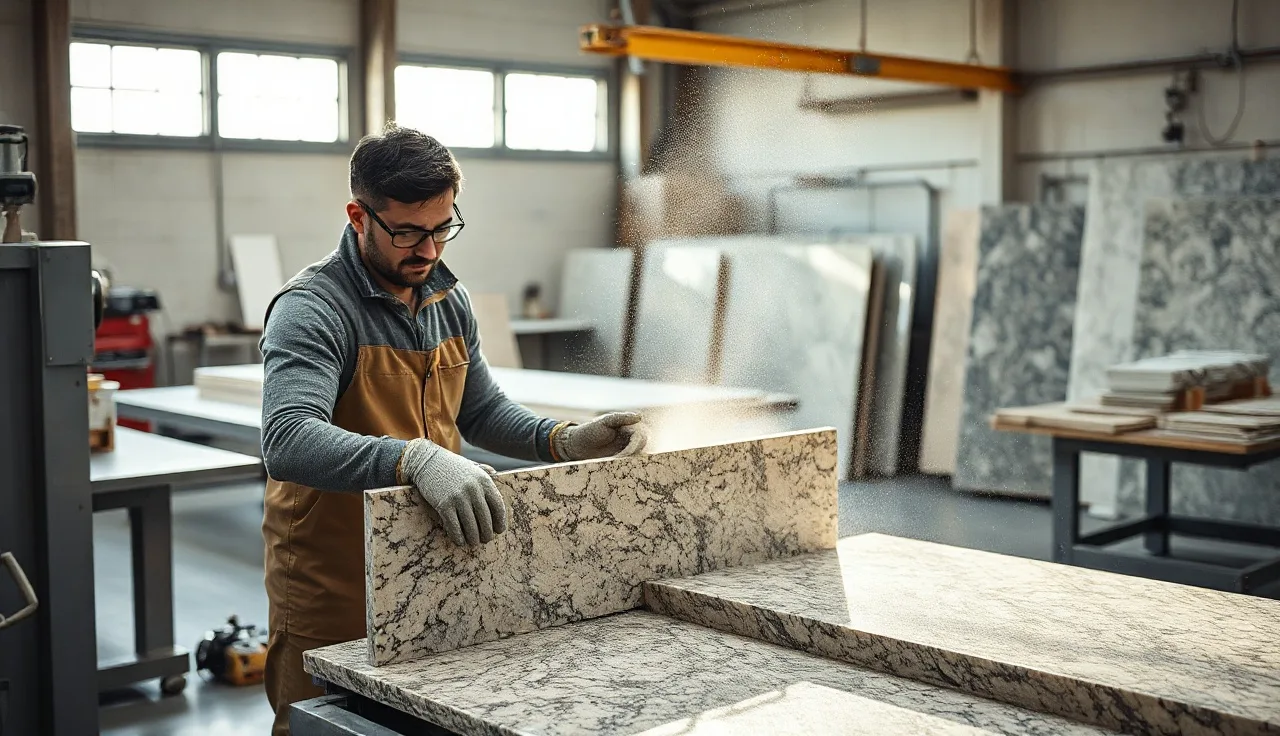
Stone work runs on equipment that spans from an $80 hand grinder to an $80,000 bridge saw. The tools split cleanly into five groups: cutting, shaping and profiling, grinding and polishing, material handling, and templating and measurement. Every shop has all five in some form.
A small shop running kitchen jobs might cut slabs on a wet tile saw, shape edges with a router, and template with a paper pattern. A high-volume shop in a city like Denver does natural stone fabrication a different way. A CNC waterjet cuts complex shapes. A CNC router profiles dozens of edge styles on its own. A laser templater sends digital measurements straight to the machine with no paper anywhere.
The right tool set follows volume, material, and margin. Granite and quartzite are hard enough that cheap tooling burns up fast, so quality diamond tooling and properly rated machines pay back quickly. Softer stones like soapstone or marble forgive more but need sharper tooling to avoid chipping the face.
None of this holds still. Manufacturers reformulate diamond bonds all the time, CNC software keeps getting smarter, and entry-level CNC prices have fallen far enough that a shop doing 20 to 30 jobs a week can now justify automation that was out of reach a decade ago.
What is a bridge saw and how much does it cost?
A bridge saw is the workhorse of any stone shop. A cutting head rides on a bridge that travels along rails above the slab, so the blade moves across the stone in precise, repeatable lines. Most run a 14-inch or 16-inch diamond blade at high RPM with constant water cooling to hold down heat and dust.
Manual bridge saws need an operator to guide each cut. CNC bridge saws accept digital cut files and run the cuts on their own, which cuts labor and tightens repeatability on complex layouts. A basic manual bridge saw from a maker like Park Industries or GMM runs roughly $30,000 to $60,000 new [1]. CNC bridge saws range from about $80,000 to $200,000 depending on table size, axis count, and brand.
Used bridge saws are everywhere and can be a smart entry point, but check the spindle bearings, water distribution, and rails before you buy. Worn rails cut wavy lines that show up at seams. A bad seam on an installed countertop is expensive to fix.
Blade choice matters as much as the saw. A soft-bond blade cuts hard granite faster because the matrix wears away and keeps exposing fresh diamond. A hard-bond blade lasts longer in soft stone. Run the wrong bond and the blade dulls fast and the motor strains. Most fabricators who have been at it a while keep two or three blade types on the shelf.
For granite countertops and other hard natural stones, the blade is not where you save money.
What does a CNC router do in a stone shop?
A stone CNC router is not the machine you would put on wood. It uses water-cooled diamond tooling and a frame built for the weight of granite, which runs about 18 to 20 pounds per square foot in 3 cm material [2]. It reads a digital file and machines edge profiles, sink cutouts, faucet holes, and complex shapes on its own.
The payoff is consistency. A hand-profiled bullnose drifts a little from piece to piece. A CNC edge is identical across every piece in the job, which matters where two runs of edge meet at a corner.
Stone CNC routers come in two styles. Vertical spindle machines move the head over a slab lying flat. Horizontal machines clamp the slab upright and move the head around it. Vertical machines are more common in the U.S. Horizontal machines are better at beveled miters and waterfall edges.
Prices spread wide. A compact router from a maker like Northwood or Breton starts around $120,000 and can run past $400,000 for larger, faster setups. Tooling is a running cost: a set of bits for one profile might cost $200 to $800, and a busy shop goes through several sets a month.
Shops doing a lot of marble countertops or engineered stone find CNC routing pays for itself faster than they expect, on labor savings alone.
How do waterjet cutters compare to bridge saws for stone?
A waterjet cuts stone by forcing a thin stream of water mixed with garnet abrasive through the material at extreme pressure, usually 60,000 to 90,000 PSI [3]. It makes no heat, so no thermal stress on the stone, and it cuts curves, circles, and detailed inlay patterns a bridge saw can never touch.
The tradeoff is speed and cost. A bridge saw cuts a straight line through 3 cm granite in seconds. A waterjet cuts the same line slower, and the machine costs more. Entry-level waterjet systems for stone shops start around $80,000, and quality units from Flow or OMAX run $150,000 to $300,000 [3].
Garnet is a running expense. A waterjet cutting full time can burn 500 to 800 pounds of garnet a day at roughly $0.25 to $0.40 per pound depending on mesh size and supplier. That adds up over a month.
Shops that own both use the bridge saw for straight cuts and the waterjet for curves, radius corners, and decorative inlays. If a shop does mostly rectangular countertops, a waterjet is hard to justify. If they do custom work, medallions, or curved islands, the waterjet opens jobs competitors cannot take.
One practical note: waterjet tanks fill with garnet sludge and need regular cleaning. Budget that maintenance time.
What grinding and polishing tools do fabricators use on stone?
Polishing stone happens in steps, working through finer and finer abrasives until the surface hits the finish you want. The tools that do it are angle grinders fitted with resin-bond diamond pads, cup wheels, and wet polishers built for stone.
A standard sequence for granite or quartz starts around 50 grit for aggressive removal, then moves through 100, 200, 400, 800, 1500, and 3000, and finishes with a buff or compound. Skip a grit and you leave scratches that show up under raking light. Each pad costs $10 to $30, and pads wear out, so polishing is a real consumable line.
Cup wheels do a different job. They strip bulk material off the edge before profiling starts and flatten surfaces that sit slightly uneven. A 4-inch turbo cup wheel removes stone fast but leaves it rough. Knowing when to swap from cup wheel to pad is one of the skills that separates a seasoned fabricator from a beginner.
Some shops run dry pads for speed, but wet polishing gives a better finish on most natural stone and stretches pad life. The water also holds down silica dust, the serious health hazard in this trade. OSHA's silica standard (29 CFR 1926.1153) requires engineering controls like wet methods or vacuum dust collection for tasks that throw respirable crystalline silica above the action level of 25 micrograms per cubic meter of air as an eight-hour time-weighted average [4].
For shops handling cambria countertops or other engineered quartz, dry grinding without dust control is a regulatory violation, more than a bad habit.
Why is dust control equipment non-negotiable in stone shops?
Respirable crystalline silica causes silicosis, a progressive lung disease with no cure. Granite, quartzite, sandstone, and engineered quartz all hold enough crystalline silica to be dangerous when cut or ground dry [4]. OSHA's construction silica rule (29 CFR 1926.1153), finalized in 2016, and the general industry standard (29 CFR 1910.1053) both set a permissible exposure limit of 50 micrograms per cubic meter of air as an eight-hour TWA [4].
The practical read for fabricators: every cutting and grinding step needs wet suppression, local exhaust ventilation, or both. Table saws and angle grinders run wet or wear shrouds tied to a HEPA-rated vacuum. OSHA lists wet methods as a Table 1 control for many stone tasks, which means if you cut wet, you are presumed compliant without air monitoring [4].
Downdraft tables with built-in suction are common in bigger shops. A fabricator dry-polishing without controls is risking a worker's lungs and inviting an OSHA case. Serious violations run up to $15,625 per violation under current OSHA penalty schedules [5].
A good shop buys the combination: wet tooling on saws and grinders, a downdraft table for dry work, and supplied-air respirators for anyone working in heavy dust. This is not optional gear. Treat it like the bridge saw.
What material handling tools do stone shops need?
A full 3 cm granite slab at 60 by 120 inches weighs roughly 400 to 500 pounds [2]. Moving that without dropping or cracking it takes real equipment. Nobody should move slabs on muscle alone.
A-frames and slab carts let you store and haul slabs upright, which is how slabs travel best. Vertical storage cuts bowing and cracking. A basic fabricated steel A-frame costs a few hundred dollars. Heavy-duty motorized A-frame carts from a maker like Tarter, or from custom fab shops, run $2,000 to $8,000.
Vacuum lifters clamp to a crane or gantry and grip the slab face with suction cups, so one or two workers move a slab that would otherwise take four. Electric or pneumatic vacuum lifters from Wood's Powr-Grip or Schmalz cost $3,000 to $15,000 depending on capacity and lift height. They earn back the price in injuries avoided.
Overhead gantry cranes or jib cranes show up in larger shops. A 2-ton gantry can move a slab from storage to the saw table safely. A permanently anchored overhead crane has to meet OSHA 29 CFR 1910.179 and often needs a licensed engineer to check the building structure [5].
On deliveries, a truck with a boom or Hiab crane lets a crew set slabs at the job site without a forklift. A delivery truck with padded walls and slab racks is a big spend but a necessary one once volume steadies.
How does digital templating work, and what tools does it use?
Templating means measuring the job site so the fabricator knows exactly where to cut. The old way uses thin strips of cardboard or luan plywood assembled in place, then carried back to the shop as a physical pattern. It works. It is also slow, easy to get wrong, and it adds a trip back before any cutting can start.
Digital templating uses a laser or optical device to capture the exact geometry of the countertop area, including walls, appliances, and any odd feature. The two dominant systems in the U.S. are the Proliner (made by Prodim) and the LT-55 and LT-2D3D from Laser Products Industries [6]. A Proliner starts around $15,000 to $20,000, and the LT systems land in the same range.
Once the template is captured, the file goes straight to the CNC saw or router. The fabricator redraws nothing. That kills a transcription step that causes a lot of errors and remakes.
The time savings are real at volume. A cardboard template for a kitchen with an island takes 45 to 90 minutes to build and haul. A digital template of the same kitchen takes 15 to 30 minutes and is ready to cut the moment the tech gets back to the shop or uploads the file from the field.
Shops that handle quoting and nesting digitally get the most out of it. Software like SlabWise takes those template files and helps lay out the slab before cutting, so you waste less of an expensive stone. Fewer remnants means better margin on every job.
What hand tools do fabricators use daily?
Angle grinders are the universal hand tool in a stone shop. A 4.5-inch or 5-inch variable-speed wet grinder handles edge polishing, small cutouts, corrections, and final detail. Dewalt, Makita, and Metabo all make grinders you will see in stone shops, running $80 to $300. It is not glamorous, and it never sits idle.
Core drill bits cut round holes for faucets, soap dispensers, and similar fixtures. A standard 1-3/8 inch diamond core bit costs $20 to $60 and drills through 3 cm granite in 2 to 5 minutes with water cooling. Cheap bits overheat and chip the edge of the hole.
Seam setters and seam phantoms line up two slab pieces before the epoxy cures. A seam setter clamps across both pieces and draws them flush so the seam surface is level. Simple tool, and it matters: a proud seam that sits high catches light and feels rough under a hand.
Epoxy color kits let fabricators mix two-part adhesive to match the stone at seams and sink cutout edges. Matching the color well is a skill, and a full set of pigments earns its keep.
A good digital level or slope indicator catches a twisted or out-of-level cabinet before the stone goes on. Fixing a level problem before install is free. Fixing it after the stone is set is expensive. A Bosch or Milwaukee digital level costs $40 to $80 and heads off a whole category of callbacks.
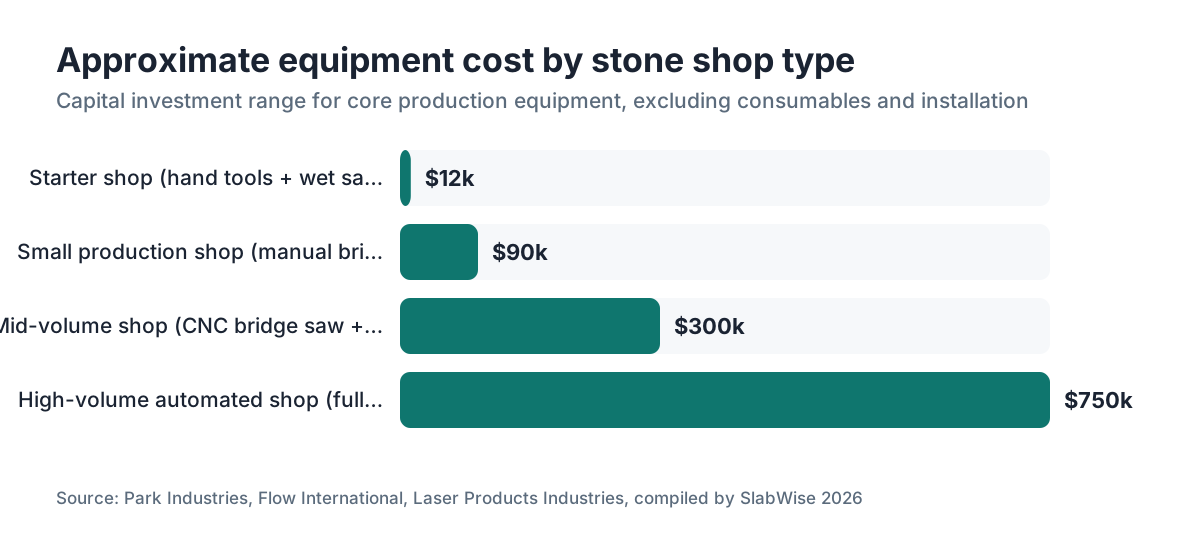
How much does it cost to equip a stone fabrication shop?
There is no single answer because it rides on volume and material mix. Here is a realistic range by shop scale.
| Shop Type | Core Equipment | Approximate Cost Range |
|---|---|---|
| Starter (hand tools + wet saw) | Wet tile saw, angle grinders, core bits, A-frame | $5,000 to $20,000 |
| Small production shop | Manual bridge saw, edge router, polishing kit, vacuum lifter | $60,000 to $120,000 |
| Mid-volume shop | CNC bridge saw, CNC router, digital templater, dust controls | $200,000 to $400,000 |
| High-volume automated shop | CNC bridge saw, waterjet, CNC router, laser templater, overhead crane | $500,000 to $1,000,000+ |
These ranges come from published price lists and industry trade sources [1][3][6]. The numbers move with manufacturer, configuration, and whether you buy new or used.
Tooling and consumables are a separate running cost. Diamond blades, polishing pads, core bits, router bits, epoxy, garnet, and saw water treatment add up to $1,000 to $5,000 a month for a shop running 30 to 60 jobs a week, though nobody publishes precise industry-wide numbers on this.
One thing experienced owners say over and over: buy the dust control with the production equipment, not later. It is tempting to defer it. Regulators and workers' comp insurers both care, and both will find out.
What safety equipment and regulations apply to stone fabrication shops?
OSHA covers stone shops under construction standards (work done at the job site) and general industry standards (shop operations). The silica rule is the biggest recent regulation, but it is not the only one.
Hearing protection is required when noise passes 85 dBA as an eight-hour TWA under OSHA 29 CFR 1910.95 [5]. Bridge saws, angle grinders, and CNC machines all make serious noise. A shop running several machines at once clears that threshold easily.
Eye and face protection under 29 CFR 1910.133 covers any operation that throws flying particles, which is nearly every stone task [5]. Safety glasses are the floor. A full face shield fits grinding.
Foot protection under 29 CFR 1910.136 is required wherever heavy objects threaten feet, which covers any shop moving full slabs [5]. Steel-toed boots are standard.
In states with their own OSHA-approved plans (California, Washington, Michigan, and 22 others), state rules can run stricter than federal OSHA [5]. California's Cal/OSHA has specific stone countertop fabrication rules under Title 8 that go past federal minimums on silica exposure monitoring.
Many fabricators find that meeting OSHA and keeping equipment in good shape also trims their workers' comp premiums over time. Carriers increasingly inspect shop operations before they write a stone fabrication policy.
How do stone fabrication tools in Denver differ from other markets?
At elevation, a few practical differences show up in how the tools run. Denver sits at about 5,280 feet, where the air is thinner. Electric motors run hotter because there is less cooling air, which shortens motor life on saws and CNC spindles if a shop ignores altitude derating. Manufacturers publish derating curves: a motor rated at 5 horsepower at sea level may need to drop to 4.5 horsepower or less above 3,300 feet [7].
Water behaves differently too. The lower boiling point does not hurt water-cooled tooling, but vacuum systems that rely on atmospheric pressure, both seam setters and vacuum lifters, generate slightly less holding force. Shops using vacuum lifters up high should confirm the rated capacity at their actual elevation, not at sea level.
Denver's construction market has grown fast. The metro area saw residential building permits climb through the early 2020s, which pushed demand for countertop fabrication [8]. That growth moved more regional shops toward the tools higher volume needs: CNC automation, digital templating, and better dust control.
Local rules matter as well. Colorado runs under federal OSHA, so shops follow federal silica and safety standards. Some Denver metro municipalities add business licensing and zoning requirements for shops that generate wastewater or slurry, which has to be handled under local stormwater permits.
For homeowners around Denver looking at kitchen countertops, knowing what a well-equipped local shop looks like helps you vet a fabricator.
What tools do small shops or DIYers actually need for stone work?
Most homeowners have no reason to own stone fabrication equipment. Stone is unforgiving, and a bad cut on a $2,000 slab cannot be undone. Minor repairs and maintenance, though, are fair DIY territory.
For small chips and cracks in granite or marble, a two-part clear epoxy or color-matched stone kit from a supplier like Tenax or Akemi costs $20 to $60 and handles most surface repairs. Application takes patience more than tools.
A variable-speed angle grinder with a set of diamond pads lets a careful homeowner refinish a scratched marble surface. Go slow through the grit sequence, keep it wet, and you get decent results. Rush it or skip grits and you get swirl marks.
For a small tile or threshold cut, a wet tile saw with a diamond blade cuts stone tile accurately. A decent 10-inch wet saw from Lackmond or QEP runs $150 to $300 at home improvement stores.
For full slabs, any realistic DIY attempt needs at least a bridge saw, or a capable circular saw with a stone blade and a reliable guide. Circular saw cuts in stone without a proper guide leave wavy edges that never look right. Professional countertop installation is usually worth the cost.
For keeping different stones looking good after install, the guides on how to clean stone countertops and how to clean quartzite countertops cover what you actually need once the tools have done their job.
Frequently asked questions
What is the most important piece of equipment in a stone fabrication shop?
The bridge saw. It makes the primary cuts that decide whether everything else lines up. A bad bridge saw with worn rails produces wavy cuts you can see at the seams. Polishing, routing, and templating can happen on lower-end tools, but the bridge saw is where most shops should spend their largest equipment budget first.
How long do diamond blades last on a bridge saw?
It depends on blade quality, material hardness, and RPM. A mid-quality 14-inch blade cutting granite might last 50 to 150 linear feet before it needs dressing or replacement. Harder stones like quartzite wear blades faster. Running the saw too fast or too slow both shorten blade life. Most shops track blade life per material type and budget accordingly.
Do fabricators need a CNC machine to be competitive?
Not at low volumes. A shop doing 10 to 15 jobs a week can compete with a bridge saw and skilled hand tools, especially on straightforward jobs. Once volume climbs past 25 to 30 jobs a week, hand profiling becomes a labor bottleneck and consistency slips. At that point a CNC router usually pays for itself within two to three years on labor savings.
What is the difference between a wet polisher and a standard angle grinder for stone?
A wet polisher built for stone has a variable speed dial, a water feed through the spindle or around the shroud, and a paddle or trigger switch instead of a thumb lock. That gives the operator control at the lower speeds polishing needs. A standard angle grinder runs at fixed high RPM and leaves uneven results on stone. Specialty wet polishers cost $200 to $600 and earn it.
Is silica dust dangerous in all types of stone fabrication?
Yes, in any dry cutting or grinding of stone that contains crystalline silica. That covers granite, quartzite, sandstone, and engineered quartz. Marble and limestone hold much less crystalline silica but still throw nuisance dust. Soapstone runs very low. OSHA's silica rule (29 CFR 1926.1153) applies regardless of stone type once silica exposure can reach the action level of 25 micrograms per cubic meter.
How do fabricators cut sink cutouts in stone countertops?
Most shops use a CNC router or a plunge-cut angle grinder with a diamond blade, guided by a template clamped to the slab. The corners get drilled out with a diamond core bit first to prevent cracking. CNC cutting gives cleaner, more consistent cutouts than hand work. The cutout piece can often be saved as a small cutting board or decorative slab if it comes out clean.
What is a seam phantom and why do fabricators use it?
A seam phantom is a suction-cup clamping tool that bridges two slab pieces across a seam and draws them flush while the epoxy cures. Without it, one piece can ride slightly higher than the other, leaving a proud seam that catches fingers and looks bad. A seam phantom costs $300 to $800 and is one of the smarter buys for a shop that cares about finished quality.
Can a regular circular saw cut granite or quartz?
Technically yes, with a proper dry diamond blade rated for the material. But without a rigid guide and water cooling, the cut wanders and the heat stresses the stone. Circular saw cuts in stone come out rough and need heavy hand polishing to clean up. Shops use circular saws only for quick rough cuts or in the field when no bridge saw is around. Never try it on a finished surface.
How often do stone shops replace polishing pads?
It varies by usage and grit. Coarse pads (50 to 200 grit) wear faster because they remove more material. A shop doing high-volume granite work might go through 10 to 30 pads a week across all grits. Pads that glaze over or leave scratches need to go immediately. Most shops buy pads in bulk from suppliers like Alpha Professional Tools or Braxton-Bragg.
What is altitude derating and how does it affect stone shop equipment in Denver?
Electric motors lose efficiency at higher elevations because the thinner air cools them less. Manufacturers publish derating factors, usually cutting rated output by about 3% per 1,000 feet above 3,300 feet. At Denver's 5,280 feet, a bridge saw motor may need to run conservatively to avoid overheating. It is not unique to stone shops but hits any high-motor-load fabrication at elevation.
What software do stone fabricators use with their CNC machines?
Most CNC machines run proprietary control software from the manufacturer. Beyond machine control, fabricators use CAD/CAM software to lay out jobs and optimize slab usage. Programs like Slabsmith, Planit Compass, and Cabinet Vision show up in larger shops. Shop management and quoting software sits on top of that and handles estimating, scheduling, and material tracking before the job reaches the machine.
How do I evaluate a used bridge saw before buying?
Check the rails for wear and straightness with a quality straightedge along each one. Run the bridge back and forth and listen for grinding or binding. Inspect the water system for corrosion and blockages. Check spindle runout with a dial indicator; more than 0.003 inches will cause blade wobble. Ask for maintenance records. A machine with none is a risk. Budget $500 to $1,500 for an inspection by a qualified technician before you buy.
What is the difference between natural stone fabrication tools and tools for engineered quartz?
The tools are mostly the same, but the consumables differ. Engineered quartz is 90 to 95 percent crushed quartz bound in resin, which makes it extremely abrasive and hard on diamond tooling. Blades and bits wear faster on quartz than on granite. The resin also reacts differently to heat, so water cooling matters more. Some router profiles that run clean on granite chip on quartz without the right bit formulation.
Sources
- Park Industries, machine specifications and pricing pages: Manual bridge saws from major manufacturers run roughly $30,000 to $60,000 new; CNC bridge saws range from $80,000 to $200,000.
- Natural Stone Institute, Technical Manual Vol. 1 (weight of stone): Granite weighs approximately 18 to 20 pounds per square foot for 3 cm (1.18 inch) slabs; a full 60x120 inch slab weighs roughly 400 to 500 pounds.
- Flow International Corporation, waterjet technology overview: Waterjet systems operate at 60,000 to 90,000 PSI; entry-level stone shop waterjet systems start around $80,000 and quality units run $150,000 to $300,000.
- OSHA, Respirable Crystalline Silica Standard for Construction (29 CFR 1926.1153): OSHA's silica PEL is 50 micrograms per cubic meter as an 8-hour TWA; the action level is 25 micrograms per cubic meter; wet methods are a Table 1 compliance option for stone cutting.
- OSHA, General Industry Standards (29 CFR 1910) and OSHA penalty schedule: OSHA noise standard (1910.95) requires hearing protection above 85 dBA TWA; serious violation penalties run up to $15,625 per violation under current OSHA penalty schedules.
- Laser Products Industries, LT-55 and LT-2D3D digital templating systems: Digital templating systems for stone shops range from approximately $15,000 to $20,000; a digital template of a kitchen takes 15 to 30 minutes vs. 45 to 90 minutes for cardboard templating.
- NEMA (National Electrical Manufacturers Association), MG 1 Motors and Generators standard: Motor manufacturers recommend derating electric motor output at altitudes above 3,300 feet; approximately 3% derating per 1,000 feet of additional elevation is a standard guideline.
- U.S. Census Bureau, Building Permits Survey (residential permits, Denver metro area): The Denver metro area saw significant residential building permit growth through the early 2020s, driving countertop fabrication demand in the region.
- Cal/OSHA, Title 8 Silica Standards for Stone Countertop Fabrication: California's Cal/OSHA enforces silica exposure rules for stone countertop shops under Title 8 that may be stricter than federal minimums.
Last updated 2026-07-09