TL;DR
- Stone fabrication turns a raw slab into a finished countertop through templating, cutting, edge profiling, and polishing.
- Installation follows within days.
- Installed cost for granite or quartz usually runs $40 to $200 per square foot, depending on material, edge complexity, and region.
- The whole process, from template to install, takes 5 to 14 business days for most kitchens.
What is stone fabrication, exactly?
Stone fabrication is the process of turning a raw stone slab into a finished countertop ready to install. That sounds simple. It is not.
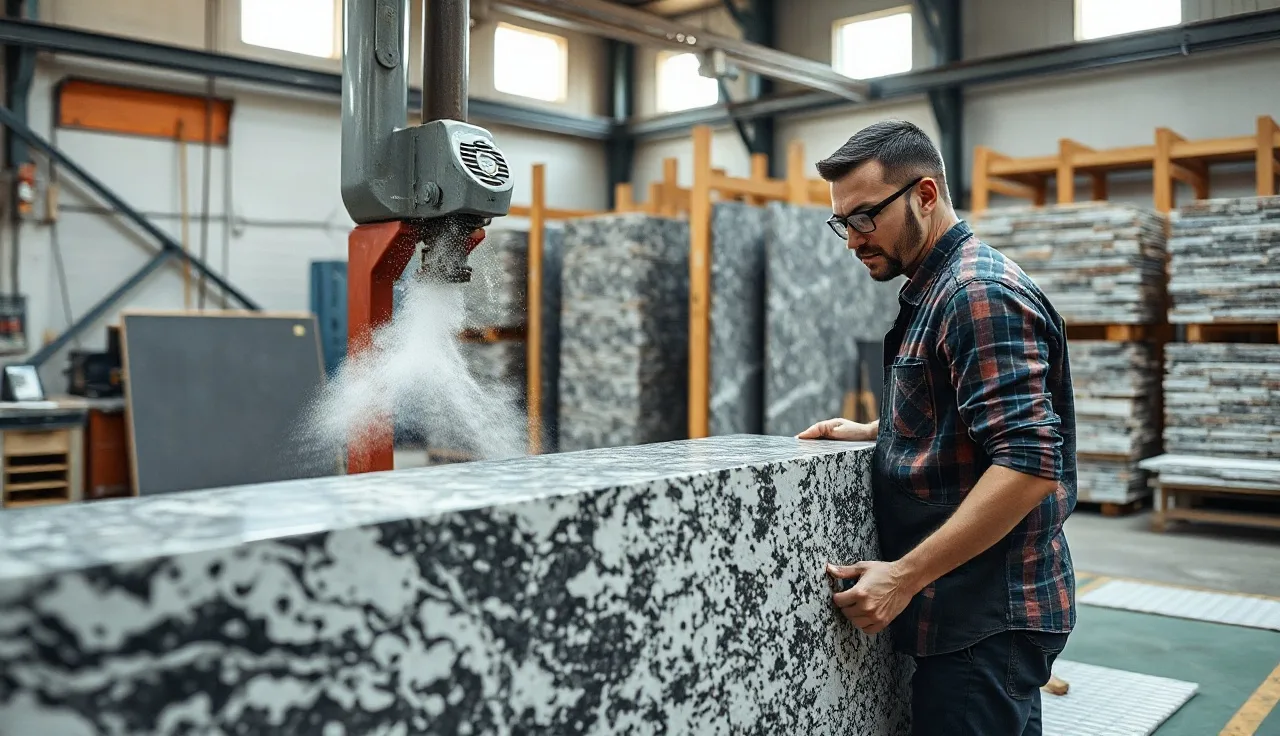
A raw granite or quartz slab shows up at a fabrication shop as a rough rectangle, usually 55 to 65 inches wide and 100 to 130 inches long, weighing several hundred pounds [1]. The fabricator cuts it to the exact shape of your cabinets, profiles the edges, cuts sink and cooktop holes, polishes the surfaces, and delivers something that fits on the first try, with seams in the right spots and no cracks.
The work needs a CNC bridge saw or waterjet cutter, edge profiling machines, diamond polishing pads, and operators who understand how stone moves, where it wants to crack, and how grain and veining decide where a seam should go. A shop doing this at volume runs these machines all day. A shop doing it part-time probably outsources at least some of it.
Fabrication is separate from installation. You can hire a fabricator who also installs, which is common, or a fabricator who hands off to a separate crew. Most residential work puts both under one contractor.
What are the main steps in the fabrication process?
The fabrication process has six phases. Each one can introduce an error that becomes permanent the moment the stone is cut.
1. Template (field measurement) A templater visits your home after cabinets are set and measures the exact countertop footprint. Modern shops use laser templating systems that capture digital measurements accurate to fractions of a millimeter [2]. Older shops still use luan wood or cardboard strips. Digital templates feed straight into CNC machines, cutting out the transcription errors that sink cardboard templates. Do not let a shop template before cabinets are fully installed and level. The countertop is built to the cabinet dimension, not the room dimension.
2. Slab selection and layout Once measurements exist, the fabricator lays the digital template over the slab to find the best cut. For natural stone this matters enormously. The goal is to keep a seam out of a dramatic vein, match grain across a seam where two pieces meet, and hold waste down. A good fabricator shows you a layout before cutting. A bad one cuts first and shows you the result.
3. Cutting A CNC bridge saw or waterjet cuts the slab to shape. Bridge saws use a diamond-tipped circular blade with water cooling. Waterjets use high-pressure water mixed with garnet abrasive and cut complex curves a bridge saw cannot touch. Most shops run both: the bridge saw for straight cuts, the waterjet for curves and cutouts.
4. Edge profiling The exposed edges get shaped and polished on CNC edge machines or with hand-held angle grinders and diamond pads. Common profiles are eased, beveled, bullnose, ogee, and waterfall. More complex profiles cost more and take longer.
5. Sink and cooktop cutouts Holes for undermount sinks and cooktops get cut with a bridge saw or CNC router. The undermount sink cutout is one of the riskier cuts in the shop, because taking out that section removes structural support from the stone. Most cracks around sinks start right here.
6. Polish and finish The field surface and edges get polished in stages with progressively finer diamond pads, often from 50-grit up through 3,000-grit or higher for a mirror finish. Honed and leathered finishes stop the polishing earlier or use different tooling to build texture.
How long does stone fabrication and installation take?
Plan on 5 to 14 business days from the day a templater walks through your door to the day the countertop goes in, for most residential projects [3]. The range is wide because shop workload swings hard.
A busy shop in a hot real estate market might quote three weeks. A smaller shop with lighter volume might turn a simple job in four days. Custom fabrication with mitered waterfall edges, book-matched slabs, or decorative inlays can stretch to four or five weeks.
Here is where the time goes:
| Phase | Typical duration |
|---|---|
| Template appointment scheduling | 1 to 3 days after cabinet sign-off |
| Template to cutting | 1 to 2 days (digital) or 2 to 5 days (manual) |
| Fabrication in shop | 2 to 5 days |
| Installation scheduling | 1 to 3 days after fabrication completes |
| Installation day (typical kitchen) | 4 to 8 hours on-site |
The bottleneck is almost always shop scheduling, not the fabrication. A modern CNC shop can physically cut and profile a typical kitchen in two to three hours of machine time. The backlog before your job reaches the machine is the real delay.
Seven business days from template to install is realistic for a straightforward job. Two days is a promise worth questioning.
What does stone fabrication and installation cost?
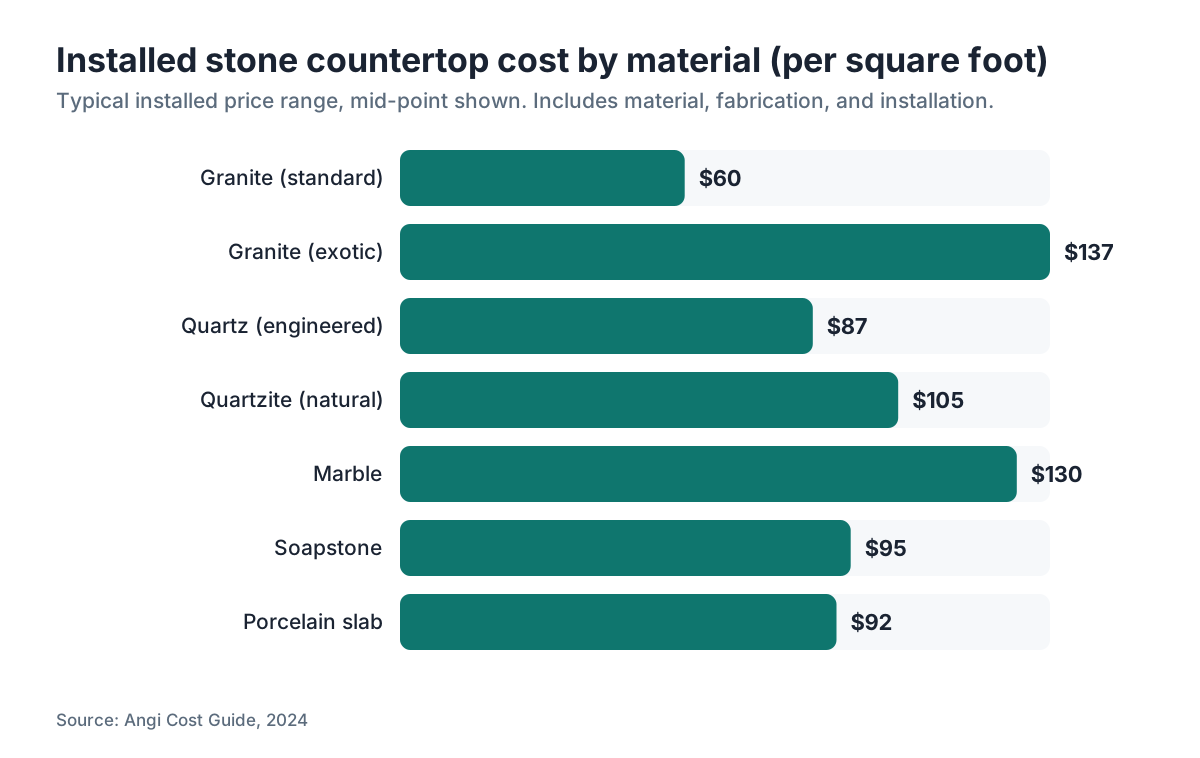
Installed stone countertops run a wide range, roughly $40 to $200 per square foot. The numbers below pull from contractor cost aggregators and wholesale material pricing, as of 2024 to 2025.
| Material | Installed cost per sq ft (typical range) |
|---|---|
| Granite, standard colors | $40 to $80 |
| Granite, exotic (rare origin, heavy movement) | $75 to $200+ |
| Quartz (engineered) | $55 to $120 |
| Quartzite (natural) | $60 to $150 |
| Marble | $60 to $200+ |
| Soapstone | $70 to $120 |
| Porcelain slab | $55 to $130 |
Those per-square-foot prices include material, fabrication labor, and installation labor. They do not include demolition of existing countertops, plumbing disconnection and reconnection, backsplash tile, or moving appliances [4].
Outside material choice, the two biggest cost variables are edge profile and number of cutouts. A standard eased edge costs next to nothing extra. A stacked mitered waterfall edge can add $500 to $1,500 to a single kitchen. Each sink cutout usually adds $150 to $300 depending on complexity.
Here is the part homeowners miss: fabricators price material by the square foot, but they charge for the full slab rectangle, which is bigger than your net countertop area. A kitchen that uses 45 square feet of countertop might need 60 to 70 square feet of slab after waste, cutouts, and layout choices. That overage is normal. Shops that quote only net square footage are handing you an incomplete number.
For a comparison across surfaces, including lower-cost options, see kitchen countertops and laminate countertops.
How do fabricators handle seams, and can you hide them?
Seams are a fact of life in stone work. Slabs are finite. Most kitchen countertops have at least one seam, usually where an L-shape turns a corner or where a long run runs past slab length.
Seam placement matters more than seam quality. A seam in the middle of a heavily veined slab, perfectly color-matched and tight, still reads as a seam. A seam tucked into a corner near the sink or behind the cooktop goes effectively invisible in daily use.
The industry standard for seam gap is 1/16 inch or less. Seams get filled with color-matched epoxy and polished flush. A well-executed seam on consistent material like quartz or solid-colored granite is hard to find with a fingertip. On heavily veined marble or quartzite, even a perfect seam shows.
Book-matching, where two adjacent slabs open like a book so veining mirrors across the seam, turns a seam into a design feature instead of a flaw. It needs matched slabs from the same bundle and precise layout work. Expect a premium, both in material (you are buying specific slab pairs) and in fabrication labor.
If a salesperson promises no seams on a 12-foot run in a material whose slabs top out at 10 feet, they are either lying or planning to use a slab too wide to transport and install safely. Ask to see the slab dimensions before you sign anything.
What equipment do fabrication shops use?
The equipment in a shop decides what that shop can do, how fast, and how accurately.
A CNC bridge saw is the core machine in most shops. It mounts a spinning diamond blade on a gantry that moves over the slab, making straight cuts with water cooling. Good bridge saws cost $30,000 to $150,000. Entry-level shops sometimes use manual wet saws, which lean on a skilled operator for straight cuts and cannot match CNC precision.
A CNC router or milling machine handles edge profiling and some cutout work on its own. The operator programs the profile, and the machine runs it the same way on every piece. Hand profiling with angle grinders still happens in smaller shops and can produce excellent results with a skilled fabricator, but it is slower and more variable.
Waterjet cutters use high-pressure water, 50,000 to 90,000 PSI, mixed with garnet abrasive to cut complex shapes with no heat and no blade contact [5]. They shine on curved kitchen islands, radius corners, and decorative inlay work. A waterjet cuts any natural or engineered stone. Not every shop has one. Shops without a waterjet subcontract complex curved work.
Digital templating systems from companies like Prodim, Laser Products Industries, or FARO capture field measurements as point clouds or CAD files that feed straight to CNC machines. They cut out manual transcription entirely. Asking a fabricator whether they use digital templating is a fair quality question.
Shops running quoting and nesting software can optimize slab layout before the first cut, holding down waste and catching conflicts between jobs that share a slab. Tools like SlabWise handle the nesting calculation automatically, which matters most when material is expensive and waste is money.
For material-specific detail, granite countertops and marble countertops cover how fabrication choices affect those stones.
What happens during countertop installation?
Installation day is faster than most homeowners expect. A typical kitchen takes four to eight hours from arrival to sign-off.
The crew shows up with the fabricated pieces, wrapped in moving blankets or riding on a padded vehicle. Each piece weighs anywhere from 30 to over 200 pounds depending on size and thickness. Crews move stone with suction cups and forearm dollies. Two-person crews handle most residential work. Three-person crews come out for heavy slabs or tight spaces.
Before any stone touches the cabinets, the installer checks cabinet levelness. Cabinets that are off get shimmed. Stone does not flex the way laminate does. A countertop set on a cabinet that is 3/4 inch out of level over a 10-foot run will rock, crack near supports, or leave gaps at the wall.
The countertop goes on with a bead of silicone along the top of the cabinet frames, not construction adhesive. Silicone stays flexible enough to handle minor seasonal movement. Some installers also use two-part epoxy at seams and at overhangs that need structural support.
Sink clips get set for undermount sinks. The fabricator usually does not install the sink. The plumber handles that on a separate visit. Caulk goes where the countertop meets the wall, in a color matched to the material.
After installation, the installer does a final walk looking for chips along edges (usually from transport), tight seam gaps, a level surface, and secure overhangs. Walk the job with them before they leave. Anything you catch then is easy to fix. Anything you catch a week later means a return visit and a harder conversation.
For the on-site process step by step, countertop installation covers installation day in full.
What can go wrong during fabrication and installation?
Most problems in this trade trace back to three roots: bad measurements, material defects nobody caught during layout, and field conditions nobody checked.
Measurement errors are the most expensive mistake. A template off by 1/4 inch on a cooktop cutout means the cooktop does not fit. A wall templated as straight when it actually bows 3/8 inch leaves a gap you can see from across the room. Digital templating cuts this risk but does not erase it if the person running the gear is inexperienced.
Material defects in natural stone include fissures (natural hairline cracks in the stone), pits (small surface voids), and weak areas along veins. A fissure is not a fabrication defect. A crack that runs from a fissure because the fabricator put a sink cutout too close to it is a fabrication error. The line between those two outcomes is genuinely blurry in some cases, which is why disputes happen. Photograph your slab before fabrication starts and flag any fissures you can see.
Field conditions that cause install problems include cabinets not fully secured to walls, walls that are not plumb, and appliances measured without accounting for trim kits or anti-tip brackets. If a refrigerator sits three inches off the wall but the countertop return was templated for two, you have a problem.
Chips along edges happen during transport more often than during fabrication. Stone is brittle, and one edge contact during loading or unloading can chip a bullnose. Inspect the pieces when they arrive, before the crew carries them inside.
Cracked countertops after installation almost always come from inadequate support: cabinet spans too wide with no crossbar, a hollow dishwasher cavity with no support at the sink area, or someone sitting on the counter. A 3cm (roughly 1.25-inch) slab can span about 24 inches without support. Beyond that, it needs a plywood sub-top or a support bracket.
How thick should stone countertops be, and does it matter?
The two standard thicknesses are 2cm (about 3/4 inch) and 3cm (about 1.25 inches). There is also 4cm (roughly 1.5 inches) for special work like thick waterfall edges, but it is rare in residential jobs.
3cm is the dominant residential standard in the United States and most of Canada [6]. It spans cabinet openings without a plywood sub-top, it looks substantial at the edge, and it skips the buildup strip that 2cm stone needs to reach a finished edge thickness. Most fabricators prefer 3cm because it is simpler to work.
2cm still gets used for vertical work (shower surrounds, fireplace surrounds), for budget projects where material cost outweighs edge appearance, and in markets where thinner slabs are common. Use 2cm on a horizontal counter and your fabricator will laminate a second strip of stone along the front edge to fake the thickness. That lamination joint has to be tight and properly supported.
For engineered quartz, the major brands (Silestone, Caesarstone, Cambria, and similar) sell in both 2cm and 3cm [12]. The 3cm product typically costs 20 to 30% more at the slab level but saves fabrication steps. Cambria countertops sell only in 3cm as a brand standard.
Thickness also drives weight. 3cm granite weighs roughly 18 to 20 pounds per square foot. A 60-square-foot kitchen in 3cm granite is over 1,100 pounds of stone. Your cabinets need to be fastened into wall studs. This is not optional.
Do stone countertops need sealing, and who is responsible for it?
Most natural stones need sealing. Engineered quartz does not, because it is roughly 90 to 93% quartz bound in polymer resin, with almost no porosity left for water to enter [7].
Granite is porous to different degrees depending on its mineral makeup. A tight, dense granite like Absolute Black barely absorbs anything. A light, open-grained granite like New Venetian Gold soaks up water fast. The water droplet test tells you what you need to know: put a few drops of water on the surface. If they bead and stay for 20 to 30 minutes, the sealer is working. If they soak in and darken the stone within a few minutes, it is time to reseal [8].
Fabricators usually apply one coat of sealer before delivery, often a basic penetrating sealer. That coat is not a lifetime solution. Most natural stone needs resealing every one to three years, depending on how porous the stone is, what sealer was used, and how much cooking, wine, and acid it sees.
Marble and quartzite are more porous than most granites and more reactive to acid. Lemon juice, vinegar, and tomato sauce will etch marble no matter how well it is sealed, because etching is a chemical reaction with the calcite in the stone, not a porosity issue. Sealing slows absorption but does nothing to stop etching. Keep that in mind when someone sells you marble for a kitchen counter without explaining it.
For maintenance specifics on porous stone, how to clean stone countertops, how to clean quartzite countertops, and how to clean soapstone countertops cover each material's needs.
How do fabricators quote a stone countertop job?
Fabricator quoting runs two ways: field measure first, or customer-supplied dimensions first.
Field measure first is more accurate. The fabricator templates your actual space, knows the exact square footage, spots the complications (a wall that bows, a corner that is not 90 degrees), and quotes on real numbers. You pay for a template visit, sometimes $75 to $150, that usually gets credited toward the job.
Customer-supplied dimensions work for early budgeting, but every fabricator who has lasted more than a year will tell you homeowner numbers run optimistic. People measure the cabinet top, not the footprint with overhangs. They forget the filler strip. They count one sink when there are two. Budget estimates from customer dimensions are starting points, not contracts.
The quote should itemize: material (slab cost plus grade), fabrication labor (per square foot or flat fee), edge profile charges, cutout fees, delivery, and installation. A quote with one number and no breakdown is impossible to compare against a competitor.
Shops running modern quoting software can generate itemized quotes fast and track actual versus quoted cost over time. That data loop is how good shops keep their margins honest. If you run a shop and you are shopping fabrication software, SlabWise is built for this workflow, with integrated nesting that shows waste before you commit to a slab.
Get at least three quotes for any stone job. The spread on the same scope is often $500 to $2,000 on a typical kitchen. Some of that is margin. Some is real differences in labor cost, material sourcing, and shop efficiency.
What questions should you ask a fabricator before signing?
There is no national license for stone fabricators in the U.S., and requirements vary state to state [10]. Some states regulate contractors broadly through general contractor licensing, which may or may not reach a stone-only fabricator depending on how the state defines the trade. Verify what your state requires, but do not assume a license means quality or that no license means incompetence.
Questions worth asking:
Where do you source your slabs? A fabricator who buys from reputable distributors can trace slab origin and consistent grading. One who buys purely from clearance lots takes on material risk they may pass to you.
Do you use digital templating? Not a dealbreaker if the answer is no, but experienced digital templaters make fewer measurement errors.
Who does the installation? Some fabricators subcontract install to day labor with no training in stone handling. That is fine when those crews know stone. It is a problem when they do not.
Can I see the slab before you cut? You should always be able to see your specific slab and approve the layout before cutting starts. A fabricator who says no here is a red flag.
What is your warranty on fabrication defects? Reputable shops warrant their work against fabrication-caused cracking and measurement errors. They do not warrant natural fissures or defects that lived in the slab. Get the terms in writing.
What is the payment schedule? A common structure is 50% deposit at signing, balance on installation day. A shop wanting 100% upfront is unusual and worth questioning. A shop asking for no deposit is probably in cash flow trouble.
Before you get into fabrication conversations, kitchen countertops covers every major surface type with honest trade-offs.
Frequently asked questions
How much does it cost to fabricate and install granite countertops?
Granite installed typically runs $40 to $80 per square foot for standard colors and $75 to $200 per square foot for exotic or high-movement stone. An average kitchen with 40 to 50 square feet of countertop lands between $1,600 and $4,000 for standard granite, all-in. Exotic material, complex edges, and multiple cutouts push it higher. Get itemized quotes from at least three fabricators to compare real numbers.
How long does countertop fabrication and installation take from start to finish?
From template to installation, plan on 5 to 14 business days for most residential projects. Simple jobs at shops with light backlogs can move in four to five days. Custom work with mitered waterfalls, book-matched slabs, or decorative inlays often takes three to five weeks. The biggest delay is shop scheduling and backlog, not actual fabrication, which can be a few hours of machine time for a standard kitchen.
What is the difference between 2cm and 3cm stone countertops?
2cm is about 3/4 inch thick; 3cm is about 1.25 inches. 3cm is the residential standard in most of the U.S. because it spans cabinet openings without a plywood sub-top and looks substantial at the edge. 2cm costs less at the slab level but needs a laminated edge buildup strip and a sub-top for horizontal use, which often closes the cost gap. Most fabricators prefer 3cm.
Can fabricators hide countertop seams completely?
No, not completely. A well-placed, well-executed seam on solid-colored quartz or consistent granite is very hard to find by touch, but it is there. On heavily veined natural stone, even a perfect seam shows. Good fabricators minimize seams through smart layout and put the unavoidable ones in low-visibility spots like near the sink or behind the cooktop. Book-matching can turn a seam into a design feature on the right material.
Does engineered quartz need sealing?
No. Engineered quartz is roughly 90 to 93% quartz bound in polymer resin, with almost no open porosity. There is nothing to seal. This is one of the main practical advantages of quartz over natural stone in a busy kitchen. Quartz still needs cleaning, and some surfaces can discolor under prolonged UV exposure or from rubber mats left on the surface, but sealing is not part of quartz maintenance.
What causes stone countertops to crack after installation?
The common causes are inadequate cabinet support across wide spans, a weak point from a sink or cooktop cutout placed too close to a natural fissure, and impact from heavy objects dropped near an edge. Stone is strong in compression and weak in tension. Spans longer than 24 inches without support create bending stress. Someone sitting on a countertop overhanging more than 12 inches without support can crack it.
Is stone fabrication licensed or regulated?
There is no national license specifically for stone fabricators in the U.S. Some states require general contractor licensing that may cover countertop installation depending on how the trade is defined. OSHA regulations apply to silica dust exposure in fabrication shops, which is a serious occupational health issue. Homeowners should ask about a fabricator's insurance and any local contractor registration, but credentials vary widely by state.
How do fabricators price the slab material, and why does waste affect the quote?
Fabricators price stone by the full slab rectangle, which is bigger than the net countertop area you use. A kitchen needing 45 square feet of countertop might require 60 to 70 square feet of slab after layout, cutouts, and waste. That overage is built into honest quotes. Shops that quote only net square footage are showing you an incomplete number. Waste runs roughly 20 to 35% depending on layout complexity and the slab's shape.
What is book-matching in stone fabrication?
Book-matching means opening two adjacent slabs from the same block like the pages of a book, so the veining mirrors across the seam. Done right, it makes the seam a visual feature rather than a flaw. It needs matched slab pairs from the same quarry bundle and precise layout work. You pay a premium in material (specific slab selection) and fabrication (careful alignment). It works best on strongly veined marble, quartzite, or onyx.
What is silica dust, and why does it matter in a fabrication shop?
Silica is a mineral found in granite, quartzite, engineered quartz, and other stone. When shops cut, grind, or polish stone, they generate fine silica dust. Inhaling respirable crystalline silica causes silicosis, an incurable and potentially fatal lung disease. OSHA's silica standard for construction (29 CFR 1926.1153) sets a permissible exposure limit of 50 micrograms per cubic meter as an 8-hour time-weighted average. Reputable shops run wet cutting, local exhaust ventilation, and respiratory protection programs.
How do I compare quotes from different fabricators?
Ask every fabricator to quote the same scope with itemized line items: slab material and grade, fabrication labor, edge profile, cutouts, delivery, and installation. A single-number quote is nearly impossible to compare. Watch what is included: some quotes cover demolition of old countertops, some do not. Ask whether the slab price is for the grade you actually want or a lower entry grade. Get at least three quotes; the range on a typical kitchen is often $500 to $2,000.
Can I install stone countertops myself?
Technically yes, but it is genuinely hard and the risk of expensive mistakes is high. A 3cm slab section for a standard kitchen weighs 400 to 600 pounds and takes multiple people, suction cups, and careful maneuvering to avoid chipping edges. The bigger risk is measurement error: a sink cutout 1/4 inch off is a ruined piece of stone. Most homeowners who try DIY either hire out the fabrication and do only the install, or end up calling a pro after the first piece.
How does a waterjet cutter differ from a bridge saw for stone fabrication?
A bridge saw uses a rotating diamond-tipped blade with water cooling to make straight cuts. A waterjet cutter uses ultra-high-pressure water mixed with garnet abrasive to cut any shape, including tight curves and decorative inlays, with no blade contact and no heat-affected zone. Waterjets are slower for straight cuts but essential for curved islands, radius corners, and inlay work. Not every shop owns one; many subcontract complex waterjet cuts.
What should I check before the installation crew leaves?
Walk the job with the installer before they load out. Check every edge for chips, especially corners. Run a fingertip across seams to feel for a proud edge or a gap. Check that the countertop sits flat on all cabinets with no rocking. Look at the gap between countertop and wall for consistency. Verify sink clips are set if you have an undermount sink. Anything you find now is easy to fix. Anything found a week later means a return visit and a longer conversation.
Sources
- Natural Stone Institute (formerly Marble Institute of America), Dimension Stone Design Manual: Standard stone slabs for countertop fabrication are typically 55 to 65 inches wide and 100 to 130 inches long
- Laser Products Industries, LT-2D3D Laser Templator product documentation: Digital laser templating systems capture field measurements accurate to fractions of a millimeter and feed CAD files directly to CNC machines
- National Kitchen and Bath Association (NKBA), Project Timeline Guidelines: From template to countertop installation, typical residential stone projects take 5 to 14 business days
- Angi (formerly Angie's List), Countertop Installation Cost Guide 2024: Installed stone countertop costs run $40, $200 per square foot depending on material, not including demolition, plumbing, or appliance moving
- OMAX Corporation, Waterjet Cutting Technology Overview: Waterjet cutters operate at 50,000 to 90,000 PSI using water mixed with garnet abrasive to cut stone without heat or blade contact
- Natural Stone Institute, technical resources on dimension stone: 3cm (approximately 1.25-inch) thickness is the dominant residential countertop standard in the United States and Canada
- Caesarstone, Product Technical Specifications: Engineered quartz contains approximately 90 to 93% natural quartz bound with polymer resins, resulting in very low porosity that does not require sealing
- Natural Stone Institute, Care and Maintenance of Natural Stone Surfaces: The water droplet test (drops bead for 20 to 30 minutes indicates adequate sealer; drops absorb and darken stone in minutes indicates resealing needed) is the standard field test for sealer adequacy
- U.S. Department of Labor, OSHA Standard 29 CFR 1926.1153, Respirable Crystalline Silica in Construction: OSHA's silica standard for construction sets a permissible exposure limit of 50 micrograms per cubic meter as an 8-hour time-weighted average
- National Conference of State Legislatures (NCSL), contractor licensing resources: There is no national license specifically for stone fabricators; licensing requirements vary by state under general contractor or specialty trade regulations
- U.S. Geological Survey (USGS), National Minerals Information Center, Dimension Stone statistics: Granite and other dimension stone slabs are produced and imported in large volumes for the U.S. countertop market, with import value tracked annually
- Silestone by Cosentino, Technical Data Sheet: Engineered quartz slabs are available in 2cm and 3cm thickness; 3cm is the predominant choice for horizontal countertop applications
Last updated 2026-07-09